Introduction
The labour market outcomes of young people have attracted considerable political and academic interest in recent years due to youth unemployment in Europe being high, with persistent shares of young people not in either education, employment or training (Bruno, Marelli and Signorelli, Reference Bruno, Marelli and Signorelli2014). Due to the documented correlation between early-life experiences and long-term outcomes, young people have become a prioritised group in European welfare politics, with precedence being given to active labour market programmes (ALMP) aimed at promoting further education and employment (Dolado, Reference Dolado2015). By ensuring an early intervention, the aim is to prevent long-term inactivity and welfare dependence. Yet, prior research concerning the use and effect of ALMPs among young people has shown that such programmes have either no effect or even negative effects on the transition rate into employment (Hardoy, Reference Hardoy2005; Kluve, Reference Kluve2010; Larsson, Reference Larsson2003; Martin and Grubb, Reference Martin and Grubb2001; Rønsen and Skarðhamar, Reference Rønsen and Skarðhamar2009; von Simson, Reference von Simson2016). Participation in ALMPs bestows the right to a supplementary benefit. However, the direct effect of this benefit on the use and outcome of ALMPs remains largely unknown. As access to benefits requires enrolment in ALMPs, it is almost impossible to disentangle the effect of benefits from the impact of such programmes. Hence, the question regarding whether or not benefits have an independent effect on employment outcomes remains unanswered.
A concomitant consequence of rising unemployment levels is that more young people become dependent on income support during the transition from education to employment (Hyggen, Reference Hyggen2008). Proponents of the ‘welfare trap’ line of argumentation suggest that the benefit scheme might actually provide young people with an incentive to drop out of education or employment and enrol in labour market schemes. The various social security schemes are thus considered to reduce their motivation and incentive to engage in educational and labour market activities. Moreover, such proponents are also concerned about the signalling effect, as young people who come under the auspices of the welfare and labour administration are ‘rewarded’ with benefits, while those who remain in education do not receive any support or funding. However, opponents of the welfare trap perspective argue that the benefit scheme can serve to motivate young people who would otherwise be inactive to participate in labour market schemes and then successfully transfer to education or employment (Gebauer and Vobruba, Reference Gebauer and Vobruba2003).
In this article, we study the effects of a Norwegian policy that pays much higher benefits (a 38 per cent increase) to recipients once they turn 19 years of age. This policy provides a natural experimental setting that allows us to utilise this sharp discontinuity to estimate the effect of benefits on programme participation, as well as labour supply net of the corresponding ALMP, using a regression discontinuity approach. As age determines the increase in benefits rather than need, it creates a random and exogenous variation in the criteria for allocating cash benefits. Our analyses cover young people between the ages of 18 and 19 during the period 2003 to 2012.
The research literature concerning the financial incentives of welfare benefits is ample, although most studies investigate the effects of unemployment insurance benefits (Falch et al., Reference Falch, Hardoy and Røed2011; Hammer, Reference Hammer1999; Jensen et al., Reference Jensen, Rosholm and Svarer2003; Lalive, Reference Lalive2008; Van Ours and Vodopivec, Reference Van Ours and Vodopivec2006; Van der Klaauw and Van Ours, Reference Van der Klaauw and Van Ours2013), disability benefits (Barr et al., Reference Barr, Clayton, Whitehead, Thielen, Burstrom, Nylen and Dahl2010; Maestas et al., Reference Maestas, Mullen and Strand2013) and social assistance (Bargain and Doorley, Reference Bargain and Doorley2011; Fortin et al., Reference Fortin, Lacroix and Drolet2004; Lemieux and Milligan, Reference Lemieux and Milligan2008). These benefits target people with previous labour market experience or those who are only temporarily outside the labour force. Benefit recipients in such categories are generally older than the young people included in the present study, while it is likely that people with previous employment experience have higher reservation wages and behave differently to teenagers. Jensen et al. (Reference Jensen, Rosholm and Svarer2003) claim that young people are more responsive towards financial incentives when compared with the population at large.
We make four contributions with this paper. First, we investigate the impact of financial incentives on an age group that is transitioning into working life. The increase in benefits is 38 per cent, which should be sufficient to trigger any behavioural effects in response to this stronger financial incentive. Youth unemployment is a significant problem in Norway, as it is in other Organisation for Economic Co-operation and Development (OECD) countries, with the share of inactive youth tripling between the ages of 19 and 29 (Sletten and Hyggen, Reference Sletten and Hyggen2013). Thus, if the benefit has a negative effect on employment around the threshold age of 19, the benefit works against the intention of the associated ALMP to strengthen young people's labour market integration.
Secondly, the use of regression discontinuity (RD) designs to study the effects of welfare policies is sparse and recent (Bargain and Doorley, Reference Bargain and Doorley2011; Lemieux and Milligan, Reference Lemieux and Milligan2008); hence, this article contributes to that body of literature. The identification strategies used in most existing research studies have relied on cross-country comparisons or responses to policy changes (Fortin et al., Reference Fortin, Lacroix and Drolet2004). Only a few studies have attempted to estimate the causal effect of benefits by utilising discontinuities in existing policies (Bargain and Doorley, Reference Bargain and Doorley2011; Lemieux and Milligan, Reference Lemieux and Milligan2008). According to Bargain and Doorley (Reference Bargain and Doorley2011), regression discontinuity designs are better suited to studying the incentive effects of benefits on the labour supply, since pre- and post-tests of reforms also need to account for any other changes to the economy during the period of observation. Moreover, the risk of contamination effects is lower when using discontinuities in existing social policy (Lemieux and Milligan, Reference Lemieux and Milligan2008).
Thirdly, we are the first to investigate the incentive effects of an increased benefit rate in a Scandinavian welfare state using a regression discontinuity design. Previous studies from Canada (Lemieux and Milligan, Reference Lemieux and Milligan2008) and France (Bargain and Doorley, Reference Bargain and Doorley2011) have found that higher social assistance transfers caused a moderate reduction in the employment rate. The cash benefit is a form of short-cycle subsistence support that requires activity on behalf of its recipients. Hence, financial incentives might have a lower ‘pull’ effect when benefits are dependent on attendance required by ALMPs compared to social assistance, which is open-ended, with only limited or no activity requirements.
Finally, a major strength of this study is the use of Norwegian administrative register data. The receipt of cash benefits by young people is a rare event (ca. 3 per cent; cf. Table 2) that is not likely to be well represented in survey data. Moreover, surveys are vulnerable to measurement error and attrition, which are negligible problems in register data. As these registers cover the entire population, we are able to estimate the effect of benefits with great accuracy, even in the small subsample of 18 to 19 year olds.
Who is entitled to cash benefits in Norway?
The Norwegian welfare system is a rights-based system characterised by universal and generous benefits. An inherent risk with high-level benefits is that their availability reduces people's willingness to work because benefits might exceed the likely wage-related income of marginalised groups. For that reason, the work approach (arbeidslinja) is a central principle of the welfare system, while activation programmes are increasingly used to end or reduce the long-term receipt of benefits among welfare claimants (Lorentzen and Dahl, Reference Lorentzen and Dahl2005; Terum and Hatland, Reference Terum and Hatland2014).
In this article, the focus is on a form of subsistence support known as Individual Assistance (IA). Participation in certain ALMPs bestows the right to this cash benefit. However, the claimant cannot be entitled to unemployment insurance benefits or other work-related benefits at the same time. If the claimant receives social assistance, the receipt of benefits results in a proportionate deduction in his/her social assistance.Footnote 1 Most young participants in this study receive benefits because they have not earned the right to unemployment insurance benefits or other work-related benefits such as work assessment allowance (arbeidsavklaringspenger) or temporary disability benefits.
IA is a form of governmental subsistence support regulated by Regulation No. 1544 of 20th December 2001 (Tiltakspengeforskriften). A national standard benefit rate is determined annually through the state budget. During the period 2001 to 2013, benefits were available from the age of 16 onwards, although a retrenchment was passed in 2013 that made benefits conditional on being 18 years old (Regulation No. 1286 of 4th November 2013). The regulation stipulates that those who are 19 years and older receive cash benefits at a higher rate than those who are 18 years of age. The difference between the high and low rate is approximately 38 per cent. Based on the 2014 rates, the cumulative difference between the high and low rate for a full year of benefits is 20,700 NOK (*0.11 = 2,277 EUR). The study participants might also receive additional benefits for housing if they have dependent children in their household and/or to cover specific expenditure related to participation in the ALMPs (i.e. travel costs).
The purpose of the benefit scheme is threefold: (1) to guarantee participants receive subsistence support during periods of unemployment or labour market inactivity, (2) to serve as an incentive for participation in work-related measures and (3) to cover certain expenses incurred in connection with the implementation of the measures (provided by supplementary benefits). Benefits are usually paid for three to six months, although recipients can receive benefits for up to one year (Drange et al., Reference Drange, Frøyland and Mamelund2015). The participants receive benefits on a day-to-day basis conditional on turnout. The monthly payment for full attendance is approximately 7000 NOK or 5000 NOK (770 EUR or 550 EUR) for 19 and 18 year olds, respectively.
Use and content of IA-benefit supported ALMPs
IA-benefit supports participation in ALMPs related to work practice, work assessment and work-oriented rehabilitation, education and training or counselling. The most frequently used ALMPs among 18- to 19-year-olds are in the category of work practice (Drange et al., Reference Drange, Frøyland and Mamelund2015; Hyggen, Reference Hyggen2017, von Simson, Reference von Simson2012). Work practice takes place in the ordinary labour market, but the participant receives adjusted work tasks and individual support from the work and welfare service and the employer. The aim is to prepare the participant for employment. Work practice can involve training for continued employment; however, when in work practice, the participant is not an employee. Work practice seldom leads to employment (von Simson, Reference von Simson2012) and experimental research shows a negative signalling effect of work practice among young job seekers (Hyggen, Reference Hyggen2017). The second most used labour market measure is education and training. This is given to participants aged 19 and above. It may qualify participants for employment, and includes short courses or vocational training. Formal education is for older age groups. In third place, counselling involves different forms of support adapted to the individuals’ needs, including support for job search, development of social skills, or adjustment and adaption of the current work situation. Participants aged 18–19 rarely receive any of the remaining ALMPs.
Youth activation: concerns and outcomes
The theoretical expectation underlying this and previous investigations of the incentive effects of welfare benefits is that financial incentives will reduce willingness to work, especially among those with low wage prospects, including marginalised youth (Bargain and Doorley, Reference Bargain and Doorley2011; Gebauer and Vobruba, Reference Gebauer and Vobruba2003; Hammer, Reference Hammer1999; Hyggen, Reference Hyggen2008). Proponents of the welfare trap perspective are concerned that cash benefits might constitute an attractive alternative to paid work that causes young people to extend their transition from education to employment. The benefit system targets young people who are not in employment, education or training and whose employment outlook is likely to be limited to temporary, unskilled jobs. Hence, to a strictly rational individual, welfare benefits would appear to be a better option than employment in the secondary labour market (Gebauer and Vobruba, Reference Gebauer and Vobruba2003). In line with this view, research has shown that an increase in the social assistance rates significantly reduced the labour supply among the target population of young men in Canada (Lemieux and Milligan, Reference Lemieux and Milligan2008) and France (Bargain and Doorley, Reference Bargain and Doorley2011). Therefore, if this theory is correct, we expect to see a higher take-up of benefits around the threshold of 19 years of age and a parallel drop in employment.
The extent to which young people are responsive to financial incentives is also likely to depend on their social position and employment commitment. The social and economic resources available in the household are an important moderator of young people's behavioural responses to welfare benefits and their attitudes towards employment. Previous research has found that social position confounds the effect of financial incentives for employment, as those with few educational resources are the most responsive to an increase in benefit levels (Bargain and Doorley, Reference Bargain and Doorley2011). Similarly, social welfare recipients and young people with no previous employment experience report a lower employment commitment (cited in Hyggen, Reference Hyggen2008: 104–105), which could make this group more responsive to an increase in benefit levels. To investigate this, we also make separate estimations for young people whose parents are social welfare claimants.
There are, however, two reasons to expect an absence of response to an increase in benefit rates. First, the studies conducted in Canada (Lemieux and Milligan, Reference Lemieux and Milligan2008) and France (Bargain and Doorley, Reference Bargain and Doorley2011) found motivational effects in response to an increase in social assistance. In contrast, in the current study, access to and receipt of cash benefits are dependent on participation in ALMPs, which can moderate any disincentive effects because the attendance requirement reduces the substitution of benefits for wages.Footnote 2 For young people in the target population, benefits might still be more attractive due to their limited experience with wage-related income and because many still live at home with their parents. Given that they have low expenses, receipt of even a modest benefit could postpone their entry into employment or education.
Second, the contrasting view of the welfare trap emphasises the social and psychological costs arising from welfare receipt. Generally, young people do not prefer to go on welfare (Gebauer and Vobruba, Reference Gebauer and Vobruba2003; Worth, Reference Worth2003). Qualitative studies have shown that young people recognise that the value of obtaining a high school diploma or work experience exceeds the short-term payout from social welfare (Drange et al., Reference Drange, Frøyland and Mamelund2015; Gebauer and Vobruba, Reference Gebauer and Vobruba2003; Worth, Reference Worth2003). Hammer (Reference Hammer1999) found that receiving unemployment benefits reduces the probability of re-employment among Nordic young people when compared to those not entitled to benefits, which would support a welfare trap perspective on benefits for this group. However, low benefit levels also result in lower re-employment rates because financial problems increase the risk of social and psychological issues that lower the likelihood of re-employment. Thus, as Hammer (Reference Hammer1999) notes, the risk of high benefit levels has been overestimated. Moreover, Hyggen (Reference Hyggen2008) found no evidence that benefit receipt caused a lowered employment commitment among adults in their late 20s and 30s. These young adults continue to display a preference for employment and he therefore found it unlikely that benefits cause an attitudinal change among welfare claimants.
Incentive effects of benefits on work and education among young people
The literature concerning incentive effects is quite extensive, although the majority of these studies investigate behavioural effects among older segments of the labour force who probably have more work experience, dependent children or health issues. These factors complicate their transitions from welfare to work, as well as their responses to any incentive or disincentive effects of benefits. We limit our review to studies that investigate and isolate the effect of increasing or decreasing benefits among young people, as well as young adults, and exclude studies that investigate the effect of ALMPs.
Jensen et al. (Reference Jensen, Rosholm and Svarer2003) studied the implementation of a youth unemployment programme in Denmark aimed at long-term unemployed young people aged 16 to 24 years who had low education levels. Young people who were unemployed for at least six months were required to participate in an education and training programme to increase their chances of finding employment. The programme entailed a 50 per cent reduction in benefits while in education or training, and non-compliance would cause a discontinuation of benefits. Due to the incremental introduction of the programme, they were able to identify programme effects by comparing transition rates from unemployment to education or employment between a control group and a treatment group. Although the programme succeeded in recruiting young people to education or training, the results revealed that the threat of a benefit reduction did not increase transition rates to education or employment, nor did the withdrawal of benefits increase activity levels among the target population. The lack of an effect indicates that these benefits did not trap young people on welfare. Coming off benefits, however, is different from beginning to receive benefits because re-employment might be difficult following long-term unemployment (Eriksson and Rooth, Reference Eriksson and Rooth2014) and because young people may have become accustomed to being unemployed. Thus, the reduction and discontinuation of benefits might not lead to faster re-employment, although raising benefit levels might still attract more welfare recipients.
Lemieux and Milligan (Reference Lemieux and Milligan2008) were among the first to use regression discontinuity designs to investigate the behavioural effect of an increase in social assistance on labour market outcomes. In Canada, childless social assistance recipients experience a 175 per cent increase in their benefits when they reach 30 years of age. Social assistance was found to have a disincentive effect on employment among the target group of childless men aged 25 to 39 years who did not have a high school diploma. The estimated effect on the employment rate was in the interval of 3 to 5 percentage points. Lemieux and Milligan (Reference Lemieux and Milligan2008) also found a small, positive effect on social assistance receipt around the age threshold. Building on this study, Bargain and Doorley (Reference Bargain and Doorley2011) used a similar design to investigate the effect of a guaranteed minimum income (Revenu Minimum d'Insertion, RMI) on the labour supply in France. The RMI resembles the benefit studied in this article, as it targets people who are not eligible for unemployment benefits or any other subsidiaries based on previous labour market activity. The largest category of RMI recipients is young, single and childless men. Bargain and Doorley (Reference Bargain and Doorley2011) found that the labour supply of the most marginal group of uneducated men dropped by 7–10 per cent under RMI. However, they found no effect among educated men. Their conclusion was that minimum incomes do reduce employment, although they only affect the most marginal groups with the worst wage prospects. Despite the rather large increases in benefits in Canada and France, both studies found only rather small behavioural adjustments to higher benefits among uneducated men. This is also true for a study that used a discontinuity in the British minimum wage at the age of 22. Young people aged 22 and older receive a minimum wage that is 16–20 per cent higher than that received by those aged below 22 years. The employment rate increased by two to four percentage points at the discontinuity point (Dickens et al., Reference Dickens, Riley and Wilkinson2014). Again, the study concentrated on men with a low education level because of the expectation that such men would respond to an increase in the minimum wage.
In sum, although all the studies found some incentive or disincentive effects of benefits and social policies – for example, the minimum wage – the behavioural effects are rather modest. Moreover, the previous literature either included only men with marginal labour market positions (Dickens et al., Reference Dickens, Riley and Wilkinson2014; Jensen et al., Reference Jensen, Rosholm and Svarer2003; Lemieux and Milligan, Reference Lemieux and Milligan2008) or else found the strongest effects among this group (Bargain and Doorley, Reference Bargain and Doorley2011). These studies concentrated on childless men because the presence of children or pregnancies affects the labour supply, especially among women. Additionally, in the Norwegian case, the presence of children would increase the amount of benefits paid. Consequently, the financial incentive to remain unemployed would be higher for parents than for childless young people, assuming the child support benefits cover the cost of having children. Although all youth benefits arguably occupy a marginal labour market position, we look particularly at those whose parents receive social assistance. Furthermore, the previous studies addressed changes in unemployment insurance (UI) benefits and social assistance, respectively. The cash benefit is different from both unemployment benefits and social assistance benefits because the duration is three to six months, and it requires some form of activity on the part of those who receive it.
Data
The data in this study are drawn from administrative registers for the Norwegian population.Footnote 3 The files used for the analyses include information on employment, receipt of social security, social assistance and educational activities. Information on the receipt of cash benefits is available from 2003. From 2003 to 2008, the registers show whether or not cash benefits were paid, as well as the duration of receipt. From 2009 onwards, the files also contain information on the amount paid. The sample population covers individuals born between 1983 and 1994 who live in Norway.
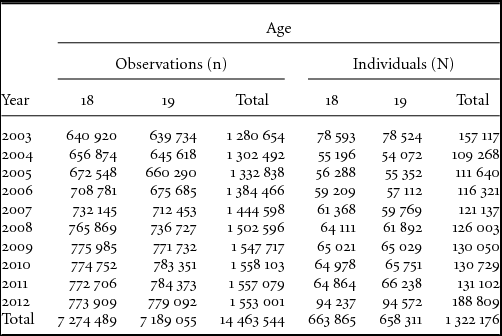
Table 1 shows the number of individual entries per age category and year. The number of new entrants is higher in 2003 and 2012 because of two adjacent birth cohorts (1983/84 and 1994/95) being included in those cells. The number of individuals per cohort increases for each year of the observation period, while the size of the cohorts also increases somewhat across the years due to immigration. To protect anonymity, the information given on date of birth only includes the month and year. Hence, we observe individuals on a monthly basis, starting from the month they turn 18 and ending with the month prior to their 20th birthday. As seen in Table 1, the total number of observations exceeds 14 million records.
Number of observations and number of individuals per age category per year

Source: Norwegian register data, 2003–2012
We obtain information on benefit receipt from the registry of service recipients administered by the Norwegian Labour and Welfare Administration (NAV) that contains dated information on access and exit from labour market measures, benefit schemes and other services. The information on employment status comes from the employment register. The lower limit for registration is at least six days of continuous employment of a minimum duration of four hours; hence, shorter employment periods or jobs not exceeding three hours of employment per week are undocumented.
The data are a panel with grouped monthly durations. We collect information on cash benefit receipt and work status on a month-to-month basis, and we extract information by the 15th of each month during the observation period. Thus, any employment or cash benefit receipt that begins after the 15th will appear in the next monthly period. This implies that we do not register employment status or cash benefit receipt for short periods (i.e. less than 16 days). Information concerning educational activities is registered twice a year, once at the beginning of the school year (October) and once by the end of the school year (June). Information on whether the school year is completed or discontinued is registered in June. Hence, the timing of school dropout is unknown.
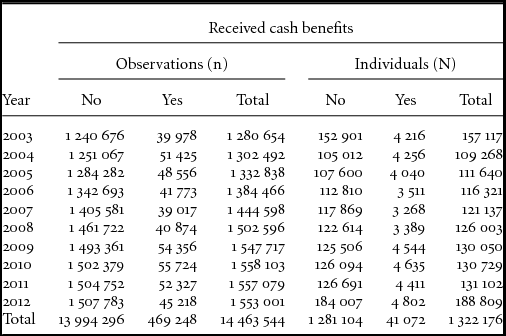
Table 2 shows the incidence of IA receipt among 18 and 19 year olds per year throughout the study period. The share of recipients varies between 2.7 and 3.9 per cent. There is a slight increase in the rate of recipients in the years following the financial crisis of 2008, although the general picture is one of stability. In Appendix A (online), we present descriptive statistics comparing young people who receive the cash benefit with those who do not.
Incidence of IA receipt among 18 and 19 year olds per year

Source: Norwegian register data, 2003–2012
Empirical approach
We exploit the discontinuity in benefits at the age of 19 to estimate the effects on programme participation and employment. If nothing else of importance to these outcomes changes discretely at this age cut-off point, discrete changes in programme participation and employment can be attributed to the discontinuity in benefits at age 19. This causal interpretation hinges on two assumptions. First, we presume that the individuals close to the cut-off point are substitutes for each other, meaning that there is no substantial difference between a person aged 18 years and 11 months and a person aged 19 years and one month. Age is often used in regression discontinuity designs (Bargain and Doorley, Reference Bargain and Doorley2011; Dickens et al., Reference Dickens, Riley and Wilkinson2014; Lemieux and Milligan, Reference Lemieux and Milligan2008) and it has the benefit of not being manipulated by the individuals. Nevertheless, age cannot be seen as completely random because, as previously discussed by Lee and Lemieux (Reference Lee and Lemieux2010) and Dickens et al. (Reference Dickens, Riley and Wilkinson2014), everyone in our sample will (hopefully) turn 19 at some point. This could give rise to anticipation effects and young people could start changing their behaviour in the months preceding their 19th birthday in order to ensure their enrolment in ALMPs at the age threshold. Conversely, young people aged 18 years and 11 months might postpone their entry into ALMPs, since programme attendance would result in cash benefits when they reached the age of 19 years. We do not perceive any anticipation effects to be widespread, since young people are generally not knowledgeable about the age threshold (Drange et al., Reference Drange, Frøyland and Mamelund2015). Furthermore, considering that benefits are given for only a fixed period with an average of three months, early enrolment could lead to the exhaustion of their rights before they reach the age threshold. We will discuss the plausibility of anticipation effects in more detail in the results section.
Second, we are not aware of any other discontinuities in policies that could affect labour market participation at the age of 19. The typical recipients of cash benefits are young men aged 17–21 years, with a peak at 21 years. This implies that we will observe an increase in the rate of IA benefit recipients during our observation window (i.e. 18–19 years old). However, we are looking for a motivational effect around the threshold age of 19 and we expect to see a discontinuity around that same age. Both programme take-up and employment display a curvilinear function for age, but, according to Lemieux and Milligan (Reference Lemieux and Milligan2008), this will not violate the assumption underlying the RD analysis so long as no other factors change discontinuously at the age threshold. The age threshold partly coincides with high school graduation and the transition from education to employment might increase reliance on labour market measures at this age. Yet, this is not a concern, as graduation is uncorrelated with the month of birth.
Since age (in months) is a discrete running variable, the treatment effect is not identified non-parametrically (Lee and Card, 2008). Following the approach of Lee and Card (2008) (see also Lemieux and Milligan (Reference Lemieux and Milligan2008) and Bargain and Doorley (Reference Bargain and Doorley2011)), we estimate the following regression model:
 $$\begin{equation}
{Y_{ia}} = {\beta _0} + {\beta _1}{\hbox{\it TREA}}{T_{ia}} + \delta \left( a \right) + {\varepsilon _{ia}},
\end{equation}$$
where Yia is the outcome variable for individual i at age a. TREATia is a dummy that takes on the value of 1 for observations 19 years old or older and 0 otherwise, δ(a) is the smooth function representing the relationship between age and the outcome, and εia is the error term. The parameter of interest is β1, which measures any discrete change in the expectation of Yia that occurs precisely at age 19 (we have centred the age variable to take a value of 0 at age 19). The identification of β1 comes from the variation across age cells, since TREATia is the same for all individuals of the same age. We will thus estimate the model using the age-specific means version of the model and using the numbers of observations by age group as weights. Because we do not know the true functional form of the relationship between age and the outcome variable, Yia, we estimate linear, quadratic, and cubic versions of it. As is common practice, we present the results of all three models. We also present results for the goodness of fit (the Akaike information criterion (AIC)) for each model. The goodness of fit measure shows us which model fits the data best.
Results
Do cash benefits motivate welfare dependency?
In this section, we formally exploit the discontinuity in benefits by estimating the regression discontinuity models. We first present regression discontinuity estimates concerning programme participation while, in the second subsection, we estimate the effect on employment. The estimations are conducted using different time windows around the 19-year cut-off point, as well as using different polynomial splines to capture nonlinearities.
Effects on programme participation
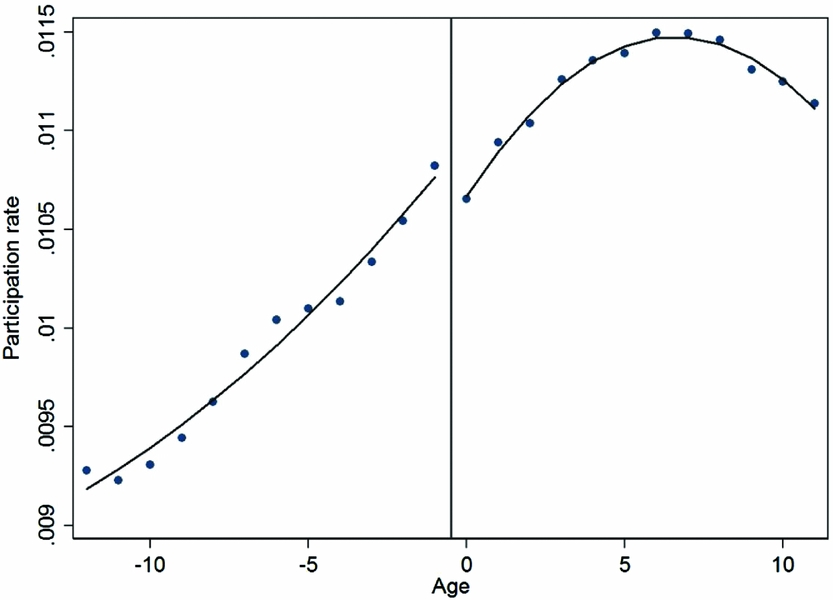
In Figure 1, we present programme participation around the 19-year threshold. The y-axis shows the participation rate, while the x-axis shows the age. The dots represent the participation rate by month bins around the threshold and the lines are fitted second order polynomial splines. The figure exhibits a positive trend in programme participation before the cut-off point that then begins to diminish after the cut-off. If anything, there is an indication of a negative effect at the age threshold.
Programme participation around the 19-year threshold

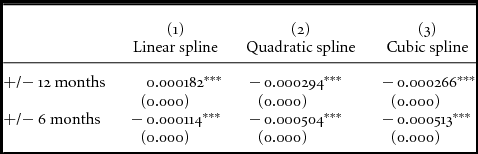
Turning to the regression results, Table 3 presents the parametrical regression discontinuity results for the different age windows and different polynomial splines of the age variable. We here provide the point estimates of the small drop in the participation rate observed in Figure 1. Since we have more than 14 million observations, the results are statistically significantly different from zero, although the magnitudes are very small in all the models. Additionally, they also change sign depending on the specification. For example, the point estimate of the discontinuity in Model 1 is very small and positive for the +/- 12-month window, while it is small and negative in Models 2 and 3. The results are similar when looking at a smaller time window around the cut-off point (+/- six months). That is, the statistically significant point estimate is not quantitatively meaningful (the estimated coefficients imply a change of between -0.05 and 0.02 per cent). The Akaike information criterion (AIC) indicates that the relative goodness of fit is better in Models 2 and 3 than in Model 1. Hence, the quadric and cubic functional forms provide a better fit to data than the linear form. In Appendix B (online), we present the results of a placebo analysis pretending that the cut-off point is at age 20, which indicates a similar very small drop in programme participation. This result further strengthens the notion that there is no meaningful effect on programme participation at the 19-year cut-off point.
RD estimates of the effect of higher benefits on programme participation

Robust standard errors in parentheses. *** p<0.01, ** p<0.05, * p<0.1.
Effects on employment
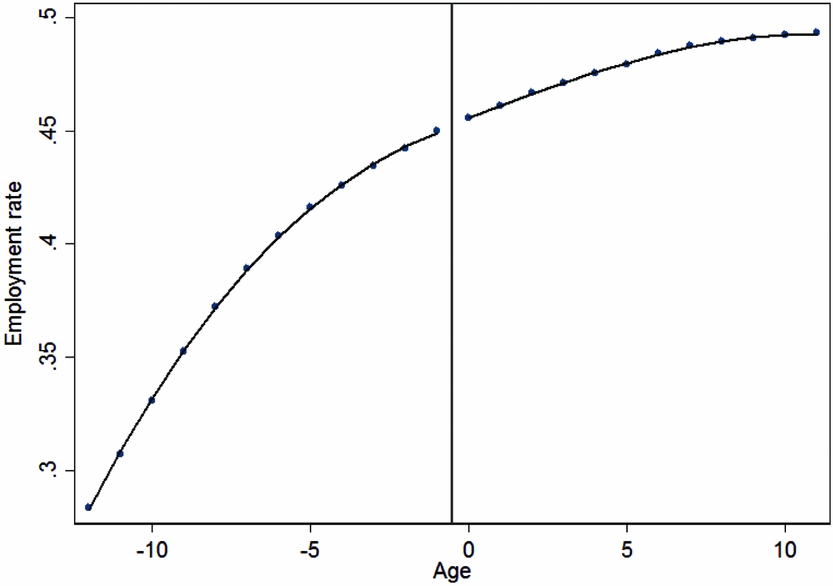
In Figure 2, we present employment around the 19-year threshold. The y-axis shows the employment rate, while the x-axis shows the age. The dots represent the employment rate by month bins around the threshold and the lines are fitted second order polynomial splines. The employment rate increases at a diminishing rate over the age span (18–19 years of age), as is expected since this is the age at which people finish high school. There is no visual evidence of a discontinuity around the 19-year threshold.
Employment around the 19-year threshold
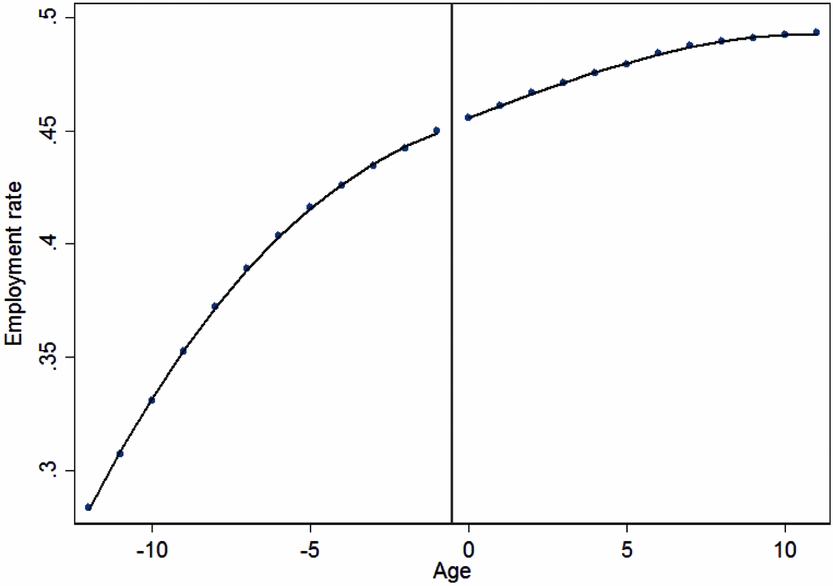
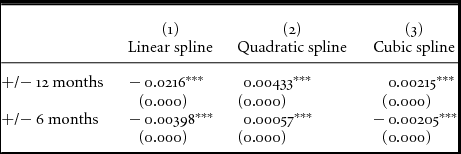
Turning to the regression results, Table 4 presents the parametrical regression discontinuity results for the different age windows and different polynomial splines of the age variable. Since we have more than 14 million observations, the results are statistically significantly different from zero, although the magnitudes are very small in all the models. Additionally, they also change sign depending on the specification. As is also evident from Figure 2, there is no meaningful discontinuity in employment around the threshold. The AIC indicates that the relative goodness of fit is better in Models 2 and 3 than in Model 1.
RD estimates of the effect of higher benefits on employment

Robust standard errors in parentheses. *** p<0.01, ** p<0.05, * p<0.1.
Effects on marginalised youth?
Previous studies have found more pronounced disincentive effects among young people in marginal labour market positions (Bargain and Doorley, Reference Bargain and Doorley2011; Lemieux and Milligan, Reference Lemieux and Milligan2008). To ensure the robustness of our results, we also estimated the models for young people originating from families where one or both parents depend on some form of subsistence support. The results, presented in Appendix C (online), are very similar to the results of the full sample and they do not indicate a more pronounced effect for young people originating from families where at least one parent depends on social assistance.
Conclusion
This article investigated young people's behavioural responses to a Norwegian cash benefit scheme. The benefit targets young people who participate in ALMPs, but who have not yet earned the right to unemployment benefits. Young people below the age of 21 are the most frequent recipients of this benefit and there is concern that the benefit will have a disincentive effect on their educational attainment and employment (i.e. it will work contrary to the purpose of the associated ALMP). The innovation in this research is that we study the effect of a Norwegian policy that pays substantially higher benefits when young people turn 19 years of age. We used this age discontinuity to identify any effects of the cash benefit in a population sample of young people aged 18 to 19 years for the period 2003 to 2012. We modelled both programme take-up and employment outcome around the age threshold.
The analyses of the motivational effects arising from the benefit showed no support for the welfare dependency hypothesis. No evidence of higher benefits having a ‘pull’ effect is observed in the form of higher take-up rates of benefits around the threshold. Nevertheless, the model showed a strong increase in take-up approximately three months prior to the 19-year threshold. This could be an anticipation effect; however, young people are generally unaware of this increase in the basic benefit rate (Drange et al., Reference Drange, Frøyland and Mamelund2015). Further, the analyses showed no drop in the employment rate at the threshold. Thus, the benefit does not substitute for employment among young people.
Although a generous welfare system can attract some opportunistic young people who are more inclined to receive benefits than enter employment, our results show that this is not likely to be true for the majority of young people in receipt of cash benefits. In general, those who receive IA benefits come from more disadvantaged family backgrounds in terms of their parents’ education level, reliance on social assistance, disability insurance and single-parent households when compared with young people on other types of benefits and those who do not receive benefits. Moreover, the young people themselves have lower levels of education and a more marginalised labour market position. This implies that young people on cash benefits have a weaker social position when compared with their peers. In addition to the lack of educational and familial resources, the NAV advisors describe such young people as lacking in self-confidence, as well as having intellectual disabilities and low levels of motivation for either work or education. Many also have histories of substance abuse or psychological problems (Strand et al., Reference Strand, Bråthen and Grønningsæter2015).
Our results are in line with previous studies that identified the disincentive effects of welfare benefits on employment to be small among young adults (Bargain and Doorley, Reference Bargain and Doorley2011; Jensen et al., Reference Jensen, Rosholm and Svarer2003; Lemieux and Milligan, Reference Lemieux and Milligan2008; Hyggen, Reference Hyggen2008). A new feature found in this research is the fact that we have investigated motivational effects among a segment of the population that has limited or no previous labour market experience and that is assumed to respond more strongly to financial incentives (Jensen et al., Reference Jensen, Rosholm and Svarer2003).
The backdrop to this study is that ALMPs show no or even negative effects among young people (Hardoy, Reference Hardoy2005; Kluve, Reference Kluve2010; Larsson, Reference Larsson2003; Martin and Grubb, Reference Martin and Grubb2001; Rønsen and Skarðhamar, Reference Rønsen and Skarðhamar2009). In Norwegian public debate, the effect of the associated benefit has received significant negative attention, with the media covering stories of young people who choose to receive benefits to support a gap year after finishing high school instead of attaining further education or employment.Footnote 4 This activity has resulted in the creation of the concept ‘to nave’, which is used in a negative manner to describe young people who receive benefits (Strand et al., Reference Strand, Bråthen and Grønningsæter2015). Although a generous welfare system can attract some opportunistic young people who are more inclined to receive benefits than to enter employment, our results show that this is not likely to be true for the majority of young people in receipt of cash benefits. Hence, benefits do not work against the intention of ALMPs, while young people's responsiveness to financial incentives cannot explain the lack of effects of such programmes.
We have made four key contributions with this paper. First, we are the first to estimate the effect of financial incentives among an age group that is transitioning into employment. Contrary to previous research on financial incentives (Bargain and Doorley, Reference Bargain and Doorley2011; Lemieux and Milligan, Reference Lemieux and Milligan2008), our results do not suggest that the benefit level has behavioural effects among young people. Second, we estimate our models using Norwegian register data for the full population of 18 to 19 year olds in the period from 2003 to 2012. Even though the receipt of ALMP-associated benefits is a rare event among 18 and 19 year olds, it is a topic of broad interest and the use of high-quality longitudinal data enables rigorous research that would not be feasible with survey data. Third, we use a regression discontinuity design to identify the causal effects of raising benefit levels. Regression discontinuity designs are preferable to other quasi-experimental designs because the social policy remains stable. This, in turn, reduces the chance of contamination of the results by other, confounding changes at the macro level in pre-test/post-test designs or across treatment and control groups (Bargain and Doorley, Reference Bargain and Doorley2011; Lemieux and Milligan, Reference Lemieux and Milligan2008). One caveat with regard to regression discontinuity designs is the limited scope of investigation. Our results are valid for 18 to 19 year olds and hence cannot reject a stronger behavioural effect among older segments of the population. Fourth, we are the first to investigate incentive effects using RD in a Scandinavian welfare context. Active labour market policies, public education systems, high employment levels and a compressed wage structure characterise the Scandinavian welfare states. These features can help to explain the absence of any behavioural effects in this study. The results are context specific, and do not generalise to a situation with higher benefit rates, or to other, more liberal economies with lower institutional support for employment, higher unemployment rates and larger wage dispersion. Negative effects on behaviour could occur under such alternative conditions.
Acknowledgements
The authors would like to thank Naimi Johansson, Angelica Schafft, Vilde Hoff Bernstøm and Daniele Evelin Alves for their helpful comments. This research received no specific grant from any funding agency in the public, commercial or not-for-profit sectors. No conflict of interest has been declared by the authors.
Supplementary material
To view supplementary material for this article, please visit https://doi.org/10.1017/S0047279418000302