Ranking among the leading causes of death worldwide, suicide takes a major toll on global public health (Naghavi, Reference Naghavi2019). Beyond suicide mortality, a much larger number of individuals attempt or consider suicide (Nock et al., Reference Nock, Borges, Bromet, Alonso, Angermeyer, Beautrais, Bruffaerts, Chiu, de Girolamo, Gluzman, de Graaf, Gureje, Haro, Huang, Karam, Kessler, Lepine, Levinson, Medina-Mora, Ono, Posada-Villa and Williams2008). Although extant research has identified a wide range of biological, psychological, clinical and social factors that act to increase suicide risk (O'Connor and Nock, Reference O'Connor and Nock2014; Turecki and Brent, Reference Turecki and Brent2016; Cha et al., Reference Cha, Franz, Guzmán, Glenn, Kleiman and Nock2018; Turecki et al., Reference Turecki, Brent, Gunnell, O'Connor, Oquendo, Pirkis and Stanley2019), our competence to accurately predict suicide is sadly no better now than it was half a century ago (Franklin et al., Reference Franklin, Ribeiro, Fox, Bentley, Kleiman, Huang, Musacchio, Jaroszewski, Chang and Nock2017). One reason for this lack of progress may be our limited ability to delineate factors associated with thoughts of suicide (suicidal ideation) as distinct from those associated with suicidal behaviour (Klonsky and May, Reference Klonsky and May2014; O'Connor and Portzky, Reference O'Connor and Portzky2018). Specifically, converging evidence suggests that many traditionally cited risk factors for suicide actually predict suicidal ideation, but not the transition from thoughts to acts of suicide (Klonsky et al., Reference Klonsky, May and Saffer2016; Nock et al., Reference Nock, Kessler and Franklin2016). This ideation–attempt distinction reflects an important behavioural threshold, in that the vast majority (71%) of adults who consider suicide will not go on to make a suicide attempt in their lifetime (Nock et al., Reference Nock, Borges, Bromet, Alonso, Angermeyer, Beautrais, Bruffaerts, Chiu, de Girolamo, Gluzman, de Graaf, Gureje, Haro, Huang, Karam, Kessler, Lepine, Levinson, Medina-Mora, Ono, Posada-Villa and Williams2008).
Accordingly, guided by an ideation-to-action framework, considerable research attention is now focused on identifying what factors may precipitate the transition from thought to enactment (O'Connor and Nock, Reference O'Connor and Nock2014; Klonsky et al., Reference Klonsky, Saffer and Bryan2018; Turecki et al., Reference Turecki, Brent, Gunnell, O'Connor, Oquendo, Pirkis and Stanley2019). Reviews of the literature indicate that predictors of suicide attempt among those considering suicide include, among others, fearlessness about death, increased pain tolerance, non-suicidal self-injury (NSSI; the intentional destruction of one's own body tissue without suicidal intent), perpetration of interpersonal violence, exposure to others' suicidal behaviour and knowledge about and access to lethal means (May and Klonsky, Reference May and Klonsky2016; Klonsky et al., Reference Klonsky, Qiu and Saffer2017; May and Victor, Reference May and Victor2018). In addition, recent large-scale studies of community-based adolescents (O'Connor et al., Reference O'Connor, Rasmussen and Hawton2012; Taliaferro and Muehlenkamp, Reference Taliaferro and Muehlenkamp2014; Mars et al., Reference Mars, Heron, Klonsky, Moran, O'Connor, Tilling, Wilkinson and Gunnell2019a; Kim et al., Reference Kim, Baek, Han, Lee and Yurgelun-Todd2015) and young adults (Dhingra et al., Reference Dhingra, Boduszek and O'Connor2015; Wetherall et al., Reference Wetherall, Cleare, Eschle, Ferguson, O'Connor, O'Carroll and O'Connor2018) have shown that, relative to those who only think about suicide, individuals who also attempt suicide are more likely to report NSSI, exposure to self-harm in others, certain mental disorders, substance use, higher impulsivity and a greater number of negative life events.
Despite this growing recognition that factors associated with suicidal ideation are distinct from those that govern the transition from ideation to attempt in the general population, comparable research is limited in prisoners – a vulnerable population at an increased risk of suicide (Fazel et al., Reference Fazel, Ramesh and Hawton2017; Favril et al., Reference Favril, Wittouck, Audenaert and Vander Laenen2019). Prevalence rates of suicidal ideation in prisoners greatly exceed those found among non-incarcerated adults (Jenkins et al., Reference Jenkins, Bhugra, Meltzer, Singleton, Bebbington, Brugha, Coid, Farrell, Lewis and Paton2005), which robustly predicts future suicidal behaviour in custody (Fazel et al., Reference Fazel, Cartwright, Norman-Nott and Hawton2008). As such, a common challenge faced by clinicians working with prisoners is to identify, out of the relatively large pool of those who experience suicidal ideation, who is at greatest risk for acting on such thoughts. Delineating factors which differentiate those who attempt suicide (attempt group) from those who experience suicidal ideation but do not go on to engage in suicidal behaviour (ideation group) is thus clinically important to improve risk assessment and identify potential targets for intervention in this high-risk population. To the best of our knowledge, however, only one prior study sought to examine which risk factors predict suicide attempt above and beyond their association with suicidal ideation (Larney et al., Reference Larney, Topp, Indig, O'Driscoll and Greenberg2012). This Australian study found that traumatic brain injury, depressive symptomatology and indicators of childhood trauma conferred an increased risk of suicide attempt among prisoners who reported suicidal ideation in bivariate analyses; however, none of these variables retained statistical significance once other covariates were controlled for (Larney et al., Reference Larney, Topp, Indig, O'Driscoll and Greenberg2012). Given the limited research in this specific area, the present study sought to advance knowledge of factors that differentiate those who have attempted suicide from those who have only considered suicide in a large sample of adult prisoners.
Methods
Sampling and procedure
Eligible study participants were all offenders (aged 18 years and over) physically residing in 15 out of 36 Belgian correctional facilities. Prisons were selected based on their geographical proximity – the Flanders region of Belgium, serving roughly half of the national prison population (Favril et al., Reference Favril, Wittouck, Audenaert and Vander Laenen2019). At each prison consecutively, an up-to-date census of all prisoners detained in the facility was obtained from the respective prison administration. During the study period (October 2015 to May 2016), a total of 3862 individuals (3636 men) were incarcerated in the 15 selected prisons, of whom 1550 (1414 men) were randomly selected by a computer to participate in the study. Since there were no a priori criteria for inclusion, the sample was reflective of the total population in each Belgian prison. The principal researcher (LF), a clinical psychologist who was independent of the prison system, personally approached all of the randomly selected prisoners. In the event of the researcher being unable to contact a particular prisoner at the time of recruitment (e.g. due to sudden release or transfer), the person was replaced by an inmate drawn from the reserve recruitment list (also randomly selected), who was subsequently contacted. In case of intellectual disability or severe mental illness (e.g. those who were actively psychotic at the time of recruitment) that prevented individuals from providing consent, a similar procedure was applied. Only when a selected inmate was contacted but refused to participate, a non-response was registered and was not substituted by another prisoner. Following written informed consent, paper-and-pencil surveys (available in Dutch, French and English) were completed either in small groups (±10 people) or individually. The route of survey administration was tailored to the characteristics of each prison. To enhance privacy and assure confidentiality during data collection, prison staff was not present during either the group or individual administration of surveys. Ethical approval for the study protocol was granted by the Ethics Committee of Ghent University, Faculty of Law and Criminology.
Measures
Demographic and criminological characteristics
The survey included details on gender (male/female), age (continuous), nationality (Belgian/other) and partnership status (dichotomized in single/divorced/widowed v. married/partner). The analysis included two criminological variables; current custodial status (remand/sentenced) and offence type. This latter variable was recoded into non-violent (e.g. drug offences, theft and fraud) v. violent (e.g. murder, manslaughter and rape) offences.
Lifetime history of suicidal ideation and attempts
Consistent with recent ideation-to-action studies in the general population (Wetherall et al., Reference Wetherall, Cleare, Eschle, Ferguson, O'Connor, O'Carroll and O'Connor2018; Mars et al., Reference Mars, Heron, Klonsky, Moran, O'Connor, Tilling, Wilkinson and Gunnell2019a), our outcome measure was a lifetime history of suicidal ideation and attempts. Based on the British National Psychiatric Morbidity Survey among prisoners (Jenkins et al., Reference Jenkins, Bhugra, Meltzer, Singleton, Bebbington, Brugha, Coid, Farrell, Lewis and Paton2005), suicidal ideation was assessed with the question ‘Have you ever thought of taking your own life, even though you would not actually do it?’ (coded as no/yes). Regardless of the answer to the question about suicidal ideation, respondents were also asked whether they ever attempted suicide (coded as no/yes). Both items were used to categorize participants in three mutually exclusive groups: those without any suicidal history (control group), those who had thought about suicide but never made a suicide attempt (ideation group) and those who had experienced suicidal ideation and attempted suicide in the past (attempt group).
Clinical variables
A self-reported diagnosis of a mental disorder was assessed by asking participants ‘Have you ever been told by a mental health professional, such as a psychiatrist or psychologist, that you had one or more of the following mental disorders?’ followed by a comprehensive list of diagnostic labels. The conditions specified were depressive, bipolar, psychotic, anxiety, eating and personality disorders. The wording of the question and choice of a self-report measure of lifetime psychiatric diagnoses is consistent with previous prison research (Binswanger et al., Reference Binswanger, Merrill, Krueger, White, Booth and Elmore2010; Stoliker, Reference Stoliker2018). Substance use disorders were excluded from the current analysis. Participants were however asked about their substance abuse, defined as using illicit drugs on an almost daily basis in the 12 months prior to incarceration and/or during imprisonment (Larney et al., Reference Larney, Topp, Indig, O'Driscoll and Greenberg2012).
NSSI history and exposure to suicidal behaviour
A history of NSSI was dichotomously assessed by asking participants ‘Have you ever deliberately harmed yourself in any way, but not with the intention of killing yourself?’ without further prompts (Jenkins et al., Reference Jenkins, Bhugra, Meltzer, Singleton, Bebbington, Brugha, Coid, Farrell, Lewis and Paton2005; McManus et al., Reference McManus, Gunnell, Cooper, Bebbington, Howard, Brugha, Jenkins, Hassiotis, Weich and Appleby2019). A single item was included to inquire about a family history of suicidal behaviour, asking participants whether there was anyone in their family who ever attempted or died by suicide (no/yes).
Statistical analysis
A key difficulty in identifying risk factors for a suicide attempt is that it rarely occurs in the absence of suicidal thoughts (Larney et al., Reference Larney, Topp, Indig, O'Driscoll and Greenberg2012; May and Klonsky, Reference May and Klonsky2016). By simply comparing prisoners who attempted suicide to those who did not, irrespective of suicidal ideation, most studies have neglected to account for this shared variance with suicidal ideation (Jenkins et al., Reference Jenkins, Bhugra, Meltzer, Singleton, Bebbington, Brugha, Coid, Farrell, Lewis and Paton2005; Sarchiapone et al., Reference Sarchiapone, Carli, Di Giannantonio and Roy2009; Sánchez et al., Reference Sánchez, Fearn and Vaughn2018; Stoliker, Reference Stoliker2018; Favril, Reference Favril2019); a methodological design which allows predictors of ideation to masquerade as predictors of attempts (Klonsky et al., Reference Klonsky, May and Saffer2016). Therefore, our analysis focuses on suicide attempts among the subsample of participants with suicidal ideation. As such, the independent contribution of risk factors for suicide attempt can be more rigorously established, as this potential confounding is accounted for by excluding non-suicidal participants (Batterham et al., Reference Batterham, Calear, Christensen, Carragher and Sunderland2018).
Group differences between those who ideate and attempt suicide were investigated using independent-samples t tests for continuous variables and χ2 tests for categorical variables. Next, all independent variables (regardless of whether they significantly distinguished between the ideation and attempt groups at the bivariate level) were entered into a multivariate logistic regression to determine their relative contributions. Crude (OR) and adjusted (aOR) odds ratios, and their 95% confidence intervals (CI) are reported as estimates of the likelihood that individuals with suicidal ideation also attempted suicide. Since there were minimal missing data (n = 87), cases with missing data were list-wise deleted for all analyses (conducted in SPSS version 25). Those who were excluded did not significantly differ from the sample as a whole on demographic and criminological characteristics, and suicidal history. All tests were two-tailed, and p values < 0.05 were considered statistically significant.
Results
Participants
Across 15 Belgian prisons, 1326 adult offenders (1203 men) with complete data on outcome measures (suicidal ideation and attempt) were included in the study. The majority of all participants had the Belgian nationality (73.5%) and their mean age was 37.7 years (s.d. = 11.8; range 18–77). One in three (34.6%) was currently on remand, while the remaining 867 participants (65.4%) were sentenced. One-fourth (26.3%) of the participants were charged with, or convicted of, a violent index offence. The modal length of time in prison was 1–6 months (28.6%), and half (50.3%) of the sample had been incarcerated for more than one year at the time of assessment.
Prevalence rates
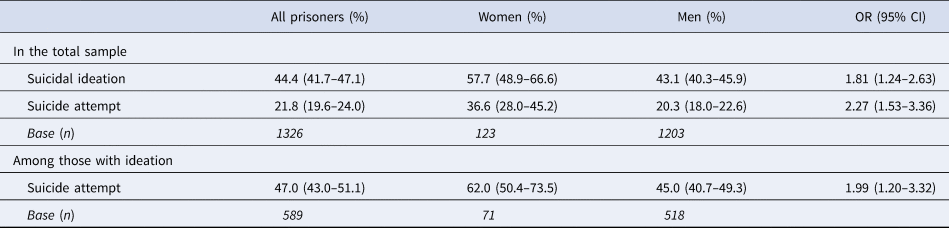
The estimated lifetime prevalence of suicidal ideation and suicide attempt among prisoners was 44.4% (95% CI 41.7–47.1) and 21.8% (95% CI 19.6–24.0), respectively (Table 1). Women were significantly more likely than men to report a lifetime history of suicidal ideation (57.7% v. 43.1%; OR 1.81, p = 0.002) and suicide attempt (36.6% v. 20.3%; OR 2.27, p < 0.0001). Of the overall sample of 1326 prisoners, 725 (54.7%) had no suicidal history, 312 (23.5%) reported suicidal ideation only, and 289 (21.8%) attempted suicide in their lifetime. Of those endorsing a suicide attempt, 12 participants (4.2%) did not report a history of suicidal ideation. After exclusion of these 12 cases (0.9% of the total sample), our findings show that 47% (95% CI 43.0–51.1) of all participants with suicidal ideation (n = 589) also report having made a suicide attempt; significantly more women than men (62.0% v. 45.0%; OR 1.99, p = 0.007).
Lifetime prevalence of suicidal ideation and attempt, by gender

OR, odds ratio; CI, confidence interval.
Bivariate and multivariate analyses
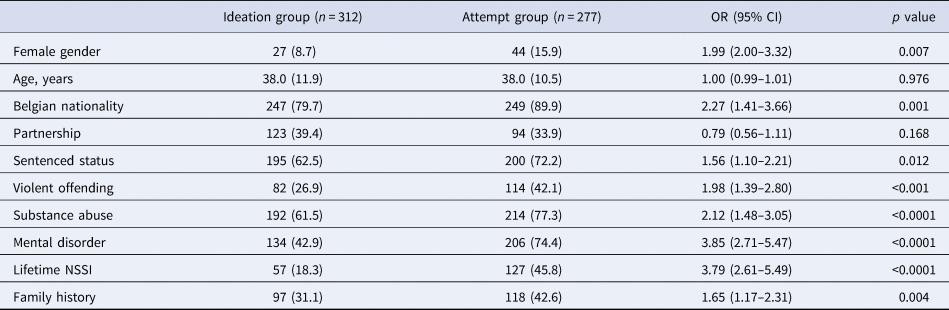
We compared prisoners who reported suicidal ideation only (ideation group; n = 312) with those who reported both suicidal ideation and attempts (attempt group; n = 277). Descriptive statistics by group membership (ideation v. attempt) and bivariate differences between both groups are presented in Table 2. Relative to those in the ideation group, those who acted on their suicidal thoughts were significantly more likely to be female (OR 1.99, 95% CI 2.00–3.32; p = 0.007), Belgian nationals (OR 2.27, 95% CI 1.41–3.66; p = 0.001) and sentenced (OR 1.56, 95% CI 1.10–2.21; p = 0.012). Prisoners who report a suicide attempt were twice as likely to be incarcerated for a violence offence than those in the ideation group (OR 1.98, 95% CI 1.39–2.80; p < 0.001). Clinically, significantly more of those in the attempt group self-reported a mental disorder diagnosis (OR 3.85, 95% CI 2.71–5.47) and substance abuse (OR 2.12, 95% CI 1.48–3.05) compared to those in the ideation group (both p < 0.0001). Nearly half (45.8%) of participants in the attempt group reported a history of NSSI, contrasting the much lower rates of NSSI (18.3%) among those in the ideation group; a difference which was significant (OR 3.79, 95% CI 2.61–5.49; p < 0.0001). Last, those in the suicide attempt group more frequently endorsed a family history of suicidal behaviour, with 42.6% reporting such exposure, compared to 31.1% in the ideation group (OR 1.65, 95% CI 1.17–2.31; p = 0.004).
Descriptive statistics and bivariate associations by group membership

Note. Data are presented as n (%) for categorical data and M (s.d.) for continuous data.
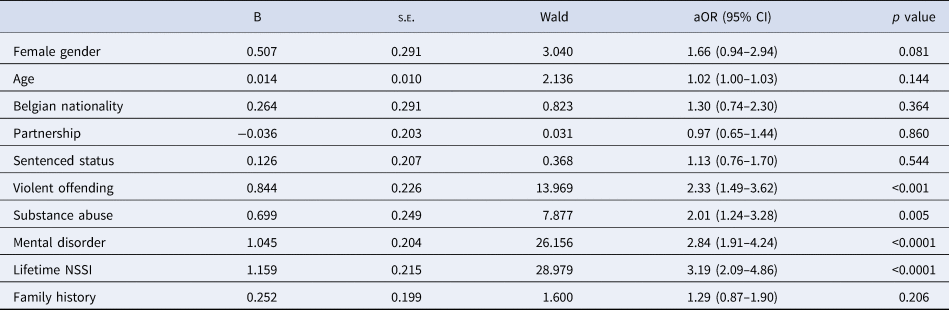
Results of the multivariate analysis are presented in Table 3. The full model containing all predictor variables was statistically significant [χ2(10) = 127.01; p < 0.0001], indicating that the model was able to distinguish between the ideation (n = 312) and attempt (n = 277) groups. Although gender, criminal status and family history were all bivariate correlates of suicide attempt among those with suicidal ideation, none of these remained significant in the multivariate model (all p ⩾ 0.081). Controlling for all other variables in the model, the factors that independently distinguished those who attempted suicide from those in the ideation group were violent offending (aOR 2.33, 95% CI 1.49–3.62; p < 0.001), NSSI history (aOR 3.19, 95% CI 2.09–4.86; p < 0.0001), mental disorder diagnosis (aOR 2.84, 95% CI 1.91–4.24; p < 0.0001) and substance abuse (aOR 2.01, 95% CI 1.24–3.28; p = 0.005). Three of these four variables (substance abuse being the exception; p = 0.005) were associated with significantly increased odds of suicide attempts among those with suicidal ideation after correcting for multiple comparisons (i.e. p < 0.005 with Bonferroni correction).
Multivariate regression for suicide attempt among those with suicidal ideation

Note. aOR, adjusted odds ratios (adjusted for all other factors in the multivariate model) and their 95% confidence intervals (CI).
Discussion
To the best of our knowledge, this study is only the second (Larney et al., Reference Larney, Topp, Indig, O'Driscoll and Greenberg2012) to specifically examine the extent to which suicide risk factors distinguish between prisoners who had attempted suicide and those who had only thought about suicide. There are four major findings from this study.
First, suicidal ideation and attempts are common among prisoners in Belgium. An estimated two out of five (44%) participants have experienced suicidal thoughts during their lifetime, while one-fifth (22%) report a suicide attempt over the lifespan. These prevalence rates largely align with prior estimates found among adult prisoners in England and Wales (Jenkins et al., Reference Jenkins, Bhugra, Meltzer, Singleton, Bebbington, Brugha, Coid, Farrell, Lewis and Paton2005), Italy (Sarchiapone et al., Reference Sarchiapone, Carli, Di Giannantonio and Roy2009) and Australia (Larney et al., Reference Larney, Topp, Indig, O'Driscoll and Greenberg2012), which are highly elevated relative to those observed among non-incarcerated people in the surrounding community (Nock et al., Reference Nock, Borges, Bromet, Alonso, Angermeyer, Beautrais, Bruffaerts, Chiu, de Girolamo, Gluzman, de Graaf, Gureje, Haro, Huang, Karam, Kessler, Lepine, Levinson, Medina-Mora, Ono, Posada-Villa and Williams2008). Furthermore, among the 589 participants in our study with a lifetime history of suicidal ideation, 47% had ever attempted suicide. Similarly, in a random sample of 996 Australian prisoners, over half (58%) of the participants with suicidal ideation reported a lifetime suicide attempt (Larney et al., Reference Larney, Topp, Indig, O'Driscoll and Greenberg2012). This ratio of suicide attempts to suicidal ideation in prisoners is substantially higher than the 29% found among adults in the general population (Nock et al., Reference Nock, Borges, Bromet, Alonso, Angermeyer, Beautrais, Bruffaerts, Chiu, de Girolamo, Gluzman, de Graaf, Gureje, Haro, Huang, Karam, Kessler, Lepine, Levinson, Medina-Mora, Ono, Posada-Villa and Williams2008). This is an important finding which requires further exploration to determine whether prisoners are faster to make the transition from thoughts to acts of suicide, and why. Collectively, our results illustrate the ubiquitous nature of suicidal thoughts and behaviour among incarcerated offenders, supporting the well-established finding that prisoners constitute a particularly high-risk group for suicide (Fazel et al., Reference Fazel, Ramesh and Hawton2017; Favril et al., Reference Favril, Wittouck, Audenaert and Vander Laenen2019).
Second, several factors in our analysis clearly discriminated between those who ideate and attempt suicide in a multivariate context. Notably, NSSI conferred a threefold increased risk of suicide attempt among prisoners with suicidal ideation, which adds to an extensive body of literature documenting that NSSI robustly predicts the progression from suicidal ideation to attempt among youth (Taliaferro and Muehlenkamp, Reference Taliaferro and Muehlenkamp2014; Kiekens et al., Reference Kiekens, Hasking, Boyes, Claes, Mortier, Auerbach, Cuijpers, Demyttenaere, Green, Kessler, Myin-Germeys, Nock and Bruffaerts2018; Georgiades et al., Reference Georgiades, Boylan, Duncan, Wang, Colman, Rhodes, Bennett, Comeau, Manion and Boyle2019; Mars et al., Reference Mars, Heron, Klonsky, Moran, O'Connor, Tilling, Wilkinson and Gunnell2019b). Similarly, violent offenders in our study were found to be twice as likely to act on their suicidal thoughts comparted with their non-violent peers. Post hoc analyses suggest that this association is largely attributable to homicidal crimes as a further breakdown by type of violent offences indicates that sexual offences did not meaningfully distinguish between those in the attempt and ideation groups. Little other research, however, has provided insight into the potential role that violent crime might play in the transition from ideation to action. One Italian study suggests that violent index offences (excluding sexual crimes) are associated with suicide attempts, but not with suicidal ideation, in 903 male prisoners (Sarchiapone et al., Reference Sarchiapone, Carli, Di Giannantonio and Roy2009). Together, these findings are consistent with converging empirical evidence (O'Connor et al., Reference O'Connor, Rasmussen and Hawton2012; May and Klonsky, Reference May and Klonsky2016; Wetherall et al., Reference Wetherall, Cleare, Eschle, Ferguson, O'Connor, O'Carroll and O'Connor2018; Mars et al., Reference Mars, Heron, Klonsky, Moran, O'Connor, Tilling, Wilkinson and Gunnell2019a) and recent theoretical models (Van Orden et al., Reference Van Orden, Witte, Cukrowicz, Braithwaite, Selby and Joiner2010; Klonsky and May, Reference Klonsky and May2015; O'Connor and Kirtley, Reference O'Connor and Kirtley2018) that emphasize the role of a suicide capability in the progression from thoughts to acts of suicide. This capability to carry out a suicidal act is key in order for an individual to bridge the behavioural threshold from suicidal ideation to action, which is thought to be acquired through exposure to painful and provocative events (May and Victor, Reference May and Victor2018). Our results align with this assumption, as the two factors that independently distinguished between those who think about suicide and those who attempt suicide – NSSI and violent offending – appear to directly facilitate habituation to violence and pain, which in turn may serve to promote one's propensity to act on suicidal thoughts (Joiner et al., Reference Joiner, Ribeiro and Silva2012; Klonsky et al., Reference Klonsky, May and Glenn2013; Stack, Reference Stack2014; Swogger et al., Reference Swogger, Van Orden and Conner2014; Rooney et al., Reference Rooney, Hill, Oosterhoff and Kaplow2019). Moreover, aggression directed towards others (interpersonal violence) and oneself (NSSI) may share a common underlying vulnerability (O'Donnell et al., Reference O'Donnell, House and Waterman2015). In this regard, childhood maltreatment and impulse control deficiencies may be implicated in both (McMahon et al., Reference McMahon, Hoertel, Olfson, Wall, Wang and Blanco2018), which are potential contributors to an increased capability for suicide.
Third, clinical factors that differentiated between prisoners who had attempted suicide (attempt group) and those who had thought about suicide without making an attempt (ideation group) are mental disorder diagnoses and substance abuse. In support of our findings, a recent population-based birth cohort study (Mars et al., Reference Mars, Heron, Klonsky, Moran, O'Connor, Tilling, Wilkinson and Gunnell2019a) indicates that the presence of a mental disorder and illicit drug use are two factors that meaningfully distinguish between those who ideate v. attempt suicide. The use of illicit substances may lower inhibition and impair decision-making, making it more likely that prisoners will act upon their suicidal thoughts (Saffer and Klonsky, Reference Saffer and Klonsky2018). With regard to mental disorders, both meta-analytical (May and Klonsky, Reference May and Klonsky2016) and epidemiological (Borges et al., Reference Borges, Nock, Abad, Hwang, Sampson, Alonso, Andrade, Angermeyer, Beautrais, Bromet, Bruffaerts, de Girolamo, Florescu, Gureje, Hu, Karam, Kovess-Masfety, Lee, Levinson, Medina-Mora, Ormel, Posada-Villa, Sagar, Tomov, Uda, Williams and Kessler2010; Nock et al., Reference Nock, Hwang, Sampson and Kessler2010; Batterham et al., Reference Batterham, Calear, Christensen, Carragher and Sunderland2018; Millner et al., Reference Millner, Ursano, Hwang, King, Naifeh, Sampson, Zaslavsky, Stein, Kessler and Nock2019) evidence suggests that disorders characterized by anxiety (e.g. posttraumatic stress disorder) and poor impulse control (e.g. substance use disorders) best predict which individuals will progress from suicidal thoughts to attempts. In the current study, however, we did not examine individual mental disorders, limiting a more fine-grained analysis to determine their unique contributions. Nonetheless, it is clear that the presence of (certain) mental disorders plays a key role in governing the translation of suicidal thoughts into attempts. Since mental disorders are disproportionally prevalent in prisoners (Fazel et al., Reference Fazel, Hayes, Bartellas, Clerici and Trestman2016; Favril and Dirkzwager, Reference Favril and Dirkzwager2019), and general population findings may therefore not be generalized to justice-involved individuals, future research should explore how specific mental disorders differentially relate to distinct stages of the suicidal process among prisoners. A study addressing this important question among a nationally representative sample of New Zealand prisoners is currently underway.
Fourth, contrary to mounting evidence that exposure to suicidal behaviour in others reliably distinguishes between youth with suicidal ideation and attempts (O'Connor et al., Reference O'Connor, Rasmussen and Hawton2012; Dhingra et al., Reference Dhingra, Boduszek and O'Connor2015; Mars et al., Reference Mars, Heron, Klonsky, Moran, O'Connor, Tilling, Wilkinson and Gunnell2019a), a family history of suicidal behaviour was not significantly associated with attempts among prisoners with suicidal thoughts in this study once other factors were controlled for. Similarly, in a recent national study in Scotland, a family history of suicidal behaviour did not significantly differentiate those with a history of ideation from those who had attempted suicide, whereas exposure to a suicide attempt of a close friend did (Wetherall et al., Reference Wetherall, Cleare, Eschle, Ferguson, O'Connor, O'Carroll and O'Connor2018). Given the relatively high frequency of familial exposure to suicidal behaviour in both (ideation and attempt) groups of prisoners, it is important not to dismiss the association between exposure and suicide risk entirely. Indeed, research should look beyond the crude frequencies of suicidal behaviour that one is exposed to, and shift its focus to different aspects of exposure (e.g. perceived impact and closeness to the decedent; Cerel et al., Reference Cerel, Maple, Venne, Brown, Moore and Flaherty2017) which may explain why some prisoners who experience suicidal ideation are propelled towards suicide, whereas others are not.
Moreover, exposure to suicidal behaviour by fellow prisoners has been linked to increased levels of suicidal ideation, attempts and psychiatric morbidity in incarcerated men (Favril et al., Reference Favril, Vander Laenen, Vandeviver and Audenaert2017; Hales et al., Reference Hales, Edmondson, Davison, Maughan and Taylor2015). Likewise, a large epidemiological study based on 2004–2009 administrative data in English and Welsh prisons found evidence of clustering in time and location of prisoners self-harming, suggesting a possible contagion effect within closed settings such as prisons (Hawton et al., Reference Hawton, Linsell, Adeniji, Sariaslan and Fazel2014). Relatedly, another prison-specific factor potentially implicated in the progression from ideation to action includes single-cell accommodation (Fazel et al., Reference Fazel, Cartwright, Norman-Nott and Hawton2008; Favril et al., Reference Favril, Wittouck, Audenaert and Vander Laenen2019). Occupying a single cell may confer increased risk due to the isolated environment within which prisoners are placed, in that they have the time and privacy to attempt suicide (Humber et al., Reference Humber, Webb, Piper, Appleby and Shaw2013). This may increase the likelihood that suicidal thoughts will be acted on, just as access to lethal means can be regarded as an environmental factor facilitating the transition from thoughts to acts of suicide, rather than being directly causative. Understanding the impact of these modifiable aspects of the prison environment on behavioural enaction in prisoners with suicidal ideation represents an important avenue of future research to better predict risk and target interventions.
Strengths and limitations
This study is one of the few to delineate factors associated with suicide attempts among prisoners with suicidal ideation, thereby helping us to better understand the transition from ideation to action in an understudied population at high risk for suicide. A noteworthy strength of the study is its large sample (n = 1326), representing 13.5% of the average daily prisoner population in Belgium (N = 9835), which was broadly representative of the annual census data during the study period (Favril and Dirkzwager, Reference Favril and Dirkzwager2019). Six methodological limitations should however be borne in mind when interpreting the results of this study.
First, the use of cross-sectional data prohibits inferences about causality and did not afford opportunities to test the temporal assumptions that were proposed. Since measures of suicidal history were assessed on a lifetime basis (Larney et al., Reference Larney, Topp, Indig, O'Driscoll and Greenberg2012; May and Klonsky, Reference May and Klonsky2016), the lack of precise temporal ordering may limit our interpretation of the nature of these associations. Second, data were based on retrospective self-report and thus may be subject to social desirability and biased recall. For example, participants in our study may have underreported sensitive information (e.g. psychiatric morbidity and suicidal history) due to stigma or fear of negative consequences, despite the anonymous nature of the survey. To the extent that this was the case, prevalence rates may be lower bound estimates. Third, a single-item assessment for both suicidal ideation and attempts was used. Although commonly adopted in prison research (Jenkins et al., Reference Jenkins, Bhugra, Meltzer, Singleton, Bebbington, Brugha, Coid, Farrell, Lewis and Paton2005; Larney et al., Reference Larney, Topp, Indig, O'Driscoll and Greenberg2012) and similar ideation-to-action studies (Wetherall et al., Reference Wetherall, Cleare, Eschle, Ferguson, O'Connor, O'Carroll and O'Connor2018; Mars et al., Reference Mars, Heron, Klonsky, Moran, O'Connor, Tilling, Wilkinson and Gunnell2019a), such an approach may bias results towards an overestimation of prevalence rates due to misclassification (Millner et al., Reference Millner, Lee and Nock2015). In doing so, we were unable to establish the intensity or severity of suicide-related outcomes – both the suicide attempt and ideation-only group therefore reflect a heterogeneous composition of suicidal individuals. Future studies should assess the characteristics of suicidal thinking (e.g. recency of ideation onset, active v. passive ideation, frequency and uncontrollability of these thoughts, severity of ideation at its worst point and presence of a suicide plan) as these features have been shown to predict the transition to suicide attempt (Nock et al., Reference Nock, Borges, Bromet, Alonso, Angermeyer, Beautrais, Bruffaerts, Chiu, de Girolamo, Gluzman, de Graaf, Gureje, Haro, Huang, Karam, Kessler, Lepine, Levinson, Medina-Mora, Ono, Posada-Villa and Williams2008, Reference Nock, Millner, Joiner, Gutierrez, Han, Hwang, King, Naifeh, Sampson, Zaslavsky, Stein, Ursano and Kessler2018; Miranda et al., Reference Miranda, Ortin, Scott and Shaffer2014). In a similar vein, most predictor variables in the analyses were dichotomous clinical variables, as opposed to more fine-grained continuous scales, limiting the ability to detect between-group differences. Fourth, we were also limited in the number of risk factors (potentially linked to a capability for suicide) that we could assess. Future research should investigate the extent to which impulsivity, aggression, childhood maltreatment, and traumatic brain injury—all highly prevalent in offender populations—are implicated in behavioural enaction among prisoners. Fifth, our data examined the presence of non-fatal suicidal outcomes, but not suicide. Because differences exist between fatal and non-fatal suicidal behaviours (Boren et al., Reference Boren, Folk, Loya, Tangney, Barboza and Wilson2018), the current findings may not be generalizable to prisoners who have died by suicide (Favril et al., Reference Favril, Wittouck, Audenaert and Vander Laenen2019). Finally, we cannot comment on the extent to which incarceration impacts upon the risk of future suicidal behaviour while incarcerated (or beyond). An important recommendation for further research, therefore, relates to the timing of suicidal outcomes. Rather than focusing on prisoners' lifetime histories, future studies should examine suicide attempts in prison as an outcome variable, whilst controlling for recent suicidal ideation. This would allow for the elucidation of custody-specific stressors and modifiable aspects of the prison regime that may play a role in the progression from thoughts to acts of suicide while incarcerated (Marzano et al., Reference Marzano, Hawton, Rivlin, Smith, Piper and Fazel2016; Favril et al., Reference Favril, Vander Laenen, Vandeviver and Audenaert2017).
Each of these limitations restricts the inferences that can be drawn from this study and represents the areas for improvement in future research. These methodological caveats notwithstanding, our results make a solid contribution to the literature as it provides a rare exploration of the ideation-to-action framework among prisoners, which has several implications for both clinical practice and suicide theory.
Clinical and research implications
Given that half of the prisoners who experience suicidal thoughts at some point attempt suicide, the high rate of suicidal ideation among prisoners requires prevention strategies targeting the early stages of the suicidal process. From a clinical point of view, identifying which prisoners are at greatest risk for acting on their suicidal thoughts, and providing them with timely and effective interventions, is imperative in order to ameliorate the risk of subsequent suicidal behaviour.
Our results underscore the need for identifying and treating prisoners' mental disorders, substance abuse and NSSI in the prevention of suicide (Jenkins et al., Reference Jenkins, Bhugra, Meltzer, Singleton, Bebbington, Brugha, Coid, Farrell, Lewis and Paton2005; Fazel et al., Reference Fazel, Hayes, Bartellas, Clerici and Trestman2016; Marzano et al., Reference Marzano, Hawton, Rivlin, Smith, Piper and Fazel2016), as they are presumably implicated in the progression from ideation to action. In order to identify such high-risk groups who might benefit from targeted interventions, screening instruments should therefore, amongst others, incorporate questions about these clinical variables (Marzano et al., Reference Marzano, Hawton, Rivlin, Smith, Piper and Fazel2016; Brown et al., Reference Brown, Hoffman, Neufeld and Mrozewski2017; Gould et al., Reference Gould, McGeorge and Slade2018). Although of interest, however, reliance on such factors may be of limited practical use for identifying suicidal prisoners prone to behavioural enaction, owing to their overall high prevalence in mainstream prisoner populations (Fazel et al., Reference Fazel, Hayes, Bartellas, Clerici and Trestman2016; Favril and Dirkzwager, Reference Favril and Dirkzwager2019). Therefore, guided by specific constructs from the Research Domain Criteria (Glenn et al., Reference Glenn, Kleiman, Cha, Deming, Franklin and Nock2018), future research should focus on novel volitional factors implicated in the transition from ideation to action, and test the predictive validity of screening instruments incorporating such factors.
This study also has several implications on a theoretical level. Not only do our findings add to the growing literature supporting an ideation-to-action framework (Klonsky et al., Reference Klonsky, Saffer and Bryan2018), they also expand its applicability to an understudied and high-risk population – prisoners – in which factors related to behavioural enaction (e.g. violent offending) may hold particular relevance. However, since the current study was largely exploratory in nature, and the included predictors were in no way exhaustive, future research should test a priori hypotheses that make specific predictions about why certain prisoners come to think about suicide and subsequently progress from ideation to action, whereas others do not. This would be a significant advance in the field as it moves beyond describing characteristics of suicidal outcomes to formulating inferential and theory-driven hypotheses about factors that are associated with the development of suicidal ideation relative to those increasing the likelihood that suicidal thoughts are acted upon (O'Connor et al., Reference O'Connor, Rasmussen and Hawton2012; Wetherall et al., Reference Wetherall, Cleare, Eschle, Ferguson, O'Connor, O'Carroll and O'Connor2018).
Conclusion
Almost half of the prisoners who experience suicidal ideation also attempt suicide. Pending replication, our results suggest that factors facilitating the transition from ideation to action include violent offending, prior NSSI, mental disorders and substance abuse. In view of the clinical importance of being able to make predictions about behavioural enaction among prisoners considering suicide, prospective studies should build on these findings and further delineate risk (and protective) factors that enable (or impede) progression from thoughts to acts of suicide over time. In sum, advancing our understanding of longitudinal predictors and mechanisms through which people come to think about suicide and subsequently cross the behavioural threshold towards attempting suicide could inform the development of interventions aimed at reducing the likelihood of individuals acting on their suicidal thoughts – in prisons and elsewhere.
Financial support
This work was supported by the Special Research Fund (BOF) of Ghent University [BOF13/24J/145]. The funding agency did not have any involvement in the study design, data collection, data analysis and the interpretation of results, nor in the writing or decision to submit the manuscript for publication.
Conflict of interest
None.
Ethical standards
The authors assert that all procedures contributing to this work comply with the ethical standards of the relevant national and institutional committees on human experimentation and with the Helsinki Declaration of 1975, as revised in 2008.