




No CrossRef data available.
Beers, Kaffi, and Schnaps: Different Grammatical Options for Restaurant Talk Coercions in Three Germanic Languages
Published online by Cambridge University Press: 30 March 2005
Abstract
This paper discusses constructions such as We'll have two beers and a coffee that are typically used for beverage orders in restaurant contexts. We compare the behavior of nouns in these constructions in three Germanic languages, English, Icelandic, and German, and take a closer look at the correlation of the morphosyntactic and semantic-conceptual changes involved. We show that even within such a restricted linguistic sample in closely related languages one finds three different grammatical options for the expression of the same conceptual transition. Our findings suggest an analysis of coercion as a genuinely semantic phenomenon, located on a level of semantic representations that serves as an interface between the conceptual and the grammatical systems and takes into account inter- and intralinguistic variations.Work on this paper was supported by NSF award BCS-0080377 to Boston University. The material is based in part on work done while the second author was serving as Director of the Linguistics Program at the U.S. National Science Foundation. Any opinions, findings, and conclusions expressed in this material are those of the authors, and do not necessarily reflect the views of the U.S. National Science Foundation. For comments on an earlier version, we would like to thank two anonymous JGL reviewers.
Information
- Type
- ARTICLES
- Information
- Copyright
- © 2005 Society for Germanic Linguistics
Introduction
The term RESTAURANT TALK (RT) refers to constructions that are typically used for beverage orders in restaurant contexts, such as in 1.

An interesting feature of this construction is the unusual behavior of the nouns that identify the beverages. Nouns such as beer and coffee that usually behave like mass nouns, as in She drinks beer/coffee, appear as count nouns in 1. Mass nouns in 1 are marked for number or combined with the indefinite article. This morphosyntactic change goes together with a reference shift from substances (beverages) to portions of substances (servings of beverages), making RT constructions an instance of mass/count coercion; that is, transitions within the mass/count domain leading to a change in interpretation from substances to objects or vice versa.1
Generally, the term objects refers to concrete physical objects as well as abstract objects, such as portions or sorts.
In this paper we take a closer look at the correlation of the morphosyntactic and semantic-conceptual changes involved in RT. We compare English RT constructions with similar constructions in two other Germanic languages, Icelandic and German, and show that even within such a restricted linguistic sample involving closely related languages there are at least three different grammatical options for the expression of the same conceptual representation. We provide evidence for interlinguistic as well as intralinguistic variation in the way the grammatical system can reflect the conceptual transition from substances such as beer or coffee to portions of these substances as served in restaurant contexts. We also discuss the implications of these findings for the interface of conceptual and grammatical structures.
The first two sections of this paper summarize the conceptual and grammatical background on the constructions under discussion. The first section characterizes the conceptual shift that underlies RT constructions as instances of mass/count coercion, and describes the relevant conceptual distinction of substances and objects. In the second section we discuss the grammatical counterpart of this distinction, demonstrating how the conceptual distinction can be reflected in differences in the morphosyntactic number marking of nouns. On this basis, the third section analyzes the different ways in which the distinction between non-plural (mass) and plural (count) nominals is put to use for mass/count coercion in English, Icelandic, and German RT. In the last section, we bring together our results and discuss them from the broader perspective of linguistic architecture.
Mass/Count Coercion
Coercion occurs when the basic (standard) interpretation of an expression yields an improbable or impossible conceptual representation due to an incompatibility of its constituents.2
The basic interpretation is the default interpretation of a construction that can be derived from the semantic representations of its constituents directly without enrichment. In some models of semantics this will be the only interpretation that conforms to strict compositionality, while in others enriched interpretations are compositional as well (see Dölling 2001 and Wiese 2003 for a detailed discussion).
This introduction of additional conceptual material has been shown to have an effect in real-time language processing, where evidence from sentence comprehension suggests that an enriched version causes a heavier processing load than one that receives the basic interpretation.3
See McElree et al. 2001 for complement coercions, and Piñango et al. 1999 and Todorova et al. 2000 for aspectual coercions.

In 2a, an example of complement coercion, the predicate denoted by the verb finish licenses an activity as its argument.4
For a detailed discussion of complement coercions, see Pustejovsky 1991, 1995 and Jackendoff 1997.
There are three main kinds of mass/count coercion, which can be distinguished as GRINDER, SORTER, and PACKER CONSTRUCTIONS. The coercion described in 2 belongs to the class of grinder constructions. In this case the enriched interpretation is based on a conceptual function that maps an object onto the substance constituting the object (or some part of it). For instance, this function maps an animal such as a chicken onto the substance chicken meat. One can think of this mapping function as a “universal grinder” that takes objects as its input and yields continuous masses as its output.5
See Pelletier 1975, and Pelletier and Schubert 1989.
See Bunt 1985.

The unifying feature of mass/count coercion is a conceptual transition between substances and objects. The relevant distinction is defined in 4.7
See Prasada 1996, 1999 for a detailed discussion of the status of structure in the conceptual distinction between substances and objects.

That is, even though a substance might have an internal structure, the latter does not feature in the representation. Consequently, while for an object such as chicken its internal structure is important (you cannot cut a chicken into two pieces and still have the same animal), for a substance such as chicken meat we do not need to be concerned about internal structure (you can cut a piece of chicken meat into two pieces and still have chicken meat).
Under this notion of substances and objects an example of a substance-denoting nominal is beer in its basic, non-coerced usage, but also chicken in a grinder construction such as 2c above. Examples of object-denoting nominals are a chicken or chickens in non-coerced constructions, as well as nominals in the coerced sorter and packer (= RT) constructions we discussed. In 5 these different usages are brought together.

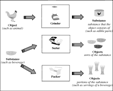
In sum, on the level of the conceptual representation grinder constructions are based on a transition from objects to substances (for example, edible parts of the object), while sorter and packer constructions reflect a conceptual transition from substances to (abstract) objects. In the case of sorter constructions these objects are sorts of a substance, while in the case of packer constructions they are portions. Figure 1 illustrates the three kinds of conceptual enrichment.

Conceptual enrichment in mass/count coercion.
The transition from substances to objects itself is a genuinely conceptual phenomenon. The conceptual system provides conceptualizations of objects and substances as well as their associations with concepts of edible parts of these objects or sorts and servings of these substances, respectively. For instance, we have concepts of wine and beer and we know that there are different sorts of wine and beer, and that in restaurants these beverages are served in different portions. Accordingly, the choice of particular conceptualizations for the enriched interpretation can be culture- and context-dependent; for example, three beers can be three servings of 1 pint, 0.3 liters, and 1 liter, etc.
The linguistic aspect of coercion concerns the way in which such transition is reflected in the grammatical system. Can expressions undergo a reference shift and receive an enriched conceptual representation as their interpretation, and if so, does this go together with a morphosyntactic change? The following section provides an overview of the morphosyntactic aspect of mass/count distinctions that will serve as a background for our discussion of various grammatical options for RT coercion.
The Morphosyntactic Aspect of Mass/Count Distinctions
The morphosyntactic distinction relevant for our discussion concerns the number marking of nominals. In languages that have systematic syntactically driven nominal plural marking (PLURAL LANGUAGES), such as English, Icelandic, and German, the conceptual distinction between substances and objects may be reflected in morphosyntax. A nominal receives plural marking when it refers to objects (for example, beers in three beers), but not when it refers to a substance (for example, beer in She drinks beer). Following Greenberg 1973, we refer to these non-plural instances as TRANSNUMERAL.9
In addition to the term transnumeral, other terms are found in the typological literature. Corbett (2000:9–10) mentions the term transnumeral, but chooses the term general number, describing the phenomenon as follows: “In English, we are usually forced to choose between singular and plural when we use a noun. However, there are languages for which number is less dominant; languages, in which the meaning of the noun can be expressed without reference to number. We shall call this ‘general number’, by which we mean that it is outside the number system.”

We describe plural marking as “not compulsory,” rather than as “obligatorily absent” for transnumeral nominals for cross-linguistic reasons. In languages such as English, transnumeral nominals do not receive any plural marking (nor can they be combined with an indefinite article). By contrast, in languages such as Chinese, Persian, or Kurdish, where nouns are transnumeral as a rule, we often find optional number marking for transnumeral nominals. These transnumeral plural (and likewise singular) markers have a different meaning from those of non-transnumeral nouns in languages such as English. They do not indicate the quantity “>1,” but emphasize (non-numerical or numerical) size. Accordingly, they can be attached to substance-denoting nouns as well as to object-denoting ones, as illustrated by Persian examples i and ii.

See Hincha 1961 and Windfuhr 1979 for a discussion of Persian number marking, and Wiese 1997b for a semantic account of transnumeral and non-transnumeral number markers.
For [−tn] nominals, plural marking is compulsory for reference to more than one instance of the nominal concept. Further, [+tn] and [−tn] nominals behave differently in a number of respects. In particular, [+tn] nominals can occur without plural marking or an article, and occur only in three-term cardinal constructions, that is, in constructions where the numeral is not followed by the noun directly, but first by a numeral classifier (= counting constructions) or a measure noun (= measure constructions). In contrast, [−tn] nominals are marked for number or combined with an article when in argument positions, and can occur in two-term counting constructions, that is, in constructions where the noun can follow the numeral directly (as well as in three-term constructions with measure nouns). The examples in 7 illustrate this point.

Accordingly, beer in our non-coerced example in 5c above is a transnumeral nominal, while beers in the RT example in 5e is non-transnumeral.

Cross-linguistically, the following generalization holds: nominals that denote substances usually behave as [+tn], whereas nominals that denote objects usually behave as [−tn] (and consequently receive systematic plural marking). In plural languages this gives rise to the bidirectional default correlation between morphosyntactic and conceptual features stated in 9.

Hence, in plural languages, transnumeral nominals usually refer to substances, such as beef, while [−tn] nominals (which we label PLURAL NOMINALS, that is, nominals that systematically pluralize) usually refer to objects, such as a cow/cows. In first language acquisition this correlation supports the interpretation of novel words and can lead to overgeneralizations for nominals that deviate from the default.11
See Brown 1957 and Bloom 1994, 2000 for data from English.

Note that the constructions in 10b are counting constructions in contrast to the measure construction in 7b above. The latter specifies the weight of beef, whereas the former specifies number; that is, it specifies the cardinality of a set consisting of individual instances of the nominal concepts cattle or furniture (for example, individual cows, or individual tables, chairs, etc.). Hence, although cattle and furniture in 10b are transnumeral nominals just as beef is in 7b, they do occur in counting constructions because, unlike beef, the nominals cattle and furniture refer to objects, and not to substances.12
Wiese and Piñango 2001 present evidence for the distinction of substance-versus object-denoting nominals within the [+tn] class in language processing.
In contrast to plural nominals, such as cows in six cows, transnumeral nominals such as cattle and furniture are not marked for plural in counting constructions. Instead, they are combined with numeral classifiers, such as head or piece, as shown in 10b. Semantically, such classifiers contribute an individuation function, that is, a semantic function that provides access to individual elements (for example, individual animals in the case of cattle) and thus prepares the number assignment.13
See Krifka 1995, Eschenbach 1993, and Wiese 1997a for a discussion of individuation functions in the semantic representation of cardinal constructions.
However, as the example of pieces in 10b shows, in plural languages such as English, classifiers can undergo pluralization.
Unlike transnumeral nominals, plural nominals occur in two-term counting constructions without a numeral classifier (as in six cows). In this case, the role of the numeral classifier is performed by the nominal number marker. Individuation is part of the quantification that plural markers carry out, and it is the prerequisite for marking the size of a set as “more than one” (for example, the plural marker in dogs indicates that we have a set of individual dogs that has more than one element).
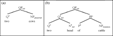
Syntactically, counting constructions can be viewed as quantifier phrases (QPs) with a numeral head that requires the feature individuation in its complement. This feature can be supplied by a plural noun or a numeral classifier. While the plural noun is part of the complement, numeral classifiers can be analyzed as non-expanding nominal head adjuncts (that is, N0-adjuncts to Q0). This accounts for central cross-linguistic characteristics of classifier constructions. First, cardinals and numeral classifiers are adjacent. Second, as mentioned above, classifiers have a nominal source, but do not show the behavior of full NPs. Third, numerals and classifiers together select their NP complements. Figure 2 provides an illustration with syntactic representations for the two-term construction six cows, which has a plural NP complement, and the classifier construction six head of cattle, which has a transnumeral NP as part of the complement.

Counting construction: Plural noun (a) versus classifier and transnumeral noun (b)
In plural languages, classifier constructions are the less common instance of counting constructions, since transnumeral nouns that refer to objects such as cattle or furniture are rare and constitute a deviation from the default correlation transnumeral → substance. However, from a broader perspective, such nouns are very common since many languages of the world are transnumeral, where nominals are generally [+tn]. Accordingly, counting constructions with numeral classifiers are the rule rather than an exception.15
There exists a small class of nominals that may show a tendency toward [−tn] behavior in overall transnumeral languages. In particular, nominals that occupy a high position on the animacy hierarchy (that is, pronouns and nouns referring to humans and some animals) are often systematically marked for plural when referring to more than one entity (Smith-Stark 1974, Corbett 2000).

For discussion of the Kurdish data we would like to thank Sarkaut Zandi, Diler Assad, and Adel Zhia.
Unlike measure nouns, such as pounds in six pounds of beef discussed above, classifier expressions can be optional; that is, they need not be overt in some languages. This is the case in Kurdish, for instance, and also in some dialects of English (we return to constructions with implicit classifiers in our discussion of German RT below).

Note that the difference between constructions with plural and transnumeral nominals is not a difference between constructions with and without agreement between numeral and plural noun. Rather, we are dealing with a distinction between nominals that mark number distinctions and those that do not. In particular, there is no plural marking on numerals on the morphosyntactic level. Morphosyntactically, a numeral such as three is not marked for number (unlike threes in They came in twos and threes). Therefore, there can be no agreement of the numeral with the plural nominal in a construction such as the English three apples. It is only on the semantic level that numerals “>1” contribute “manyness”, and on this level it would not make any sense for the nominal to agree: why would we need to contribute the same information twice (namely, that we are talking about a set of more than one element)? The sole reason for a plural nominal here is the need for the individuation that number markers in [−tn] nominals contribute.
Likewise, counting constructions with transnumeral nominals are not “non-agreement” constructions. Transnumeral nominals such as the Chinese pingguo or the Kurdish sew ‘apple’ or the English furniture are marked neither for singular nor for plural.17
Singular marking in Kurdish is realized morphosyntactically as a suffix, whereas its English counterpart is a lexical “singular element,” namely, the indefinite article.
Since transnumeral nominals transcend number marking (as opposed to being marked for plural or singular), there is variation as to whether they are combined with plural or singular verbs. In transnumeral languages that have number distinctions on verbs, such as Kurdish and Persian, the choice of plural or singular verbs for transnumeral subjects can depend on such features as animacy or respect. In English, we find different options depending on the noun. For example, furniture is combined with singular verbs, as in The furniture has been sold. In contrast, cattle goes mostly with plural verbs, as in The cattle have been sold, although in some dialects it can also be combined with singular verbs. In counting constructions with numerals “>1,” there are plural verb forms triggered by semantic “manyness.”
This makes the distinction between transnumeral and plural nominals an instance of the general rule that although it is possible in principle to express everything in every language, different languages have different requirements as to what one has to express. For instance, in English uncle refers to the brother (or brother-in-law) of either of one's parents, whereas in Kurdish it is necessary to specify whether the person in question is the mother's brother (in which case he is called xālo) or the father's (in which case he is called māma). Similarly, in buying certain kind of fruits, say apples, English forces a specification of whether one is involved (I bought an apple) or more than one (I bought apples). By contrast, Kurdish does not force such a specification (that is, sew can mean either ‘an apple’ or ‘apples’).19
In plural languages such as English, where transnumeral nominals have only a marginal status, they are often superordinate terms and carry the pragmatic implication that they refer to a non-singleton set. Although in principle transnumeral nominals such as furniture can refer to one sofa/table/chair etc., as well as to many pieces of furniture, in a sentence such as Karen bought furniture the default interpretation is that she bought more than one piece.
Restaurant Talk in English, Icelandic, and German
How is the morphosyntactic distinction of transnumeral and plural nominals put to use for mass/count coercion in plural languages and, in particular, for RT? This section discusses RT constructions in English, Icelandic, and German, three Germanic languages that, as we show, have at least three different options for the grammatical integration of packer transitions with often more than one option realized in the same language.
In their basic interpretation, the nominals that denote beverages (for example, coffee, wine, beer, etc., which we refer to as BEVERAGE NOMINALS) refer to substances and behave as transnumeral; that is, they are not pluralized and can occur as bare NPs. When such nouns occur in RT constructions, we find inter- as well as intralinguistic variation with respect to the following questions.

English: Coffees and Beers
In English, the answer to both of these questions is definitely “yes.” In RT coercion, beverage nominals undergo a reference shift and refer to portions of substances, and the reference shift is accompanied by a shift in morphosyntax from [+tn] to [−tn]. In their basic occurrence, as illustrated in 15a below, the beverage nominals refer to substances and show transnumeral behavior: they occur without an article and plural marking. In RT contexts such as 15b beverage nominals refer to portions of the substances (abstract objects) and show [−tn] behavior: they are combined with an indefinite article or marked for plural.

In English, then, beverage nominals undergo both a conceptual shift and a morphosyntactic shift. The two shifts go hand-in-hand based on the default transnumeral → substance. Accordingly, the semantic contribution of the constituents in a simple English RT construction such as two coffees can be characterized as follows: while the numeral two contributes the cardinality, the plural beverage nominal coffees receives an enriched interpretation that identifies the complex concept portions of coffee; that is, it denotes the result of applying the “packer” in Figure 1 above to the substance coffee. This distribution is summarized in 16 (the constituents are identified by subscripts, their semantic contribution by expressions in small caps).20
This is an informal summary that serves as a basis for our comparison of English RT constructions with their Icelandic and German counterparts. A general discussion of formal semantic representations for RT constructions is given in Wiese 1997a.

From a syntactic point of view, an RT construction such as two coffees constitutes a standard plural counting construction, with a plural complement (coffees) that contributes the individuation aspect required by the numeral. This is illustrated in figure 3.

English RT: Counting construction with plural nominal.
Excursus: Could Coercion Be a Purely Syntactic Phenomenon?
As evident from our analysis of constructions such as two coffees, we follow standard approaches found in the semantic literature in regarding coercion as a phenomenon characterized by an enrichment of the semantic representation.21
See Pustejovsky 1995 and Jackendoff 1997.
In order to account for coercion as a purely syntactic phenomenon, one would have to assume a phonologically empty element as part of the syntactic derivation in order to obtain the correct meaning. This element would have to contribute the portion aspect required for the meaning of the construction. One can think of such a phonologically empty element as something along the lines of the “silent nouns” suggested in Kayne 2003a,b.22
For example, Kayne (2003a,b) proposes that constructions such as few NUMBER books or a red COLOR car (where capital letters indicate non-pronunciation) contain silent nouns such as NUMBER or COLOR.
Below we discuss a different kind of construction where this kind of morphosyntactic evidence can be found, namely, RT constructions with transnumeral beverage nominals in Icelandic. We show that in these constructions gender marking on the numeral supports an analysis that involves phonologically empty nouns on the syntactic level (albeit empty container nouns, rather than the general silent noun portion).
Moreover, if there is no conceptual enrichment for beverage nominals, but instead a silent noun contributes the portion aspect, we have to account for the pluralization of the beverage nominal somehow. This could be done by a syntactic representation where portions is merged as -s [portion]. Under this interpretation, two coffees would be represented as in 17.

Since the plural marker -s is a suffix, and as such must be attached to the beverage noun coffee, coffee would then have to raise to the left of -s, while portion is PF deleted.24
This syntactic analysis was suggested by one of the JGL reviewers.
Another point that speaks against such a raising analysis is the fact that we can have constructions such as two black coffees, where the beverage nominal is preceded by an adjective that modifies the beverage. If there was the silent noun portion in the syntactic representation, it should come before black; that is, black would be between portion and coffee, as in 18.

Raising of coffee to the left of -s would then lead to two coffees black; that is, an incorrect word order. In addition, quantifiers that modify the portion aspect can occur in the position immediately before adjectives, such as black in two small black coffees. In this case, portion would appear between small and black before PF deletion, as shown in 19, and raising of coffee would lead to two small coffees black.

By contrast, having the meaning of “portion” included in the semantic representation of coffee, but not in the syntactic representation of the construction, does not pose any special combinatorial problems. Nouns with complex semantic representations can often be combined with modifiers that apply to only a part of the nominal semantic representation. For instance, in the default interpretation of good dancer the modifier good applies only to the semantic representation of the verbal stem dance, not to that of the whole noun (a good dancer is someone who dances well, not a good person who dances).25
See Egg 2004 for a recent discussion of such cases and a proposal for the derivation of their semantic representations.
Taken together, we interpret this as evidence that portion appears only in the semantic, but not in the syntactic representation. In other words, there is no silent noun portion in syntax. The notion of portion is not introduced via a syntactic representation where it contributes its semantics before being deleted at PF; rather, it is introduced only on the semantic level via conceptual enrichment of a representation that otherwise would lead to a clash in the interpretation.
Icelandic: Kaffi and Bjórar
Most Icelandic beverage nominals do not undergo a syntactic change in RT, rather they remain transnumeral; that is, they do not receive number marking.26
For discussion of the Icelandic data we would like to thank Anna Sigurðardóttir, Berglaug Skúladóttir, Guðmundur Ásgeirsson, Halldór Ármann Sigurðsson, Helgi Skúli Kjartansson, Jóhanna Barðdal, Kjartan Ottósson, Magnús Björnsson, Margrét Jónsdóttir, Nanna Reykdal, and Sigríður Magnúsdóttir, and members of the audience at the Linguistics Discussion Group at the University of Iceland where the second author presented some of this material on September 17, 2004.

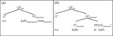
Note that in Icelandic a compound such as kaffibolla ‘coffee cups’ can also be used here. In contrast to English and German, the construction with a compound is ambiguous; that is, tvo kaffibolla in 20b can mean ‘two cups of coffee’ as well as ‘two coffee cups’. Hence we have two kinds of constructions with explicit container nouns in Icelandic. In both cases, the nominal complement has a plural head, the container noun. Accordingly, in 20b the numeral agrees in gender with this container noun bolla, not with the beverage noun kaffi. Being plural, the container noun provides the individuation required for the QP. The transnumeral beverage noun is embedded morphologically in compound constructions (where the container noun acts as its morphological head), and syntactically in constructions where the container noun acts as its syntactic head, as shown in figure 4.

Icelandic RT with explicit container nouns that embed beverage nominals (a) morphologically or (b) syntactically.
In addition to this explicit kind of RT construction, Icelandic has two kinds of constructions without container nouns. The first kind is similar to English RT, with a plural beverage noun that receives an enriched portion interpretation. As in English, this coerced nominal does not have a container noun as its head, but is combined with the numeral or determiner directly. Accordingly, in this kind of Icelandic RT construction, there is gender agreement between the determiner or numeral (for numerals up to four) and the beverage noun:27
Note that bjóra is accusative, as are the beverage nouns in 20 above, because in Icelandic (and similarly, in German, see 25 below), orders are given in the accusative case even if subject and verb are omitted.

However, this construction is restricted to a few nouns. In general, Icelandic RT constructions without an explicit container noun are characterized by transnumeral beverage nouns, that is, nouns that do not receive plural marking, although they are not embedded under an explicit container noun. Compared to the explicit construction in 20b, this third kind of construction is somewhat marginal, and speakers' intuitions regarding the acceptability of particular examples may differ. In general, nouns seem likely to occur in these constructions if they do not have a straightforward plural form (unlike bjór ‘beer’) and denote beverages that are often ordered in standard portions in restaurants, bars, or liquor stores.28
In addition, a list effect for the occurrence of container noun ellipsis in Icelandic restaurant talk can be observed, as suggested by Helgi Skúli Kjartansson, personal communication with J. Maling, November 21, 2003. Gender agreement with an implicit container noun is more likely in a list, especially if the genders of the beverage nouns in this list differ.
Constructions with masculine numerals seem to be more common, probably because masculine gender for numerals appears also in other bare constructions without a (explicit) head noun, which might support the acceptability of elliptical RT constructions with masculine numerals. These constructions include, in particular, numerals used in rote counting (“one, two, three, …”), but also numerals in—mostly idiomatic—constructions that refer to abstract entities, as in i and ii below (we thank Helgi Skúli Kjartansson for pointing out these constructions to us). Note, however, that similar constructions with masculine numerals exist in German, as shown in i′ and ii″ below, which does not have container noun ellipsis in RT. This suggests that such elliptical RT constructions in Icelandic are an independent phenomenon (although the existence of constructions such as i and ii might lead to a higher acceptability of elliptical RT with masculine numerals in Icelandic):


This example is from Kress (1982:186, note 2), who comments: “Bei Bestellungen in Restaurants bleibt das Genus unberücksichtigt.” (“Grammatical gender is disregarded in restaurant orders” [translation, HW/JL].) In view of 22c and the contrast between 22c and 22d, this seems to be too general. Although there can be gender agreement in this kind of Icelandic RT, it is not with the beverage nominal itself, but with its head, the implicit container noun. Note that, as mentioned above, not all speakers can use the masculine form of the numeral as in Kress's example. Some speakers accept only eina mjólk with feminine numeral, while others, especially those from the north of Iceland, accept einn mjólk. The masculine numeral may be default masculine, as discussed in note 29 above, since milk would normally be served in a glass (denoted by a neuter noun in Icelandic) or a carton (denoted by a feminine noun). No speakers accept the neuter numeral eitt with mjólk, or even with the neuter noun vatn ‘water’.
The agreement with an empty container noun distinguishes these RT constructions from sorter constructions in Icelandic. In sorter constructions, we also find a numeral followed by a beverage noun, but in this case the determiner agrees with the beverage noun, suggesting a reference shift of the beverage noun whose interpretation is enriched by a sorts concept. Compare, for example, the RT construction in 22a above with its sorter counterpart in 23.

Hence in the Icelandic RT constructions in 22, beverage nominals are combined with an empty container noun. The agreement relations discussed above indicate the presence of such a container noun in the grammatical representation, and since container nouns contribute portion concepts, beverage nouns in these constructions, unlike those in English, do not receive an enriched interpretation. Also, unlike their English counterparts, they undergo neither a reference shift nor a morpho-syntactic change, but remain substance denoting and transnumeral.
Our findings with respect to tvo kaffi(-bolla)/(bolla af) kaffi ‘two (cups of) coffee’ are summarized in 24, parallel to the sketch of semantic contributions of English RT we provided in 16 above (subscripts in brackets indicate optionally elliptical constituents).

Given the lack of oblique case marking on the beverage nominal, we believe that elliptical phrases (for example, tvo kaffi) are derived from constructions such as tvo (bolla) kaffi, where kaffi stands in apposition to the numeral plus container noun.31
Note that the beverage nominal receives dative case from the preposition af in constructions such as tvo bolla af kaffi or tvœr flöskur af víni, while in Icelandic compounds similar to tvo kaffibolla the first element can either be a bare stem (vínglas) assigned genitive case (rauðvínsglas, mjólkurglas), or contain a linking element (see Indriðason 1999).
German: Bier, Schnaps, and Schnäpse
German has two kinds of RT constructions. One has the same structure as English RT constructions, with plural beverage nominals as in 25a, while the other kind of construction involves transnumeral beverage nominals that do not get number marking, as in 25b.

Note that the nominals in 25b are not marked for plural, explicitly or implicitly (by phonologically empty plural marking). Given that some nouns in German have identical forms for the nominative and the accusative singular and plural (for instance, the plural of Sänger ‘singer’ is Sänger ‘singers’), one might argue that the beverage nominals in 25b are not transnumeral but rather plural nouns with implicit phonologically empty plural allomorphs. Such an interpretation would make this construction comparable to the one in 25a and to those in English RT, and thus of rather less interest for our discussion. However, sorter constructions such as the one in 26 show that this is not the case, since Kaffee, Bier, and Wein do occur in their plural form with an explicit plural suffix, not a zero suffix.

This means that the beverage nominals in 25b are indeed transnumeral; they occur in their non-plural forms unlike the ones in 25a and 26. Thus, in German the transnumeral versus plural behavior of nominals such as Kaffee, Bier, or Wein in mass/count coercion can distinguish between constructions with a sorter interpretation (26) and RT constructions with a packer interpretation (25b). While beverage nominals in German sorter constructions are always plural, in RT contexts the construction with transnumeral beverage nominals seems to represent the default case. In contrast, constructions with plural beverage nominals such as 25a are marginal, being possible with only a few nouns. Some nouns can occur in both kinds of constructions, as is the case for Schnaps in 27.

In contrast to Icelandic RT constructions with transnumeral nominals, in German RT the determiner agrees in gender with the overt beverage noun, not with a possible empty container noun, as shown in 28.

This fact speaks against an analysis of these constructions as elliptical in German, since unlike Icelandic German does not have container noun ellipsis in RT. The beverage nominals are combined with a determiner or a numeral directly, without the interference of a container noun. In these constructions, then, the beverage nominals themselves, albeit transnumeral, encompass the packer aspect. They receive an enriched interpretation and denote portions of the substance in question. This analysis implies that German RT deviates from the standard correlation transnumeral → substance (since we have transnumeral, non-plural, nominals with object-reference). As we have shown above, such a deviation is not uncommon. It is an option not only realized in transnumeral languages such as Chinese and Kurdish, but also through lexical items such as cattle or furniture in plural languages such as English, German, and Icelandic. Just as these nouns, beverage nominals in German RT are object-denoting expressions, even though they remain transnumeral rather than become pluralized.
Further support for this analysis comes from constructions such as the one exemplified in 29, where an optional numeral classifier (CL) occurs with the transnumeral beverage noun.

The fact that Glas is not marked for number indicates that it is used as a numeral classifier in 29, and not as a container noun. Although it is characteristic of classifiers to be combined with numerals in their bare form, container nouns require plural marking in German (as well as in other plural languages such as English or Icelandic).32
This is a general characteristic of numeral classifiers; see our discussion above and the English, Chinese, and Kurdish classifiers in 10b, 11b, and 12b, respectively.

Taken together, this suggests that German RT constructions with transnumeral nominals involve an implicit—optionally overt—numeral classifier, similar to RT constructions in transnumeral languages such as Kurdish, where classifiers are optional in general (see also our discussion of optional classifiers above).

These data support an analysis of German RT constructions such as zwei Wein as counting constructions with an implicit classifier and a transnumeral nominal complement. Hence, the beverage nominals in German RT constructions can remain transnumeral (and do so by default), but they still undergo a reference shift from substance to portions of a substance. Unlike plural nominals—and like all transnumeral nominals—they are not individuated in their semantic representation, but rather the individuation is contributed by a numeral classifier (implicit or explicit). In 32, we summarize the semantic contribution of the constituents in German RT for our example two coffees (German zwei Kaffee).

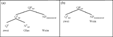
The syntactic representations for such constructions with explicit and implicit classifiers are outlined in figure 5.

German RT with (a) explicit and (b) implicit numeral classifier.
Note that by “implicit classifier” we do not mean that there is a specific covert classifier such as Glas or Tasse in the syntactic representation. Rather, in German RT (as in similar constructions in other languages with implicit classifiers such as in the Kurdish example 31) the individuation contributed by a classifier is added to the representation implicitly. Syntactically, the individuation requirement is satisfied within the QP head, while semantically it is bound by existential quantification.
The availability of such constructions in German RT is supported by the existence of constructions such as the one exemplified in 33, where a propositional classifier Mal (whose approximate meaning is ‘time’) is employed for meal orders in restaurants.

While these constructions are similar to RT constructions such as 32 in that they also involve a classifier (albeit one for propositions, not for portions), they are not structurally identical to them. The differentiation becomes evident, for instance, in the fact that constructions with Mal typically involve a definite article as in 33 (den kleinen Salat), whereas this is not possible in RT, as shown in 34.

Consequently, constructions such as the one in 32 cannot be analyzed as being similar to the one in 33, but with the element Mal being deleted at PF. Rather, they constitute a separate category of RT constructions.
A Note on Restaurant Talk versus Sorter Constructions
Note that in both Icelandic and German there is a difference between RT constructions and constructions with sorter interpretation. While we found RT constructions with transnumeral beverage nominals (in addition to plural constructions), no such option was available for sorter constructions. In sorter constructions, beverage nominals are marked for plural in German, and agree in gender with the determiner in Icelandic. Accordingly, we found minimal pairs such as those in 35 and 36.

Examples 35 and 36 suggest that sorter coercions are always morphologically marked, while RT constructions can remain unmarked. At present we cannot tell whether this pattern holds only for the languages we investigated or reflects a general cross-linguistic tendency in plural languages. However, we believe the latter to be the case in view of the linguistic and extralinguistic context of RT constructions. RT constructions occur in specialized contexts, namely as part of restaurant orders where the beverage nominal is usually combined with a numeral. This context is strong enough to support the portion interpretation for the construction even in the absence of morphological marking.
By contrast, sorter constructions are much freer in their distribution, and their occurrence is not bound to particular contexts. This means that in the absence of an explicit noun such as sorts (parallel to an explicit container noun in RT), one needs to indicate that a sortal interpretation is intended. Given the default correlation transnumeral → substance for conceptual and grammatical distinctions in plural languages, a straightforward way to do this in languages such as English, Icelandic, and German is to mark the beverage nominal for number. Plural marking—or, in singular constructions as in Icelandic, agreement with the determiner—then indicates reference to objects (in this case, sorts of a substance), rather than to substances. Consequently, there is a strong motivation to morphologically mark sorter coercions, while for RT portion interpretations constructions without such a marking are possible as well.
If this account is correct, one would expect a tendency in transnumeral languages to avoid sorter coercions and to favor instead explicit constructions with a noun meaning ‘sort’, since these languages cannot make use of the default transnumeral → substance found in plural languages and hence cannot indicate reference to objects (= sorts of a substance) via plural marking. RT constructions, on the other hand, should be unproblematic since here the context is sufficient to indicate reference to portions.
Conclusion
Our discussion has shown that RT in English, Icelandic, and German makes use of three different grammatical options for the same underlying conceptual structures, and that variation occurs not only between languages, but also within languages.
Option 1: Reference shift accompanied by morphosyntactic change. This is the option most significantly realized in English RT. It is also available in German and Icelandic, but here the construction has only a marginal status in RT, where it is restricted to a few nouns (while it is dominant for sorter constructions).
In this kind of construction, beverage nominals undergo a reference shift from substance to objects; that is, they receive an enriched interpretation and refer to portions of a beverage. This shift is accompanied by a morphosyntactic change in accordance with the default correlation of conceptual and grammatical distinctions in plural languages. When they denote substances, beverage nominals are transnumeral (that is, they do not receive number marking), and when they denote portions of these substances in RT constructions they undergo pluralization and are semantically individuated.
Option 2: No reference shift, and no morphosyntactic change. This option does not involve coercion and exists in all three languages. However, in Icelandic it may give rise to RT constructions with a numeral immediately followed by a beverage nominal. In this kind of construction, beverage nominals do not undergo a reference shift, but remain substance denoting. Accordingly, they also do not change their syntactic behavior and remain transnumeral, so no pluralization occurs. The packer concepts that map the substances in question onto their portions are contributed by container nouns. These container nouns can be phonologically empty in Icelandic, leading to two term RT constructions.
Option 3: Reference shift, but no morphosyntactic change. This is the dominant option in German RT. In this construction, beverage nominals undergo a reference shift. As in Option 1 (and unlike in Option 2) they receive an enriched interpretation and refer to portions of a beverage. However, in contrast to Option 1 the nominals remain transnumeral and semantically non-individuated. Implicit or explicit numeral classifiers contribute the individuation that is necessary for counting constructions.
Table 1 summarizes the correlation of morphosyntactic and conceptual features in RT constructions consisting of a numeral and a beverage nominal.

From the perspective of the grammatical-conceptual interface, these findings suggest two kinds of distinctions. First, they support a distinction between syntactic and semantic classifications in the mass/count domain, since elements of the same syntactic mass/count category, namely transnumeral (= non-plural) nominals, can belong to different semantic mass/count categories denoting either substances or objects. In particular, transnumeral beverage nominals are substance denoting in Icelandic RT (as well as in their basic, that is, non-RT interpretation in English, Icelandic, and German), while they are object denoting in German RT.
Second, our analysis supports a distinction between language specific semantic and general conceptual aspects of mass/count coercion. While there are always the same packer associations between substances and portions of substances available in the conceptual system (that is, associations that support the conceptual transitions underlying mass/count coercion), languages differ as to whether and how these associations are integrated into the semantic representation of the expressions employed in RT.
In English and German, enriched interpretations that include packer concepts are available for beverage nominals in general, whereas in Icelandic this situation only holds for a few nouns (such as bjór ‘beer’), while for the others the packer aspect has to be contributed by an overt or phonologically empty container noun.
Moreover, beverage nominals that receive enriched interpretations are pluralized and contribute an individuation function as part of their semantic representation in English and in Icelandic (for those nouns that allow enrichment at all), but only in a few cases in German. By default, in German RT the beverage nominal remains transnumeral, and consequently the individuation aspect has to be contributed by an explicit or implicit numeral classifier. Since there is also another marked kind of plural construction in German that follows the English pattern, this second difference occurs not only between languages, but can also be observed between different nouns in one language (for example, German Bier versus Martini). In addition, as our data have shown, different options can even be available for individual nouns (as is the case for Schnaps).
Hence, we find inter- and intralinguistic differences as to whether reference shifts leading to enriched packer interpretations are available for the beverage nouns in RT at all, and if so, whether or not they bring with them a shift to semantic individuation and plural behavior of the nominal in question. This variation in view of the same underlying conceptual representations supports an analysis of coercion that makes use of a mediating level of semantic structure to account for language specific, as well as lexical idiosyncratic differences in the integration of conceptual structures into the grammatical system.33
See Bierwisch 1983, Pinker 1989, Lang 1994, Wunderlich 1991, Dölling 2001, and Wiese 2004 for a distinction of grammatical semantic and conceptual structures in the derivation of interpretations for linguistic expressions.
Under this view, semantic representations constitute the interface between grammatical and conceptual structures rather in the way that phonological representations constitute the interface between grammatical and phonetic structures. While the semantic interface accounts for the way that the grammatical system of a language accesses and integrates representations of meaning, the phonological interface accounts for the way that the grammatical system of a language accesses and integrates representations of sounds.34
For a discussion of these architectural parallels, see Wiese 2003 (chapter 5), 2004.
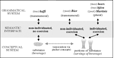
The three options for RT constructions we discussed in this article can be regarded as three different ways in which semantic representations integrate the conceptual representations of substances and their portions in the case of beverage nominals. They identify which conceptual representations can be accessed (that is, whether a beverage nominal can only refer to a substance or whether it can also undergo coercion and refer to portions of this substance), and in what form they enter the grammatical system (that is, whether the nominal is semantically individuated or non-individuated, and accordingly morphosyntactically plural or transnumeral). Figure 6 illustrates this organization of linguistic meaning; that is, the integration of substance and portion concepts into the grammatical system via semantic representations, for beverage nominals in the different kinds of RT constructions we found in English, German, and Icelandic.

Integration of conceptual representations into the grammatical system via semantics.
One way to look at the mediating semantic level is to regard it as a system that captures the generation of QUALIA STRUCTURES from general conceptual structures, as suggested within the Generative Lexicon framework.35
See Pustejovsky 1991, 1995.
Under this approach, the function of a semantic level understood as a system mediating between conceptual and grammatical representations is to identify the elements that enter such qualia structures in the representation of beverage nominals in different languages, and to determine which associated concepts (in our case, packer concepts) can be integrated in the course of semantic composition into the linguistic representations that these items enter.
As our discussion has shown, this process of generating enriched interpretations is not based on a straightforward, immediate access to (classes of) associated representations in the conceptual system, but is subject to language specific constraints that govern the availability of enriched interpretations for certain expressions, as well as the way this enrichment is reflected in their grammatical behavior. This speaks for an analysis of coercion as a genuinely semantic—as opposed to general conceptual or syntactic—phenomenon, a phenomenon that is located at the interface between the conceptual and the linguistic system, that is, on a level of semantic representations.
References
Bierwisch Manfred.
1983.
Semantische und konzeptuelle Repräsentation lexikalischer Einheiten.
Untersuchungen zur Semantik, ed. by
Rudolf Ruzicka and
Wolfgang Motsch,
61–
99.
Berlin:
Akademie.
Bloom Paul.
1994.
Syntax-semantics mappings as an explanation for some transitions in language development.
Other children, other languages: Theoretical issues in language development, ed. by
Yonata Levy
41–
75.
Hillsdale, NJ:
Erlbaum.
Bloom Paul.
2000. How children learn the meanings of words.
Cambridge, MA:
MIT Press.
Brown Roger W.
1957.
Linguistic determinism and the parts of speech.
Journal of Abnormal and Social Psychology
55.
1–
5.Google Scholar
Bunt Harry C.
1985.
The formal representation of (quasi-)continuous concepts.
Formal theories of the commonsense world, ed. by
Jerry R. Hobbs, and
Robert C. Moore,
37–
70.
Norwood, NJ:
Ablex.
Corbett Greville G.
2000.
Number.
Cambridge:
Cambridge University Press.
Dölling Hannes.
2001.
Systematische Bedeutungsvariationen: Semantische Form und kontextuelle Interpretation (Linguistische Arbeitsberichte, 78).
Leipzig:
Leipzig University.
Egg Markus.
2004.
Anti-Ikonizität an der Syntax-Semantik-Schnittstelle. To appear in Zeitschrift für Sprachwissenschaft.
Greenberg Joseph H.
1973.
Numeral classifiers and substantival number. Problems in the genesis of a linguistic type.
Working Papers on Language Universals
9.
1–
39.Google Scholar
Indriðason Þorsteinn G.
1999.
Um eignarfallssamsetningar og aðrar samsetningar í íslensku. [On genitive compounds and other compounds in Icelandic.] Íslenskt mál
21.
107–
150.Google Scholar
Jackendoff Ray S.
1997.
The architecture of the language faculty.
Cambridge, MA:
MIT Press.
Kayne Richard S.
2003a.
Some notes on comparative syntax, with special reference to English and French.
Unpublished ms.,
New York University.
Kayne Richard S.
2003b.
Silent years, silent hours. Grammar in focus, vol. 2, Festschrift for Christer Platzack, 18 November 2003, ed. by
Lars-Olof Delsing,
Gunlög Josefsson,
Halldór Sigurdsson, and
Cecilia Falk,
209–
226.
Lund:
Department of Scandinavian Languages, Lund University.
Kress Bruno.
1982. Isländische Grammatik.
Leipzig:
Enzyklopädie.
Krifka Manfred.
1995. A theory of common nouns. The generic book, ed. by
Gregory N. Carlson and
Francis Jeffry Pelletier,
398–
411.
Chicago:
Chicago University Press.
Lang Ewald.
1994. Semantische vs. konzeptuelle Struktur: Unterscheidung und Überschneidung. Kognitive Semantik, ed. by
Monika Schwarz,
25–
41.
Tübingen:
Narr.
McElree Brian,
Matthew J. Traxler,
Martin J. Pickering,
Ray S. Jackendoff and
Rachel E. Seely.
2001.
Coercion in on-line semantic processing.
Cognition
78.
B17–
B25.Google Scholar
Pelletier Francis Jeffry.
1975/1979.
Non-singular reference: Some preliminaries.
Mass terms: Some philosophical problems, ed. by
Francis Jeffry Pelletier,
1–
14.
Dordrecht:
Reidel.
Pelletier Francis Jeffry, and
Schubert Lenhard K.
1989.
Mass expressions.
Handbook of philosophical logic,
vol. 4, ed. by
Dov M. Gabbay and
Franz Guenthner,
327–
407.
Dordrecht:
Reidel.
Piñango Maria,
Edgar Zurif, and
Ray S. Jackendoff.
1999.
Real-time processing implications of aspectual coercion at the syntax-semantics interface.
Journal of Psycholinguistic Research
28.
394–
414.Google Scholar
Pinker Steven.
1989. Learnability and cognition. The acquisition of argument structure.
Cambridge, MA:
MIT Press.
Prasada Sandeep.
1996.
Quantification, arbitrariness of structure, and the count-mass noun distinction. Proceedings of the 20th annual Boston University conference on language development, I–II, ed. by
Andy Stringfellow,
Dalia Cahana-Amitay,
Elizabeth Hughes, and
Andrea Zukowski,
600–
609.
Somerville, MA:
Cascadilla Press.
Prasada Sandeep.
1999. Names for things and stuff: An Aristotelian perspective. Language, logic, and concepts: Essays in memory of John Macnamara, ed. by
Ray S. Jackendoff,
Paul Bloom, and
Karen Wynn,
119–
146.
Cambridge, MA:
MIT Press.
Pustejovsky James.
1991.
The generative lexicon.
Computational Linguistics
17.
409–
441.Google Scholar
Pustejovsky James.
1995. The generative lexicon.
Cambridge, MA:
MIT Press.
Smith-Stark T. Cedric.
1974.
The plurality split.
Chicago Linguistics Society
10.
657–
671.Google Scholar
Todorova Marina,
Kathy Straub,
William Badecker, and
Robert Frank.
2000. Aspectual coercion and online computation of sentential aspect. Proceedings of the 22nd annual conference of the Cognitive Science Society, ed. by
Lila R. Gleitman and
Aravind K. Joshi,
545–
550.
Mahwah, NJ:
Erlbaum.
Wiese Heike.
1997a.
Zahl und Numerale. Eine Untersuchung zur Korrelation konzeptueller und sprachlicher Strukturen (Chapter 7: Kardinal-Konstruktionen) (Studia Grammatica, 44).
Berlin:
Akademie.
Wiese Heike.
1997b.
Semantics of nouns and nominal number.
ZAS Papers in Linguistics
8.
136–
163.Google Scholar
Wiese Heike.
2003. Sprachliche Arbitrarität als Schnittstellenphänomen. Habilitationsschrift, Humboldt University, Berlin.
Wiese Heike.
2004.
Semantics as a gateway to language.
Mediating between concepts and language, ed. by
Holden Härtl and
Heike Tappe,
197–
222. (Trends in Linguistics, 152).
Berlin: Mouton de Gruyter.
Wiese Heike, and
Piñango Maria.
2001. Mass and count in language and cognition: Some evidence from language comprehension.
Proceedings of the 23rd annual conference of the Cognitive Science Society, ed. by
Johanna D. Moore and
Keith Stenning,
1244. Mahwah, NJ: Erlbaum.
Wunderlich Dieter.
1991. Bedeutung und Gebrauch.
Semantik Semantics, ed. by
Arnim von Stechow and
Dieter Wunderlich,
32–
52. (Handbücher zur Sprach- und Kommunikationswissenschaft, 6.)
Berlin:
Mouton de Gruyter.
Conceptual enrichment in mass/count coercion.
Counting construction: Plural noun (a) versus classifier and transnumeral noun (b)

English RT: Counting construction with plural nominal.
Icelandic RT with explicit container nouns that embed beverage nominals (a) morphologically or (b) syntactically.
German RT with (a) explicit and (b) implicit numeral classifier.
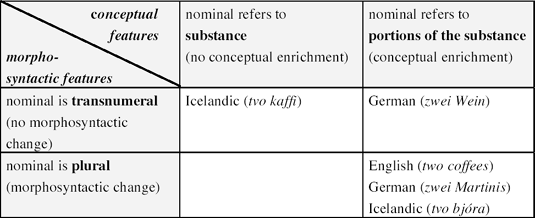
Table 1. Correlation of conceptual and morphosyntactic features of beverage nominals in RT constructions.
Integration of conceptual representations into the grammatical system via semantics.
 You have
Access
- 28
- Cited by