Introduction
Loss of autonomy and independence are among the top concerns of older adults (Andersen, Wittrup-Jensen, Lolk, Andersen, & Kragh-Sorensen, Reference Andersen, Wittrup-Jensen, Lolk, Andersen and Kragh-Sorensen2004). A hallmark feature of dementia is functional disability. Functional disability is often operationalized as the loss of the ability to independently perform instrumental activities of daily living (IADLs), such as cooking, performing household tasks, managing finances and medications, and driving (Albert et al., Reference Albert, DeKosky, Dickson, Dubois, Feldman, Fox and Phelps2011; Barberger-Gateau et al., Reference Barberger-Gateau, Alioum, Peres, Regnault, Fabrigoule, Nikulin and Dartigues2004; Peres, Helmer, Letenneur, Jacqmin-Gadda, & Barberger-Gateau, Reference Peres, Helmer, Letenneur, Jacqmin-Gadda and Barberger-Gateau2005; Peres, Verret, Alioum, & Barberger-Gateau, Reference Peres, Verret, Alioum and Barberger-Gateau2005). Loss of independence in IADLs, in turn, is associated with elevated risk for numerous deleterious outcomes, including greater caregiver burden (Gallagher et al., Reference Gallagher, Ni Mhaolain, Crosby, Ryan, Lacey, Coen and Lawlor2011; Razani et al., Reference Razani, Kakos, Orieta-Barbalace, Wong, Casas, Lu and Josephson2007), initiation of home-help services (Biegel, Bass, Schulz, & Morycz, Reference Biegel, Bass, Schulz and Morycz1993; Robinson, Buckwalter, & Reed, Reference Robinson, Buckwalter and Reed2005), placement in residential and nursing home care (Gaugler, Kane, Kane, Clay, & Newcomer, Reference Gaugler, Kane, Kane, Clay and Newcomer2003; Wattmo, Londos, & Minthon, Reference Wattmo, Londos and Minthon2014), and reduced quality of life for the affected individual and their families (Andersen et al., Reference Andersen, Wittrup-Jensen, Lolk, Andersen and Kragh-Sorensen2004; Conde-Sala, Garre-Olmo, Turro-Garriga, Lopez-Pousa, & Vilalta-Franch, Reference Conde-Sala, Garre-Olmo, Turro-Garriga, Lopez-Pousa and Vilalta-Franch2009). Additionally, the long-term economic burden associated with providing care to older adults with functional disability is considerable (Gaugler et al., Reference Gaugler, Hovater, Roth, Johnston, Kane and Sarsour2013; Zhu et al., Reference Zhu, Leibman, McLaughlin, Zbrozek, Scarmeas, Albert and Stern2008), and it is estimated that a delay in the onset of functional disability of 5 years would dramatically reduce the total costs for care of individuals with Alzheimer’s Disease (AD) (Alzheimer’s Association Expert Advisory Workgroup on NAPA, 2012). To this end, it is critical to better understand early precursors of functional disability in IADLs to inform when and how to intervene.
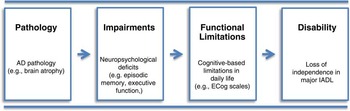
The Disablement Process Model (Verbrugge & Jette, Reference Verbrugge and Jette1994) is a useful theoretical framework from which to study the evolution of functional disability. This model has most commonly been used to conceptualize how chronic medical illnesses and physical functional limitations (e.g., difficulty with walking) lead to functional disability (Jette, Reference Jette2006; Jette et al., Reference Jette, Manago, Medved, Nickerson, Warzycha and Bourgeois1997; McDonough & Jette, Reference McDonough and Jette2010), but it is also very applicable to understanding functional disability associated with cognitive impairment and dementia (Barberger-Gateau et al., Reference Barberger-Gateau, Alioum, Peres, Regnault, Fabrigoule, Nikulin and Dartigues2004; Barberger-Gateau, Fabrigoule, Amieva, Helmer, & Dartigues, Reference Barberger-Gateau, Fabrigoule, Amieva, Helmer and Dartigues2002; Peres, Verret, Alioum, & Barberger-Gateau, Reference Peres, Verret, Alioum and Barberger-Gateau2005). According to this model (see Figure 1), disease(s) develops and disrupts basic organ systems (e.g., in the case of AD, neuropathological changes in the brain), resulting in organ-specific “impairments” (e.g., impairments in cognitive processes, such as memory and executive function, among others). Cognitive/neuropsychological impairments can subsequently lead to “functional limitations,” which are defined in the current study as mild restrictions in one’s ability to use specific cognitive processes in performing everyday tasks, such as remembering a grocery list, following a map to a new location, and keeping financial records organized (Barberger-Gateau et al., Reference Barberger-Gateau, Fabrigoule, Amieva, Helmer and Dartigues2002; Verbrugge & Jette, Reference Verbrugge and Jette1994). According to this model, functional limitations are the precusors to “functional disability.” That is, as functional limitations become more severe, they can eventually lead to disability, which is defined as complete loss of independence in major domains of life (e.g., IADL domains), such as the ability to shop, drive, and manage finances independently.
The main disease-based disablement pathway (adapted from Verbrugge & Jette, Reference Verbrugge and Jette1994).

While the Disablement Process Model has not been extensively used in the cognitive aging and dementia literature, there is support for various aspects of this model. First, it is well documented that indicators of AD pathology such as whole brain and hippocampal atrophy are associated with neuropsychological impairment and clinical disease progression (see reviews by Buckner, Reference Buckner2004; Jack et al., Reference Jack, Knopman, Jagust, Shaw, Aisen, Weiner and Trojanowski2010; Nelson, Braak, & Markesbery, Reference Nelson, Braak and Markesbery2009). Greater neuropsychological impairments, particularly in memory and executive functions, have also been shown in cross-sectional studies to correlate with more severe functional limitations (Farias, Park, et al., Reference Farias, Park, Harvey, Simon, Reed, Carmichael and Mungas2013) and neuropsychological performance predicts faster subsequent decline in a variety of functional outcome measures (Cahn-Weiner et al., Reference Cahn-Weiner, Farias, Julian, Harvey, Kramer, Reed and Chui2007; Cahn-Weiner, Malloy, Boyle, Marran, & Salloway, Reference Cahn-Weiner, Malloy, Boyle, Marran and Salloway2000; Cahn-Weiner, Ready, & Malloy, Reference Cahn-Weiner, Ready and Malloy2003; Farias, Mungas, Reed, Haan, & Jagust, Reference Farias, Mungas, Reed, Haan and Jagust2004).
Also consistent with the Disablement Process Model, there is indirect evidence to support the hypothesis that functional limitations in early disease increase risk of the development of disability or loss of IADL independence. Specifically, there is a growing body of work demonstrating that individuals with mild cognitive impairment (MCI), often a prodromal state before a diagnosis of dementia, show mild changes in their ability to perform everyday activities (Brown, Devanand, Liu, Caccappolo, & Alzheimer’s Disease Neuroimaging Initiative, Reference Brown, Devanand, Liu and Caccappolo2011; Burton, Strauss, Bunce, Hunter, & Hultsch, Reference Burton, Strauss, Bunce, Hunter and Hultsch2009; Peres et al., Reference Peres, Helmer, Amieva, Matharan, Carcaillon, Jacqmin-Gadda and Dartigues2011; Perneczky et al., Reference Perneczky, Pohl, Sorg, Hartmann, Komossa, Alexopoulos and Kurz2006; Tabert et al., Reference Tabert, Albert, Borukhova-Milov, Camacho, Pelton, Liu and Devanand2002). There is even some evidence to suggest that there are detectable functional limitations in cognitively normal elders who later go on to develop MCI (Farias, Chou, et al., Reference Farias, Chou, Harvey, Mungas, Reed, DeCarli and Beckett2013; Marshall et al., Reference Marshall, Zoller, Kelly, Amariglio, Locascio and Johnson2014).
Based conceptually on the Disablement Process Model, as well as on the empirical work emphasized above, the present study examined the degree to which functional limitations measured at study baseline are associated with the risk of the later development of functional disability in IADLs. Functional limitations were assessed using the Everyday Cognition scales (ECog) from which a summary “Total Score” can be derived as well as six specific functional limitation domains: Everyday Memory, Everyday Language, Everyday Visuospatial abilities, and three everyday executive domains including Everyday Planning, Everyday Organization, and Everyday Divided Attention. While functional limitations as measured by the ECog are cognitively oriented, they are operationalized within the context of specific functional everyday tasks. Incident disability was operationalized as the loss of ability to independently perform IADLs. We hypothesized that more severe functional limitations at study baseline (using the ECog Total Score) would be associated with increased risk for incident disability (e.g., developing dependence in two or more IADL domains) over study follow-up. We further speculated that certain types of functional limitations on the ECog, and more specifically Everyday Memory and everyday executive functions (e.g., Everyday Planning, Everyday Organization and/or Everyday Divided Attention), would be most strongly associated with the subsequent development of disability. Because neuropsychological impairment has previously been associated with IADL disability (Boyle et al., Reference Boyle, Malloy, Salloway, Cahn-Weiner, Cohen and Cummings2003; Cahn-Weiner et al., Reference Cahn-Weiner, Farias, Julian, Harvey, Kramer, Reed and Chui2007, Reference Cahn-Weiner, Malloy, Boyle, Marran and Salloway2000, Reference Cahn-Weiner, Ready and Malloy2003), follow-up analysis also examined whether functional limitations at study baseline predict incident disability above and beyond the degree of neuropsychological impairment present at baseline. Finally, since we anticipated that functional limitations increase risk of disability, which, in turn, should be associated with a diagnosis of dementia, secondary analysis also examined the association between functional limitations and risk of incident dementia.
Methods
Participants
Participants in this study were part of a longitudinal research cohort at the University of California, Davis, Alzheimer’s Disease Center (ADC) and have been described elsewhere (e.g., Farias et al., Reference Farias, Mungas, Reed, Cahn-Weiner, Jagust, Baynes and Decarli2008; Farias, Park, et al., Reference Farias, Park, Harvey, Simon, Reed, Carmichael and Mungas2013). Participants were selected for inclusion in the present study if they: (1) were older adults who spoke English, (2) had an informant with whom the participant had regular contact and could complete informant-based ratings, (3) were considered cognitively normal or diagnosed with MCI at study baseline, and (4) had baseline data for the functional measures of interest (ECog Scale and Lawton & Brody IADL ratings) and had longitudinal data (e.g., at least one follow-up visit) for the primary disability outcome variable (IADL ratings). Exclusion criteria included an unstable major medical illness, a current severe/debilitating psychiatric disorder (milder forms of depression were acceptable), another existing neurologic condition outside of the target diseases (e.g., AD and related disorders, and cerebrovascular disease), and active alcohol or drug abuse/dependence.
All participants received annual multidisciplinary clinical evaluations that included a physical and neurological exam, imaging, lab work, and neuropsychological testing from the Alzheimer’s Disease Uniform Dataset Neuropsychological Battery (Weintraub et al., Reference Weintraub, Salmon, Mercaldo, Ferris, Graff-Radford, Chui and Morris2009). For participants in this study, baseline diagnosis was categorized as cognitively normal or MCI. Participants with MCI were diagnosed according to standard clinical criteria according to current Alzheimer’s Disease Centers Uniform Data Set guidelines (Morris et al., Reference Morris, Weintraub, Chui, Cummings, Decarli, Ferris and Kukull2006). Consistent with the most recent diagnostic guidelines for MCI due to AD (Albert et al., Reference Albert, DeKosky, Dickson, Dubois, Feldman, Fox and Phelps2011), it was permissible for individuals with MCI to have mild problems performing complex functional tasks, but they had to require only minimal assistance from others. Over the course of the study, some participants converted to a diagnosis of dementia (12 Normals and 77 MCI). Dementia was diagnosed using the criteria outlined in the Diagnostic and Statistical Manual for Mental Disorders–Third Edition–Revised (DSM-III-R; American Psychiatric Association, 1987), but criteria were modified so that a diagnosis of dementia was made if there were significant impairments in two or more cognitive domains. For these individuals diagnosed with dementia, performance on clinical neuropsychological tests was considered significantly impaired if the score fell below 1.5 standard deviations compared to age and education-matched norms. Neuropsychological tests used to make a clinical diagnosis were separate from the neuropsychological tests used as variables in the current study. Additionally, for clinical diagnostic purposes, everyday function was assessed using a variety of standardized tests and a clinical interview with the participant and informant. Importantly, clinical diagnoses were made completely independent of the ECog and IADL ratings; that is clinicians involved in rendering the syndromic diagnosis at each annual visit did not have access to these data. All participants signed informed consent, and all human subject involvement was approved by Institutional Review Boards at University of California at Davis, the Department of Veterans Affairs Northern California Health Care System and San Joaquin General Hospital in Stockton, California.
Assessment of Everyday Functional Limitations
Degree of functional limitations was operationalized as a continuous variable using the Everyday Cognition (ECog) scale. The ECog is a 39-item informant-based questionnaire. It was designed specifically to be sensitive to mild functional limitations that predate the loss of independence and has been shown to be relevant to functional changes associated with MCI (Farias et al., Reference Farias, Mungas, Reed, Cahn-Weiner, Jagust, Baynes and Decarli2008, Reference Farias, Mungas, Reed, Harvey, Cahn-Weiner and Decarli2006). The ECog items cover six cognitively relevant domains (Everyday Memory, Everyday Language, Everyday Spatial abilities, Everyday Planning, Everyday Organization and Everyday Divided Attention) from which domain scores can be generated in addition to a total summary score. Example items include: “Remembering appointments, meetings or other engagements,” “Following a map to a new location,” and “Keeping financial records organized.” Informants completing the ratings were typically spouses or adult children of the participant, and in most cases, the same informant completed the ratings throughout the study. Informant ratings were made independent of the diagnosis rendered as part of the associated annual visit. On each item of the ECog scale, informants were asked to assess the participant’s current level of everyday functioning in comparison to how he/she functioned 10 years earlier. In this way, individuals served as their own control. Each item on the ECog is rated on a four-point scale: 1=better or no change compared to 10 years earlier; 2=questionable/occasionally worse; 3=consistently a little worse; 4=consistently much worse. Higher scores indicated more severe functional limitations. Scores were calculated by summing items and dividing by the number of items completed, which allows for some missing or non-answered items (at least half of the items need to be completed to calculate a score). The current study used the ECog Total score as well as the six domain scores to measure functional limitations. Previous confirmatory factor analysis supports the use of both a global score and domain-specific scores (Farias et al., Reference Farias, Mungas, Reed, Cahn-Weiner, Jagust, Baynes and Decarli2008). Test–retest reliability for the ECog has been shown to be good (Farias et al., Reference Farias, Mungas, Reed, Cahn-Weiner, Jagust, Baynes and Decarli2008). Literature on the ECog has also shown evidence of content, convergent and discriminant, and external validity (Farias et al., Reference Farias, Mungas, Reed, Cahn-Weiner, Jagust, Baynes and Decarli2008; Farias, Park, et al., Reference Farias, Park, Harvey, Simon, Reed, Carmichael and Mungas2013).
Assessment of Incident Disability in IADLs
Disability was measured as a dichotomous variable in which the participant was coded as “independent” or “dependent” at each annual visit using the Lawton and Brody Instrumental Activities of Daily Living scale (Lawton & Brody, Reference Lawton and Brody1969). This is a widely used informant-based measure used to rate participants’ abilities across eight activities, including the ability to use a telephone, shop, prepare food, complete housework, do laundry, use public transportation, administer medication, and handle financial responsibilities. Each item was coded dichotomously: 1=can complete the task independently, 0=the task must now be completed by someone else. In the current study, incident functional disability was defined as obtaining a score of zero (dependence) on two or more items of the IADL scale. To be included in this study, participants had to be coded as independent at study baseline. Inter-rater reliability is reported to be .85 for the total IADL score (Lawton & Brody, Reference Lawton and Brody1969). Basic activities of daily living (BADLs), while also often included in the measurement of disability, were not measured in the present study because as a whole, the sample was mildly impaired and had very few problems in BADLs.
Neuropsychological Assessment
Neuropsychological functioning was assessed using the Spanish and English Neuropsychological Assessment Scales battery (SENAS). The SENAS has undergone extensive development as a battery of neuropsychological tests relevant to diseases of aging (Mungas, Reed, Crane, Haan, & Gonzalez, Reference Mungas, Reed, Crane, Haan and Gonzalez2004; Mungas, Reed, Marshall, & Gonzalez, Reference Mungas, Reed, Marshall and Gonzalez2000; Mungas, Reed, Tomaszewski Farias, & DeCarli, Reference Mungas, Reed, Tomaszewski Farias and DeCarli2005). Modern psychometric methods based on item response theory were used to create psychometrically matched measures across different scales. This study used two composite indices from the SENAS, episodic memory and executive function, due to previous findings that consistently reported a relationship between these abilities and everyday functioning (Bertrand & Willis, Reference Bertrand and Willis1999; Boyle et al., Reference Boyle, Malloy, Salloway, Cahn-Weiner, Cohen and Cummings2003; Burton et al., Reference Burton, Strauss, Bunce, Hunter and Hultsch2009; Cahn-Weiner et al., Reference Cahn-Weiner, Farias, Julian, Harvey, Kramer, Reed and Chui2007, Reference Cahn-Weiner, Malloy, Boyle, Marran and Salloway2000; Schmitter-Edgecombe, Woo, & Greeley, Reference Schmitter-Edgecombe, Woo and Greeley2009). The Episodic Memory Index is a composite score derived from a multi-trial word list-learning test (Word List Learning I). The Executive Function Index was a composite measure constructed from component tasks of Category Fluency, Phonemic (letter) Fluency, and Working Memory. These measures do not have appreciable floor or ceiling effects for participants in this sample and have linear measurement properties across a broad ability range. The SENAS indices are psychometrically matched measures of domain specific neuropsychological abilities (i.e., the indices have comparable reliability and sensitivity to individual differences). SENAS development and validation are described in detail elsewhere (Gonzalez, Mungas, & Haan, Reference Gonzalez, Mungas and Haan2002; Mungas et al., Reference Mungas, Reed, Crane, Haan and Gonzalez2004, Reference Mungas, Reed, Marshall and Gonzalez2000).
Statistical Analyses
Two-sample t tests, Wilcoxon rank-sum tests (for ECog scores and follow-up time), and χ2 tests (for categorical variables) were used to compare diagnostic groups on demographics, functional limitations and incident disability, and neuropsychological function. Cox proportional hazards models were used to assess associations between functional limitations and incident disability. The follow-up time from the baseline visit to either the visit at which an individual was classified as disabled or the last clinical visit (whichever came first) was used as the event time in incident disability models, with those that did not become disabled considered censored. Models were adjusted for baseline age, education, sex, and race/ethnicity. Secondary analyses assessed the association between functional limitations and incident disability independent of episodic memory and executive function. These models were then analyzed separately for those who were cognitively normal at baseline and those who were MCI at baseline to assess differences in the associations in the two diagnostic groups. Further models assessed the association between functional limitations and incident dementia; in this case, follow-up time from the baseline visit to either the visit at which an individual was classified as demented or the last clinical visit, whichever came first, was used as the event time with those that did not become demented considered censored. To further ensure that informants’ reports of incident disability were associated with objective cognitive decline, we used a mixed effects model to estimate the difference in the rates of change in episodic memory and executive functions between older adults who became disabled and those who did not become disabled. All analyses were conducted in SAS version 9.2 and a p-value <.05 was considered statistically significant.
Results
Sample Characteristics at Baseline
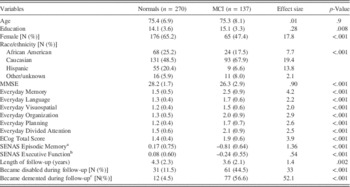
The primary sample consisted of 407 participants without dementia or disability at baseline who had ECog scores and IADL ratings collected at baseline and IADLs collected during follow-up visit (s). At baseline, participants on average were 75.3 years old (SD=7.3), and had an average of 14.4 years (SD=3.5; range=0–20 years) of education. Females represented 59.2% of the sample. The racial/ethnicity breakdown was: 55.3% Caucasians, 22.7% African Americans, 15.8% Hispanics, 5.2% Asians, and 1.0% other/unknown. The majority of informants were either the spouse (51.1%) or the adult child (29.1%). Informants spent 88.7 hr per week (SD=70.1; range=0–168 hr per week), on average with the participant. Table 1 presents baseline demographic information, ECog domain and Total scores, and episodic memory and executive function composite scores on neuropsychological testing for cognitively normal older adults and MCI. Participants in this study were followed longitudinally on average for 4.1 years (range=0.8–9.2 years). The average time between baseline and becoming disabled or the last follow-up (whichever came first) was 3.2 years (range=0.7–8.8 years), while the average time between baseline and becoming demented, or between baseline and the last follow-up in which the participant was seen if they never became demented over the course of follow-up, was 3.3 years (range=0.8–8.8 years).
Demographic characteristics, ECog domain and Total scores, and cognitive functioning at baseline (unless otherwise noted)

Note. Values represented are mean (standard deviations in parentheses) unless otherwise noted. Effect size refers to Cohen’s d, a probability based effect size expressed as odds for the ECog scores and time to follow-up (Ruscio, Reference Ruscio2008), or the difference in percentage, where appropriate. All p-values are based on the two-sample t-test except for the ECog scores and time to follow-up (Wilcoxon rank sum test) and the categorical variables (chi-square test). ECog=Everyday Cognition Scale; MCI=mild cognitive impairment; MMSE=Mini-Mental State Exam; SENAS=Spanish English Bilingual Neuropsychological Assessment Scales.
a Missing for 84 Normals and 42 MCI.
b Missing for 83 Normals and 41 MCI.
c Missing for 3 Normals and 1 MCI.
Functional Limitations at Baseline and Incident Disability at Follow-Up
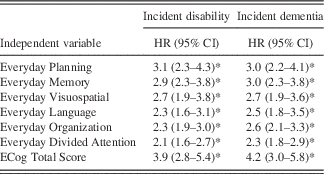
We examined how the risk of incident functional IADL disability (defined as being rated as dependent in two or more IADLs) was associated with functional limitations on the ECog Total Score and individual ECog domain scores at baseline, after controlling for age, education level, sex, and race/ethnicity. As hypothesized, a higher Total ECog score at baseline, reflecting more severe overall functional limitations, predicted greater risk of incident functional disability at follow up (hazard ratio [HR]=3.9, 95% CI [2.8–5.4]; p<.001). When examining each individual ECog domain as a predictor of incident disability, we found that each subscale was significantly associated with increased risk of subsequent disability (p<.001). Of the six ECog domains, the greatest risk of incident functional disability was associated with more severe functional limitations in Everyday Planning (HR=3.1; 95% CI [2.3–4.3]; p<.001), Everyday Memory (HR=2.9; 95% CI [2.3–3.8]; p<.001), and Everyday Visuospatial (HR-2.7, 95% CI [1.9–3.8]; p<.001), such that a one unit increase in baseline Everyday Planning, Everyday Memory, and Everyday Visuospatial domains was associated with approximately a three-fold increased risk of incident functional disability after adjusting for covariates. Table 2 presents corresponding hazard ratios associated with the ECog Total and domain scores. When models were analyzed separately for the cognitively normal individuals, the ECog Total Score (HR=3.8; p<.001), Everyday Planning (HR=3.5; p<.001), and Everyday Memory (HR=3.1; p<.001) remained associated with the highest increased risk of incident disability. The other sub-domains had similar hazard ratios to those in Table 2, except for Everyday Organization (HR=2.8; p<.001). In the MCI group, however, only the ECog Total Score (HR=1.8; p=.01), Everyday Planning (HR=1.6; p=.02), and Everyday Memory (HR=1.4; p=.04) were significantly associated with incident disability.
Associations between ECog domain and Total scores at baseline, and incident functional disability and incident dementia at follow-up after controlling for baseline age, education, sex, and race/ethnicity

Note. ECog=Everyday Cognition Scales; CI=confidence interval; HR=hazard ratio.
*p<.001
Functional Limitations and Neuropsychological Functioning at Baseline and Incident Disability at Follow-Up
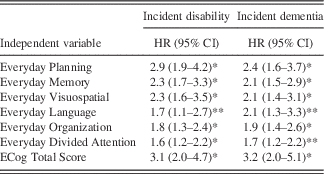
In the next set of analyses, we examined whether ECog scores at baseline (along with age, education, sex, and race/ethnicity as covariates) predicted the risk of incident disability when also considering baseline performance on neuropsychological measures of memory and executive functions. Results showed that even after accounting for neuropsychological function at baseline, a one unit increase (2 standard deviation increase) in the Total ECog was associated with over a three-fold increase in the hazard of becoming disabled (HR=3.1; 95% CI [2.0–4.7]; p<.001); a one standard deviation increase in the Total ECog was still associated with a nearly double increase in the hazard (HR=1.8). Of the six ECog domain scores, Everyday Planning, Everyday Memory, and Everyday Visuospatial were again associated with the greatest risk of becoming disabled (see Table 3). Of the neuropsychological predictors, in all models, better episodic memory performance on the SENAS was associated with a reduced risk of becoming disabled (p<.001, data not shown), while executive function was not significant (p>.3). Overall, results showed that functional limitations at baseline remained a significant predictor of risk for incident disability at follow-up independent of neuropsychological performance. When models were run separately in each diagnostic group, the general pattern remained similar in the cognitively normal group, except that Everyday Language was no longer significant (HR=1.7; p=.19). In the MCI group, the Total ECog (HR=2.4; p=.007), Everyday Planning (HR=2.3; p=.003), Everyday Memory (HR=2.2; p=.002), and Everyday Visuospatial (HR=1.8; p=.04) were significantly associated with incident disability, independent of neuropsychological function.
Associations between ECog domain and Total scores at baseline, and incident functional disability and incident dementia at follow-up after controlling for baseline age, education level, sex, race/ethnicity, episodic memory, and executive function performance

Note. ECog=Everyday Cognition Scales; CI=confidence interval; HR=hazard ratio.
*p≤.001, ** p<.05.
Incident Disability and Rates of Cognitive Change in Episodic Memory and Executive Functions
To further corroborate informants’ report of incident disability, we examined the rates of objective neuropsychological change for participants who became disabled and those who did not become disabled over study follow-up. Estimates of slope differences revealed that older adults who became disabled over the course of study follow-up had a statistically significant faster rate of neuropsychological decline on measures of episodic memory (β=−.09; SE=.02; p<.001) and executive functions (β=−.07; SE=.02; p<.001) in comparison to older adults who did not become disabled.
Association of Functional Limitations at Baseline and Incident Dementia at Follow-Up
Lastly, given that functional disability is a core feature for dementia, we examined the association of functional limitations at baseline and risk of incident dementia at follow-up. A total of 89 individuals in the sample (12 Normals and 77 MCI) progressed to dementia during follow-up; 63 (70.8%) of them were also disabled, while 28 of those who became disabled did not become demented. Results revealed that more severe functional limitations on the ECog Total score at baseline was associated with a four-fold increase in incident dementia (HR=4.2; 95% CI [3.0–5.8]; p<.001). Individual analyses of the six ECog domains were also significant (see Table 2). Again, baseline functional limitations in Everyday Planning (HR=3.0; 95% CI [2.2–4.1]; p<.001) and Everyday Memory (HR=3.0; 95% CI [.3–3.8]; p<.001) predicted the greatest risk of incident dementia at follow-up. A one-unit increase at baseline in each of these ECog domains was associated with a three-fold increased risk of incident dementia after adjusting for age, education, sex, and race/ethnicity. After accounting for episodic memory and executive function performance on the SENAS, an increase in the ECog Total score and the six ECog domain scores were each associated with an increased hazard of incident dementia, although the hazard was reduced (p<.001 for all scores except for Everyday Language and Everyday Divided Attention which had p<.05; see Table 3).
Discussion
Our main findings demonstrated that, among older adults without functional disability in IADLs or dementia at baseline, more severe functional limitations at study baseline, as reported by informant ratings on the ECog, were associated with an almost four-fold increased risk of losing the ability to independently perform IADLs over the next few years. Consistent with the Disablement Process Model (Verbrugge & Jette, Reference Verbrugge and Jette1994), our results support the hypothesis that functional limitations predispose older adults with normal cognition or MCI to the development IADL disability. Such findings are consistent with prior work showing that more severe functional difficulties among older adults with MCI predict disease progression (Aretouli, Okonkwo, Samek, & Brandt, Reference Aretouli, Okonkwo, Samek and Brandt2011; Gomar et al., Reference Gomar, Bobes-Bascaran, Conejero-Goldberg, Davies and Goldberg2011; Hsiung et al., Reference Hsiung, Alipour, Jacova, Grand, Gauthier, Black and Feldman2008; Purser, Fillenbaum, Pieper, & Wallace, Reference Purser, Fillenbaum, Pieper and Wallace2005).
Unique to this study, we also examined the relationships between different types of everyday functional limitations, as measured by the individual ECog domains, and the risk of future disability. We found that more severe functional limitations in each of the six ECog domains were associated with higher risk of becoming subsequently disabled, but there was also evidence that certain domains confer greater risk than others. Of the individual ECog domains, functional limitations in everyday activities that tax executive planning skills (e.g., anticipating events, putting together the sequence for completing a particular task, and prioritizing activities) were most strongly predictive of the loss of independence in IADLs. The functional limitation domain with the second strongest associated risk for disability was the Everyday Memory domain of the ECog, which measured functional limitations, such as difficulty remembering appointments and shopping items. Results remained similar in follow-up analysis that examined functional limitation predictors in those participants who started with a diagnosis of MCI verses those who were cognitively normal. The importance of limitations in everyday executive and memory functions in predicting greater risk for future functional decline is consistent with the body of literature that links neuropsychological measures of episodic memory and executive function to a variety of everyday functional outcomes (Cahn-Weiner et al., Reference Cahn-Weiner, Farias, Julian, Harvey, Kramer, Reed and Chui2007, Reference Cahn-Weiner, Malloy, Boyle, Marran and Salloway2000, Reference Cahn-Weiner, Ready and Malloy2003; Farias et al., Reference Farias, Mungas, Reed, Haan and Jagust2004; Farias, Mungas, Reed, Harvey, & DeCarli, Reference Farias, Mungas, Reed, Harvey and DeCarli2009; Farias, Park, et al., Reference Farias, Park, Harvey, Simon, Reed, Carmichael and Mungas2013). In addition to everyday executive and memory functions, our findings showed that early limitations in performing everyday visuospatial tasks (e.g., following a map to a new location, finding a car in a parking lot, etc.) predicted future disability in IADLs. This is not surprising as visuospatial impairment is often an early cognitive marker of neurodegenerative disease, and common complaints, such as getting lost are frequently brought on by changes in the medial temporal lobes and parietal cortex, areas critical for navigation learning (Possin, Reference Possin2010). Previous literature has also shown that neuropsychological measures of visuospatial impairments predicted IADL dependence as reported by caregivers (Glosser et al., Reference Glosser, Gallo, Duda, de Vries, Clark and Grossman2002; Jefferson, Barakat, Giovannetti, Paul, & Glosser, Reference Jefferson, Barakat, Giovannetti, Paul and Glosser2006). The current findings further extend that previous work by showing that even informant ratings of early everyday executive, memory, and visuospatial functional limitations are predictive of the loss of functional independence in IADLs.
It is important to highlight that functional limitations were independent predictors of eventual loss of independence in IADLs even after considering neuropsychological test performance in executive functioning and memory. In fact, the strength of the association between functional limitation domains and risk of disability decreased only modestly when neuropsychological performance was included in the model. This finding suggests that everyday functional limitation ratings and neuropsychological test performance are capturing unique aspects of functioning. Consistent with this idea, most studies report fairly moderate associations between objective neuropsychological test scores and everyday functional outcomes (Chaytor & Schmitter-Edgecombe, Reference Chaytor and Schmitter-Edgecombe2003; Spooner & Pachana, Reference Spooner and Pachana2006), calling into question the extent to which neuropsychological test performance captures how cognitive difficulties might manifest in everyday life. It has been suggested that numerous factors, including the differing environmental demands between the neuropsychological testing setting and “real life” situations, and extra-individual and non-cognitive variables (e.g., physical limitations and emotional well-being), reduces the strength of the relationship between neuropsychological test performance and function in everyday life (see review by Chaytor & Schmitter-Edgecombe, Reference Chaytor and Schmitter-Edgecombe2003; see also the literature on cognitive frailty referring to simultaneous occurrence of both physical and cognitive impairment (e.g., Panza et al., Reference Panza, Solfrizzi, Barulli, Santamato, Seripa, Pilotto and Logroscino2015)). While some performance-based assessments of everyday functional tasks may be more ecologically valid (McAlister & Schmitter-Edgecombe, Reference McAlister and Schmitter-Edgecombe2013; Tucker-Drob, Reference Tucker-Drob2011), the lack of current availability of many of these instruments as well as practical constraints limit their use in clinical settings. Recognizing that neuropsychological test performance and ratings of everyday functional limitations may reflect separate, yet related constructs suggests that both measurements should be included as part of many clinical evaluations. The finding that functional limitation ratings on the ECog are strongly predictive of future loss of IADLs independence even when neuropsychological test performance is considered demonstrates that these ratings are of incremental value.
To further validate our findings, we examined the association between functional limitations and risk of incident dementia. As expected, baseline total functional limitations were also associated with a higher risk of getting a diagnosis of dementia over the study follow-up period. Furthermore, the relative strength of the relationships between specific functional limitation domains and the risk of incident dementia was very similar to the analysis using disability as the outcome. It is important to note that neither the ECog nor the Lawton and Brody IADL measure were used in making a diagnosis of dementia. For this reason, there was not 100% overlap in older adults who converted to dementia over time and those who met study criteria for developing IADL disability over time.
Current findings have important implications for clinical practice and treatment. The period of time during which an older adult exhibits mild functional limitations, but remains independent in IADLs provides a critical window of opportunity to intervene. For example, the implementation of cognitive training at that point may serve to delay the development of disability (Rebok et al., Reference Rebok, Ball, Guey, Jones, Kim, King and Group2014; Willis et al., Reference Willis, Tennstedt, Marsiske, Ball, Elias and Koepke2006). Potentially even more fruitful may be development of interventions that specifically target enhancement of compensatory strategies to better support everyday functional abilities in the face of declining cognition. In support of this idea, a 6-week behavioral intervention program designed to teach older adults with amnestic MCI on how to use an external memory support system (e.g., calendar and note taking system), showed an improvement in memory-related everyday functional limitations (Greenaway, Duncan, & Smith, Reference Greenaway, Duncan and Smith2013; Greenaway, Hanna, Lepore, & Smith, Reference Greenaway, Hanna, Lepore and Smith2008). Other interventions that have specifically focused on training techniques for everyday executive function skills, such as the Goal Management Training (Levine et al., Reference Levine, Schweizer, O’Connor, Turner, Gillingham, Stuss and Robertson2011; Levine et al., Reference Levine, Stuss, Winocur, Binns, Fahy, Mandic and Robertson2007; Robertson, Reference Robertson1996) and a virtual supermarket task (Jacoby et al., Reference Jacoby, Averbuch, Sacher, Katz, Weiss and Kizony2013), have also been shown to improve performance on simulated tasks of everyday demands in older adults as well as other populations, such as traumatic brain injury. Interventions used to address everyday executive function skills for attention-deficit hyperactivity disorder (Safren et al., Reference Safren, Sprich, Mimiaga, Surman, Knouse, Groves and Otto2010; Solanto, Marks, Mitchell, Wasserstein, & Kofman, Reference Solanto, Marks, Mitchell, Wasserstein and Kofman2008) could also be adapted for older adult populations to help compensate for cognitive loss and support functional independence.
The current study has several strengths that should be noted. The sample was comprised of a well-characterized and broadly representative cohort of older adults with significant educational and ethnic diversity (roughly 40% of participants are Hispanic and African American). Additionally, participants in the study were followed for up to 8 years with an average follow-up rate of 4 years. As with any study, there are also several limitations. Functional capacities, both in terms of early functional limitations and loss of independence in IADLs were measured using informant report. Informant report is subject to several biases (Jorm et al., Reference Jorm, Christensen, Henderson, Korten, Mackinnon and Scott1994; Zanetti, Geroldi, Frisoni, Bianchetti, & Trabucchi, Reference Zanetti, Geroldi, Frisoni, Bianchetti and Trabucchi1999), including some historical knowledge of the participant’s diagnostic status. While all data, including functional ratings are collected before participants’ annual diagnostic review, informants’ knowledge of a previous diagnostic status (e.g., a diagnosis of MCI in the preceding year(s)) may contribute to increased awareness and endorsement of participants’ functional limitations and IADL performance. Despite these potential biases, previous work has shown that informant-reported functional abilities can be quite accurate and are of value. For example, informant functional ratings help to discriminate diagnostic groups (Farias, Mungas, & Jagust, Reference Farias, Mungas and Jagust2005; Rueda et al., in Reference Rueda, Lau, Saito, Harvey, Risacher and Aisenpress; Schinka, Reference Schinka2010) and predict disease progression (Farias, Chou, et al., Reference Farias, Chou, Harvey, Mungas, Reed, DeCarli and Beckett2013). Informant-reported functional abilities have also been shown to be related to concurrently objective measures of disease, including cognition (Farias et al., Reference Farias, Mungas and Jagust2005; Morales, Bermejo, Romero, & Del-Ser, Reference Morales, Bermejo, Romero and Del-Ser1997; Rueda et al., in Reference Rueda, Lau, Saito, Harvey, Risacher and Aisenpress), brain atrophy, and other indicators of brain pathology (Farias, Park, et al., Reference Farias, Park, Harvey, Simon, Reed, Carmichael and Mungas2013; Rueda et al., in Reference Rueda, Lau, Saito, Harvey, Risacher and Aisenpress). Furthermore, using the current study sample, those who became disabled by informant report over study follow-up also showed a statistically significant faster rate of cognitive decline on neuropsychological tests of episodic memory and executive functions; such results provide additional objective support of the validity of informant-based functional ratings.
In summary, this study demonstrates that functional limitations at early stages of the disease (e.g., when older adults are cognitively normal or have mild cognitive impairments) pose significant risk for future disability and dementia. Recognizing the early role of functional limitations on future disability and dementia will allow for early identification of older adults who are in need of intervention. To this end, further development of interventions specifically aimed at enhancing and/or supporting everyday executive and memory abilities is an important avenue of further study as delaying loss of independence would have major benefits in terms of human and economic costs.
Acknowledgments
This study was supported by the following grants from the National Institute on Aging (grant numbers: AG031252 and AG10129). The authors have no conflicts of interest to report. No competing financial interests exist.