‘…a public awareness campaign is needed to demystify some of the myths, fear and culture surrounding the end of life’ (Royal College of Physicians ‘Talking about Dying’ Report, 2018: 14)
‘Our aim is to increase awareness of death to help people make the most of their (finite) lives’ (Jon Underwood, Founder of Death Café)
Introduction
Globally, more people are dying now than at any point in human history. This is a result of spectacular population growth. We are also facing unprecedented population ageing in virtually every country. According to the United Nations (2019), population ageing will be responsible for the twenty-first Century’s most dramatic social transformations, affecting every aspect of society and requiring new social policy responses. In sum, the world is experiencing a ‘new demography of death’ with more people dying, at increasingly older ages (Leeson, Reference Leeson2014). These changing patterns of death are accompanied by changing patterns of dying. People no longer ‘get sick and die’ but rather live for long periods in fragile health with multiple, chronic illnesses and uncertain trajectories (Lynn, Reference Lynn2005). While most people may die in hospitals, the bulk of dying – and thinking about dying – is done in communities. The consensus, therefore, is that the new demography of death is going to require concomitant policy responses and community-level engagement.
One combined response from the third sector and civil society has been the ‘Compassionate Communities’ initiative (Kellehear, Reference Kellehear2005; Wegleitner et al., Reference Wegleitner, Heimerl and Kellehear2015). Framed as a public health response, the aim of Compassionate Communities/Cities is to de-professionalise death and dying, giving communities permission to respond to the needs of the dying and their families beyond those explicitly addressed by health and social care providers. Its ultimate aim is to raise public awareness and initiate behaviour change in order that people may be 1) better prepared for death, having discussed their wishes in advance, and 2) more willing to respond compassionately to others in their community who are nearing the end-of-life or are recently bereaved. This willingness could manifest itself in the form of offering practical assistance to direct neighbours or volunteering for a wider community network to help with pragmatic tasks not requiring specialist skills e.g. dog walking, shopping, preparing meals and so forth (Kumar, Reference Kumar2004; Abel et al., Reference Abel, Bowra, Walter and Howarth2011). Abel et al. (Reference Abel, Bowra, Walter and Howarth2011) label these as ‘network’ approaches focused on behaviour change, which they contrast sharply to ‘educational’ approaches focused on attitudinal change, which in this context are focused on overturning the so-called death taboo.
Network initiatives of all varieties, while strongly advocated for and given a prominent position in English palliative care policy (National End of Life Care Partnership (Ambition 6), 2015), are currently few and far between (Wegleitner et al., Reference Wegleitner, Heimerl and Kellehear2015). Community responses will need to be scaled up significantly if the end-of-life is to be de-institutionalised in line with individuals’ wishes to die at home and if pressure on hospitals is to be reduced (Gomes et al., Reference Gomes, Calanzani, Gysels, Hall and Higginson2013). There are various structural barriers which work against empowering communities. These range from entrenched cultural norms about privacy to legal and regulatory codes deterring lay involvement (Zaman et al., Reference Zaman, Whitelaw, Richards, Inbadas and Clark2018). In order for societies to prepare effectively for the new demography of death, a panoply of innovative and imaginative end-of-life interventions will be needed to overcome these structural barriers. These issues are hugely significant for policy-making and for strategic intervention, but largely ignored beyond debates within the end-of-life care specialism.
One novel community response which we argue merits attention is ‘Death Café’. In the first study of its kind, we analyse the international spread of the Death Café phenomenon in order to map its form, reach, and potential. We begin the article by describing what a Death Café is before moving on to outline our research objectives and methods. We then present our analysis of the study’s empirical findings before returning, in the discussion and conclusion, to the broader issue of how Death Café relates to other community initiatives, all of which are responses to the new demography of death.
What is a Death Café?
A ‘Death Café’ is a temporary (or ‘pop up’) event where people, often strangers, meet over food and drink to discuss aspects of death and dying. The concept originated with Jon Underwood (1972-2017) in London in 2011. Underwood wanted to encourage the creation of ‘safe spaces’ for people to communally reflect on the finite nature of life, in the ‘ultimate prioritisation exercise’ (BBC World News, 2014). He credited the Swiss sociologist, Bernard Crettaz, with inspiring Death Café. From 2004 to 2011, Crettaz organised approximately forty ‘Café Mortels’ in Switzerland (Guinness, Reference Guinness2010). Underwood codified the concept and, in a voluntary capacity, he set up and managed a central website whereby anyone, anywhere in the world, could freely register their own Death Café. The only proviso was that they agree to follow the official guide (Underwood, Reference Underwood2011) and offer events:
With no intention of leading participants to any conclusion, product or course of action;
As an open, respectful and confidential space where people can express their views safely;
On a not-for-profit basis;
Alongside refreshing drinks and nourishing food and cake.
In addition, the website states that Death Café: is not bereavement counselling; that it should not be viewed as an opportunity to give out information about death and dying, no matter how well intentioned; and that it should not be used as a method of community consultation or engagement. According to Miles and Corr (Reference Miles and Corr2017), it is the proscription against any predetermined agenda that makes Death Café unique and distinguishes it from more ideologically driven awareness raising initiatives.
There is a dearth of literature that explores the Death Café phenomenon in any substantive way. Miles and Corr (Reference Miles and Corr2017) focus on accounting for the spread of the concept to America, where it is now well-established. Their article draws parallels between Death Café and features of other death-related social movements: the hospice movement; the spread of academic courses on death and dying; and bereavement support groups. In doing so, they stake a claim for its importance as more than just a ‘passing trend’ by anchoring it historically amongst other worthy social movements. Elsewhere, Baldwin (Reference Baldwin2017: 4) interviewed fifteen Death Café organisers, also in America, some of whom worked in death-related industries. As with Miles and Corr, Baldwin (Reference Baldwin2017: 6) takes a markedly uncritical approach: ‘Death Café facilitators breathe new life into our communication about death and dying’. This romanticised view continues in Fong’s (Reference Fong2017: 11) monograph, which draws heavily on Miles and Corr’s (Reference Miles and Corr2017) data. Fong defines Death Café as a ‘bona fide transformative and existential social movement’ which ‘allows participants to communicate freely their anxieties and sense of liberation.’ While Fong’s contribution is distinguished by his deployment of Habermas’s theory of the public sphere and conceptualisation of Death Cafés as ‘third spaces’ between individual and systemic responses to end-of-life, his uncritical tone coupled with the scant data on which his claims are based (5 Death Café ‘events’ in one state in the US) casts doubt on his overall analysis. Finally, Hammer et al. (Reference Hammer, Ravindran and Nielsen2019) report briefly on their positive impressions of running a regular hospital-based Death Café in America, in an attempt to combat ‘burn out’ among staff. In sum, the academic contributions to the study of Death Café are sparse in number and scope, with low objectivity ratings. Indeed, we would argue that there has been more interest shown in Death Café by journalists than academic researchers (Meltzer, Reference Meltzer2018; Leland, Reference Leland2018).
Research objectives
Here, we present the first empirical study to examine the international Death Café movement and how it relates to behaviour change and awareness raising initiatives broadly conceived as Compassionate Communities or public health approaches to palliative care.
Our four research objectives were:
1. To identify how the Death Café initiative has spread around the world and what form Death Cafés take in different cultural contexts;
2. To assess to what extent the motivations of Death Café organisers reflect the original ethos of Death Café;
3. To determine how far Death Café can be considered a social movement;
4. To analyse how Death Café organisers perceive the relationship between their Death Cafés and broader cultural attitudes to death and dying in their country.
Before embarking on our study, we conceptualised Death Café as an end-of-life ‘cultural intervention’. This was one of ten categories of interventions – or ‘organised responses to end of life issues’ – we had previously classified, ranging from policy interventions to clinical and educational interventions (Clark et al., Reference Clark, Inbadas, Colburn, Forrest, Richards, Whitelaw and Zaman2017). We characterised cultural interventions as the ‘structured use of art, culture, and imagination to raise questions, challenge existing viewpoints, provide opportunities for reflection, promote debate, and foster engagement’ (Clark et al., Reference Clark, Inbadas, Colburn, Forrest, Richards, Whitelaw and Zaman2017: 8). Unlike most other end-of-life interventions, cultural interventions are not tied up with standards, outcomes or measurability. They originate through civil society or creative industries and encompass such things as art, literature, and film, along with a host of other death ‘themed’ activities and events. Although the focus is on the expressive value of these interventions, when they attract the attention of policy makers and those who deliver services, they can be harnessed or co-opted for their perceived instrumental value.
Ultimately, if ‘having the conversation’ is being claimed as an undisputed social good in policies and rhetoric, it is essential to understand how cultural interventions designed to promote ‘death talk’ operate at the grassroots level around the world. This study stands as an important contribution to a nascent social policy of death and dying (Foster et al., Reference Foster, Woodthorpe and Walker2019).
Methods
We set out to generate a diverse sample of Death Café organisers from around the world. The study had an inductive, qualitative design involving semi-structured interviews with organisers. Countries and organisers were identified from the central deathcafe.com website. At the time of commencing data collection in May 2018, the website listed fifty-six territories worldwide where Death Cafés had taken placeFootnote 1. Our guiding principle was to interview organisers in as many countries as possible, focussing where possible on the first organisers in each country/territory. We wanted to discover both the scale of the movement and the reason for its spread to different countries. Figure 1 illustrates the process of identifying organisers in the fifty-six countries listed. After gaining research ethics approval from University of Glasgow College of Social Science Research Ethics Committee, we contacted organisers through personal or professional email whenever this was listed, or through the deathcafe.com contact form. Organisers were asked if they wanted to take part in an (approximately) hour long interview and were given an indication of the interview questions and were asked to sign a consent form. A second round of contact attempts and follow-up emails took place two months after the first, at which point we also contacted two Death Cafés through Facebook and posted a call for participants on a Facebook page dedicated to organisers of Death Cafés worldwide. On three occasions, contact was made through the recommendations of other organisers.
Recruitment Flowchart.

Most interviews were conducted in English by telephone, Skype or another communication programme (WhatsApp, Google hangout) and were recorded and transcribed verbatim. Interviews lasted between forty-five to seventy-five minutes. Two organisers agreed to answer the interview questions in writing in their own language due to a lack of confidence speaking in English. Of these, one was professionally transcribed and another transcribed by GK. Three interviews were conducted in Spanish and another in a Scandinavian language. These were carried out, conducted, transcribed and translated by GK. Where cafés were organised by two or three people who wanted to be interviewed together, interviews were conducted as dyads or, in one case, a triad.
We followed the principles of thematic analysis identified by Ritchie et al. (Reference Ritchie, Spencer, O’Connor, Ritchie, Spencer and O’Connor2005) following close reading of interview transcripts and team discussions of emerging themes. The transcribed interviews were coded in the data management programme NVivo. The initial coding framework corresponded to the research objectives and interview schedule. As is customary in inductive research, we also allowed for themes that stood out in the data to guide the coding in a second, fine-grained reading, resulting in several new codes (by GK and SMG). In the synthesis of themes presented below, we retain key phrases and expressions used by participants in order to prioritise their voice. In order to preserve the anonymity of organisers in light of the fact that some countries have only ever had one or two Death Cafés, we only identify organisers by continent when quoting them directly.
Findings
How international is the Death Café movement?
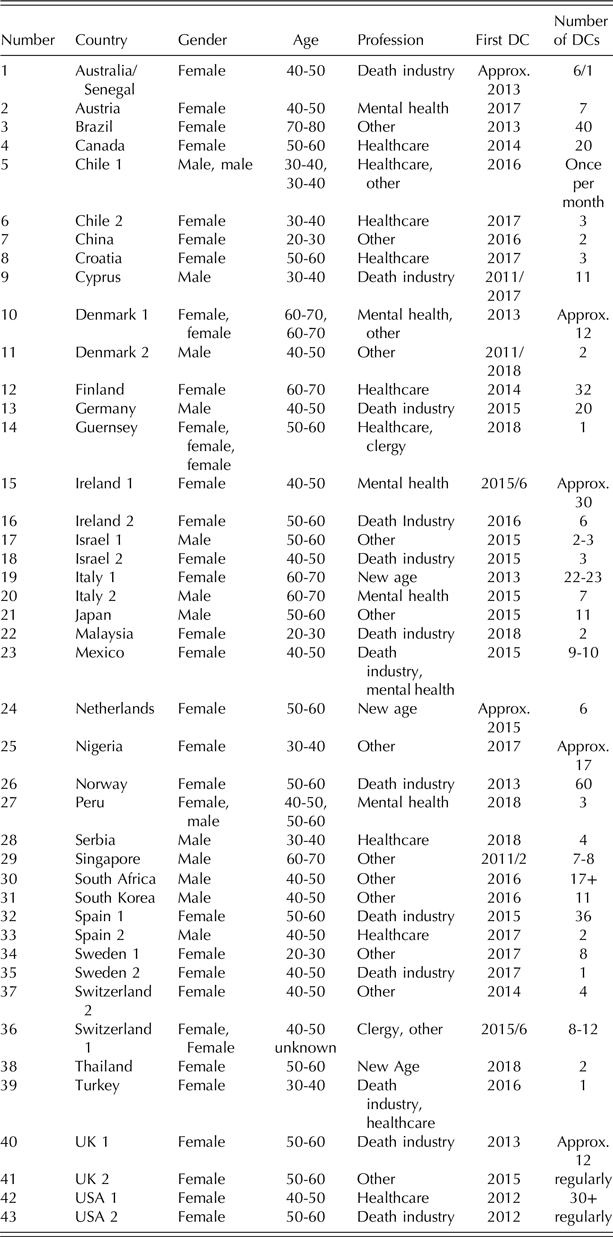
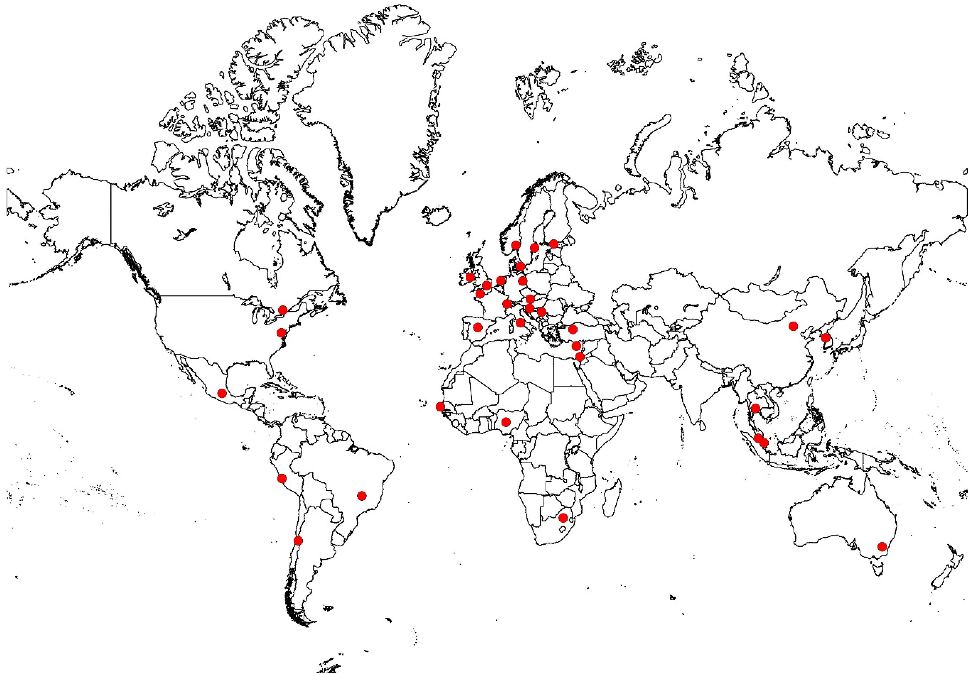
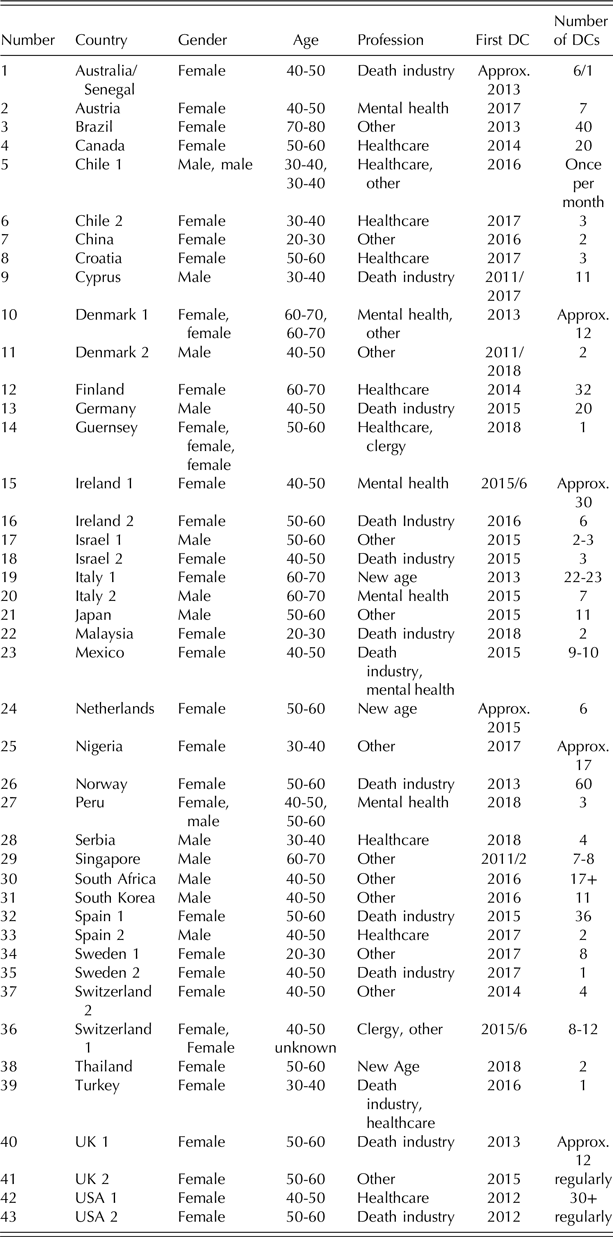
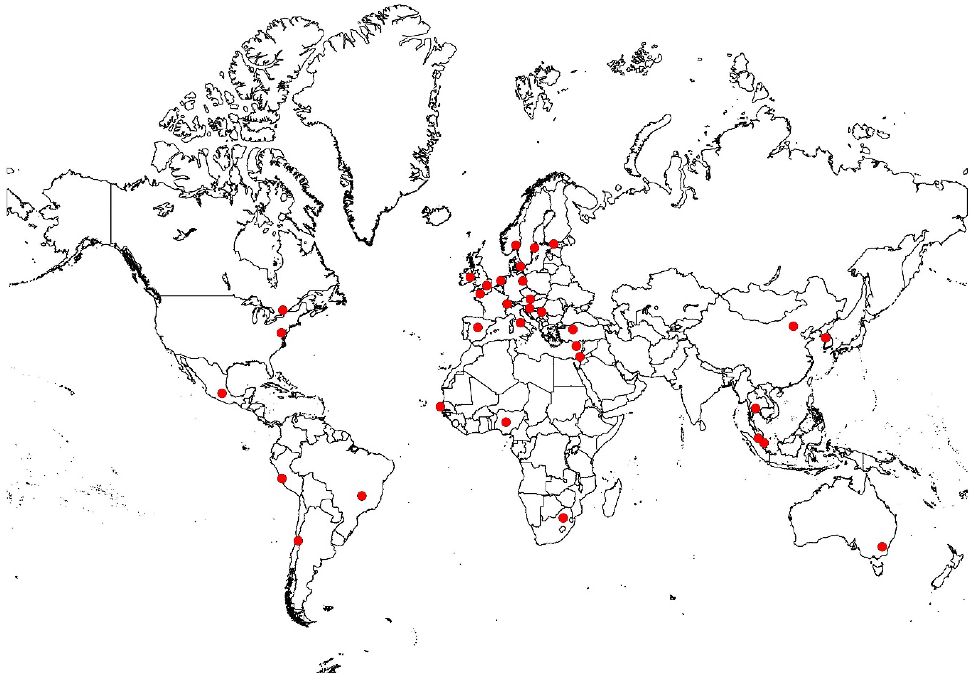
In total, we conducted forty-three interviews with forty-nine Death Café organisers (four were dyads, one triad) from thirty-four territories/countries, out of a possible sample of fifty-one countries (Table 1). Figure 2 shows a map of the world indicating the capital cities of the countries/territories where Death Cafés were organised by interviewees. Our research confirms that the Death Café movement has spread from the UK to North America, Europe, Asia, South America and Africa. Outside of Europe and North America, Death Cafés have sometimes been organised by migrants (people of a different nationality to the country where they are organising a Death Café), or by people with strong links to, or recently returned from, the Anglosphere. However, it is not always the case that there is a traceable trajectory from global North to global South. Our study evidences that, in just seven years, the Death Café concept has spread from England to thirty-four other territories/countries, and that this number is growing each year. By all accounts, Death Café has proved particularly popular in the US, as indicated by the volume of American Death Cafés listed on the central website (4905 registered on the website as of October 2019, which is over half of the total number of Death Cafés reported on the website).
Death Café organisers interviewed indicating country, gender, age, profession, when they organised their first Death Café, and approximate total number organised
Global map of spread of Death Café.
A Death Café organiser who was a close personal friend of Jon Underwood and attended his original café in London, remarked on the rapidity of the global spread:
…it sort of just did this thing where one minute it was a cool thing happening in Jon’s kitchen, and then the next thing it was like this global sensation [Organiser, Europe].
Organisers saw the international transfer of the concept from the UK to other countries as part of a wave of rising death awareness. In some cases, they explicitly referenced the ‘death positive’ movement or cognate initiatives such as death salon or death doula training (lay persons who offer (paid) support at end-of-life) (Francis, Reference Francis and Loftland2019). Organisers spoke proudly of being part of a bigger movement; being part of the zeitgeist:
They are a success story […] we’ve lit the match […] There are people who meet in Santander or in Granada or in Seville, Madrid, Barcelona once a month doing Death Café. And they fill up. They always fill up. [Organiser, Europe]
Jon Underwood, what a hero that man was, from the first Death Café in his living room with his mum, to taking place over 6,000 events in fifty countries in the world [Organiser, Europe].
While it was clear that organisers felt part of something global, they also recognised that the concept was far from being mainstream, being both ‘everywhere’ and ‘underground’ at the same time:
Death Cafés are everywhere, and that’s really positive that we have some underground forums where people are plotting new things. [Organiser, Europe]
Organisers had become aware of Death Café via mainstream media reports, social media commentary, academic conferences, and by word of mouth. The central Death Café website was perceived as an essential mechanism for extending the global reach of the concept. Some felt that because the website and associated documentation were in English this might account for take up of the concept being higher in Anglophone countries and communities.
Who are the organisers and who are the attendees?
Table 1 indicates the characteristics of the organisers, the date of their first Death Café and the total number of Death Cafés organised. The age of organisers ranged from twenty to seventy. However, the average (mean) age of organisers was forty to fifty years old, making them younger than the ‘babyboomer’ organisers reported in other studies of Death Cafés in single countries (e.g. Green et al., Reference Green, Daley, Ward and Wilcock2016; Fong, Reference Fong2017). Our study therefore reveals a somewhat wider age range of organisers when examining the international picture, as well as a significant number of younger organisers (ten of the organisers we interviewed were under the age of forty). Thirty-five organisers were women and eight were men. Some worked in death-related industries such as funerary agencies, bereavement counselling or as death doulas. Others had a clinical, psychotherapy or counselling background. Some clearly saw themselves as part of the wider ‘death positive’ movement while others were motivated by their own existential preoccupations or by experiences of grief following the death of a partner or parent. A person is more likely to have experienced a bereavement by the age of forty to fifty, the average age of our sample of organisers. Organisers gave the general impression that the Death Café concept suited their identity, captured their imagination, and could be a ‘container’ or vehicle for exploring their thoughts on the topic:
Until I found the Death Café, I thought I was really weird [Organiser, Europe]
Most of the organisers had run more than one café, and indeed some had run one every few months over successive years. According to Underwood’s conception of Death Café, the facilitation role did not require any professional counselling skills or specialist knowledge, as the conversations were ideally to be non-directed and flow naturally. However, those with professional facilitation skills, and especially those working in the death industry, said they felt a strong obligation to manage risk and regulate the event: ensuring that no one got too upset, or that no one started proselytising for a particular cause. Some also felt responsible for giving gentle encouragement or prompts and subtly steering the conversation, or correcting information perceived to be incorrect.
So as a facilitator, what I’m trying to do is make sure everybody talks [Organiser, Europe].
…when the group starts to go a little bit deeper, and then someone gets uncomfortable, and makes a joke or interrupts […] it’s sort of my job to curtail that [Organiser, Europe].
The locus of Death Cafés was not exclusively the ‘café’. They took place in pubs, function rooms, leisure centres, people’s homes, and even cemeteries. According to organisers, there was considerable diversity in the demographics of attendees. In the UK, it has been reported that Death Cafés are dominated by middle aged women working in healthcare (Green et al., Reference Green, Daley, Ward and Wilcock2016). While it was certainly the case that some organisers had the impression that this was the dominant group, there were also examples of Death Cafés where the majority of attendees were in their twenties and thirties. In others, babyboomers (aged fifty-five to seventy) dominated:
…it’s come up into the consciousness of the silver tsunami of baby boomers [Organiser, North America].
There were also instances of a wide age span within each Death Café. For example, one organiser said that their Death Cafés were attended by ‘teenagers to eighty year olds’. Our international data thus evidences that Death Café appeals across generations.
Reported attendances at the Death Cafés ranged from two to seventy people. There was a sense that more women than men attended, but some were keen to point out that men did also attend and that it was not a concept or form exclusively of interest to women. Attendees were drawn from similar professions to organisers, presumably because of shared social networks. Occupations were not always known:
In my case, since I’m a nurse, it was nurses and doctors, I would say 90% [Organiser, South America]
Student, professor, religious personnel, lecturer, business owner, office worker [Organiser, Asia]
The above comments about the demographics and characteristics of attendees are reliant on organisers’ impressions, reported to us after the fact, so should be considered a partial rather than a systematic account of who was attending their Death Cafés.
International variation in the Death Café form
The distinguishing feature of Death Café is that events are intended to be non-directive and organisers are not meant to lead attendees to a particular product or conclusion. Conversation is meant to be led by attendees and generated by the particular mix of biographical perspectives. In other words, the prescribed form of a Death Café is that there is no prescribed form:
In one way the rules are very clear and strict. And in one way they’re very open [Organiser, Asia]
This means that inviting an expert speaker to give a talk, for example, is perceived by some as ‘bastardising the concept’ [Organiser, North America]. For some of our interviewees, fidelity to the concept was critical because it was what distinguished Death Café from the myriad other death awareness events or concepts circulating via social mediaFootnote 2. It was also about maintaining the ethos or the spirit in which Death Café had been conceived, as an open free-flowing discussion among strangers:
You know, it also took me a bit to get the hang of, actually the Death Café is a model, you know, it is a thing and Jon is, or was, very active in keeping on top of who was having Death Cafés and what they were doing. So, he would give a helpful little nudge, like, ‘I see you’re doing this at your Death Café, that’s not really a Death Café’ [Organiser, Europe]
I would want to be true to Jon Underwood’s vision and his…I don’t know. I just want it to remain authentic [Organiser, Europe]
A desire to ‘remain authentic’ and avoid ‘bastardising the concept’ was clearly important to some. It was also important to Jon Underwood, who would spend a lot of time contacting organisers perceived to have contravened the guidelines and ask them either to abide by the central ethos or to refrain from calling themselves a ‘Death Café’. Developing the logo was part of this impetus to preserve the cohesiveness of the concept as it spread to different countries:
We had to submit to his rules and regulations and call it “Death Café” and post our events on his English webpage […] we wanted to post it on our own webpage in our own language […] But [Jon] wanted none of that […] Because that was his copyright he felt. [Organiser, Europe].
Some were unaware that their local adaptations were not in keeping with the Death Café concept. For example, organisers told us about: Death Cafés addressing certain themes identified in advance; talks given by professionals at the Death Café; mindfulness practice at the beginning or end; use of prompt cards; holding poetry readings; film showings; musical performances and so forth to frame the event. Some did acknowledge that these adaptations were not officially sanctioned, but when asked why they had made them, they replied ‘because we saw it was working!’ or because ‘people need help to do it because they don’t know how.’ Given the shared aim of raising awareness, organisers questioned what the harm was in being flexible about the form.
Why organisers think Death Cafés are needed
Officially, Death Cafés have no intended purpose other than ‘helping people to make the most of their finite lives’. Yet, we discovered that organisers had different motivations for organising a Death Café. In addition, when they experienced for themselves, or perceived in others, the beneficial effects of their Death Cafés, organisers’ motivation was further invigorated. Organisers expressed the view that people needed a ‘safe space’ to discuss death and dying and express emotions that they were not free to do elsewhere:
they go because they’re going to be able to have that conversation that maybe they can’t have with other people in their life. [Organiser, Europe].
people that go to Death Cafés […] they all feel like they don’t have the place or the people to talk to about these things [Organiser, South America].
Organisers spoke at length about the cultural attitudes to death and dying prevalent in their country. Some discussed ‘superstition’ surrounding death: ‘people think ‘if I talk about death, the death will come’’ [organiser, Europe]; or ‘unspoken rules that this is not supposed to be talked about, at least not in a public space’ [organiser, Africa]; or such conversations being beyond ‘the boundaries of polite society’ [organiser, Europe]. Notwithstanding the range of countries included in the study, and the different cultures, religions and traditions represented, similar themes emerged about cultural avoidance, loss of traditions, and the outsourcing of death and dying to professionals – aspects of what is collectively termed ‘the death taboo’:
It used to be hands-on, now institutions have taken over [Organiser, Europe].
It’s a Catholic country, and you don’t talk about death. Death is decided by God, whenever is your time, you will go. There is nothing to talk about before. You can’t choose, you can’t prepare. And it’s even a blasphemy to talk about it [Organiser, Europe].
The perceived willingness of Death Café attendees to talk and engage in conversation with strangers on this ‘taboo’ topic seemed to provide evidence of the need for such spaces:
there wasn’t a single minute of silence throughout those two hours. People were speaking non-stop. Non-stop [Organiser, Asia].
I always say it’s magical because it is almost unbelievable how complete strangers are just opening up [Organiser, North America].
The benefits of talking were repeatedly emphasised by organisers. Some were very much in alignment with Jon Underwood’s original vision for Death Café: that talking about death could help bring a sense of perspective to people’s lives; a sense of carpe diem:
The stories about death are a good remedy that reminds me to focus on the moment rather than the future [Organiser, Asia].
because I’m more aware that I can die any time, you know, and in any circumstance, I try to enjoy every moment [Organiser, North America].
Overall, we were struck by the similarity in the rationale given by organisers about why Death Cafés were needed and the emphasis placed repeatedly on the perceived benefits of talking about death.
The perceived effects, beyond the event itself
The ability of Death Café events to elicit death talk was celebrated by organisers as a good thing in and of itself. However, we also asked organisers if they perceived any longer-term benefits to attending a Death Café, beyond the ‘magical’ quality [organiser, North America], or ‘comfort’ offered [organiser, Asia]. Some thought the death talk would extend to other spheres; that attendees would be more inclined to ‘continue the conversation elsewhere’ [organiser, North America]:
I hope those people take just a little bit of that information that they’ve gained and take it back to their family who then, in turn, take it to their family and to their friends and it goes slowly through their community and outside their community and it kind of rolls and rolls and rolls [Organiser, Africa].
Another perceived effect of attending a Death Café was making practical plans, or as one organiser put it, ‘returning home with a task in their head’ [Organiser, Europe]. Advance care planning was mentioned by some:
…especially people who are elder, they come and they realise that this is a possibility for accomplishing something more specific. So, they come back and usually they say, how do I do my advanced health directives? [Organiser, South America]
Some organisers even held workshops on advance care planning, commenting that ‘many people did their own [plan] after that’ [Organiser, Europe]. However, there was also resistance to focusing too much on tangible effects beyond the Death Café itself. This was either because it was deemed to detract from the sense of being ‘in the moment’, or because having a focus on outcomes was interpreted as a form of agenda-setting which ran counter to the central ethos of Death Café:
in my head I have this idea that we’re doing things and we have to evaluate what happens to people afterwards. And I’m tempted to do it. But I feel that in doing so I’d be robbing them of the original essence of Death Café which is just to have a space for conversation [Organiser, South America].
Organisers identified a need for broad cultural change, rather than focusing on specific practical actions, and the hope was that Death Cafés could cause a ripple effect. A sense of frustration was sometimes expressed about Death Café not being sufficient to really make a difference because it was only a ‘drop in the ocean’ [organiser, Europe] due to the small numbers attending and the entrenched nature of cultural avoidance. Others focused on the international spread of the concept and the sense of being part of something bigger, which gave cause for optimism:
I think it has a very subtle and subjective impact, and we can only really understand the consequence of it over a longer period of time and considering all the Death Cafés that go on around the world. There’s no one Death Café I think is going to make a huge change. It’s a cumulative effort. It’s making cultural changes and that’s really hard to do [Organiser, Europe].
Discussion
This study is the first to track comprehensively the spatio-temporal spread of the Death Café concept. Death Café organisers and journalists around the world are making claims for the movement’s importance, but so far these claims lack detailed research scrutiny. Death Café is a novel cultural intervention, which is widely seen to have potential to increase public awareness and contribute to the de-professionalisation of death and dying. This is at a time when the number of deaths globally is increasing, and governments are having to devise new ways to reduce pressures on health and social care sectors. Foster et al. (Reference Foster, Woodthorpe and Walker2019) have argued for a social policy of death which goes beyond the current, almost exclusive, focus on palliative and end-of-life care. This study stands out as an important contribution to a nascent social policy of death and dying. While Death Café is far from being a mainstream mass movement, the thousands of events which have been organised in the UK and US in particular, and its international spread to upwards of thirty-four countries/territories in seven years, revealed here for the first time, is indicative of its perceived strength as an intervention and its growing name recognition.
Despite the wide variety of countries included in our study, there were remarkable cross-cultural similarities in the perception of need for Death Café; what is termed ‘frame alignment’ in the social movement literature (Snow et al., Reference Snow, Rochford, Worden and Benford1986). There was a universally held view that the so-called death taboo is having a corrosive effect on human relationships and the ability to cope with experiences of death and dying. All the interviewees advocated for talking more about death, reflecting sentiments which have been central to the ‘happy death movement’ since the 1970s (Lofland, Reference Lofland2018[1978]) and continued through the death ‘revivalism’ of the 1990s (Walter, Reference Walter1995). At this time, traditional views about death, and acceptance of death as part of life, were ‘revived’ through the active promotion of discourses about the benefits of open communication. In a globalised world connected through social media, Death Café founder, Jon Underwood, was able to disseminate his concept and attract significant international media coverage, nearly all of it positive, espousing the value of death talk. This has now been taken up beyond the bounds of the Anglo-Saxon world. Despite his own unexpected death in 2017, Underwood’s concept lives on. The work of Death Café centrally is continued by Underwood’s family whilst Death Café organisers all over the world use social media to share experiences, knowledge and strategies. Rather than precipitating the demise of the movement, Jon Underwood’s sudden death may have intensified its spread, as some organisers said they felt compelled to carry on his work.
The Organisers
Our findings in this study offer a corrective to the existing literature about who Death Café organisers are and who is attending Death Cafés. In the limited studies that currently exist, Death Café is often characterised as being the preserve of women (Green et al., Reference Green, Daley, Ward and Wilcock2016; Baldwin, Reference Baldwin2017). Yet the Death Café concept originated with two men (Underwood and, earlier, Crettaz), and we interviewed male Death Café organisers in all the continents represented in our study. Existing literature also characterises Death Café as attracting mainly those in midlife or ‘babyboomers’ – people witnessing the death of parents and starting to think about their own (Fong, Reference Fong2017: 10). We show that young people are also involved in the international movement, both as organisers and attendees, substantiating the view that Death Café is perceived to have relevance and applicability across the life course.
Transfer, translation and alignment
The transfer of Death Café internationally is not so much a matter of policy transfer (Dolowitz and Marsh, Reference Dolowitz and Marsh1996), as of a single idea. It is perhaps the simplicity of the concept which has spurred a grassroots movement that relies on motivated individuals to adopt the concept. The progression from ‘Café Mortel’ in Switzerland to ‘Death Café’ in England was effectively the first transfer and translation of the barebones concept. Somewhat inevitably, through its transfer, the concept has undergone a ‘translation’ by adopters in different countries (Czarniawska and Sevón, Reference Czarniawska and Sevón2005). We discovered wide variation in the form of Death Cafés around the world which challenges the view that they are ‘spontaneous, unstructured’ events (Hammer et al., Reference Hammer, Ravindran and Nielsen2019). There were attempts to actively curate Death Cafés with references to ‘making people talk’, encouraging people to ‘go deeper’, and ‘moving things along’. Organisers argued that providing external stimuli to attendees was sometimes a necessary and legitimate translation because they ‘saw it was working’ or because people ‘needed help’ to ‘have the conversation’. Despite guidance from the centre that the Death Café form should not vary and that events should always be unstructured, or they were not to be considered ‘Death Cafés’, our data shows that this was far from the case. It appeared that at the margins, the Death Café concept was perceived to be fluid. Organisers perceived themselves to be in line with the mobilising messages of the broader social movement (Snow et al., Reference Snow, Rochford, Worden and Benford1986), whether that be ‘death positivity’ or ‘Compassionate Communities’, and within this they felt free to innovate and adapt the Death Café form.
In analysing the broader significance of Death Café, we were interested in any alignment between the goals of organisers/attendees and national policy agendas. The drive by governments and policymakers to address the challenges of ageing populations, growing levels of need for end-of-life care and an increased commitment to person-centred care, undoubtedly requires preparedness at the individual, community and institutional level. Cultural interventions such as Death Café may be one route to socio-cultural preparedness, affecting the kind of attitudinal and behavioural changes identified by Abel et al. (Reference Abel, Bowra, Walter and Howarth2011) and Noonan et al. (Reference Noonan, Horsfall, Leonard and Rosenberg2016) as necessary for building Compassionate Communities. Examples of the tangible benefits which could potentially accrue from a more strategic use of Death Café might be: encouraging people to formalise their wishes about end-of-life care and treatment; devolving substitute decision-making powers in the event of mental incapacity; and building capacity for caring for the dying in their own homes. Certainly, some Death Café organisers expressed the hope that attendees might ‘continue the conversation’ after the event itself, and potentially take pragmatic steps towards a general preparedness for death. Some even aligned their Death Café with practical sessions on Advance Care Planning or used them as springboards for marketing other entrepreneurial initiatives such as Death Doula training. Instrumental or strategic usage of the Death Café form is also reported in the literature – for example, to prevent burnout amongst front-line clinical staff (Hammer et al., Reference Hammer, Ravindran and Nielsen2019) or to raise awareness of hospice services (Adler et al., Reference Adler, Remer, Coulter and Miller2015). However, not all organisers were happy about Death Café being adapted for such strategic purposes.
Instrumental and incidental effects
In order to conceptualise the different effects of Death Café, we distinguish between instrumental and incidental effects. While the policy focus might be on instrumental usage of the Death Café form, for some organisers, any tangible outcomes in terms of, for example, advance care planning, were considered incidental. For these organisers, to be ‘outcomes driven’ would be to ‘rob [attendees] of the original essence of Death Café, which is to impart a sense of carpe diem. The idea that raising people’s consciousness of their own mortality through Death Café may lead incidentally to behaviour change is the inverse of the ‘starting with behaviour change’ approach promoted by champions of the Compassionate Communities model (Abel et al., Reference Abel, Bowra, Walter and Howarth2011). To go a step further, not only might these behaviour changes be incidental to the aims of Death Café, but the very notion of planning for death could be considered contrary to the Death Café ethos of accepting that death is part of life and accepting that there are limits to our ability to control it. If Death Café discussions are intended to lead attendees to accept a lack of control over death, it then seems paradoxical to propose ways of ‘fixing’ this lack of control, for example, through advance care planning. Ultimately, for Death Café organisers who do not want to see the concept ‘bastardised’, there is a distinction worthy of protection between the kinds of conversations which are taking place in Death Cafés around the world, and the kinds of conversations which policymakers might want to be taking place.
Tensions
The evident tensions involved in translating a cultural intervention into a policy intervention is not specific to the end-of-life (for example, Mindfulness (Williams and Kabat-Zinn, Reference Williams and Kabat-Zinn2011)). In view of the scale of the demographic and epidemiological challenges faced globally, and the pressures to find both new models of care and individual risk management strategies, it is not surprising that policymakers are being drawn to cultural interventions for their potential utility in responding to these challenges. Nevertheless, viewing Death Café instrumentally as a way of bringing about attitudinal and behaviour change could be considered a form of postmodern neoliberal governmentality (Rose, Reference Rose, Heelas and Morris1992; Árnason and Hafsteinsson, Reference Árnason and Hafsteinsson2003). This is the Foucauldian notion that governments must engage the self-activating capacities of individuals in order that they act upon their own subjectivity, which in the case discussed here would translate into planning for their own death. However, the idea fundamentally challenges the view that cultural interventions such as Death Café can prompt spontaneous, free and expressive conversations which can tap into people’s imaginations. While we do not intend to reproduce well-rehearsed Foucauldian dialectics on power and agency, we think it is important to acknowledge these arguments in the light of claims made about the role and function of cultural interventions at the end-of-life. We strongly argue that, given the interview data presented here, cultural interventions in general, and Death Café in particular, do have the power to raise new questions and not just answer the pre-determined questions of policy-makers. This grassroots movement has its own dynamics and momentum, which is no more controlled by the centre and its own founder, Jon Underwood, than it is by health and social care professionals or policymakers who try to use it as a tool to facilitate planning (Bruntink, Reference Bruntink2019). Death Café represents a cultural intervention which certainly has the potential to contribute to policy-makers’ neoliberal agenda to increase individual responsibility for death and dying (Borgstrom and Walter, Reference Borgstrom and Walter2015). For example, Death Cafés have been promoted by the UK’s Dying Matters Coalition (Hospice UK, Reference Hospice2018), the Conversation Project in the US (Institute for Healthcare Improvement, 2019), and by the Australian Government (ACT, 2019), which is even considering funding them (Report of the Select Committee on End of Life Choices in the ACT, 2019). Cultural attempts to generate lay responses to death and dying outside of the dominant healthcare structures ultimately face strong pressures of convergence towards them. The conclusion we arrive at is that these cultural interventions can exist both within these structures and outside of them and that their imaginative and innovative potential cannot be entirely subsumed or dismissed.
Limitations
A potential limitation of this study is that we cannot verify comments made by organisers about what actually happens in their Death Cafés – we are reliant solely on the self-reports of self-selected Death Café organisers. In order to mitigate this potential limitation, we have been careful to present reports of what happened in Death Cafés as indicative, and not necessarily as verifiable facts. Ultimately, we were interested in mapping the scope of the movement and organisers’ motivations and perceptions, rather than in the discursive details of Death Café conversations. There is an as yet unpublished anthropological study by Solveiga Zibaite of the University of Glasgow (Reference ZibaiteZibaite, as yet unpublished) which examines conversations across multiple Death Cafés in one country (UK).
A second potential limitation is that we were not able to interview organisers from every country where Death Cafés have taken place (see Figure 1). However, we argue that our sample is sufficiently large and diverse to give a sense of the international scope of the movement as well as the cross-cutting themes that traverse different cultural contexts.
Conclusion
In view of the scale of the challenges presented by the new demography of death, cultural interventions are seen as an important part of the mix in a multi-pronged public health approach to end-of-life issues (Public Health Palliative Care International, 2010). Death Cafés, where strangers meet informally to engage in death talk, are one such cultural intervention, and this study confirms that they have spread to at least thirty-four countries/territories in just seven years. We found remarkable coherence in terms of the perception of the need for revivalist practices to bring death talk, currently considered to be absent or lacking, into the mainstream in the countries where Death Cafés have been organised. However, most organisers were aware that the concept would only appeal to certain sections of the population. Some spoke of Death Café being a ‘drop in the ocean’, and indeed in some countries in our sample only one or two Death Cafés have taken place. At the same time, other organisers were optimistic about the power of ‘cumulative efforts’ to spread the message about the value of death talk.
Talking has become a significant policy issue in recent years, with Conversation Cafés (Involve Foundation, 2018) being promoted as a method of public engagement, as well as talk-based campaigns to combat loneliness (HelpAge Canada, 2018; Australian Coalition to End Loneliness, 2017; Campaign to End Loneliness UK, 2018). ‘Starting the conversation’ is a frequently heard policy mantra for many social issues. We have highlighted tensions around the strategic use of Death Café to promote specific kinds of talk focussed on specific kinds of outcomes, namely increased planning and preparedness for death. This is not a welcome development for organisers who view Death Café as being, at its core, non-directive and freely expressive. Nor is it in line with the carpe diem spirit of Death Café: that to truly accept that death is a part of life, and that doing so encourages people to value and make the most of their present time, is also to accept that death cannot always be controlled and planned for. Those studying social movements have long recognised that their aims are not always precise and are subject to change as the world itself changes (Levitas, Reference Levitas1977). Social movements are in a dialectical relationship with other social forces and we cannot always predict how they will be adapted or used instrumentally.
It would be a mistake to over-claim the relevance of Death Café, and other cultural interventions like it. As a ‘talking shop’, Death Café is a long way from initiating the type of hands-on behaviour change which Abel et al. (Reference Abel, Bowra, Walter and Howarth2011) and Noonan et al. (Reference Noonan, Horsfall, Leonard and Rosenberg2016) claim is desperately needed. However, the enthusiasm of Death Café organisers and their belief in the potential for change, via a talking revolution, is compelling. It offers a counter-narrative that has been able to capture people’s imagination. Unfortunately, the strength of enthusiasm among organisers is somewhat dwarfed by the scale of the challenge presented by the new demography of death.
Acknowledgements
We would like to thank all the Death Café organisers around the world who agreed to be interviewed for this study. We would also like to thank Jools Barsky, Sue Barsky Reid and Donna Molloy at deathcafe.com for their advice and comments; we are grateful to them for continuing to support our work, just as Jon Underwood, the Death Café founder, had done prior to his death in July 2017. Finally, we would like to thank colleagues in the Glasgow End of Life Studies Group for their formative feedback and specifically David Clelland for his assistance with producing our map (Figure 2). This work was supported by a Wellcome Trust Investigator Award [103319] to Professor David Clark.