Implications
In riding centres horses are fed low quantity of hay, with high amounts of concentrate in a limited number of meals that can increase the incidence of colic. To limit these potential negative effects, the distribution sequence of a concentrate meal containing 33% starch before or with the hay meal was studied and compared with a hay diet. Our results suggested that to simplify feeding practice, hay and concentrate could be distributed simultaneously without provoking digestive disturbances.
Introduction
Horses possess a great number and variety of microbes in their voluminous hindgut. These microbes are essential for utilizing dietary plant fibre and converting them into volatile fatty acids (VFAs) that provide energy to the host and for preserving a healthy environment of the intestinal ecosystem. To sustain the efficient functioning of the hindgut microbes, it has long been recommended to feed at least 10 g of hay dry matter (DM)/kg BW per day (Miyaji et al., Reference Miyaji, Ueda, Nakatsuji, Tomioka, Kobayashi, Hata and Kondo2008). Recent recommendation proposed increasing the minimal amount of roughage to 20 g (84% to 90% DM)/kg BW per day (Coenen et al., Reference Coenen, Kienzle, Vervuert and Zeyner2011). In most riding centres in France, the quantity of hay distributed to horses is often lower. Combined with large meals of concentrate fed to meet horses’ exercise energy requirements, such diets may be associated with increased risk of colic (Goncalves et al., Reference Goncalves, Julliand and Leblonde2002; Archer and Proudman, Reference Archer and Proudman2006). To limit this potential negative impact, one strategy is to change the distribution sequence of concentrate and hay. Indeed, compared with feeding concentrate before hay, distributing hay first has been reported to lessen the hindgut physicochemical environment alterations which may disturb the caecal (Jensen et al., Reference Jensen, Austbø and Tauson2012), colonic (Philippeau et al., Reference Philippeau, Faubladier, Goachet and Julliand2009) and faecal (Zeyner et al., Reference Zeyner, Geißler and Dittrich2004) microbial ecosystems. The impact of feeding both hay and concentrate simultaneously has not been studied on the equine gastrointestinal health, although in the field, for practical issues, this is a common practice. The purpose of the present study was thus to assess the impact of distributing the concentrate meal before or with the hay meal on postprandial variations in pH and VFA from different hindgut compartments and faeces. These fermentation parameters can serve as an indicator for microbial activity (Santos et al., Reference Santos, Rodrigues, Bessa, Ferreira and Martin-Rosset2011).
Material and methods
The experiment was conducted at the horse research facilities of AgroSup Dijon under approval from the Ethics Committee for Animal Well-Being of the University of Burgundy, Dijon, France (agreement no. C1311).
Animals, management and diets
Four adult cross-bred geldings (average BW of 500.0±35.7 kg and mean age 11.5±3.2 years) were individually housed in 3×3 m free stalls bedded with wood shavings. They were dewormed (Eraquell-Virbac SA, Glattbrugg, Switzerland) before the beginning of the trial. Except on collection days, horses had access to a sand paddock for free exercise 5 h/day (1200 to 1700 h), 6 days each week and were exercised with an automatic walker for 1 h/day (1 h after the morning meal), five times per week. Each animal was fitted with caecum and right ventral colon polyvinyl chloride cannulas (30 mm).
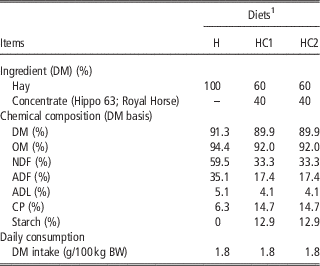
Horses were fed a hay diet (100% meadow hay) during the first 3 weeks (H) of the experimental trial, a hay–concentrate diet (40% concentrate and 60% meadow hay; DM basis) with both concentrate and hay distributed at the same time (HC1 diet) during the following 3 weeks, and finally with concentrate offered before hay (HC2 diet) during the last 3 weeks of the study. The concentrate was a commercial pelleted feed (Hippo 63; Royal Horse, Vannes, France). The chemical composition of the diets is presented in Table 1. The diets H, HC1 and HC2 were fed at 1.8 kg DM/100 kg BW. For H and HC1 diets, hay or hay plus concentrate were offered daily in two equal meals at 0800 and 1700 h. For the diet HC2, animals were fed concentrate at 0800 and 1600 h and hay at 1000 and 1730 h. Each experimental period (H, HC1 and HC2) was separated by 10 days, where horses were fed the hay diet, followed by 10 days where horses were progressively adapted to the next diet. Salt blocks and water were available ad libitum.
Ingredients and mean chemical composition of the diets

DM=dry matter; OM=organic matter.
1 Diet H: 100% forage diet; diet HC: 40% concentrate/60% forage; for diets H and HC1, feeds were offered daily in two equal meals at 0800 and 1700 h; for the diet HC2, concentrate was offered at 0800 and 1600 h and hay at 1000 and 1730 h.
Measurements and analyses
For each period on day 15, digestive contents were collected before (0) and at 2, 4, 6 and 8 h after the first morning meal was given (hay or hay plus concentrate or concentrate morning meal for periods H, HC1 and HC2, respectively). Caecal and right ventral colonic digesta samples were collected by gravity via the cannulas. Faecal samples were grabbed in the rectum. All digestive contents were filtered (Blutex nylon filter 100 µm; Tripette and Renaud, Paris, France) and immediately frozen (−20°C) for further analysis of VFA (1 ml added with 0.1 ml of a preservative mixture of 5% H3PO4+1% HgCl2).
The pH of caecal, colonic and filtered faecal content was measured immediately after each collection, using an electronic pH meter (pH 340i/SET; Wissenschaftlisch-TechnischeWerkstätten, Weilheim, Germany). Volatile fatty acid concentrations were determined using GLC (Gas chromatograph model Clarus 500; PerkinElmer, Courtaboeuf, France) (Jouany, Reference Jouany1982).
Statistical analyses
Data were processed by ANOVA using the MIXED procedure of SAS v9.3 (SAS Institute Inc., Cary, NC, USA). For each digestive segment, the statistical model included horse, diet, sampling time and diet×sampling time. Horse was considered as random effect. A repeated-measures ANOVA was performed to compare profiles of fermentation parameters (VFA concentrations, proportions and pH) using the repeated time option of SAS v9.3. All statistical procedures were performed separately for the caecum, colon and faeces with horse as experimental unit. Least-squares means were compared using a Tukey’s test, and effects declared significant at P<0.05.
Volatile fatty acid concentrations and pH were also analyzed using a principal component analysis (PCA) performed on the covariance matrix of the samples (caecum, right ventral colon and faeces). Principal component analysis and the Monte Carlo test (10 000 permutations) were performed using the ADE-4 software (Thioulouse et al., Reference Thioulouse, Chessel, Dolédec and Olivier1997). Volatile fatty acid proportions and pH were also analyzed using a PCA; however, the same effects than those observed on concentrations were highlighted (data not shown). Thus, in the present study only PCA analysis carried on VFA concentrations and pH was presented. Each PCA analysis has been made with 180 data (3 sites × 3 diets × 4 animals × 5 h of sampling).
Results
All horses remained clinically healthy throughout the study.
Postprandial evolution in the caecum, colon and faeces
Irrespective of the digestive segments, no significant effect of time of sampling, diet and their interaction were found on VFA proportions nor on the ratio ((acetate+butyrate)/propionate) (data not shown).
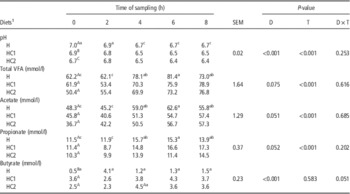
In the caecum, no interaction of the time of sampling and the diet was detected for pH values and VFA concentrations (Table 2, P>0.05). pH values and butyrate concentration depended on the diet (P<0.001). Regardless of the time of sampling, caecal pH value was in mean significantly lower when horses were fed diet HC2 than diets H or HC1 (P<0.001). It was significantly greater in horses fed H diet compared with HC1 diet. Butyrate concentration was significantly lower in horses receiving diet H than diets HC1 and HC2 (P<0.001). With the concentrate diets there was a high trend for acetate (P=0.051) and proprionate (P=0.052) decrease.
Postprandial evolution of caecal pH and volatile fatty acid (VFA) concentrations of horses given three different diets

D=diet; T=time of sampling.
A,BWithin a column, means without common superscript letters differ (P<0.05) and are representative of diet effect.
a,b,cWithin a row, means without common superscript letters differ (P<0.05) and are representative of time of sampling effect.
1 Diet H: 100% forage diet; diet HC: 40% concentrate/60% forage; for diets H and HC1, feeds were offered daily in two equal meals at 0800 and 1700 h; for the diet HC2, concentrate was offered at 0800 and 1600 h and hay at 1000 and 1730 h.
pH values, total VFA, acetate and propionate concentrations differed significantly with sampling time (P<0.001). Whatever the diet, caecal pH decreased significantly 4 h after the morning meal and stayed at the minimum value until 8 h postprandial (P<0.001). Caecal, total VFA, acetate and propionate concentrations increased after feeding to reach a maximum from 4 to 8 h postprandial (P<0.001).
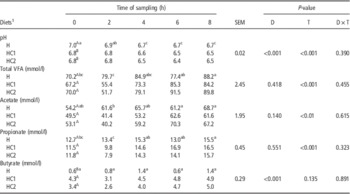
In the right ventral colon, no interaction was found between the time of sampling and the diet (Table 3, P>0.05). pH values and butyrate concentrations depended on the diet (P<0.001). The colonic pH value was significantly lower when horses were fed diets HC1 and HC2 than diet H (P<0.001). Butyrate concentration was significantly lower in horses fed diet H than diets HC1 and HC2 (P<0.001). Butyrate concentrations remained stable over time (P=0.121). Colonic pH decreased within the first 4 h postprandial and remained minimum between 4 and 8 h after the meal (P<0.001). Colonic acetate, propionate and total VFA concentrations increased after feeding to reach a maximum between 4 and 8 h postprandial (P<0.01).
Postprandial evolution of colonic pH and volatile fatty acid (VFA) concentrations of horses given three different diets

D=diet; T=time of sampling.
A,BWithin a column, means without common superscript letters differ (P<0.05) and are representative of diet effect.
a,b,cWithin a row, means without common superscript letters differ (P<0.05) and are representative of time of sampling effect.
1 Diet H: 100% forage diet; diet HC: 40% concentrate/60% forage; for diets H and HC1, feeds were offered daily in two equal meals at 0800 and 1700 h; for the diet HC2, concentrate was offered at 0800 and 1600 h and hay at 1000 and 1730 h.
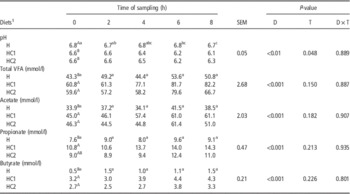
In the faeces, no interaction between the time of sampling and the diet was found (Table 4, P=0.882). pH values and all VFA concentrations depended on the diet (Table 4, P<0.001). The faecal pH value was significantly lower when horses were fed diets HC1 and HC2 than diet H (P<0.001). The concentration of acetate, butyrate and total VFA were significantly higher when horses received diets HC1 and HC2 than diet H (P<0.0001). No differences were observed between diets HC1 and HC2 (P>0.05). The concentration of propionate was higher when horses were fed diet HC1 than diet H (P<0.001). No differences were observed between diet H and diet HC2 (P>0.05). Faecal pH decreased regularly during the 8 h postprandial (Table 4, P=0.048).
Postprandial evolution of faecal pH and volatile fatty acid (VFA) concentrations of horses given three different diets

D=diet; T=time of sampling.
A,BWithin a column, means without common superscript letters differ (P<0.05) and are representative of diet effect.
a,b,cWithin a row, means without common superscript letters differ (P<0.05) and are representative of time of sampling effect.
1 Diet H: 100% forage diet; diet HC: 40% concentrate/60% forage; for diets H and HC1, feeds were offered daily in two equal meals at 0800 and 1700 h; for the diet HC2, concentrate was offered at 0800 and 1600 h and hay at 1000 and 1730 h.
Global appraisal of the effects of gut location and diet
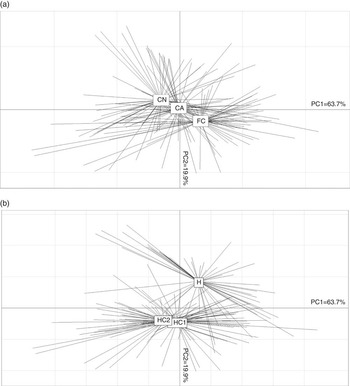
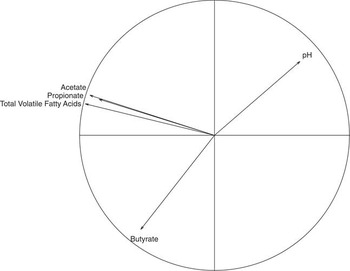
Principal component analysis data for the pH values and VFA concentrations of caecal, right ventral colonic and faecal samples are presented according to the gut location (Figure 1a) or the diet (Figure 1b). In both figures, the first axis (PC1) explained 63.7% of the total variability and the second axis (PC2) explained 19.9% of the total variability. pH values and VFA concentrations showed no differences between the three gut locations (Figure 1a, Monte Carlo test: P>0.05). However, irrespective of digestive segment considered, samples from H diet were separated from those of HC diets on PC1 and PC2 axes (Figure 1b). This discrimination on PC1 and PC2 was explained by acetate, propionate and total VFA concentrations on PC1 axis and by pH and butyrate concentration on PC2 axis (Figure 2) (Monte Carlo test: P<0.001).
Comparison of pH values and volatile fatty acid concentration variability performed by principal component (PC) analysis. Data were obtained from caecum (CA), right ventral colon (CN) and faeces (FC) of horses (n=4) given three different diets (H: 100% forage diet; HC: 40% concentrate/60% forage; for diets H and HC1, feeds were offered daily in two equal meals at 0800 and 1700 h; for the diet HC2, concentrate was offered at 0800 and 1600 h and hay at 1000 and 1730 h). Each line represents one observation. Principal component analysis was performed taking into account the digestive segment (a) or the diet (b).

Principal component analysis correlation circle of pH values and volatile fatty acid concentration profiles obtained from caecum, right ventral colon and faeces of horses (n=4) given three different diets (H: 100% forage diet; HC: 40% concentrate/60% forage; for diets H and HC1, feeds were offered daily in two equal meals at 0800 and 1700 h; for the diet HC2, concentrate was offered at 0800 and 1600 h and hay at 1000 and 1730 h).

Discussion
Considering the small number of data reported in the literature on in vivo measurements of fermentation parameters using horses fitted with two cannulas in the hindgut (de Fombelle et al., Reference de Fombelle, Julliand, Drogoul and Jacotot2001; Julliand et al., Reference Julliand, de Fombelle, Drogoul and Jacotot2001; Medina et al., Reference Medina, Girard, Jacotot and Julliand2002), the present work using horses fistulated in both caecum and ventral colon for studying the impact of feeding sequence on postprandial variations of microbial fermentations is an original point.
Adding concentrate in the diet was associated with an overall alteration of the pH values and VFA concentrations in caecum, right ventral colon and faeces compared with the hay diet. In agreement with the literature, caecal, colonic and faecal pH values decreased (Goodson et al., Reference Goodson, Tyznik, Cline and Dehority1988; McLean et al., Reference McLean, Hyslop, Longland, Cuddeford and Hollands2000; Medina et al., Reference Medina, Girard, Jacotot and Julliand2002), total faecal VFA concentration increased (Hussein et al., Reference Hussein, Vogedes, Fernandez and Frankeny2004) as well as faecal acetate and propionate concentrations (Hussein et al., Reference Hussein, Vogedes, Fernandez and Frankeny2004; Swyers et al., Reference Swyers, Burk, Hartsock, Ungerfeld and Shelton2008) and caecal, colonic and faecal butyrate concentrations (de Fombelle et al., Reference de Fombelle, Varloud, Goachet, Jacotot, Philippeau, Drogoul and Julliand2003; Hussein et al., Reference Hussein, Vogedes, Fernandez and Frankeny2004). Most of these data are in line with a change towards an acidogenic environment which in large extent can be at risk and disrupt the balance of the hindgut microbial ecosystem. On the contrary, some of our results were not in compliance with studies reporting the impact of adding concentrate to a forage diet on caecal acetate and propionate concentrations (Kern et al., Reference Kern, Slyter, Weaver, Leffel and Samuelsons1973; Medina et al., Reference Medina, Girard, Jacotot and Julliand2002). Compared with these previous studies, the percentage of concentrate in our ration was lower; 40% v. >50% of the DM intake. In addition, the concentrate tested in the present work was low in starch (32.3% DM) compared with cereals. When starch amounts >0.2% BW are fed, undigested starch can flow into the hindgut and be rapidly fermented, thus leading to an increase in VFA production and a decrease in pH and cellulolytic activity (Julliand et al., Reference Julliand, de Fombelle, Drogoul and Jacotot2001).
The overall analysis carried on all pH values and VFA concentrations from caecum, right ventral colon and faeces, showed no impact on the concentrate feeding sequence. In the caecum and colon as in the faeces, we found little impact of the concentrate feeding sequence on the fermentation parameters. Only caecal pH values were significantly lower when the concentrate meal was offered 2 h before the hay meal instead of at the same time. However, pH value did not decrease intensely (6.4 v. 6.7 in average), suggesting a moderate impact of feeding concentrate before hay on equine gastrointestinal health. This was in accordance with Jensen et al. (Reference Jensen, Austbø and Tauson2012), who observed that feeding hay before or after oats did not affect minimum pH in the caecum. No impact of the concentrate feeding sequence was observed on the colonic pH values and fermentation parameters in the present work. This could be related to the low starch content of the commercial pelleted concentrate we fed to our horses. In colon digesta, Philippeau et al. (Reference Philippeau, Faubladier, Goachet and Julliand2009) observed indeed a higher magnitude of the pH drop when a ground barley concentrate was offered 2 h before the forage meal compared with 2 h after, whereas no effect of the concentrate feeding sequence was observed when horses were fed a fibrous commercial pelleted concentrate. Measuring faecal fermentation parameters, Zeyner et al. (Reference Zeyner, Geißler and Dittrich2004) reported that offering the forage meal before the crushed oat meal seemed to protect against the acidification due to the diet. Our results appeared to be in disagreement as no effect of concentrate feeding sequence was observed on pH and VFA concentrations.
In the present study, pH and VFA postprandial responses to diet changes were also compared between different hindgut segments. Taking into account all sampling times, we found no difference regarding pH values and VFA concentrations between the caecum, right ventral colon and faeces. This was not in accordance with previous data reporting that microbial fermentation parameters were different between caecum, right dorsal colon and faeces (Dougal et al., Reference Dougal, Harris, Edwards, Pachebat, Blackmore, Worgan and Newbold2012). The dissimilarities of the results could be due to differences in experimental procedures; whereas horses were euthanized for collecting a single digestive sample at the end point of the experimental trial, we collected five samples of digestive contents on alive horses from each intestinal compartment and from faeces.
When pH and VFA postprandial responses were studied in each digestive segment separately, the response differed according to the hindgut location. To our knowledge, this postprandial response had never been compared between the caecum, right ventral colon and faeces of the horse within the same trial. In the caecum, the pH decrease and the VFA concentrations increase observed from 4 to 8 h after the morning meal were consistent with data previously reported in the literature (Moore-Colyer et al., Reference Moore-Colyer, Hyslop, Longland and Cuddeford2000; Medina et al., Reference Medina, Girard, Jacotot and Julliand2002; Zeyner et al., Reference Zeyner, Geißler and Dittrich2004; Jensen et al., Reference Jensen, Austbø and Tauson2012). Similarly to the caecum, pH values decreased and VFA concentrations increased in the colon within the range of 4 to 8 h after the morning meal. In their recent chapter, Merritt and Julliand (Reference Merritt and Julliand2013) summarized that the transit rate of digesta through the small intestine of the horse is very rapid for liquids and in average between 4 and 7 h for particulate matter. This means that 4 to 8 h after feed consumption, most digesta have already reached the caecum and ventral colon (Van Weyenberg et al., Reference Van Weyenberg, Sales and Janssens2006), and are subjected to a maximal microbial fermentation (Medina et al., Reference Medina, Girard, Jacotot and Julliand2002; Philippeau et al., Reference Philippeau, Faubladier, Goachet and Julliand2009). In the faeces, the postprandial response of the microbial ecosystem was observed on pH values and appeared between 6 and 8 h after the morning meal. This suggested that the variation of faecal pH could be an indicator of those of the caecal and colonic pH with a 2 h delay. This is consistent with the average total tract mean retention time of particulate matter that was estimated to vary from 22.3 to 29.7 h in the digestive tract of horses fed forage-only diets (Merritt and Julliand, Reference Merritt and Julliand2013).
The present study showed that with a 33% starch commercial pelleted, concentrate feeding sequence had minor effect on hindgut microbial fermentation parameters, and thus on equine gastrointestinal function and health. In practice, this suggests that hay and concentrate could be distributed simultaneously, therefore making easier every day horse feeding. However, more studies are needed to confirm whether similar conclusion could be drawn with other type of concentrate such as different sources or forms of cereals.
Acknowledgement
The authors are grateful to the staff of AgroSup Dijon’s horse research facilities and laboratory for their technical assistance.