Introduction
Reading entails the identification of word forms, the retrieval of their meaning, and subsequently the integration of that meaning in the context of the sentence, paragraph or story. When a person has knowledge of two or more languages, an important question arises: are words from these different languages co-activated during bilingual reading? A popular method to attempt to answer this question is to study responses to words that share orthography and/or meaning across the different languages of a bilingual. If the responses to these words are different from the responses to control words, this can be considered as evidence that words belonging to the non-target language were activated. These activated words can either inhibit, or facilitate, the activation of orthographic forms and the subsequent mapping on semantic representations in the target language. Examples of words that share characteristics across languages are cross-lingual homographs. These words share the same orthography, but have different meanings. For example, the word room exists in Dutch and English, but means cream in Dutch. Dijkstra, Timmermans and Schriefers (Reference Dijkstra, Timmermans and Schriefers2000) tested Dutch–English bilinguals in a go/no-go task in which they had to press a button only if the presented word was an English word. Reaction times for inter-lingual homographs were slower than for control words. This suggests that the Dutch representation of the homograph was activated and interfered with the lexical access of the English word.
This theoretical question about co-activation is related to the question of how lexical items are stored in the bilingual lexicon. van Heuven and Dijkstra (Reference Dijkstra, van Heuven, Grainger and Jacobs1998) provide evidence for non-selective lexical access and a shared bilingual lexicon, in which words from both languages are stored in an integrated manner, using an orthographic neighborhood manipulation. An orthographic neighbor is any word that differs by one letter from the target word, respecting the other letters’ position. For example the Dutch word tolk, meaning translator in English, has the English word toll as a neighbor. In monolingual studies, word identification and naming are sensitive to the number of within-language neighbors of that word (Grainger, O'Regan, Jacobs & Segui, Reference Grainger, O'Regan, Jacobs and Segui1989; Snodgrass & Mintzer, Reference Snodgrass and Mintzer1993). Van Heuven, Dijkstra and Grainger (Reference van Heuven, Dijkstra and Grainger1998) reported orthographic neighborhood effects across languages. The recognition of exclusively English target words by Dutch–English bilinguals was slower when this target word had a larger number of orthographic neighbors in Dutch. This shows that words from a non-target language are activated during word recognition, which then compete for lexical selection with target-language representations. For an overview of the large number of studies providing evidence for language independent activation of words and a shared bilingual lexicon see de Groot (Reference De Groot2011), Chapter 4.
Cognate facilitation
Most studies investigating language non-selective activation of words have used cognates. Cognates are translation equivalent words that not only overlap in meaning but also in orthography. An example of an identical cognate, for which the orthographic overlap across languages is complete, is the word piano in English and in Dutch. An example of a non-identical cognate is the Dutch word “tomaat”, of which the English translation equivalent is tomato. Identical and non-identical cognates are recognized faster and more accurately than control words in behavioral studies that present words in isolation, such as lexical decision tasks (e.g., Bultena, Dijkstra & Van Hell, Reference Bultena, Dijkstra and Van Hell2013; Dijkstra, Grainger & van Heuven, Reference Dijkstra, Grainger and van Heuven1999; Dijkstra, Miwa, Brummelhuis, Sappelli & Baayen, Reference Dijkstra, Miwa, Brummelhuis, Sappelli and Baayen2010; Peeters, Dijkstra & Grainger, Reference Peeters, Dijkstra and Grainger2013), translation priming tasks (Davis, Sánchez-Casas, García-Albea, Guasch, Molero & Ferré, Reference Davis, Sánchez-Casas, García-Albea, Guasch, Molero and Ferré2010; Sánchez-Casas, Davis & García-Albea, Reference Sánchez-Casas, Davis and García-Albea1992), or progressive demasking tasks (e.g., Dijkstra et al., Reference Dijkstra, Miwa, Brummelhuis, Sappelli and Baayen2010; Lemhöfer, Dijkstra, Schriefers, Baayen, Grainger & Zwitserlood, Reference Lemhöfer, Dijkstra, Schriefers, Baayen, Grainger and Zwitserlood2008). In second language (L2) processing, cognate facilitation is larger than in native language (L1) processing (e.g., Kroll, Dijkstra, Janssens & Schriefers, Reference Kroll, Dijkstra, Janssens, Schriefers, Vandierendonck, Brysbaert and Van der Goten1999), although cognate facilitation has also been found in strict L1 contexts (e.g., Van Hell & Dijkstra, Reference Van Hell and Dijkstra2002).
These cognate facilitation effects for isolated visual word recognition are not necessarily informative about whether or not both languages of a bilingual are activated during reading in actual natural contexts (e.g., reading a newspaper). Words are usually embedded in sentences, which are most often written in one language. Then, it would actually be an efficient strategy to restrict lexical search to the language of that sentence, similar to the way readers predict semantically plausible upcoming words. Another reason to investigate cognate processing in a sentence context, instead of in isolation, is that most isolated-word methods, such as lexical decision, entail a decision component. This component recruits processes that do not necessarily involve language processing, thus possibly disguising the actual effects reflecting lexical access in bilinguals.
A series of recent experiments have therefore explored cognate facilitation effects for target words in a (mostly L2) sentence context (Bultena, Dijkstra & Van Hell, Reference Bultena, Dijkstra and Van Hell2014; Duyck, Van Assche, Drieghe & Hartsuiker, Reference Duyck, Van Assche, Drieghe and Hartsuiker2007; Libben & Titone, Reference Libben and Titone2009; Schwartz & Kroll, Reference Schwartz and Kroll2006; Van Assche, Drieghe, Duyck, Welvaert & Hartsuiker, Reference Van Assche, Drieghe, Duyck, Welvaert and Hartsuiker2011; Van Assche, Duyck & Brysbaert, Reference Van Assche, Duyck and Brysbaert2013; Van Hell & de Groot, Reference Van Hell and de Groot2008). The replication of the cognate effect with these materials suggests that the mere representation of words in a sentence, and the language cue that a sentence provides, do not restrict dual-language activation in the bilingual language system (e.g., Bultena et al., Reference Bultena, Dijkstra and Van Hell2014; Duyck et al., Reference Duyck, Van Assche, Drieghe and Hartsuiker2007). These cognate effects are modulated by the predictability of the target word in the particular sentence context. When the sentence is of low constraint, comparable facilitation effects are found as in isolation studies (e.g., Schwartz & Kroll, Reference Schwartz and Kroll2006; Van Hell & de Groot, Reference Van Hell and de Groot2008). Mixed results have been found when the sentence context provides semantic constraints for lexical activation. Recent eye tracking studies have shown that a high semantic constraint does not necessarily eliminate cross-lingual activation in the bilingual language system (e.g., Van Assche et al., Reference Van Assche, Drieghe, Duyck, Welvaert and Hartsuiker2011), at least for early interaction effects reflected in early eye movement measures, such as skipping rates and first fixation durations (e.g., Libben & Titone, Reference Libben and Titone2009). For later eye movement variables, such as total reading time and regression rate this is less clear.
Very few studies have tested whether there can be cognate facilitation in an L1 sentence context (Titone, Libben, Mercier, Whitford & Pivneva, Reference Titone, Libben, Mercier, Whitford and Pivneva2011; Van Assche, Duyck, Hartsuiker & Diependaele, Reference Van Assche, Duyck, Hartsuiker and Diependaele2009). Both of these eye tracking studies embedded target words in low-constraint L1 sentences and found cognate facilitation. Titone et al. (Reference Titone, Libben, Mercier, Whitford and Pivneva2011) presented low- and high-constraint L1 sentences to English–French bilinguals. They used 32 form-identical cognates as target words. In experiment 1, the main effect of word type (cognate or not) was not significant in their analysis of first fixation duration or gaze duration. First fixation duration is the duration of the first fixation to land on a certain word. Gaze duration is the sum of all fixation durations during the first pass of reading, before the eyes move out of the word. They did find a marginally significant interaction between L2 age of acquisition (AoA) and word type for first fixation duration. They continued to analyze a subset of their data and included only low constraint sentences. In this analysis, the interaction between L2 AoA and word type was significant. Cognate facilitation was larger on early reading time measures for bilinguals who acquired the L2 early in life, but there was no contrast directly comparing control words and cognate words for these participants. The L2 age of acquisition did not affect cognate facilitation effects on late reading time measures, but here semantic constraint did. Significant cognate facilitation was only found in low-constraint sentences: when the words were embedded in high-constraint sentences, no cognate facilitation was found.
Van Assche et al. (Reference Van Assche, Duyck, Hartsuiker and Diependaele2009) also found non-identical cognate facilitation for Dutch–English bilinguals reading low-constraint sentences in Dutch (L1). They used 40 cognates with varying degree of orthographic overlap. Orthographic overlap had a continuous effect on first fixation durations, gaze durations and go past times. The go past time is the sum of all fixation durations on the target word including all of the regressions to previous words until the eyes move rightward from the target word. The results showed that words that shared more overlap with the translation equivalent were read faster.
Earlier studies investigating cognate effects in sentence context have often made discrete distinctions between identical cognates or non-identical cognates and control words (Duyck et al., Reference Duyck, Van Assche, Drieghe and Hartsuiker2007; Schwartz & Kroll, Reference Schwartz and Kroll2006) or identical cognates and control words (Libben & Titone, Reference Libben and Titone2009). However, identical overlap in spelling is not required to facilitate the processing of cognates in L2 sentence contexts (e.g., Davis et al., Reference Davis, Sánchez-Casas, García-Albea, Guasch, Molero and Ferré2010; Van Hell & de Groot, Reference Van Hell and de Groot2008) or even L1 sentence contexts (Van Assche et al., Reference Van Assche, Duyck, Hartsuiker and Diependaele2009). Therefore, to fully understand cognate processing, it is necessary to investigate the influence of the gradual similarity between translation equivalent words. Two studies have explicitly tested the effect of gradual degree of orthographic overlap of target words in L2 sentence contexts (Bultena et al., Reference Bultena, Dijkstra and Van Hell2014; Van Assche et al., Reference Van Assche, Drieghe, Duyck, Welvaert and Hartsuiker2011). Both studies have shown continuous effects of orthographic overlap. If a target word has a larger overlap with its translation equivalent, it is read faster. Bultena et al. (Reference Bultena, Dijkstra and Van Hell2014) found facilitation for nouns only in go past times, while Van Assche et al. (Reference Van Assche, Drieghe, Duyck, Welvaert and Hartsuiker2011) found cognate facilitation effects both in early and late eye movement measures.
Cognate representation
Despite the abundance of behavioral studies that report cognate facilitation effects, there is no consensus about the mechanisms leading to the easier processing of words with orthographically overlapping translation equivalents. An important issue here is to understand how cognate words are represented in the bilingual lexicon. Over the years, several theoretical accounts have been proposed.
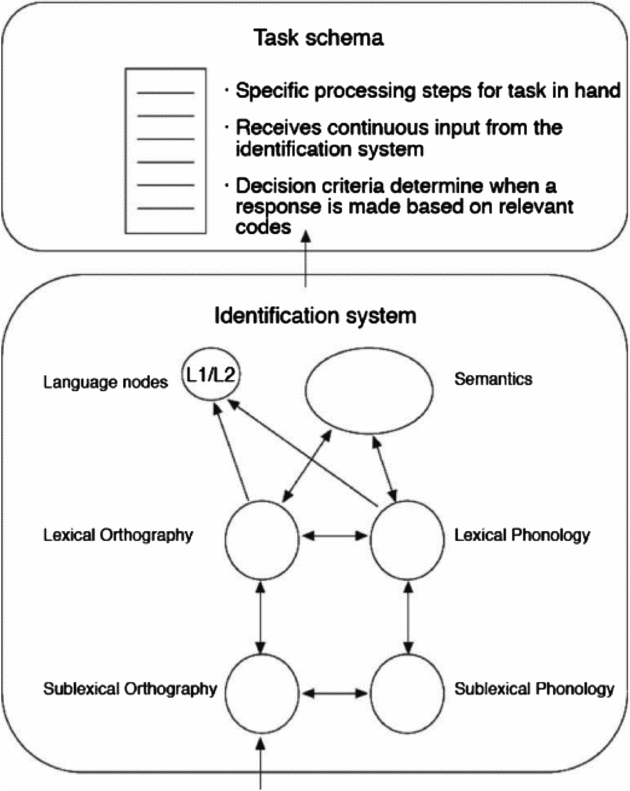
According to one account, cognate facilitation can be framed within the BIA+ (Bilingual Interactive Activation Plus) model of visual word recognition (Dijkstra & van Heuven, Reference Dijkstra and van Heuven2002). The BIA+ assumes that L1 and L2 lexical items are stored in an integrated manner: orthographic, phonological and semantic representations of words are accessed in a language non-selective way. This model is the successor of the original BIA model (Dijkstra & van Heuven, Reference Dijkstra, van Heuven, Grainger and Jacobs1998), which is a bilingual adaptation of the Interactive Activation model (McClelland & Rumelhart, Reference McClelland and Rumelhart1981). When a word is encountered, matching orthographic candidates are activated through bottom-up activation, dependent on their similarity to the printed word and their resting-level activation, determined by the subjective frequency. As L2 items tend to be lower in subjective frequency, their representations are activated somewhat slower than L1 items. The activation spreads from the orthographic candidates to the connected phonological and semantic representations. Every word in the lexicon is connected to one of the available language nodes, representing the language membership of that word. In BIA+, these nodes also represent the global lexical activity of a language. These nodes do not feed activation back to the orthographic or phonological level so they cannot function as a language selection mechanism. Instead, in order to account for differences in word recognition depending on tasks and other non-linguistic variables (e.g., instructions, expectations of the participants) a task/decision system is proposed. See Figure 1 for a schematic representation of the BIA+ model.
The architecture of the BIA+ model (taken from Dijkstra & Van Heuven, Reference Dijkstra and van Heuven2002).

Within the BIA+ framework, the combination of meaning and form overlap gives rise to the cognate facilitation effect. The degree of this cross-linguistic overlap will determine the amount of facilitation from these overlapping representations. For non-identical cognates, the input word will activate all lexical candidates, including the target representation and the form-overlapping cognate in the non-target language. For example: tomato in English will activate both the Dutch orthographic representation tomaat and the English correct orthographic representation tomato. The overlapping semantic representation of tomaat will facilitate the recognition of the target word tomato. As described above, cognate facilitation may indeed emerge when orthographic overlap is incomplete. In fact, the size of the facilitation effects should depend on the cross-linguistic overlap: more overlap results in stronger cognate facilitation effects (Bultena et al., Reference Bultena, Dijkstra and Van Hell2014; Dijkstra et al., Reference Dijkstra, Miwa, Brummelhuis, Sappelli and Baayen2010; Van Assche et al., Reference Van Assche, Drieghe, Duyck, Welvaert and Hartsuiker2011, Reference Van Assche, Duyck, Hartsuiker and Diependaele2009). For unbalanced bilinguals, another hypothesis arises. Because L1 lexical representations are used more often than L2 lexical representations, the higher resting activation for L1 items will result in larger cognate facilitation in L2 processing than in L1 processing.
An important question is whether identical cognates are represented in the same way as non-identical cognates and whether they share one orthographic representation or instead have two distinct orthographic representations. The shared orthographic representation option would distinguish identical cognates from other translation equivalents and non-identical cognates, which by definition need to be represented twice in the bilingual lexicon, because of their orthographic (and phonological) differences. As Dijkstra et al. (Reference Dijkstra, Miwa, Brummelhuis, Sappelli and Baayen2010) note, the BIA+ model leaves open the option for both possibilities. In case of two distinct orthographic codes, it can be expected that at some point during the word recognition process, two lexical candidates receive the same amount of activation. In the BIA+ framework, this will cause lateral inhibition. When it is assumed that identical cognates share one orthographic representation, this lateral inhibition will be absent. So in the latter case, an additional facilitation effect for identical cognates on top of the effect of orthographic overlap should be present. Following this reasoning, the facilitation for identical cognates should be detected relatively fast. The facilitation for non-identical cognates would take place later as an effect of shared semantic representation feedback (Dijkstra et al., Reference Dijkstra, Miwa, Brummelhuis, Sappelli and Baayen2010).
To be able to distinguish between the two possibilities, Dijkstra et al. (Reference Dijkstra, Miwa, Brummelhuis, Sappelli and Baayen2010) explicitly investigated the two distinct effects of identical cognate status and orthographic overlap. They tested Dutch–English bilinguals’ performance on an L2 lexical decision task (Experiment 1, Dijkstra et al., Reference Dijkstra, Miwa, Brummelhuis, Sappelli and Baayen2010). They showed that both identical cognate status and orthographic overlap had a facilitating effect on reaction times. Larger orthographic overlap between a word and its translation equivalent yielded faster recognition. In addition to the expected facilitation by orthographic overlap, identical cognates showed much faster reaction times. This large discontinuous facilitation for identical cognates implies that identical cognates may be represented differently than non-identical cognates and may share one orthographic representation between languages.
Another viewpoint on cognate representation assumes that cognates have a supra-lexical connection with their cross-language translation equivalents. This supra-lexical representation transcends each language-specific lexicon (Cristoffanini, Kirsner & Milech, Reference Cristoffanini, Kirsner and Milech1986; Davis et al., Reference Davis, Sánchez-Casas, García-Albea, Guasch, Molero and Ferré2010; Kirsner, Lalor & Hird, Reference Kirsner, Lalor, Hird, Schreuder and Weltens1993; Lalor & Kirsner, Reference Lalor and Kirsner2000; Sánchez-Casas et al., Reference Sánchez-Casas, Davis and García-Albea1992; Sánchez-Casas & García-Albea, Reference Sánchez-Casas, García-Albea, Kroll and de Groot2005). This idea is similar to Giraudo and Grainger's (2003) idea of a shared morphemic representation. More specifically, words that share an etymological root share a representation at the morphological level, located between the form and the lemma level. This cross-language connection for cognates could facilitate recognition. As a consequence, cognate facilitation should be sensitive to the cumulative frequency of the shared morphemic representation: reaction times for cognates should be more affected by this cumulative frequency measure than by individual frequencies. However, it remains unclear what the necessary degree of form overlap should be to create such a cross-language connection or shared morpheme. This shared-morpheme view suggests that once this threshold of orthographic overlap necessary to create a shared morpheme is crossed, equal facilitation for all cognates should be found.
In contrast to the shared-morpheme explanation, Peeters et al. (Reference Peeters, Dijkstra and Grainger2013) proposed a two-morpheme view in which identical cognates are represented by one orthographic representation and have two distinct language-specific morphological representations. The BIA+ architecture is used to explain the cognate facilitation effect, namely activation spreading from orthographic codes to other representations. This two-morpheme view allows for cognates to have different gender and plural information and a separate subjective frequency in the two languages. This account also explains the larger facilitation for identical cognates compared to non-identical cognates (Dijkstra et al., Reference Dijkstra, Miwa, Brummelhuis, Sappelli and Baayen2010). Peeters et al. provide evidence for two-separate rather than one morphological representation (e.g., Sánchez-Casas & García-Albea, Reference Sánchez-Casas, García-Albea, Kroll and de Groot2005) by testing late French–English bilinguals on an L2 lexical decision task. Because cognates with a low L2 and high L1 frequency have a higher subjective cumulative frequency than those with high L2 and low L1 frequency, the shared-morpheme account predicts that the former words would be responded to faster in L2 than the latter. Peeters et al.’s results provided evidence against the shared-morpheme account: cognates with a high L2 frequency and a low L1 frequency were processed more quickly than cognates with a low L2 frequency and a high L1 frequency. Peeters et al. claim that for late bilinguals, two separate morphological representations for identical cognates are plausible and might develop, because of the different learning contexts (classroom vs. at home).
Present study
The first aim of the present study is to investigate whether cognate facilitation is restricted to reading of experimental materials, or whether it is strong enough to influence reading of continuous, meaningful, unconstructed text (i.e., a novel). The sentence reading studies described above (e.g., Duyck et al., Reference Duyck, Van Assche, Drieghe and Hartsuiker2007; Libben & Titone, Reference Libben and Titone2009; Schwartz & Kroll, Reference Schwartz and Kroll2006; Titone et al., Reference Titone, Libben, Mercier, Whitford and Pivneva2011; Van Assche et al., Reference Van Assche, Drieghe, Duyck, Welvaert and Hartsuiker2011; Van Hell & De Groot, Reference Van Hell and de Groot2008) aimed to operationalize natural reading by embedding target words in experimentally constructed L1 or L2 sentences, but this is still a rather contrived situation. Although in daily life, people are exposed to such isolated sentences, for example when reading text on computer screens (short Facebook posts or tweets) or forms, they also (and predominantly) read sentences that are embedded in a larger meaningful whole, such as a novel or a newspaper. Here, it may be possible that the more constrained semantic context of a sentence, embedded in a larger text, reduces the cross-lingual activation causing cognate effects, or that the additional processes inherent to text processing and integration outweigh and obscure the word-level cognate effects that are observed in experimental materials. Second, most of the papers reporting isolated sentence research have used constructed sentences manipulating the frequency of the target words or structures of the sentences, therefore making the materials less representative for real-life reading material. On the other hand, these manipulated sentences could provide more power to test specific hypotheses, while using non-constructed text might yield more generalizable findings. Nevertheless it is possible that cognate effects observed in single sentences may be restricted to everyday reading of isolated sentences and may not generalize to sentences embedded in a larger text and semantic context. Also, the difference in goals people have for reading isolated sentences in an experimental setting, compared to meaningful text, could elicit different reading strategies for these different contexts. There is indeed evidence that reading a continuous text or story is not the same as reading isolated sentences. Radach, Huestegge and Reilly (Reference Radach, Huestegge and Reilly2008) showed that the total reading time of words is longer for reading passages, but also the earlier eye movements are faster than when reading isolated sentences. Radach et al. explained this by suggesting that readers of passages of text perform a fast first pass across the text followed by a rereading of the passage. This may make it more difficult to detect cognate effects in reading of extended text. In short, the differences between the previous isolated-sentence studies (e.g., Duyck et al., Reference Duyck, Van Assche, Drieghe and Hartsuiker2007; Libben & Titone, Reference Libben and Titone2009; Schwartz & Kroll, Reference Schwartz and Kroll2006; Titone et al., Reference Titone, Libben, Mercier, Whitford and Pivneva2011; Van Assche et al., Reference Van Assche, Drieghe, Duyck, Welvaert and Hartsuiker2011; Van Hell & De Groot, Reference Van Hell and de Groot2008) and the current study are a) the use of non-manipulated, natural text, and b) the use of coherent sentences in a much larger semantic context, i.e., a novel.
There is only one study that did investigate cognate facilitation in a larger textual context (Balling, Reference Balling2013), but only in L2. Balling (Reference Balling2013) instructed Danish–English bilinguals to read paragraphs of texts in their L2 of about 260 words. From these texts, 105 words were analyzed. In the statistical analysis of the data contextual predictability, word repetition and word position in line were inserted in the model. Her results showed no clear cognate facilitation in first fixation durations, but in gaze duration and total reading time, morphologically simple words were read faster when they were cognates. This is indeed evidence for the relevance of cross-lingual interactions in reading, but in everyday life we do not encounter solely monomorphemic words. On the contrary, most content words are morphologically complex.
Hereby, we aim to replicate Balling's findings for L2 reading of an entire novel. Narrative or extended text reading introduces many additional processes (e.g., syntax, pragmatics, text integration) that are not, or less, important for reading isolated words or sentences. The current approach therefore allows investigating the generalizability of effects that are observed in the reading of shorter materials. Also, we will try to extend these results to L1 reading. Cognate facilitation in L1 visual word recognition is usually smaller than in L2 reading and has not been reported very often (for a few exceptions, see Van Hell & Dijkstra, Reference Van Hell and Dijkstra2002; Van Assche et al., Reference Van Assche, Duyck, Hartsuiker and Diependaele2009, Titone et al., Reference Titone, Libben, Mercier, Whitford and Pivneva2011). The BIA+ model (Dijkstra & van Heuven, Reference Dijkstra and van Heuven2002) indeed predicts smaller cognate facilitation effects in L1 versus L2. On top of that, the question whether L1 cognate facilitation can be found in an extended narrative reading context has never been tested.
The second aim is to investigate the difference between the facilitation effects for identical and non-identical cognates, because this difference reveals how cognates might be represented in the bilingual brain. These two distinct effects were already investigated together for L2 word recognition in isolation by Dijkstra et al. (Reference Dijkstra, Miwa, Brummelhuis, Sappelli and Baayen2010). As described above, L2 lexical decision times were faster as the orthographic overlap was larger, but an added drop in reaction times was found for identical cognates. We will investigate these effects simultaneously during extended narrative reading. If we find similar results, this offers evidence for the viewpoint which assumes that identical cognates are represented by one orthographic representation, while non-identical cognates have two separate orthographic codes (e.g., Dijkstra & van Heuven, Reference Dijkstra and van Heuven2002; Peeters et al., Reference Peeters, Dijkstra and Grainger2013). If we do not replicate the additional drop in eye movement durations for identical cognates, this may be a consequence of the lexical decision task used in the study of Dijkstra et al. (Reference Dijkstra, Miwa, Brummelhuis, Sappelli and Baayen2010): for instance, due to the decision component that it entails.
Given the architecture of the BIA+ model (Dijkstra & van Heuven, Reference Dijkstra and van Heuven2002), we expect to find early facilitation effects for identical cognates and later effects of non-identical cognate facilitation. The absence of lateral inhibition on the orthographic level for identical cognates sharing an orthographic representation would cause a very early difference to arise between these and other words. For non-identical cognates, two lexical orthographic representations are activated that initially inhibit each other via lateral inhibition, but may still lead to later cognate facilitation effects via semantic resonance.
Method
This method section is partly taken from Cop, Drieghe and Duyck (Reference Cop, Dirix, Drieghe and Duyck2015) because the data in this analysis is a subset from a large eye movement corpus described in Cop, Dirix, Drieghe and Duyck (Reference Cop, Dirix, Drieghe and Duyck2015).
Participants
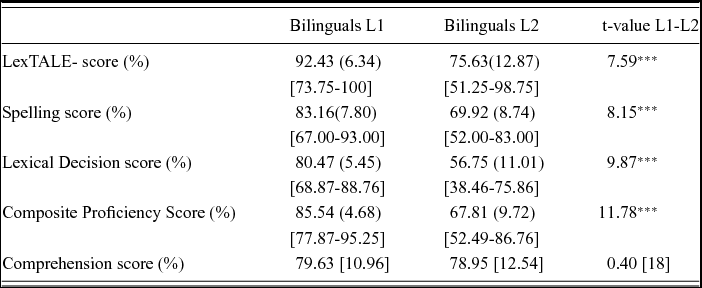
Nineteen unbalanced bilingual Ghent University undergraduates participated either for course credit or monetary compensation. The participants’ dominant language was Dutch and their second language was English. The participants were all intermediate to advanced L2 learners with a relatively late L2 age of acquisition (mean = 11 [2.46]). All had had formal education of English in the Belgian school system from age 12 or 13. The average age of the participants was 21.21 years [19-25]. Two males and seventeen females participated. Participants had normal or corrected-to-normal vision. None of the participants reported having any language and/or reading impairments. Participants completed a battery of language proficiency tests including a Dutch and English spelling test (GLETSHER and WRAT4), the LexTALE (Lemhöfer & Broersma, Reference Lemhöfer and Broersma2012) in Dutch and English, a Dutch and English lexical decision task and a self-report language questionnaire (based on the LEAP-Q, Marian, Blumenfeld & Kaushanskaya, 2007). Due to the lack of a standardized cross-lingual spelling test, we tested the English spelling with the spelling list card of the WRAT 4 (Wilkinson & Robertson, 2006) and the Dutch spelling with the GLETSHER (Depessemier & Andries, 2009). The LexTALE (Lexical Test for Advanced Learners of English) is an unspeeded lexical decision task that contains a high proportion of words with a low corpus frequency. First developed as a vocabulary test, Lemhöfer and Broersma (Reference Lemhöfer and Broersma2012) have validated this as a measure of general English Proficiency. This test has been later extended to Dutch and German. The mean accuracy scores for the LexTALE and the spelling test are reported in Table 1. Two bilinguals were classified as lower intermediate L2 language users (50%–60%), ten bilinguals were classified as upper intermediate L2 language users (60%–80%), seven bilinguals scored as advanced L2 language users (80%–100%) according to the LexTALE norms reported by Lemhöfer and Broersma (Reference Lemhöfer and Broersma2012).
Average percentage scores (standard deviations between brackets and range between square brackets) on the LexTALE, Spelling test and Lexical Decision task for the bilingual and monolingual group.

***p < .001
A classical speeded lexical decision task was also administered in Dutch and English, where participants had to classify letter strings as words or non-words as fast as possible. In Table 1, the percentage of correct word trials corrected for false alarms is shown.
We additionally calculated a composite L1 and L2 proficiency score by averaging the score on the spelling test, the score on the LexTALE and the adjusted score of the lexical decision task. This composite score shows that bilinguals score significantly higher on general L1 proficiency than they do on L2 proficiency (see Table 1). Although this is a very interesting variable to inspect, this composite score would be difficult to replicate for other researchers. This is why only the LexTALE score is used in the analysis. This score has been used in many bilingual studies (e.g., Bultena et al., Reference Bultena, Dijkstra and Van Hell2014; Diependaele, Lemhöfer & Brysbaert, Reference Diependaele, Lemhöfer and Brysbaert2013) and is also clearly defined as reflecting vocabulary size. This makes it easier to compare effects of this variable to previous (and future) findings.
Apparatus
The bilingual eye movement data were recorded with a tower-mounted EyeLink 1000 system (SR-Research, Canada) with a sampling rate of 1 kHz. Participants’ head movements were minimized by the use of a chin rest. Reading was binocular, but eye movements were recorded only from the right eye. Text was presented in black 14 point Courier New font on a light grey background. The lines were triple spaced and 3 characters subtended 1 degree of visual angle or 30 pixels. Text appeared in paragraphs on the screen. A maximum of 145 words was presented on one screen. During the presentation of the novel, the room was dimly illuminated.
Materials
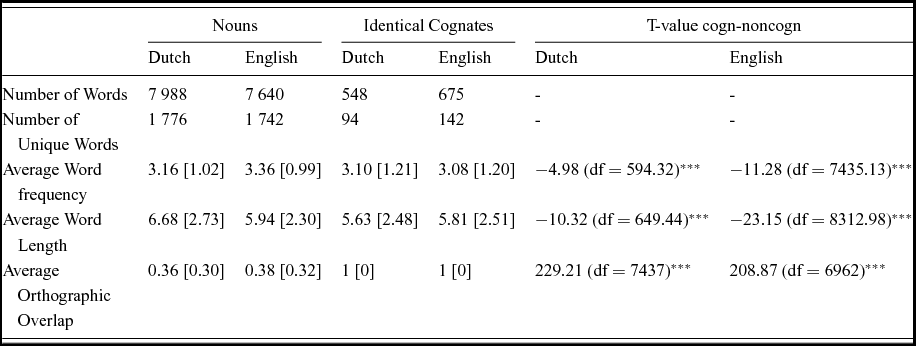
The participants were asked to read the novel The mysterious affair at Styles by Agatha Christie (Title in Dutch: De zaak Styles). This novel was selected out of a pool of books that were available via the Gutenberg collection. The books were judged on length and difficulty, indicated by the frequency distribution of the words that the book contained. We selected the novel whose word frequency distribution was the most similar to the one in natural language use (Subtlex database). The Kullback–Leibler divergence was used to measure the difference between the two probability distributions (Cover & Thomas, 1991). See Table 2 for characteristics of the target nouns in the novel. Both word frequency and word length show minor differences across languages, these variables will be included in the higher order interactions in our linear mixed model to ensure statistical control of these predictors that were not experimentally controlled.
Summary of the characteristics of all of the nouns and the identical cognates in the novel. Standard deviations (SD) are in brackets.

Only the nouns were selected for the current analyses. We excluded nouns that were presented at the beginning and end of a line of text (for similar practices see Balling, Reference Balling2013; Whitford & Titone, Reference Whitford and Titone2012), because their fixation times represent also peripheral processes. We only analyzed eye movements towards nouns. Most previous studies investigating the processing of cognates have looked at nouns. This means we can compare our results more readily with previous findings (for recent exceptions using verbs, see Bultena et al., Reference Bultena, Dijkstra and Van Hell2013, Reference Bultena, Dijkstra and Van Hell2014; Van Assche et al., Reference Van Assche, Duyck and Brysbaert2013). Secondly, the cognate status of nouns is determined more easily than that of, for example, verbs, for which it is not always clear what form of the verb should be considered to determine cognate status.
Analyzing a subset of our data also served a practical purpose. Because we used the authentic text of a novel, we had to assess the cognate status and in-context translation of all nouns manually. Even without other word types, this was already a huge effort.
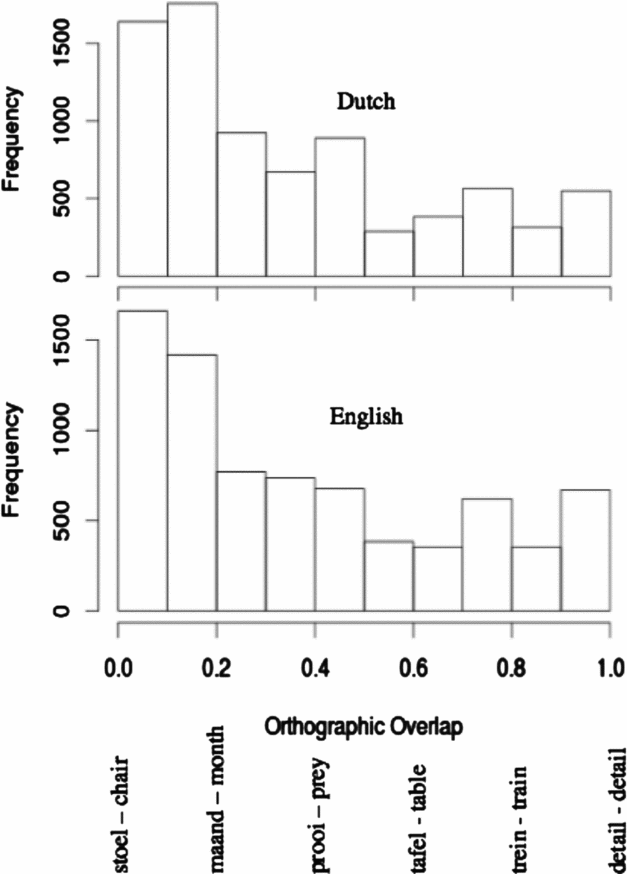
Balling (Reference Balling2013) already showed that the cognate status of words in sentence context must be evaluated relative to the context-appropriate translation equivalent. For example, when the Dutch word arm is placed in a context as a noun, it is a cognate with the English word arm, whereas when it is placed in a Dutch context as an adjective, it means poor in English and can no longer be considered a cognate. We therefore manually assessed all the possible appropriate translations in context for each noun in the novel. We then selected the translation that was orthographically closest to the target word. When this translation was orthographically identical to the target word it was classified as an identical cognate. For all translation pairs we calculated the corrected Levenshtein distance (Schepens, Dijkstra & Grootjen, Reference Schepens, Dijkstra and Grootjen2012). For the formula, see Appendix A. This variable was used as a measure for continuous orthographic overlap in our analyses. For the frequency distribution of orthographic overlap and some examples of translation pairs, see Figure 2.
The frequency distribution of orthographic overlap for all nouns in the Dutch and English version of the novel. Examples of translation equivalent pairs dependent on orthographic overlap are given below the graphs.

Procedure
All of the participants reported that they had not read the novel The mysterious affair at Styles by Agatha Christie before, either in Dutch or English. The participants read the entire novel in four sessions of an hour and a half. One bilingual participant read only the first half of the novel in English in two sessions. The others read half of the novel in Dutch, the other half in English. The order was counterbalanced.
The participants were instructed to read the novel silently while the eye tracker recorded their eye movements. It was stressed that they should move their head and body as little as possible while they were reading. The participants were informed that they would be presented with multiple-choice questions about the contents of the book after each chapter. This was done to ensure that participants understood what they were reading and paid attention throughout the session. The book consisted of thirteen chapters. The participants read the first four chapters in the first session, chapters five through seven in the second session, chapters eight through ten in the third session and in the final session they read chapters eleven through thirteen.
The text of the novel appeared on the screen in paragraphs. A maximum of 145 words were presented on the screen in one trial. When the participant finished reading the sentences on one screen, he or she pressed the appropriate button on a control pad to move to the next part of the novel. After each chapter, multiple-choice questions were given to the participant. Participants were given the choice to pause for a maximum of 10 minutes after each chapter.
Before starting the practice trials, a nine-point calibration was executed. After this, the calibration was done every 10 minutes, or more frequently when the experiment leader deemed necessary.
Analyses
The temporal resolution of eye movement recording during reading enables the distinction between early and late language processing to be made. We analyzed four eye movement measures that reflect early language processes such as initial lexical access: a) First fixation duration, the duration of the first fixation on the target noun the first time they land on it; b) Single fixation duration, first pass fixation duration on a word that is fixated exactly once; c) Gaze duration, the sum of all fixation durations during first passage before the eyes move out of the word and, d) probability of first pass skipping of a word. We analyzed two eye movement measures of reading times of the nouns that reflect later, higher-order, language processes such as semantic integration: a) Go past time, the sum of all fixation durations on the target word including all of the regressions to previous words until the eyes move rightward from the target word; b) Total reading time, the sum of all fixation durations on the target word, including refixations. Fixations shorter than 100 ms were excluded from the dataset (Rayner, Reference Rayner1998).
Reading time measures and skipping probabilities were fitted in (generalized) linear mixed models using the lme4 package (version 1.1-7) of R (version 3.0.2). All of the initial models contained the fixed factors of Language (L1 or L2) and Cognate status (Identical Cognate or not) and the covariates Orthographic Overlap (continuous), L1 proficiency (continuous) and L2 Proficiency (continuous) and the control variables of word frequency (continuous), word length (continuous) and rank of occurrence of the noun (continuous). As proficiency variables we used the score on the L1 and L2 LexTALE (Lemhöfer & Broersma, Reference Lemhöfer and Broersma2012). For the word frequency, the subtitle word frequency measures (English: Brysbaert & New, 2009; Dutch: Keuleers, Brysbaert & New, 2010) were log transformed to normalize their distribution. The rank of occurrence was the chronological rank of the word form in which it was encountered for the participants. For example, if the same word was encountered once previously in the novel, the rank of occurrence of the target noun would be 2. To reduce collinearity, all continuous predictors were centered.
We included a random intercept per subject in all initial models. This ensured that differences between subjects concerning genetic, developmental or social factors were represented in the model (Baayen, Davidson & Bates, Reference Baayen, Davidson and Bates2008). We also included a random intercept per word, to be able to generalize to other nouns, because our stimuli sample is not an exhaustive list of all nouns in a language. The models were fitted using restricted maximum likelihood estimation (REML). First a full model, including the two random factors and all of the 2-and 3-way interactions between the fixed effects, was fitted. The optimal model was discovered by backward fitting of the fixed effects, then forward fitting of the random effects and finally again backward fitting the fixed effects (Barr, Levy, Scheepers & Tily, 2013). To be more specific, in the first phase of backward fitting we excluded the fixed model term that was contributing the least to the goodness of fit of the current model. Then we used model comparison to confirm that the newly constructed model was not significantly lower in goodness of fit than the previous model. We always kept the simple fixed effects in the model. This means we only excluded the 3- and 2-way interactions that were not significant. When arriving at the restricted model, we added random slopes in order of theoretical importance. We again tested the contribution of each of the random slopes with model comparisons. We strived to include a maximal random structure in the final models (Barr et al., 2013). After adding all of the contributing random slopes, we again excluded non-significant fixed interaction effects one by one, until we arrived at the optimal model.
Results
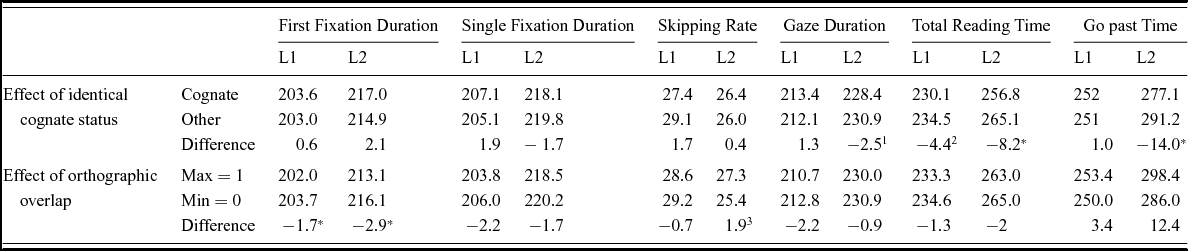
For an overview of the fitted values for the effect of identical cognate status and orthographic overlap of the final models, see Table 3.
Mean fitted values and difference score for First Fixation duration, single fixation duration, gaze duration, total reading time, go past time and skipping rate for the effect of identical cognate status and orthographic overlap in the presence of possibly interacting variables as shown in tables 4–9 of the final models.

+p-value < 0.1 in final model,* p-value < 0.05 in final model
1 The interaction with word length was marginally significant. The effect of cognate status was significant for nouns shorter than 2 characters.
2 The interaction with word frequency was significant. The effect of cognate status was significant for nouns with a log frequency lower than 0.8 and higher than 4.6.
3 The interaction with word length was significant. The effect of orthographic overlap was significant for nouns shorter than 7 characters.
First fixation duration
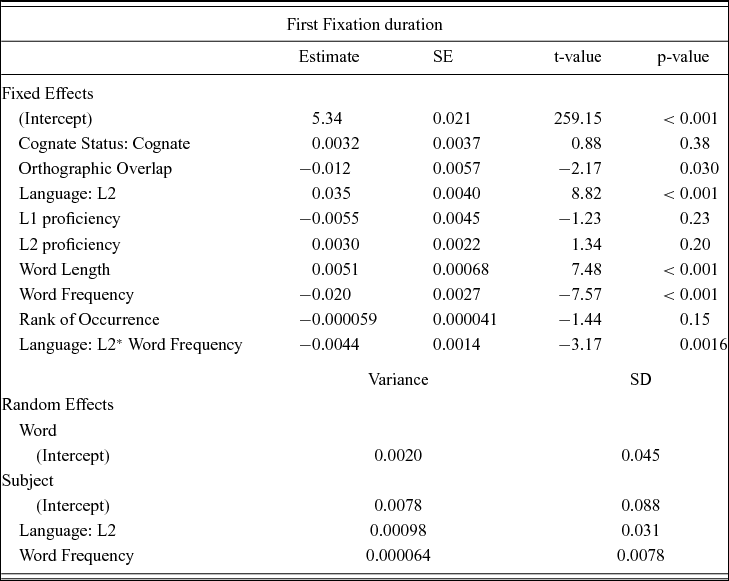
First Fixation durations that differed more than 2.5 standard deviations from the subject means per language (2.15% for Dutch, 2.21% for English) were excluded. This left us with 87 980 data points. The dependent variable was log transformed to normalize the distribution as suggested by the Box-Cox method (Box & Cox, Reference Box and Cox1964). The outcome of the final model for first fixation duration is presented in Table 4. The maximum correlation between fixed effects in the final model was −.69 for L1 and L2 proficiency. All other correlations were smaller than .40 except the correlation between Orthographic Overlap and cognate status, which was −.52. We chose not to drop any of these variables, because doing this could cause the estimate for the fixed effects that remain in the model to be inflated (Baguley, Reference Baguley2012); also, there is no way to make a distinction between either L1 and L2 proficiency or cognate status and orthographic overlap. Keeping correlated fixed effects in the same model causes these to have a larger standard error, making the estimates less accurate, however they remain unbiased. We calculated the variance inflation factor (VIF) for all fixed effects using an R-code written by Dr. Nielsen provided by one of the reviewers of this manuscript. In this case the VIF is 1.92 for both proficiency effects and 1.37 for the cognate status and the orthographic overlap. Seeing that a VIF value larger than 5 is considered to be problematic (Fox & Weisberg, Reference Fox and Weisberg2010), the correlation matrix for this model is not a problem. However, the t-value will be slightly further from statistical significance, meaning the tests for L1 and L2 proficiency and cognate status and orthographic overlap will be more conservative than the other tests for the fixed effects (Baguley, Reference Baguley2012). This effect will be attenuated because of our large sample size. For these reasons, we keep all fixed effects in our models for the following analyses as long as the VIF is lower than 5.
Estimates, standard errors (SE) t-values, and p-values for the fixed effect and variance and SD's for the random effects for the final model for first fixation durations. Treatment coding was used for the factor language with L1 as reference level and for the factor cognate status with non-cognate as the reference level

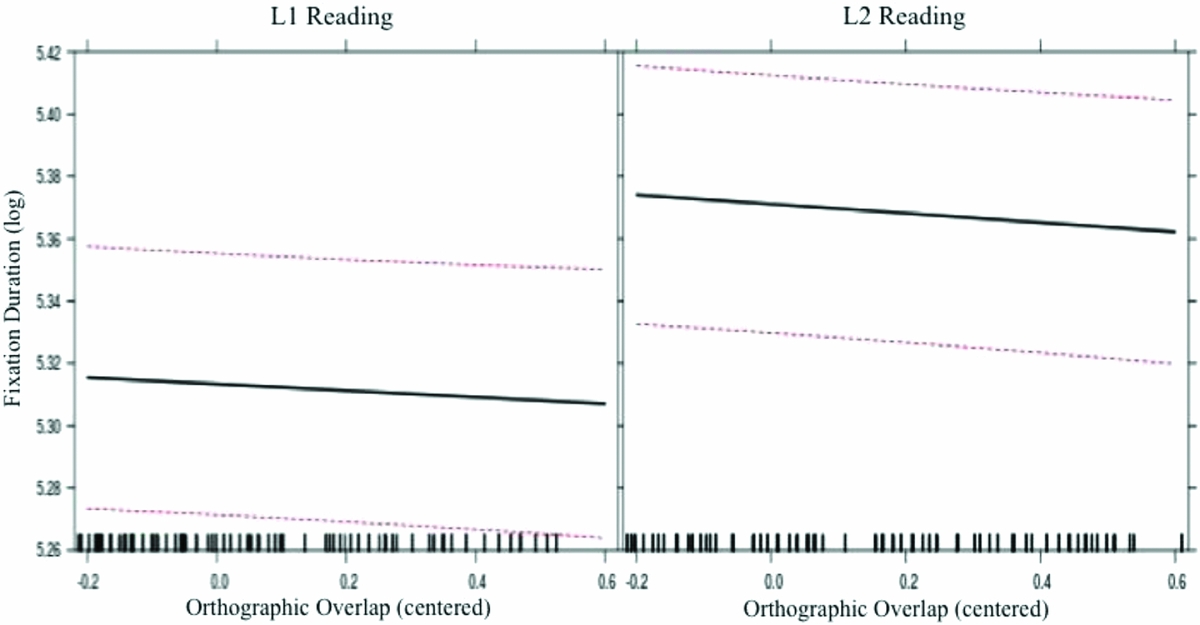
A significant main effect of language was found. First fixations on nouns were longer in L2 (226 ms) than in L1 (212 ms). Importantly, we found an effect of orthographic overlap: target words with larger orthographic overlap with their translation equivalents yielded shorter first fixation durations (see Figure 3). This variable did not interact with language, indicating a comparable cognate facilitation effect in L1 and L2.
Effect of orthographic distance on first fixation duration (log transformed) for L1 and L2 reading. The 95% Confidence Intervals (CI's) are depicted as dotted lines.

The effect of identical cognate status was not significant. This means that there was no additional facilitation for identical cognates compared to non-identical cognates that cannot be explained by a linear decrease in fixation duration due to the increase in orthographic overlap.
In addition, for first fixation duration we found an interaction between language and word frequency. Separate analyses for each language showed that the facilitatory effect of word frequency was larger for L2 (β = −0.0096, se = 0.0015, t = −6.46, p < .01) than for L1 (β = −0.0082, se = 0.0013, t = −6.33, p < .01).
Single fixation durations
Single Fixation durations that differed more than 2.5 standard deviations from the subject means were excluded per language (2.17% for Dutch, 2.22% for English). This left us with 61 860 data points. The dependent variable was log transformed to normalize the distribution as suggested by the Box-Cox method (Box & Cox, Reference Box and Cox1964).
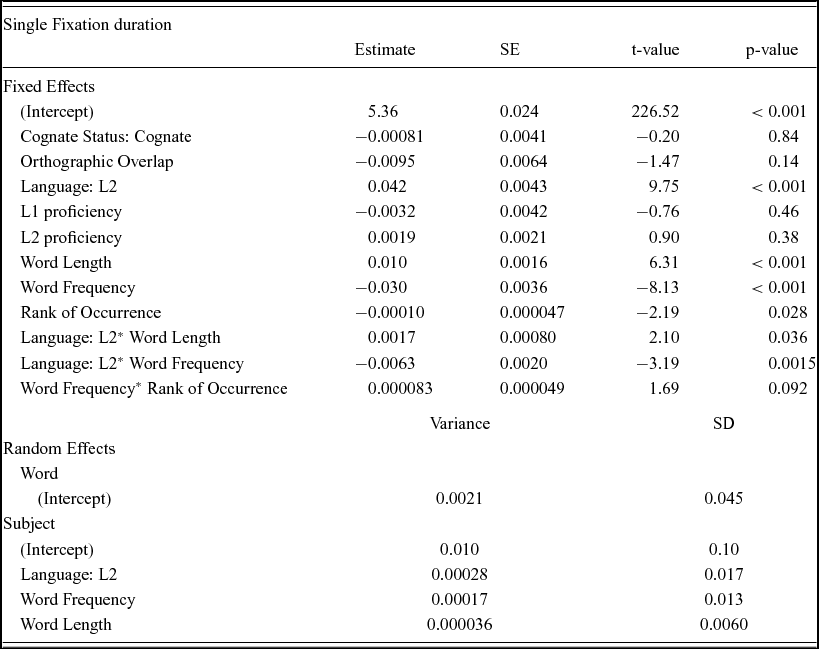
The outcome of the final model for single fixation duration is presented in Table 5. The maximum correlation between fixed effects in the final model was −.69 for L1 and L2 proficiency. The maximum value of VIF was 1.95.
Estimates, SE's and t-values for the fixed effect and variance and SD's for the random effects for the final model for Single fixation durations. Treatment coding was used for the factor language with L1 as reference level and for the factor cognate status with non-cognate as the reference level.

A significant main effect of language was found. Single fixations on nouns were longer in L2 (236 ms) than in L1 (218 ms).
Neither the effect of orthographic overlap, nor the effect of identical cognate status reached significance. These variables did not interact significantly with any other fixed effects.
There was again a significant interaction of language and word frequency, but also with word length. Separate analyses for each language showed that the facilitatory effect of word frequency was again larger for L2 (β = −0.017, se = 0.0022, t = −7.52, p < .01) than for L1 (β = −0.012, se = 0.0015, t = −8.12, p < .01). The inhibitory effect of word length was also larger for L2 (β = 0.005, se = 0.0009, t = 5.49, p < .01) than for L1 (β = 0.0041, se = 0.0007, t = 5.73, p < .01).
Gaze duration
Gaze durations that differed more than 2.5 standard deviations from the subject means were excluded per language (2.44% for Dutch, 2.45% for English). This left us with 87 643 data points. The dependent variable was transformed with the Box-Cox transformation (1) to normalize the distribution (Box & Cox, Reference Box and Cox1964). The value for lambda was set at −0.5.
 $$\begin{equation}
{y_{transformed}} = {\rm{\ }}\frac{{{y^{ - 0.5}} - 1}}{{ - 0.5}}
\end{equation}$$
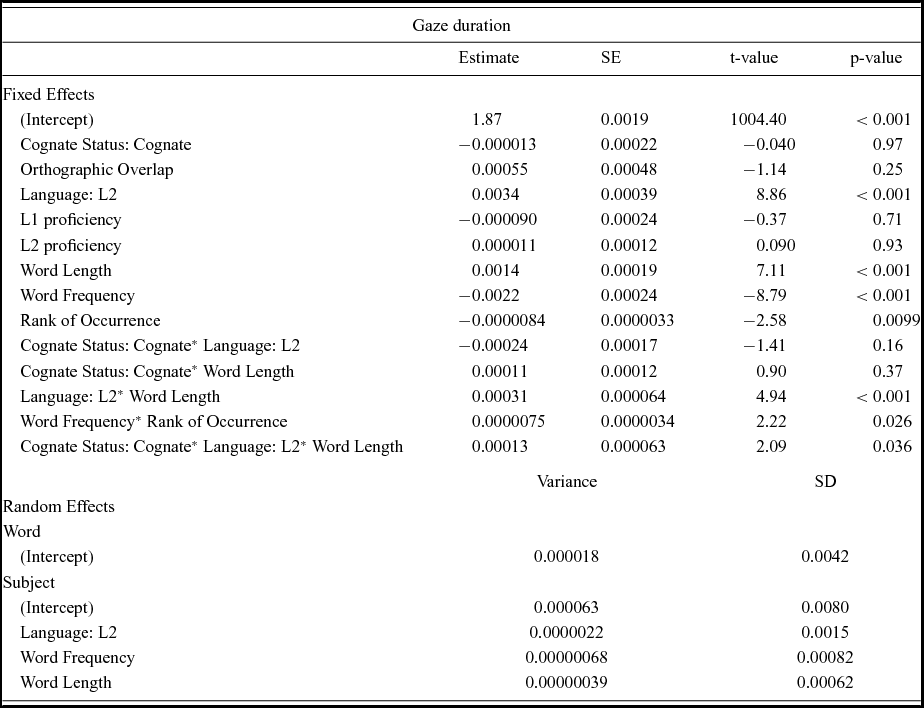
The outcome of the final model for gaze durations is presented in Table 6. The maximum correlation between fixed effects in the final model was −.69 for L1 and L2 proficiency. All VIF's were below 1.91.
Estimates, SE's and t-values for the fixed effect and variance and SD's for the random effects for the final model for gaze durations. Treatment coding was used for the factor language with L1 as reference level and for the factor cognate status with non-cognate as the reference level

A significant main effect of language was found. The effect of orthographic overlap was not significant. The main effect of identical cognate status was not significant but a 3-way interaction between language, identical cognate status and word length was found. Separate analyses per language revealed that for L1 reading there was no effect of identical cognate status (β = 0.00050, se = 0.00092, t = 0.54, p = .59) and no interaction with word length (β = −0.00015, se = 0.00033, t = −0.48, p = .63).
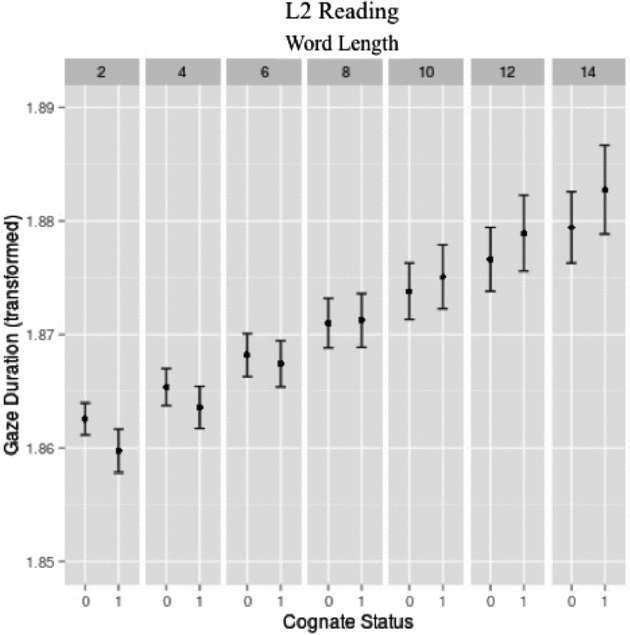
In L2, a marginal significant interaction effect of identical cognate status and word length was found (β = 0.00051, se = 0.00029, t = 1.73, p = .083). Although the main effect of identical cognate status did not reach significance for L2 reading (β = −0.00083, se = 0.00080, t = −1.0), the marginal interaction with word length indicated that identical cognates were read faster than other nouns (see Figure 4). Planned comparisons showed that gaze durations of nouns of 4 characters or fewer were facilitated when the target noun was an identical cognate (χ2 = 3.19, df = 1, p = .074), but this effect only reached full significance when the target noun was 2 characters or less (χ2 = 3.85, df = 1, p < .05). There were 120 unique identical cognate nouns in the novel, which were 4 characters long or shorter, but there was only one unique identical cognate that was 2 characters long. This means that this significant effect needs further investigation, possibly within a factorial design including more short identical cognate nouns, before definite conclusions can be made.
Effect of identical cognate status (1 = Identical Cognate, 0 = Other) on gaze durations (transformed) dependent on word length for L2 reading. The 95% CI's are depicted as whiskers.Footnote 1

Probability of skipping
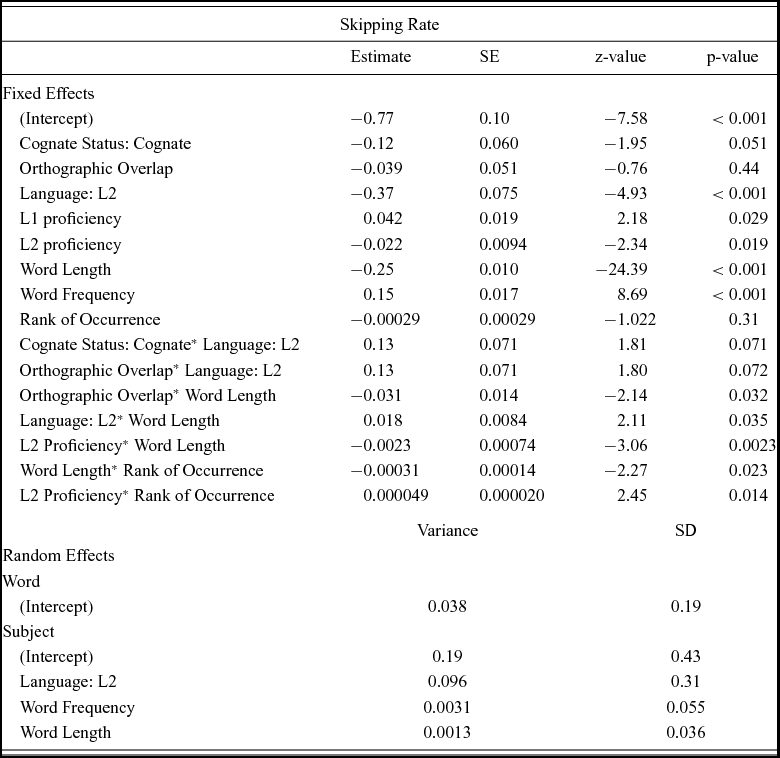
For skipping probability a logistic linear mixed model was fitted with a binary dependent variable (i.e., whether the word was skipped or not). We analyzed 116 695 observations. The outcome of the final model for skipping probabilities is presented in Table 7. The maximum correlation between fixed effects in the final model was −.54 for L1 and L2 proficiency. The maximum VIF value was 3.38.
Estimates, SE's and t-values for the fixed effect and variance and SD's for the random effects for the final model for skipping rates. Treatment coding was used for the factor language with L1 as reference level and for the factor cognate status with non-cognate as the reference level

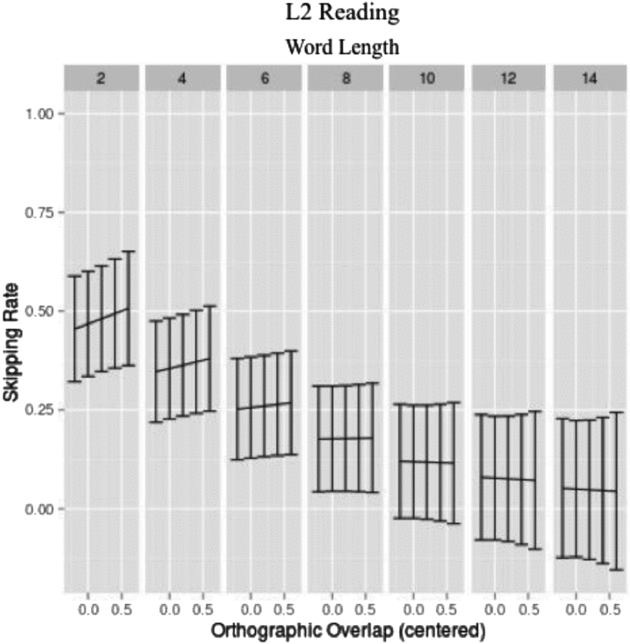
We found a main effect of language. We did not find a main effect of orthographic overlap. The interaction of orthographic overlap and word length was significant and the interaction between orthographic overlap and language was significant. Separate analyses showed that for L1 reading the effect of orthographic overlap was not significant (β = −0.037, se = 0.052, t = −0.72, p = .47), neither was the interaction of this variable with word length (β = −0.020, se = 0.020, t = −1.03, p = .30). In L2, the effect of Orthographic Overlap was significant (β = 0.10, se = 0.049, t = 2.13, p = .033) and interacted with Word Length (β = −0.040, se = 0.020, t = −2.05, p = .040) (see Figure 5). Planned comparisons showed that L2 nouns shorter than 6 characters were skipped more often when they had a larger orthographic overlap (χ2 = 4.27, df = 1, p < .05).
Effect of orthographic distance (centered) on skipping rates for L2. The 95% CI's are depicted as dotted lines.Footnote 2

We found a main effect of identical cognate status and the interaction of identical cognate status with language was marginally significant. Separate analyses showed no significant effect of identical cognate status in either language (L1: β = −0.084, se = −0.063, t = −1.33, p = .18; L2: β = 0.019, se = 0.056, t = 0.34, p = .73).
We also found a significant effect of L1 proficiency on skipping rates. When L1 proficiency scores were higher, participants were more likely to skip words. The effect of L2 proficiency was also significant. When L2 proficiency scores were higher, participants were less likely to skip a noun.
Total reading times
Total reading times that differed more than 2.5 standard deviations from the subject means were excluded per language (2.83% for Dutch, 2.82% for English). This left us with 87 348 data points. The dependent variable was transformed using the Box-Cox transformation (1) to normalize the distribution (Box & Cox, Reference Box and Cox1964). The value for lambda was set at −0.5.
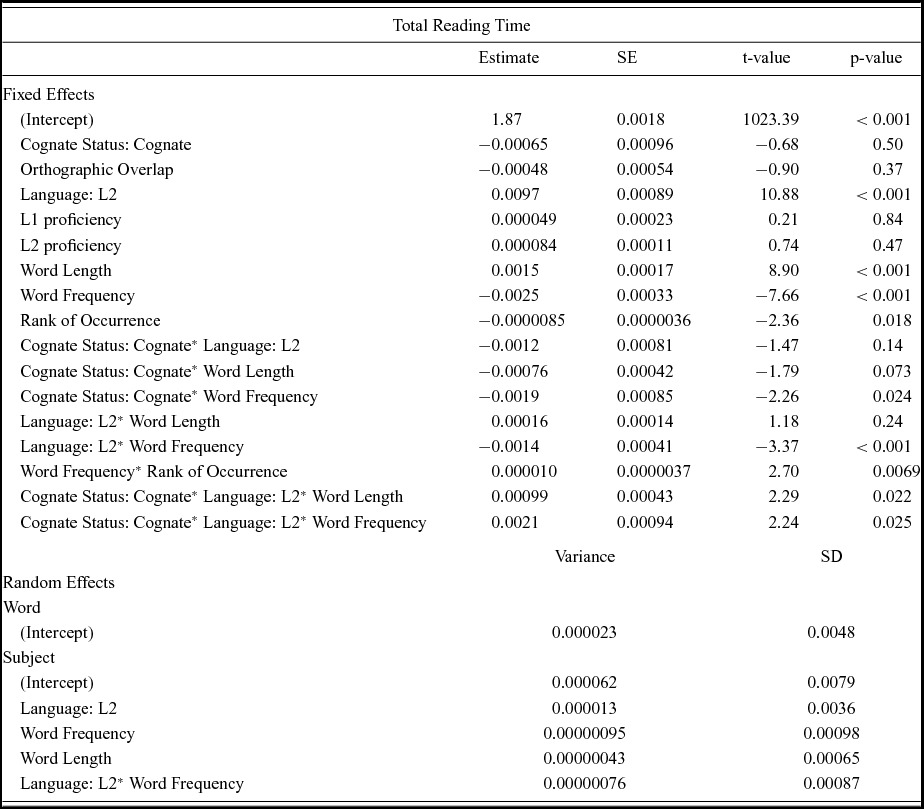
The outcome of the final model for total reading times is presented in Table 8. The maximum correlation between fixed effects in the final model was −.69 for L1 and L2 proficiency. The maximum value of the VIF was 4.07.
Estimates, SE's and t-values for the fixed effect and variance and SD's for the random effects for the final model for total reading times. Treatment coding was used for the factor language with L1 as reference level and for the factor cognate status with non-cognate as the reference level

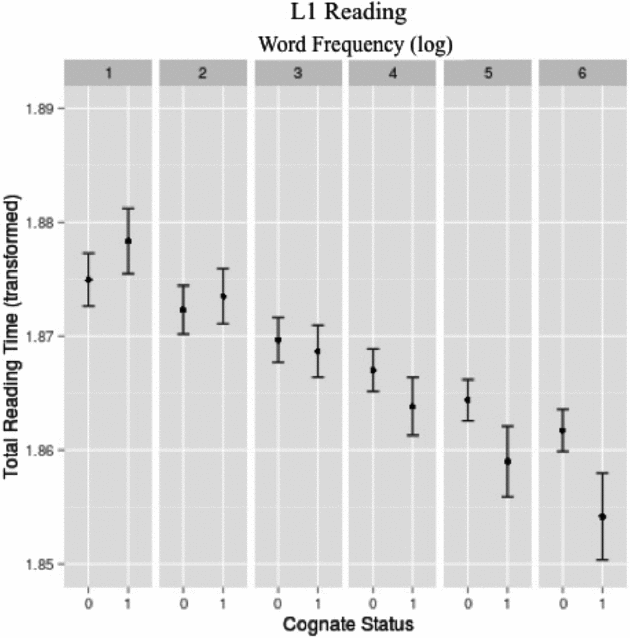
A main effect of language was found. The main effect for identical cognate status was not significant, but the 3-way interaction with language and word frequency and the 3-way interaction with language and word length were. Separate analyses per language showed that the effect of identical cognate status was not significant in L1 (β = −0.0012, se = 0.0012, t = −1.00, p = .32) and that the interaction of cognate status with word length was also not significant (β = −0.00070, se = 0.00049, t = −1.45, p = .15). The interaction of identical cognate status and word frequency was significant (β = −0.0022, se = 0.00095, t = −2.30, p = .021) (see Figure 6). Planned comparisons showed that for very high frequency words (> 4.60 log word frequency) there was identical cognate facilitation for total reading times (χ2 = 3.92, df = 1, p < .05). The only identical cognate with a frequency higher than 4.6 was the word man (which each participant read 45 or 22 times depending on which half of the novel they read in L1). For very low frequency nouns (< 0.80 log word frequency) we found identical cognate inhibition (χ2 = 3.94, df = 1, p < .05). There were only 4 identical cognates in the novel whose frequency was lower than 0.80.
Effect of cognate status (1 = Identical Cognate, 0 = Other) on total reading time (transformed) for L1 reading dependent on word frequency (log-transformed). The 95% CI's are depicted as whiskers.Footnote 3

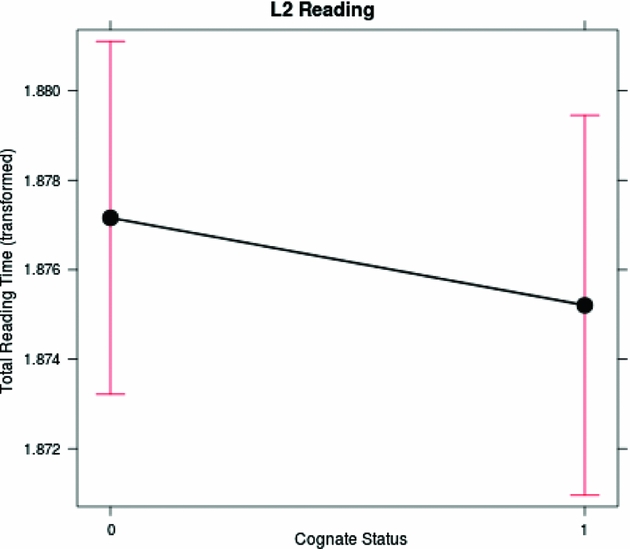
The effect of identical cognate status was significant in L2 (β = −0.0019, se = 0.00087, t = −2.20, p = .028). For L2 reading, identical cognates were read faster in total reading times (307 ms) than other words were (313 ms) (See Figure 7). The interactions of identical cognate status with word length and word frequency were not significant for L2 reading (β = 0.00021, se = 0.00038, t = 0.56, p = .57; β = 0.00069, se = 0.00087, t = 0.79, p = .43).
Effect of cognate status (1 = Identical Cognate, 0 = Other) on total reading time for L2 reading. The 95% CI's are depicted as whiskers.Footnote 4

Go past times
Go past times that differed more than 2.5 standard deviations from the subject means were excluded per language (2.38% for Dutch, 2.36% for English). This left us with 87 799 data points. The dependent variable was transformed using the Box-Cox transformation (1) to normalize the distribution (Box & Cox, Reference Box and Cox1964). The value for lambda was set at −0.50.
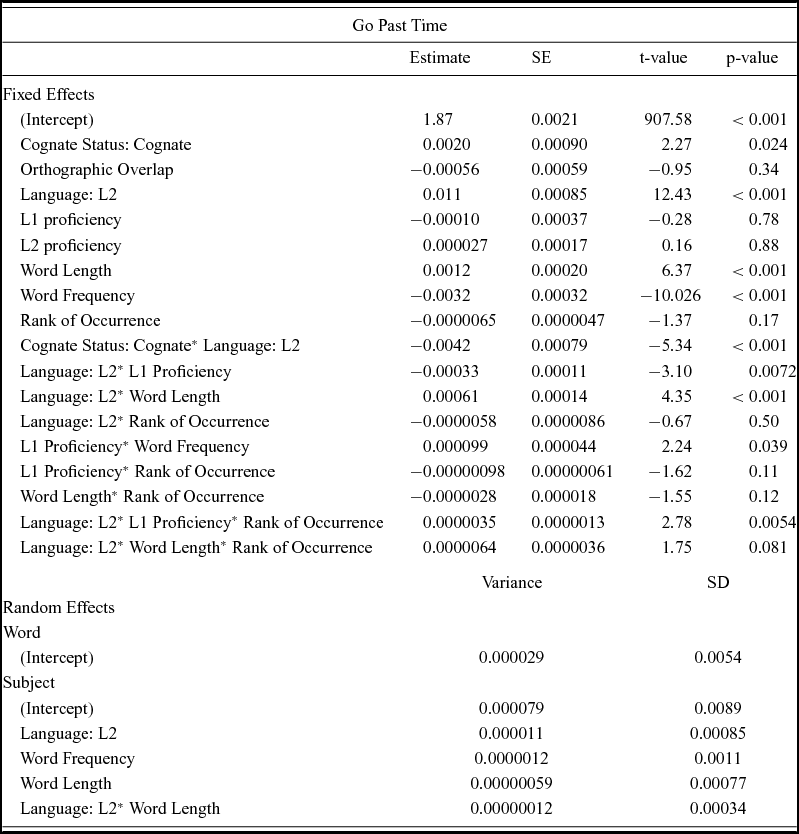
In Table 9 the outcome of the final model for go past times can be found. The maximum correlation between fixed effects in the final model was −.62 for L1 and L2 proficiency. The maximum value for VIF was 2.37.
Estimates, SE's and t-values for the fixed effect and variance and SD's for the random effects for the final model for go past times. Treatment coding was used for the factor language with L1 as reference level and for the factor cognate status with non-cognate as the reference level

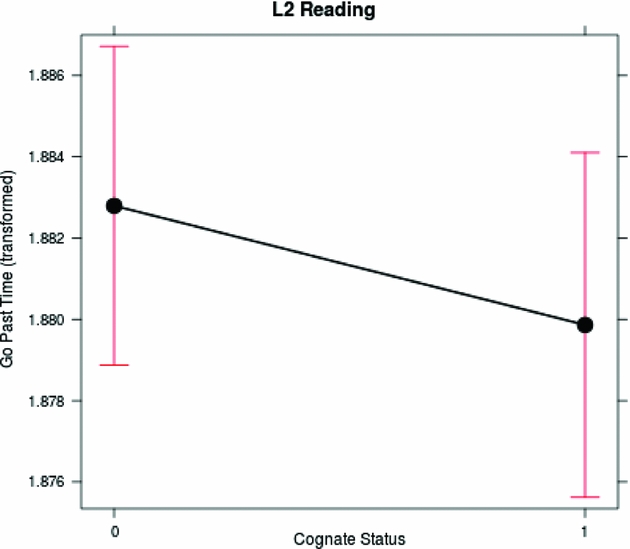
A main effect of language was found. We found a main effect of identical cognate status. Identical cognate status interacted with language. Separate analyses revealed no effect of identical cognate status in L1 (β = 0.0015, se = 0.0011, t = 1.39, p = .16). In L2 there was indeed a significant main effect of identical cognate status (β = −0.0020, se = 0.00096, t = −2.05, p = .040). Identical cognates had a shorter go past time (352 ms) than other nouns (367 ms) (See Figure 8). This indicates that during regressions identical cognates were looked upon for a shorter amount of time than non-identical cognates.
Effect of cognate status (1 = Identical Cognate, 0 = Other) on go past times for L2 reading. The 95% CI's are depicted as whiskers.Footnote 5

The effect of orthographic overlap was not significant. Neither were any of the interactions with this variable.
In addition, there was a significant three-way interaction between language, L1 proficiency and rank of occurrence. Separate analyses for each language showed that interaction between L1 proficiency and rank of occurrence was significant for L1 (β = 0.00001, se = 0.000004, t = 2.47, p < .05) but not for L2 (β = 0.00001, se = 0.00001, t = 1.22, p = .22). Planned comparisons for L1 didn't result in a significant effect. There was also a marginally significant interaction between language, word length and rank of occurrence, separate analyses for each language showed that the interaction between word length and rank of occurrence was significant for both languages (β = −0.0002, se = 0.00005, t = −4.19, p < .001 for L1, β = 0.0002, se = −0.0001, t = −2.66, p < .01 for L2). Planned comparisons for L1 showed that the inhibitory effect of word length was only significant up to the 35th occurrence of a word (χ2 = 4.09, df = 1, p < .05), and that there was a facilitatory effect for words which occurred for the 101st time or more (χ2 = 3.88, df = 1, p < .05). For L2, the inhibitory effect of word length was only significant up to the 49th occurrence of a word (χ2 = 4.05, df = 1, p < .05). Finally, there was a significant interaction between L1 proficiency and word frequency. Planned comparisons showed that the facilitatory effect of word frequency was significant for all proficiency scores, but the effect became smaller with an increasing proficiency.
Discussion
We studied the effect of identical cognate status and orthographic overlap for translation equivalent nouns in an extended narrative reading context. The eye movements of late Dutch–English bilinguals who read an entire novel in L1 and L2 were analyzed. We found cognate facilitation in early and late eye movement measures in both L1 and L2 reading.
L2 cognate facilitation
The analyses of the early reading measures showed clear cognate facilitation effects for reading in L2. First fixation durations were facilitated by cross-lingual orthographic overlap. Because we only found an effect for first fixation durations, not for single fixation durations or gaze durations, this effect was driven exclusively by the first fixation landing on the target noun: when reading in a second language, a word with more cross-lingual orthographic overlap elicited a shorter first fixation. Additionally, skipping probabilities for short words (6 characters or less) were higher when the orthographic overlap was higher. These results show that nouns were more likely to not receive a fixation on first pass reading when the orthographic overlap with their translation equivalent was larger. When they did, lexical access was faster for words with a larger orthographic overlap. The failure to find this effect for words with seven letters or more might be the result of a low skipping rate for longer words (8%), causing floor effects and also reduced parafoveal processing for the final letters of these words preventing a more thorough lexical processing.
For first fixation durations and skipping rates, we did not find an additional effect of identical cognates: words that have complete orthographical overlap across languages were not processed faster than would be expected if the effect was only due to orthographic similarity.
In the other reading time measures under investigation, clear identical cognate facilitation was found for total reading times and go past times. For gaze duration, this effect only reached significance for extremely short nouns, which included only one identical cognate (the word ‘ma’). This means that caution is warranted in interpreting the effect found in gaze duration. The results for total reading times and go past times however clearly show that for word processing stages after first fixation durations, only identical cognates are read faster than control words. Non-identical cognates are not. Given that regressions generally represent semantic integration issues, the results for go past times imply that identical cognates read in L2 are easier to integrate in the larger semantic context.
The findings for total reading times replicate and extend those of Balling's (2013) L2 paragraph reading experiment. While she only found cognate facilitation for morphologically simple words, we found it for a set of complex and simple words. On top of that we found cognate facilitation for earlier measures, namely first fixation durations and skipping rates.
L1 cognate facilitation
Next, we discuss the effects of cognate status and orthographic overlap for L1 reading. For the early eye movements under investigation, we detected cognate facilitation. Orthographic overlap of the L1 target noun with its L2 translation equivalent shortened the first fixation duration on the target nouns. We found no additional facilitation when the target noun was an identical cognate.
These results indicate that cognate facilitation is detectable in L1 text reading during the earliest stages of word recognition. This finding is compatible with results found in single L1 sentence contexts (Titone et al., Reference Titone, Libben, Mercier, Whitford and Pivneva2011; Van Assche et al., Reference Van Assche, Duyck, Hartsuiker and Diependaele2009). In these experiments the target nouns were presented without the larger and much more complex semantic context that is present when reading a novel. As such, the present study surpasses previous findings on cognate processing in L1 and provides compelling evidence for cross-lingual interaction in early L1 language processing.
As we predicted, the effect size of the cognate facilitation was rather small. The difference between the fitted value for first fixation duration for words with the smallest and the highest orthographic overlap for L1 reading was only 2 ms. Van Assche et al. (Reference Van Assche, Duyck, Hartsuiker and Diependaele2009) also report a rather small effect size for cognate facilitation (5 ms) for first fixation durations in L1 reading. Titone et al. (Reference Titone, Libben, Mercier, Whitford and Pivneva2011) report a small (non-significant) cognate facilitation effect of about 1–3 ms for first fixation durations. The size of the effects is probably partly due to floor-effects because the first fixation durations are rather short (212 ms on average in L1 reading). Also, in text reading, eye tracking data represent many other processing stages (e.g., text integration) that are not always present in isolated word reading, which implies a smaller relative effect of a word-level variable like cognate status.
For L1 single fixation durations, gaze durations and skipping rates, no cognate facilitation was found. This is compatible with Titone et al.’s (2011) findings. Van Assche et al. (Reference Van Assche, Duyck, Hartsuiker and Diependaele2009) did find cognate facilitation for gaze durations, but their replication of that effect with a different stimulus set yielded only a marginally significant effect for gaze durations.
In later eye movement measures we detected identical cognate facilitation for total reading times, but not for go past times. Total reading times were shorter for high frequency nouns, when this noun was an identical cognate. We must note that this was only the case for extremely high frequency nouns. Future research specifically aimed at investigating the impact of frequency on identical cognate facilitation in L1 is therefore warranted.
This result is, in part, compatible with Titone et al.‘s (2011) and Van Assche et al's (Reference Van Assche, Duyck, Hartsuiker and Diependaele2009) results. Titone et al. found identical cognate facilitation for total reading times and go past times in an L1 low constraint sentence context, but not in a high constraint sentence context. Van Assche et al. found identical and non-identical cognate facilitation for go past times in low constraint sentences. They did not analyze total reading times.
When comparing the results, it is of utmost importance to make a distinction between our experimental design and that of the studies by Titone et al. (Reference Titone, Libben, Mercier, Whitford and Pivneva2011) and Van Assche et al. (Reference Van Assche, Duyck, Hartsuiker and Diependaele2009). In our experiment, participants read a book. The materials contained within this book were not experimental items designed to manipulate one or a few linguistic variables and we did not manipulate the constraint of the semantic context. We can suppose that some of the nouns analyzed in this study were highly constrained by the sentence context, or by the context of the novel as a whole, whereas others were constrained to a lower degree by the semantic context. This kind of text represents a richer equivalent of daily reading and the interesting finding is that we detect cognate facilitation across this wide variety of non-experimental sentences. However, because semantic constraint is not manipulated or even measured we cannot make strong claims here about the effects of the semantic context. This is possible though in studies where sentences are deliberately constructed to constrain lexical access to one lexical representation. With these strong manipulations it is not inconceivable that cross-lingual effects are no longer found as shown by Titone et al's (Reference Titone, Libben, Mercier, Whitford and Pivneva2011) results.
Interestingly, we detected identical cognate inhibition on total reading times when the cognates were of very low frequency. Although we did not predict this, it could be the case that for those low frequency nouns the translation equivalent in L2 is unknown to the participant and so even though the noun has an orthographically identical translation, this noun does not function as a cognate. For example the identical cognate noun begonia has a Dutch log word frequency of 0.30. It is very plausible that these words are not known in the second language of the participants. Another possibility is that the L2 representation of the word is only partially or ‘not fully’ formed, which could inhibit the activation of the L1 representation.Footnote 6
To sum up, for the first time, early and late cognate facilitation has been found in L1 extended narrative reading, without the use of a restricted, contrived set of low constraining sentences but with bilinguals reading a real novel containing a large diversity of semantic contexts. This shows that a bilingual reading in his or her most dominant and first-acquired language is influenced by knowledge of translations in another language.
The exploratory nature of our design warrants cautious interpretation of the results, especially where interactions are concerned. For example, the late identical cognate facilitation found in total reading times only reached full significance when the nouns were very highly frequent. As our materials were not constructed to test specific hypotheses, the identical cognates in the novel of such high frequency were sparse. This means that conclusions about identical cognate facilitation in L1 should be made with caution. However, our findings can guide future research efforts concerning the effect of word frequency on cognate facilitation, using targeted experimental manipulations.
A factor that was not directly investigated in this study is phonological overlap. Consequently, orthographic and phonological overlap of cognates are confounded here. It is therefore possible that the cognate effects that we obtained did not solely originate from orthographic representations. Indeed, there is ample evidence that phonology gets activated automatically and quickly both for isolated visual word recognition (Duyck, Reference Duyck2005; Frost, Reference Frost1998, Jared & Kroll, Reference Jared and Kroll2001), and sentence-level reading (Kush, Johns & Van Dyke, Reference Kush, Johns and Van Dyke2015). For the purpose of the present study, the cognate effects (albeit orthographic or phonological in nature) in any case indicate cross-lingual lexical interactions.
Cognate representation
The present study showed continuous effects of orthographic similarity, with more cross-lingual orthographic overlap leading to faster first fixation durations in L1 and L2 and higher skipping rates in L2. Also, effects in L2 are larger and were present across more eye movement measures than effects in L1. These results are in line with models, which assume that cognate facilitation arises from converging cross-lingual lexical activation from activated lexical candidates (e.g., Dijkstra & van Heuven, Reference Dijkstra and van Heuven2002; Midgley, Holcomb & Grainger, Reference Midgley, Holcomb and Grainger2011). Considering the BIA+ architecture (Dijkstra & van Heuven), non-identical cognates and other translation equivalents have two distinct language-specific orthographic representations connected to a shared semantic representation. For translation equivalents with some orthographic overlap, the cross-lingual activation of similar orthographic representations results in more activation spreading to the same semantic representation. The more orthographic overlap between the written target word and the translation equivalent, the more activation spreads towards the shared semantics. This mechanism might explain the linear non-identical cognate facilitation we found in the current study. Viewpoints that assume qualitative differences such as differences at a morphological level between cognates and non-cognates (e.g., Sánchez-Casas & García-Albea, Reference Sánchez-Casas, García-Albea, Kroll and de Groot2005) could not account for these continuous effects of orthographic overlap.
For other eye movement variables, total reading times and go past times, we found facilitation only for identical cognates. This means that after the first fixation in the reading process there is a processing difference for identical cognates compared to all other nouns, regardless of the orthographic overlap between them and their translation equivalent. To explain these kinds of effects, it has been proposed that identical cognates may be represented differently from other words at the lexical level (Dijkstra et al., Reference Dijkstra, Miwa, Brummelhuis, Sappelli and Baayen2010). Peeters et al. (Reference Peeters, Dijkstra and Grainger2013) suggested that identical cognates share one orthographic representation (e.g., Dijkstra & van Heuven, Reference Dijkstra and van Heuven2002; Dijkstra et al., Reference Dijkstra, Miwa, Brummelhuis, Sappelli and Baayen2010; Midgley et al., Reference Midgley, Holcomb and Grainger2011), and thus lack the lateral inhibition on that level.
This architecture seems to predict that both of the effects should be present at the same time: there should be additional facilitation for identical cognates compared to non-identical cognates, on top of orthographic overlap effects. Dijkstra et al. (Reference Dijkstra, Miwa, Brummelhuis, Sappelli and Baayen2010) found exactly this: a continuous effect of orthographic overlap of translation equivalents on reaction times and an additional drop in reaction times for identical cognates during a lexical decision task. Also, identical cognate effects should be detectable earlier in the language process, because lateral inhibition takes place early in the visual word recognition process, than non-identical cognate effects, because semantic activation and feedback occur later in this process. Also, the orthographic form of an identical cognate is encountered more often than the orthographic forms of non-identical cognates and non-cognates, so the subjective frequency should be higher for these nouns resulting in higher resting activation levels and may be activated more quickly (Gollan, Forster & Frost, 1997).
Our results diverge on two points from this proposed mechanism. First of all, no additional identical cognate facilitation is found above and beyond the effect of orthographic overlap. We do find both effects, but they are not present at the same time in the reading process. Our results suggest that this additional facilitating effect of identical cognate status is limited to certain tasks, like the lexical decision task of Dijkstra et al. (Reference Dijkstra, Miwa, Brummelhuis, Sappelli and Baayen2010) and is not necessarily generalizable to an extended reading context.
Second, a delineation of early identical cognate effects and late non-identical cognate effects was not found. Actually, what we find looks more like the opposite. The earliest indication of language processing, skipping probability, was only affected by continuous orthographic overlap, not by identical cognate status. Another early reading time measure, namely first fixation durations, also showed non-identical cognate facilitation. Later eye movement measures, total reading time and go past time, did not show convincing non-identical cognate facilitation, but did show identical cognate facilitation.
The BIA+ model (Dijkstra & van Heuven, Reference Dijkstra and van Heuven2002) only hypothesizes inhibitory links between lexical representations. Motivated by our findings of the early linear effects of orthographic overlap, we propose that translation equivalents could be connected through excitatory connections of which the weight varies with the orthographic overlap between the two. This kind of connection could emerge when learning a second language and perceiving orthographic similarities for certain translations. These direct links could be an efficient way to speed up L2 learning and lexical retrieval. By also assuming two orthographic representations for identical cognates, this assumption predicts early continuous effects of orthographic overlap without an additional boost for identical cognates. The late effects of identical cognate status might indicate stronger semantic feedback for identical cognates compared to non-identical cognates. A paper by Tokowicz, Kroll, de Groot and Van Hell (Reference Tokowicz, Kroll, de Groot and Van Hell2002) found that for nouns with only a single or very dominant translation, ratings of meaning overlap across languages are higher than for words with multiple translations. This is supported by studies finding slower translation latencies for words with multiple translation possibilities (e.g., Tokowicz & Kroll, Reference Tokowicz and Kroll2007). Also, cognates are less likely than non-cognates to have multiple translations (Tokowicz et al., Reference Tokowicz, Kroll, de Groot and Van Hell2002), implying that cognates could have a larger cross-lingual overlap in semantic representations, leading to larger semantic facilitation for the target word. This could result in larger late cognate facilitation. Of course this mechanism necessitates the existence of separate but overlapping semantic representations for cognates. For the few cognates that do have multiple meanings in one of the languages (e.g., the Dutch–English cognate arm, which refers to both a body part and being poor in Dutch), this semantic facilitation may be different or absent. Although we have some preliminary ideas, the processes underlying the particular unfolding of cross-lingual interactions are not yet clear. Further tailored research might clarify the precise way in which cognates are processed in the bilingual lexicon.
Other effects in bilingual reading
Besides the effects of cognate status and orthographical overlap, the analyses also pointed out a role for other variables on our timed measures. In go past times, we found that an increased L1 proficiency yielded a smaller frequency effect. Language interacted frequently with other variables, showing that the effect of predictors such as word frequency or word length manifests differently for L1 and L2 reading. More specifically, in early measures we found that the effects of word frequency (facilitatory) and word length (inhibitory) were larger for L2 than L1 reading. Furthermore, the effect of word length on go past times persisted longer in L2 reading (up to the 49th occurrence of a word) than in L1 reading (35th occurrence). It seems that the less-practiced L2 reading is more heavily influenced by word characteristics than L1 reading. For a more extensive discussion of these effects on bilingual (and monolingual) reading we refer to Cop, Keuleers, Drieghe and Duyck (Reference Cop, Keuleers, Drieghe and Duyck2015).
Conclusion
This paper examined the cognate effect in L1 and L2 text reading of a complete novel. The effect of identical cognate status and the continuous effect of orthographic overlap were investigated, both in early and in late reading measures.
We found early and late L1 and L2 cognate facilitation effects. These results provide an important insight into the processing of cognates by unbalanced bilinguals. By using a large, naturalistic body of text, we have shown that a variably constrained, extended narrative unilingual context does not eliminate cross-lingual activation effects in L1 or L2, and therefore that these effects are real and sufficiently meaningful to influence everyday reading.
This is the first time L1 cognate effects have been studied in a semantic linguistic context that is larger than one sentence. We found non-identical cognate facilitation for L1 reading for first fixation duration. This effect demonstrates that even when reading in the mother tongue, the readers’ lexical access is not restricted to the target language.
For total reading times, we found identical cognate facilitation for extremely high frequent nouns and inhibition for extremely low frequent nouns. Further research is needed to consolidate this finding.
Our findings of linear facilitating effects of orthographic overlap can be framed within the BIA+ model and are consistent with the idea of cross-lingual orthographic-semantic resonance leading to cognate facilitation. However, some of our more specific results diverge from previous ones found in studies with, for example, lexical decision tasks (Dijkstra et al., Reference Dijkstra, Miwa, Brummelhuis, Sappelli and Baayen2010), which illustrates that tasks and language context may indeed influence cross-lingual interactions. Furthermore, frameworks that assume a shared-morpheme (e.g., Sánchez-Casas et al., Reference Sánchez-Casas, Davis and García-Albea1992) for cognates cannot accommodate the linear effect of orthographic overlap.
We also found identical cognate facilitation, although not in conjunction with non-identical cognate facilitation. This could point towards a ‘special’ status for identical cognates compared to non-identical cognates or control words. A possibility is the existence of one shared orthographic representation for identical cognates, thus removing the lateral inhibition of two activated orthographic representations.
An alternative explanation of the results entails excitatory connections between translation equivalents, weighted by orthographic overlap, combined with separate representations for identical cognates sharing more semantic overlap than non-identical cognates.
In all, this study is the first to indicate just how ubiquitous cognate effects are in both L1 and L2 daily reading. Future research will have a large role in determining what the conditions and lexical variables are that determine the exact size and maybe even the direction of these effects.
Appendix A: Formula for the used measure of Orthographic Overlap. (The formula for the Corrected Levenshtein Distance was taken from Schepens et al., Reference Schepens, Dijkstra and Grootjen2012)
 $$\begin{equation*}
Orthographic\ Overlap = 1 - \ \frac{{Distance}}{{Length}}
\end{equation*}$$
Distance = min (number of insertions, deletions and substitutions needed to edit target word into translation word)
Length = max (length of target word, length of translation word)