Introduction
Since the first report of a live birth after embryo cryopreservation in 1985 (Downing et al., Reference Downing, Mohr, Trounson, Freemann and Wood1985), this technique has been applied widely by assisted reproduction technology (ART) laboratories to store embryos that are surplus after fresh embryo transfer (ET), for women with signs of severe ovarian hyperstimulation syndrome and for fertility preservation in cancer patients (Lattes et al., Reference Lattes, Checa, Vassena, Brassesco and Vernaeve2017). The past decade has seen a shift from slow freezing to vitrification. Nevertheless, for a long time, slow freezing was the main method of cryopreservation, and a large number of embryos frozen by slow freezing are cryopreserved in ART laboratories at this time. Slow freezing is still used in several ART laboratories. Following the repeal of the one-child policy in China, embryos that had been cryopreserved for long periods of time were thawed for frozen embryo transfer (FET). This has led to safety concerns regarding the potential effects of the cryopreservation duration of slow-frozen early-cleavage human embryos on the clinical and neonatal outcomes after autologous FET.
Several studies have explored the possible effects of the cryopreservation duration on embryo viability, implantation competence, perinatal and neonatal outcomes and congenital malformation. Most of these studies did not identify an apparent negative effect of the cryopreservation duration on these clinical outcomes, although the data suggested a potential influence on embryo survival and implantation (Testart et al., Reference Testart, Lassalle, Forman, Gazengel, Belaisch-Allart, Hazout, Rainhorn and Frydman1987; Li et al., Reference Li, Yin, Wang, Lin, Chen, Wang, Lyu, Wang, Kuang and Zhu2020). In other studies, the storage time was not shown to influence the survival and pregnancy outcomes of slow-frozen early-cleavage human embryos (Riggs et al., Reference Riggs, Mayer, Dowling-Lacey, Chi, Jones and Oehninger2010; Liu et al., Reference Liu, Lian, Huang, Ren, Li, Lin, Liu and Qiao2014). Several other cohort studies found that storage neither impaired the viability of vitrified blastocysts nor worsened the clinical outcomes, and observed no increase in the malformation rate over time (Wirleitner et al., Reference Wirleitner, Vanderzwalmen, Bach, Baramsai, Neyer, Schwerda, Schuff, Spitzer, Stecher, Zintz and Zech2013; Sekhon et al., Reference Sekhon, Lee, Flisser, Copperman and Stein2018; Ueno et al., Reference Ueno, Uchiyama, Kuroda, Yabuuchi, Ezoe, Okimura, Okuno, Kobayashi and Kato2018). However, most embryos included in those studies had been cryopreserved for less than 6 years. In contrast, few studies have explored the effect of a cryopreservation duration longer than 7 years on clinical and neonatal outcomes, and some relevant studies have involved limited numbers of FET cycles. One Chinese study reported five live births after FET with embryos that had been cryopreserved for at least 12 years and for a maximum of 16.8 years (Yuan et al., Reference Yuan, Mai, Ma, Deng, Xu, Zhuang and Zhou2019). However, this study only included 20 patients and 28 FET cycles. Studies with larger sample sizes are needed to demonstrate the effect of the cryopreservation duration on human embryos.
In this study, we evaluated the effect of the duration of cryopreservation, especially very long-term cryopreservation (>84 months), on the clinical and neonatal outcomes and congenital malformation of slow-frozen early-cleavage human embryos after FET. We focused on slow-frozen embryos because the embryos subjected to long-term storage were cryopreserved using slow-freezing methods.
Materials and methods
Patients and study design
Patients who underwent FET between February 2013 and August 2017 at the In Vitro Fertilization (IVF) Center, Women’s Hospital, Zhejiang University School of Medicine were included in this study. Their embryos had been cryopreserved before January 2014 using slow-freezing methods. The 1624 included cycles were divided into five groups based on the storage duration: Group 1, 6–12 months; Group 2, 13–36 months; Group 3, 37–60 months; Group 4, 61–84 months; and Group 5, >84 months. We retrospectively analyzed the thawed embryo survival rate, embryo implantation rate, clinical pregnancy rate and live-birth rate. The analysis also included the gestational age (weeks), singleton birth weight, newborn sex and any neonatal malformations. This retrospective study was approved by the medical ethics committee of Women’s Hospital, Zhejiang University School of Medicine.
Controlled ovarian stimulation and embryo culture
The ovarian stimulation protocol, embryo culture protocol and embryo selection criteria have been summarized elsewhere (Fang et al., Reference Fang, Jin, Li, Cui and Ye2016; Ye et al., Reference Ye, Qian, Xu and Jin2012). Oocytes, zygotes and embryos were cultured in G-series reagents (Vitrolife Sweden AB, Västra Frölunda, Sweden) at 37°C in a humidified atmosphere containing 6% CO2.
Freezing protocol, embryo thawing and transfer
Cleavage-stage embryos were frozen using a Planer freezer (Planer Ltd, Sunbury, Middlesex, UK) and the Embryo Freeze Media Kit (Irvine Scientific, Santa Ana, CA, USA). The freezing programme was conducted according to the manufacturers’ instructions, and the specific steps have been described elsewhere (Fang et al., Reference Fang, Jin, Li, Cui and Ye2016). Briefly, the freezing programme adhered to the following steps: from a starting temperature of 20°C, the temperature was decreased by a rate of −2°C/min to −7°C. After 5 min of soaking followed by manual seeding and a 10 min rest, the samples were cooled at −0.3°C/min to −30°C and at −30°C/min to −120°C, and then immersed directly in liquid nitrogen. The Embryo Thaw Media Kit (Irvine Scientific, Santa Ana, CA, USA) was used for embryo warming. An intact blastomere survival rate of at least 50% indicated a successful thaw.
Embryos were transferred during natural, controlled ovarian hyperstimulation (COH) or oestrogen–progesterone hormonally supplemented cycles. Before transfer, the warmed embryos were cultured in G-1 (Vitrolife Sweden AB, Västra Frölunda, Sweden) medium for at least 2 h. One to two embryos were transferred for patients who were <35 years old and undergoing a first transfer cycle. For other patients, no more than three embryos were transferred before mid-2013. Subsequently, one to two embryos were transferred for all patients.
Definition of outcomes
The embryo survival rate was defined as the number of surviving embryos divided by the number of recovered embryos after thawing. The implantation rate was calculated as the number of gestational sacs divided by the number of transferred embryos. The clinical pregnancy rate was determined by the number of fetal heartbeats visualized on ultrasound at 8–12 weeks after ET, divided by the number of transfer cycles. The live-birth rate was calculated as the number of cycles with live births divided by the number of total transfer cycles.
Statistical analysis
The chi-squared or Fisher’s exact test was used to compare categorical variables. For descriptive data, normality was evaluated by using the Kolmogorov–Smirnov test (with Lillefor’s significance correction), and homoscedasticity was evaluated by using Levene’s test for all variables. An analysis of the descriptive data was performed using the two-tailed t-test, one-way analysis of variance (ANOVA) or Kruskal–Wallis test, as indicated. The effects of cryopreservation duration on the clinical pregnancy rate, live-birth rate and singleton birth weight were analyzed using a logistic regression analysis to calculate the adjusted odds ratio. In the analysis of the clinical pregnancy rate and live-birth rate, the factors used in the binary logistic regression analysis included the duration of cryopreservation, maternal age at cryopreservation, body mass index (BMI), maternal age at ET, number of embryos transferred and endometrial preparation programme. In the analysis of singleton birth weight, the factors used in the multiple linear regression analysis included the duration of cryopreservation, BMI, maternal age at ET, number of embryos transferred, newborn sex, gestational age and endometrial preparation programme. Statistical analyses were performed using SPSS software (version 20.0; SPSS, Chicago, IL, USA). A P-value <0.05 was considered statistically significant.
Results
Patients’ demographics and clinical outcomes
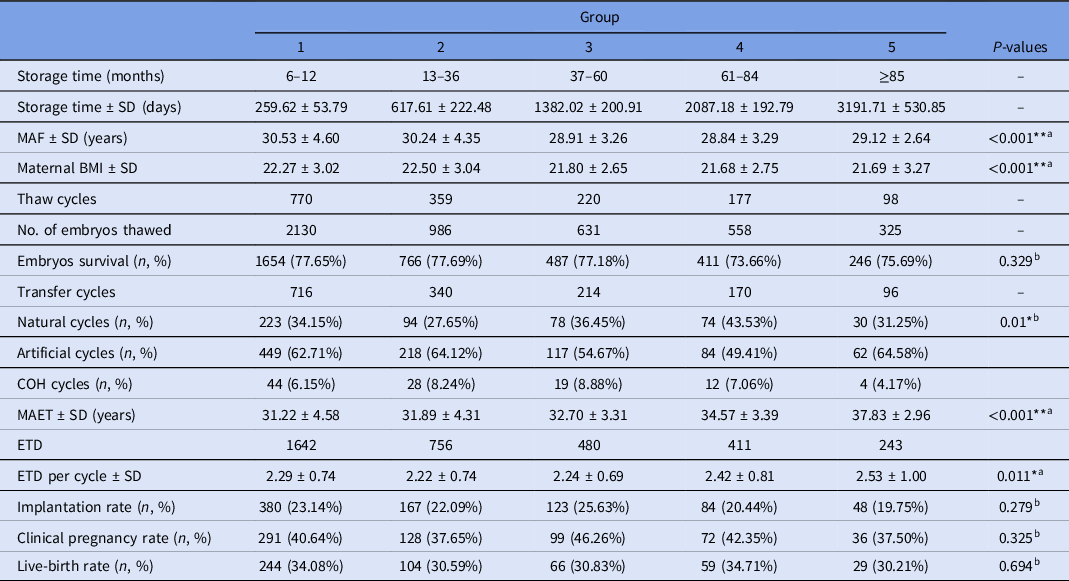
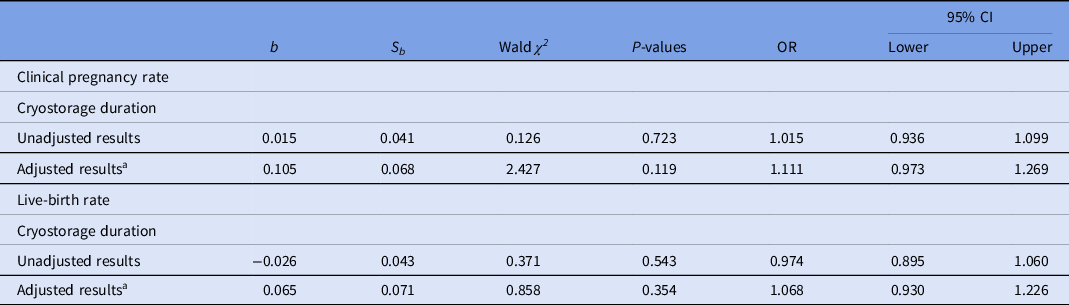
In total, 1624 FET cycles were included in this study and grouped according to the cryopreservation duration. Groups 1, 2, 3, 4 and 5 included 770, 359, 220, 177 and 98 FET cycles, respectively. The patients’ demographics, cycle characteristics and clinical outcomes are listed in Table 1. In total, 4630 embryos were thawed, and a survival rate of 76.98% was achieved. The survival rates of embryos in groups 4 (73.66%) and 5 (75.69%) were slightly lower than those of embryos from groups with shorter storage durations, but these differences were not statistically significant. The results suggest that the storage time has little effect on embryo survival. The clinical outcomes, which include the clinical pregnancy, live birth and implantation rates, were not significantly different between groups with different storage times, although the implantation rates in groups 4 (20.44%) and 5 (19.75%) were lower than those in groups 1–3. However, the maternal ages and BMI at freezing were significantly different between the groups. Additionally, the maternal age at ET increased from group 1 to group 5 (i.e. with increasing cryopreservation duration). The number of transferred embryos and the endometrial preparation programmes also differed between the groups. Accordingly, we applied a binary logistic regression analysis adjusted for the maternal age and BMI at freezing, maternal age at ET, number of embryos transferred and endometrial preparation programmes to further clarify the effect of the cryopreservation duration on FET clinical outcomes. The results demonstrated that the cryopreservation duration was not correlated with the clinical pregnancy rate and live-birth rate (Table 2).
Maternal characteristics, cycles characteristics and clinical outcomes after different cryopreservation duration

Abbreviations: BMI, body mass index; COH, controlled ovarian hyperstimulation; ETD, embryos transferred; MAET, maternal age at embryo transfer; MAF, maternal age at freezing.
a Values are given as mean ± SD using the Kruskal–Wallis test.
b Results are presented as (n, %) using chi-squared test. * P < 0.05. ** P < 0.001.
Relationship between cryostorage duration and clinical pregnancy rate and live-birth rate

a The effects of cryopreservation duration on the clinical pregnancy rate and live-birth rate were analyzed by using a binary logistic regression analysis, these results had been adjusted for the maternal age and body mass index at freezing, maternal age at embryo transfer, number of embryos transferred and endometrial preparation programmes.
Neonatal outcomes
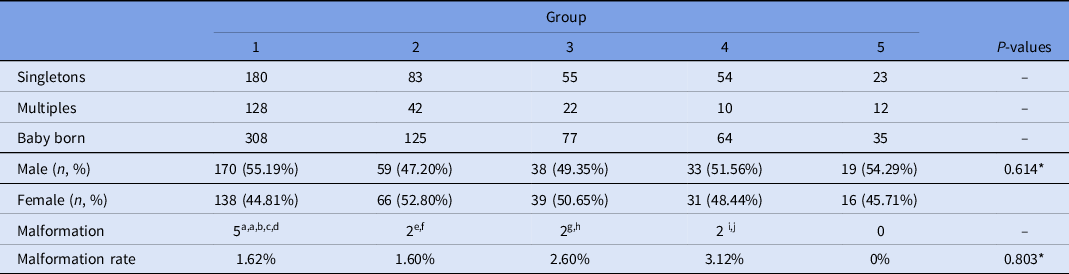
The numbers of live births (singletons, multiples and in total), newborn sex distribution and malformations in each group are listed in Table 3. There were no differences in the newborn sex ratio between groups. Malformation was recorded in 11 cases and included hearing abnormalities, atrial septal defects, cleft lip and palate, ear deformities, cryptorchidism, echogenic intracardiac focus, thoracic haemangioma, neonatal ovarian cysts, syndactyly and hydrocephalus. A relatively low malformation rate was observed in group 5, which included only 29 cycles with live births. It is difficult to draw a conclusion regarding the correlation between the cryopreservation duration and malformations based on the limited sample size.
Characteristics of the children born

Malformation was recorded in 11 cases:
a Hearing abnormal;
b Atrial septal defect;
c Cleft lip and palate;
d Left ear deformity;
e Baby was born with hydrocephalus and treated with ventricular drainage;
f Cryptorchidism;
g Echogenic intracardiac focus;
h Haemangioma on chest;
i Neonatal ovarian cysts;
j Syndactyly.
* Results are presented as (n, %) using chi-squared test.
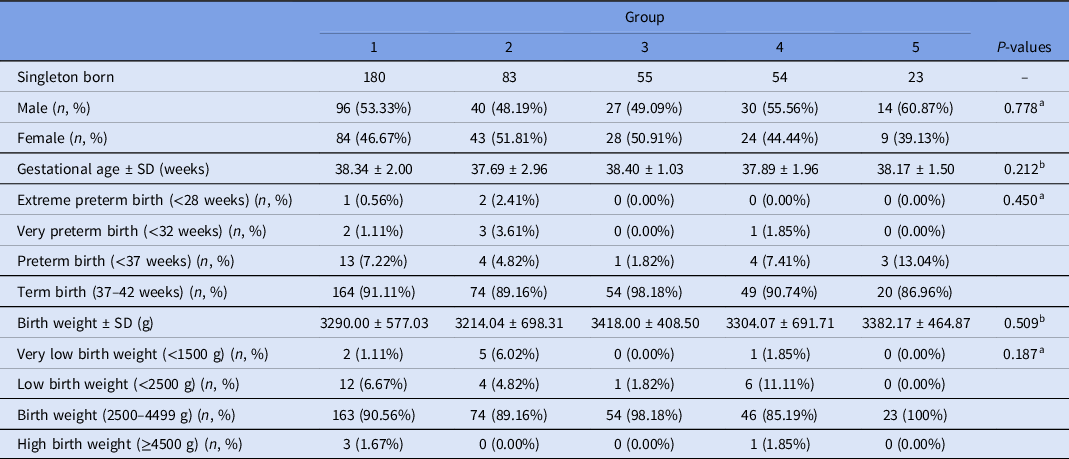
Because the fetal number may influence the neonatal outcomes, we analyzed the sexes, birth weights and gestational ages of newborn singletons in different groups. No significant difference in the sex distribution was observed between the groups. The numbers (rates) of term births (37–42 weeks gestation) in groups 1, 2, 3, 4 and 5 were 164 (91.11%), 74 (89.16%), 54 (98.18%), 49 (90.74%) and 20 (86.96%), respectively. The term birth rate did not differ significantly between the groups. With regard to birth weight, the numbers (rates) of newborns with normal birth weights (2500–4500 g) in groups 1, 2, 3, 4 and 5 were 163 (90.56%), 74 (89.16%), 54 (98.18%), 46 (85.19%) and 23 (100%), respectively. No significant difference in the normal birth weight rate was observed between the groups (Table 4).
Obstetric outcomes of singleton gestation

a Results are presented as (n, %) using chi-square test.
b Values are given as mean ± SD using Kruskal–Wallis test.
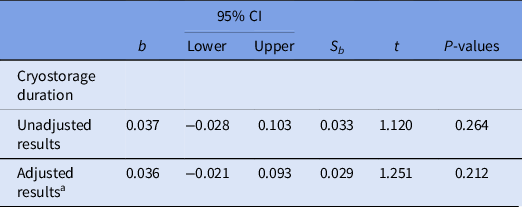
A multiple linear regression analysis was conducted to further analyze the relationship between the cryopreservation duration and singleton birth weight. According to the results, these variables were not significantly correlated after adjustment for the BMI, maternal age at ET, number of embryos transferred, newborn sex, gestational age and endometrial preparation programmes (Table 5).
The relationship between cryostorage duration and singleton birth weight

a The effects of cryopreservation duration on the singleton birth weight were analyzed by using a multiple linear regression analysis, these results had been adjusted for the body mass index, maternal age at embryo transfer, number of embryos transferred, newborn sex, gestational age and endometrial preparation programmes.
Siblings
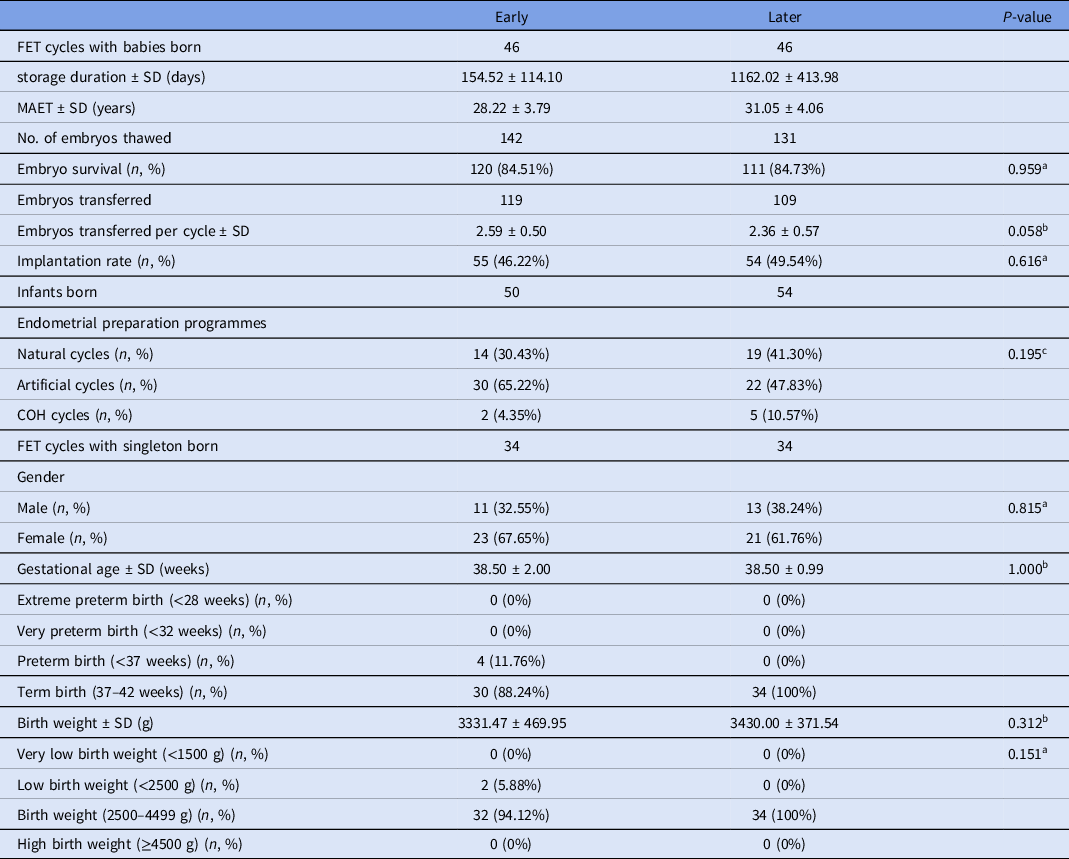
In this study cohort, 46 patients underwent two FET cycles using embryos generated from the same oocyte retrieval cycle and achieved live births in both cycles. No significant differences in the embryo survival and implantation rates were observed between the earlier and later cycles (Table 6). Among these patients, 34 gave birth to singletons in both cycles. We compared the newborn sexes, birth weights and gestational ages between the earlier and later FET cycles and observed no significant differences (Table 6).
Comparison of siblings born from two FET cycles after a same oocyte retrieval cycle

Abbreviations: MAET, Maternal age at embryo transfer.
a Results are presented as (n, %) using Fisher’s exact test.
b Values are given as mean ± SD using the two-tailed t-test.
c Results are presented as (n, %) using chi-squared test.
Discussion
In this study, we did not observe any significant differences in the clinical and neonatal outcomes after the transfer of slow-frozen human cleavage embryos in relation to the cryopreservation duration. Additionally, we did not observe a high incidence of congenital malformation among babies born from long-term cryopreserved embryos. To the best of our knowledge, this is the largest study to analyze the potential effect of a cryopreservation duration longer than 84 months on the viability of the thawed embryos and the clinical and neonatal outcomes after FET. It is also the first study to divide FET cycles involving embryos cryopreserved longer than 7 years into an independent group.
The cryo-stability of embryos stored in liquid nitrogen has been evaluated using theoretical models. For example, one model found that a cryopreserved mammalian embryo could be stored for at least 2000 years (Glenister et al., Reference Glenister, Whittingham and Lyon1984; Whittingham, Reference Whittingham1977). However, previous studies of human embryos reported controversial results. Riggs et al. (Reference Riggs, Mayer, Dowling-Lacey, Chi, Jones and Oehninger2010) reported that the storage duration did not adversely affect the post-thaw survival or pregnancy outcomes of patients after IVF or oocyte donation. Wirleitner et al. (Reference Wirleitner, Vanderzwalmen, Bach, Baramsai, Neyer, Schwerda, Schuff, Spitzer, Stecher, Zintz and Zech2013) similarly observed no significant differences in the pregnancy and birth rates after the transfer of vitrified blastocysts with a storage duration of less than 6 years. In contrast, an earlier study observed a decrease in the human embryo survival rate and pregnancy rate after several months of storage (Testart et al., Reference Testart, Lassalle, Forman, Gazengel, Belaisch-Allart, Hazout, Rainhorn and Frydman1987). A more recent study reported that a prolonged storage time negatively affected the biomedical pregnancy, clinical pregnancy and live-birth rates after the transfer of vitrified embryos with storage durations of up to 2 years (Li et al., Reference Li, Yin, Wang, Lin, Chen, Wang, Lyu, Wang, Kuang and Zhu2020).
In our study, we included 4630 embryos from 1624 thaw cycles that had been cryopreserved for 6–160 months. We found that the cryopreservation duration had little effect on the clinical outcomes of FET, although embryos that were cryopreserved for longer than 60 months had lower survival and implantation rates. Because few studies have investigated the clinical outcomes of FET with embryos cryopreserved for longer than 72 months, we paid special attention to the 65 embryos from 18 thaw cycles that had been cryopreserved for longer than 120 months. These embryos had a lower embryo survival rate (67.69%), implantation rate (12.50%), clinical pregnancy rate (27.78%) and live-birth rate (27.78%) than embryos with shorter cryopreservation durations. However, the birth weight (3406 g) and gestational age (37.8 weeks) of the newborns resulting from these long-term cryopreserved embryos were similar to those of embryos with shorter storage durations. Because of the limited sample size, we did not divide embryos that had been cryopreserved for longer than 120 months into an independent group and cannot make a solid conclusion regarding cryopreservation for >120 months. However, we did set 325 embryos in 98 thaw cycles that had been cryopreserved for longer than 84 months as an independent group (group 5). The embryo survival, implantation, clinical pregnancy and live-birth rates; newborn sex ratio; and singleton gestational age and birth weight in group 5 were comparable with those in other groups. Future studies with larger sample sizes are needed to investigate the effect of very long-term cryopreservation on human embryos.
In this study, the maternal age and BMI at the time of oocyte retrieval exhibited negative correlations with an increasing storage duration, whereas the number of embryos transferred per cycle exhibited a positive correlation with an increasing storage duration. In the past decade, the average age of patients who underwent IVF at our centre increased gradually. Fewer embryos were transferred in recent years, whereas the embryo developmental potential was enhanced (the implantation rates in groups 4 and 5 were lower than those in groups 1–3, although the difference is not statistically significant), resulting in similar clinical pregnancy and live-birth rates among different groups. To exclude potential confounding factors, we conducted binary and multiple linear regression analyses to analyze the relationship between the cryopreservation duration and clinical and neonatal outcomes. After adjusting for maternal age and BMI at freezing, maternal age at ET, number of embryos transferred and endometrial preparation programmes, we found that the clinical pregnancy and live-birth rates and the singleton birth weight did not differ significantly between the groups, suggesting little effect of the storage duration on the clinical and neonatal outcomes.
Our study focused on the safety of cryopreservation in terms of the health of the resulting infants. Previous large cohort studies determined that embryo cryopreservation was not associated with an increased risk of major congenital malformation (Schwarze et al., Reference Schwarze, Crosby and Zegers-Hochschild2015; Belva et al., Reference Belva, Bonduelle, Roelants, Verheyen and Van Landuyt2016). Ueno et al. (Reference Ueno, Uchiyama, Kuroda, Yabuuchi, Ezoe, Okimura, Okuno, Kobayashi and Kato2018) similarly found no association between the cryopreservation duration and malformation (Ueno et al., Reference Ueno, Uchiyama, Kuroda, Yabuuchi, Ezoe, Okimura, Okuno, Kobayashi and Kato2018). Our findings are consistent with those earlier reports. We observed in total, 11 malformations in live births, and the malformation rates were comparable among groups with different storage times.
Both multiple gestation and singleton births resulting from IVF pregnancy were reported to face increased risks of preterm delivery and a low birth weight (Schieve et al., Reference Schieve, Ferre, Peterson, Macaluso, Reynolds and Wright2004; Wang et al., Reference Wang, Sullivan, Black, Dean, Bryant and Chapman2005). In studies of singleton pregnancies, a low birth weight was observed more frequently among IVF pregnancies than among spontaneous pregnancies (Klemetti et al., Reference Klemetti, Sevón, Gissler and Hemminki2010; D’Angelo et al., Reference D’Angelo, Whitehead, Helms, Barfield and Ahluwalia2011). Birth weight is related to morbidity and mortality and is a commonly used measure of the perinatal outcome (Land, Reference Land2006; Sekhon et al., Reference Sekhon, Lee, Flisser, Copperman and Stein2018). A lower birth weight has been associated with obesity, hypertension and increased risks of latent autoimmune diabetes and type 2 diabetes in adulthood (Hjort et al., Reference Hjort, Alfredsson, Carlsson, Groop, Martinell, Storm, Tuomi and Carlsson2015; Hovi et al., Reference Hovi, Vohr, Ment, Doyle, McGarvey, Morrison, Evensen, van der Pal, Grunau, Brubakk, Andersson, Saigal and Kajantie2016; Jornayvaz et al., Reference Jornayvaz, Vollenweider, Bochud, Mooser, Waeber and Marques-Vidal2016; Chen et al., Reference Chen, Jin, Yang, Jiang, Huang, Liu and Jin2019). In our study, neither long-term cryopreservation nor FET had a negative effect on singleton birth weights. This relationship warrants further investigation in future studies.
In Table 6, we present the data of a special group of patients who gave birth to two singletons in earlier and later FET cycles. The embryos thawed in these two FET cycles were generated during the same COH and oocyte retrieval cycle. No differences were observed in the clinical and neonatal outcomes between the two FET cycles. These data provide further evidence supporting the use of long-term cryopreserved embryos.
In conclusion, neither the clinical nor the neonatal outcomes of cleavage embryos transferred after slow freezing were impaired by cryopreservation for up to 160 months in our analysis. This result is encouraging for people who hope to achieve a second pregnancy after the transplantation of embryos that have been cryopreserved for many years. However, our data only include cleavage embryos subjected to slow freezing. Studies involving embryos cryopreserved at different stages using different freezing methods are needed to investigate the safety of long-term cryopreservation and the long-term outcomes of live births are warranted.
Acknowledgements
We kindly acknowledge Wenting Zhu for her help in data statistics.
Financial support
This work was supported by national key R&D programme of China (2021YFC2700100), National Natural Science Foundation of China (81974228) and key R&D programme of Zhejiang (2021C03G2013079).
Conflict of interest
The authors declare none.