Introduction
The provision of welfare benefits is one of the most significant activities of the state in all modern democracies. In many rich countries welfare expenditures account for more than half of total government spending and equal between a fifth and a third of gross domestic product (GDP). Understanding the sources of variation in welfare spending across space and time is therefore a key task for social research.
Traditional accounts of the welfare state have, broadly speaking, focused on three strands of argument. The functionalist approach explains the emergence of the welfare state as a response by the state to the risks created by the industrialised capitalist economy (Flora and Heidenheimer Reference Flora and Heidenheimer1981; Wilensky, Reference Wilensky1975). State-centred accounts focus on the role of state-building, the bureaucracy, and the design of institutions (Skocpol, Reference Skocpol1992; Weir et al., Reference Weir, Orloff and Skocpol1988). Finally, power resource theories view the welfare state as an outcome of class struggles and interest group mobilisation (Huber and Stephens, Reference Huber and Stephens2001; Korpi, Reference Korpi1983; Stephens, Reference Stephens1979).
These classic accounts did usually not incorporate gender as a central explanatory factor. However, in the past decades a number of studies have brought gender into the study of the welfare state (Bolzendahl, Reference Bolzendahl2010; Bolzendahl and Brooks, Reference Bolzendahl and Brooks2007; Huber and Stephens, Reference Huber and Stephens2000; Misra, Reference Misra2003; Orloff, Reference Orloff1993, Reference Orloff1996).
While many scholars have addressed the impact of welfare regimes on gender relations, others have set out to examine whether women's political representation affects social policy outcomes. Drawing on theories of gender and the welfare state (Bussemaker and Van Kersbergen, Reference Bussemaker, Van Kersbergen and Sainsbury1994; Huber and Stephens, Reference Huber and Stephens2000; Lewis, Reference Lewis1992; Orloff, Reference Orloff1993, Reference Orloff1996; Sainsbury, Reference Sainsbury1994) and work on the impact of female representation in political institutions (Childs and Krook, Reference Childs and Krook2008; Dahlerup, Reference Dahlerup1988), prior research has answered this question in the affirmative (Bolzendahl, Reference Bolzendahl2009, Reference Bolzendahl2010, Reference Bolzendahl2011; Bolzendahl and Brooks, Reference Bolzendahl and Brooks2007; Bratton and Ray, Reference Bratton and Ray2002). In general, higher levels of female representation in the legislative arena have often been found to correlate with more generous welfare provision, be it in terms of spending, coverage, or benefit generosity.
The present paper contributes to this literature by combining existing theoretical arguments to arrive at a novel expectation. It starts from the premise that women – especially in the realm of family benefits – prefer public service provision to cash benefits (Huber and Stephens, Reference Huber and Stephens2000), since the former does more to facilitate the reconciliation of family life and paid employment.
This double burden exists because the large-scale entry of women into the labour force has not resulted in a proportionate shift in the distribution of childcare duties between fathers and mothers. To reduce the double burden, while keeping an autonomous source of income, women voters demand higher levels of in-kind spending on family benefits (i.e. childcare services) as they enter the labour force in greater numbers.
Since women politicians are particularly receptive to these demands (e.g. Bratton and Ray, Reference Bratton and Ray2002; Kittilson, Reference Kittilson2008), increased female political representation leads to higher spending on family services – especially when women's labour force participation is high. The empirical implication of this argument is that there should be a positive interaction effect of women's political representation and female labour force participation on in-kind spending but not on cash spending for families.
This expectation is tested with data covering spending on family benefits in 27 OECD countries between 1980 and 2011. The results show that women's political representation and female labour force participation are associated with higher levels of in-kind spending on family benefits, yet not with higher levels of cash transfers.
In addition, there is a strong interaction effect. At low female labour force participation rates, the impact of political representation on in-kind spending is essentially zero. The highest levels of spending on services for families occur when both female political representation and women's labour force participation are high. This finding shows that the socio-economic transformations (such as the rise in female employment during the past decades) and political change (such as the increase in women's representation) in combination produce policy change.
The next section reviews (parts of) the literature on gender and the welfare state, before discussing the role of women's political representation and theorizing about its differential impact on cash benefits and in-kind spending. It then argues that the effect of political representation should be conditional on female labour force participation. The data section introduces the empirical design and operationalisation. Finally, the analytical section tests the expectations outlined in the theoretical framework, and discusses the findings in the light of the extant literature on gender and welfare spending.
Theoretical framework
Gender and the welfare state
During the past decades mainstream theories of the welfare state have been criticized for not paying enough attention to the role of gender relations in welfare regimes (Sainsbury, Reference Sainsbury1999). Bussemaker and Van Kersbergen (Reference Bussemaker, Van Kersbergen and Sainsbury1994), for instance, argue that power resources theory focuses on state–market relations at the expense of the family realm: ‘de-commodification is too fixated on the impact of wage labour and neglects the crucial role of unpaid caring work in the welfare state’ (Bussemaker and Van Kersbergen, Reference Bussemaker, Van Kersbergen and Sainsbury1994: 24). In a similar vein, Lewis (Reference Lewis1992) has proposed to incorporate the relationship between paid and unpaid work into existing welfare state concepts. More specifically, she argues that the extent to which welfare regimes have embraced the male-breadwinner model explains much of the variation in the position of women in the labour force.
One of the most comprehensive critiques has been put forward by Orloff (Reference Orloff1993) who integrates concepts from the feminist literature into the power resources approach, and thus generates a modified conceptual framework to understand variation in welfare state regimes (see also Orloff, Reference Orloff1996).
While much of the feminist critique has thus argued that existing theoretical frameworks fail to incorporate gender relations, a related concern has been that welfare state theories do not grasp how changes in the economic, social, and political status of women affect welfare regimes. After all, gender relations and welfare regimes can arguably serve as both, the dependent and the independent variable. Hence the structure and scope of the welfare state do not only affect gender relations, they are also shaped by them (e.g. Skocpol, Reference Skocpol1992).
The impact of female political representation on social policy
Any explanation of how gender affects social policy outcomes needs to start from the observation that, by and large, women voters today prefer more generous welfare arrangements than men and also vote for left-wing parties in greater numbers (Inglehart and Norris, Reference Inglehart and Norris2003). While one strand of research focuses on the causes of this gender gap in political preferences (Finseraas et al., Reference Finseraas, Jakobsson and Kotsadam2012; Iversen and Rosenbluth, Reference Iversen and Rosenbluth2006), another examines whether the increased political representation of women helps translate these preferences into policy.
The ‘politics of presence’ (Phillips, Reference Phillips1995) argument holds that, while women's political interests are heterogeneous, they diverge systematically from men's and cannot be subsumed under other political conflicts along class, ethnic, or religious lines. In order for women's interests to be influential in the policy-making process, Lovenduski and Norris (Reference Lovenduski and Norris2003: 88) argue that (1) women need to be recognised as a social category, (2) power inequalities between the genders need to be acknowledged, and (3) policies that advance women's autonomy need to be made.
Many scholars have pointed to the numerical presence of women in politics as a central condition for this process to take place. The (sometimes misunderstood) concept of critical mass (Childs and Krook, Reference Childs and Krook2008; Dahlerup, Reference Dahlerup1988; Kanter, Reference Kanter1977a, Reference Kanter1977b) implies that an increase in the share of female legislators will result in policy output that is more attuned to the interests of women. Of course, this assumption can only be true as long as the gender gap on welfare attitudes found among voters is also present among political elites. Only then will descriptive representation translate into substantive representation.
A number of studies have found empirical support for the ‘critical mass’ proposition, often concerning the realm of social policy. Bratton and Ray's (Reference Bratton and Ray2002) analysis, for instance, shows that childcare coverage in Norwegian municipalities co-varies with the share of women on local councils. Work by Giles-Sims et al. (Reference Giles-Sims, Green and Lockhart2012) suggests that U.S. states adopt more elderly-friendly social policies the greater the legislative influence of women. Swiss et al. (Reference Swiss, Fallon and Burgos2012) report that a larger share of women in parliament is associated with significantly better child health outcomes in developing countries. More evidence comes from Svaleryd (Reference Svaleryd2009), who shows that female local councillors in Sweden prefer higher levels of spending on childcare and education than their male colleagues, and that a greater proportion of women councillors is correlated with higher spending in exactly those categories. Likewise, Kittilson's (Reference Kittilson2008) analysis shows that women's parliamentary presence has a positive effect on the duration and generosity of family leave as well as on childcare benefits.
Using a wider set of measures of women's status in the economic, social, and political sphere, Catherine Bolzendahl has shown in a series of publications that gender relations are an important determinant of welfare spending and benefit generosity. Bolzendahl and Brooks (Reference Bolzendahl and Brooks2007) demonstrate that a higher share of women in the legislature correlates with increased social spending (see also Bolzendahl, Reference Bolzendahl2009, Reference Bolzendahl2011). The size of the effect is substantial, rivalling many of the traditional explanatory variables in welfare state research. Using entitlement data provided by Scruggs and Allan (Reference Scruggs and Allan2006), Bolzendahl (Reference Bolzendahl2010) also reports evidence for the impact of female political representation (and other measures of gender relations) on benefit generosity.
It is important to note, though, that many aspects of the relationship between women's political interests and the welfare state are poorly covered by quantitative approaches. Chief among them are questions of agency, lobbying, and organisation. A number of qualitative studies, often focused on the Scandinavian model, have pointed to the relevance of women's movements and organisations in shaping welfare policies, often in interaction with established political actors such as left-wing parties and unions (Bertone, Reference Bertone2003; Hobson and Lindholm, Reference Hobson and Lindholm1997; Jenson and Mahon, Reference Jenson and Mahon1993; Lewis and Åström, Reference Lewis and Åström1992).
The impact of gender on family policy: distinguishing cash benefits and services
Scholars of gender and the welfare state have always assumed that one of the areas where the political mobilisation of women should have a substantial impact on policy is family benefits and the provision of childcare (Gustafsson, Reference Gustafsson and Sainsbury1994; Jenson, Reference Jenson1986; Misra, Reference Misra2003). This is because the potential to improve the position of women is greater in family and childcare policy making than in many other fields.
Female labour force participation in developed countries has strongly increased over the past decades. Yet it remains true that mothers continue to perform the lion's share of childcare work in the household (Craig and Mullan, Reference Craig and Mullan2011). This double burden creates a demand for government support – especially for the provision of childcare services.
Indeed, there are good reasons why women may prefer the provision of services over cash transfers (and not only in childcare but also in other domains). Prime among them is that cash benefits may act as a disincentive to enter paid employment, thus increasing the dependency of mothers on the (usually) male breadwinner (Bonoli and Reber, Reference Bonoli and Reber2010). By contrast, women's autonomy is strengthened by facilitating their re-entry into the labour market after childbirth (Sefton et al., Reference Sefton, Evandrou and Falkingham2011).
Given the prevalence of divorce in modern societies, it is rational for women to seek to maintain an autonomous source of income. Such financial autonomy is, of course, typically guaranteed by staying in paid employment. In-kind benefits, such as the public provision of childcare, may therefore be viewed as more compatible with greater levels of female autonomy than cash benefits (Cooke, Reference Cooke2009; Förster and Verbist, Reference Förster and Verbist2012; Kamerman and Gatenio-Gabel, Reference Kamerman, Gatenio-Gabel, Sipilä, Repo and Rissanen2010).
This proposition chimes with empirical findings by Huber and Stephens (Reference Huber and Stephens2000), who demonstrate that female labour force participation is strongly correlated with spending on welfare services and civilian government employment (which happens mostly in education, health care, child and elderly care). Furthermore, Bolzendahl's (Reference Bolzendahl2011) analysis of disaggregated expenditure patterns shows that female labour force participation is positively correlated with spending on in-kind benefits, but not with spending on cash transfers.
As alluded to above, one central mechanism through which women's preferences on in-kind and cash benefits are translated into policy outcomes is the representation of women in the political sphere. Female politicians should be particularly receptive to the demand for greater public provision of childcare services (Svaleryd, Reference Svaleryd2009). As women become a greater presence in political office, the overall preferences of legislatures and governments should shift towards higher levels of expenditure on family-related services. As a consequence, higher proportions of female politicians should correlate with higher spending on in-kind family benefits – but not with cash expenditures. This is the first hypothesis:
-
H1 Spending on in-kind family benefits increases with female political representation, whereas spending on cash benefits does not.
However, the effect posited under H1 is likely to be conditional on how strong the demand for childcare services is. As long as the proportion of women in the labour force remains small, the electoral pressure to respond to calls for more in-kind spending on family benefits is likely to be low. As more and more women enter paid employment, the double burden of managing work and childcare duties is felt by an increasing share of voters. As a result, the calls for government-sponsored childcare services are likely to become more pronounced.
Higher levels of female labour force participation thus boost the political salience of childcare and put pressure on politicians to respond to these demands. Assuming, again, that women politicians are more receptive to these calls, we should observe an interaction effect between female labour force participation and the proportion of women in politics. This is the second hypothesis:
-
H2 The effect of female political representation on in-kind expenditures for families increases with female labour market participation.
Data and method
The hypotheses will be tested on government expenditure data covering 27 OECD countriesFootnote 1 between 1980 and 2011, thus providing the most comprehensive analysis of spending on family benefits to date. Importantly, the analysis below is one of the first to include a substantial number of countries from Central and Eastern Europe (CEE), a region whose welfare systems have received considerably less attention than those in Western Europe.
Figures on expenditures for cash and in-kind family benefits are taken from the OECD Social Expenditure Database (OECD, 2014). Cash benefits typically cover family or child allowances and support payments during parental leave, whereas in-kind spending mostly goes towards financing and subsidising services such as institutional childcare and early childhood education. Across all observations, average spending on cash benefits is 1.45 per cent of GDP, the figure for in-kind benefits is 0.71 per cent.
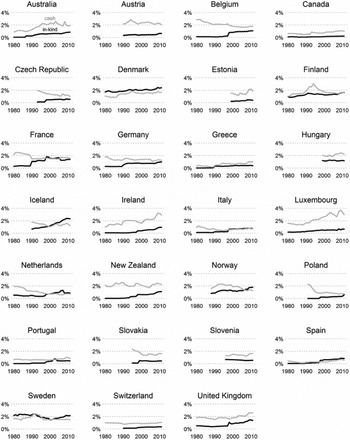
Figure 1 depicts spending trends for all countries over the period of observation. In most country-year observations spending on cash benefits (grey lines) is higher than on in-kind benefits (black lines). The exceptions to this rule are clustered in Northern Europe (Denmark, Sweden, more recently also Iceland and Norway), and the Netherlands, Italy, and Spain after 1998. In 2011, spending on cash benefits was highest in several English-speaking countries (Ireland, United Kingdom, New Zealand) and parts of continental Europe (Luxembourg, Hungary, Austria). Unsurprisingly, in-kind spending was highest in the five Nordic countries.
Cash and in-kind spending on families as a share of GDP

Figure 1 also suggests an overall upward trend in family-related expenditures. Cash benefits rose until 1995 and have stagnated ever since. The reverse is true for in-kind benefits. Here, spending is basically flat until the mid-1990s, before increasing from an average of around 0.6 per cent to over 1 per cent of GDP by 2011. While we have thus seen a modest shift away from cash transfers and towards in-kind spending, the former is still substantially larger than the latter in most countries.
The operationalisation of the independent variables requires data on female representation in parliaments which are taken from Armingeon et al. (Reference Armingeon, Isler, Knöpfel, Weisstanner and Engler2015). Data on the share of ministerial posts occupied by women was collected by the author and supplemented with figures from O'Brien et al. (Reference O'Brien, Mendez, Peterson and Shin2015).
A number of control variables will be specified, largely taken from the literature on welfare spending. Following Bolzendahl (Reference Bolzendahl2009, Reference Bolzendahl2011), the models include measures of female labour force participation and marriage rates, thus capturing gender relations in the economic and social domains. Data on the former are obtained from the OECD, and supplemented for a small number of country-year observations, with information provided by the International Labour Organization (ILO).Footnote 2 Information on marriage rates is taken from Eurostat and supplemented with OECD figures.
Next, the share of cabinet posts occupied by left-wing and right-wing parties will be included as predictors (Armingeon et al., Reference Armingeon, Isler, Knöpfel, Weisstanner and Engler2015). Also, economic and demographic conditions will be captured: gross domestic product (GDP) per capita, unemployment, and the child dependency ratio (the ratio of under 15-year-olds to those of working age, i.e. 15 to 64), all taken from the OECD statistical database. Finally, a year variable is included to account for trending in the data.
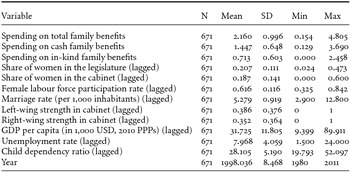
Table 1 presents an overview of the descriptive statistics for all variables used in the models. It shows that there is quite some variation in the presence of female politicians. The average share of women in legislatures is just over one fifth, whereas the corresponding figure for cabinets is just a little below that number. While nine per cent of all observations have zero women in the cabinet, some recent cabinets in Finland have had more female than male ministers.
Descriptive statistics

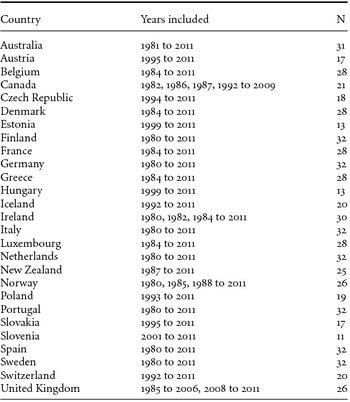
The total number of observations for the regression models is 671. Missing data in the dependent variables and the exclusion of periods under non-democratic regimes accounts for missing country-year observations. Table A1 in the appendix details the exact temporal coverage by country.
Analysis
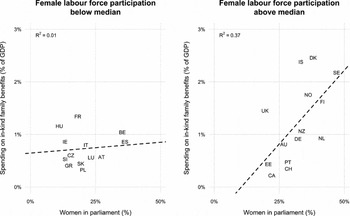
Before moving to the multivariate models, it is worth taking a closer look at bivariate relationships. Figure 2 presents a cross-sectional examination of the relationship between the share of women legislators and in-kind spending on family benefits (data are for 2009, the most recent year with all countries included). The overall correlation between these two variables is r = 0.56 (N = 27, p < 0.01), which conforms to H1. However, once we split the data into countries with below- and above-median levels of female labour force participation, the relationship breaks down in the former group but holds up in the latter.
Correlations of female representation and in-kind spending in 2009

As the left-hand panel in Figure 2 shows, there is essentially no correlation between female political representation and spending on in-kind family benefits for countries with below-median female labour force participation. By contrast, the relationship is strong among countries with above-median female labour force participation. This is exactly the pattern assumed under H2: female labour force participation interacts positively with female political representation to produce increased levels of spending on family services.Footnote 3
To see whether these patterns hold up in a multivariate analysis, a number of regression models will be specified, using spending on cash and in-kind benefits as dependent variables. Since the data are in time-series cross section format and display strong first-order autocorrelation (AR1) and heteroscedasticity, the models will employ Prais–Winsten estimation and panel-corrected standard errors as proposed by Beck and Katz (Reference Beck and Katz1995). Following these authors, the autocorrelation structure is assumed to be uniform across panels: thus only a single autocorrelation parameter (ρ) is reported per regression. Specifying a panel-specific autocorrelation structure yields very similar results, though with somewhat larger effect sizes and smaller standard errors. Therefore the more conservative estimates are reported. Note that all independent variables are included with one-year lags.
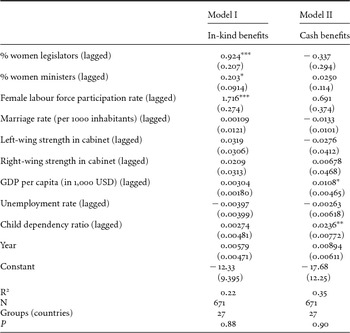
The two models in Table 2 report tests of H1. They explain between 22 per cent (in-kind benefits) and 35 per cent (cash benefits) of the variation in spending. Autocorrelation is substantial, as indicated by the high values of ρ.
Female political representation and spending on family benefits (H1)

Note: Prais–Winsten regressions with panel-corrected standard errors in parentheses; uniform autocorrelation structure assumed; all lags are by one year; # p < 0.1, * p < 0.05, ** p < 0.01, *** p < 0.001.
Substantively, female representation in parliament and cabinet has a positive impact on in-kind spending. Of course, these two variables are highly correlated (r = 0.79), since the share of women legislators is a logical predictor of the share of women ministers. Yet the effects of these variables persist when either is excluded. The coefficients in Model I suggest that a 10 per cent increase in the share of female MPs is associated with an increase in spending on in-kind benefits by 0.09 per cent of GDP. On top of this effect, having ten per cent more female ministers corresponds to a rise of 0.02 per cent of GDP in expenditures on services for families.
As expected in H1, there is no discernable impact of female representation on cash spending. While earlier evidence has suggested such an effect (Bolzendahl, Reference Bolzendahl2011), the analysis here is more comprehensive in terms of geographical and temporal scope. The presence of female politicians is thus not associated with cash spending on family benefits. This result fits with the argument that women (politicians) associate a greater utility with the provision of family services than with cash benefits.
Further support for this interpretation comes from the finding that female labour force participation is a strong predictor of in-kind spending but not of cash spending.
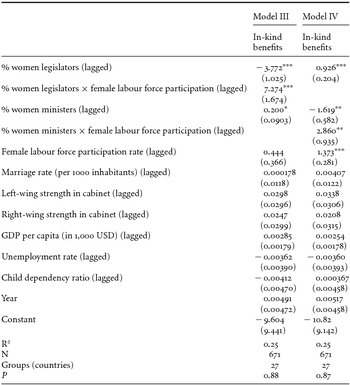
Turning to H2, the regression models in Table 3 introduce interaction effects between the two representation measures and the labour force participation variable. Both interaction terms are positive and significant – thus, in line with the expectations outlined in H2.
Female political representation, female labour force participation, and spending on family benefits (H1)

Note: Prais–Winsten regressions with panel-corrected standard errors in parentheses; uniform autocorrelation structure assumed; all lags are by one year; # p < 0.1, * p < 0.05, ** p < 0.01, *** p < 0.001.
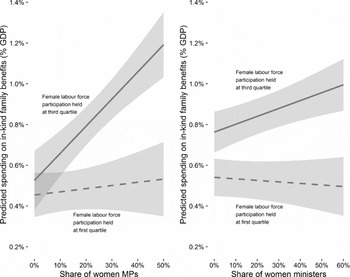
To be sure, a direct interpretation of regression coefficients is not always substantively meaningful when modeling interactive relationships (Brambor et al., Reference Brambor, Clark and Golder2006). For instance, the negative coefficient for the share of women legislators in Model III (-3.772) refers to the effect of that variable in cases when female labour force participation is zero – clearly a nonsensical assumption. To arrive at a more meaningful interpretation, Figure 3 presents predicted values of in-kind spending on family benefits across the empirical range of the representation variables and with female labour force participation held at the first (54 per cent) and third (70 per cent) quartile, respectively. All other predictors are held constant at their means.
The interaction effect of women's political representation and female labour force participation on in-kind family benefits
Note: Predicted values of spending on in-kind family benefits, with 95 per cent confidence intervals. Calculations based on Models III and IV. Female labour force participation held at first (54 per cent) and third (70 per cent) quartile. All other variables held at their means.

As indicated by the dashed lines, there is zero effect for both political representation measures when female labour force participation is low. The predicted level of spending in this scenario is essentially flat across the empirical range of the representation variables. Thus, the presence of women in legislatures and parliaments is unrelated to in-kind spending as long as women do not join the labour force in great numbers.
Yet once a large majority of working-age women have entered paid employment, there is a strong relationship between the share of women in politics and expenditures on family-related services. At a level of 70 per cent female labour force participation (the third quartile), moving from 20 to 50 per cent women MPs (which represents an empirically plausible range at this high a presence of women in the workforce) is associated with an increase in spending from 0.8 to 1.2 per cent of GDP. For female government ministers, the effect is somewhat smaller. In the high labour force participation scenario (70 per cent), moving from 10 to 60 per cent female ministers yields a spending increase from 0.8 to 1 per cent of GDP.
To be sure, it must be noted that the interacting variables are themselves strongly correlated (r = 0.57 for participation–parliament and r = 0.70 for participation–government). That means that, empirically, more women in politics are likely to be found where the female labour force participation rate is high. However, even within the narrow band between 70 and 75 per cent labour force participation, observations range between 18 and 42 per cent for parliamentary representation and between 8 and 60 per cent for governmental representation. This empirical variance suggests that even though the interacting variables correlate, they do not determine each other. In other words, there is enough variation in the representation measures at all levels of the labour force participation variable for the effects to be meaningful.
Taken together, Models I to IV present evidence that is in line with the two hypotheses outlined in the theoretical section. First, female political representation is positively correlated with spending on in-kind family benefits, but not with expenditures on cash transfers. Having more women represented in political office thus means that more resources will be devoted to the provision of childcare services, whereas monetary benefits will not be affected much. This finding resonates with the argument that women politicians are especially responsive to demands for more extensive provision of family-related services. Such services disproportionately benefit women voters, since mothers are still shouldering the bulk of childcare duties in the family.
Second, further analysis in Models shows that the relationship posited under H1 (and confirmed in the first step of the analysis) is only present when a large share of the female population has entered paid employment. Women's labour force participation thus moderates the impact of female political representation on in-kind spending. While the statistical analysis cannot prove which mechanism is behind this interaction effect, the result has a very plausible interpretation. As more women enter the labour force, the demand for publicly provided or financed childcare services increases. A higher presence of female politicians makes it more likely that this demand will be met.
While the findings presented in the Tables above clearly support H1 and H2, they come with an important caveat. Once country-fixed effects are added to the regression models, the results no longer hold – unless the year variable is excluded. This is hardly surprising. Since country dummies and the time trend alone yield R2s of 0.68 and 0.58 for in-kind and cash spending, respectively, there is little left for the substantive variables to explain.
Yet, almost all work using government expenditure data faces these limitations. Much of the variation is between countries (creating the potential for omitted variable bias), and what variation is left within countries often follows a time trend, since budgets are usually altered incrementally. However, rather than discard the results on these grounds one should adopt a conservative interpretation: the findings are by no means invalid, but they apply more strongly to comparisons between, rather than within, countries.
Aside from the central result of the analysis, the control variables yield few strong relationships. GDP per capita is positively related to cash spending on family benefits. Richer countries thus expend a greater share of their financial resources on monetary transfers to families. Also, the child dependency ratio yields a statistically significant coefficient for cash spending. This is a very intuitive relationship: the larger the proportion of young dependents, the greater the share of GDP that goes to families.
Yet neither marriage rates nor the political make-up of cabinets, nor unemployment levels have a statistically significant effect on spending. A number of additional variables that are common in studies of social spending have also been tested, but are not reported due to space considerations (Christian party strength, government type, veto players). None of these predictors yields significant effects.
Conclusion
How does female political representation affect spending on family benefits? This paper starts from the observation that women, even after having entered the labour force in large numbers, carry out the bulk of family duties in most countries. This double burden creates demand for publicly provided (or at least subsidised) childcare services. Such services are more likely than cash transfers to enable women to maintain paid employment. Women politicians are especially likely to respond to these demands. The greater their presence, the higher the level of in-kind spending on family benefits.
Two empirical implications flow from this reasoning. First, a larger proportion of women in political office should be associated with higher public spending on family services, but not with higher cash benefits. Second, the relationship between female political representation and in-kind family expenditures should be conditional on women's labour force participation. More women in paid employment creates greater demand for childcare services, and more women in political office makes it more likely that these demands are acted upon.
The analysis yields support for both hypotheses by looking at spending patterns for cash and in-kind benefits in 27 OECD countries between 1980 and 2011 – the most comprehensive quantitative analysis of family-related public expenditures thus far. The finding that cash spending is not responsive to the share of women in parliament (or government, for that matter) is an important qualification of results reported in earlier studies (Bolzendahl, Reference Bolzendahl2011; Bonoli and Reber, Reference Bonoli and Reber2010).
The more significant result, however, is that women's labour force participation moderates the impact of female political representation on in-kind family spending. In other words, the transformations of gender relations in the economic (labour force participation) and political realms (representation of women in politics) work in concert to affect spending on childcare services. Both political demand by women voters and political supply in the shape of female political representation appear to be necessary to produce high levels of spending on in-kind benefits for families.
It may not be surprising that two historical developments such as the advancement of women in the labour market and in politics have mutually reinforcing effects on social policy. Yet this result is an important reminder about the interdependencies and contingencies that drive the political processes shaping welfare regimes around the world.
A secondary contribution of this paper is to show that female political representation does not end with the gender balance in legislatures. To the best of the author's knowledge, it is the first study ever to examine the impact of the gender composition of governments on social spending. Spending on family benefits not only responds to female representation in parliament but also to the share of women ministers.
The relevance of the gender balance in the executive is underscored by the fact that the gains in female representation have been accumulating at a much faster pace in this arena. In the 27 countries under study, the average share of female legislators rose from 13 to 27 per cent between 1985 and 2011. Across the same time period, the average proportion of women ministers increased from 7 to 29 per cent. From 2008 onwards, the average share of women ministers exceeds the average proportion of women MPs.
The present paper points to a number of possible avenues for future research. Quantitative approaches to gender and the welfare state are still relatively rare. A similar analysis to the one conducted here could certainly be applied to other categories of spending or to data on benefit generosity and other measures of social policy output (e.g. Bolzendahl, Reference Bolzendahl2010; Kittilson, Reference Kittilson2008). Going into greater analytical detail with respect to the political representation of women, it could be a fruitful endeavour to examine whether the qualitative allocation of ministerial portfolios between the genders (Krook and O'Brien, Reference Krook and O'Brien2012) shapes social policy. This would be a perspective that could be married to work on women's agency as policy entrepreneurs.
Finally, there is of course the question of whether the trends in female political representation and labour force participation will continue in the future. In a number of Western democracies (e.g. Germany, Denmark, the Netherlands, and Australia), the rise in the proportion of female MPs has slowed markedly during the past ten years. Female representation in parliaments has plateaued. There is thus no guarantee that women will at some point reach parity with men in the political realm (or the labour market for that matter). Yet this paper has shown that there may be a positive feedback loop at work. As an increasing number of female politicians cater to the demands of an increasing number of working women by delivering social policies that reduce the double burden, a new and self-sustaining equilibrium of gender relations in the political and social realm may arise.
Appendix
Country-year observations included in the data