


1. Introduction
While polarization in America has been a well-explored topic within academia and is of wide public concern in the media, there are only a few empirical studies that address polarization beyond Capitol Hill (e.g., Gerzon, Reference Gerzon2016). With advances in computational social sciences, network science, and AI, and the ubiquity of social media, we can now analyze diverse belief systems, spanning from everyday dialogs to expert discourses. However, understanding how partisan polarization—particularly during elections—translates into other polarization types remains a largely unexplored area.
There are a few reasons behind this gap in empirical research. The first is the issue of definition. Although polarization is widely recognized as a driver of destructive outcomes such as democratic decline, institutional erosion, social divides, and even conflict (McCoy et al., Reference McCoy, Rahman and Somer2018), it remains inconsistently defined and measured (Bruns et al., Reference Bruns, Bechmann, Charquero-Ballester, Walter, Stromer-Galley, McKernan and Vilkins2023; Esau et al., Reference Esau, Choucair, Vilkins, Svegaard, Bruns, O’Connor-Farfan and Lubicz-Zaorski2025; Kubin and Sikorski, Reference Kubin and Von Sikorski2021). While two dominant approaches that frame the literature—ideological polarization (Abramowitz, 2010; Layman, et al., Reference Layman, Carsey and Horowitz2006) and affective polarization (Iyengar et al., Reference Iyengar, Sood and Lelkes2012; Mason, Reference Mason2018; Wagner, Reference Wagner2021)—remain central (Lelkes, Reference Lelkes2016; Mason, Reference Mason2018), they do not encompass the full spectrum of polarization phenomena, and numerous alternative conceptualizations continue to fuel debate over how best to define and measure the concept (Bruns et al., Reference Bruns, Bechmann, Charquero-Ballester, Walter, Stromer-Galley, McKernan and Vilkins2023; Esau et al., Reference Esau, Choucair, Vilkins, Svegaard, Bruns, O’Connor-Farfan and Lubicz-Zaorski2025; Kubin and Sikorski, Reference Kubin and Von Sikorski2021).
Scholars continue to debate the scope, trajectory, and consequences of polarization. While partisan polarization is evident, some argue that popular polarization is overstated, driven more by elites and activists than the broader, often moderate public (Abramowitz, 2010; Baldassarri and Bearman, Reference Baldassarri and Bearman2007; Fiorina and Abrams, Reference Fiorina and Abrams2008). Others question whether polarization is truly increasing: some attribute its rise to online echo chambers and selective exposure (Cinus et al., Reference Cinus, Minici, Monti and Bonchi2022; Coscia and Rossi, Reference Coscia and Rossi2022; de Arruda et al., Reference de Arruda, Cardoso, de Arruda, Hernández, da Fontoura Costa and Moreno2022; Quattrociocchi et al., Reference Quattrociocchi, Scala and Sunstein2016; Nyhan et al., Reference Nyhan, Settle, Thorson, Wojcieszak, Barberá, Chen and Tucker2023), while others find weaker effects and note that older, less digitally active groups often display higher polarization (Boxell et al., Reference Boxell, Gentzkow and Shapiro2017; Gentzkow, Reference Gentzkow2016). Methodological choices further shape these conclusions, leaving the trend contested. Finally, while severe polarization is linked to division, declining trust, and democratic erosion, moderate levels may also foster civic engagement and clarify political choices, raising questions about when polarization is detrimental versus productive (Bruns et al., Reference Bruns, Bechmann, Charquero-Ballester, Walter, Stromer-Galley, McKernan and Vilkins2023; Esau et al., Reference Esau, Choucair, Vilkins, Svegaard, Bruns, O’Connor-Farfan and Lubicz-Zaorski2025; Le Bas, Reference Le Bas2018; McLaughlin, Reference McLaughlin2018).
Despite ongoing debates, there are several avenues for expansion of polarization studies. First is the diversity and size of new data sources. Online and social media data provide large-scale, real-time insights into interactions, content sharing, and network structures, revealing how discourses spread and echo chambers form (Bruns et al., Reference Bruns, Bechmann, Charquero-Ballester, Walter, Stromer-Galley, McKernan and Vilkins2023; Quattrociocchi et al., Reference Quattrociocchi, Scala and Sunstein2016; Yarchi et al., Reference Yarchi, Baden and Kligler-Vilenchik2024). Yet exclusive reliance on these sources risks neglecting offline arenas such as traditional media or think tank publications, where critical policy debates occur (Boxell et al., Reference Boxell, Gentzkow and Shapiro2017; Gentzkow, Reference Gentzkow2016). Extending analysis to think tanks and presidential candidates is therefore vital. Think tanks shape debates, sustain partisan or cross-cutting ties, and both reflect and reinforce polarization (Bertelli and Wenger, Reference Bertelli and Wenger2009; Bruns et al., Reference Bruns, Bechmann, Charquero-Ballester, Walter, Stromer-Galley, McKernan and Vilkins2023; Esau et al., Reference Esau, Choucair, Vilkins, Svegaard, Bruns, O’Connor-Farfan and Lubicz-Zaorski2025; Fagan, Reference Fagan2022; Fischer, Reference Fischer1996; Jacobsen, Reference Jacobsen2019; McCoy et al., Reference McCoy, Rahman and Somer2018), while candidate statements highlight how elites articulate divisions or seek to bridge them (Abramowitz, 2010; Mason, Reference Mason2018). Comparing these domains clarifies how epistemic communities reinforce or resist partisan polarization (Hohmann, et al., Reference Hohmann, Devriendt and Coscia2023).
Second, polarization is not uniform or universally bipolar. While US politics is often framed through a left–right divide (Mason, Reference Mason2018), other systems exhibit multipolar, cross-cutting, or asymmetric patterns shaped by distinct historical, cultural, or institutional contexts. Recognizing such variation is essential for avoiding overgeneralization and ensuring that analyses remain sensitive to the actual structure of ideological conflict. The present study, even within a nominally bipolar US setting, uncovers discursive patterns that are more multidimensional than the standard binary suggests—highlighting the importance of treating polarization as a flexible, context-dependent construct rather than reducing it to a binary framework.
Moreover, the recent emergence of new, powerful computational tools allows scholars to bridge some of the empirical and methodological gaps. For example, researchers are increasingly incorporating large language models (LLMs) and network analysis into study of polarization (e.g., Donkers and Ziegler, Reference Donkers and Ziegler2025). LLMs enable scalable analysis of texts such as think tank reports and political speeches, extracting policy positions, ideological signals, and semantic overlaps (Donkers and Ziegler, Reference Donkers and Ziegler2025; Kubin and Sikorski, Reference Kubin and Von Sikorski2021; Paschalides et al., Reference Paschalides, Pallis and Dikaiakos2025). Combined with social network analysis (SNA), these methods map alignments and divisions among actors, revealing ideological clusters, influential nodes, and bridging or peripheral positions (Hohmann et al., Reference Hohmann, Devriendt and Coscia2023). Together, LLMs and network analysis provide a structured approach to examining the degree and structure of polarization across policy communities.
This study advances polarization research by introducing a methodology for assessing policy polarization as a function of existing partisan polarization with state-of-the-art computational tools. We focus on discursive policy polarization among American think tanks in the lead-up to the 2024 presidential election, conceptualizing them as epistemic social networks. While prior work on “epistemic communities” (Haas, Reference Haas1992), “epistemic networks” (Moldoveanu and Baum, Reference Moldoveanu and Baum2021), and “social epistemic networks” (Sullivan et al., Reference Sullivan, Sondag, Rutter, Meulemans, Cunningham, Speckmann and Alfano2020) highlights how expert knowledge shapes discourse, these frameworks overlook the dual role of think tanks as both knowledge producers and political actors within partisan coalitions.
We aim to make several contributions. First, our framework addresses the above gap by modeling think tanks as nodes within broader political networks, enabling simultaneous analysis of discourse, coalition dynamics, and their role in driving or mitigating polarization.
Second, focusing on communities represented by American think tanks, we analyze their epistemic discourses (e.g., analytical outputs) rather than the more commonly analyzed content such as news or social media. Using the polarized statements of the 2024 presidential candidates, Trump, Biden, and Harris, on key policy issues we develop an algorithm to assess similarities between politicians’ statements and those of think tanks.
Third is methodological innovation: we develop and apply a computational methodology that combines LLMs with SNA to generate polarization metrics from latent semantic structures. By embedding textual data into network models, we capture not only the content of policy discourse but also the relational patterns through which coalitions form, cleavages emerge, and bridging actors operate. Finally, we illustrate how this network perspective contributes to polarization research by shifting attention from isolated policy positions to the structural dynamics of epistemic and partisan communities, offering new leverage for understanding how ideological conflict is organized and sustained. Together, these contributions extend both the conceptual foundations and methodological tools for studying polarization beyond Congress and public opinion, providing a scalable framework for analyzing how knowledge-producing institutions shape political conflict.
2. Measuring polarization: Theoretical and methodological background
2.1 Conceptualization
A clear conceptual definition is essential for the study of political polarization, broadly understood as the movement of actors, parties, or citizens toward opposing positions with diminishing overlap. Early research emphasized ideological polarization—the widening distance between liberal and conservative orientations, measured through legislative voting or voter self-placement (Abramowitz, 2010; Layman et al., Reference Layman, Carsey and Horowitz2006; Poole and Rosenthal, Reference Poole and Rosenthal1984, Reference Poole and Rosenthal2000). Subsequent work highlighted affective polarization, defined as partisan hostility, distrust, and social distance even when substantive policy preferences remain moderate (Iyengar et al., Reference Iyengar, Sood and Lelkes2012; Mason, Reference Mason2018). These two forms remain central (Lelkes, Reference Lelkes2016; Mason, Reference Mason2018), yet differences in their conceptualization and measurement have produced conflation, ambiguity, and concerns about validity (Bruns et al., Reference Bruns, Bechmann, Charquero-Ballester, Walter, Stromer-Galley, McKernan and Vilkins2023; Esau et al., Reference Esau, Choucair, Vilkins, Svegaard, Bruns, O’Connor-Farfan and Lubicz-Zaorski2025).
More recent scholarship extends the concept to capture additional dimensions. Policy polarization refers to disagreements on concrete policy issues, distinct from abstract ideology and focused on tangible decisions over taxation, welfare, or civil liberties (Bruns et al., Reference Bruns, Bechmann, Charquero-Ballester, Walter, Stromer-Galley, McKernan and Vilkins2023; Esau et al., Reference Esau, Choucair, Vilkins, Svegaard, Bruns, O’Connor-Farfan and Lubicz-Zaorski2025; Paschalides et al., Reference Paschalides, Pallis and Dikaiakos2025; Yarchi et al., Reference Yarchi, Baden and Kligler-Vilenchik2021; Grumbach, Reference Grumbach2018). Discursive polarization highlights divergences in the language, narratives, and frames through which issues are articulated (Meyer and Brüggemann, Reference Brüggemann and Meyer2023, Reference Meyer, Brüggemann, Nai, Grömping and Wirz2025). Related forms include identity polarization, rooted in cultural or religious cleavages; interactional polarization, reflected in segmented communication networks; and behavioral polarization, expressed through actions such as voting or protest (Bruns et al., Reference Bruns, Bechmann, Charquero-Ballester, Walter, Stromer-Galley, McKernan and Vilkins2023; Mason, Reference Mason2013; Paschalides et al., Reference Paschalides, Pallis and Dikaiakos2025; Yarchi et al., 2021).
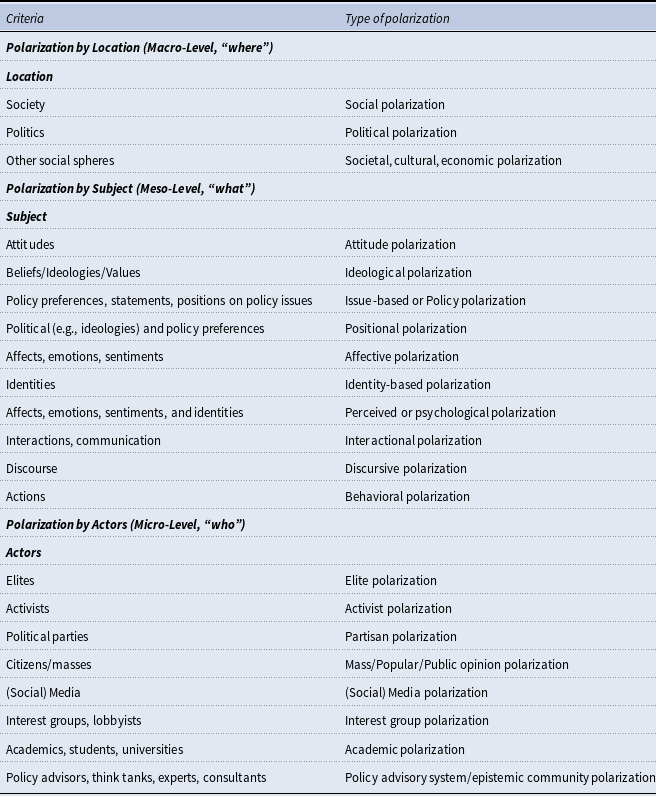
At broader levels, polarization can be classified across political, societal, cultural, and economic subsystems (Parsons, Reference Parsons1971), or by identifying who is polarized: elites, citizens, parties, media, or institutions. This systematization helps clarify overlaps while preserving analytical distinctions (Bruns et al., Reference Bruns, Bechmann, Charquero-Ballester, Walter, Stromer-Galley, McKernan and Vilkins2023; Esau et al., Reference Esau, Choucair, Vilkins, Svegaard, Bruns, O’Connor-Farfan and Lubicz-Zaorski2025). Resulting literature-based, systematized illustration of the proposed conceptualization of different types of polarization is presented in Table 1 and Figure 1.
Re-conceptualized types and forms of polarization and their interrelationships. Notes: *A solid line indicates that the type of polarization the arrow points to is fully encompassed by, or directly derived from, the polarization from which the arrow originates. ** A dotted line indicates that the type of polarization the arrow points to is only partially encompassed by the polarization from which the arrow originates.

Figure 1 Long description
A flowchart illustrating the types and forms of polarization and their interrelationships. The flowchart starts with two main branches: Discursive and Attitude. Discursive leads directly to Attitude. Attitude branches into Ideological, Affective, and Positional. Ideological and Positional are interconnected, with Positional also leading to Policy/Issue. Affective leads to Perceived/Psychological, which then leads to Identity. Policy/Issue and Identity both lead to Behavioral. There are solid lines indicating direct derivation or full encompassment and dotted lines indicating partial encompassment between different types of polarization.
Polarization by location, subject, and actors

Table 1 Long description
A table categorizing types of polarization by location, subject, and actors. The table has three main sections: Polarization by Location, Polarization by Subject, and Polarization by Actors. Each section lists specific criteria and corresponding types of polarization. Polarization by Location includes Society, Politics, and Other social spheres, with types such as Social polarization, Political polarization, and Societal, cultural, economic polarization. Polarization by Subject includes criteria like Attitudes, Beliefs/Ideologies/Values, Policy preferences, Political ideologies, Affects, Identities, Interactions, Discourse, and Actions, with types such as Attitude polarization, Ideological polarization, Issue-based or Policy polarization, Positional polarization, Affective polarization, Identity-based polarization, Perceived or psychological polarization, Interactional polarization, Discursive polarization, and Behavioral polarization. Polarization by Actors includes Elites, Activists, Political parties, Citizens/masses, Social media, Interest groups, Academics, and Policy advisors, with types such as Elite polarization, Activist polarization, Partisan polarization, Mass/Popular/Public opinion polarization, Social media polarization, Interest group polarization, Academic polarization, and Policy advisory system/epistemic community polarization.
In this framework, social polarization is treated as the most general concept, encompassing four dimensions that correspond to Parsons’s (Reference Parsons1971) typology of social subsystems. This represents a macro-level analysis of polarization (Table 1). At the meso-level of analysis, we can examine what is polarized—attitudes, positions, identities, interactions, discourses, and actions, meaning most types span from macro to micro levels of analysis (graphically, these types are presented in Figure 1). Finally, different types of polarization can be distinguished at the micro-level of analysis, depending on who is polarized (last section of Table 1). This includes divided elites, activists, political parties, citizens, traditional and social media, interest groups, universities, and think tanks, among others.
Within this framework, discursive policy polarization occupies a crucial middle ground: it captures substantive disagreements over issues, while illuminating how narratives and language frame these divides. It links macro-level political trends to micro-level actors’ communicative practices, offering insight into how elite debates and epistemic communities structure broader patterns of polarization.
2.2 Measurement
Polarization is typically measured using three main approaches: surveys, experiments, and media analysis. Surveys capture self-reported attitudes, perceptions, and identities across large populations, providing generalizable insights but also introducing biases such as social desirability and framing effects (Barbera et al., Reference Barberá, Jost, Nagler, Tucker and Bonneau2015). Experiments test responses to partisan cues or messaging under controlled conditions, offering causal leverage but facing challenges of external validity (Barbera et al., Reference Barberá, Jost, Nagler, Tucker and Bonneau2015). Media analysis, increasingly focused on social media, examines how polarized discourses are produced and consumed, often through computational methods. While powerful for mapping large-scale communication patterns, it faces limits in data access and interpretation (Barbera et al., Reference Barberá, Jost, Nagler, Tucker and Bonneau2015; Paschalides et al., Reference Paschalides, Pallis and Dikaiakos2025).
Recent computational approaches integrate structured and unstructured media data, analyzing both textual content (posts, news, online discourse) and user interactions (reposts, mentions, hyperlinks, hashtags). Text-based analyses typically employ natural language processing (NLP) to assess opinions, sentiments, and topics, while interaction-based analyses use SNA to model clustering into polarized groups. Poles may be defined by predefined categories (e.g., ideology) or inferred through unsupervised partitioning techniques (Paschalides et al., Reference Paschalides, Pallis and Dikaiakos2025).
Measures of polarization typically track ideological distance or partisan hostility. Ideological polarization is often gauged through differences in party means or medians (Abramowitz, 2010; Layman et al., Reference Layman, Carsey and Horowitz2006), the dispersion (standard deviation or kurtosis) of ideological self-placement (Bramson et al., Reference Bramson, Grim, Singer, Berger, Sack, Fisher and Holman2017), or indices such as Esteban and Ray’s (1994) polarization measure, which captures the formation of distinct opinion clusters. Affective polarization is usually measured through “thermometer gaps” in partisan ratings (Iyengar et al., Reference Iyengar, Sood and Lelkes2012; Mason, Reference Mason2018) or indices of partisan social distance, reflecting reluctance to associate with political opponents (Iyengar et al., Reference Iyengar, Sood and Lelkes2012).
In this paper, we do not claim to resolve all conceptual and operational challenges associated with the definition of polarization. Guided by established practices (Kubin and Sikorski, Reference Kubin and Von Sikorski2021) and contributing to the refinement of more precise definitions, we explicitly focus on the measure of discursive policy polarization among think tanks, and position it alongside partisan polarization, thereby illustrating how our approach complements and extends current methodologies.
Methodologically, by leveraging LLMs for text extraction, summarization, and statement synthesis, our study builds upon and extends the Discourse Network Analysis (DNA) framework, as well as the broader body of research it has inspired (for an overview and applied examples, see Leifeld, 2017). Leifeld’s contributions (2013, 2017) have been pivotal in demonstrating how network analysis of policy positions—typically derived through manual coding—can uncover discourse and advocacy coalitions, and their dynamics. His framework models these dynamics through actor–concept relations, where concepts refer to specific policy instruments proposed by actors, and statements are represented as a two-mode network linking actors to concepts with signed edges—positive when the actor supports the concept, and negative when they oppose it. This two-mode network can then be transformed into an actor congruence network, where the connection between any two actors reflects the number of concepts they both either support or oppose. The resulting connection weight can be interpreted as a measure of similarity in their policy positions: the more frequently two actors express the same sentiment toward the same concepts, the stronger their link in the network (Leifeld, 2013).
DNA provides the conceptual foundation for our approach by treating political discourse as a relational structure in which alignment between actors is inferred from shared positions on policy issues. This relational perspective enables the identification of coalitions and the measurement of polarization through patterns of agreement and disagreement embedded in network structure. Building on this foundation, we extend DNA by replacing manual concept coding with LLM-based extraction and synthesis of policy statements, enabling analysis at greater scale and across diverse textual sources. Instead of linking actors through shared stances on predefined concepts, we construct networks based on semantic similarity between full policy statements embedded in a shared vector space. This shift preserves the relational logic of DNA while modifying its unit of analysis and measurement strategy, allowing polarization to be captured through structural features such as clustering, distances between actors, and the presence of bridging or intermediary positions.
We emphasize that the primary contribution of the proposed framework lies not only in computational text processing, but in the formalization of polarization as a structural property of networks derived from political discourse. Rather than treating textual data as an end in itself, we use it to generate relational data that can be analyzed using established network-analytic principles. Specifically, policy statements are embedded into a shared semantic space, and similarities between these statements are used to define weighted ties, producing a multimodal network that connects actors to the policy positions they articulate. This construction enables the transformation of unstructured discourse into a network representation in which polarization can be examined as a pattern of distances, clustering, and connectivity.
Within this framework, polarization is not measured as an abstract ideological difference, but as a property of network structure, manifested through the relative positioning of actors, the formation of clusters, and the presence or absence of bridging connections. By applying network-analytic tools such as centrality measures and correspondence analysis, we identify how epistemic and political actors align, where divisions emerge, and which actors occupy intermediary or structurally influential positions. In this sense, the contribution of the paper is to extend network-based approaches to polarization by introducing a scalable method for constructing discourse networks from semantic data, thereby linking advances in computational text analysis to core questions in network science regarding structure, connectivity, and relational patterns.
3. Data and methodology
3.1 Data collection
Our data collection was divided into two main stages: first, we collected data on presidential candidates from the two major parties, which in the American context relates to both elite and partisan polarization; second, we collected data on American think tanks, reflecting epistemic polarization. We have used a diverse set of sources to collect documents related to the policy statements of the 2024 presidential candidates—Trump, Harris, and Biden. The following were the sources of data: the American Presidency Project’s debate transcript database (The American Presidency Project, 2024) with the transcripts of presidential candidate debates that took place on June 27, 2024 and September 10, 2024; candidate’s official websites (The Office of Kamala D. Harris, 2025; 2024 Democratic Party Platform; 2024 GOP Party Platform) with the texts of their programs; the RollCall interview database (RollCall, 2025) with transcripts of interviews with the candidates. For Trump, these were interviews that took place between January 01, 2024 and November 5, 2024; for Biden—from January 01, 2024 to July 21, 2024, the date when he dropped out of the presidential race; for Harris—from July 21, 2024 to November 5, 2024.
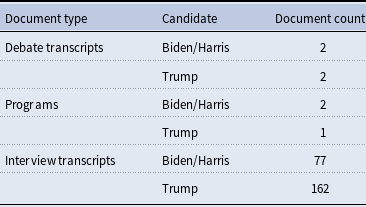
For our analysis, the candidates’ programs were used as-is, without any filtering applied. However, we did apply filters to debates and interview transcripts to retain only the candidates’ words; without comments from other parties. The counts of candidate documents described above are presented in Table 2.
Number of candidate documents in the corpus

Table 2 Long description
A table titled Number of candidate documents in the corpus. The table has three columns: Document type, Candidate, and Document count. It also has four rows including the header row. Row 1: Document type, Candidate, Document count. Row 2: Debate transcripts, Biden/Harris, 2. Row 3: Debate transcripts, Trump, 2. Row 4: Programs, Biden/Harris, 2. Row 5: Programs, Trump, 1. Row 6: Interview transcripts, Biden/Harris, 77. Row 7: Interview transcripts, Trump, 162.
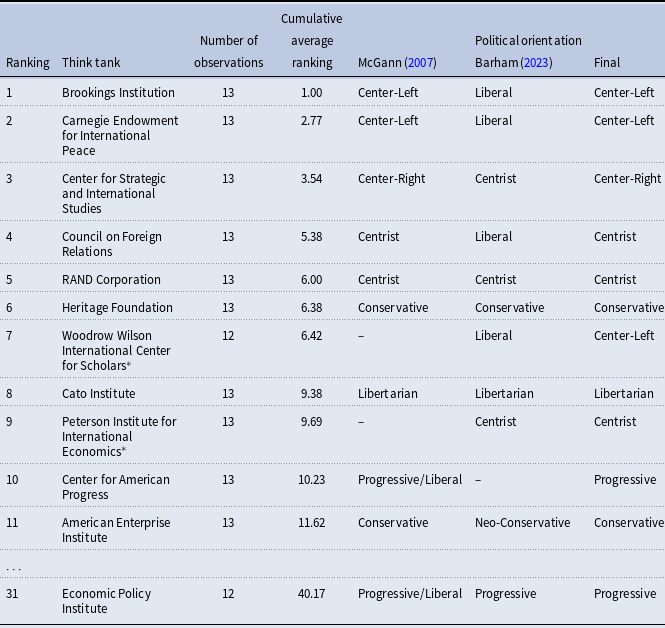
Next, we selected the ten most influential think tanks in the United States, controlling for the diversity of their political orientations. To do so, we utilized the McGann Global Go To Think Tank Reports (McGann, Reference McGann2009–2021), focusing on the “Top Think Tanks in the United States” rankings from 2008 to 2020.Footnote 1 First, we selected think tanks that appeared in the rankings for at least 12 out of the 13 observed years, resulting in a total of 38 institutions. Second, we calculated an average ranking score for each think tank over the observed years, where the minimum possible value was 1.00 and the maximum was 54.75. Finally, we assigned each think tank a political orientation by synthesizing classifications from McGann (Reference McGann2007) and Barham (Reference Barham2023), who map think tanks along a left–right spectrum based on policy positions, affiliations, and stated missions (see Table 3 for details).
Think tanks included in the study

Table 3 Long description
The table ranks think tanks based on cumulative average ranking and political orientation. It includes 11 rows and 6 columns. The columns are labeled Ranking, Think tank, Number of observations, Cumulative average ranking, McGann (2007), Political orientation Barham (2023), and Final. The rows list the think tanks and their respective data. Row 1: Ranking 1, Think tank Brookings Institution, Number of observations 13, Cumulative average ranking 1.00, McGann (2007) Center-Left, Political orientation Barham (2023) Liberal, Final Center-Left. Row 2: Ranking 2, Think tank Carnegie Endowment for International Peace, Number of observations 13, Cumulative average ranking 2.77, McGann (2007) Center-Left, Political orientation Barham (2023) Liberal, Final Center-Left. Row 3: Ranking 3, Think tank Center for Strategic and International Studies, Number of observations 13, Cumulative average ranking 3.54, McGann (2007) Center-Right, Political orientation Barham (2023) Centrist, Final Center-Right. Row 4: Ranking 4, Think tank Council on Foreign Relations, Number of observations 13, Cumulative average ranking 5.38, McGann (2007) Centrist, Political orientation Barham (2023) Liberal, Final Centrist. Row 5: Ranking 5, Think tank RAND Corporation, Number of observations 13, Cumulative average ranking 6.00, McGann (2007) Centrist, Political orientation Barham (2023) Centrist, Final Centrist. Row 6: Ranking 6, Think tank Heritage Foundation, Number of observations 13, Cumulative average ranking 6.38, McGann (2007) Conservative, Political orientation Barham (2023) Conservative, Final Conservative. Row 7: Ranking 7, Think tank Woodrow Wilson International Center for Scholars, Number of observations 12, Cumulative average ranking 6.42, McGann (2007) -, Political orientation Barham (2023) Liberal, Final Center-Left. Row 8: Ranking 8, Think tank Cato Institute, Number of observations 13, Cumulative average ranking 9.38, McGann (2007) Libertarian, Political orientation Barham (2023) Libertarian, Final Libertarian. Row 9: Ranking 9, Think tank Peterson Institute for International Economics, Number of observations 13, Cumulative average ranking 9.69, McGann (2007) -, Political orientation Barham (2023) Centrist, Final Centrist. Row 10: Ranking 10, Think tank Center for American Progress, Number of observations 13, Cumulative average ranking 10.23, McGann (2007) Progressive/Liberal, Political orientation Barham (2023) -, Final Progressive. Row 11: Ranking 11, Think tank American Enterprise Institute, Number of observations 13, Cumulative average ranking 11.62, McGann (2007) Conservative, Political orientation Barham (2023) Neo-Conservative, Final Conservative. Row 31: Ranking 31, Think tank Economic Policy Institute, Number of observations 12, Cumulative average ranking 40.17, McGann (2007) Progressive/Liberal, Political orientation Barham (2023) Progressive, Final Progressive.
* Think tanks not included in the final sample are marked with asterisks.
From the initial top 11 think tanks, we selected nine. We excluded the Woodrow Wilson International Center for Scholars, as we already had two center-left think tanks in the top two, and the Peterson Institute for International Economics, as we already had two centrist think tanks in the top five. We included the Economic Policy Institute (EPI) in the final sample, as we had only one progressive think tank in the top ten. The resulting sample of ten think tanks is balanced, representing a wide range of political orientations and the most influential institutions (Table 3).
Next, we collected documents from think tanks’ websites. We first downloaded links to their publications using web scraping techniques. We have collected publications published between January 1, 2024, and November 5, 2024, as this was the presidential campaign period in 2024. In addition to the official publications links from all think tanks, we have additionally collected links to informal blog posts made by Economic Policy Institute (EPI) and Council for Foreign Relations (CFR), due to the fact that the corpus of their publications was noticeably smaller than corpus of other think tanks. Due to differences in think tanks’ website search interfaces, we implemented a two-stage filtering procedure for link extraction. In the first stage, we used the websites’ native search capabilities to limit the download period to between January 1, 2024, and November 5, 2024. We have then downloaded the publication links, as well as the exact dates the publications were made. In the second stage, we used local filtering with the publication dates to filter out the publications that were made outside of the 2024 presidential campaign period.
Having collected the links to the publications, we have used a generic article download and extraction tool based on curl-impersonate (CurlImpersonate) and go-readability (Go-Readability) to download and extract the texts of the publications in an automated fashion. Texts that were not downloaded by the generic tool were removed from the analysis.
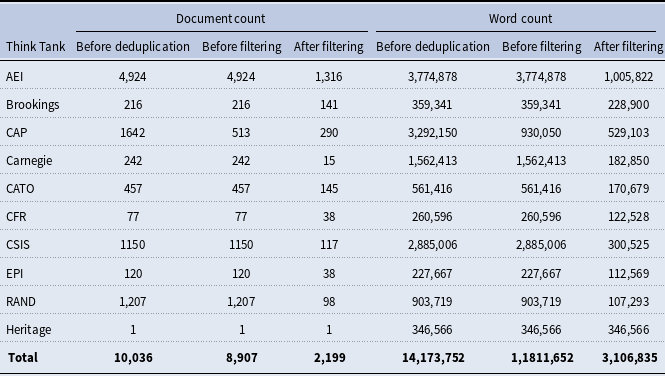
We have then used a deduplication algorithm to remove duplicate texts from our corpus. In the case of the Heritage foundation, we opted to use only their official “Mandate for Leadership” pub-lication in our corpus, because of its status as the official policy agenda publication and its large length. The total size of the corpus under analysis is presented in Table 4, with 8907 items in total.
Total corpus in the analysis

Table 4 Long description
The table presents the total corpus in the analysis, focusing on document and word counts for various think tanks. It includes data before deduplication, before filtering, and after filtering. The table has 12 rows and 7 columns. Column headers are Think Tank, Document count Before deduplication, Document count Before filtering, Document count After filtering, Word count Before deduplication, Word count Before filtering, and Word count After filtering. Row labels include AEI, Brookings, CAP, Carnegie, CATO, CFR, CSIS, EPI, RAND, Heritage, and Total. Row 1: AEI, 4,924, 4,924, 1,316, 3,774,878, 3,774,878, 1,005,822. Row 2: Brookings, 216, 216, 141, 359,341, 359,341, 228,900. Row 3: CAP, 1642, 513, 290, 3,292,150, 930,050, 529,103. Row 4: Carnegie, 242, 242, 15, 1,562,413, 1,562,413, 182,850. Row 5: CATO, 457, 457, 145, 561,416, 561,416, 170,679. Row 6: CFR, 77, 77, 38, 260,596, 260,596, 122,528. Row 7: CSIS, 1150, 1150, 117, 2,885,006, 2,885,006, 300,525. Row 8: EPI, 120, 120, 38, 227,667, 227,667, 112,569. Row 9: RAND, 1,207, 1,207, 98, 903,719, 903,719, 107,293. Row 10: Heritage, 1, 1, 1, 346,566, 346,566, 346,566. Row 11: Total, 10,036, 8,907, 2,199, 14,173,752, 1,1811,652, 3,106,835.
3.2 Data pre-processing
In our pipeline, we employ LLMs as capable data annotators to automatically extract and summarize policy issue formulations from politician’s debate transcripts, interviews, and campaign programs. This approach follows recent findings demonstrating that LLMs can perform reliable data annotation tasks at scale (Gu et al., Reference Gu, Li, Colon, Evans, Mondal and Boyd-Graber2025). Furthermore, recent findings (Burnham, Reference Burnham2025) show that zero-shot models can be used for political stance analysis. To ensure transparency and reproducibility, we have also included the prompts used for this process in the Supplementary Materials.
For extraction and summarization of policy issues, we have employed Phi-4, using the 4-bit quantized version provided by Ollama, a decoder-only LLM designed for tasks such as text extraction and summarization. This model was selected because it was one of the newest at the time of writing, and because it was specifically trained to minimize model hallucinations in its output (Abdin et al., Reference Abdin, Aneja, Behl, Bubeck, Eldan, Gunasekar and Zhang2024). The context length of this model was set to 16384 tokens, both because of inference GPU limitations, and because the model was originally trained to handle context this long. Additionally, we have used Qwen2.5-7B-Instruct (the Q6_K quantized version provided on HuggingFace website) for text embedding generation. This model was chosen because it was one of the strongest in its size class at the time of writing; we had to use a smaller model for embedding computation because of inference hardware limitations, specifically, because embedding usage requires a much larger minibatch size, and much more VRAM. For our verification pass (to validate results of the first pass) we have utilized Gemma 3 12B (specifically, the Gemma 3 12B IT QAT checkpoint, quantized to Q4_0, as provided on HuggingFace website), for both decoder-only and embedding workloads.
For the decoder-only LLM, our inference engine is Ollama, accessed through its OpenAI API endpoint. For text embeddings, we have used the OpenAI API endpoint of llama.cpp. In our second verification pass, we have used the llama.cpp inference engine (build b6357) for both generation and embedding workloads. All experiments were conducted on a machine equipped with a NVIDIA 4090 Laptop GPU (16 GB VRAM), an Intel i9-13900HX CPU, and 96 GB of system RAM. The code and data necessary for replicating these experiments is available at the anonymous GitHub link provided in Data availability statement.
In the first phase of our analysis, we extracted concise formulations of policy issues mentioned by presidential candidates in debates, interviews, and campaign programs (hereafter “documents”). For example, one issue was coded as “abortion rights decentralization.” Using a decoder-only LLM with a tailored issue-extraction prompt, we identified issue formulations in each document for each candidate. To ensure consistency, constrained generation was applied so that outputs followed a predefined JSON schema, which facilitated automated post-processing. For longer texts, documents were segmented into 8,192-word units before extraction. The resulting outputs were compiled into candidate-specific issue lists.
We then employed the same LLM, again with constrained generation, to synthesize overlapping formulations across candidates and to remove duplicates. For instance, variations such as “abortion rights and access to healthcare,” “abortion access and healthcare impact,” and “abortion law federalism debate” were consolidated into the unified issue “abortion rights decentralization.” In total, 80 distinct issues were identified (Table 1S, Supplementary Materials). The prompts used in this process are provided in the Appendix.
To validate the coverage of our extracted issues, we compared them with topic lists from two established sources: OnTheIssues (2024) and the Comparative Agendas Project (2025). The comparison confirmed that the major policy domains from both projects were well represented in our dataset (see Table 2S, Supplementary Materials). Nonetheless, LLM-based extraction has limitations, including risks of inconsistency and overgeneralization, which we address in the Discussion and Limitations section along with strategies for improvement in future research.
After generating the list of common policy issues, we conducted an additional pass over the corpus using the pre-established policy issues list to create prompts for the extraction of policy statements by the LLM. Each extracted policy statement included both a description of the policy problem and a proposed solution, with the LLM instructed to extract exact quotes from the documents. Any policy problems related to issues not present in the common issue list were disregarded. For lengthy documents, the chunking method was applied, and for each document, a list of policy issues along with their corresponding statements was created, ensuring all LLM outputs adhered to a specific format for automated post-processing. We have applied an additional filtering step, where we have removed issues for which the LLM failed to extract policy statements for at least one of the candidates, from the list of the common issues. Subsequently, we utilized the decoder-only LLM to synthesize policy statements that summarized each candidate’s general position on the common policy issues.
Since a number of think tank publications were not relevant to our analysis (e.g., did not touch on issues of internal US policy), we have implemented an additional semantic filtering step, where we have utilized the decoder-only LLM as a selection tool to determine whether the texts are relevant to the analysis. As in our previous steps, we have utilized a decoder-only LLM with constrained generation to implement this filtering step. The total size of the corpus under analysis after semantic filtering is also presented in Table 4, with 2199 documents in total.
We have then employed a procedure similar to candidate policy statement extraction and synthesis to the filtered think tank text corpus. We have first extracted statements from each of the documents in the corpus, and then utilized the decoder-only LLM to create synthetic policy statements describing the positions of each of the think tanks in relation to the policy issues. To improve the reliability and alignment of the synthesized statements for think tanks, our statement synthesis procedure did not ensure policy statements are produced for all think tanks on all issues. In total, we have produced 743 synthetic policy statements from our document corpus, as shown in Table 3S of Supplementary Materials.
3.3 Analysis
Next, we have computed embeddings that encoded the synthetic policy statements we have generated for each of the candidates and think tanks. We employed a methodology initially proposed by Tao et al. (Reference Tao, Shen, Gao, Zhang, Li, Tao and Ma2024) to adapt a decoder-only LLM into an embedding model capable of understanding natural language queries for embedding generation. We have utilized Qwen2.5-7B-Instruct with a prompt instructing the model to understand and summarize the position of a policy actor, given a description of their position on a particular issue. We have then utilized last token pooling to retrieve the embedding of the policy statement. In our prior experiments, we have noticed that the embeddings display a high degree of similarity, even when a pair of sentences demonstrating completely different policy statements is encoded. This leads to a notable reduction in the ability to use the embeddings to discriminate between different policy statements. This was previously shown to be caused by the embedding being dominated by the effects of irrelevant tokens, making semantic nuance hard to distinguish in the latent space (Zhang et al., Reference Zhang, Zhou and Bollegala2025). In addition to that, high similarity in the embedding space might be caused by biases inherent to the model itself. Mirroring Zhang et al. (Reference Zhang, Zhou and Bollegala2025) methodology to deal with this problem, we first computed the embeddings of completely non-informative policy statements on each of the issues, which contained only placeholder text. With this procedure, these embeddings should effectively capture both the inherent bias present in the model, and the influence of the prompting format and non-relevant tokens. Next, when computing an embedding of a statement related to a candidate or a think tank, we subtracted the embedding of the generic statement to remove the common component. This resulted in a considerable increase in the discriminatory power of the model embeddings.
To verify the validity of issue extraction and synthesis, we have performed the statement extraction and analysis step for the second time, using a different model (Gemma 3 12B) for decoder-only workloads. We have then computed the embeddings of the synthetic statements using the Gemma 3 12B model in embedding mode, while modifying our embedding prompt to follow the new model’s chat format. We have then computed the similarities between actors using the same procedure we used for the first pass.
Additionally, we have computed the embeddings of the synthetic policy statements from the verification pass using Qwen2.5-7B-Instruct, to enable us to perform more direct comparisons. We have then computed the similarity matrix using these embeddings. Since these embeddings were computed using the same model, we have then compared the distances using the paired t-test. This test has also shown that there are no significant differences between the similarities we computed (p-value 0.1112). To avoid making any parametric assumptions, we have compared the similarities using the paired Wilcoxon signed rank test, with it also showing no significant differences (p-value 0.4507).
Next, we have computed the similarities between pairs of synthetic statements with the same actor and issue computed during the first pass and the verification pass. We have then compared the most similar and the most dissimilar pairs of statements, to manually check whether they describe similar positions. We evaluated all dissimilar (<0) and a random selection of similar statements for their correspondence to the actual texts and extracted issues. Results of manual verification have confirmed that while there are some known problems (such as hallucinations) that are present in the model results, they do not alter the polarization levels we were trying to estimate.
We have then constructed a network of policy statements. All network analysis was performed using R statistical software (R Project), using packages “sna” (Butts, Reference Butts2008, Reference Butts2024) and “igraph” (Csardi & Nepusz, Reference Csardi and Nepusz2006; Csardi et al., Reference Csárdi, Nepusz, Traag, Horvát, Zanini, Noom and Müller2025). The network was complete, with policy statements as nodes, and the similarity measure between them used as the edge weight. To ensure comparability, we removed ties between statements that addressed different substantive issues, whether issued by the same actor or by different actors, as such links would only indicate topic difference rather than meaningful similarity or dissimilarity. Next, we have added links between candidates and think tanks and their respective statements and set their weight to a constant value of 1. All visualizations were performed using Gephi (Bastian et al., Reference Bastian, Heymann and Jacomy2009).
As a final step, we have used the methodology of Zhu et al. (Reference Zhu, Kuskova, Wasserman and Contractor2016) to conduct multiple correspondence analysis of the resulting multimodal network by creating a multiple indicator matrix of 3,425 unique actor–statement dyads. The analysis was performed using R package “CA” (Nenadic and Greenacre, Reference Nenadic and Greenacre2007) and the multiple joint correspondence analysis approach.
4. Results
While in this section we represent factual results, we also offer one possible way to interpret them. Our study offers a methodological approach, so interpretations may differ based on a different theoretical foundation.
Graphically, results of the analysis can be represented as a network of actors, statements, and similarities between them, computed algorithmically. Figure 2, which was created using Gephi (Bastian, Reference Bastian, Heymann and Jacomy2009) using Force Atlas 2 algorithm (Jacomy et al., Reference Jacomy, Venturini, Heymann and Bastian2014), shows the relationship between think tanks and presidential candidates and their statements. Degree centrality is used to illustrate node sizes. We do not offer any interpretations of this Figure as it merely describes the resulting network in terms of actors and the statements they’ve made.
Graphic representation of the resulting network of actors, statements, and computed similarities (Degree centrality as node size).

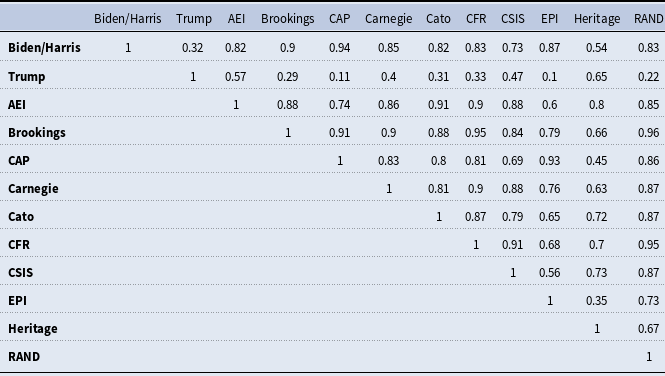
We have used our computed embeddings to calculate the similarities between the policy actors under analysis. To do so, we first summed the embeddings of all statements belonging to the same actor and then computed cosine similarities between the obtained actor embeddings. Since the model was instructed to encode the inferred policy position of the actor in its embeddings, the cosine similarities between the computed vectors can be interpreted as levels of similarity of policy positions of the actors. The results of this analysis are presented in Table 5, where small similarities indicate the largest polarization (the largest dissimilarity).
Cosine similarities between the actor embeddings

Table 5 Long description
A table titled cosine similarities between the actor embeddings. The table has 11 rows and 11 columns, including headers. The rows and columns are labeled with the names of different think tanks and political figures: Biden/Harris, Trump, AEI, Brookings, CAP, Carnegie, Cato, CFR, CSIS, EPI, Heritage, and RAND. Each cell in the table contains a numerical value representing the cosine similarity between the corresponding row and column labels. The values range from 0.1 to 0.96. The table provides a detailed comparison of the similarities between these entities based on their embeddings.
As is apparent from Table 5, partisan polarization is, indeed, present, contrary to some suggestions in the literature (e.g., Baldassarri and Bearman, Reference Baldassarri and Bearman2007). Partisan polarization, represented by similarity between presidential candidates Democratic (Biden/Harris) versus Republican (Trump), is 0.32, and it is the lowest similarity for Biden/Harris (all of their similarity scores with think tanks are higher).
However, there isn’t that much polarization among think tanks, even the most conservative and the most progressive—the think tanks are positioned between these two party polarization poles. “Progressive” think tanks (EPI and CAP) are closest to the Democratic candidates, as is Brookings, which is traditionally associated with the Democratic Party. The think tanks whose narratives most closely align with Trump’s discourse are Heritage, whose Project, 2025 was specifically created for a potential Trump administration, to the point where many observers can barely distinguish between Trump’s position and Heritage’s, and AEI, which has traditionally been associated with the Republican Party. The Heritage Foundation, in particular, registers a similarity score of 0.65 with Trump, the highest among all think tanks, reinforcing its close alignment with the Republican candidate’s policy outlook.
However, it is noteworthy that even the think tanks that lean toward one end of the political spectrum do not appear to exhibit the same level of polarization as that between the candidates themselves. For instance, CAP’s similarity with Biden/Harris is 0.94, but CAP’s similarity with Trump is 0.11, about as low as the similarity between Trump and EPI. This indicates that, although strong partisan affinities exist, think tanks may hold more nuanced or multidimensional policy positions relative to the stark Democratic–Republican divide at the elite electoral level.
Additionally, we present Table 5 as a graph visualization (Figure 3), where we removed weak edges with similarity less than 0.5 based on distribution of similarity values. We then computed modularity clusters (shown as colors) and betweenness centralities (shown as relative node sizes).
Actor similarity network visualization.

As Figure 3 demonstrates, AEI and Heritage have the highest betweenness centrality, serving as key connectors between Trump and the rest of the network. This result is somewhat surprising: in theory, think tanks are expected to function as “idea brokers” (Smith, Reference Smith1993) or “knowledge brokers” (Anderson et al., Reference Anderson, De La Cruz and López2017; Zaytsev et al., Reference Zaytsev, Kuskova and Kononova2022) that generate ideas to be consumed by diverse actors. Under this assumption, one would expect all think tanks to exhibit relatively high betweenness centrality compared to other actors—especially politicians.
However, this is not the case here. Only AEI and Heritage, the two conservative think tanks, show higher betweenness centrality than other think tanks, many of which have scores equal to or lower than those of Biden and Harris. They are two think tanks that connect Trump to the broader network. Notably, AEI is the only think tank with highest betweenness centrality that is directly connected to both Biden/Harris and Trump. Heritage comes next, linking Biden/Harris and Trump indirectly through AEI and RAND. From these results, we can tentatively conclude that AEI and Heritage generate ideas that are consumed across party lines. This hypothesis, however, requires further testing.
Another visualization of Table 5 was created using t-SNE to show the resulting similarity matrix in 2D space. The results of this visualization, side by side with correspondence analysis of the resulting network, are shown in Figure 4. Figure 4 (left) visualizes the positions of politicians and think tanks in a two-dimensional space based on the similarity of their policy statements across 80 policy issues. We can clearly identify “Republican” and “Democratic” think tanks aligned with the discourses of Trump and Biden/Harris, respectively. The think tanks closest to Trump’s position are the “conservative” Heritage Foundation and AEI. Cato appears somewhat more distant from them, which can be explained by its “libertarian” orientation—potentially placing it closer to another of Trump’s allies, Elon Musk.
t-SNE visualization of actor embeddings (left) and correspondence analysis of multimode actor–statement network (right).

Figure 4 Long description
Panel A: A scatter plot visualizes actor embeddings. The plot features various labeled points representing different actors, grouped into distinct clusters. The clusters are enclosed by dashed lines of different colors, indicating different groupings of actors. Panel B: Another scatter plot shows the results of correspondence analysis of a multimode actor-statement network. This plot also features labeled points grouped into clusters, enclosed by dashed lines of various colors. The axes are labeled as First Eigenvector and Second Eigenvector, with numerical values marked along both axes.
On the Democratic side, the “progressive” think tanks EPI and CAP are positioned closer to the policy discourse of the Biden/Harris campaign. However, what is most noteworthy is the strong central cluster, where the remaining five think tanks are situated. This supports our initial hypothesis about the weak discursive policy polarization among American think tanks. Instead of polarization, the data suggests a fragmented landscape within the epistemic community.
An even more interesting picture appears on the right side of Figure 4, which shows the results of a correspondence analysis that maps the political and epistemic social networks—along with related policy issues—into a two-dimensional space. The first dimension clearly represents the traditional “Left–Right” divide in American policy. This axis is anchored by the conservative Heritage on the right and the progressive EPI on the left, known for its support of workers’ rights movements. Interestingly, the Democratic and Republican presidential candidates are not positioned at the extreme ends of the spectrum; however, they are notably more distant from each other compared to the majority of think tanks. This is not surprising, given the discussions in terms of policy issues between candidates found in exploratory analysis.
The second dimension is even more interesting. It is defined by the contrast between Trump and Carnegie, with all other actors positioned closer to Carnegie than to Trump. This dimension can be interpreted as an establishment versus anti-establishment axis, reflecting discussions around issues that Trump has introduced or emphasized in the policy agenda. For example, on this dimension, Trump is the closest to issue 59, “opponents’ philosophical shifts.” Trump’s quotes illustrate his anti-establishment stance, for example, “I’m the only one that is going to stop World War III…” (Pool, Reference Pool2024), “Nobody wanted to bring it until I decided to run” (Bloomberg, 2024). All of these were interpreted by the model as the following synthetic statement: “Ensuring accountability by holding politicians responsible for any deviations from their stated principles”—a formulation capturing the core of anti-establishment sentiment.
The closer connections between Biden, Harris, and a variety of think tanks may reflect the more conventional—more rational than populist—campaigning styles of Democratic candidates. Such campaigning would presumably involve more explicit statements on specific policy issues, thereby generating greater affinity with think tank policy documents. While Carnegie addresses fewer issues than most other actors in the dataset, its position is not anomalous in this regard. Along the second (vertical) dimension, it is located close to other well-established think tanks such as CFR and CSIS, and its contrast with Trump aligns with the broader pattern separating establishment-oriented actors from his campaign discourse.
Since all the think tanks in this analysis are positioned in opposition to Trump, we can hardly speak of polarization along this dimension—Trump appears isolated, facing a considerable unified front rather than a balanced divide. This may also reflect the isolation of an unconventional candidate, campaigning on his own base instincts, from the US political and policy-making establishment that think tanks, perhaps even including the Heritage Foundation, have typically represented. The second dimensionFootnote 2 may reflect not only an establishment versus anti-establishment divide, but also a distinction between conventional and populist campaigning styles. The closer alignment between Democratic candidates and think tanks may stem from more traditional, policy-oriented communication strategies, whereas Trump’s discursive isolation may be rooted in a more instinct-driven and less policy-specific approach.
Next, we can identify at least four clusters. First, the “conservative” think tanks—Heritage and AEI, both traditionally associated with the Republican Party—are positioned very close to each other. However, they remain distant from Trump, as do all the other think tanks in the analysis, with Trump constituting a separate cluster (second) on his own. This leads to a striking conclusion: if polarization exists, it is not between two opposing ideological camps within the epistemic community, but rather between Trump and all other epistemic actors. This suggests that Trump’s policy discourse stands apart and is not meaningfully connected to any established source of expert policy advice. On the one hand, this may reflect the Trump campaign’s strategic efforts—often echoed in mainstream media coverage during the campaign—to signal some distance from Heritage’s Project, 2025 agenda, potentially as a way to reassure voters uneasy about that initiative (a dynamic that would help explain the observed gap between Trump and Heritage). On the other hand, it may also reflect Trump’s broader communication style, which tends to emphasize broad slogans over detailed policy proposals—resulting in a general lack of alignment with the more structured policy platforms typically articulated by think tanks.
We also observe a clearly defined “Democratic” or “Liberal” cluster, consisting of the “progressive” think tanks EPI and CAP, as well as the “center-left” Brookings and Carnegie. This represents the third cluster.
The fourth cluster, positioned near the middle of the “Left–Right” dimension, includes two “centrist” think tanks—CFR and RAND—alongside the “center-right” CSIS. The “libertarian” Cato Institute is also located near the center; while it is not clearly separated in the visualization, its distinct ideological orientation suggests some distance from the other three think tanks of this cluster.
5. Discussion and limitations
Our study is methodological, offering an approach to incorporate unstructured data analysis methods into the study of political polarization. The interpretation of the results we offer is based on theoretical understanding of discursive policy polarization and could contribute to a nuanced understanding of policy polarization in epistemic communities. Consistent with prior studies (e.g., Abramowitz, 2010; Baldassarri & Bearman, Reference Baldassarri and Bearman2007), we find evidence of partisan alignment: “progressive” think tanks cluster near Democratic candidates, whereas “conservative” think tanks align more closely with the Republican candidate. Interestingly, “centrist” think tanks, particularly those with bipartisan reputations, remain spatially central in the network visualizations, suggesting that policy positions within influential epistemic networks do not necessarily mirror the stark two-pole divide often observed among elected officials.
Our interpretation of findings extends the ongoing debates over whether political polarization is primarily driven by elite cues (Fiorina and Abrams, Reference Fiorina and Abrams2008) or more organic, mass-level processes. The presence of discernible alignments between think tanks and candidates lends credence to the idea that certain elite institutions, beyond Congress and campaigning politicians, do help structure public policy narratives in ways that might reinforce partisan boundaries. However, the relative clustering of think tanks around a more moderate midpoint suggests that a uniform march toward extremes may be less prevalent among policy experts than it is among political candidates. Future studies could investigate whether think tanks actively shape or simply respond to shifts in partisan discourse.
A noteworthy dimension of this study is our effort to isolate policy polarization, defined as divergence on specific policy statements, from more abstract ideological or affective polarization. Although many think tanks convey recognized political orientations (e.g., conservative, progressive, centrist), the range of policy issues they address and their specialized expertise suggest more granularity in their positions than mere party labels might indicate. Our analysis reveals that even overtly “partisan” think tanks sometimes align with candidates in some areas yet diverge in others, pointing to the importance of capturing multi-issue nuance rather than relying on broad ideological scales alone. It is important to note that this study is only assessing published statements, not actual policies.Footnote 3 Therefore, when we speak about aligning between the political candidates and think tanks, we cannot evaluate whether this alignment reflects the true state of events or the deliberate attempt by a political candidate to disengage from a specific think tank during political campaigning if this is perceived as electorally beneficial.
Even though our approach shares conceptual foundation with DNA framework (Leifeld, 2017), particularly in its focus on actor–concept relations, it differs methodologically in that our primary aim is to measure polarization, rather than to trace the formation and evolution of advocacy or discourse coalitions. Accordingly, we begin by identifying policy issues and statements, rather than concepts. Leifeld’s concepts are short and specific—for example, “cut pensions” or “tax pensions.” In contrast, our statements take the form of extended narrative passages, each averaging around 220 words. Each statement includes two parts: a formulation of the policy problem and a corresponding proposed solution. This conceptualization of a policy position as a coupling between problem and solution reflects the logic of the multiple streams framework in policy science (Kingdon, Reference Kingdon1984), which emphasizes the importance of how problems and solutions are linked in shaping policy agendas. We believe that our approach is better suited to measuring polarization because polarization often emerges within broader discursive contexts, rather than around short and concrete policy concepts alone. By analyzing extended problem–solution formulations, our method captures the nuances and framing differences where polarization is most likely to occur. For example, a concept such as “deal with illegal migration” may appear unifying—all major policy actors in the United States agree on the need to address it. However, this issue is among the most polarized in American politics. The polarization lies not in the abstract agreement on the goal, but in the specifics of how to formulate and implement it—debates over the necessity, scope, and rules of deportations; the definition of “illegal”; controversial practices such as family separation; etc. Our approach allows such distinctions to be surfaced and compared across actors.
Importantly, we do not rely solely on actor–concept co-occurrence for inferring similarity. Instead, we compute similarity between entire statements directly, using semantic similarity measures derived from sentence-transformer embeddings. This allows us to assess the degree of alignment or divergence in how different actors frame both problems and solutions—capturing more subtle rhetorical, ideological, and policy-based distinctions than concept-level agreement alone.
We fully recognize that the DNA tradition, through Leifeld and many subsequent publications, has made significant contributions to identifying advocacy and discourse coalitions, as well as tracing their evolution, in public discourse. Our aim is to extend this line of research by introducing computational tools that preserve theoretical foundations of DNA while expanding its applicability to different research focuses—such as the measurement of polarization. We acknowledge that these goals may require different design choices. While our approach emphasizes semantic comparison of full statements, it remains compatible with core DNA principles and could be cross-validated in future work using more traditional, manually coded DNA methods.
Next, instead of manual coding, we use LLMs to automatically identify, extract, and annotate policy statements across large corpora. This enables the efficient generation of discourse networks at a much broader scale and across multiple domains: our analysis includes statements spanning numerous policy areas or issues, not just a single debate context. We also verify the results obtained by one LLM by means of another, given that these models, at the time of writing, are not completely reliable in their outputs and interpretations. We additionally perform random manual verification of the obtained results.
However, several limitations must be acknowledged. First, our emphasis on online publications and digital archives inevitably raises questions about data completeness; offline outputs, private briefings, or non-textual materials may be overlooked.
Second, LLMs can occasionally introduce bias or omit important details during summarization, increasing the risk of construct contamination, where extraneous information skews the analysis, or construct deficiency, in which key nuances are omitted (Kubin and Sikorski, Reference Kubin and Von Sikorski2021). Although a comparison with authoritative topic classifications (Comparative Agendas Project (CAP), 2025; OnTheIssues, 2024) demonstrates that our extracted issues broadly capture the policy agenda—both in a universal sense (the CAP policy topics were developed for cross-national comparative research) and specifically in the US context (the OnTheIssues project focuses exclusively on the American policy agenda)—our list is more granular, comprising 80 issues compared to 21 and 24 topics, respectively (Table 2S). This higher level of detail complicated direct mapping to CAP and OnTheIssues categories. Some extracted issues naturally spanned multiple domains (e.g., crime rate increase due to immigration, leadership accountability for border policies), resulting in 101 issue–topic assignments for 80 unique issues. Furthermore, while CAP and OnTheIssues primarily emphasize social and public policy, several politically oriented issues (e.g., campaign ethics and politics, lack of honest media coverage) were difficult to align with existing categories and thus appeared mainly under principles and values (Table 2S). Our primary objective was to measure polarization during the 2024 American presidential election, and the extraction process was optimized to capture issue distinctions most relevant to this goal. This focus partly explains the detailed segmentation of certain topics, their nuanced granularity and cross-cutting nature across broader policy domains, and the underrepresentation of others (e.g., education, environment).
It is important to clarify the scope and interpretation of the proposed measurement approach. The similarity scores derived from embeddings reflect the degree of semantic alignment between policy statements, capturing how actors frame issues, define problems, and articulate solutions. As such, the resulting measure should be interpreted as an indicator of discursive proximity or distance, rather than a direct measure of agreement or opposition in the strict sense. Low similarity may indicate substantive disagreement, but it may also reflect differences in emphasis, framing, or the specific dimensions of an issue that actors choose to highlight.
Accordingly, the present framework is designed to capture discursive policy polarization as variation in the structure of policy-related communication, rather than as binary support or opposition toward predefined positions. This distinction is particularly relevant in complex policy domains, where actors may share general goals while diverging in how those goals are operationalized or justified. The network representation therefore reflects patterns of alignment, separation, and fragmentation in discourse, without assuming that all observed distances correspond to direct disagreement.
Finally, we note that translating semantic similarity into explicit agreement or opposition would require an additional layer of analysis, such as stance detection or contradiction classification. Incorporating such methods would enable the construction of signed networks more directly comparable to traditional DNA approaches. However, this extension lies beyond the scope of the present study, whose primary objective is to establish a scalable method for representing and analyzing the relational structure of policy discourse.
Nonetheless, certain inconsistencies—such as near-duplicate entries (e.g., Biden administration’s policy critiques, and criticism of Biden administration policies) and occasional omissions (e.g., debates on tax cuts)—reflect limitations of the automated approach rather than deliberate research design choices. Future research could address these limitations in two complementary ways: (i) by prompting the LLM with predefined policy taxonomies and labeled corpora from OnTheIssues (2024) and the Comparative Agendas Project (2025), thereby grounding issue extraction in established categorization schemas; and (ii) by leveraging the embeddings extracted during the LLM-based issue extraction to map issues to these policy categories and construct a hierarchical representation of policy issues for more granular analysis, extending the semi-automated mapping already illustrated in Table 2S. Both approaches would produce a more reliable, balanced, and hierarchically structured set of policy issues.
Third, the temporal scope of our dataset, which spans only the 2024 campaign period, may not capture fluctuations in polarization that arise from longer-term political shifts or unexpected global events; a longitudinal design could shed light on how these trends evolve over time.
Building on these limitations, future research might expand to larger corpora or incorporate multilingual and cross-national data for comparative analyses of think tanks and politicians in different political systems. Another promising avenue is exploring how affective and identity-based polarization interacts with the policy-level divergence we capture here, potentially by integrating sentiment analysis or social identity cues into the computational pipeline (Mason, Reference Mason2018). Also, it’s worth notingFootnote 4 that in this study, we do not measure “policy stances.” In the NLP field, a “stance” is characterized as a measure of support or opposition toward a particular statement. In this study, we are measuring the semantic similarity between statements made by the actors under investigation (by analyzing the similarities and distances between the relevant embeddings). Therefore, future research could address actual support and/or opposition to issues that underlie political polarization.
Investigating whether epistemic communities actively drive partisan polarization, or instead reflect preexisting political fault lines, presents an important next step in understanding the broader ecology of partisan conflict. But most importantly, incorporating network analysis opens multiple opportunities for additional insights. For example, social influence models could incorporate measures of centrality (such as those illustrated in the article) into linear models to explain non-network characteristics, such as the relative power of think tanks or other political actors. Similarly, social selection models could be developed to predict polarization—measured as dissimilarity between actors’ policy statements—based on diverse node attributes (e.g., political orientation, budgets, or other resources). Finally, it would be possible to model the associations, and potentially even the causal relationships, between different types of polarization across various actors, including think tanks, politicians, NGOs, and active citizens.
6. Conclusion
This study demonstrates a novel approach to measuring policy polarization within epistemic social networks by comparing how major US think tanks align (or diverge) from leading 2024 presidential candidates. In doing so, our work clarifies how policy polarization can be delineated from other forms of polarization, such as ideological and affective variants, and illustrates the usefulness of combined LLM and network analysis techniques in systematically mapping actor positions.
Although our interpretation of findings confirms a discernible partisan structure in these networks, they also highlight that think tanks often occupy nuanced positions that do not always neatly conform to the candidate-level divides. Such complexity underscores the importance of examining specific policy statements rather than assuming think tanks will simply replicate elite and partisan narratives. More broadly, our multimodal, computationally driven method can be readily adapted to other policy contexts, both within and beyond US politics, to advance understanding of how polarization emerges, consolidates, and persists across diverse social and institutional settings. By refining measurement approaches and expanding the scope of investigation, researchers, policymakers, and civil society actors can better identify potential avenues for dialog and de-escalation in an era of seemingly intensifying social and political divisions.
Supplementary material
The supplementary material for this article can be found at https://doi.org/10.1017/nws.2026.10039.
Data availability
Data and code are available via the following anonymous github repository: https://anonymous.4open.science/r/polarization_sna_llms_measurement-1611.
Funding statement
This research received no specific grant from any funding agency in the public, commercial, or not-for-profit sectors.
Competing interests
The authors declare no competing interests.




 Open access

