INTRODUCTION
Benthic diatoms are one of the most diverse taxonomic groups in estuarine ecosystems (Sullivan & Currin, Reference Sullivan, Currin, Weinstein and Kreeger2000; Tiffany, Reference Tiffany, Seckbach, Kociolek and Seckbach2011) and theoretically they are present in all shallow water systems. However, although benthic diatom inventories either as checklists or as elements of the structure of particular assemblages are not uncommon, many interesting localities in terms of their biodiversity are yet to be surveyed. Thus, in spite of their importance and the growing need for determining their ecological relations as bioindicators of environmental quality, in palaeoecology, etc., benthic diatom flora and their ecology issues are scarcely known, especially in tropical and subtropical regions (Gaiser et al., Reference Gaiser, Wachnicka, Ruiz, Tobias, Ross and Bortone2005) where the great species diversity of benthic diatoms contrasts with the need for taxonomic surveys (Round et al., Reference Round, Crawford and Mann1990), especially those aimed at characterizing particular ecosystems.
One of the least studied tropical marine substrates is macrophytes which are commonly colonized by macro and microbiota. Diatoms in particular thrive on macroalgae thalli and on seagrass blades that represent a more extended colonizing surface than sediments (Main & McIntire, Reference Main and McIntire1974; Zieman et al., Reference Zieman, Fourqurean and Iverson1989; Teena et al., Reference Teena, Hyun, Hanna and Spafford2008). In general, though, the epiphytic diatom flora of seagrasses has received little attention. In the case of Thalassia testudinum (Banks ex König, 1805) the first surveys were carried out on the Atlantic coasts during the 1970s (Reyes-Vásquez, Reference Reyes-Vasquez1970; Sullivan, Reference Sullivan1979), and almost two decades went by before further research was done on this subject (Frankovich et al., Reference Frankovich, Gaiser, Zieman and Wachnicka2006; Corlett & Jones, Reference Corlett and Jones2007).
For the Caribbean Sea, even though Navarro & Hernández-Becerril (Reference Navarro, Hernández-Becerril and Chiang1997) published a check-list that included over a thousand marine diatom taxa, both planktonic and benthic, specific studies on benthic diatoms were hitherto non-existing for the Mexican Caribbean.
Thus, our research was aimed at: (1) constructing the first benthic diatom floristic list for the Mexican Caribbean, specifically of epiphytic diatoms of T. testudinum which is the dominant macrophyte in the Yalahau lagoon area; and (2) to describe the diatom assemblage structure on the basis of ecological parameters such as species richness and diversity.
MATERIALS AND METHODS
Study area
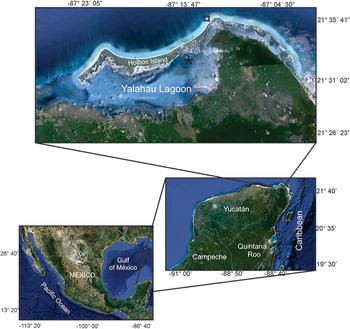
Yalahau lagoon in Quintana Roo, Mexico, is located between Chiquilá to the south and Holbox Island to the north at 21°26′ and 21°36′N and 87°08′ and 87°29′W (Figure 1). It extends approximately 275 km2, with a depth variation of 0.3 to 4 m. It shows narrow shallow areas along its internal margin (mean depth of 2.0 m) with extensive seagrass beds dominated by Thalassia testudinum. Towards the middle of the lagoon the bottom is sandy supporting a variety of macrophytes, reaching a depth of 3 to 4 m. The internal part of the lagoon shows a muddy bottom deprived of seagrasses (Olmsted et al., Reference Olmsted, Durán, González-Iturbe, Calvo-Remolina and Canela-Rojo2000; Ordoñez-López & García-Hernández, Reference Ordoñez-López and García-Hernández2005). Cabo Catoche is a spit located approximately 43 km east of Holbox Island and marks the continental division between the Gulf of Mexico and the Caribbean Sea, indicating the south-western limit of the Yucatán channel (Figure 1).
Location of study area and sampling sites. Punta Arbolitos* and Cabo Catoche ¤ .

Field work
Sampling was carried out during the dry season from 26 to 29 March 2011 in Yalahau lagoon, east of Holbox Island in ten sites around the locality known as Arbolitos (Figure 1), and at Cabo Catoche, outside the lagoon (Figure 1). Physical and chemical data (temperature, salinity and dissolved oxygen) were measured in situ using a field multi-sensor. Depth was recorded with a diving computer, and location was determined with a Garmin 60 GPS.
EPIPHYTIC DIATOM FLORA
In each sampling site three 50 × 50 cm squares were cast along a 100 m line perpendicular to the coast: at 0 m, halfway (50 m) and at 100 m. In each square five vegetative shoots of Thalassia testudinum were collected. Samples were transported to the laboratory in tagged plastic bags in ice and in the dark.
Epiphytic diatoms from two shoots were scraped off using a glass slide for each sampling square. Then a compound sample was formed for each site and preserved in commercial ethanol (70%); observations of the fresh diatom samples were made. Afterwards, in order to clean the diatom frustules the organic matter was oxidized with a mixture of sample, commercial ethanol and nitric acid at 1:3:5 (Siqueiros-Beltrones & Voltolina, Reference Siqueiros-Beltrones and Voltolina2000). The samples were then rinsed with drinking water until a pH >6 was reached. From each compound sample six permanent slides were mounted for Yalahau lagoon and four for Cabo Catoche. Pleurax (R. I. = 1.7) was used as mounting medium.
The whole ten slides of each sample were examined in order to make the floristic survey. Whilst, only two slides from Yalahau (LI and LII) and one from Cabo Catoche (LIII) were used for the quantitative analysis. A compound microscope (Zeiss) with phase contrast illumination was used; observations were done at 400× and 1000×. Elaboration of the floristic list followed Round et al. (Reference Round, Crawford and Mann1990) at division, class, subclass, order, family and genus levels. Taxonomic keys used included: Schmidt et al. (1874–Reference Schmidt, Schmidt, Fricke, Heiden, Müller and Hustedt1959), Peragallo & Peragallo (1897–Reference Peragallo and Peragallo1908), McIntire & Reimer (Reference McIntire and Reimer1974), Navarro (Reference Navarro1982), Foged (Reference Foged1984), Witkowski et al. (Reference Witkowski, Lange-Bertalot, Metzeltin and Lange-Bertalot2000), Siqueiros-Beltrones (Reference Siqueiros-Beltrones2002) and López-Fuerte et al. (Reference López-Fuerte, Siqueiros-Beltrones and Navarro2010). The relative abundance of each identified species was estimated (N = 500 valves; Siqueiros-Beltrones, Reference Siqueiros-Beltrones2002); with these, ecological indices were computed in order to describe the structure of the epiphytic diatom assemblages. Species diversity was measured using Shannon's H′, Simpson's 1-λ, and Pielou's equitability (J′). Rare species (abundance ≤ two valves) were not included in the quantitative analysis. Similarity between samples and sites was measured with Jaccard's index (Magurran, Reference Magurran1988) on the basis of presence/absence using all of the identified species. These were fed into Program Primer V.5 using an agglomerative classification module with flexible algorithm (Clarke & Gorley, Reference Clarke and Gorley2001).
RESULTS
Field observations showed that, in general, to the interior of Yalahau lagoon currents were weak but southerly winds were strong and constant, promoting sediment suspension and turbidity, and thus low visibility in the sampling sites. Maximum depth measured in the lagoon was 2 m, while at Cabo Catoche a 13 m depth was recorded (Table 1). Salinity showed differences between sampling sites in the interior of the lagoon where a minimum of 39 psu and a maximum of 42 psu were recorded (Table 1), which renders it a metahaline environment. Salinity values between the lagoon and Cabo Catoche on the other hand showed a clear difference, with values being lower to the exterior of the lagoon which characterized it as euhaline (Table 1). Mean surficial and bottom temperatures varied little, both to the interior and the exterior of the lagoon (Table 1); variations seemed to correspond with the hour of sampling with lower values recorded in the morning hours. Dissolved oxygen values varied between 6.27 mg/l in site 4 to 8.66 mg/l in site 3.
Values of physical and chemical variables in Yalahau lagoon and Cabo Catoche: surficial and bottom temperatures (T°C), pH, salinity (psu) and dissolved oxygen. ND, no data.

Diatom flora
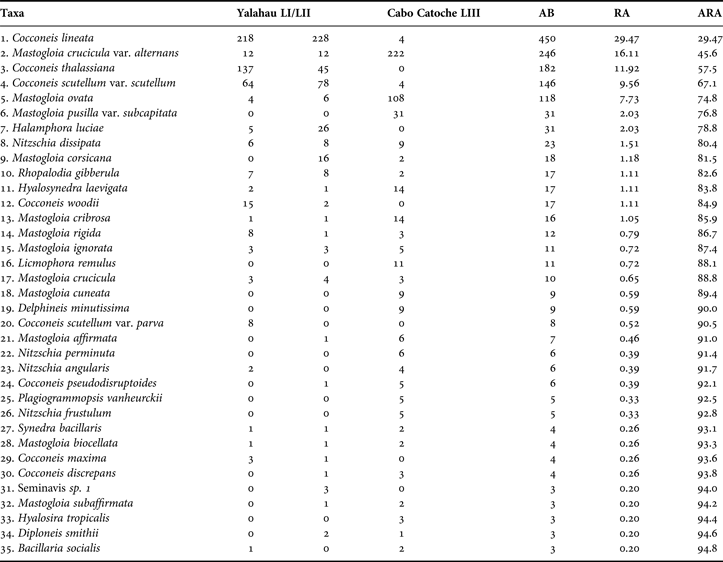
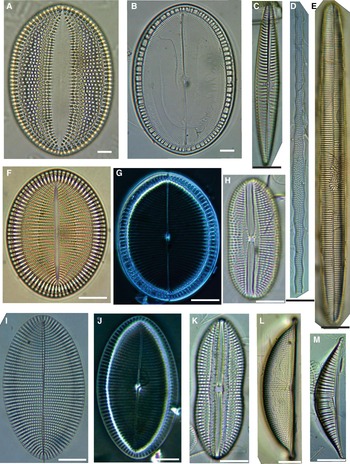
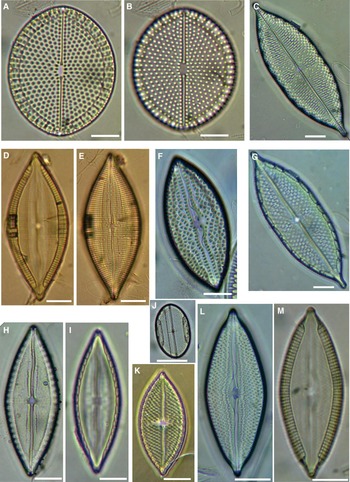
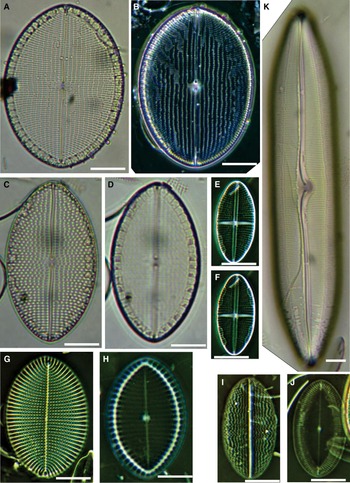
Floristic analysis yielded 107 taxa including species, varieties and forms within 38 genera of diatoms epiphytic on Thalassia testudinum (Appendix). The Bacillariophyceae were the most diverse class with 87 taxa vs the Fragilariophyceae with 10 and the Coscinodiscophyceae with 9. The genera with higher number of species were Mastogloia (30), Nitzschia (11), Cocconeis (9), Navicula (5) and Amphora (6). Meanwhile 21 genera were represented by a single species, mostly uncommon. The most abundant taxa were: Cocconeis lineata Ehrenberg, 1846 (Figure 5I, J), Cocconeis thalassiana Romero & Lopez-Fuerte, Reference Romero and López-Fuerte2013 (Figure 3F, G), Cocconeis scutellum var. scutellum Ehrenberg, 1838 (Figure 5G, H), Mastogloia crucicula (Grunow) Cleve, 1895 var. crucicula (Figure 5E, F), Mastogloia ovata Grunow, 1860 (Figure 5A, B), and Mastogloia pseudolatecostata Yohn & Gibson, 1982 (Figure 5C, D) (Table 2). Overall, these taxa accounted for 75% of the total valve count (N = 1527). Fifty taxa appeared only once. Sixty-four taxa were observed exclusively on the samples of T. testudinum blades from Yalahau, while Cabo Catoche yielded 15 exclusive taxa; 28 taxa were common in both sites. Nine taxa are new records for Mexico: Caloneis excentrica (Grunow) Boyer, 1927 (Figure 5K), Cocconeis thalassiana Romero & López-Fuerte, Reference Romero and López-Fuerte2013, Navicula normaloides Cholnoky, 1968, Synedra bacillaris (Grunow) Hustedt, 1932 (Figure 3E), Mastogloia affirmata (Leudiger-Fortmorel) Cleve, 1892, Mastogloia bahamensis Cleve, 1893 (Figure 4F), Mastogloia barbadensis (Greville) Cleve, 1895 and Mastogloia biocellata (Grunow) G. Novarino & A.R. Muftah, 1991; although several have been recorded for other parts of the Caribbean. And last, Mastogloia cf. braunii Grunow, 1863, which exhibits meristic patterns similar to M. braunii; however; the shape of the partecta and wider frustules sets it apart, hence it requires a closer taxonomic approach.
Epiphytic diatom taxa found on Thalassia testudinum from Yalahau lagoon and Cabo Catoche, used in ecological index computation. Taxa represented by two valves or fewer were not included. AB, abundance; RA, relative abundance; ARA, accumulated relative abundance; L, slide used in the quantitative analysis.

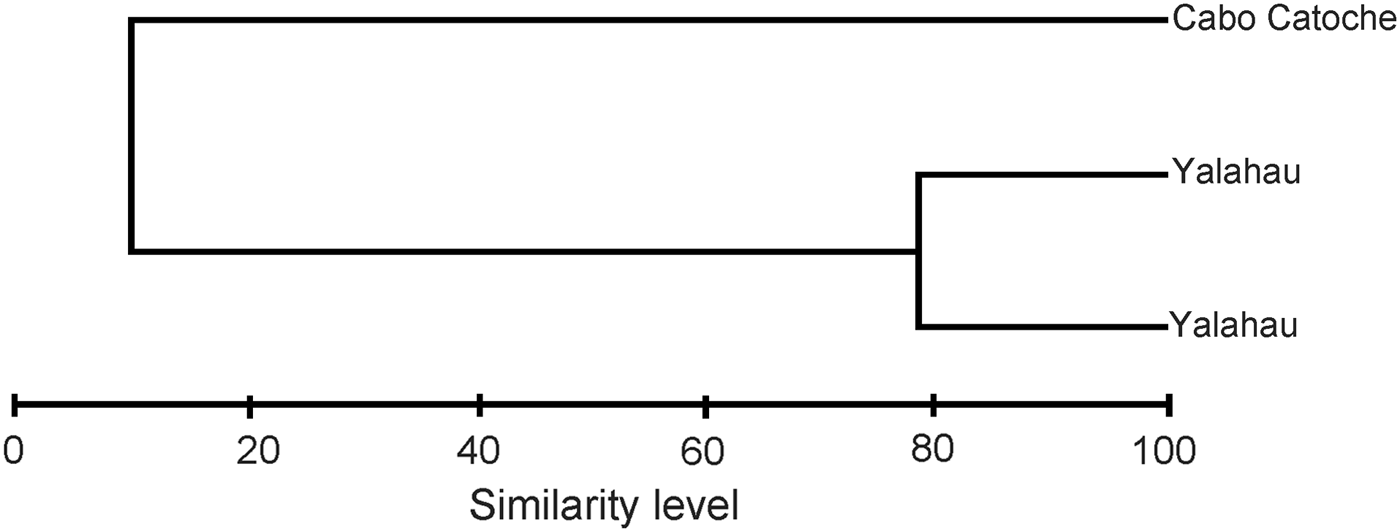
Jaccard's index separated two associations of epiphytic diatoms on T. testudinum (Figure 2). As expected, the two samples from Yalahau lagoon are very similar and represent a hypersaline condition, while the sample from outside the lagoon (Cabo Catoche), would represent the marine influence.
Grouping of epiphytic diatoms of Thalassia testudinum Banks ex König, 1805, based on Jaccard's similarity index.

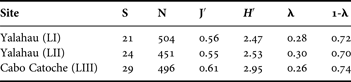
In Table 3 the estimated values for community parameters of the epiphytic diatom assemblages found on T. testudinum are shown. Both species richness and equitability values in the samples were low corresponding with the low diversity values either with H′ or with Simpson's index. Apparently Cabo Catoche shows higher values overall, which in combination may prove to be significant.
Epiphytic diatoms of Thalassia testudinum Banks ex König, 1805. (A) Cocconeis maxima (Grunow) Peragallo & Peragallo, 1897, rapheless valve (RLV); (B) C. maxima raphe valve (RV); (C) Navicula agnita Hustedt, 1955; (D) Toxarium undulatum J.W. Bailey, 1854; (E) Synedra bacillaris (Grunow) Hustedt, 1932; (F) Cocconeis thalassiana Romero & López-Fuerte, Reference Romero and López-Fuerte2013, RLV; (G) C. thalassiana RV; (H) Diploneis obliqua (Brun) Hustedt, 1937; (I) Cocconeis woodii Reyes, 1970, RLV; (J) C. woodii RV; (K) Diploneis didyma (Ehrenberg) Ehrenberg, 1845; (L) Amphora corpulenta var. capitata Tempere & Peragallo, 1909; (M) Rhopalodia pacifica Krammer, 1987. Scale bars: 10 µm.

Epiphytic diatoms of Thalassia testudinum. (A, B) Mastogloia cribrosa Grunow, 1860; (C, G) Mastogloia rostellata (Grunow) Grunow, 1877; (D, E) Mastogloia cf. braunii Grunow 1863; (F) Mastogloia bahamensis Cleve, 1893; (H, I) Mastogloia jelineckii (Grunow) Grunow, 1877; (J) Mastogloia binotata (Grunow) Cleve 1895; (K) Mastogloia lacrimata Voigt 1963; (L, M) Mastogloia subaffirmata Hustedt, 1927. Scale bars: 10 µm.

Epiphytic diatoms of Thalassia testudinum. (A, B) Mastogloia ovata Grunow, 1860; (C, D) Mastogloia pseudolatecostata Yohn & Gibson, 1982; (E, F) Mastogloia crucicula (Grunow) Cleve, 1895 var. Crucicula; (G, H) Cocconeis scutellum var. scutellum Ehrenberg, 1838; (I, J) Cocconeis lineata Ehrenberg, 1846; (K) Caloneis excentrica (Grunow) Boyer, 1927. Scale bars: 10 µm.

Estimated values of ecological indices for the epiphytic diatom assemblages found on Thalassia testudinum from Yalahau lagoon and Cabo Catoche. S, species richness; H′, Shannon's species diversity; J′, equitatibility; 1-λ, Simpson's diversity and dominance (λ).

DISCUSSION
As compared to the few other studies on the epiphytic diatoms of Thalassia testudinum the species richness (107 taxa) that we report surpasses those by Reyes-Vásquez (1970), Sullivan (Reference Sullivan1979) and Corlett & Jones (Reference Corlett and Jones2007) who recorded 42, 45 and 61 taxa, respectively. Moreover, our species list had only seven, four and six taxa in common with these studies, respectively. Although Frankovich et al. (Reference Frankovich, Gaiser, Zieman and Wachnicka2006) recorded 332 taxa for a one year cycle, the floristic comparison could only be made with 92 taxa used in the statistical analysis (in Supplementary Electronic Material section). In spite of that, the similarity between both floras is considered high (19 taxa in common). Overall these represent 36% of the diatom taxa we recorded. Further floristic surveys that take into account the different microhabitat that may be found in the lagoon should yield many more diatom taxa.
Although few sites and dates were sampled in this investigation these comprised two different environments in terms of salinity in Yalahau lagoon. In one case hypersaline conditions were detected with higher salinities toward the interior part of the lagoon, while off Cabo Catoche marine conditions prevailed. Said difference was reflected in the species composition of epiphytic diatoms. This may be the dominating condition during the dry season, but in the rainy season estuarine conditions may cause the presence of freshwater or brackish-water species. Either way, diversity would be expected to show higher values toward marine conditions which are most stable. Previous investigations have recorded a tendency for benthic diatom assemblages to exhibit higher diversity values going from estuarine to marine conditions (DeFelice & Lynts, Reference DeFelice and Lynts1978; Huvane, Reference Huvane, Porter and Porter2002).
Besides the above, much of the difference between the epiphytic diatom assemblages from the interior and exterior parts of the lagoon was determined by the different microhabitats that may be found in the lagoon which in the interior, may reflect the influence of the epipsammic diatoms due to re-suspension by wind action on the shallow bottom.
Species proportions and structure of the diatom assemblages on T. testudinum are very similar to what Reyes-Vásquez (1970) and Sullivan (Reference Sullivan1979) observed, i.e. with few dominating taxa and many rare taxa with each showing a relative abundance of <1% (observed only once). This same pattern has been frequently reported for other benthic marine diatom assemblages from different substrata in the southern part of the de Baja California peninsula (Siqueiros-Beltrones, Reference Siqueiros-Beltrones2002; Siqueiros-Beltrones et al., Reference Siqueiros-Beltrones, López-Fuerte and Gárate-Lizárraga2005; López-Fuerte & Siqueiros-Beltrones, Reference López-Fuerte and Siqueiros-Beltrones2006). Most comprehensive samplings over the T. testudinum beds and other substrata should render better insight into the actual proportions of many of the diatom taxa and their potential importance in the community.
The average diversity measured at Yalahau lagoon is similar to other values of epiphytic diatoms of T. testudinum from estuarine systems (H′ = 2.14, DeFelice & Lynts, Reference DeFelice and Lynts1978; H′ = 2.77, Frankovich et al., Reference Frankovich, Gaiser, Zieman and Wachnicka2006 but lower than for beds of T. testudinum from reefs zones in marine systems (H′ = 3.42, Montgomery, Reference Montgomery1978). Altogether, ecological index values and floristic composition for a slightly hypersaline environment (Yalahau lagoon) and a typical marine one (Cabo Catoche) seemed apparently similar. However, in spite of the statistical limitation the higher values estimated for Cabo Catoche may actually reflect a less harsh environment that explains the presence of most species and most equally represented. The estimated index values were influenced by low species richness in the samples mainly because of the many rare species that were not included during the quantitative analysis. Besides, measured equitability (J′) was relatively low indicating that few species were clearly more abundant than the rest.
An outstanding feature that we find about the tropical and subtropical diatom flora is the high species richness of the genus Mastogloia and their individual relative abundance (Reyes-Vásquez, Reference Reyes-Vasquez1970; DeFelice & Lynts, Reference DeFelice and Lynts1978; Montgomery, Reference Montgomery1978; Siqueiros-Beltrones, Reference Siqueiros-Beltrones2006; López-Fuerte et al., Reference López-Fuerte, Siqueiros-Beltrones and Navarro2010; Loza et al., Reference Loza, Sánchez, Carmenate and Siqueiros-Beltrones2011). Frankovich et al. (Reference Frankovich, Gaiser, Zieman and Wachnicka2006) reported that up to 24.6% of the taxa and 19.7% of the total valves that they observed belonged to Mastogloia. Likewise, DeFelice & Lynts (Reference DeFelice and Lynts1978) and Montgomery (Reference Montgomery1978), recorded relative abundance of Mastogloia spp., of 34.5 and 70.7%, respectively in their studies. In our inventory Mastogloia species represented 27% of the total species and 33% of the valve count; out of the 30 identified Mastogloia species, 14 were found only in Yalahau lagoon, 4 in Cabo Catoche and 12 in both sites. Frankovich et al. (Reference Frankovich, Gaiser, Zieman and Wachnicka2006) determined that the diatom species dominating the epiphytic assemblages of T. testudinum depicted a classic estuarine model represented in this case by a transition from marine species of Mastogloia to brackish-water representatives such as Brachysira aponina (Kützing, 1836), Nitzschia liebetruthii (Rabenhorst, 1864) and Reimerothrix floridensis (A.K.S.K. Prasad, personal communication, 2001) toward the interior of Florida Bay. Our observations follow said model roughly.
Although in general the most numerous taxa were Cocconeis lineata, Cocconeis scutellum var. scutellum and Cocconeis thalassiana, toward the exterior part of the lagoon Mastogloia crucicula var. crucicula, Mastogloia ovata and Mastogloia pusilla var. subcapitata (Hustedt, 1933) were most abundant. In similar studies, Cocconeis spp., have been recorded as the characteristic taxa in epiphytic diatom assemblages of Zostera marina (Linnaeus, 1753) in temperate waters, particularly Cocconeis scutellum (Siqueiros-Beltrones et al., Reference Siqueiros-Beltrones, Ibarra-Obando and Loya-Salinas1985).
The diatom flora of Mexico is still poorly known and the present work is the first of its kind for the Mexican Caribbean waters. Thus, the generated information is relevant both in biogeographical as well as in environmental health terms. Understanding the structure of benthic diatom assemblages and their variations due to natural and anthropogenic causes provides a reference for monitoring pristine environments such as those from the Mexican Caribbean.
ACKNOWLEDGEMENTS
We acknowledge the support given by the Universidad Autónoma de Baja California Sur, for the processing of the samples, and two anonymous referees who helped to improve the manuscript. D.A.S.B. is COFAA and EDI fellow at the IPN.