1 Introduction
Research into the phonology of Tashlhiyt Berber has mainly concentrated on its phoneme inventory, syllable structure and sonority, intonation having been somewhat neglected. Dell & Elmedlaoui sum up the situation: ‘stress and intonation in Tashlhiyt are still terrae incognitae’ (2002: 14). More recent studies have contributed to the general picture (Grice et al. Reference Grice, Roettger, Ridouane and Fougeron2011, Gordon & Nafi Reference Gordon and Nafi2012), but have also shown that the intonation of this language involves a high degree of variation, both within and across speakers, especially with regard to the placement of F0 peaks, corresponding to H tones. The aim of this paper is to account for the observed variability by disentangling the multiple factors responsible for the placement of these F0 peaks.
2 Tashlhiyt Berber
Berber is an Afro-Asiatic group of languages spoken in large parts of North Africa, stretching from the Atlantic to the oasis of Siwa in Western Egypt. It is spoken by substantial numbers of people in Morocco, Algeria, Tunisia, Libya, Egypt, Mauritania, Mali and Niger, and is an official language in Morocco. Tashlhiyt Berber, the variety investigated here, is one of three main Berber dialects spoken in Morocco, and is sufficiently homogeneous for native speakers, who number an estimated eight to nine million people, to communicate without difficulty (Stroomer Reference Stroomer, Lubotsky, Schaeken and Wiedenhof2008).
Tashlhiyt is well documented in terms of its grammar (Aspinion Reference Aspinion1953). There are analyses of its phoneme inventory, syllable structure and morphophonological alternations (Dell & Elmedlaoui Reference Dell and Elmedlaoui2002 and references therein). Moreover, phonetic recordings of a number of specific segmental phenomena are available, and have been annotated and analysed (e.g. Ouakrim Reference Ouakrim1993, Ridouane Reference Ridouane2007, Reference Ridouane2008, Hermes et al. Reference Hermes, Ridouane, Mücke and Grice2011, Ridouane & Fougeron Reference Ridouane and Fougeron2011).
2.1 Syllable structure
According to some analyses (Dell & Elmedlaoui Reference Dell and Elmedlaoui1985, Reference Dell and Elmedlaoui1988, Reference Dell and Elmedlaoui2002), Tashlhiyt has syllables without vocalic nuclei, resulting in particularly long consonantal sequences (but see Coleman Reference Coleman, Durand and Laks1996, Reference Coleman, Ohala, Hasegawa, Ohala, Granville and Bailey1999, Reference Coleman2001 for an alternative account).
In addition to the typologically common syllables with vocalic nuclei V, CV, VC and CVC, the language has been described as having consonant-only syllables C̩, CC̩, C̩C and CC̩C.Footnote 1 According to Dell & Elmedlaoui (Reference Dell and Elmedlaoui1985, Reference Dell and Elmedlaoui1988, Reference Dell and Elmedlaoui2002), all consonant types are allowed in syllable nucleus position, even a voiceless stop, as exemplified in (1) (syllable boundaries are indicated by dots).
-
(1)

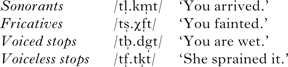
The analysis results from a syllabification algorithm that goes through the sonority scale from highest to lowest, assigning the syllable nucleus to the most sonorous segments in a sequence, according to the following scale: low vowels > high vowels > liquids > nasals > voiced fricatives > voiceless fricatives > voiced plosives > voiceless plosives (cf. Dell & Elmedlaoui Reference Dell and Elmedlaoui1985).Footnote 2 In addition to sonority requirements, the competition between segments is governed by well-formedness conditions, such as a dispreference for complex subsyllabic constituents (onset, coda) and onsetless syllables.
The main sources of evidence for syllabification are judgements about well-formedness in versification (Dell & Elmedlaoui Reference Dell and Elmedlaoui2002, Ridouane Reference Ridouane2008), morphological regularities that can be captured straightforwardly if this syllabification is assumed (Dell & Elmedlaoui Reference Dell and Elmedlaoui2002) and native-speaker intuitions (Dell & Elmedlaoui Reference Dell and Elmedlaoui2002, Ridouane et al. Reference Ridouane, Hermes and Hallé2014). However, words like those in (1) may surface phonetically with one or more vocoids that have a schwa-like quality. The above authors treat these vocoids as phonetic artefacts, resulting from the articulatory realisation of the consonantal sequences they appear to break up (Dell & Elmedlaoui Reference Dell and Elmedlaoui1985, Reference Dell and Elmedlaoui2002, Reference Dell and Elmedlaoui2008, Ridouane Reference Ridouane2008, Ridouane & Fougeron Reference Ridouane and Fougeron2011). Support for this analysis comes from the observation that vocoids frequently surface next to voiced segments and rarely surface within homorganic sequences, which have unreleased consonants (but see Dell & Elmedlaoui Reference Dell and Elmedlaoui2008 for exceptions). Thus they are assumed to be largely predictable from the laryngeal and supralaryngeal specification of the consonantal environment.
However, this analysis has been challenged (e.g. Coleman Reference Coleman, Durand and Laks1996, Reference Coleman, Ohala, Hasegawa, Ohala, Granville and Bailey1999, Reference Coleman2001, Angoujard Reference Angoujard1997, Louali Reference Louali1999, Louali & Puech Reference Louali and Puech2000). For instance, Coleman (Reference Coleman2001) affords vocoids a phonological status, treating them as epenthetic vowels that occupy an empty nucleus position, leading to the syllabification of words such as in (1) as /təs.χəft/ rather than /ts̩.χf̩t/. In the remainder of this paper, we refer to this account as the ‘nuclear schwa’ account.
While arguments in favour or against the different analyses are based on phonotactic and metrical evidence, it might be informative to look at other levels of prosodic organisation, as suggested by Gordon & Nafi (Reference Gordon and Nafi2012). They suggest that there may be two types of vocoid, one intrusive, playing no role in the phonology (see Hall Reference Hall2006 for extensive discussion), and one with a phonological role in terms of its tone-bearing qualities. Although in Tashlhiyt these vocoids do not contribute to syllable weight for versification in traditional songs, they can nonetheless align with musical notes (Dell & Elmedlaoui Reference Dell and Elmedlaoui2008, Dell Reference Dell, Cairns and Raimy2011): ‘schwas may not be metrically relevant … but they are nonetheless relevant in singing, as they participate in the mapping of the text onto the melody’ (Dell & Elmedlaoui Reference Dell and Elmedlaoui2008: 152).
For example, consider a disyllabic word (e.g. /ad.rar/ ‘mountain’), produced in a song with a sequence of two musical notes X and Y. The musical notes are aligned to the two vowels in a one-to-one mapping. However, in words with no vowel but with sonorant consonants, the musical notes can either be realised on the sonorant consonants or on transitional vocoids within the consonant cluster (e.g. /n.∫r̩k/ [n∫rk] or [nə∫rək] ‘we share’). Dell & Elmedlaoui (Reference Dell and Elmedlaoui2008) report free alternation between these two forms. Furthermore, if the word contains a syllable with neither a lexical vowel nor a sonorant consonant (such as the second syllable of /tn̩.db̩t/ ‘you regret’), there are three options: (i) the second musical note is not realised at all, (ii) it is realised on a vocoid or (iii) it is realised earlier, resulting in two notes aligned to the first syllable /tn̩/.
Dell & Elmedlaoui argue that vocoids serve as carriers of musical notes in singing and are thus relevant for a description of musical form, suggesting that they could be relevant for the description of intonational tones too. However, Dell & Elmedlaoui maintain that despite their role in singing, they do not need to be considered as phonological entities (2008: 177–182), since they do not play a role in syllabification or in metre (2008: 55). We return to this in the interpretation of the results in §3.2.5.
2.2 Stress and intonation
In terms of stress and intonation, Tashlhiyt Berber is particularly challenging. Due to its rare phonotactic patterns, the phonetic opportunity afforded for the execution of intonational pitch movements is exceptionally limited. While research on the language has mainly concentrated on elements lower in the prosodic tree such as the syllable, little is known about its metrical structure. Dell & Elmedlaoui point out that stress accent is likely to be a property of units larger than words, rather than being part of the lexical representation. Even before this, Applegate (Reference Applegate1958: 9) noted in his grammar of Tashlhiyt:
stress patterns referred to here apply only to utterances consisting of a single word. If the utterance contains more than one word, the stress is reduced slightly on all vowels except those in the final word. It can be said, therefore, that primary stress occurs only at the end of an utterance.
Tonal aspects of Tashlhiyt are reported to interact with its phonotactic patterns. Based on preliminary observations and native-speaker intuitions, Dell & Elmedlaoui (Reference Dell and Elmedlaoui1985) provide an analysis of optional syllabification in intonation phrase final position which goes hand in hand with the placement of intonational tones. For example, when the word /igidr/ ‘eagle’ is at the end of a phrase with interrogative intonation, a rising F0 contour can occur on the final /r/, in which case it is analysed as a syllable nucleus and thus a tone-bearing unit (resulting in /i.gi.dr̩/). Alternatively, within this analysis, the final consonant can ‘lose’ its syllabic status, and be annexed to the previous syllable (resulting in /i.gidr/). In this case, the F0 peak is on the second vowel /i/. They propose an optional rule of prepausal annexation, turning trisyllabic /i.gi.dr̩/ into disyllabic /i.gidr/, with a final complex coda. This analysis is supported by Elmedlaoui's intuitions about syllable count and acceptability of F0 peak placement. According to Dell & Elmedlaoui, this alternation is only observable when the word has a final sonorant consonant, which would either form the nucleus of a light syllable or be part of a complex coda. They state that ‘similar observations can be made with other intonations’ (Dell & Elmedlaoui Reference Dell and Elmedlaoui1985: 119).
The question arises as to whether this constitutes variation in the phonological association of the intonational tone or whether it should be seen as variation in phonetic alignment. We take association to be discrete, referring to a phonological linking of a tone with a tone-bearing unit, and alignment to be continuous, referring to the exact position of a tone in relation to a landmark in the speech signal, such as the edge of a constituent (see e.g. Ladd Reference Ladd2008). Dell & Elmedlaoui (Reference Dell and Elmedlaoui1985: 119) explicitly claim that the intonational tone is ‘assigned to the last tone-bearing unit’, which they define as a syllable with a sonorant nucleus (vowel or sonorant consonant), indicating that there may be evidence for a discrete location of tones, and thus a phonological association. Furthermore, they also discuss the importance of sonority and syllable weight, both of which play a relevant role in other areas of the linguistic system of Tashlhiyt (e.g. Dell & Elmedlaoui Reference Dell and Elmedlaoui2002).
In many languages, tonal association is determined by word stress (e.g. Ladd Reference Ladd2008). For instance, in many dialects of Arabic a pitch accent is typically associated with a lexically stressed syllable (Chahal & Hellmuth Reference Chahal, Hellmuth and Jun2014). As pointed out above, the very existence of word stress in Tashlhiyt has been called into question. Nonetheless, Gordon & Nafi (Reference Gordon and Nafi2012) have recently found evidence for word-level prominence. Their investigation of three acoustic correlates of potential phonological prominence (F0, intensity and duration) revealed that word-final syllables have greater intensity than their counterparts in the penultimate syllable of a word. Moreover, as they point out, phrase-final and, to a lesser degree, word-final nuclei were consistently lengthened, although it is difficult to tease apart the effect of word- or phrase-level prominence from word- or phrase-level lengthening (also referred to as domain-final lengthening; e.g. Beckman & Edwards Reference Beckman, Edwards, Kingston and Beckman1990). Interestingly, Gordon & Nafi also found that phrase-final syllables were associated with a higher F0 than other syllables, and interpret this as a reflex of a high pitch accent. Predictably, this H tone was phonetically more salient when associated with sonorant nuclei (vowel or sonorant consonant) than with voiced obstruent nuclei. Phrase-final high pitch can be a result of a final rise to a high boundary (analysed as a boundary tone H%), which is common in list intonation, for example.
Gordon & Nafi report that phrase-final syllables with voiceless obstruent nuclei often surfaced with interconsonantal vocoids that provided a phonetic context for a F0 peak. Moreover, there were more vocoids in the final syllable (both at word and phrase level) than in the penult. They speculate that the presence of these vocoids might be due to the necessity to realise a communicatively relevant pitch movement in that position. This fits in with the observations by Dell & Elmedlaoui (Reference Dell and Elmedlaoui2008) and Dell (Reference Dell, Cairns and Raimy2011) on singing discussed above, in which vocoids are said to bear musical notes.
Nonetheless, we cannot rule out an alternative explanation for the presence of vocoids towards the end of words and phrases: at least in English, phrase-final position goes hand in hand with a reduction in overlap of articulatory gestures (Edwards et al. Reference Edwards, Beckman and Fletcher1991). This reduction in overlap results in more space for open transitions (and thus vocalic elements) between the oral release and subsequent constriction. This is the case regardless of accentuation or any requirement to produce a particular pitch movement.
Gordon & Nafi's study provided evidence that certain elements of the utterance are highlighted through a combination of segmental prominence and pitch movement. Whether this is a manifestation of word stress or not is unclear, partly due to the nature of the corpus (isolated words and words with a following adverb), making it difficult to tease apart whether a tone is purely delimitative (in terms of an edge tone) or prominence-lending (in terms of a pitch accent) and whether an apparent segmental prominence is a result of modifications in gestural organisation at the edges of phrases.
A first instrumental investigation on intonational tones in slightly longer sentences was conducted by Grice et al. (Reference Grice, Roettger, Ridouane and Fougeron2011), who investigated the nature and distribution of an intonation phrase medial H tone in declarative sentences for three speakers. The target word was placed in a constant carrier phrase and was implicitly contrasted with other target words in the same experiment (/inna target baHra/ ‘he said target a lot’). They obtained a F0 peak on the penultimate syllable of the utterance (i.e. /baH/) followed by a fall to low pitch (represented as a HL boundary sequence). Unlike Gordon & Nafi, they did not find a final rise in pitch at the end of the phrase. Instead, they found an F0 peak earlier in the phrase (represented as a H tone). The distribution of this phrase-medial H peak was highly dependent on the segmental make-up of the target word: the F0 peak was consistently located on a sonorant nucleus in the target word, if one was available. Moreover, if two sonorant nuclei were available in the target word (e.g. /fl̩.kl̩f/ ‘on skin patches’) the F0 peak occurred on the rightmost of the two. If the target word contained no sonorants, the location of H was highly variable: it was either on a vocoid within the word or on a lexical vowel before the target word (i.e. on /inna/). Recall that similar strategies have also been reported for musical notes (which can align with either a vocoid in the syllable associated with the note or with the preceding syllable; see §2.1).
Grice et al. (Reference Grice, Roettger, Ridouane and Fougeron2011) thus showed (i) that F0 peaks corresponding to H tones can occur utterance-medially, (ii) that the location of the H is affected by the segmental makeup of the target word, (iii) that the H may be located on a transitional vocoid (or even on a vowel before the target word) and (iv) that the H might be used to mark contrast or some other kind of prominence. However, since these recordings were made for an independent articulatory experiment (Hermes et al. Reference Hermes, Ridouane, Mücke and Grice2011), this study was exploratory in nature, and lacked the necessary control to tease apart the different factors affecting F0 peak placement.
In the current study we investigate tonal placement, controlling for segmental make-up and introducing an explicit contrast. To investigate the intonation patterns with respect to the function they perform, we also recorded two different sentence modalities, in the form of polar questions and contrastive statements. We explicitly tested the validity of Dell & Elmedlaoui's observations that intonational tones are associated with tone-bearing units, and that sonority and syllable weight affect this association.
3 Reading task
3.1 Method
3.1.1 Speakers
Four native speakers of Tashlhiyt (2 female (S1, S2) and 2 male (S3, S4)) were recorded. All speakers lived in Paris at the time of recording, but had spent at least their first 24 years in Morocco, and reported using the language frequently, for example with family and friends. The age of the subjects ranged from 31 to 46. All of the participants reported being able to speak Moroccan Arabic, Standard Arabic and French, as is common for native Tashlhiyt speakers. Two of the participants were able to speak English as well.
3.1.2 Speech materials
We controlled the segmental properties of the target words, so as to investigate the interaction of sonority and weight as determining factors in tonal association (cf. Dell & Elmedlaoui Reference Dell and Elmedlaoui1985). In addition, we manipulated sentence modality, using the structures most frequently produced in the semi-spontaneous elicitation task described in Appendix A, as shown in (2).
-
(2)
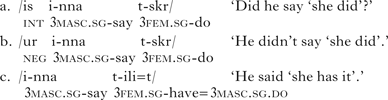
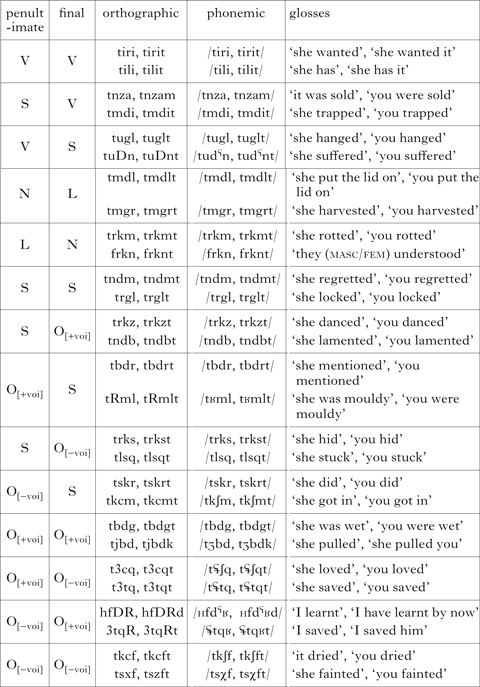
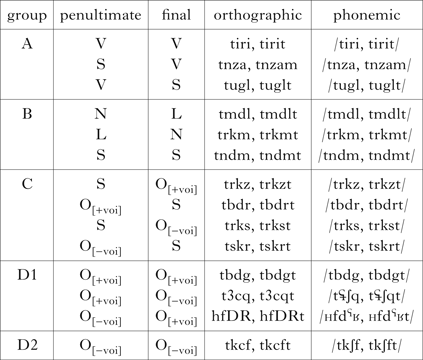
We recorded 28 pairs of disyllabic target words, which varied in the sonority of the nucleus of both syllables. Corresponding members of a pair differ in the syllable weight of the final syllable (CV vs. CVC). Stimuli were selected to cover a wide range of segment types. Two different words were used for each combination of syllable types. Table I shows the make-up of the syllabic nucleus in the penultimate and final syllables, with examples (see Appendix B for the full list of target words).Footnote 3
Examples of target words and conditions, each condition consisting of two item pairs. The members of each pair differ in syllable weight. V=vowel, S=sonorant consonant, N=nasal, L=liquid, O=obstruent ([+voice] and [−voice]). Examples are given in the Latin script used here (see note 3) and in phonemic transcription.

3.1.3 Procedure
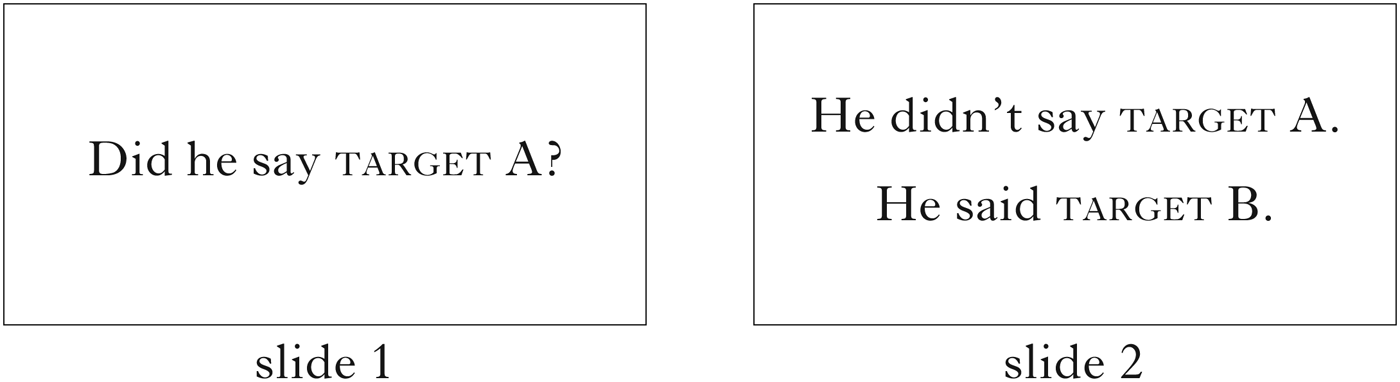
Recordings were made in a soundproof booth at the Laboratoire de Phonétique et Phonologie in Paris for three of the subjects (S1, S3 and S4), and in a quiet room for S2. The reading was recorded using a Marantz PMD 660 solid-state recorder at a sampling rate of 44·1 kHz, and a Shure SM10A head-mounted microphone. Before recording began, participants were asked to read a word-list to the experimenter, to ensure that they were familiar with all the items in the experiment. They were then seated in front of a computer screen, and read out orthographically presented materials containing the target words along the lines of (2), as pairs of slides like those in Fig. 1.
Form of elicitation materials (in translation) presented to subjects on consecutive slides for reading aloud.

Slide sequences were presented in random order. In slide 1 a target word (A) is in a polar question. In slide 2 the same target word is presented in a negative statement, followed by a different target word (B) in a contrastive statement. Because of the previous negative statement, the second target word is explicitly contrasted (corrective focus). The negative statement served merely as a context to trigger this contrast, and is not analysed further. In both the polar question and the contrastive statement, the target word is located at the right edge of the intonational phrase. Each target word appeared in both positions three times, resulting in 336 tokens per speaker (the 14 phonotactic conditions in Appendix B×2 words per condition×2 syllable weights (light vs. heavy)×2 sentence modalities (statement vs. question)×3 repetitions).
3.1.4 Analyses
All acoustic material was manually annotated, employing the following labelling criteria. The location of the F0 peaks under investigation was judged by ear and subsequently confirmed by visual inspection of the F0 contour and spectrogram provided by Praat (Boersma & Weenink Reference Boersma and Weenink2012). Around the rise-contour area we identified local maxima in the F0 contour by hand (assigning them the label H). To ascertain interrater reliability in F0 peak placement, a randomly selected subset of the words containing sonorants (10% of the total number of stimuli) was transcribed by two independent transcribers. For these words there was 100% agreement as to the location of the F0 peak on the penultimate or final syllables, confirming the impressionistic observation that the F0 peak location is easy to perceive. As the obstruent-only words were more difficult to analyse, all of these tokens were labelled by the two transcribers. Agreement was 96% (see note 5 for further information). Only cases where transcribers agreed were further analysed.
For the acoustic analysis of the segments, we identified segmental boundaries of the target word in the acoustic waveform. To do this, we examined an oscillogram and a wideband spectrogram simultaneously. All segmental boundaries of vowels and consonant were labelled at abrupt changes in the spectra at the time the closure was formed or released: this was the case for nasals, laterals (especially in the spectra for the intensity of higher formants) and fricatives (at random noise patterns in the higher-frequency regions).
3.2 Results
3.2.1 General properties of the pitch contours
In both sentence types there was a rise to a F0 peak, followed by a fall in F0 that was occasionally truncated. This truncation was speaker-dependent, and appeared to be related to the position of the peak: while speakers S1 and S2 placed the F0 peaks consistently later (in both sentence modalities) and thus sometimes truncated the fall considerably, speakers S3 and S4 placed the F0 peaks earlier and showed less truncation. In general, polar questions had an overall higher pitch register and greater pitch range, a steeper rise to the F0 peak and a slightly later F0 peak, resulting in more truncation.
3.2.2 Tonal placement in target words with at least one vowel
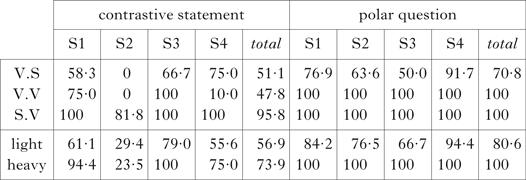
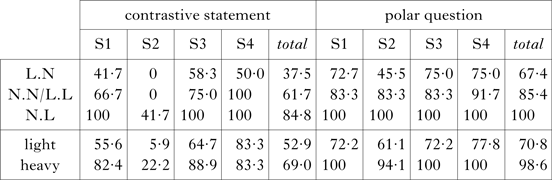
We first consider target words that contain typologically common segment sequences, i.e. those with at least one vowel (group A in Table I). In these target words, the F0 peak location showed some degree of variation. It was located either on the final syllable or on the penultimate syllable. If we examine the F0 peak placement distribution categorically, there was a strong overall preference for the F0 peak to be on the final syllable (78% of all cases). With respect to the segmental properties of the words, vowels are preferred over sonorant consonants, and heavy syllables over light syllables, as shown for each speaker separately in Table II. These tendencies are found in both sentence modalities, although questions are generally more often produced with a final F0 peak (90%) than statements (65%). This results in ceiling effects in questions: if the final syllable contains a vowel or is heavy, it always receives the final F0 peak; if it contains a sonorant consonant and the penult contains a vowel, three speakers (S1, S2 and S4) still place the F0 peak on the final syllable in the majority of cases.
Mean proportion (%) of F0 peak location on the final syllable in contrastive statements and polar questions for each speaker, depending on the syllable nucleus of the penultimate and final syllable (V=vowel, S=sonorant consonant) and weight of the final syllable (light or heavy).

3.2.3 Tonal placement in target words with sonorant consonants but no vowels
We now turn to typologically less common segment sequences, looking at target words that contain no vowel but at least one sonorant consonant (groups B and C in Table I). In target words with only one sonorant consonant in the syllable nucleus position (group C; e.g. /r/ in /tr̩.kz̩, tb̩.dr̩/), the F0 peak was predominantly located on that syllable (92%). This is consistent with the results reported in Grice et al. (Reference Grice, Roettger, Ridouane and Fougeron2011). If the target word contained two sonorant consonants in syllable nucleus position (group B in Table I), the F0 peak location showed considerable variation. Again, the observed patterns of distribution resemble those discussed in §3.2.2. There was a strong preference for placing the F0 peak on the final syllable (73% of all cases), questions were more often produced with a final F0 peak (85%) than statements (61%) and heavy syllables were preferred over light syllables. Moreover, similarly to target words containing vowels, some of the variation can be captured by the nature of the segment in syllable-nucleus position. Syllables containing a liquid (/r l/) were more often produced with a F0 peak than syllables containing a nasal (/m n/), as shown in Table III.
Mean proportion (%) of F0 peak location on the final syllable in contrastive statements and polar questions for each speaker, depending on the syllable nucleus of the penultimate and final syllable (N=nasal, L=liquid) and weight of the final syllable (light or heavy).

Taking the results presented in Tables II and III together, the effect of the syllable nucleus on H-tone placement can be captured in terms of relative sonority. This relation has already been argued to play a role in determining syllabification patterns in the language. Thus we claim that syllables containing more sonorous segments are more likely to bear a H tone than syllables containing less sonorous segments.
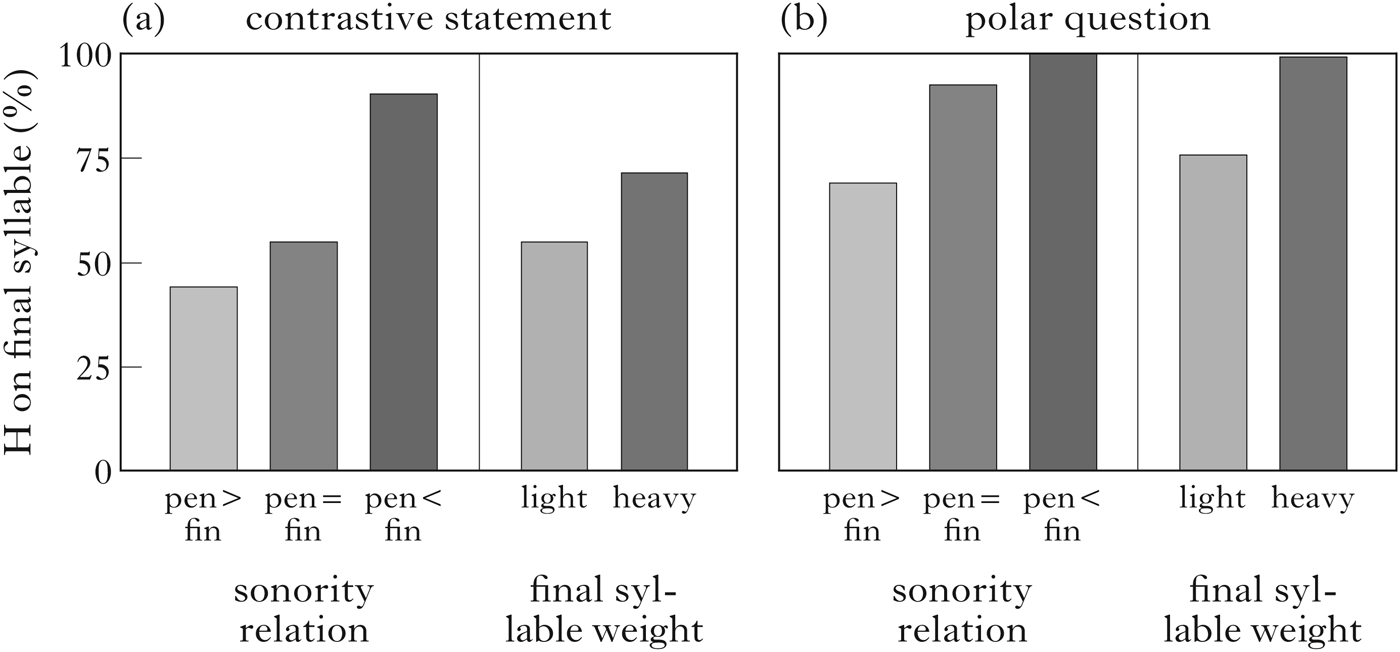
Figure 2 displays the overall results for target words with vowels and/or sonorant consonants. A comparison of (a) and (b) shows that there is an overall tendency for an intonational H tone to be placed on the final syllable, and that this tendency is greater in polar questions than in contrastive statements. If we look at each of the sentence modalities separately, we can see that in both cases the peak is preferentially placed on the final syllable if the penult is less sonorous than the final syllable (pen<fin), and if the final syllable is heavy rather than light.
Mean proportion (in %) of F0 peak location on the final syllable as a function of sonority relations between the penultimate and the final syllable and the weight of the final syllable (light or heavy) for (a) contrastive statements and (b) polar questions, pooled across speakers (target groups A and B in Table I).

3.2.4 Tonal placement variation
Having captured factors determining F0 peak placement, we now turn to the nature of the variation observed. In the material discussed, there is a considerable amount of variation across speakers. As shown in Tables II and III, speakers S1, S3 and S4 showed an overall preference for placing the F0 peak on the final syllable, while speaker S2's peak placement was highly dependent on sentence modality. She strongly preferred to place the F0 peak in contrastive statements on the penult, and in polar questions on the final syllable. This effect of sentence modality on F0 peak position was also found for speakers S1, S3 and S4, but to a lesser extent.
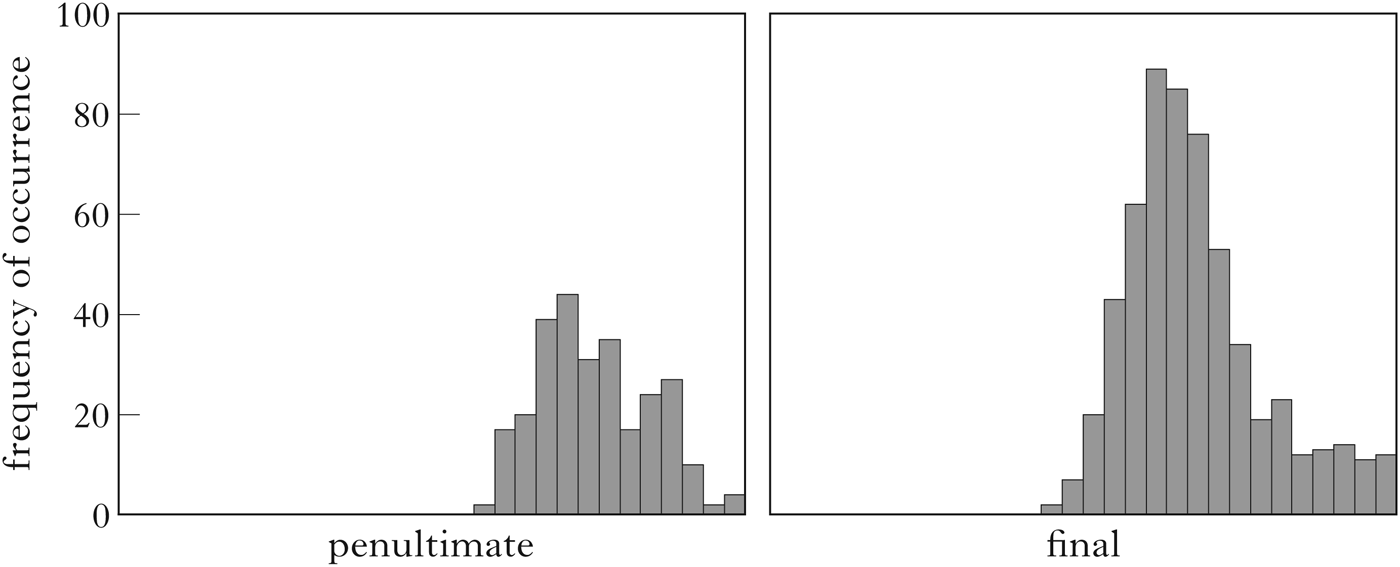
Crucially, there was also variation within speakers. As illustrated in Fig. 3, the same speaker could produce either penultimate or final peaks in either of the sentence modalities, even with the same target word. This type of variation is also found in target words containing vowels (e.g. /tu.gl̩/), although to a lesser degree. This variation in F0 peak placement was not gradual. The distribution of the F0 peak is clearly bimodal, as shown in Fig. 4, indicating that it was either on the penult or on the final syllable, but rarely in between. In other words, there is evidence for a consistent alignment of the tone to a particular structural unit, the syllable. This consistency in alignment can be interpreted as a phonological association of the tone to a syllable. Thus this pattern of alignment gives us a first indication that we are dealing with discrete association of tones to a tone-bearing unit, as assumed by Dell & Elmedlaoui (Reference Dell and Elmedlaoui1985).
Representative waveforms and F0 contours of two realisations by speaker S3 of (a) the contrastive statement /inna tn̩.dm̩/ ‘He said ‘she regretted’.’ and (b) the polar question /is inna tn̩.dm̩/ ‘Did he say ‘she regretted’?’. The two realisations of each sentence illustrate variation in F0 peak placement.

Distribution of F0 peak position relative to the penultimate and final syllables (normalised duration; divided into 30 equal bins for each syllable). F0 peaks on all target words with a sonorant nucleus (target groups A-C in Table I; n=846). Note that there are no F0 peaks in the earlier portions of either syllable, as shown by the empty bins.

To sum up, the placement of tones in words with sonorant nuclei (vowels and sonorant consonants) seems highly complex and clearly subject to the influence of a number of interacting factors. We have identified four of these: more sonorous nuclei are more likely to co-occur with the F0 peak, heavy syllables are more likely to co-occur with the F0 peak than light syllables, interrogatives are more likely than declaratives to be realised with a F0 peak located on the final syllable and there is a general preference for rightmost syllables to bear the F0 peak. The weighting of these different factors, and the extent to which they interact, is to some degree speaker-dependent, and remains unclear. We also confirmed Dell & Elmedlaoui's observation that tonal placement in Tashlhiyt is to some extent freely alternating: there were numerous cases where the same speaker produced different F0 peak locations on the same target word in identical contexts. Moreover, the observed F0 peaks seem to be consistently aligned to a particular syllable, underpinning the hypothesis of a phonological association to a tone-bearing unit.
3.2.5 F0 peak placement in target words with no available sonorant
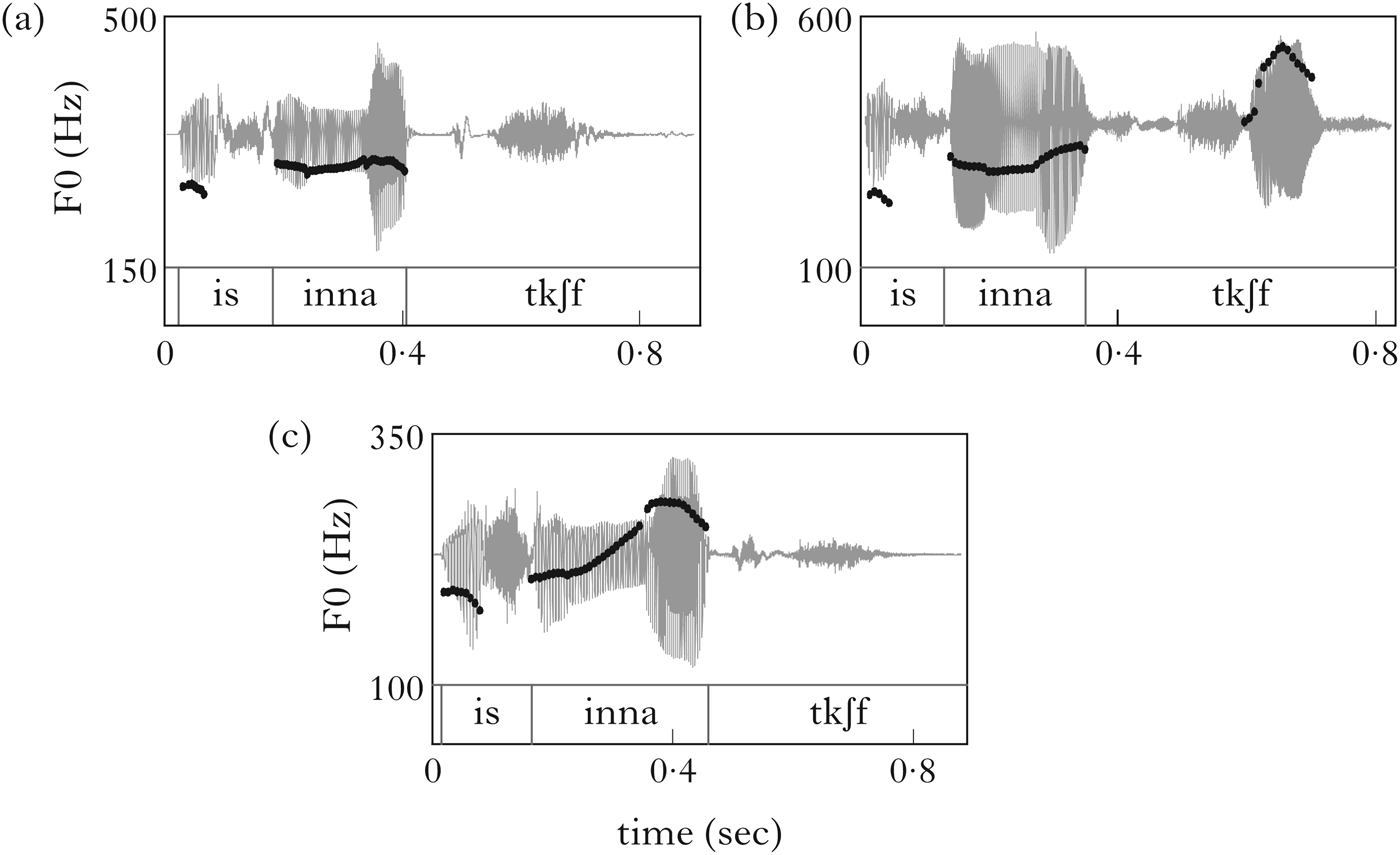
If the target word contained neither a lexical vowel nor a sonorant consonant (group D in Table I), it sometimes had no F0 peak at all (Fig. 5a).Footnote 4 Alternatively, the F0 peak was either on a transitional vocoid within the consonantal string of the target word (b) or on a vowel in the previous word, i.e. on /a/ of /inna/ (c). The patterns in (b) and (c) were also found in Grice et al.'s (2011) study, in which the target word was phrase-medial. The difference in realisation in the current study was to some extent speaker-dependent: for example, speaker S3 placed the F0 peak on a vowel in the previous word relatively frequently, while the other speakers only rarely produced this pattern.Footnote 5 However, all speakers showed instances of all three patterns. Furthermore, all three patterns were found for both sentence modalities.
Waveform and F0 contours for three realisations of /is inna tk̩∫f̩/ ‘Did he say ‘it dried’?’, (a) with no tonal prominence manifested through F0 (speaker S2), (b) with a F0 peak on a transitional vocoid between /∫/ and /f̩/ (speaker S1) and (c) with a F0 peak on the final vowel of the preceding word (speaker S3).

It has to be stressed here that the pattern in Fig. 5c was only found in utterances containing target words made up entirely of obstruents. Thus, to account for differences in the observed tonal patterns, we need to differentiate between syllables made up entirely of obstruents and those containing sonorants. Following Dell & Elmedlaoui's (Reference Dell, Cairns and Raimy1985, Reference Dell and Elmedlaoui1988, Reference Dell and Elmedlaoui2002) syllabification model, this distinction is made referring to syllables with a sonorant nucleus (/tn̩.dm̩/ ‘she regretted’ and /ti.li/ ‘ewe’) and those without (/tk̩.∫f̩/ ‘it dried’). In the ‘nuclear schwa’ account, in which an epenthetic vowel may occupy an empty syllable-nucleus position, we would need to differentiate between syllables with a lexical vowel and those with an epenthetic vowel. In the latter case, we would also need to differentiate between those with a sonorant coda and those without. In that account, it would be the words with lower sonority in the coda that would allow for the pattern in Fig. 5c. Regardless of syllable structure, distinctions between sonorants and obstruents have been made in the analysis of other languages (e.g. in Japanese, Pierrehumbert & Beckman Reference Pierrehumbert and Beckman1988 take the sonorant mora to be the tone-bearing unit).
All three patterns in Fig. 5 are akin to patterns obtained in singing (as detailed in §2.1). The frequency of occurrence of these tonal realisations was not dependent on sentence modality, i.e. they were distributed equally across both questions and statements. Thus, even if a word was explicitly contrasted (‘she didn't say X, she said Y’), the H tone did not always occur on this word, but was frequently located on the preceding word (/inna/) instead.
As predicted by several authors (e.g. Dell & Elmedlaoui Reference Dell and Elmedlaoui2002, 2008, Ridouane & Fougeron Reference Ridouane and Fougeron2011), transitional vocoids did not occur between homorganic consonants (e.g. between /q/ and /ʁ̩/ in /ʢt̩.qʁ̩/). Their presence was thus to some degree dependent on the articulatory properties of the surrounding consonants. Note that this differs from Dell & Elmedlaoui's (Reference Dell and Elmedlaoui2008) findings for singing, in which vocoids were also found in homorganic clusters. Although the absence of vocoids in the present study might be due to the limited range of phonotactic patterns, vocoids were nonetheless obtained in voiceless clusters (group D2 in Table I, in line with other studies, e.g. Puech & Louali Reference Puech, Louali, Ohala, Hasegawa, Ohala, Granville and Bailey1999, Coleman Reference Coleman2001, Gordon & Nafi Reference Gordon and Nafi2012). Importantly, these were always accompanied by a H tone (as shown for [tk.∫əf] in Fig. 5b). Note that this is not an idiosyncratic or spurious result, as such vocoids were present in voiceless clusters in the production of all four speakers. Of the obstruent-only words with voiceless clusters, 23% of all analysed realisations (n=288) had a transitional vocoid bearing a F0 peak (S1: 21%; S2: 28%; S3: 21%; S4: 22%). This might be taken as evidence against a phonetic account that describes these vocoids as being entirely predictable from the laryngeal and supralaryngeal specifications of the consonantal environment.
However, the presence of these vocalic elements between voiceless obstruents may be due to factors leading to reduction in overlap of articulatory gestures. Recall the interpretation of Gordon & Nafi's study in §2.2, in which it was suggested that this reduction in overlap (also referred to as ‘underlap’) may be due to a slowing down of the articulation in phrase-final position (Browman & Goldstein Reference Browman and Goldstein2000, Byrd & Saltzman Reference Byrd and Saltzman2003). An alternative interpretation is that the slowing down occurs because the word is contrasted, and therefore prominent (see Mücke & Grice Reference Mücke and Grice2014 for durational adjustments due to prominence in German). Prosodically triggered gestural adjustments not only affect oral gestures, but also laryngeal gestures. Since there is evidence that complex voiceless clusters in Tashlhiyt have to be considered as sequences of glottal opening gestures (Ridouane et al. Reference Ridouane, Hoole, Fuchs, Trouvain and Barry2007), a slowing down of the articulation might result in an underlap of glottal opening gestures. If glottal opening gestures are pulled apart sufficiently, glottal adduction can occur. This in turn would lead to an articulatory configuration that gives rise to a vowel-like element (Goldstein Reference Goldstein, Gutiérrez-Bravo, Mikkelsen and Potsdam2011).
In other words, the fact that there is voicing in a voiceless environment does not necessarily mean that the vocoid is a syllable nucleus. The voicing could still be attributed to a gestural reorganisation for the purpose of marking/lending prominence. Furthermore, the slowing down may be related to the tone itself. Katsika et al. (Reference Katsika, Krivokapić, Mooshammer, Tiede and Goldstein2014) found for Greek that articulation was slowed down on syllables bearing intonational tones. These tones were not pitch accents, but phrase accents (Grice et al. Reference Grice, Ladd and Arvaniti2000), i.e. tones that have both edge-marking and prominence-lending functions.
This account is also consistent with Ridouane & Fougeron's (Reference Ridouane and Fougeron2011) study, which found no vocoids breaking up voiceless clusters in words that already contained a vowel. It would also support Gordon & Nafi's (Reference Gordon and Nafi2012) suggestion that the pressure to realise the F0 peak in what they analyse as a pitch accent could be playing a role in realising these vocoids. We return to the issue of how to analyse the tone and its functions in the general discussion of tonal association below.
4 General discussion
4.1 Factors determining F0 peak placement
Our results point to four competing factors affecting the location of the F0 peak. They can be stated as in (3).
-
(3)
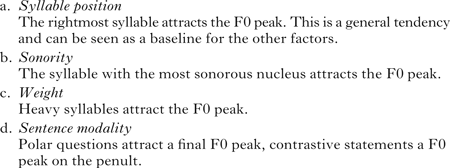
The competition amongst these factors leads to a probabilistic distribution of F0 peak placement across the different conditions.
It is possible to account for the tendency to place F0 peaks late in the phrase and on the most sonorous syllable in terms of phonetic grounding. A pitch event near the end of the phrase is salient, due to recency effects (e.g. Healy et al. Reference Healy, Havas and Parkour2000). Furthermore, a F0 peak later in the phrase may better highlight the target word (that is phrase-final in our case): F0 peak delay has a similar effect to an increase in peak height (Gussenhoven Reference Gussenhoven2004), which is often used for emphasis (Ladd & Morton Reference Ladd and Morton1997). In terms of sonority, a pitch target or contour on a vowel is easier to perceive than one on a consonant. Even if the consonant is voiced – clearly a prerequisite for pitch – a pitch target is easier to perceive on nasals and liquids than on fricatives and stops (e.g. Zhang Reference Zhang, Hayes, Kirchner and Steriade2004, Barnes et al. Reference Barnes, Brugos, Veilleux, Shattuck-Hufnagel, Campbell, Gibbon and Hirst2014).
The different preferences in polar questions and contrastive statements might also be considered as functionally motivated, in this case to help distinguish sentence modality. A final rise in pitch is cross-linguistically common in polar questions (Ultan Reference Ultan, Greenberg, Ferguson and Moravcsik1978, Ohala Reference Ohala1983, Reference Ohala1984, Gussenhoven Reference Gussenhoven2004, although see Rialland Reference Rialland, Riad and Gussenhoven2007). However, it is also fairly common for a rise to occur on the accented syllable and for a fall to follow it post-accentually (Grice et al. Reference Grice, Ladd and Arvaniti2000). In this latter case, the fall occurs on a less prominent part of the phrase, making the rise the salient feature. The later rise in polar questions might thus be seen as ensuring that the rise is the predominant pitch movement over the word. The variability across the two sentence modalities in this dataset may also reflect the redundant nature of F0 peak location: both morphosyntactic devices (question particle) and global pitch cues (cf. §3.2.1) could already be sufficient for marking sentence modality.
As discussed in §3.2.2–§3.2.4, the variation in F0 peak placement found in this study supports Dell & Elmedlaoui's (Reference Dell and Elmedlaoui1985) observation that alternation in tonal association is determined by the identity of the nucleus and the weight of the final syllable. We now turn to another of their observations, that variability in the placement of intonational tones can be related to syllabification in intonation phrase final position. Recall that Dell & Elmedlaoui propose an optional rule of prepausal annexation that transforms a syllabic consonant into a coda. Prepausal annexation allows them to make the generalisation that the last tone-bearing unit in the utterance bears the tonal event. Under this assumption, a word such as /tugl/ would be monosyllabic if the F0 peak is on /u/, and disyllabic if it is on /l/. Even though this analysis reflects native-speaker intuitions on syllable count and acceptability judgements on the placement of the H tone, it is not sufficient to explain some of our observations in the present study.
First, disyllabic words containing two vowels can show the same type of alternation. For instance, in /ti.ri/ ‘she wanted’, the H tone can occur on either of the vowels, at least in contrastive statements. For native speakers, words with two vowels are disyllabic, regardless of the position of the H tone. Thus there appear to be cases in which the position of the H tone is not related to a different syllabification of the word.
Second, disyllables with a final heavy syllable, e.g. /tu.glt/, showed F0 peak alternation too. According to Dell & Elmedlaoui (Reference Dell and Elmedlaoui1985: 120), prepausal annexation ‘requires the prepausal syllable to be an open one’. This means that resyllabification cannot account for these cases either. Thus, although the generalisation that the last tone-bearing unit in the utterance bears the tone reflects a clear tendency, it is not absolute.
4.2 Tonal association
We have discussed the representation of F0 peak location in terms of phonological association of a H tone. The tone-bearing units were identified as syllables with sonorant nuclei. However, we have also observed that not every such syllable is associated with a tone, leading to the question as to what exactly determines association in this language.
Gordon & Nafi (Reference Gordon and Nafi2012) argue that tones are associated with metrically strong syllables. They interpret increased intensity and duration on word-final syllables as reflective of metrical strength, and an accompanying F0 peak as a H pitch-accent tone. The results they obtain point clearly to this analysis, as the position of the tonal peak was constant across the different words. The question arises, then, as to why there was so much variation in peak position in our study and so little in theirs. A close examination of the word-set used in their study provides an explanation: of the 22 target words, 14 had a heavy final syllable (a factor leading to a preference for a final F0 peak in our data). Of the remaining eight target words, five had an obstruent in penultimate position and a sonorant in the final syllable (again, this would also have led to a final peak in our data). It is therefore unsurprising that the peak was consistently on the final syllable (although there was some degree of alternation; Matt Gordon, personal communication).
The variability in peak placement found in the productions of all four of our speakers is difficult to reconcile with an analysis of the H tone as a pitch accent on a lexically specified metrically strong syllable. Instead, our results provide support for Dell & Elmedlaoui's suggestion that tones are ‘a property of units larger than words’ (2002: 14). Thus they could be seen as associated with postlexical prosodic structures. In this view, not only tone but also metrical strength is determined outside the lexicon. This is consistent with an account in which the H tone is associated with a constituent higher than the prosodic word, since we have seen that, if the target word contains no sonorants, the tone can be placed on a syllable outside the target word. The semi-spontaneous recordings indicate that polar questions and contrastive statements have edge tones at different levels in the prosodic hierarchy. Further recordings are needed to confirm this, however.
The fact that there is a general rightmost tendency in both questions and statements points to an analysis of the H tone as a right peripheral tone – an edge tone. However, this tone can be associated with specific syllables (if the nucleus of the syllable is sonorant). In line with the proposed analysis of intonation phrase medial tones in Grice et al. (Reference Grice, Roettger, Ridouane and Fougeron2011), one could account for this association as a secondary association of a phrasal edge tone to a tone-bearing unit (Pierrehumbert & Beckman Reference Pierrehumbert and Beckman1988, Grice et al. Reference Grice, Ladd and Arvaniti2000). The F0 peak in both contrastive statements and polar questions could thus be analysed as final edge tones seeking a secondary association to a syllable. This association has been shown to lead to increases in intensity and duration (Katsika et al. Reference Katsika, Krivokapić, Mooshammer, Tiede and Goldstein2014), explaining Gordon & Nafi's observations and their subsequent analysis involving a pitch accent.
In Grice et al.'s (2000) analysis of the ‘Eastern European Question Tune’, edge tones with the possibility of a secondary association to a tone-bearing unit are referred to as phrase accents. These tones share many of the properties of pitch accents if they are associated with a tone-bearing unit. Phrase accents are at once edge tones (‘phrase’) and prominence-lending tones (‘accent’). This analysis incorporates the insights from Gordon & Nafi as to the phonetic characteristics of syllables bearing these tones, and captures the fact that these tones tend to occur near the right edge of phrases. However, more compelling evidence for this account comes from cases where a target word has neither vowels nor sonorant consonants. In §3.2.5 we illustrated three possible patterns that may be obtained. The first pattern has no F0 peak at all. In the second pattern there is a F0 peak on a vocoid within the target word. The fact that the F0 peak is actually on the vocoid means that we cannot a priori rule out an association of tones with syllables containing these vocoids.
However, the third pattern provides evidence against treating syllables with vocoids like syllables with lexical vowels and sonorants. In this pattern the F0 peak is anticipated; it is placed on the word before the target word. Our results point to strong restrictions on the distribution of this pattern: the F0 peak can only be anticipated if the target word has no lexical vowels or sonorant consonants. The presence of a vocoid next to a voiced obstruent does not necessarily cause the peak to occur on the target word, making the analysis of the vocoid as epenthetic (as in the ‘nuclear schwa’ account) problematic.
If the F0 peak is anticipated in words made up entirely of voiceless obstruents, there cannot be a vocoid on the target word at all. Thus, even though tonal placement cannot be explained in the ‘nuclear schwa’ account, an adequate treatment of the prosodic structure needs to make reference to the vocoid: a peak before the target word and a vocoid breaking up a voiceless cluster in this target word are mutually exclusive. Thus the vocoid is relevant for the intonational description of the language, even if it might be the result of prosodically conditioned gestural organisation.
The question arises as to how the placement of the edge tone can be accounted for without an association to a tone-bearing unit (i.e. a syllable with a vowel or a sonorant consonant) in the target word. There is evidence supporting an analysis in which it would simply align with an element with enough voicing or energy to make it audible. This analysis is also compatible with Gussenhoven's (Reference Gussenhoven, Broe and Pierrehumbert2000) treatment of non-peripheral placement of edge tones. In his treatment, a distinction is made between ‘association’, equivalent to what we refer to as secondary association to a tone-bearing unit, and OT ‘alignment’, where a tone is placed close to another tone or a phrase edge, but without reference to any particular syllable. In Gussenhoven's approach, a target word with no lexical vowel or sonorant would require the H tone to simply align with voiced material as close to the edge as possible.
The observed patterns of tonal association need to be considered in the light of language typology. Although free alternation of secondary association is so far unattested, some degree of alternation is observed in a number of languages, depending on the properties of syllables at or near the phrase edge. For instance, in Standard Greek, we find secondary association of a phrase accent to a lexical stress if there is one available; otherwise the edge tone is close to the phrase edge. Moreover, in Cypriot Greek the phrase accent is always at the edge (Grice et al. Reference Grice, Ladd and Arvaniti2000, Arvaniti et al. Reference Arvaniti, Ladd and Mennen2006, Arvaniti Reference Arvaniti, Cohn, Fougeron and Huffman2012).
Cross-linguistically, there are stress and tone systems that are prominence-driven (e.g. de Lacy Reference de Lacy2002, 2007). Many languages have weight-sensitive word stress or tone systems (see Gordon Reference Gordon2006 for an overview). Sonority is a well-known determinant of phonotactic patterns and syllable structure. However, languages in which sonority determines structures at higher levels of the prosodic hierarchy are typologically rare. While sonority certainly plays a role in many lexical tone systems, the sonority of segments can also determine word-stress patterns, although this is less common (cf. de Lacy Reference de Lacy and de Lacy2007 for an overview). Thus, both syllable weight and sonority are known to have an impact on prosodic regularities within word-prosodic domains. An impact of these factors on prosodic constituents higher in the prosodic hierarchy has also been reported in the literature, as in Japanese, which allows secondary association of edge tones to sonorant moras, but not to non-sonorant moras (Pierrehumbert & Beckman Reference Pierrehumbert and Beckman1988). Nonetheless, no language has so far been reported to have such a high degree of variability in the extent to which all of these factors together affect the placement of tones.
5 Conclusion
We have observed intonation patterns in Tashlhiyt contrastive statements and polar questions, which we analyse as containing a H-edge tone of a prosodic constituent. This constituent is not the same across the two sentence modalities, but the exact nature of the constituent in each case will require further experimental study. What the two sentence modalities have in common is that, depending on the segmental make-up of the words, the edge tone can have a secondary association to a tone-bearing unit close to its respective edge. Moreover, we have identified the syllable with a sonorant nucleus as a tone-bearing unit in this language, based on the distribution of F0 peaks on such syllables.
We have shown that target words with a vocoid do not have the same distribution patterns for the F0 peak as words with lexical vowels. Although the F0 peak may phonetically align with vocoids, this only happens under certain conditions, making this alignment one of last resort. Nonetheless, we have shown that this vocoid plays a role in the intonation and cannot be ignored: the presence of the vocoid is not entirely predictable from the laryngeal and supralaryngeal properties of neighbouring segments – a vocoid can occur between two voiceless obstruents, and appears to be at least in part conditioned by prominence. Moreover, it has to be taken into account for the description of tonal placement in cases of anticipated F0 peaks (F0 peaks before the target word). Here the similarity with singing is striking: an intonational tone, like a musical note, can be realised on a vocoid, can be anticipated (on a previous word or syllable respectively) or can be left unrealised. In singing, as in speech, the latter two options are available only if the target word is made up entirely of obstruents.
The variability in the placement of the F0 peak, both within and across speakers, is attributed to competition between a number of factors affecting the association of the tone, leading to the conclusion that F0 peaks are preferentially obtained on syllables which can be regarded as prosodically privileged, due either to their peripheral position in the phrase (rightmost) or to their properties in terms of weight or sonority, two factors that play a role in other areas of the linguistic system of Tashlhiyt (versification and syllabification respectively).
Lastly, it may appear that a probabilistic account is only necessary for describing a language with an attested high degree of variation. However, as more corpus studies are carried out, it is increasingly coming to light that many languages have intonational variation at some level. This variation can be at the level of non-canonical realisations of communicative functions (‘descriptions very rarely mention alternative intonations for a particular sentence type’; Cruttenden Reference Cruttenden1997: 157) or non-canonical realisation of phonological categories (Niebuhr et al. Reference Niebuhr, D'Imperio, Gili Fivela and Cangemi2011). Dealing in a principled way with this variation will advance our understanding of intonation in general.
Appendix A: Validating morphosyntactic patterns
We carried out a semi-spontaneous task in the field to ascertain which morphosyntactic structures Tashlhiyt speakers use to express polar questions and explicit contrast of the type ‘not X, but Y’. The elicitation method involved presenting short cartoons to nine native speakers of Tashlhiyt (7 men, 2 women; average age 28·1) to obtain polar questions, negative statements and contrastive statements, as in Fig. 6. In the cartoons, the first character is shown to utter something unintelligible. The second asks a third character whether the first said a particular target word (target A). The third replies that the first did not say target A, but a different word (target B).
Cartoons used for the elicitation of polar questions, negative statements and contrastive statements. Participants were assigned to either the dark grey or the light grey smiley. Both groups were given all three cartoons, and had to play the roles of their respective smiley.

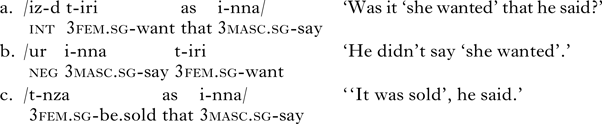
In the majority of cases, speakers used the morphosyntactic patterns given in (2). These structures correspond to the unmarked word order VSO (cf. e.g. Dell & Elmedlaoui Reference Dell and Elmedlaoui2002, Mettouchi & Fleisch Reference Mettouchi, Fleisch, Fiedler and Schwarz2010). Alternatively, speakers produced structures in which the target word was fronted and marked for focus with an enclitic /a(s)/, as in (4). Such structures were less frequent than the structures given in (2), motivating our choice to take the latter for the reading task.
-
(4)
Appendix B: Full list of target words