Survival rates for palliative surgical procedures for single ventricle CHD have improved significantly over the past 20 years.Reference Mahle, Spray, Wernovsky, Gaynor and Clark 1 , Reference Tweddell, Ghanayem and Mussatto 2 Utilisation of staged palliation,Reference Mainwaring, Lamberti, Uzark, Spicer, Cocalis and Moore 3 additional surgical innovations, for example, lateral tunnel and extracardiac conduit modifications, Fontan baffle fenestration placement, and modified ultrafiltration, and improved perioperative management have steadily increased surgical survival rates after modified Fontan procedure from 60% in the 1970s to >98% at present.Reference Khairy, Fernandes and Mayer 4 As a result, a large population of Fontan survivors is now ageing into adulthood.
Despite improvements in survival, significant morbidity remains after Fontan completion related to arrhythmias, systolic and diastolic myocardial dysfunction, diminished exercise capacity, thromboembolic complications, and abnormalities of vascular function.Reference Schwartz, Sullivan and John 5 These haemodynamic abnormalities can lead to chronic heart failure, which may require Fontan revision and/or “Fontan conversion”, heart transplantation, or sudden cardiac death.Reference Khairy, Fernandes and Mayer 4 , Reference Mavroudis, Deal and Backer 6 Strikingly, Fontan survivors now make up 70–80% of patients transplanted for CHD.Reference Jayakumar, Addonizio and Kichuk-Chrisant 7
Furthermore, the effects of the Fontan circulatory arrangement extend outside the cardiovascular system. Manifestations of the “failing Fontan physiology” include short stature, haematopoietic abnormalities, renal and hepatic insufficiency, plastic bronchitis, and protein-losing enteropathy.Reference Schumacher, Stringer and Donohue 8 In fact, as augmenting cardiac output halts and frequently reverses these sequelae, the focus of care has shifted from maximising perioperative survival to improving the monitoring of long-term survivors. If minimally invasive measures of multi-organ system function could identify higher-risk patients by predicting depressed cardiac index, then pre-emptively introducing pharmaceutical, catheter-based, electrophysiological, and/or surgical interventions to optimise circulatory parameters could potentially avoid or postpone the need for transplantation.
Serum biochemical and haematopoietic markers are minimally invasive, rapid, widely available, and examiner independent; they can be used serially in Fontan survivors; and previous studies suggest an association between serum biochemical and haematopoietic markers and post-Fontan haemodynamic abnormalities. In a small case series by Chin et al, four children demonstrated profoundly short stature and low serum total alkaline phosphatase in association with invasively measured low cardiac index. After interventions to raise cardiac index – for example, relief of pulmonary venous pathway obstruction, enlargement of systemic and pulmonary venous fenestration pathway, or the up-titration of angiotensin-converting enzyme inhibitors – total alkaline phosphatase increased within days.Reference Chin, Stephens, Goldmuntz and Leonard 9 As bone-specific alkaline phosphatase – a marker of osteoblastic activity – accounts for the vast majority of total alkaline phosphatase in pre-adolescent children, the rapid increase in total alkaline phosphatase observed with cardiac index augmentation is consistent with the hypothesis that low cardiac index post-Fontan reduces bone perfusion and osteoblast function. As osteoblasts are known to regulate nearby haematopoietic stem cells, this hypothesis may also explain, at least in part, the anaemia and thrombocytopaenia observed in some Fontan survivors.Reference Kaushansky 10 , Reference Collins, Piran, Harrison, Azevedo, Oechslin and Silversides 11 Hypoperfusion of other organ systems exhibiting different autoregulation than the brain and the heart, such as kidneys and the liver, may also affect the erythroid and megakaryocytic lineages because of their role in the production of erythropoietin and thrombopoietin.
A non-invasive serum biochemical or haematopoietic Fontan biomarker set that predicts lower cardiac index would allow for earlier intervention to augment cardiac index and prevent or prolong the time to the development of the “failing Fontan” physiology, thereby minimising vital organ complications and potentially improving the quality of life in this high-risk population.
The aim of this study was to identify serum biochemical and haematopoietic markers that predict low cardiac index in the Fontan population. We hypothesise that there is an association between serum biochemical and haematopoietic marker levels and cardiac index in the Fontan population.
Materials and methods
Research design
This study was a multi-centre retrospective case series undertaken by the Consortium of Clinical Investigation for Complex CHD comparing cardiovascular MRI-derived cardiac index with serum biomarkers. Study sites included the following: Cincinnati Children’s Hospital Medical Center, Data Coordinating Centre; University of Michigan C.S. Mott Children’s Hospital; Children’s Hospital of Wisconsin; Ann & Robert H. Lurie Children’s Hospital of Chicago; Cleveland Clinic; Mayo Clinic; Nationwide Children’s Hospital; and The Children’s Hospital of Philadelphia. The study was approved by the Institutional Review Board at each participating centre.
Patient population
Patients were included if they had undergone single ventricle palliation culminating in the Fontan procedure, were ⩾6 years of age, had a cardiovascular MRI study with phase-contrast cardiac index measured in the caval veins and/or pulmonary arteries, and had biochemical and haematopoietic biomarkers obtained within 12 months of cardiovascular MRI. Fontan survivors were excluded if they had undergone previous heart transplantation or were pregnant at the time of the cardiovascular MRI or blood testing.
Patient data collection
Patient data were acquired subsequent to a waiver of consent at each institution, and the cardiovascular MRI databases at each institution were screened for a list of patients ⩾6 years of age who had undergone the Fontan procedure. Laboratory databases were then accessed, and serum biochemical and/or haematopoietic markers for each patient were obtained from patient data that were collected within 12 months of cardiovascular MRI. Eligible patients’ charts were reviewed to obtain demographic and clinical data. The demographic information collected included the following: date of birth, sex, ethnicity, and race. The clinical variables collected included the following: primary and secondary diagnoses at the time of the cardiovascular MRI, all other previous cardiac surgeries and interventions, dates of previous cardiac surgeries and interventions, medications, and the presence of chronic diseases such as hyperthyroidism, hypothyroidism, alcohol and/or drug abuse, or diabetes. The patients’ outpatient cardiology clinic letter and echocardiogram report closest to the cardiovascular MRI were also obtained to confirm the primary diagnosis. Patients who met inclusion criteria were excluded if they had undergone an intervention that could have potentially changed their cardiac index between the cardiovascular MRI-derived cardiac index assessment and the biomarker acquisition.
Biomarker data collection
The following serum and haematopoietic marker levels were obtained through review of the electronic medical records or patient chart reviews: total bilirubin, albumin, total protein, total alkaline phosphatase, alanine aminotransferase, aspartate aminotransferase, γ-glutamyl transpeptidase, serum creatinine, haemoglobin, platelet count, white blood cell count, and mean corpuscular volume.
Cardiovascular MRI data collection
Cardiovascular MRI data were assessed for technical adequacy by the cardiologist and/or radiologist at each respective site before inclusion to the study and then reviewed for cardiac index measurements. Flow was measured with standard phase-contrast imaging, using an electrocardiographic-gated, cine velocity-encoded sequence. For assessment of cardiac index, the sum of the flow in the superior caval vein and the inferior caval vein was primarily used, rather than the flow in the ascending aorta, to avoid including flow due to the presence of systemic-to-pulmonary artery collateral vessels in the cardiac index measurement.Reference Whitehead, Gillespie, Harris, Fogel and Rome 12 If there was no fenestration or baffle leak, the sum of the flow in the left and right pulmonary arteries was sometimes used as an acceptable alternative for cardiac index, depending on the quality of data. We also recorded other cardiovascular MRI specifics including the following: date of scan, height, weight, body surface area,Reference Mosteller 13 and respiratory and ventilatory support parameters.
Statistical methods
Normal serum biochemical and haematopoietic values vary by gender and age.
To account for this normally occurring variation in these serum values, normal serum biomarker data from Quest Diagnostics were used to create age- and sex-specific LMS curves to calculate age- and gender-specific z-scores for each biomarker, with the exception of estimated creatinine clearance. Estimated creatinine clearance (ml/minute/1.73 m2) was calculated using the Schwartz formula.Reference Schwartz, Brion and Spitzer 14
Spearman’s Rank correlation was used to measure the association between biomarker z-scores and estimated creatinine clearance and cardiac index. A sensitivity analysis was performed including only the cardiovascular MRI with the latest date for each patient with more than one cardiovascular MRI.
In addition, cardiac index values were dichotomised based on whether the cardiac index value was above or below the 25th percentile of the observed data, which was estimated to be 2.14 L/minute/m2. This value was determined to be a clinically relevant value for indicating the presence of low cardiac index. For each of the three biomarkers that were determined to be statistically significant based on the Spearman’s test – that is, total alkaline phosphatase, estimated creatinine clearance, and mean corpuscular volume – receiver operating characteristic curves were estimated separately using logistic regression modelling with dichotomised cardiac index category as the dependent variable and the biomarker value as the independent variable. The area under the receiver operating characteristic curve was estimated, and the cut-off point that maximised the sensitivity and specificity was determined for each biomarker. The receiver operating characteristic analysis was repeated using multivariate logistic regression analysis with cardiac index category as the dependent variable and all three significant biomarkers were included in the model. The multi-marker area under the curve was estimated. The combination of biomarker values that maximised the sensitivity and specificity for the multivariate model was determined. On the basis of the receiver operating characteristic analyses, the biomarker cut-off points were used to categorise patients into two groups – higher-risk and lower-risk – dependent on whether the patient had a biomarker value below or above the cut-off point. This approach was used for each biomarker separately and for the three biomarkers combined. Wilcoxon’s Rank Sum tests were used to compare cardiac index values between the two groups of patients; p-values <0.05 denoted statistical significance. No p-value adjustment for multiple comparisons was used for this study as the tests were considered to be hypothesis generating and no definitive conclusions were being made. Statistical analyses were carried out using SAS version 9.2 and JMP Genomics version 5 (SAS Institute Inc., Cary, North Carolina, United States of America).
Results
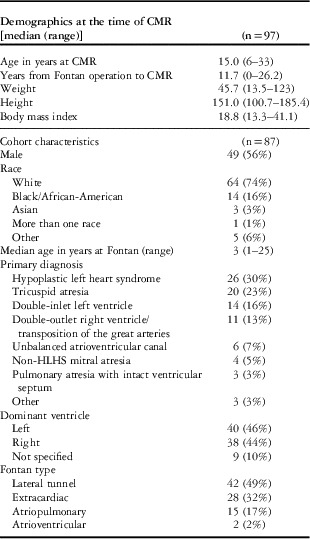
Records were reviewed from 97 cardiovascular MRIs at eight centres for 87 patients who met inclusion criteria for at least one biomarker (Table 1). Among all, four patients had two cardiovascular MRIs with 2 years (one patient) and 4 years (three patients) between subsequent cardiovascular MRIs; three additional patients had three cardiovascular MRIs with 1–4 years between subsequent cardiovascular MRIs. The median age of the patients at Fontan was 3.0 years. The median age of the patients at cardiovascular MRI was 15.0 years, with a median time from Fontan to cardiovascular MRI of 11.7 years. The majority of patients were male (56%) and three-quarters were white. Ventricular morphology was diverse; the predominant CHD was hypoplastic left heart syndrome (30% of patients), although the percentage of patients with dominant left ventricles was greater than dominant right ventricles (46 versus 44%). A lateral tunnel Fontan was the most common Fontan type (49%) (Table 1).
Demographics and Fontan type at the time of CMR and cohort characteristics.

CMR=cardiovascular magnetic resonance; HLHS=hypoplastic left heart syndrome
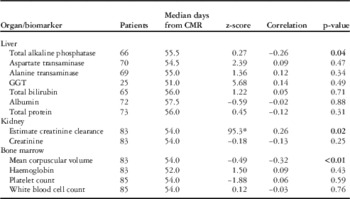
Correlation of biomarkers obtained within 1 year of CMR to cardiac index.

CMR=cardiovascular magnetic resonance; GGT=γ-glutamyl transpeptidase
* ml/minute/1.73 m2
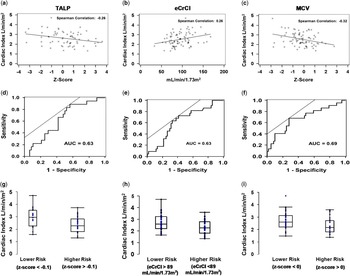
In total, three biomarkers had statistically significant correlations with cardiac index (Table 2; Fig 1a–c). Total alkaline phosphatase (r=−0.26; p=0.04, Fig 1a) and mean corpuscular volume (r=−0.32; p<0.01, Fig 1c) were negatively correlated with cardiac index. Estimated creatinine clearance was positively correlated with cardiac index (r=0.26; p=0.02, Fig 1b). Sensitivity analysis removing the 10 cardiovascular MRIs/biomarker pairs in the patients who had multiple cardiovascular MRIs had minimal impact on the estimated correlations and did not alter the inferences. Total bilirubin, total protein, serum albumin, aspartate transaminase, alanine transaminase, γ-glutamyl transpeptidase, creatinine, haemoglobin, platelet count, and white blood cell count did not significantly correlate with cardiac index.
Biomarker Correlation Scatterplots, receiver operating characteristic curves, Boxplots by Risk Group: ( a – c ) correlation scatterplots for total alkaline phosphatase, estimated creatinine clearance, and mean corpuscular volume; ( d – f ) receiver operating characteristic curves with area under the curve for total alkaline phosphatase, estimated creatinine clearance, and mean corpuscular volume; ( g – i ) boxplots of higher-risk and lower-risk groups for total alkaline phosphatase, estimated creatinine clearance, and mean corpuscular volume. Of note, the width of the boxplot is representative of the sample size within each risk group.

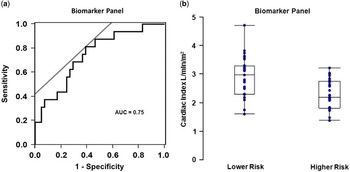
Receiver operating characteristics were created for each of the significant biomarkers identifying the sensitivity and specificity of each biomarker for predicting low cardiac index at each z-score, for total alkaline phosphatase (Fig 1d) and mean corpuscular volume (Fig 1f), and at each clearance rate for estimated creatinine clearance (Fig 1e). For total alkaline phosphatase and estimated creatinine clearance, the area under the curve was 0.63, whereas for mean corpuscular volume the area under the curve was 0.69 (Fig 1d–f). When all three biomarkers were included in a logistic regression model to form a biomarker panel to predict low cardiac index, the area under the curve improved to 0.75 (Fig 2a).
( a ) Receiver operating characteristic and area under the curve for the three biomarkers combined, total alkaline phosphatase, estimated creatinine clearance, and mean corpuscular volume. ( b ) Boxplot by risk group for the three biomarkers combined, total alkaline phosphatase, estimated creatinine clearance, and mean corpuscular volume.

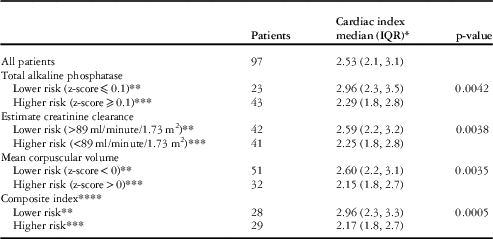
When cardiac index was compared above and below the cut-off points identified by the receiver operating characteristic curves, significant differences were found (Table 3). For total alkaline phosphatase, the higher-risk group had a median cardiac index of 2.29 L/minute/m2 compared with 2.96 L/minute/m2 (p<0.01) for the lower-risk group (Fig 1g). For estimated creatinine clearance, the higher-risk group had a median cardiac index of 2.25 L/minute/m2 compared with 2.59 L/minute/m2 (p<0.01) for the lower-risk group (Fig 1h). Similarly, for mean corpuscular volume, the higher-risk group had a median cardiac index of 2.15 L/minute/m2 compared with 2.60 L/minute/m2 (p<0.01) for the lower-risk group (Fig 1i). When the biomarkers were used together to form a composite index, the differences were more pronounced; the higher-risk group had a median cardiac index of 2.17 L/minute/m2, whereas the lower-risk group had a cardiac index of 2.96 L/minute/m2 (p<0.01, Fig 2b).
Differences in cardiac index at cut-off points identified in ROC curves.

ROC=receiver operating characteristic
* L/minute/m2
** Low risk defined as having a z-score below the cut-off point identified on the ROC curve
*** High risk defined as having a z-score above the cut-off point identified on the ROC curve
**** Composite index derived from multivariate logistic regression incorporating all three independently significant variables
Discussion
This study demonstrates, for the first time, an association between important serum and haematopoietic biomarkers and cardiac index in the adolescent and young adult Fontan populations. Total alkaline phosphatase and mean corpuscular volume were negatively correlated with lower cardiac index, and estimated creatinine clearance was positively correlated with lower cardiac index. These data suggest that in adolescent or young adult Fontan survivors a higher than normal total alkaline phosphatase or mean corpuscular volume or an estimated creatinine clearance <89 ml/minute/1.73 m2 is indicative of lower cardiac index, resulting in clinically important vital organ hypoperfusion. Receiver operating characteristic curve analysis for the three biomarkers together revealed an acceptable area under the curve. We demonstrated cut-off points in this cohort for each specific biomarker capable of identifying Fontan patients at higher-risk for lower cardiac index. Statistically and clinically significant differences in cardiac index were noted between higher-risk and lower-risk subgroups for all three biomarkers, as well as the combined biomarker panel. On the basis of its retrospective nature and the limited number of biomarkers available for analysis, a prospective study assessing these three candidate biomarkers and other new biomarkers that may be more sensitive to mild alterations in specific vital organ function is needed to further assess the utility of serum, urine, and stool biomarkers in the Fontan population. The results of this study may inform the development of a clinically useful Fontan biomarker panel used to identify and monitor those Fontan patients with diminished cardiac index, and prompt further haemodynamic evaluation and potential intervention, which may ultimately lead to a reduction in morbidity and improvement in overall quality of life.
In children, liver and bone isoenzymes are the main contributors to total alkaline phosphatase.Reference Van Hoof, Hoylaerts, Geryl, Van Mullem, Lepoutre and De Broe 15 In actively growing children, 70–95% of the total alkaline phosphatase is from bones,Reference Van Hoof, Hoylaerts, Geryl, Van Mullem, Lepoutre and De Broe 15 whereas after the normal adolescent growth spurt, or in children with hepatic or biliary dysfunction, the liver isoform predominates. Chronically elevated systemic venous pressure, ventricular dysfunction, and diminished cardiac index increase the risk of progressive hepatic dysfunction and damage in patients with the Fontan circulation, related either to chronic hypoperfusion or to post-hepatic portal hypertension with consequent hepatobiliary damage and fibrosis.Reference Schwartz, Sullivan and Cohen 16 , Reference Kiesewetter, Sheron and Vettukattill 17 , Reference Poelzl, Ess, Mussner-Seeber, Pachinger, Frick and Ulmer 18 The association between higher total alkaline phosphatase and lower cardiac index in our population likely reflects early biliary dysfunction. This is in contrast with a previous small case series in which three of the four Fontan survivors with low cardiac index had low levels of total alkaline phosphatase.Reference Chin, Stephens, Goldmuntz and Leonard 9 Nevertheless, these patients were much younger at the time of assessment than our population (4–15 versus 6–33 years), and the biochemical changes reported likely reflect age-related differences in the proportion of bone-derived alkaline phosphatase.Reference Van Hoof, Hoylaerts, Geryl, Van Mullem, Lepoutre and De Broe 15 The predominant contribution to total alkaline phosphatase in pre-adolescence is from osteoblasts, whereas the predominant contribution from adolescence onwards is from bile duct epithelial cells.Reference Van Hoof, Hoylaerts, Geryl, Van Mullem, Lepoutre and De Broe 15 The only other study assessing the relationship between hepatic dysfunction and lower cardiac index in Fontan survivors was by Camposilvan et al who showed that a “liver disease score” derived by expert consensus, which included clinical, serum, and hepatic ultrasonographic measures, correlated with cardiac index, as did coagulopathy (Factor V level, Prothrombin Time International Normalized Ratio), and total bilirubin.Reference Camposilvan, Milanesi, Stellin, Pettenazzo, Zancan and D’Antiga 19 Total alkaline phosphatase was not included in the Camposilvan analysis. We did not find a similar association between total bilirubin and cardiovascular MRI-derived cardiac index, potentially indicating an earlier stage of hepatobiliary injury in our population. Although elevated total alkaline phosphatase has been independently associated with increased clinical severity and poor prognosis in chronic heart failure, this is the first report of elevated total alkaline phosphatase as a marker for lower cardiac index in the Fontan population.Reference Ronco, McCullough and Anker 20
There are no previously published data assessing the relationship between creatinine and estimated creatinine clearance and cardiac index in the Fontan population; however, the recently codified concept of the cardiorenal syndrome reflects the appreciation of cross-talk between the two organs. 21 Specifically, cardiorenal syndrome Type II defines chronic heart disease–kidney interactions, which are relevant to our study population. Kidney insufficiency is prevalent in adult patients with congestive heart failure, and decreased kidney function is an independent risk factor for mortality in patients with systolic and diastolic ventricular dysfunction.Reference Al-Ahmad, Rand and Manjunath 22 – Reference McAlister, Ezekowitz, Tonelli and Armstrong 24 Although almost half of the Fontan patients in our cohort had a normal estimated creatinine clearance, there was a significant association between a low estimated creatinine clearance (<90 ml/minute/1.73 m2) and lower cardiac index. As consensus guidelines define chronic kidney disease at this threshold, we suggest early deteriorating estimated creatinine clearance may be a harbinger for worsening cardiac index.
Microcytic anaemia is often found in patients with congestive heart failure due to renal dysfunction, along with neuro-hormonal and pro-inflammatory cytokine activation in heart failure.Reference Anand 25 – Reference Opasich, Cazzola and Scelsi 27 Early-stage iron deficiency is found in over one-third of adults with chronic heart failure, including those with normal haemoglobin levels.Reference Jankowska, Rozentryt and Witkowska 28 Indeed, we found relative microcytosis in the upper three cardiac index quartiles of our patients; however, in the lowest cardiac index quartile, we observed a relative macrocytosis. Not surprisingly, all patients had elevated haemoglobin levels (z-score, +1.50), consistent with chronic hypoxaemia. A potential explanation for the macrocytosis is compensatory reticulocytosis due to high erythropoietic drive resulting from poor renal perfusion. Other causes might be chronic liver disease or folate or B12 deficiency, possibly associated with enteropathy. Regardless of the mechanism, relative macrocytosis appears to be associated with declining cardiac index.
Receiver operating characteristic analysis for the three candidate biomarkers revealed important cut-off points to discern potentially higher- and lower-risk groups for diminished cardiac index and vital organ perfusion. When combined, the three candidate biomarkers had an improved area under the curve relative to each individual biomarker, indicating an advantage to using a Fontan biomarker panel, as opposed to assessing single organ-specific candidate biomarkers. Importantly, a post-hoc analysis of these biomarker-specific cut-off points revealed statistically significant differences in cardiac index in this study cohort. In addition, the combined biomarker set also had a statistically significant and clinically significant difference in cardiac index between the lower-risk and higher-risk subgroups.
Serial invasive assessment of cardiac index – for example, cardiac catheterisation – in Fontan survivors is not common. Estimation of cardiac index by nearly all non-invasive methods has been unreliable and based on many anatomical and physiological assumptions. Exercise testing assumes equal pulmonary and systemic blood flow, which cannot be assumed in Fontan patients as they often have surgical or catheter-based fenestrations, baffle leaks, systemic-to-pulmonary arterial collaterals, or veno–venous collaterals. In addition, numerous technical difficulties make cardiac index estimation by echocardiography unreliable in Fontan survivors. Specifically, quantification of right ventricular function with echocardiography has been problematic, and measuring cardiac index by velocity time integration across the systemic semilunar valve has been shown to result in significant variance.Reference Powell and Geva 29 Cardiovascular MRI has been shown to be a reliable and valid method to non-invasively assess cardiac index.Reference Powell, Maier, Chung and Geva 30 – Reference Chin, Whitehead and Watrous 32 Cardiovascular MRI averages cardiac index over many heartbeats more accurately, reflecting the patient’s physiology. Unfortunately, cardiovascular MRI is not generally obtained for the sole purpose of assessing cardiac index and requires deep sedation for patients <10 years of age. It is critically important to identify an inexpensive, simple, rapid, examiner-independent, widely available, non-invasive measure for routine monitoring of cardiac index that reliably identifies declining cardiac index in Fontan survivors before the clinical manifestations of “failing Fontan” physiology to allow for earlier intervention to augment cardiac index. The use of serum biochemical and haematopoietic, urine, and stool markers may allow for the pre-emptive introduction of interventions to augment cardiac index such as myocardial pacing, Fontan fenestration creation or enlargement, Fontan revision or “conversion”, inhibition of the renin–angiotensin–aldosterone system, sildenafil or bosentan administration, and/or the implementation of a cardiac exercise re-habilitation programme to potentially improve patient outcome.Reference Khairy, Fernandes and Mayer 4 , Reference Mavroudis, Deal and Backer 6 , Reference Goldberg, French and McBride 33 Equally important, the use of such biomarkers would allow clinicians to assess the effectiveness of these interventions.
Limitations
The Fontan population utilised for this study may not be generalisable to the larger Fontan population in the United States. The Quest Diagnostics normative data from which biomarker z-scores were generated may not be generalisable to the larger United States population. The patient biomarker and cardiovascular MRI data were retrospective in nature and may be incomplete. There was likely significant variation between programmes relative to screening of serum biochemical and haematopoietic tests. Blood samples used to analyse each biomarker may have been processed and measured differently at each site. The variable timing of cardiac index and biomarker measurements, different cardiovascular MRI techniques used to obtain the cardiovascular MRI-derived cardiac index, and varying techniques in serum biomarker analysis may have resulted in measurement error, which in turn could have resulted in an attenuated correlation coefficient. Given the retrospective nature of this study, there was also a lack of clinically useful cardiac-specific biomarkers as benchmarks for the other analyses examined. Given the important findings in this study and the noted limitations, a prospective study with timed measurements and standard methodology with a core laboratory analysing cardiac-, bone-, bone marrow-, kidney-, liver-, and intestine-specific biomarkers with a centralised cardiovascular MRI reading core is warranted. Although the initial Schwartz formula used for this study has been shown to overestimate true glomerular filtration rate due to the contribution of tubular secretion of creatinine, this overestimation is inversely proportional to glomerular filtration rate (only 0.1±3% at glomerular filtration rate>90 ml/minute/1.73 m2).Reference Seikaly, Browne, Bajaj and Arant 34 Thus, we are confident that our choice of the 90 ml/minute/1.73 m2 estimated creatinine clearance threshold using the Schwartz formula is appropriate for the purposes of this study.
Conclusion
Serum biochemical and haematopoietic biomarkers that correlate with lower cardiac index in Fontan patients include higher total alkaline phosphatase and mean corpuscular volume as well as lower estimated creatinine clearance. The use of biomarkers to monitor haemodynamics and organ-specific effects warrants prospective investigation.
Acknowledgements
The authors acknowledge the Heart Institute Research Core at Cincinnati Children’s Hospital Medical Center, which functioned as the data coordinating centre for this study. The following physicians and study coordinators assisted with the acquisition of data at the study sites: The Children’s Hospital of Philadelphia – Tonia Morrison, Somaly Srey, Christina Hayden Rush, and Nicole Mirarchi, MD; Cleveland Clinic – Allison Siegel and Denise Davis; University of Michigan C. S. Mott Children’s Hospital – Karen King; Ann & Robert H. Lurie Children’s Hospital of Chicago – Tania L. Saroli, MD, R. Andrew de Freitas, MD, and Katie L. Matthews. The authors also thank Quest Diagnostics for providing the normal data used for this study.
Financial Support
There are no industry financial relationships to report pertinent to this manuscript. Quest Diagnostics shared data with the investigators to generate the age- and sex-specific z-scores for the biomarker analysis.
Conflicts of Interest
None.
Ethical Standards
The authors assert that all procedures contributing to this work comply with the ethical standards of the relevant national guidelines on human experimentation at each participating centre and with the Helsinki Declaration of 1975, as revised in 2008, and have been approved by the institutional committees at each participating centre. The authors assert that all procedures contributing to this work comply with the ethical standards of the relevant national guides on the care and use of laboratory animals at each participating centre and have been approved by the institutional committee at each participating centre.