Introduction
The caloric vestibular test, first described by Barany in 1906, remains the cornerstone of the clinical vestibular test battery.Reference Barany1 In present protocols, the test involves the infusion of warm (44°C) and cool (30°C) water into the external auditory meatus for 30 seconds whilst the supine patient's head is inclined at 30° from the horizontal. In a patient with normal horizontal semicircular canal function, this will result in approximately one minute of nystagmus, with the fast phase beating towards the irrigated ear during warm irrigation and away from it during cool irrigation. The ocular nystagmus produced can be measured using video-nystagmography, and the maximum slow phase velocity calculated so that the sensitivity of each horizontal semicircular canal can be calculated, allowing the clinician to identify a canal paresis or directional preponderance.
As with other clinical diagnostic tests, risk management requires the identification of contraindications to testing. Many clinics have local protocols, but in the UK the British Society of Audiology has produced national guidelines for caloric vestibular testing, including contraindications.2 A major contraindication excluding a significant minority of patients from testing relates to conditions that might be worsened by the presumed autonomic stimulation caused by caloric vestibular stimulation, specifically hypertension and cardiac disease. It is this contraindication that is the focus of the present study.
Concerns arose over caloric testing in certain patients following the report by Eviatar of two cases of bradycardia during caloric testing.Reference Eviatar3 Both patients had a history of cardiac disease and had suffered previous myocardial infarctions. Neither patient was reported to have been harmed.
Several studies have considered the autonomic effects of vestibular stimulation.Reference Ray and Carter4 These can be divided into studies stimulating the otoliths (with ‘head down rotation’) and those stimulating the horizontal semicircular canal (with the caloric test or ‘head rotation’). Different authors have used a variety of methods to stimulate otoliths and to measure the autonomic response via surrogate markers such as peripheral muscle sympathetic nerve activity and skin sympathetic nerve activity.Reference Ray and Carter4, Reference Carter and Ray5 The contradictory effects of head down rotation on sympathetic outflow to the muscle and skin are a clear demonstration of the differential control of sympathetic activity by the vestibulosympathetic reflex in humans. In addition, in contrast with otolithic activation by head down rotation, natural stimulation of the horizontal semicircular canals by dynamic yaw head rotation (as in caloric stimulation) does not activate peripheral muscle sympathetic nerve activity in humans.Reference Ray, Hume and Steele6 This finding is in agreement with animal studies indicating that the semicircular canals do not participate in the vestibulosympathetic reflex.Reference Yates and Miller7
Ageing also attenuates the vestibulosympathetic reflex in humans. Research by Monahan and Ray indicated that, upon stimulation of the vestibular system with head down rotation, 64-year-olds had a greater decrease in mean arterial blood pressure compared with 26-year-olds.Reference Monahan and Ray8 This suggests that the elderly are more likely to have cardiovascular instability when their otoliths are challenged. There have been no studies investigating ageing and caloric stimulation or head rotation.
The contribution of the vestibular system to sympathetic and blood pressure regulation in humans has not been extensively studied. Costa and colleagues found no significant changes in sympathetic nervous function (via measuring peripheral muscle sympathetic nerve activity) following caloric stimulation.Reference Costa, Lavin, Robertson and Biaggioni9 Conversely, Jauregui-Renaud et al. found variable blood pressure and heart rate results in young patients (aged 25 to 35 years) following caloric stimulation while controlling for respiratory rate.Reference Jauregui-Renaud, Yarrow, Oliver, Gresty and Bronstein10 These changes were not seen in the labyrinth-defective control patient, suggesting that the cardiovascular changes were in fact due to the vestibular system. However, none of the identified studies utilising caloric vestibular stimulation to investigate human sympathetic responses have followed British Society of Audiology recommended guidelines as routinely practised in the UK.
The present study sought to move a step closer to determining the cardiovascular effects on patients with mild or stable cardiovascular disease, following caloric vestibular testing as performed in the UK. It also aimed to extrapolate the results to patients with more serious cardiovascular disease, to ascertain whether observed cardiovascular changes were significant enough to warrant exclusion of such patients. Our unit's audiology clinicians' 25 years' experience in clinical caloric testing has led us to believe that the cardiovascular burden of caloric testing is minimal, and that the British Society of Audiology contraindications may be inappropriate and could be an obstacle preventing some patients obtaining a definitive diagnosis.
In this study, we assessed all patients referred for caloric vestibular testing, regardless of past medical history, in an initial attempt to establish the cardiovascular burden on this heterogeneous group.
Materials and methods
Ethical considerations
Ethical approval was obtained from the Cambridgeshire 2 research ethics committee prior to initiation of the study.
Patient recruitment and pre-caloric testing
All adult patients (i.e. over 18 years of age) who were referred from the general ENT clinic and the joint ENT and audiology dizziness clinic for caloric vestibular testing between August 2008 and February 2009 were invited to participate in the study. Eighteen patients responded, and all were recruited.
Immediately prior to vestibular assessment, the patients' weight and height were measured (researcher AVK) in order to obtain accurate blood pressure readings. Details of their medical history and medications were also documented.
At this time, each patient was also administered the State-Trait Anxiety Inventory (Form Y) in order to gauge their anxiety. Form Y consists of 40 statements, half of which measure anxiety state and the other half anxiety trait.Reference Spielberger11
Patients then underwent routine vestibular testing, which concluded with the caloric test.
Caloric test procedure
Caloric vestibular testing was conducted according to the most recent published guidelines at the time.2 Patients were advised not to take vestibular sedatives or alcohol 48 hours prior to testing. Otoscopy and tympanometry were undertaken in each case to check the external auditory canal and tympanic membrane.
Patients were then fitted with VG40 video goggles (Otometrics, Taastrup, Denmark) and the ICS Chartr 200 monitor (Otometrics) which measured their ocular nystagmus. The equipment was then calibrated. After being positioned comfortably on a couch with their head and back inclined at 30° to the horizontal, patients were attached to a Portapres® monitor (Model-2; Finapres Medical Systems, Amsterdam, The Netherlands) at the wrist and middle finger, to enable continuous blood pressure and heart rate recording. The monitored hand was rested over the chest at the level of the heart to enable accurate monitoring.
The warm and cold water temperatures were set to 44 and 30°C, respectively, and delivered by a Variotherm Plus machine (Atmos, Lenzkirch, Germany). Each irrigation produced approximately 250 ml of water in 30 seconds. Immediately after each irrigation, patients performed tasks such as mental arithmetic in order to prevent inhibition of nystagmus by cortical influence over vestibular centres in the brainstem. The irrigations were carried out in the following order: right ear, warm water; left ear, warm water; right ear, cold water; left ear, cold water. If the irrigations failed to provide an ocular nystagmus, patients underwent ice cold water irrigation at approximately 4°C. At least a 2 minute period of observation was carried out after each irrigation in order to measure the degree of nystagmus. We allowed 5 minute periods between each irrigation to ensure that any nystagmus elicited had resolved prior to the next irrigation, and also to allow the inner-ear temperature to stabilise.
Data collection
Researcher AVK was present during all caloric tests, and noted patients' medical history and medications. He also administered Form Y to measure anxiety state and trait levels. Scores for anxiety state and anxiety trait were calculated, allowing individuals to be compared.
After each water irrigation and observation time period, patients were asked to rate the level of dizziness or symptoms they had just experienced from 0 to 10, with 0 indicating ‘no dizziness or nausea’ and 10 ‘worst possible dizziness or nausea imaginable’.
After each post-irrigation observation period, the maximum slow phase velocity was calculated by the audiologist conducting the caloric test.
The heart rate and mean arterial pressure data were loaded from the Portapres monitor onto a computer for statistical analysis. Data were collated and stored on a Microsoft Excel spreadsheet.
Statistical analysis
Statistical advice and analysis were conducted by a medical statistician (RP) using the Statistical Package for the Social Sciences version 16 software (SPSS Inc, Chicago, Illinois, USA).
Beatscope 1.1A software (Finapres Medical Systems) was used to calculate the mean heart rate and mean arterial pressure during the 30 second period before irrigation and the 45–75 second period after the start of irrigation. The raw data were averaged every 5 seconds prior to calculation of the mean heart rate and mean arterial pressure. The changes in mean heart rate and mean arterial pressure, comparing before and after irrigation, were then calculated for all patients, and appropriate statistical tests were conducted to compare these changes to the maximum slow phase velocity and patient's dizziness score. As each individual differs in how they respond to changes in absolute values of heart rate and mean arterial pressure, the mean changes for each irrigation were also translated to corresponding percentage changes in relation to the patient's baseline heart rate and mean arterial pressure. Baseline figures were obtained at the start of each patient's caloric test. These data enabled more detailed analysis of each patient, and assessment of the likelihood of clinical safety as judged by the cardiologist (DPD). Patients' anxiety state and trait scores were also compared with their cardiovascular parameters, maximum slow phase velocity and dizziness scores.
Finally, any patients with cardiac or blood pressure problems (termed ‘cardiac patients’) were compared with those patients without such problems (termed ‘non-cardiac patients’) to see if any trends could be identified.
Results and analysis
Eighteen patients were recruited to the study (10 women and eight men). The patients' mean age was 51.6 years. Table I shows the patients' medical histories, in categories that we felt were important to distinguish.
Patients' ages and medical histories

Heart rate and blood pressure data were not available for patients 2, 10, 11 and 16 due to Portapres malfunction. Yr = years; Med Hx = past medical history; ✓ = condition present; IHD1 = stable angina or ischaemic heart disease; IHD2 = unstable angina or ischaemic heart disease; BP1 = stable hypertension; BP2 = poorly controlled or previously unknown hypertension; psych = depression- or anxiety-related diagnoses; chest = previous pneumonia, pulmonary embolism or asthma; None = no other related medical problems
Missing data
Of the 18 patients recruited, the Portapres monitor malfunctioned in four patients at random, due to failure to obtain a good seal around the patient's finger or to detect the digital arteries (see Table I). These four patients, like all other participants, had all other remaining data collected. Of the total 18 patients, 17 underwent four caloric irrigations. One patient (number 8) underwent a further two caloric irrigations, including right and left ear ice cold water irrigations.
Portapres data (i.e. heart rate and mean arterial pressure) were missing for a further two irrigations, due to machine malfunction, and for another irrigation during which mean arterial pressure readings alone were lost. The amount of missing data was thus small enough to not affect the statistical analysis. In addition, the missing data were not related to patient responses, and therefore did not affect the analysis.
Main analyses
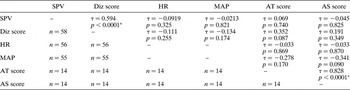
Table II displays the various statistical analyses comparing heart rate, mean arterial pressure, maximum slow phase velocity, dizziness score, and anxiety state and anxiety trait scores against each other. Kendall's τ correlation coefficient for the association between each variable was calculated. In each case, we tested the null hypothesis that the correlation coefficient was zero; the corresponding two-sided p value at the 1 per cent significance level was also calculated. Heart rate and mean arterial pressure values were calculated as stated in the Methods section.
Statistical analysis of main variables

See text for information on statistical analysis. *Statistically significant. n = number of values taken into account; SPV = maximum nystagmus slow phase velocity; diz = dizziness; HR = heart rate; MAP = mean arterial pressure; AT = anxiety trait; AS = anxiety state
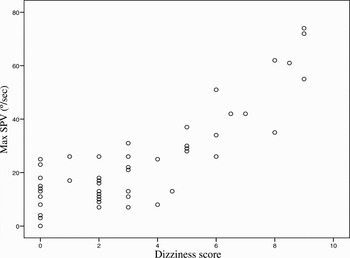
Notably, the maximum slow phase velocity and dizziness scores were positively correlated (τ = 0.594, p < 0.0001). Figure 1 displays a scatter plot of maximum slow phase velocity versus dizziness scores for all 58 irrigations. The only other positive association was anxiety state score with anxiety trait score (τ = 0.828, p < 0.0001).
Scatter plot of maximum nystagmus slow phase velocity (SPV) versus dizziness score for all 58 caloric irrigations.

Statistical power
For testing the null hypothesis that the correlation between differences in mean arterial pressure or heart rate and maximum slow phase velocity or dizziness score was zero, the data only allowed us to detect correlations of at least 0.38 magnitude with reasonable power (i.e. 80 percent power) at the 1 percent level. This was a reasonable level of power for detection of a low level (0.38) of correlation.
Cardiac versus non-cardiac patients
Analysis was also conducted on patients with cardiovascular disease (i.e. cardiac or blood pressure related disease; patients 1, 2, 3, 9 and 13) (see Table I). Patient 2 had no heart rate or mean arterial pressure data available due to Portapres malfunction. Heart rate and mean arterial pressure values were calculated as stated in the Methods section, including the difference between the mean for the 30 second pre-irrigation period and that for the 30 second post-irrigation period (during maximum nystagmus slow phase velocity). For each patient, only data from the irrigation producing the maximum change in cardiac parameters were used for analysis. Therefore, a total of 14 values were analysed, as there were 14 patients with Portapres data (4 cardiac patients and 10 non-cardiac patients). The maximum slow phase velocity, dizziness score, and anxiety state and trait scores were also compared between cardiac and non-cardiac patients to rule out any confounding factors, should a significant association be found for the heart rate and mean arterial pressure changes.
The independent samples parametric t-test results are displayed in Table III. This test determined whether the sample means were significantly different in cardiac patients versus non-cardiac patients. The 1 percent significance level was used and a two-tailed test was carried out. No significant differences were found between the group means, testing at the 1 percent level of significance. The 1 percent significance level was used to reduce the chances of a type one error due to the number of tests performed.
Statistical analysis of cardiac vs non-cardiac patients

*Independent samples parametric t-test for cardiac vs non-cardiac patients, 1% significance level, two-tailed test. SD = standard deviation; C = cardiac; CI = confidence interval; HR = heart rate; MAP = mean arterial pressure; SPV = maximum nystagmus slow phase velocity; diz = dizziness; AS = anxiety state; AT = anxiety trait
Caloric test results
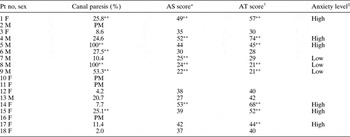
Of the 14 patients whose heart rate and mean arterial pressure were measured during caloric testing, six had an abnormal caloric result (see Table IV). A result was classified as abnormal if a particular ear had a canal paresis of 25 percent or more, using Jongkees and colleagues' formula.Reference Jongkees, Maas and Philipszoon12 Of those patents with abnormal results, two were from the cardiac group and four were from the non-cardiac group. There were only 4 patients in the cardiac group, and 10 patients in the non-cardiac group with cardiovascular data to analyse. The other 4 patients had the portapres machine malfunction during testing.
Patients' caloric test results and anxiety state and trait scores

Patients 1, 2, 3, 9 and 13 were cardiac patients. *Normative means: men, 36; women, 35. †Normative means: 35 for men and women. ‡High or low anxiety level indicated by state or trait score over or under 1 standard deviation (SD) from mean, respectively. **Abnormal result (i.e. 25% or more for canal paresis, or more than one SD from mean for anxiety score). No = number; AS = anxiety state; AT = anxiety trait; F = female; M = male; PM = Portapres malfunction
Normative data for anxiety state and trait scores differ for working men and women: the anxiety state mean score is 36 in men and 35 in women (standard deviation of 10 for both sexes), while the anxiety trait mean score is 35 for both men and women (standard deviation of 9 for both sexes).Reference Spielberger11 Table IV displays the anxiety state and trait scores for each of our patients.
Patient cardiac safety
The cardiologist (DPD) reviewed all patient data including medical histories, and concluded that no patient taking part in the study experienced clinically unsafe effects as a result of the HR and MAP changes they experienced.
Discussion
Key findings
This is the first study to measure the heart rate and mean arterial pressure of patients undergoing caloric vestibular testing as recommended by the British Society of Audiology.2 This study shows that, at least in normal, healthy people, there is no significant association between caloric vestibular activation (as measured by maximum slow phase velocity and subjective dizziness score) and the heart rate or mean arterial pressure. Our findings also suggest that patients with mild systemic cardiovascular disease, (correlating to the ‘cardiac issues or hypertension’ cited in the British Society of Audiology guidelines) experience no significant change in heart rate or mean arterial pressure during caloric testing. Furthermore, we found that ‘cardiac’ patients displayed no difference in heart rate or mean arterial pressure response, compared with ‘non-cardiac’ patients, although our patient numbers were too small for meaningful statistical analysis. We also demonstrated a positive association between dizziness score and maximum slow phase velocity (τ = 0.594). There was a broad spread of results (both in terms of induced caloric nystagmus and anxiety); thus, lack of significant changes in heart rate and mean arterial pressure were not due to low levels of patient anxiety or to vestibular hypofunction.
Study strengths
The study was prospectively conducted and included all adult patients referred for caloric vestibular testing, regardless of increased age or cardiovascular medical problems; thus, it included patients more likely to suffer from labile cardiovascular control.Reference Carter and Ray5, Reference Ray and Monahan13
Study weaknesses
Due to ethical reasons, the study could not be designed to investigate the results of caloric testing specifically in patients with heart or blood pressure problems. However, by chance, patients with a cardiac history and hypertension were included. Patients who were cardiovascularly compromised (i.e. hypertension and ischaemic heart disease) did not show any increased heart rate or mean arterial pressure changes. However, our patient numbers were too small to detect any true small or moderate differences between the cardiac and non-cardiac groups.
Comparison with other studies
Normal subjects were used by Jauregui-Renaud et al., who demonstrated only minor, clinically insignificant changes in cardiovascular parameters during caloric testing.Reference Jauregui-Renaud, Yarrow, Oliver, Gresty and Bronstein10 However, these authors' caloric testing method was quite different from that specified in UK recommended guidelines, and from routine UK practice.2 In fact, of all the published studies investigating the cardiovascular effects of caloric testing, we could not identify a single one which followed the British Society of Audiology recommended guidelines. Our findings support those of Costa et al., who found that caloric stimulation does not alter the sympathetic neural outflow to the leg.Reference Monahan and Ray8 Similarly, Ray et al. found that yaw head rotation, which activates the semicircular canals in humans, did not significantly alter heart rate, mean arterial pressure, peripheral muscle sympathetic nerve activity or skin sympathetic nerve activity.Reference Wilson, Kuipers, McHugh and Ray14 Likewise, Wilson et al. also performed yaw head rotation before and after whole body heating, and found no change in skin sympathetic nerve activity.Reference Ray and Monahan13 In contrast, Cui and colleagues' findings conflict with our own and those cited above; these authors reported changes in peripheral muscle sympathetic nerve activity and skin sympathetic nerve activity with caloric testing.Reference Cui, Mukai, Iwase, Sawasaki, Kitazawa and Mano15, Reference Cui, Iwase, Mano and Kitazawa16
In our study, elderly patients were not subdivided for further analysis. Ray and Monahan found that elderly patients (defined as over 55 years of age) showed less cardiovascular reserve and had an attenuated vestibulosympathetic response.Reference Ray and Monahan13 They noted that this attenuation resulted in a larger drop in blood pressure following stimulation of the otolith organs. Our patient population included eight patients in this age range; therefore, our analysis could have been expected to show significant differences for cardiovascular responses and maximum slow phase velocities in these patients. However, it must be noted that caloric testing stimulates primarily the horizontal semicircular canals of the vestibule, rather than the otolith organs. Therefore, if we rely on the published evidence, it is unlikely that caloric irrigation would have an effect on the elderly, as found by Ray and Monahan, as the otolith organs are not stimulated to any significant degree.
To our knowledge, the current study is the first to assess the clinical safety of caloric testing using cardiological analysis of cardiovascular parameters. Our cardiologist could find no clinically significant changes in heart rate or mean arterial pressure amongst our patients. In addition, the current study is the first to consider patients' anxiety levels when measuring cardiovascular responses to caloric testing; we found no association between patients' anxiety levels and their heart rate or mean arterial pressure changes.
Clinical applications
There is sparse evidence to support the exclusion of patients with a ‘history of cardiac problems’ or ‘high blood pressure’ from caloric vestibular testing, as recommended by the current British Society of Audiology test guidelines.2 Such exclusion is due to the presumed effect of the vestibulosympathetic reflex on the cardiovascular system. Our study followed recommended British Society of Audiology guidelines on caloric testing, and as such has direct clinical applicability. We found no evidence that caloric testing caused significant heart rate or mean arterial pressure changes in any of our patients. Although our patient cohort included several with medical problems, only a minority had cardiac disease or hypertension. Therefore, it would be inappropriate to conclude that our study demonstrated that caloric vestibular testing is safe in these specific patient groups. However, it can be concluded that, at least in normal, fit patients, caloric testing is not associated with any significant cardiovascular changes.
• British Society of Audiology caloric testing guidelines exclude patients with any cardiovascular disease from the test, for fear of vestibulosympathetic reflex consequences
• All human and animal studies on selective stimulation of the vestibular horizontal canal via caloric stimulation or dynamic yaw head rotation, bar one, have found a lack of vestibulosympathetic response
• This study is he first to demonstrate that heart rate and arterial blood pressure are not significantly influenced by caloric testing, using the above guidelines; also, patient anxiety does not significantly affect their cardiovascular responses in this setting
• Findings suggest that elderly patients and those with high blood pressure do not suffer significantly increased heart rate and arterial blood pressure changes following caloric testing
This preliminary work has furnished evidence to support the recruitment of patients with stable hypertension and mild cardiovascular disease for further caloric testing studies. Future studies should determine the risk, if any, of regular caloric vestibular testing in this patient cohort.
Acknowledgements
Anand Kasbekar is grateful for grants received from the Cambridge Hearing Trust and the Royal Society of Medicine. David Baguley's research role is supported by an NHS East of England Senior Academic Clinical Fellowship. The Portapres device used was generously loaned to the research group by Pauline Kitchener.