Introduction
The Levant, a historically and geographically significant region in the Eastern Mediterranean, has served as an important crossroad for civilizations and cultures. It is characterized by an abundance of natural resources and extensive ecological, geographical, and environmental diversity, featuring varied landscapes such as coastal plains and mountains (Binst et al. Reference Binst, Gatier, Gubel, Marquis, Nehmé, Rousset and Yon1999; Steiner and Killebrew Reference Steiner and Killebrew2014). These attributes have fostered human settlement since the Palaeolithic era, giving this eastern Mediterranean land a rich cultural heritage spanning multiple chronological periods (El Zaatari Reference El Zaatari2018). Occupied since the Lower Palaeolithic period (3.3 million to 300 thousand years BP), Lebanon lies in the center of the Levantine strip, thus holding an important, rich, and diverse archaeological heritage (Lehmann G. Reference Lehmann2002).
In the Levant, the Chalcolithic period (ca. mid-5th to mid-4th millennium BCE) represents a crucial and complex transitional phase that occurred after the establishment of sedentary agricultural societies in the Neolithic and before the widespread use of metal alloys like bronze (Levy Reference Levy, Steiner and Killebrew2014).
During this period, settlements were marked by dwellings and funerary practices. Furthermore, the Chalcolithic is characterized by a remarkable change in socio-political organization, increased craft production, and the adoption of new technologies such as metallurgy, along with advancements in agricultural practices. These developments are reflected in ceramics, stone working, and ivory carving. However, metallurgy represents the most significant leap in technological knowledge (Rowan and Golden Reference Rowan and Golden2009). The continuity of prehistoric traditions during the fifth and fourth millennium BCE, combined with the emergence of new technologies, makes understanding the Chalcolithic period complex and controversial (Genz Reference Genz, Steiner and Killebrew2014). This has sparked a debate among researchers as to whether the Chalcolithic in general, and that of Lebanon, should be classified as part of the Early Bronze Age or recognized as a transitional phase between the Neolithic and the Bronze Age (Artin Reference Artin2018).
The Chalcolithic in Lebanon: Insights and challenges
The Chalcolithic period in Lebanon underwent significant developments, evident in settlement patterns, material culture, as well as funerary practices. New technologies, such as metallurgy, were introduced, craft production advanced, and agricultural practices improved (Artin G. Reference Artin, Steiner and Killebrew2014, 2018). However, further understanding the Chalcolithic in the Lebanese context is particularly challenging due to the absence of absolute dates, and the limited number of studied sites: Byblos (Dunand M. 1973), Sidon (Saidah R. Reference Saidah1979), Khaldé II (Saidah R. Reference Saidah1969), Minet el-Dalieh (Cauvin 1962, 1968), Kfarabida (Genz et al. Reference Genz, Çakirlar, Damick, Jastrzebska, Riehl, Deckers and Donkin2009), Kfar Jarra (Guigues Reference Guigues1937), and Menjez (Tallon M. Reference Tallon1959, 1964; Steimer-Herbet T. 2000) as shown in Figure 1. The chronology of Chalcolithic occupations, mainly along the Lebanese coast, has been largely relying on data from Byblos, one of the largest excavated sites featuring both settlement and funerary contexts (Artin Reference Artin2010; Dunand Reference Dunand1973). However, challenges remain in fully understanding the ambiguous stratigraphy of Byblos in the absence of well-published comparative assemblages and limited absolute radiocarbon dates (Artin Reference Artin2010). Additionally, in other Lebanese sites, much of the material has been collected through surface surveys, often with limited stratigraphic control (Burkhalter Reference Burkhalter1946–1948; Besançon & Hours Reference Besançon and Hours1970, Reference Besançon and Hours1971; Copeland and Wescombe Reference Copeland and Wescombe1965, Reference Copeland and Wescombe1966; Marfoe L. Reference Marfoe1978; Seif A. Reference Seif2010). They have not been stratigraphically studied nor dated by absolute methods. The only available 14C date belonging to the Chalcolithic comes from Kfarabida (Genz et al. Reference Genz, Çakirlar, Damick, Jastrzebska, Riehl, Deckers and Donkin2009; Höflmayer et al. Reference Höflmayer, Dee, Genz and Riehl2014). This highlights the need for additional absolute dating to enhance our understanding of this period in Lebanon.
The major Chalcolithic sites in Lebanon with the location of RML79 (Artin G. 2018).

Within this context lies the importance of RML79, a site located on the northern slope of the Ashrafieh hill, in the eastern part of the capital Beirut, which features a clear and reliable stratigraphy revealed through meticulous single-context excavation and recording techniques. The preliminary phasing of the site is based on the retrieved ceramics, which indicate that the site was occupied as early as the Chalcolithic period. This rather early dating for this part of the city, compelled us to ascertain the chronology at hand through absolute dating, and to subsequently refine the age bracket within which the occupation took place.
The radiocarbon dates presented in this article, deriving from 4 charcoal samples retrieved from sealed contexts, correlated with the exhumed material culture, contribute to a more refined chronological understanding of the Chalcolithic period in Lebanon, with a particular focus on Beirut. Moreover, this process and the dates produced strongly contribute to the construction of the Lebanese absolute chronology database project, a key aspect of the Archaeological Science Laboratory work at the Lebanese Atomic Energy Commission (LAEC).Footnote 1
The Chalcolithic period in Rmeil, RML79
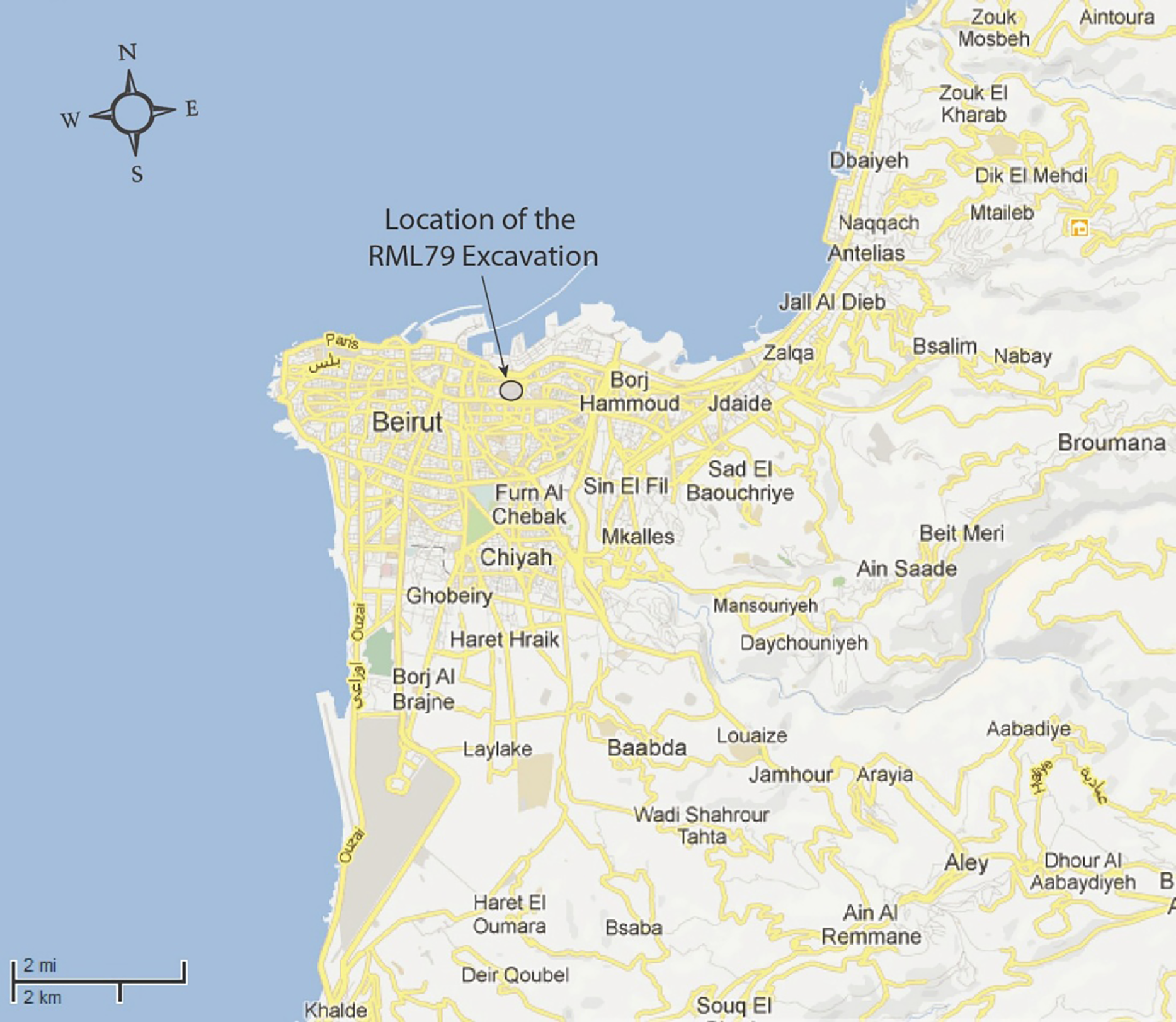
RML79 is located in the Rmeil area on the northern slope of the Ashrafieh Hill, one of the hills surrounding the Lebanese capital, as shown in Figure 2. The excavations held between 2008 and 2009, then resumed between 2011 and 2012, revealed a rather deep stratigraphic sequence bearing multiple occupations and horizons stretching from the Chalcolithic until the later Roman period.
Topographic location of RML79 in Beirut.

The archaeological investigations at RML79, took place within the framework of Beirut’s ongoing urban development. Here, the archaeological remains at the site were identified only after building works had already begun. By that time, a substantial portion of the archaeological deposits had been removed through mechanical excavations. Therefore, the subsequent involvement of the Directorate General of Antiquities’ archaeology team, which excavated the site, took place under rescue conditions, as is sometimes the case in urban excavations. Consequently, most of the spotted chrono-stratigraphic phases were only recorded in restricted strips. The excavation of the site’s undisturbed northern sector revealed a south-to-north running ravine following the hill’s slope. This ravine was gradually filled with thick layers of clay, followed by sandy accumulations within which several occupational horizons were recorded.
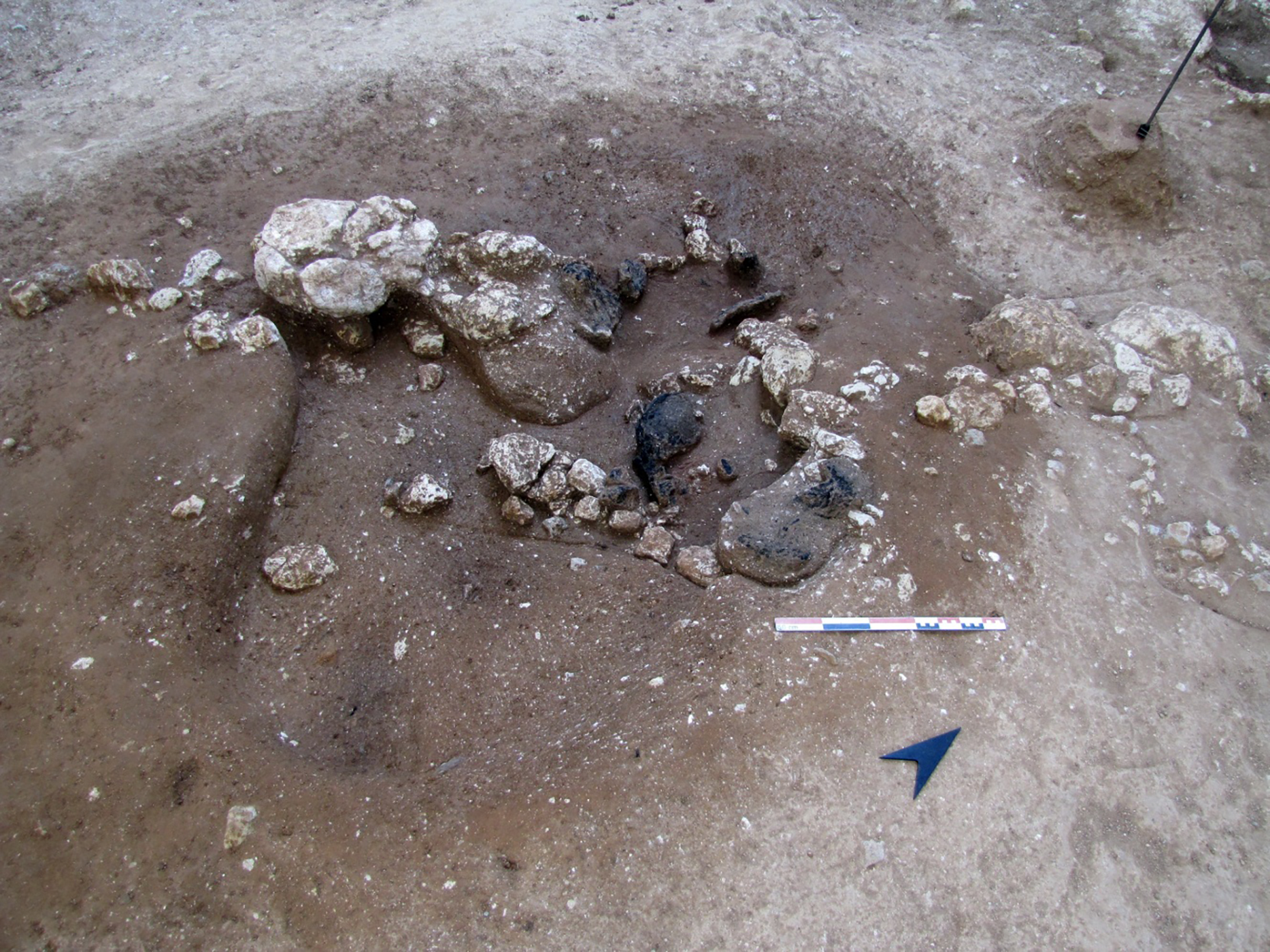
Within the site’s Chalcolithic stratigraphic horizon, a combustion feature, probably a hearth, was spotted on the eastern edge of the ravine, built over the remains of a retaining wall (Figure 3). Thirty meters to the south of this feature, a rectangular structure partially built over the sloping bedrock has been discovered (Figure 4). The structure measures 5.8 m from north to south, and up to 6.7 m from east to west, with walls reaching a thickness of 0.6 m. The spatial and stratigraphic analysis showed that this structure was either intermittently or seasonally inhabited. It revealed what could be interpreted as a domestic setup associated with in-situ chipped stone tools, ceramic vessels, and animal bones.Footnote 2 The preliminary interpretation suggests that this occupation may represent a seasonal enclosure, possibly related to hunting activities, likely influenced by its proximity to a water stream that may still have been active within the ravine. However, further investigations are still required to confirm or refute this hypothesis.
Close view of the combustion feature.

General view of the structure.

Although overlaid and partially disturbed by later alluvial deposits and cuts, the structure appears to have been reused with slight modifications to its original plan. Material remains were sparse in this second occupational phase. However, pottery shards, chipped stone tools, and a grinding stone, also suggest a domestic occupation, most probably associated with agricultural and hunting activities, in continuity with the earlier one.
The presence of a settlement from as early as the Chalcolithic, within now long-gone ravines in the hills next to Beirut, offers new insights into the dynamics happening around the city during these times. This discovery will certainly adjust our comprehension of the early settlements and their evolution in the city and its surroundings. The RML79 structure also echoes the settlement patterns of the diverse valleys along the Mount Lebanon chain and promises to shed light on the occupation history of the northern coastal hills of the Levant during the end of the 5th millennium BCE. It shall, furthermore, provide us with a better understanding of the economy of the Chalcolithic period in Lebanon, its fauna, flora, material culture, and concomitant natural landscape (studies in progress).
Materials and methods
Charcoal samples were selected for radiocarbon dating as they were the most abundant and well-preserved materials available at the site. Four charcoal samples were collected from the Chalcolithic combustion feature and structure of RML79, as shown in Figure 5.
Map of the site with the locations of the samples.

The choice of samples was based on two main criteria. It first targeted sealed contexts where very few disturbances should have occurred, and then it intended to fill in some gaps in archaeological dates. For instance, the combustion feature next to the stream produced relatively little dated material, and so dating it via 14C was crucial to be able to chronologically place it in its right phase. Other features, such as the baked clay fragments (cxt. 1475) next to the structure, were horizontally truncated by machines, making them impossible to be placed with certainty in the chrono-stratigraphic sequence without absolute dating. On the other hand, the two samples originating from the structure (cxt. 1395 and 2008), were chosen in relation to the ‘construction - use - disuse’ sequence recorded within the structure itself. They came to refine the wide dating margins provided by the material culture, namely pottery and worked lithics.
Contexts 2096 and 1475 were stratigraphically dated, while contexts 2008 and 1395 were preliminarily dated through both their relative stratigraphic position and associated ceramics.Footnote 3
One animal bone sample was collected from context 1454, which belongs to the second abandonment phase. Unfortunately, not enough collagen has remained in this sample for reliable 14C dating (see below).
Contexts description
Context 2096 (US2096) has been interpreted as an open-area combustion feature, likely situated on the eastern bank of the water stream running through the site. Fragments of baked clay, along with charcoal, shells, pottery, lithics, and burned stones, were recorded during excavation works.
Context 2008 (US2008) represents one of the fills recorded beneath the occupation horizon of the earlier Chalcolithic structure. Based on its shape and level, it was associated with the other circular cuts observed along the eastern bank of the ravine. Fill 2008 comprises charcoal, lithics, shells, pots, and seeds.
Context 1395 (US1395) is a deposit upon which two contexts from the second occupation of the structure (i.e., wall and occupation) were recorded. It could also tentatively be interpreted as part of the abandonment phase of the earlier occupation, as it stands above this earlier phase. Finds and inclusions from this context include charcoal, lithics, and pottery.
Context 1475 (US1475) has been interpreted as a dump made up of baked clay fragments and large chunks of charcoal or charred wood. Although no specific function could be assigned to it at this stage, the absence of thermal alteration in the surrounding sediment suggests that it possibly originating from the structure.
Radiocarbon dating
Radiocarbon dating was conducted at the Laboratoire des Sciences du Climat et de L’Environnement (LSCE-UMR 8212- CEA-CNRS-UVSQ) - Gif-sur-Yvette - Paris, using the Accelerator Mass Spectrometry Method (AMS) – ECHoMICADAS. Charcoal samples were subject to physical treatment targeting the complete removal of roots and soil. Subsequently, a chemical treatment based on the acid-base-acid (ABA) method was applied to eliminate foreign radiocarbon and potential contaminants, such as fulvic and humic acids (Hatté et al. Reference Hatté, Morvan, Noury and Paterne2001). Graphitization was performed using the fully automated AGE3 system (Ionplus, Switzerland). Charcoal samples were combusted in an Elemental Analyzer at 900°C, and the resulting CO₂ was transferred to the coupled graphitization unit, where it was reduced to graphite at 550–650°C in the presence of iron as a catalyst. The resulting graphite was then pressed into targets for measurement. Oxalic acid II and phthalic anhydride were used as the standard and one blank sample, respectively. Graphite targets were measured using ECHoMICADAS AMS (Cersoy et al. Reference Cersoy, Zazzo, Rofes, Tresset, Zirah, Gauthier, Kaltnecker, Thil and Tisnérat-Laborde2017; Hatté et al. Reference Hatté, Arnold, Dapoigny, Daux, Delibrias, Du Boisgueheneuc, Fontugne, Gauthier, Guillier, Jacob, Jaudon, Kaltnecker, Labeyrie, Noury, Paterne, Pierre, Phouybandhyt, Poupeau, Tannau, Thil, Tisnérat-Laborde and Valladas2024; Thil et al. Reference Thil, Tisnérat-Laborde, Hatté, Kader, Noury, Paterne, Phouybandhyt and Wacker2024; Tisnérat-Laborde et al. Reference Tisnérat-Laborde, Thil, Synal, Cersoy, Hatté, Gauthier, Massault, Michelot, Noret, Siani, Tombret, Vigne and Zazzo2015).
Collagen preservation in the bone sample collected from context 1454 was assessed by determining the %N and C/N ratio using a Thermo Flash EA 1112 Series Elemental Analyzer. The results indicated poor preservation with extensive diagenesis. Results showed poor collagen preservation as % N was lower than 0.7% and C/N was higher than 5, indicating extensive diagenetic alteration or contamination by exogenous carbon (Baydoun and El Morr Reference Baydoun and El Morr2019). Hence, the sample was not adequate for radiocarbon dating. The charcoal samples collected from contexts US2008, 1395, 2096, and US1475 were dated to 5350 ± 30 BP, 5370 ± 30 BP, 5290 ± 30 BP and 5620 ± 40 BP respectively. Radiocarbon ages were calibrated using the IntCal20 atmospheric curve (Reimer et al. Reference Reimer, Austin, Bard, Bayliss, Blackwell, Bronk Ramsey, Butzin, Cheng, Edwards, Friedrich, Grootes, Guilderson, Hajdas, Heaton, Hogg, Hughen, Kromer, Manning, Muscheler, Palmer, Pearson, Van der Plicht, Reimer, Richards, Scott, Southon, Turney, Wacker, Adolphi, Büntgen, Capano, Fahrni, Fogtmann-Schilz, Friedrich, Köhler, Kudsk, Miyake, Olsen, Reining, Sakamoto, Sookdeo and Talamo2020). The 14C ages and the calibrated ages of the charcoals are reported in Table 1, while Figure 6 shows the OxCal plot of the radiocarbon dates.
14C ages and the calibrated ages of the dated charcoals from RML-79

*Radiocarbon dates were calibrated using OxCal v4.4.4 (Bronk Ramsey Reference Bronk Ramsey2021) and the IntCal20 atmospheric curve (Reimer et al. Reference Reimer, Austin, Bard, Bayliss, Blackwell, Bronk Ramsey, Butzin, Cheng, Edwards, Friedrich, Grootes, Guilderson, Hajdas, Heaton, Hogg, Hughen, Kromer, Manning, Muscheler, Palmer, Pearson, Van der Plicht, Reimer, Richards, Scott, Southon, Turney, Wacker, Adolphi, Büntgen, Capano, Fahrni, Fogtmann-Schilz, Friedrich, Köhler, Kudsk, Miyake, Olsen, Reining, Sakamoto, Sookdeo and Talamo2020).
OxCal plot of all 14C dates of the charcoal samples.

Discussion
Radiocarbon dates correlated well with the relative dates and with the typo-chronological dating of the ceramics found on site. All obtained dates are consistent with the Chalcolithic period, as indicated by their interpreted stratigraphic context. Radiocarbon dates proved that the earliest occupation at RML79 occurred indeed during the second half of the fifth millennium. Charcoal sample from context US1475 appears slightly earlier than the other three contexts, suggesting a possible initial episode of activity. Nevertheless, the close overlap of the calibrated dates points to a main phase of occupation that intensified between approximately 4330 and 4000 BCE
As shown in Figure 7, the calibrated probability distributions of the four calibrated ages fall within a plateau-age of the IntCal20 curve (4350–4050 calBCE). This age of the calibration curve displays minimal variation in atmospheric 14C levels through time, which give wide calendar-age range. The plateau effect consequently reduces chronological precision. Despite this limitation, the overlap of the four calibrated results supports the interpretation that all charcoal samples derive from a single Chalcolithic occupation phase at RML-79These findings corroborate the chronological placement of one of the early occupations in Beirut and thus contribute to our understanding of the factors governing similar settlements during the Levantine Chalcolithic. Even if radiocarbon age US1475 is almost 300 years earlier than the other three, because of the linear part of the calibration curve at around 4350 calBCE, the calibrated ranges are not so far away, which strengthens the hypothesis of an early stage (and possibly a duration of occupation).
Calibration curve plot of the 14C dates of the charcoal samples.

The integration of archaeological data, such as stratigraphy and material culture, with absolute dating methods, provides a bracketed and more precise timeframe, enabling us to define the “when” and “where” of technological innovations and cultural developments. This approach is particularly crucial for the Lebanese Chalcolithic, a relatively underexplored period, where accurately dated patterns could help delineate potential sub-phases at both regional and national scales.
Conclusion
The radiocarbon dating of four samples from the RML79 excavation has helped secure and confirm the dates suggested by the excavators and prehistorians. It showed that a group of prehistoric Beirutis erected and sustained a small shelter-like structure next to a water stream in the eastern hilly Ashrafieh area, presumably for seasonal hunting activities, and did so within a limited period set between 4330 BCE and 4000 BCE.
Though relatively early in the Chalcolithic, such an occupation could probably be considered as the predecessor of the Bronze Age communities that inhabited the city later on.
While substantial work is still needed to grasp a proper understanding of the various dynamics characterizing such settlements in terms of economy, geographic extent, technology, and social patterns, this second absolute dating attempt for the Chalcolithic periodFootnote 4 has contributed to connecting some of the dots that are essentially needed to properly define this period and be able to associate it with other concomitant occupations in the Levant.
As scientific methods are significantly advancing and historic chronologies are constantly evolving, further absolute dating for such early periods seems necessary and inevitable within Lebanese archaeology. We hope that our contribution will encourage the implementation of systematic dating efforts and spark further national investigation regarding these early transitional phases.
Acknowledgments
The authors thank the International Atomic Energy Agency – IAEA and the Commissariat à l’Energie Atomique – CEA for supporting this work. We express our gratitude to the technical staff at the Laboratoire des Sciences du Climat et de l’Environnement (LSCE-UMR 8212- CEA-CNRS-UVSQ) for their great assistance and contribution in carrying out the chemical treatment, graphitization, and physical measurement.