INTRODUCTION
The term “carer”—or, more specifically, “informal carer”—refers to those who are not professionally trained but are yet instrumental in the care of, for example, a person with cancer (Molyneaux et al., Reference Molyneaux, Butchard and Simpson2011; Thomas, Reference Thomas1993). This role is most commonly adopted by a partner or family member upon whom the success of home care is dependent (Hinton, Reference Hinton1994). Carers of people with cancer face different challenges from others who provide care for long-term chronic conditions, in that the need to care will peak at certain points (e.g., during treatment or upon palliative care) in the disease (Milne & Quinn, Reference Milne, Quinn, Hudson and Payne2008).
An increasing focus is being placed on understanding the experience of cancer from the perspective of those involved as informal carers. The reason for this interest is threefold. First, a supportive response from significant others during cancer-related ill health has been found to have a positive impact on the person's management of their illness (Carlson et al., Reference Carlson, Ottenbreit and St. Pierre2001). Second, evidence is mounting related to the impact of cancer upon the well-being of family and friends in their own right (Donnelly et al., Reference Donnelly, Anderson and Johnston2008). Third, such social networks are more often being relied upon in order to provide care within the home for those with cancer at varying stages of the illness, particularly at the end of life (Kellehear, Reference Kellehear, Hudson and Payne2008), making an increased focus on carer well-being imperative.
It has been estimated that the majority of terminally ill cancer patients will spend the majority of their last year being looked after by informal carers (Seale, Reference Seale2000). As a result of this increased role for informal carers, several authors have attempted to determine the psychosocial impact of caring. For example, Stenberg and coworkers (Reference Stenberg, Ruland and Miaskowski2010) found more than 200 different types of caregiving difficulties reported in a review of the literature. Of these, the most commonly reported difficulties were psychological (e.g., anxiety and depression) or social aspects of the individual's life (e.g., loneliness). However, the effect of caring may differ depending on the stage of the cancer. Dubenske and colleagues (Reference Dubenske, Wen and Gustafson2008) described differing needs when treating cancer compared to when the care had become palliative.
While qualitative research has played a valuable role in elucidating the experiences of carers for people with cancer, to date there has not been an integration of the body of the available literature. Where a critical mass of such studies exists, there is a need to amalgamate the findings of these in a meaningful manner, much in the same way as in quantitative research with systematic reviews and metaanalysis. In addition, as discussed above, there is research and service interest in understanding caregiver experiences when caring for a person with cancer. Consequently, the aim of the present study was to synthesize the findings of qualitative studies exploring the experience of the caring role so as to help inform support packages better tailored to the needs of carers.
METHOD
Search Strategy
We searched for relevant studies using four electronic databases (Academic Search Complete, PsychInfo, CINAHL and PubMed) using the following terms: (carer or caregiver or caring) AND (cancer or oncology).
Studies were included in the present paper if they: (1) employed qualitative methods and findings were evidenced through the use of direct participant quotes, (2) explored the experience of caring from the perspective of the carer, (3) were written in English, due to time and financial constraints eliminating the possibility of translation, and (4) were published in peer-reviewed journals. A study was excluded if: (1) it was quantitative or employed a mixed-methods approach without fully reporting the qualitative findings, (2) it was a review paper, (3) it was not specifically about the experience of caring (e.g., about the experience of cancer), (4) the care recipients had illnesses/disabilities other than cancer, or (5) the carers or care recipients were aged under 18 or the papers were related to the experiences of staff and services.
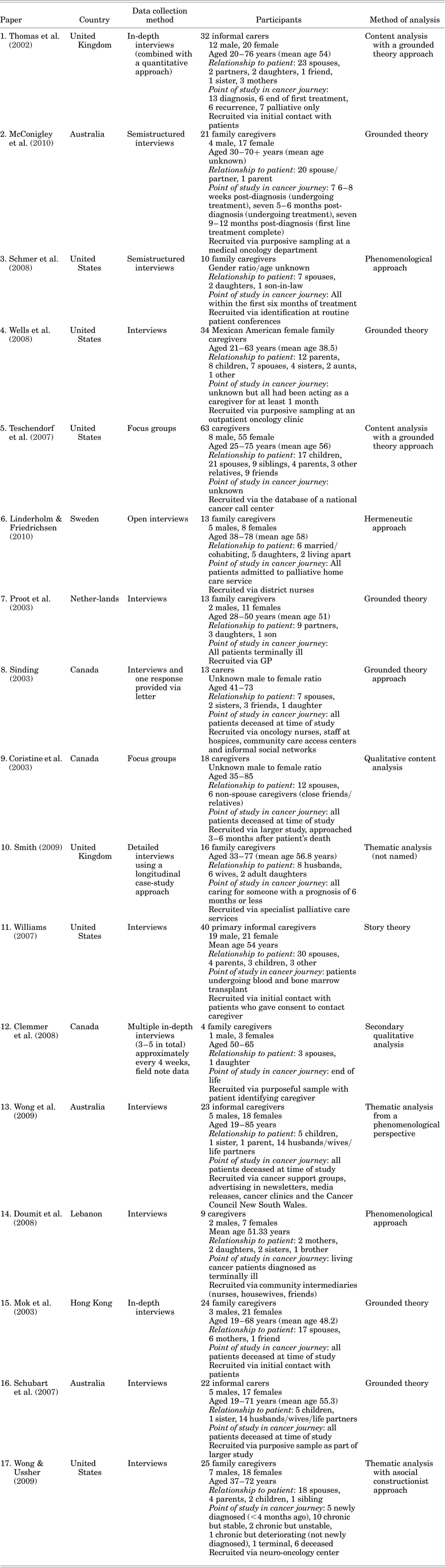
Conducted during February 2012, our search yielded a total of 265 studies that required closer examination of their potential relevance. Thus, the abstracts were read closely and those papers meeting the above inclusion criteria included in the final study. This resulted in a total of 17 papers being included in the synthesis. A summary of these papers can be found in Table 1.
Summary of study characteristics

The Meta-Ethnography Approach
The present review utilizes the meta-ethnography technique described by Noblit and Hare (Reference Noblit and Hare1988). The aim of this approach is to synthesize qualitative studies on a similar topic, producing interpretations that go beyond that of each study. Thus, papers are read to determine “first-” and “second-order” interpretations or constructs (Atkins et al., Reference Atkins, Lewin and Smith2008). First-order interpretations refer to results presented that reflect the talk of participants, while second-order interpretations are the analysis of these findings presented by the authors of the paper in question. In addition to noting these key interpretations within each paper, papers were read to determine any recurring themes across the studies. This led to the production of third-order interpretations—namely, those that encompass the first- and second-order constructs of the individual papers, along with an additional, integrative thematic interpretation.
Quality Assessment
The exclusion of qualitative studies on the basis of quality is a contentious issue, with some arguing that studies should not be removed from the synthesis due to a lack of “quality” (Sandelowski et al., Reference Sandelowski, Docherty and Emden1997). As Sandelowski and colleagues state, surface-level mistakes in the conduct or presentation of a qualitative study do not equate to meaningless findings. Thus, excluding a study on the basis of errors in method or reporting may lead to the loss of an important outcome.
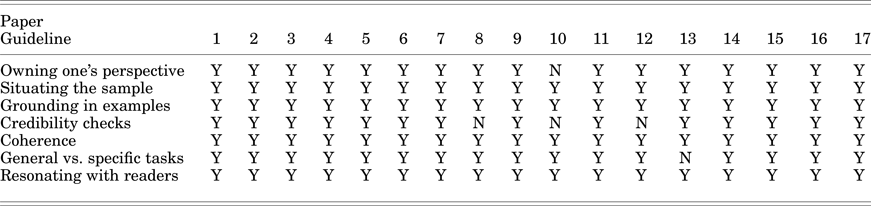
In the present study, papers were assessed for quality using the guidelines for evaluation of qualitative research set forth by Elliott et al. (Reference Elliott, Fischer and Rennie1999) (see Table 2). No papers meeting the inclusion criteria were excluded on the basis of quality.
Quality assessment results

Characteristics of the Studies
The carers in the present study were aged between 19 and 85. There were various relationships to the individual with cancer represented, including partners, children, siblings, nieces and nephews, and friends. The point at which the study took place for participants in terms of the cancer journey spanned from the initial diagnosis through to the palliative stages, with five studies being conducted with bereaved participants. Five studies were conducted in the United States, three in Australia, three in Canada, three in Europe, one in Hong Kong, and one in Lebanon (see Table 1).
RESULTS
The synthesis resulted in three main concepts: (1) identity and adopting the caring role, (2) the perception of care tasks, and (3) relationship dynamic changes as a result of caring.
Identity and Adopting the Caring Role
Within this concept, a temporal experience was described, with four subthemes depicting the journey that carers take with respect to their identity. All but two papers (Doumit et al., Reference Doumit, Abu-Saad Huijer and Kelley2008; Wong et al., Reference Wong, Ussher and Perz2009) contributed to the composition of the concept of identity within caring. The four subthemes to be described in more detail below are as follows: “becoming a carer,” “reconstructing identity,” “being a carer means being invisible,” and “losing the carer identity.”
Becoming a Carer
All but two (Doumit et al., Reference Doumit, Abu-Saad Huijer and Kelley2008; Wong et al., Reference Wong, Ussher and Perz2009) of the studies found that people described role changes as a result of caring for a family member or friend with cancer. The decision to adopt the role of carer was an important beginning to participants' stories. Some talked about the caring role beginning at the point of cancer diagnosis, initially through acts such as information seeking on behalf of the person with cancer (Coristine et al., Reference Coristine, Crooks and Grunfeld2003; Schubart et al., Reference Schubart, Kinzie and Farace2007; Schmer et al., Reference Schmer, Ward-Smith and Latham2008; Smith, Reference Smith2009; McConigley et al., Reference McConigley, Halkett and Lobb2010). However, there were a variety of reasons presented by participants for assuming the role of carer. This included caring being a cultural, societal, or professional expectation (Clemmer et al., Reference Clemmer, Ward-Griffin and Forbes2008; Wells et al., Reference Wells, Cagle and Bradley2008) as well as a perceived obligation or duty to their ill relative (Mok et al., Reference Mok, Chan and Chan2003; Linderholm & Friedrichsen, Reference Linderholm and Friedrischsen2010). Participants felt a sense of responsibility for being able to provide the best care (Sinding, Reference Sinding2003; Wong & Ussher, Reference Wong and Ussher2009), that caring was in their “nature” (Coristine et al., Reference Coristine, Crooks and Grunfeld2003), or simply that they cared out of love and concern (Smith, Reference Smith2009). Consequently, the overarching feeling was that the integration of the role of carer into one's identity was an action people had little choice over. Indeed, they may have felt under pressure from external forces, such as culture or duty, or simply were responding to an internal drive to care due to feelings of love for the person with cancer.
Reconstructing Identity
Adopting the caring role could result in a challenging reconstruction of one's identity, with caring taking precedence over other roles present in a person's life (Coristine et al., Reference Coristine, Crooks and Grunfeld2003; Mok et al., Reference Mok, Chan and Chan2003; Proot et al., Reference Proot, Abu-Saad and Crebolder2003; Sinding, Reference Sinding2003; Schubart et al., Reference Schubart, Kinzie and Farace2007; Teschendorf et al., Reference Teschendorf, Schwartz and Ferrans2007; Williams, Reference Williams2007; Clemmer et al., Reference Clemmer, Ward-Griffin and Forbes2008; Schmer et al., Reference Schmer, Ward-Smith and Latham2008; Wells et al., Reference Wells, Cagle and Bradley2008; Smith, Reference Smith2009; McConigley et al., Reference McConigley, Halkett and Lobb2010). As a result, participants described the need to shift their priorities somewhat in order to accommodate their new role: “I think my biggest challenge was trying to juggle a job, and run a home, and do this” (Teschendorf et al., Reference Teschendorf, Schwartz and Ferrans2007, p. 185).
Life itself had to be restructured in differing ways. For instance, some tasks became a lower priority to participants, with some reducing or even ceasing employment or relying upon other family members to take care of children (McConigley et al., Reference McConigley, Halkett and Lobb2010). In other cases, whole families reorganized themselves around the person with cancer and the carer (Wells et al., Reference Wells, Cagle and Bradley2008). Adopting the identity of carer resulted in difficulties for the individual, potentially contributing toward disagreements within the family. Additionally, the carer experienced the feeling that other aspects of their identity, such as being a parent, were being neglected. Inevitably, there was an experience of being split between different roles for carers. However, carers talked about being bound most significantly by their caring duties: “You're there all the time [in the home of the patient] (. . .) I went back to my job again, but only for half days. And when I get back [from my job], I go there right away” (Proot et al., Reference Proot, Abu-Saad and Crebolder2003, p. 116). Furthermore, when the relationship between the person with cancer and their carer was spousal, husband and wife were transformed into “patient” and “carer” (Teschendorf et al., Reference Teschendorf, Schwartz and Ferrans2007; Clemmer et al., Reference Clemmer, Ward-Griffin and Forbes2008; Schmer et al., Reference Schmer, Ward-Smith and Latham2008; McConigley et al., Reference McConigley, Halkett and Lobb2010). As a result, further difficulties arose in adjusting to this conflicting relationship, balancing between the identity of partner and carer at differing times. Indeed, when responsibility for care was removed (e.g., through hospitalization), some carers were able to shift back into their original role (e.g., of wife) for some time (Clemmer et al., Reference Clemmer, Ward-Griffin and Forbes2008). However, others described still completing care tasks when their loved one was admitted to hospital, thus being unable to relinquish their carer identity once it had begun (Sinding, Reference Sinding2003).
Being a Carer Means Being Invisible
A theme arising from many of the studies was that of invisibility, indicating that services were centered around the needs of the person with cancer, while often overlooking the support needs of the carers themselves (Thomas et al., Reference Thomas, Morris and Harman2002; Proot et al., Reference Proot, Abu-Saad and Crebolder2003; Sinding, Reference Sinding2003; Schubart et al., Reference Schubart, Kinzie and Farace2007; Clemmer et al., Reference Clemmer, Ward-Griffin and Forbes2008; Smith, Reference Smith2009; Linderholm & Friedrichsen, Reference Linderholm and Friedrischsen2010).
Participants described this pressure as arising from social rules, which specify the need to prioritize the person with cancer (Thomas et al., Reference Thomas, Morris and Harman2002; Mok et al., Reference Mok, Chan and Chan2003; Sinding, Reference Sinding2003; Wells et al., Reference Wells, Cagle and Bradley2008). Thus, after attending to the needs of the person with cancer, all other aspects of one's identity (e.g., employee, partner, parent, daughter) were prioritized before addressing one's own needs. In some circumstances, this would result in the carer putting their own life “on hold” (Clemmer et al., Reference Clemmer, Ward-Griffin and Forbes2008, p. 275). Similarly, others talked about minimizing their own needs and becoming invisible to those around them. This resulted in a sense of isolation upon adopting the caring role: “I'm not getting any calls (. . .) I'm just feeling down and depressed (. . .) a phone call would have been nice” (Clemmer et al., Reference Clemmer, Ward-Griffin and Forbes2008, p. 277). In essence, this may be a way of coping with the demands of adopting a new role. Therefore, the person could experience a distinct loss of (pre-carer) self.
Losing the Carer Identity
Inevitably, there came a time when the caring role ceased. This was either through the person with cancer regaining their health or, unfortunately, losing their life. Participants expressed concern about the termination of their carer role (Mok et al., Reference Mok, Chan and Chan2003; Clemmer et al., Reference Clemmer, Ward-Griffin and Forbes2008; Smith, Reference Smith2009; Linderholm & Friedrichsen, Reference Linderholm and Friedrischsen2010), particularly when all other aspects of their identity had been neglected for its duration: “What do the carers do when the caring ends?” (Smith, Reference Smith2009, p. 70). Thus, the carer identity became all-consuming in a way that other life roles tend not to (e.g., one is typically able to give equal weight to other needs such as being a parent and a spouse).
Additionally, the person may have dedicated large amounts of their time to caring—as described above, life may have been “put on hold.” Therefore, the loss of the role of carer led to a sense of emptiness, compounded when the person had also lost a loved one: “Now I've been totally forgotten (. . .) When it was all over it was quiet, and it still is. It is like a vacuum around me (. . .) It feels hard because I'm not needed anymore” (Linderholm & Friedrichsen, Reference Linderholm and Friedrischsen2010, p. 33). Furthermore, it is worth noting that there was not only the loss of the “carer” identity but also that of daughter, spouse, friend, and so on, depending on the relationship to the person with cancer upon their death (Clemmer et al., Reference Clemmer, Ward-Griffin and Forbes2008). So some described a need to “reconnect with their own lives” (Mok et al., Reference Mok, Chan and Chan2003, p. 271) after caring, bringing about a closure to the identity of carer.
The Perception of Care Tasks
This concept relates to the experience of the care tasks and the impact of them upon the individual. It is divided into four subthemes, described in more detail below: “confidence in caring ability,” “the evolving care tasks,” “the impact of care tasks,” and “coping with caring.” All of the papers included in the present study contributed to this theme.
Confidence in Caring Ability
A major factor affecting individuals' experience of care tasks was their level of confidence in conducting them, described by eight of the present studies (Mok et al., Reference Mok, Chan and Chan2003; Proot et al., Reference Proot, Abu-Saad and Crebolder2003; Teschendorf et al., Reference Teschendorf, Schwartz and Ferrans2007; Clemmer et al., Reference Clemmer, Ward-Griffin and Forbes2008; Schmer et al., Reference Schmer, Ward-Smith and Latham2008; Wong et al., Reference Wong, Ussher and Perz2009; Linderholm & Friedrichsen, Reference Linderholm and Friedrischsen2010; McConigley et al., Reference McConigley, Halkett and Lobb2010). As such, the initial adoption of the role of carer could be a particularly stressful period, with some feeling unprepared for the caregiving role:
Oh no, it was really hard, you know, emotional, and highlights the fact that you haven't prepared for anything like that in your life. I was only 38 or 39, and you don't sort of think about dying. (McConigley et al., Reference McConigley, Halkett and Lobb2010, p. 475)
Similarly, others described feeling “astounded” (Schmer et al., Reference Schmer, Ward-Smith and Latham2008, p. 81) by the depth of change experienced in their life. Not only were families having to adapt to the challenging impact of cancer; in addition, at a time when stress was high, carers also had to learn new skills, often very quickly. This sudden need to begin providing care was described by some as being “consuming” and “overpowering” (Teschendorf et al., Reference Teschendorf, Schwartz and Ferrans2007, p. 185). Furthermore, individuals were concerned not to fail the person with cancer in providing their care, resulting in anxiety and added pressure (Proot et al., Reference Proot, Abu-Saad and Crebolder2003; Teschendorf et al., Reference Teschendorf, Schwartz and Ferrans2007; Linderholm & Friedrichsen, Reference Linderholm and Friedrischsen2010). Indeed, some talked about a sense of shame when they were unable to meet care demands (Sinding, Reference Sinding2003). Additionally, some discussed worries around what others may have thought about their caring ability:
People will think I'm not taking good care of him if he looks a mess, so I have to dress him and help him eat, to keep the food off his clothes and his face. (Schmer et al., Reference Schmer, Ward-Smith and Latham2008, p. 82)
Therefore, one way of tackling a lack of confidence and anxiety around care tasks was to develop an acceptance of the situation, with some finding that this then delivered the strength needed to perform caring responsibilities (Wong et al., Reference Wong, Ussher and Perz2009). Another means of increasing confidence was to acquire information from professionals and in doing so developing new skills: “The doctor and nurses (. . .) would explain my wife's condition to us. The nurse taught me how to give the medications (. . .) The information increased my confidence in looking after my wife” (Mok et al., Reference Mok, Chan and Chan2003, p. 270).
The Evolving Care Tasks
Throughout the cancer journey, care tasks evolved and developed, typically becoming more difficult and time consuming toward the end of a person's life, but varying depending upon the stage of illness and any related treatments. In total, seven papers described the changing care tasks over time (Thomas et al., Reference Thomas, Morris and Harman2002; Coristine et al., Reference Coristine, Crooks and Grunfeld2003; Sinding, Reference Sinding2003; Teschendorf et al., Reference Teschendorf, Schwartz and Ferrans2007; Clemmer et al., Reference Clemmer, Ward-Griffin and Forbes2008; Smith, Reference Smith2009; Linderholm & Friedrichsen, Reference Linderholm and Friedrischsen2010; McConigley et al., Reference McConigley, Halkett and Lobb2010). These increasing and varying care demands could become overpowering:
I was so overwhelmed. (. . .) You're just always running, running, running and it's just nonstop. (Teschendorf et al., Reference Teschendorf, Schwartz and Ferrans2007, p. 186)
Some struggled with the increasing need to perform medical tasks such as injections:
[Learning to administer injections] (. . .) was (. . ..) hammered in my head by the doctors (. . .) don't be afraid to give that needle you're not going to overdose her.” (Clemmer et al., Reference Clemmer, Ward-Griffin and Forbes2008, p. 273).
Similarly, others found the provision of personal care to their relative particularly difficult (Teschendorf et al., Reference Teschendorf, Schwartz and Ferrans2007). In addition to the physical tasks of caring, participants found that there were many more aspects for them to learn. For example, some had to keep information from the person with cancer in order to protect them, acting almost as a gatekeeper (Thomas et al., Reference Thomas, Morris and Harman2002; Proot et al., Reference Proot, Abu-Saad and Crebolder2003; Teschendorf et al., Reference Teschendorf, Schwartz and Ferrans2007; Doumit et al., Reference Doumit, Abu-Saad Huijer and Kelley2008).
Protecting the emotional health of the person with cancer was also of utmost importance, with carers monitoring and evaluating the patient's well-being and modifying their own behavior in order to promote this. Some made sure that they were optimistic and strong when in front of the ill person, hiding their emotions to defend the care recipient: “She will always receive my optimism because that is part of the treatment as well” (Wells et al., Reference Wells, Cagle and Bradley2008, p. 228).
When the cancer was terminal and the individual was approaching death, carers described feeling dissonance (Smith, Reference Smith2009). Thus, on the one hand, carers wanted the person to stay well and ultimately alive. However, providing care made them aware of the person's suffering, which led them to wish for its end, so that at the same time the carer hoped that the person could live longer but also that death would take them quickly and easily. This difficult dilemma was described by a participant in Sinding's Reference Sinding2003 study who was desperate for medical assistance so that she wouldn't have to deal with what she had to deal with (p. 161).
The Impact of Care Tasks
All papers discussed the impact of carrying out care tasks on individual carers. Indeed, witnessing such suffering contributed to one aspect of the negative effect of caring and had a profound effect on participants: “Dealing with the pain and watching the person suffer for me was absolutely excruciating” (Teschendorf et al., 2009, p. 186). Additionally, caring for a loved one who was terminally ill led to carers “hurting too much” (Wells et al., Reference Wells, Cagle and Bradley2008, p. 229), potentially impacting their ability to provide care. Furthermore, a loss of happiness as a result of caring was described by participants in a study conducted by Doumit and colleagues (Reference Doumit, Abu-Saad Huijer and Kelley2008). Some carers reported feeling tired and frustrated as a result of provision of care tasks (Thomas et al., Reference Thomas, Morris and Harman2002; Proot et al., Reference Proot, Abu-Saad and Crebolder2003; Teschendorf et al., Reference Teschendorf, Schwartz and Ferrans2007).
Some talked about feeling a “prisoner in my own home” (Sinding, Reference Sinding2003, p. 156), along with the impact of several different staff and family or friends visiting leading to a lack of privacy and sense of invasion. At the same time, loneliness was experienced, particularly when the person with cancer was a partner or spouse (Proot et al., Reference Proot, Abu-Saad and Crebolder2003). Additionally, carers talked about going to extraordinary lengths to maintain the comfort of the care recipient, which at times could lead to “blowing yourself out” or “becoming a basket case” (Sinding, Reference Sinding2003, p. 157). Further, patient anxiety was deemed more difficult to manage than physical care tasks by some, which in turn increased carer anxiety (Coristine et al., Reference Coristine, Crooks and Grunfeld2003; Schubart et al., Reference Schubart, Kinzie and Farace2007). Carers talked about running out of momentum sometimes, particularly when life expectancy was exceeded (Smith, Reference Smith2009).
Coping with Caring
Coping with care tasks was an integral aspect of the caring role, represented in all but three of the present studies (Coristine et al., Reference Coristine, Crooks and Grunfeld2003; Sinding, Reference Sinding2003; Wong & Ussher, Reference Wong and Ussher2009). Various methods of coping were employed; for instance, remaining positive, being patient, allowing time to oneself, utilizing faith, being determined, and continuing activities as normal. Others talked about acceptance of the current situation, combined with external support, leading to the development of a strength that they needed in order to continue caring (Wells et al., Reference Wells, Cagle and Bradley2008; Wong et al., Reference Wong, Ussher and Perz2009). In a study performed by Teschendorf and coworkers (Reference Teschendorf, Schwartz and Ferrans2007), participants used several metaphors to describe ways of coping with the caring role. For instance, they talked about “developing an armour” (p. 187) in order to protect themselves from conflicts arising within families. Additionally, “donning a mask” (p. 187) was employed to maintain the pretense that they were coping with difficult care tasks when actually they were struggling inside. Similarly, when care tasks were deemed repulsive, participants talked about “going incognito” (p. 186) as a means of coping. There was also a sense of stopping and regrouping before completing the next task. Additional methods of coping included taking caring one day at a time, particularly when the future was uncertain (Williams, Reference Williams2007; Wells et al., Reference Wells, Cagle and Bradley2008), or to “go with the flow” (Clemmer et al., Reference Clemmer, Ward-Griffin and Forbes2008, p. 274) when managing changing care needs and complexities. Finally, some talked about coping with care tasks by enhancing their knowledge of practical issues, such as medicine management (Mok et al., Reference Mok, Chan and Chan2003; Wells et al., Reference Wells, Cagle and Bradley2008; McConigley, Reference McConigley, Halkett and Lobb2010). However, for some there was a sense that coping had not been mastered: “I have no idea how I'm coping (. . .) I just don't know (. . .) I just try to get through each day (. . .) and hope the world doesn't fall apart around me” (Clemmer et al., p. 274).
Relationship Dynamic Changes as a Result of Caring
Participants in all but two (Schubart et al., Reference Schubart, Kinzie and Farace2007; Doumit et al., Reference Doumit, Abu-Saad Huijer and Kelley2008) of the studies discussed the impact of caring upon their relationship with the cared-for. This concept has three subthemes: “togetherness through caring,” “relationship damage as a result of caring,” and “positive and negative change.”
Togetherness Through Caring
As Sinding (Reference Sinding2003) notes, “informal care is always about a relationship” (p. 157). Thus, a common theme within the stories of carers was facing the cancer together with the patient, arising in the accounts of participants in 12 papers (Thomas et al., Reference Thomas, Morris and Harman2002; Coristine et al., Reference Coristine, Crooks and Grunfeld2003; Mok et al., Reference Mok, Chan and Chan2003; Sinding, Reference Sinding2003; Teschendorf et al., Reference Teschendorf, Schwartz and Ferrans2007; Williams, Reference Williams2007; Clemmer et al., Reference Clemmer, Ward-Griffin and Forbes2008; Wells et al., Reference Wells, Cagle and Bradley2008; Smith, Reference Smith2009; Wong et al., Reference Wong, Ussher and Perz2009; Wong & Usher, Reference Wong and Ussher2009; Linderholm & Friedrichsen, Reference Linderholm and Friedrischsen2010). As such, there was a shared construction of the reality of the illness and the care tasks at hand. Additionally, some dyads used the model of coping developed in their relationship prior to the cancer to face this new challenge together (Smith, Reference Smith2009). Therefore, despite the inevitable relationship changes between care recipient and carer, both become united through the process of caregiving. This added to a deeper sense of togetherness between the carer and the person with cancer. Furthermore, such unity may have been less apparent before caregiving commenced, when suddenly there was the opportunity to share more time together:
Taking him to radiotherapy, all of that, there was a togetherness and a closeness, because he'd always done his own thing (. . .) so I guess there was that sort of closeness that we hadn't had before. (Wong et al., Reference Wong, Ussher and Perz2009, p. 192)
Thus, spending added time together as a result of caring could lead to an improved relationship with the person with cancer, a better mutual understanding and growing closeness: “I love her more each day (. . .) I like to spend as much time as possible [at the hospital]” (Clemmer et al., Reference Clemmer, Ward-Griffin and Forbes2008, p. 278). Indeed, dyads becoming closer resulted in carers feeling increased recognition when performing their duties, with this even mitigating the negative impact of more difficult care tasks (Sinding, Reference Sinding2003; Linderholm & Friedrichsen, Reference Linderholm and Friedrischsen2010). The ability to provide care for one's partner was seen by some as “realizing” the love they had for them (Wong et al., Reference Wong, Ussher and Perz2009, p. 192). Similarly, caring could be a way of “paying back” for the support given by the person with cancer in previous experiences (Mok et al., Reference Mok, Chan and Chan2003; Wells et al., Reference Wells, Cagle and Bradley2008). Consequently, when the cancer is terminal, there is an imperative to spend as much time as possible with the dying person, which in turn enriches the relationship (Sinding, Reference Sinding2003; Wong et al., Reference Wong, Ussher and Perz2009).
Relationship Damage as a Result of Caring
While the above describes some positive influences of caring upon the dyad, six studies portrayed the partnership as weakening due to the enactment of the carer role and the change in relating to each other (Thomas et al., Reference Thomas, Morris and Harman2002; Coristine et al., Reference Coristine, Crooks and Grunfeld2003; Proot et al., Reference Proot, Abu-Saad and Crebolder2003; Sinding, Reference Sinding2003; Schmer et al., Reference Schmer, Ward-Smith and Latham2008; McConigley et al., Reference McConigley, Halkett and Lobb2010). This is highlighted in the following extract, suggesting that different methods of coping with the situation may result in difficulties:
It was extremely difficult because there came to be a great division between us, my emotional reaction and hers. My sort of trying to make the most of the time that was left and she wanting to sort of carry on a normal life. (Coristine et al., Reference Coristine, Crooks and Grunfeld2003, p. 716)
Likewise, when there was little closeness between the carer and care recipient, carers could experience themselves as being dismissed and undervalued, and care tasks became more difficult to maintain and less satisfying: “I did feel a lot like a taxi driver (. . .) I could never understand why she wouldn't have used me in a different way” (Sinding, Reference Sinding2003, p. 158). The cancer itself could result in some changes to the central characteristics of the person, such as personality changes as a result of brain metastases, making coping with caring more problematic (Coristine et al. Reference Coristine, Crooks and Grunfeld2003; Schmer et al., Reference Schmer, Ward-Smith and Latham2008). Such changes may be frustrating for the carer, who was used to a partner with greater abilities. However, this frustration was coupled with guilt at finding caring difficult: “He cannot stay focused on a task. I am becoming a nag, but cannot figure out another way. It's just lucky that he does not remember, but I do, and I feel terrible about what I have to do” (Schmer et al., Reference Schmer, Ward-Smith and Latham2008, p. 82).
Positive and Negative Change
Participants in seven of the studies talked about experiencing change as a result of caring and facing cancer, as well as death, with the person (Mok et al., Reference Mok, Chan and Chan2003; Teschendorf et al., Reference Teschendorf, Schwartz and Ferrans2007; Wells et al., Reference Wells, Cagle and Bradley2008; Smith, Reference Smith2009; Wong et al., Reference Wong, Ussher and Perz2009; Wong & Ussher, Reference Wong and Ussher2009; McConigley et al., Reference McConigley, Halkett and Lobb2010). Thus, there may be a reassessment of life priorities along with any related goals. For instance, some participants talked about noticing a positive change in their attitudes toward life, with a greater emphasis placed upon relationships and reduced significance placed upon financial gains. Additionally, a new appreciation for what matters in life was discussed, and participants also talked about the development of a strength they had not realized they possessed (Wells et al., Reference Wells, Cagle and Bradley2008; Wong et al., Reference Wong, Ussher and Perz2009). Indeed, the experience of strength was central to the discourse of the participants in a study by Wells and colleagues (Reference Wells, Cagle and Bradley2008). Thus, care tasks and the ability to undertake such a difficult role changed participants' perspectives on their ability to cope with future challenging situations. Others found positive adjustment more difficult, instead being confronted with worries about the future as a result of having experienced death and dying (Teschendorf et al., 2003; Smith, Reference Smith2009). Similarly, some experienced a total loss of dreams they had harbored due to the death of the person with whom they had been shared (Thomas et al., Reference Thomas, Morris and Harman2002; Smith, Reference Smith2009): “Cheated (. . .) because of all the things that we were going to do” (Smith, Reference Smith2009, p. 71).
DISCUSSION
The key findings from the present paper are relevant to service improvement in supportive care. First, within the concept of identity was the feeling from carers that they are invisible. Some felt overlooked by professionals, whose primary aim was the well-being of the person with cancer. However, as has been demonstrated by previous studies along with the present review, carers may experience adverse emotional or physical effects as a result of caring (Donnelly et al., Reference Donnelly, Anderson and Johnston2008). It is thus important for services to consider the needs of carers along with those of the patient. One aspect that affected carers' satisfaction with their role was their level of confidence in their ability to perform care tasks. The provision of timely and appropriate information and support with respect to care tasks could thus help reduce any self-doubt experienced by carers (Eriksson & Lauri, Reference Eriksson and Lauri2000).
One means by which to accomplish this may be through the delivery of a group-based intervention for carers. For instance, a psycho-education group has been found to increase both carer confidence and coping ability (Robinson et al., Reference Robinson, Angeletti and Barg1998). Similarly, Harding and coworkers (Reference Harding, Higginson and Leam2004) developed a multi-professional education and peer-support group intervention for family caregivers of palliative cancer patients. Consequently, attendees reported enhanced knowledge, along with benefits gained from sharing experiences with other carers. Indeed, the group-based intervention may reduce some of the isolation felt by carers. However, attrition in Harding et al.'s (Reference Harding, Higginson and Leam2004) study was relatively high, indicating that attending a regular group may be difficult for carers. The findings from the present review certainly suggest that individuals would struggle to put their own needs above their role as caregiver. There is thus the need to consider alternative approaches to support carers and reduce the likelihood of them having a negative experience. Walsh et al. (Reference Walsh, Estrada and Hogan2004) developed a nursing-led telephone counseling service for the family caregivers of those who are seriously ill with cancer. The family carer received one telephone call every other week for 10 weeks, with the nurse inquiring about their emotional well-being and providing the space to talk about and reflect upon their caregiving experience. Consequently, participants reported feeling supported in caring and found the telephone calls helpful. Therefore, the development of such approaches could be effective in supporting carers without the support feeling like an added burden.
Within carer/cared-for dyads, some carers reported an increase in closeness, while others found a weaker relationship within which they felt undervalued. Along with readjusting to their changing roles and renegotiating their relationship, carers could face an impending loss—of life, of a partner, of future hopes and dreams. However, informal caring not only had the potential to benefit the patient but also the carer themselves.
One means by which a strong relationship between carer and cared-for may be fostered is through therapy specifically focused on the couple and their interactions. Certainly, the provision of a safe space in which such issues can be openly explored has been found to be of benefit in reducing anxiety and distress about dying for both parties (Mohr et al., Reference Mohr, Moran and Kohn2003). McClean and Nissim (Reference McClean and Nissim2007) describe a form of marital therapy incorporating ideas from attachment theory. The authors describe the sudden need to receive or provide care as eliciting an internal working model for attachment relationships that is developed based on childhood experiences. This working model then influences the ways in which the care recipient responds to the carer and vice versa (Shields et al., Reference Shields, Travis and Rousseau2000). The experience of giving and receiving care in advanced cancer is thus influenced by confidence in the carer's ability to meet the needs of the ill person, as well as how comfortable carers are in providing such care. Therefore, caring is essentially dependent on the attachment security within the dyad. As a result, the authors argue that emotionally focused couples therapy (Johnson, Reference Johnson2002) is an appropriate means through which to strengthen the bond between carer and care recipient.
CONCLUSION
In summary, the present review highlights the fact that carers often feel invisible and unsupported. The experience of caregiving is influenced by a variety of factors, some of which can be altered by tailoring professional support in order to enhance carer well-being within their role. It is therefore important to recognize and support the sometimes exceptional lengths that families and friends go to when delivering care for their loved one with cancer.
NOTE
The following studies were included in the meta-synthesis: Clemmer et al. (Reference Clemmer, Ward-Griffin and Forbes2008), Coristine et al. (Reference Coristine, Crooks and Grunfeld2003), Doumit et al. (Reference Doumit, Abu-Saad Huijer and Kelley2008), Linderholm and Friedrischsen (Reference Linderholm and Friedrischsen2010), McConigley et al. (Reference McConigley, Halkett and Lobb2010), Mok et al. (Reference Mok, Chan and Chan2003), Proot et al. (Reference Proot, Abu-Saad and Crebolder2003), Schmer et al. (Reference Schmer, Ward-Smith and Latham2008), Schubart et al. (Reference Schubart, Kinzie and Farace2007), Sinding (Reference Sinding2003), Smith (Reference Smith2009), Teschendorf et al. (Reference Teschendorf, Schwartz and Ferrans2007), Thomas et al. (Reference Thomas, Morris and Harman2002), Wells et al. (Reference Wells, Cagle and Bradley2008), Williams (Reference Williams2007), Wong and Ussher (Reference Wong and Ussher2009), Wong et al. (Reference Wong, Ussher and Perz2009).