Introduction
Deliberate self harm (DSH) and suicide are rare behaviors in older people. The incidence rate for DSH in people aged 65 and over has been estimated as being between 50 and 100 episodes per 100,000 per year, which is 5 to 10 times lower than in younger people (Wilkinson et al., Reference Wilkinson2002; O'Loughlin and Sherwood, Reference O'Loughlin and Sherwood2005). However, the opposite is true when it comes to suicide. Although suicide rates in older people are low at approximately 15 per 100,000 per year (McClure, Reference McClure2000), this incidence rate is higher than in younger, working age adults. Moreover, because acts of DSH are less common in older than younger populations (Moscicki, Reference Moscicki1997), it follows that the ratio of acts of DSH to completed suicide is higher in adolescence (200:1) (Langley and Bayatti, Reference Langley and Bayatti1984) than in the general population (8:1 to 33:1) (Paykel et al., Reference Paykel, Myers, Lindenthal and Tanner1974) and higher still than in later life (4:1) (Parkin and Stengel, Reference Parkin and Stengel1965; De Leo et al., Reference De Leo2001). It has also been considered that physical frailty and a greater determination to die increase the risk of death from each episode of DSH in older people (Conwell et al., Reference Conwell1998). Thus, an episode of DSH in an older person is a serious harbinger of later suicide (Salib et al., Reference Salib, Tadros and Cawley2001). The proportions of people completing suicide following DSH in well-designed cohort studies are 4.5% after 20 years (Hawton and Harriss, Reference Hawton and Harriss2006), 5.5% after 4 years (Chiu et al., Reference Chiu1996) and 12.7% after 12 months (De Leo et al., Reference De Leo2002) with overall repeated self harming in 13.6%, 20.8% and 23.8% of patients respectively.
Depression is often cited as the most important risk factor for DSH in older people with prevalences ranging from 33% (Ruths et al., Reference Ruths, Tobiansky and Blanchard2005) to 93% (Pierce, Reference Pierce1987). In a review of the topic (Draper, Reference Draper1996), it was concluded that the overall rate of depression in patients who deliberately harm themselves was approximately 55%, though an additional 30% will have this diagnosis coexisting with other psychiatric disorders, for example, alcohol misuse (Blixen et al., Reference Blixen, McDougall and Suen1997; Prigerson et al., Reference Prigerson, Desai, Liu-Mares and Rosenheck2003; Blow et al., Reference Blow, Brockmann and Lawton2004). Furthermore, poor social support (Avlund et al., Reference Avlund, Lund, Holstein, Due, Sakari-Rantala and Heikkinen2004), negative life events (Heikkinen et al., Reference Heikkinen1997; Rubenowitz et al., Reference Rubenowitz, Waern, Wilhelmson and Allebeck2001; Osvath et al., Reference Osvath, Voros and Fekete2004; Tsoh et al., Reference Tsoh2005) and socio-economic deprivation (Brock et al., Reference Brock, Baker, Griffiths, Jackson, Fegan and Marshall2006) have all been cited as possible risk factors for DSH and suicide in older people. However, despite the attention paid to the association between personality disorder and DSH in working age adults, this has never been examined systematically in older populations. The aim of this study was to determine the relationship between personality disorder and DSH in older people, hypothesizing that there would be a greater prevalence of personality disorder in people who self harmed than those who did not.
Methods
A case control study was undertaken. Cases were those patients aged 65 years and older who had deliberately harmed themselves and had presented because of this to either secondary medical or psychiatric services in North London. To allow us to explore all potential associations between PD and DSH, we undertook no matching of cases and controls. Existing definitions of “attempted suicide” (Stengel, Reference Stengel1952), “parasuicide” (Kreitman et al., Reference Kreitman, Philip, Greer and Bagley1969), “deliberate self harm” (Morgan, Reference Morgan1979), “instrumental suicide-related behavior” (O'Carroll et al., Reference O'Carroll1996) or “self harm” (National Institute for Clinical Excellence, 2004) were not felt to capture the behavior which we sought to describe in this study. This was because the existing definitions implied a relationship with suicidal intent (Stengel, Reference Stengel1952; Kreitman et al., Reference Kreitman, Philip, Greer and Bagley1969), excluded those who were suicidal (O'Carroll et al., Reference O'Carroll1996), required objective evidence of harm (Morgan, Reference Morgan1979) or were over inclusive (National Institute for Clinical Excellence, 2004). We then used our own definition that aimed to overcome those shortcomings: Any injurious act which is thought by either the patient, their family or treating doctors to have been deliberate with the intent of causing harm to the self physically.
Controls were drawn randomly from elective and trauma orthopedic wards, general surgical wards and care of the elderly wards serving the same geographical area from which the cases were drawn.
A diagnosis of personality disorder was derived from the informant based Standardized Assessment of Personality (SAP) (Mann et al., Reference Mann, Jenkins, Cutting and Cowen1981) which generates both ICD-10 and DSM-IV research diagnoses. It is also purely informant based, thereby reducing the risk of the interviewer introducing observer bias from their assessment of the patient. The scale was applied by researchers blind to whether the patient was a case or control. For the purposes of analysis several outcomes were derived from the SAP: (1) full personality disorder criteria; (2) subthreshold personality disorder (we defined this with reference to the requirement that to meet the criteria for personality disorder a patient must exhibit both a certain number of predefined traits being present and these traits causing “harm” to the person or others; therefore subthreshold personality disorder was defined when there were sufficient traits but no “harm” or “harm but insufficient traits”); (3) traits present within a diagnostic criterion; and (4) clusters (Cluster A – schizoid, paranoid; Cluster B – impulsive, dissocial, histrionic and borderline; Cluster C – anxious avoidant, dependent and anankastic). The analysis was based on ICD-10 Research Criteria derived from the SAP.
Potential confounding variables measured were standard demographic characteristics, the deprivation index (using the U.K. Office of National Statistics rankings of all U.K. post codes in terms of their level of social deprivation), source of finances, life events using the list of threatening experiences (LTE) (Brugha, Reference Brugha, Bebbington, Tennant and Hurry1985), social support using the Medical Outcome Study (MOS) social support scale (Sherbourne and Stewart, Reference Sherbourne and Stewart1991) and domains, alcohol use using the Alcohol Use Disorders Identification Test (AUDIT) (Saunders et al., Reference Saunders1993), religion and religious participation, ethnicity and country of birth, medical and psychiatric history (including use of prescribed medication) and depression using the Beck Depression Inventory (BDI) (Beck et al., Reference Beck1961).
Group comparisons between cases and controls were made using odds ratios (OR), the chi-squared statistic (χ2) and Student's t-test as appropriate. A planned multivariate analysis was undertaken using an arbitrary significance level of >0.1 for expulsion of potential confounders independently related to outcome (case-control status) from the model. A lower threshold of α at 0.2 would favor a lack of precision in the model and may generate false positive assumptions that would affect the adjustment of the true association; conversely a higher level of 0.05 would be too precise and run the risk that true confounders may be excluded erroneously from the final model. The latter problem occurs particularly in small studies which run a greater risk of a lack of power. Variables associated with DSH were identified in the whole data set initially (including those patients where an SAP was not performed). The variables identified in this dataset were then checked in the subgroup of the sample where the SAP was completed. This allowed for a more powerful analysis to take place and a more accurate assessment for potential confounders.
Our analysis followed a three-step process. First, variables associated with DSH were identified; second, the associations of these variables with personality disorder were measured and, where the variable was associated with both DSH and personality disorder, a Mantel Haenzel stratification was conducted to assess formally for confounding or interaction. Finally, a regression model was developed with the outcome (DSH) as the dependent variable in order to determine the relative importance of the principal exposure, while adjusting for confounders. Data that were not normally distributed were transformed for analysis using natural logs for data skewed to the right and cubes for left skewed data.
From previous research, it was expected that 30% (the median of the range of all published clinically based prevalence data) of the controls would exhibit personality disorder (Abrams and Horowitz, Reference Abrams, Horowitz, Rosowsky, Abrams and Zweig1999). From this prevalence it would be possible with 62 subjects in each group to detect with 80% power at the 5% level of significance, an OR of at least 3.0. To maximize power and, given the assumption that controls would be easier to recruit than cases, we decided to recruit three controls for each case. Therefore the recruitment target was 186 controls and 62 cases.
The study was approved by the relevant ethics committees.
Results
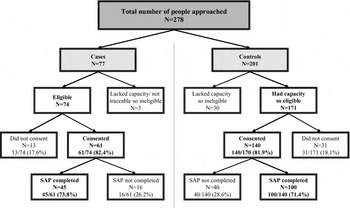
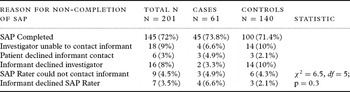
Two-hundred and seventy-eight patients were approached for inclusion in the study: 77 people who had self harmed and 201 who had not. It was deemed that 30 potential controls and three potential cases lacked the necessary capacity to sign a consent form. The eligible sample therefore comprised 74 potential cases of whom 61 (82.4%) consented and 171 potential controls of whom 140 (81.9%) consented. It can be seen that the final sample size was 201 consisting of 140 controls and 61 cases (Figure 1). Demographic and clinical data were documented for all these patients with only very occasional missing data. The SAP was completed for 45/61 cases (73.8%) and 100/140 controls (71.4%), with reasons listed for non-completion given in Table 1.
Subject accountability through the study.

Reasons for non-completion of Standardized Assessment of Personality (SAP)

In the entire population, irrespective of SAP completion, cases and controls differed across a range of clinical and demographic variables: Cases were significantly younger [mean = 75.1 (SD = 8.3) years v. 81.5 (SD = 8.6) years; p<0.001], more likely to be divorced or separated [χ2 = 15.3, df = 3; p = 0.002], less likely to be Jewish [χ2 = 11, df = 5; p = 0.05] and more likely to have been of Irish descent [χ2 = 11.7, df = 5; p = 0.04]. They also exhibited less religious participation [χ2 = 11.6, df = 4; p<0.02] and were more likely to live in social housing [χ2 = 25.4, df = 10; p<0.0001]. Clinically, cases were more depressed at interview as assessed using the BDI [mean = 16.3 (SD = 1.9) v. 7.1 (SD = 2); p<0.0001] and were more likely to have been diagnosed in the past with depression [χ2 = 31.1, df = 1; p<0.001]. They also had a greater prevalence of alcohol misuse problems as defined by a score >8 on the AUDIT [9/60 (15%) v 5/139 (3.7%); χ2 = 8.3, df = 1; p = 0.004]. Using the MOS rating scale and subscales; cases had fewer close friends or relatives whom they could confide in [mean = 3.3 (SD = 2) v 4.7 (SD = 2.3); p = 0.008], less positive social interaction [mean = 53.2 (SD = 22.8) v 68.4 (SD = 25.2); p<0.0001], a perception of less emotional and informational support [mean = 63.6 (SD = 63.2) v 79.5 (SD = 70.2); p<0.0001] and a reduced availability of tangible support [mean = 74.4 (SD = 68.7) v 82.1 (SD = 70.5); p = 0.01]. Cases were also more likely to have had at least one serious negative life event in the 6 months preceding DSH than controls reported in the 6 months prior to interview [χ2 = 21.5, df = 4; p<0.0001]. They more frequently reported life events involving relationship difficulties with partners, friends, spouses and neighbors. They were also more likely to report a financial crisis and were more likely to suffer from a mental illness [χ2 = 37.5, df = 3; p<0.0001] and be prescribed psychotropic drugs [χ2 = 58.8, df = 4; p<0.0001].
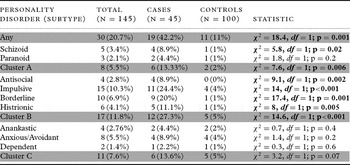
There were 145 completed SAP schedules (i.e. 72.1% of the sample who were interviewed. The rates of completion were similar between cases 45/61 (73.8%) and controls 100/140 (71.4%). There were no significant differences between the two groups in terms of who the informants were by gender [χ2 = 0.86, df = 1; p = 0.36] or the relationship to the study subject [χ2 = 9.3, df = 13, p = 0.75]. Thirty patients had at least one diagnosis of personality disorder, giving an overall prevalence in this sample of 20.7%. The most common subtypes of personality disorder were both from cluster B namely impulsive (15/145) and borderline (10/145) subtypes. Nineteen cases (19/45 or 42%) and eleven controls (11/100 or 11%) had personality disorder [χ2 = 18.4, df = 1; p = 0.001]. Table 2 shows the breakdown of personality disorder by subtype and cluster.
Prevalence of personality disorder by cluster and subtype.

The associations demonstrated between DSH and potential confounders listed above remained valid in the sub-population where a SAP was completed.
Of the variables already noted as being associated with DSH; patients who had personality disorder were younger [mean = 76.8 (SD = 1.7) v 80.2 (SD = 9.3); p = 0.08] and more likely to be either divorced or separated [9/30 (30.0%) v 97/106 (91.5%); χ2 = 12, df = 3; p = 0.007]. They were more likely to suffer from depression [16/30(53.3%) v 40/114 (35.1%); χ2 = 3.3, df = 1; p = 0.07] and demonstrated an increased risk of alcohol problems [6/30 (20%) v 4/114 (3.5%); χ2 = 31.1, df = 1; p<0.001]. People with personality disorder also had more negative life events [χ2 = 12.1, df = 4; p = 0.02] People with personality disorder also had lower scores through comparisons of quartile scores for positive social support [χ2 = 8.2, df = 3; p = 0.04] and emotional and instrumental social support [χ2 = 13, df = 3; p = 0.005] as derived from the MOS.
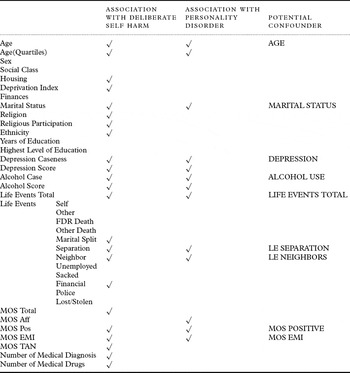
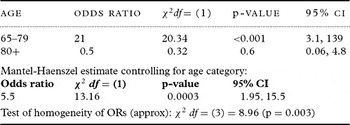
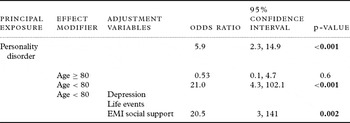
Those variables associated with both the outcome (DSH) and primary exposure (personality disorder) (Table 3) were explored further. Age was identified as having a strong interaction between personality disorder and DSH; there was no association between personality disorder and DSH in patients >80 years of age, the median age of the whole sample (Table 4), but a significant association below this cut-off. In the younger group (65–80 years), depression, emotional and instrumental support from the MOS and the total number of life events entered the final regression model as potential confounders (Table 5). After adjusting for these variables, the ORadj was 20.5 (95% CI = 3141; p = 0.002).
Final list of potential confounders of relationship between an act of deliberate self harm and personality disorder

MOS = Medical Outcome Study; Aff = affectionate support; Pos = positive social interaction; EMI = emotional and instrumental support; TAN = tangible support.
Stratum specific ORs measuring association between an act of deliberate self harm and personality disorder for the two age bands

Association between personality disorder and deliberate self harm after stratification for interaction and adjustment for potential confounding

EMI = emotional and instrumental.
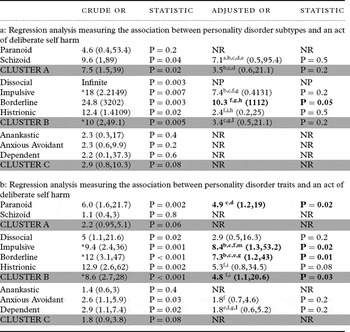
The analysis was repeated for each of the personality disorder subtypes, clusters, subthreshold personality disorder and traits. This revealed that borderline personality disorder was associated with DSH (Table 6a) after adjusting for the confounding effects of depression, alcohol use and age (though there was no evidence of an interaction with age for this particular exposure) (ORadj = 10.3, 1112; p = 0.05). No sub-threshold subtype was associated with an act of DSH after adjustment for potential confounders (not shown). However, after adjustment for potential confounders, paranoid [ORadj = 4.9 (95% CI = 1.2, 19) p = 0.02)], impulsive [ORadj = 8.4 (95% CI = 1.3, 53.2) p = 0.02] and borderline [ORadj = 7.3 (95% CI = 1.2, 43) p = 0.01] traits were significantly associated with DSH. Moreover, having any one of the cluster B traits was associated with an act of DSH [ORadj = 4.8 (95% CI = 1.1, 20.6) p = 0.03]. For all of these personality traits there was evidence of an interaction with age and the results shown only apply to those patients aged 65–80 years old; there were no associations demonstrated in the patients aged >80.
Crude and adjusted ORs for the association between (6a) subtypes and clusters of personality disorder, and (6b) subtypes and clusters of personality disorder traits, and an act of deliberate self harm

*Association had effect modified by age, results presented for group <80 as > 80 had no significant crude associations.
Superscripts refer to adjustments for the following exposures: ahousing, btotal life events, clife events with neighbors, d positive social support, eemotional and instrumental social support, fdepression, galcohol use, hage, Imarital status, jtangible social support, ktotal number of friends, lnumber of medical diagnoses, mfinancial life events.
Discussion
These data have demonstrated that personality disorder is strongly associated with DSH in patients aged between 65 and 80. Above this age, personality disorder appears to have no impact on the risk of self harm. We observed an association between cluster B (or immature) personality traits and DSH in that same age group, which has been frequently reported in adults of working age (Klonsky et al., Reference Klonsky, Oltmanns and Turkheimer2003; Forman et al., Reference Forman2004).
The size of this sample means that some of our analyses will have lacked power, especially those identifying potential confounders. The testing of different subtypes and levels of personality disorder and traits also increases the likelihood of a Type 1 error. Despite this, we feel that the strength of the association between personality disorder as a whole, as well as with cluster B, borderline and impulsive traits in patients aged between 65 and 80 is important. We believe therefore that this observation would benefit from further exploration. A further three caveats in the inference that can be drawn from this study are worth noting. First, the study used a bespoke definition of deliberate self harm given the perceived shortcomings of the current definitions in common usage. This may limit the generalizability of our findings where other definitions are routinely used. However, we believe that the clear articulation of our self harming population will allow readers to be able to contextualize our findings with their own practice or research. Secondly, we used an informant-based method for determining Personality Disorder; whilst this overcomes observer bias, it may lack the precision from the informant to ascertain accurately the level of distress and impairment the personality traits cause the individual. Thirdly, we only recruited patients who deliberately self harmed and presented to either Accident and Emergency (A&E) departments or direct to psychiatric services. We may have uncovered different associations had we sampled patients presenting solely to primary care as well where (perhaps) the level of psychiatric and social comorbidities are less. Future studies building on our research may wish to address this.
As far as we are aware, this is the first large-scale investigation whose principal aim was to describe and measure the association between personality disorder and DSH in an older population. Our observation that there was a significant interaction between age and the impact of personality disorder on DSH merits further comment as does the other key observation that it was the cluster B types of personality that were driving the association.
Cluster B types of personality are associated with high rates of morbidity and mortality (Fishbain, Reference Fishbain1991; Dumais et al., Reference Dumais2005a; Reference Dumais2005b). Moreover, as they are considered the immature personality types, there is an inference that these traits mature with age and accordingly become less troubling. Our data suggests that there will be some people in whom these traits are resistant to maturity and that when they reach retirement age, they do so socially isolated, in financial difficulty and with a history of broken relationships. They continue to act in an impulsive manner and when faced with life events, mainly around interpersonal relationships, they harm themselves. There is also the possibility that the age-related loss of protective relationships and formal supports that have carried people with cluster B traits through their working lives may mediate self harm.
Our data would suggest that survival of this population into their 80s is unlikely possibly because of an associated mortality or perhaps because of an eventual (late) maturation and reduction of risk taking. We could hypothesize that either the person does not survive beyond 80 or that they do but the cluster B personality disorder traits do not. Cohort studies of older adults with personality disorder would help elaborate on these two possibilities.
If our observations are valid, and given the strong association between DSH and completed suicide in older people, then it is important to consider personality traits as diligently as we currently assess mood in the assessment of older people who self harm. Moreover, psychological (rather than pharmacological) intervention may be of particular benefit in this population in any attempt to reduce repeated self harm and improve survival. In younger patients, dialectical behavior therapy (DBT) is routinely used for managing behaviors associated with borderline personality disorder (Koerner and Linehan, Reference Koerner, Linehan and 2000), an intervention which may be used to good effect in older patients (Lynch et al., Reference Lynch, Morse, Mendelson and Robins2003). Given the infrequent nature of DSH in older people such services should be established within the framework of those already available for adults of working age. Enhanced assessment and identification of personality issues as a major factor in self harming behavior needs to enter routine psychiatric practice to ensure appropriate and timely intervention.
Conflict of interest
None.
Description of authors' roles
CWR designed the study, interviewed all the cases, collated and analyzed all the data and led the preparation of the paper. MBK and MB assisted in the design of the study, its analysis and interpretation and preparation of the paper. NT and FN undertook blinded informant interviews and assisted with the preparation of the paper. SO, ME and GK interviewed controls as well as assisting in the preparation of the paper. SE, CB and DL identified patients for the study from their clinical services and also assisted with the interpretation of the data and drafting of the paper.
Acknowledgments
We would like to acknowledge the following clinical colleagues who referred patients into this study and enabled access to their clinics or wards to recruit control subjects: Professor Gill Livingston, Dr. Vincent Kirchner, Dr. Suzanne Joels and Dr. Ruth Allen.
This study was funded through a Medical Research Council Health Services Research Fellowship awarded to CWR.