


Dissemination: a moral imperative?
The importance of empirically supported psychological therapies has been accorded a high profile in policy literature in the last decade (DoH, 1996, 2001, 2004, 2005). Cognitive behavioural (CB) approaches remain consistently the ‘front runner’ in this context, reflected in clinical practice guidelines, with British mental health nurses constituting the largest professional group in the overall dissemination agenda (DoH, 2005). Since the publication of the Depression Report (2006), and the Labour Government's manifesto commitment in 2005 to increase the psychological treatments available to those suffering from anxiety and depression, the more recent pioneering development of both demonstration and pathfinder project sites, and the government's future investment of £173 million pounds to better cater for common emotional difficulties, the profile of CBT has arguably never been higher (DoH, 2007a–c; NIMHE, 2007).
Models of implementation
The models of implementation envisaged in policy define two levels of practitioner within a stepped care model, to work with anxiety and depression of various severities (NIMHE, 2007). The levels of practitioner are described as low-intensity and high-intensity workers. It is envisaged that the low-intensity workers mainly monitor medication and case-manage depression with a focus on behavioural activation and problem-solving therapies. Whilst for the anxiety disorders, case management remains important but with more of an emphasis on brief psychological interventions such as exposure and brief cognitive therapies. As part of the low-intensity pathway clients are also offered computer-assisted cognitive behavioural therapy (CCBT) (DoH, 2007a) or other supported self-help materials.
The vision for the high-intensity workers is twofold: first, to work with clients who have not responded to the first line of therapy with a low-intensity worker, but also to work with clients who were screened out of the low-intensity pathway due to their difficulties being too severe or too chronic. They also have a secondary role to play in supervising low-intensity workers (NIMHE, 2007). In addition to the practitioners, the services are set up with supporting clinical pathways and supporting systems and processes to ensure rapid assessment and implementation of the protocols, with assertive follow-up of clients referred to the respective services.
The above model has so far been tested in two pilot projects in Newham and Doncaster, and the emergent results show good outcomes are being achieved (Richards, 2007). These studies are, however, incomplete along with the economic analysis also being carried out (Parry, Reference Parry2007). Despite this, policy is being developed to implement the models further and dissemination and further pilot work is currently being implemented in a further ten sites in England. These pilot sites are aiming to test alternative models, and to learn from the process to inform policy, with wider client groups including the elderly and children/adolescent services also being included (DoH, 2007a).
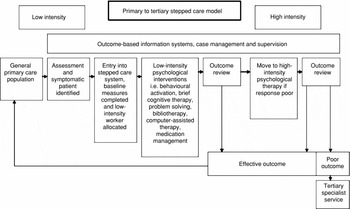
In anticipation of the imminent translation of policy to practice, and following earlier policy work regarding counselling and psychotherapy services (DoH, 1996), many trusts have begun to develop psychological therapies services that have been organized on a stepped care basis. Evidence-based stepped care within health care has two key aspects. The first of these and the one which equates with low-intensity workforce development in psychological therapies is that the amount of therapist time utilized is limited but focused around those psychological interventions that the evidence indicates will provide significant psychological health gain. In stepped care, more intensive treatments are then reserved for people who do not benefit from the simpler first-line interventions, or for those people where it can be accurately predicted that no or limited benefit will be derived from the first step interventions. The second important feature of stepped care is that the system must be self-correcting, meaning that the outcomes of therapy must be closely monitored and case-managed in order that the interventions are stepped up if health benefits are not being released with lower intensity interventions.
Thus stepped care is a rational evidence-based and economic approach to psychological therapies delivery that its exponents argue has the potential for deriving the greatest benefit from available therapeutic and economic resources available (Bower & Gilbody, Reference Bower and Gilbody2005). Fig. 1 shows the key elements of a stepped care approach to psychological therapies.
Flowchart of the key elements of a stepped care approach to psychological therapies.

The DoH is also emphasizing that the worker roles (high- and low-intensity workers) in the services should have defined competencies rather then have allegiances to or be aligned to specific professional groups or specific academic levels of preparation (DoH, 2007c; NIMHE, 2007):
Rather than prescribing the exact workforce profile in terms of numbers and type of staff, we will emphasize the functions/competences and levels of work of members of these teams or services.
(DoH, 2007c, p. 3)What this will therefore mean is that existing service models will need reconfiguring, with the opportunity to develop new roles and new workers to address Improving Access to Psychological Therapies (IAPT) standards.
Educational preparation and curriculum development
In support of the whole implementation process, appropriate and effective education and training is required. This is acknowledged by the National Institute of Mental Health in England (NIMHE) in its guidance documentation (NIMHE, 2007, p. 5) in section 5:
5.1 Service commissioners rarely become involved in the commissioning of education and training [with the exception of the Primary Care Mental Health Workers]. This is usually the role of SHA's and employers. An active dialogue is therefore going to be important in local Pathfinder sites.
5.2 Where there are existing courses for graduate workers and CBT therapists, these should be reviewed to ensure they are fit for purpose. The IAPT workforce team will be producing exemplar curricula, in modular form, based on competences, to assist local commissioners and providers which may include Higher Education Institutions in this review.
5.3 Accreditation levels for CBT training are variable nationally, although the BABCP has developed extensive standards. The IAPT workforce team is engaging them and other key stakeholders to agree accreditation levels. In 2008, Skills for Health will be producing a new national qualification framework and there will be close co-operation with them in 07/08.
5.4 Person centred values and psychological awareness needs to be present in the entire workforce at primary and secondary levels. This therefore needs to be factored in to a local training strategy.
There is little in this guidance document that would be considered controversial by most commentators other than the statement that the IAPT workforce team will be producing an exemplar curriculum for both low- and high-intensity workers based on competencies alongside planned reviews of existing psychological therapies training to ensure these meet IAPT criteria.
The assumption of the Care Services Improvement Partnership (CSIP) and the IAPT workforce team seems to be that only programmes that meet these emergent criteria should be commissioned by strategic health authorities (SHA) and local employers or be funded through the IAPT programme. Any initiative that brings into education new recurrent commissioning, funding and support should be broadly welcomed, particularly in the context of SHA not routinely commissioning whole CBT courses directly in most areas, as is the case for other forms of training required for delivery through the NHS. In the experience of the first two authors, based on their own course data the current situation is that most therapist training is either funded by therapists themselves or with support from their local NHS employer, or in some cases a combination of self and employer funding.
Despite the above investment in training and workforce development, it may result in a number of unintended consequences that we believe will also need to be addressed as policy is developed:
(1) The emphasis on training programmes that focus purely on anxiety and depression might lead to a reduction in access to psychological therapies training for therapists who work with other client groups, e.g. psychosis or personality disorders.
(2) There is a suggestion that some psychological therapies training might not be fit for purpose. In other words, that it might not meet the specific and focused IAPT standards. Yet these new standards and curricula are not yet developed, implemented or tested.
(3) There is also the assumption that the new set of standards will somehow be better than what has been developed over many years by the British Association for Behavioural and Cognitive Psychotherapies (BABCP) and higher education (HE) providers working in partnership with their local employer commissioners based on local assessed need.
(4) It is possible that the commissioning of new programmes might actually have the effect of destabilizing existing, well established and highly regarded programmes that have traditionally been supported by local employers and self-funding students.
(5) The issue of long-term recurrent funding will also need to be addressed. If not, then in the longer term access to training and appropriate services may become diminished rather than expanded as envisaged by IAPT.
(6) The establishment of another review process by IAPT will be in addition to the BABCP accreditation processes; the Higher Education Quality Assurance Agency (QAA) review; Major Health Reviews which are joint QAA and QAA review processes as well as internal Higher Education programme review process. This will then constitute another tier of time-consuming quality monitoring that might well be unnecessary.
(7) Despite the stated intention of career pathways within psychological therapies services, no acknowledgement is made of the work undertaken by BABCP and the accredited course at the University of Derby (www.derby.ac.uk) to widen opportunities for people from non-traditional (i.e. non-professional) backgrounds to train through a 5-year process from undergraduate to postgraduate to become autonomous cognitive behavioural psychotherapists through the knowledge skills and attitudes (KSA) equivalence routes (www.babcp.com).
Overall it appears that the policy statements and documents that are supporting the IAPT development are presenting themselves as revolutionary replacement rather than evolutionary development of existing services, preparatory educational programmes and processes.
Despite this critical analysis, the current proposals do give an important lever and opportunity for HE providers to engage in further work with SHA, local employers and IAPT on new models of curricula, which could lead to better and more modern ways of working between the NHS and HE providers.
Traditional vs. collaborative curricula
A curriculum is an educational strategy that is laid out in order that students meet defined learning outcomes. It contains the important elements of the content of what needs to be taught and learned, the form that the learning will take and the methods that will be used, where the learning will take place (e.g. the classroom or the work environment) and how the learning outcomes will be assessed (Hughes, Reference Hughes2007).
Traditional curricula in the psychological therapies field is usually based on a classroom and practice placement model. The classroom-based teaching is usually a combination of didactic theory and clinical skills development through role play with feedback on performance. This is then supported by supervision in the practice setting with the assumption of the transfer of knowledge from one setting to the other and vice versa.
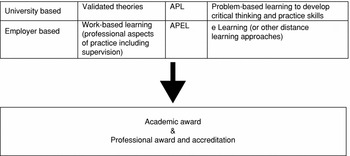
The traditional model has generally served the field well, but recently has been replaced by many HE providers with more collaborative curricula approaches with employers. These include work-based learning, acknowledgement by academic credit of prior learning (APL) or accreditation for prior experiential learning (APEL) processes of existing knowledge and skills learned within the workplace. Curricula have also been developed that enable formal structured learning to take place within the workplace that lead to academic credit. Such a model is shown in Fig. 2. In addition, a more blended and creative approach to learning has been developed to address issues such as depth of knowledge, levels of competency and expertise, application of practice to real-world contexts and synchrony in learning. Blended learning usually consists of problem-based learning, e learning, prescribed self-directed learning, with much less emphasis on didactic teaching, with the continuation of skills-based learning through role play, and effective placements with trained supervisors.
Example of a collaborative approach to the curriculum structure to promote partnership and between employers and higher education.

Student preparation: the classroom-to-employer work setting
In addition to the development of collaborative curricula, national and local policy and financial developments must also utilize and take into account relevant theory that helps students and their employers to make the transfer in learning between HE and the workplace setting. In terms of the teaching and learning perspective, at least six theoretical areas are relevant in this regard and must therefore be included in emergent curricula: these are the Lewin–Kolb learning cycle (Lewin, Reference Lewin1946; Kolb, Reference Kolb1984); the ‘head-heart lag’ (Lee, Reference Lee and Gilbert2005; Power & Dalgleish, Reference Power and Dalgleish1997; Teasdale & Barnard, 1983); the novice-to-expert trajectory Dreyfus, Reference Dreyfus and Burke1989); the declarative, procedural and reflective (DPR) model (Bennett-Levy, Reference Bennett-Levy2006); problem-based learning (Baden, Reference Baden2004) and e learning (Walsh et al. Reference Walsh, Wanberg, Brown and Simmering2003; Townend, Reference Townend2005a; Townend & Wood, Reference Townend and Wood2007) and the crucial role of supervision (Milne & James, Reference Milne and James2000; Armstrong & Freeston, Reference Armstrong, Freeston and Tarrier2006; Sloan, Reference Sloan2006; Townend, in press).
The Lewin–Kolb learning cycle
A classic model of reflective learning, the Lewin–Kolb cycle proposes that experience in the form of action is followed by observation of such action (Lewin, Reference Lewin1946; Kolb, Reference Kolb1984). Subsequent reflection involves making sense of what happened and relating it to previous experience of knowledge in a search for understanding. Cognitive behavioural students then generalize from this to abstract principles which fit with clients' emerging formulations, and subsequently plan in the form of considering implications for moving client interventions forward. The cycle then begins again with more action experience.
The head-heart lag
This model suggests a division between two different levels of emotion and information processing. The propositional system is concerned with intellectual reasoning and explicit, conscious and controlled self-processing, amounting to cognitive understanding or ‘knowing in my head’. In contrast, the implicational system relates to emotional reasoning and implicit self-processing. This is automatic, affective and unconscious, constituting emotional understanding or ‘feeling in my heart’ (Teasdale & Barnard, 1983; Power & Dalgleish, Reference Power and Dalgleish1997; Lee, Reference Lee and Gilbert2005; Townend, in press).
The novice-to-expert trajectory
This model constitutes six competence level descriptors and underpins the Cognitive Therapy Scale – Revised (CTS-R) (Blackburn et al. Reference Blackburn, James, Milne, Baker, Standart, Garland and Reichelt2001; Milne et al. Reference Milne, Claydon, Blackburn, James and Sheikh2001). Incompetent therapists commit errors and display poor and unacceptable behaviour, leading to negative therapeutic consequences. At the novice level, therapists display rigid adherence to taught rules and an inability to take account of situational factors or display discretionary judgement. Advanced Beginners treat all aspects of the task separately and give equal importance to them, although there is evidence of situational perspectives and discretionary judgements. Competent therapists are able to see tasks linked within a conceptual framework and can make plans within this framework using standardized and routinized procedures. Proficient therapists view clients' problems holistically and are able to prioritize tasks and make quick decisions in a skilled and able way. Finally, Expert therapists no longer need to use rules, guidelines or maxims. They have a deep tacit understanding of key issues and are able to use novel problem-solving techniques, demonstrating such skills even in the face of difficulties such as excessive client avoidance (Dreyfus, Reference Dreyfus and Burke1989).
The DPR model
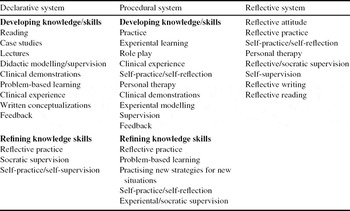
According to Bennett-Levy, student cognitive behavioural therapists develop in relation to three systems of learning (Bennett-Levy, Reference Bennett-Levy2006). The declarative and procedural systems amount to knowledge of factual information, or ‘knowing that’ and are associated with novice learning. The reflective system is more advanced, and relates to ‘when-then’ rules, plans, procedures and skills (Sutton et al. Reference Sutton, Townend and Wright2007). Table 1 shows the appropriate classroom activities associated with each system.
Classroom activities associated with declarative, procedural and reflective systems

Problem-based learning
Problem-based learning is an educational strategy that has been developed for posing realistic, contextualized, real-world clinical problems to students and then providing resources, guidance, and instruction to learners so that they can develop content knowledge and problem-solving skills (Mayo et al. Reference Mayo, Donnelly, Nash and Schwartz1993; Baden, Reference Baden2004). In problem-based learning, students collaborate to study the issues of a clinical problem as they strive to create viable contextual solutions. Unlike traditional instructive learning, which is often conducted in lecture format, teaching in problem-based learning normally occurs within small discussion groups of students facilitated by a lecturer (Bridges & Hallinger, Reference Bridges and Hallinger1991; Aspy et al. Reference Aspy, Aspy and Quimby1993; Baden, Reference Baden2004). The ability to solve clinical problems is more than just accumulating knowledge and rules; it is the development of flexible, cognitive strategies that help analyse unanticipated, ill-structured situations to produce meaningful and workable solutions. Even though complex clinical situations are within the realm of student learning outcomes in order for them to become competent practitioners, the skills needed to tackle these problems are often missing from traditional learning approaches (Reich, Reference Reich and Bacharach1990; Baden, Reference Baden2004). Real-life clinical problems seldom parallel well-structured problems; and it can also be argued that handling the uncertainties of practice through the development of critical thinking skills are both necessary learning outcomes for students in cognitive behavioural psychotherapy. In real-life clinical situations therapists seldom repeat exactly the same steps to solve problems; therefore, the lockstep solution sequence taught through traditional didactic learning is seldom transferable. Instead, real-life problems present an ever-changing variety of goals, contexts, contents, obstacles, and unknowns which influence how each problem should be approached. To be successful as cognitive behavioural psychotherapists, students thus need practice solving ill-structured problems that reflect life beyond the classroom. This skill is the goal of problem-based learning.
e Learning
Educational practitioners and educational researchers agree that technological advances are altering the training and development landscape (Townend, Reference Townend2005a). In particular, the increased use of internet-based technologies to deliver professional training has been heralded as an e learning revolution (Walsh et al. Reference Walsh, Wanberg, Brown and Simmering2003). e Learning can be defined as the use of a computer network over an intranet or over the internet to deliver education and training to individuals or groups (Townend, Reference Townend2005a; Townend & Wood, Reference Townend and Wood2007). This training delivery can be either asynchronous or synchronous in format.
To date, there is compelling evidence from non-health-care contexts that learning can take place through e learning. Most studies show that it is at least as effective, and possibly slightly better, than classroom-based learning for short and focused courses with less technical content that have an emphasis on cognitive learning outcomes (Walsh et al. Reference Walsh, Wanberg, Brown and Simmering2003). It has also been found in some studies that lower levels of computer self-efficacy are related to lower learning outcomes, but that learning style and gender do not determine effectiveness.
The importance of systems of supervision
Clinical supervision is an essential component of training programmes and continued professional development in CBT. It enables effective skills to be developed and maintained through systems of feedback on performance and the transfer of knowledge from the classroom into practice (Townend, Reference Townend2005a; Grant & Townend, Reference Grant and Townend2007; Townend, in press). Despite recent work there appears to be a range of assumptions which clearly illuminate the conceptual ambiguities around clinical supervision in CBT (Armstrong & Freeston, Reference Armstrong, Freeston and Tarrier2006; Townend, in press).
Sloan (Reference Sloan2006) reported that clinical supervision has a broad scope, with managerial agendas having considerable emphasis during supervision, performance appraisals, professional development plans, service developments and staff relations. With senior management endorsing ‘anything and everything’ discussions in supervision, issues emanating from the supervisees' clinical work and how they engaged with patients were overshadowed (Sloan, Reference Sloan2006). When clinical issues were afforded space, these discussions took the form of caseload management with the supervisee providing their supervisor (line manager) with a brief update on many patients in a short period of time. Consequently, the supervisor's knowledge of the supervisee's caseload expanded, while simultaneously limiting the extent of the supervisee's exploration and discovery of new meanings. Essentially, little reflection took place within the supervisory process.
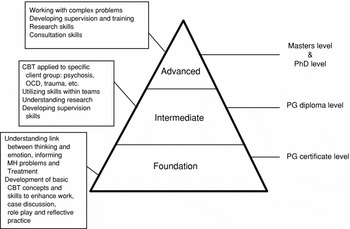
More specifically in CBT, supervision is characterized by an active directive approach, with case discussion and development of formulation (Grant et al. Reference Grant, Townend, Mills and Cockx2008) as the central features, with much less use made of video and DVD feedback and standardized ratings of performance (Townend et al. Reference Townend, Iannetta and Freeston2002; Grant & Townend, Reference Grant and Townend2007) than would be expected. Thus local initiatives have emerged in England such as that illustrated in Fig. 3, based on cognitive behavioural expertise, supervision and practice.
Hierarchical structure for the organization of supervision.

Bridging the classroom to work setting divide: emerging implications
The clear message emerging from the above, interrelated, educational theoretical and empirical models are that there needs to be an equal weighting given to university preparation, learning within the workplace and personal development. Therefore attention to the organizational work-setting location for learning and support is crucial and will need to be addressed within collaborative curricula. This is highlighted in the discussion below.
Related maladaptive organizational assumptions
We believe that breakdown of the classroom to work-setting transition at the level of organizational support relates to frequently displayed organizational assumptions around clinical supervision, organizational change and role preparation. These could be addressed through new curricula models, and collaboration and contracts between HE and NYH employers. These would stress and lay out the roles and responsibilities of NHS employers in creating the learning environments required, in tandem with similar processes amongst HE providers. Such an approach could then create a coherent environment of learning that transcends organizational boundaries and locations.
Problems in the cognitive behavioural dissemination literature
The above classroom-to-service organizational transfer issues are sadly neglected in the CBT dissemination literature. An observable trend in this literature is that the task of organizational preparation of the uptake of cognitive behavioural approaches is constructed in exclusively rational terms (Mills, Reference Mills2003; Grant et al. Reference Grant, Mills, Mulhern and Short2004; Poole & Grant, Reference Poole and Grant2005). The message is one of implicit organizational persuasion and advice on best practice through clinical practice and policy guidelines:
• The rational agenda should work, e.g.
research should provide information about which new treatments are efficacious. These should then be disseminated into clinical practice and services organized or configured to accommodate them and facilitate delivery.
(Tarrier et al. Reference Tarrier, Barrowclough, Haddock and McGovern1999, p. 569)• A mutuality of reasonableness is constantly anticipated, e.g.
The aim is to help translate national policy to improve standards of mental health treatment and care with local action.
[DoH, 2004, p. 9 (KSF)]• But the rational agenda is threatened by potential resistance, e.g.
Accepting the recommendation of this report may require a change in attitude towards psychological therapies in some localities . . . psychological therapies should no longer be regarded as optional.
[DoH, 2004, p. 9 (KSF)]• This may be to do with occupational power, e.g.
PSI may promote professional tribalism, insofar as it is perceived as a challenge to the medical hegemony in psychiatric institutions.
(Milne & Roberts, Reference Milne and Roberts2002)• But we are not entirely sure, e.g.
At present our understanding of these topics is patchy and the methodology for investigating them undeveloped.
(Tarrier et al. Reference Tarrier, Barrowclough, Haddock and McGovern1999, p. 581)Rather ironically, it has long been recognized that there are organizational factors which impede the uptake of evidence-based mental health interventions (Brooker & Butterworth, Reference Brooker and Butterworth1991; Kavanagh et al. Reference Kavanagh, Clark, Piatkowska, Manicasvasagar, Rosen and Tennant1993; Fadden, Reference Fadden1997; Price, Reference Price1999; Tarrier et al. Reference Tarrier, Barrowclough, Haddock and McGovern1999; Brooker et al. Reference Brooker, Saul, Robinson, King and Dudley2003). However, these writers have not gone beyond simply describing impediments, such as lack of time and competing work pressures, or suggesting that services should be reconfigured; to consider how factors within the ways in which organizations are socially constructed might undermine the relative success of implementation (Poole & Grant, Reference Poole and Grant2005).
Philosophical theory and organizational change
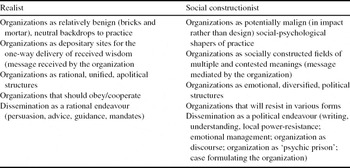
In order to understand some of the difficulties of dissemination, it is helpful to consider the contrasts between realist with social constructionist assumptions about health-care organizations (see Table 2).
Implicit assumptions about organizations

Source: Grant et al. (Reference Grant, Mills, Bridgeman, Mulhern and Short2006), p. 31.
The socially constructed organization
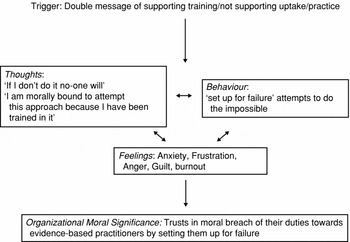
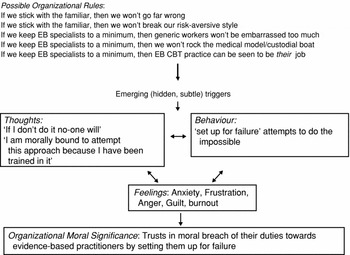
It arguably behoves managers of psychological therapies services, cognitive behavioural practitioners, supervisors and trainers to have a sophisticated grasp of organizational theory. Respect for this knowledge domain seems threatened currently by a distinct lack of paradigmatic pluralism in the philosophy of science underpinning CBT (A. Grant & M. Townend, unpublished observations). There are four conceptual and theoretical areas which may help to understand and begin to redress this state of affairs. These are Goffman's (Reference Goffman1969) ‘backstage-frontstage’ metaphor which is the idea that policy rhetoric and the reality of delivery of services become meshed in a culture of illusionary collusion. Recognizing the reality and working to address the changes needed being the resultant challenge (Duncan-Grant, Reference Duncan-Grant2001). The myth of the organizational ‘hero-innovator’ (Georgiades & Phillimore, Reference Georgiades, Phillimore, Kiernan and Woodford1975) which when translated into cognitive behavioural therapy and organizational change, is the apparent assumption that one (or a small team of newly educated cognitive behavioural therapists) can change the whole organization on their own, or that they can do their old job and simply incorporate cognitive behavioural principles; again the falsity of this needs to be recognized and addressed (see Figs 4 and 5).
Formulating the ‘hero-rescuer’ CB practitioner (from Grant et al. Reference Grant, Mills, Bridgeman, Mulhern and Short2006, p. 32).

Formulating the organization, in relation to the hero-rescuer (from Grant et al. Reference Grant, Mills, Bridgeman, Mulhern and Short2006, p. 32).

The metaphor of organization as ‘psychic prison’ can also be a useful concept that refers to the proposition that although the operating assumptions of the organization may be contradictory and self-defeating, they are experienced as right and proper, thus requiring no scrutiny. Thus, mental health organizations may continually fail at the levels of ‘single’ and ‘double-loop’ learning – the former term referring to learning from mistakes and the latter to learning about the learning (Grant et al. Reference Grant, Mills, Bridgeman, Mulhern and Short2006). In the words of Morgan (Reference Morgan1997, p. 219):
Such is the nature of psychic prisons. Favoured ways of thinking and acting become traps that confine individuals within socially constructed worlds and prevent the emergence of other worlds.
Finally Pfeffer's (Reference Pfeffer1981) theoretical and empirical social-psychological thesis, that difficulties with change can be due to organizational members being socialized into varying degrees of the custom and practice rules of the organization. These rules are taken for granted as ‘right and proper’, and beyond question, and result in an implicit organizational contract, developing slowly over time, between organizational members. This draws individuals and organizational stakeholder groups more or less into a corporate mind- and behavioural-set which can be antagonistic to the uptake of evidence-based approaches, through the process of privileging the maintenance of custom- and practice-based ‘business as usual’.
The importance of a supportive organizational infrastructure for skills/knowledge consolidation
In order for there to be appropriate collaboration and partnership between employers and HE in supporting access to psychological therapies agenda, we have argued that the issue of organizational development must be addressed explicitly as part of the the implementation process. Unless system and process issues are addressed, there is a real danger that the whole process will fail to deliver the anticipated outcomes and that this will be attributed to the myth of the ‘superficiality of CBT’ and its shortcomings, rather than endemic NHS structural, process ands socially constructed organizational problems.
These structural and process issues are now being recognized widely within the NHS and we anticipate that in the IAPT process effective learning can also take place from the work of the pathfinder sites. Best practice in respect of organizational preparation is in our view exemplified in clinical and organizational process re-engineering that utilizes learning principles as originally developed by Toyota. These are now being applied and evaluated within health care alongside other approaches to the development of individuals and teams within complex systems (Cancer Services Collaborative Improvement Partnership, 2005; CSIP, 2008). These same lessons need to be learned and applied to the development of integrated stepped care systems across primary and secondary care in a way that transcends all traditional professional barriers to inter-professional and inter-agency working (Townend, Reference Townend2005b).
As trainers and supervisors, we constantly witness a breakdown at the level of organizational support for the university education of CBT practitioners. In our view, what should happen is that new roles are built into organizational development and vision plans; that effective forms of clinical supervision facilitate reflective practice, and that there is adequate social and material environmental support. Unfortunately, all too often we witness the opposite: temporary roles arranged informally for the student and not considered within organizational development; debased forms of clinical supervision, and environmental support not formally underwritten.
Care delivery in the NHS in England and Wales, and Scotland is influenced by policy and clinical guidelines which emanate from the National Institute for Health and Clinical Excellence (NICE) and the Scottish NHS Quality Improvement Scotland (NHS QIS). Both organizations contribute to how clinical practice is delivered, basing recommendations on the best available evidence and involving all stakeholders in a transparent and collaborative manner.
It should be of no surprise that the recommendations from NICE and NHS QIS, informing clinical practice in mental health-care delivery, are replete with references to CBT. However, while some Trusts and other organizations are willing to support staff by meeting the costs of initial training, there appears to be less enthusiasm for the development of, and support for, dedicated CBT posts (NIMHE, 2007). This will of course now change in primary care with the development of IAPT services, but in doing so further challenges will be created regarding the interface and joined up working between primary and secondary services. Unfortunately, all too often we have witnessed the opposite. Following CBT education, clinicians often return to their existing generic roles in secondary care, preventing them from making full use of the range of new skills their training has equipped them with. Consequently, in attempting to address a plethora of work duties, clinical supervision is too broad and poorly focused; priorities – often determined by the supervisor – detract from the clinical focus and outcome focus essential for the reflective development of CBT knowledge, skills, expertise and better outcomes for clients.
Some emerging implications
The jubilation expressed by the Department of Health, patient advocacy groups and professionals has been tempered by the realisation that there is now a huge job to be done. At the moment there simply is not the infrastructure to support the huge planned expansion . . . Next year, in preparation for this massive growth, the NHS and universities will be asked to gear up to the task of training another 3400 therapists. By 2009 the programme will begin to treat large volumes of patients.
(Richards, 2007, p. 41)In spite of the prevailing CBT dissemination zeitgeist, it seems clear that the translation of cognitive behavioural policy-drivers into organizational practice has been, and will continue to be, met with varying degrees of service organizational resistance. This has an adverse psychological effect on cognitive behavioural students and, obviously, their clients. A major challenge is thus for cognitive behavioural practitioners and leaders, and mental health-care managers, to embrace the interpretive as well as the positivist paradigm in the service of the meaningful evidence-based organizational practice. This in itself may require an equally major revision of what constitutes ‘evidence-based practice’, which currently privileges the quantitative-experimental approach and the RCT at the expense of qualitative organizational data (Grant et al. Reference Grant, Mills, Mulhern and Short2004; A. Grant & M. Townend, unpublished observations).
Mental health-care organizations have a moral duty to work in partnership with higher educational institutions, in order to manage students' successful knowledge and skills acquisition and transfer from classroom to organizational reflective cognitive behavioural practice. Since this transfer is theoretically and empirically underpinned by reflective learning and cognitive science literature, it seems inexcusable for the cognitive behavioural communities in the academy and the Trusts, and mental health management, to continue to ignore this issue.
For the first time, you, me, your friends and anyone else struggling with common emotional distress will get more than a kindly GP consultation and drug treatment. It cannot come too soon.
(Richards, 2007, p. 41)Richards (2007) does not make clear the nature of the infrastructural development needed to support the ‘huge planned expansion’, but suggests a contradiction between hope and experience. In our view, developmental work must comprehensively address social-psychological and scientific paradigm revision and reform. This might be a difficult task in both the CBT communities and mental health-care organizations since, in the words of Marshal McLuhan, ‘the last thing a fish notices is the water it's swimming in’.
Summary
(1) The translation of CBT implementation policy to practice is reflected in local service initiatives.
(2) The transfer of CBT knowledge and skills, from classroom to work setting, is underpinned by key reflective learning and cognitive science theory and principles.
(3) Such transfer requires an imperative for service organizations to provide the necessary organizational support to facilitate reflective learning in CBT practitioners.
(4) The transfer is undermined by maladaptive service organizational assumptions, largely ignored in the CBT dissemination literature.
(5) Qualitative data from trainers and CBT students lend support to formulating organizations in breach of their moral duty to CBT student-practitioners.
(6) Emerging implications include the need for CBT practitioners and leaders, and mental health-care managers, to embrace the interpretive as well as the positivist paradigm in partnership work with higher educational institutions.
Declaration of Interest
Michael Townend is Editor of The Cognitive Behaviour Therapist, Programme Leader M.Sc. Course, University of Derby, and member of the IAPT Education and Training Committee.
Learning outcomes
After reading and considering this paper the reader will:
(1) be aware of the widening access to psychotherapies policy agenda and models of implementation;
(2) understand the importance of collaborative curricula between Higher Education and NHS Employers that will be needed to deliver low- and high-intensity workers;
(3) be appraised of educational theory that needs to underpin collaborative curricula;
(4) recognize the importance of organizational theory and development in order to deliver better services and learning environments for students.



Comments
No Comments have been published for this article.