Intrauterine growth restriction (IUGR) is an adaptation to adverse preconceptual and prenatal conditions such as malnutrition, poor placental supply, genetic disposition, or maternal stress by protecting the development of vital organs (i.e., the brain) while constraining the fetus from reaching its potential size (Gluckman, Hanson, Cooper, & Thornburg, Reference Gluckman, Hanson, Cooper and Thornburg2008). These unfavorable conditions in utero may affect behavioral functioning and health in later life via prenatal programming during developmental periods of high organ plasticity (Barker, Reference Barker2007; Gluckman et al., Reference Gluckman, Hanson, Cooper and Thornburg2008; Workalemahu et al., Reference Workalemahu, Grantz, Grewal, Zhang, Louis and Tekola-Ayele2018). IUGR is associated with small for gestational age (SGA) birth, low birth weight (<2,500 g), preterm birth (<37 weeks’ gestational age), and increased long-term morbidity (Raikkonen & Pesonen, Reference Raikkonen and Pesonen2009).
In addition to poor health outcomes, those born SGA are at increased risk to score lower than their peers born appropriate for gestational age (AGA) in cognitive abilities (Gutbrod, Wolke, Söhne, Ohrt, & Riegel, Reference Gutbrod, Wolke, Söhne, Ohrt and Riegel2000), mathematics, reading, and fine motor skills at age 5 (Li et al., Reference Li, Eiden, Epstein, Shenassa, Xie and Wen2017). Mild cognitive deficits of children born SGA may result in lower academic achievement and a higher likelihood of being recommended for special education than those born AGA (Strauss, Reference Strauss2000); however, there are controversial findings about whether being born SGA still affects cognition in adulthood. Some have found that SGA individuals continue to show higher rates of learning difficulties in adolescence (O'Keeffe, O'Callaghan, Williams, Najman, & Bor, Reference O'Keeffe, O'Callaghan, Williams, Najman and Bor2003) and lower IQ scores in young adulthood (19–20 years of age) compared with AGA peers (Lohaugen et al., Reference Lohaugen, Ostgard, Andreassen, Jacobsen, Vik, Brubakk and Martinussen2013). Others reported that SGA birth at term may have few long-term effects on executive function, attentional control (Kulseng et al., Reference Kulseng, Jennekens-Schinkel, Naess, Romundstad, Indredavik, Vik and Brubakk2006), and general IQ into adulthood (Eryigit Madzwamuse, Baumann, Jaekel, Bartmann, & Wolke, Reference Eryigit Madzwamuse, Baumann, Jaekel, Bartmann and Wolke2015; Pyhala et al., Reference Pyhala, Lahti, Heinonen, Pesonen, Strang-Karlsson, Hovi and Raikkonen2011), indicating the brain's potential to compensate and catch up after IUGR. These contradictory findings may be the result of individual differences in susceptibility to environmental influences among those born SGA (van der Kooy-Hofland, van der Kooy, Bus, van Ijzendoorn, & Bonsel, Reference van der Kooy-Hofland, van der Kooy, Bus, van Ijzendoorn and Bonsel2012; Windhorst et al., Reference Windhorst, Rippe, Mileva-Seitz, Verhulst, Jaddoe, Noppe and Bakermans-Kranenburg2017).
The adverse and scarce conditions SGA born individuals face in utero in association with IUGR may lead to an increased adaptability to the environment after birth (i.e., being able to survive in unpredictable conditions) (Wadhwa, Buss, Entringer, & Swanson, Reference Wadhwa, Buss, Entringer and Swanson2009); thus, compared with AGA infants, those born SGA may be programmed for a higher susceptibility to environmental influences (Pluess & Belsky, Reference Pluess and Belsky2011; van der Kooy-Hofland et al., Reference van der Kooy-Hofland, van der Kooy, Bus, van Ijzendoorn and Bonsel2012). Accordingly, differential susceptibility theory (DST) proposes that those that have been traditionally viewed as vulnerable to environmental influences in the diathesis-stress framework (Zuckerman, Reference Zuckerman1999) are in fact more susceptible to environmental impacts, for better or worse (Belsky, Bakermans-Kranenburg, & van IJzendoorn, Reference Belsky, Bakermans-Kranenburg and van IJzendoorn2007). According to the diathesis-stress framework, individuals born SGA (i.e., those who carry the risk factor) would be predicted to perform worse than those born AGA given adverse environmental conditions (e.g., low sensitive parenting). When reared in an enriched environment (e.g., high maternal sensitivity), those born SGA would do as well as their AGA peers. DST also predicts that those born SGA (i.e., those who carry the susceptibility factor) would perform worse than their AGA peers given an adverse environment (e.g., low maternal sensitivity). The difference is that DST predicts better than average performance of SGA compared with AGA individuals given an enriched environment (e.g., high parental sensitivity). In contrast, those without the risk factor (i.e., born AGA) may be invulnerable and little affected by adverse or enriched environments. The underlying mechanisms that explain why SGA may be a marker for prenatally programmed increased susceptibility that leads to superior outcomes in the context of beneficial postnatal experiences are not yet fully understood. Findings from one study of individuals born with mild perinatal adversity (late preterm [LP, 34–36 weeks’ gestational age] or SGA at term) suggest that the complex interplay between the central nervous and endocrine systems (i.e., the hypothalamic–pituitary–adrenal axis) may be altered (Windhorst et al., Reference Windhorst, Rippe, Mileva-Seitz, Verhulst, Jaddoe, Noppe and Bakermans-Kranenburg2017), which may result in differential registration and subsequently sensitized response to environmental cues. Specifically, harsh parenting disproportionately affected the stress response of those born with mild perinatal risk compared with those without (i.e., term-born AGA), suggesting a higher susceptibility to environmental cues among those born SGA or LP (Windhorst et al., Reference Windhorst, Rippe, Mileva-Seitz, Verhulst, Jaddoe, Noppe and Bakermans-Kranenburg2017). In contrast, if the environment is supportive, such as providing a reading intervention, children born LP or SGA at term outperformed their term-born AGA peers, suggesting that children born with mild perinatal risk may be more susceptible to environmental stimulation and support than those born without risk (van der Kooy-Hofland et al., Reference van der Kooy-Hofland, van der Kooy, Bus, van Ijzendoorn and Bonsel2012). Although individuals born SGA, on average, may experience less favorable long-term outcomes than their AGA peers, we hypothesize that the adverse intrauterine conditions that lead to protection of the brain by downregulating weight gain may result in high individual susceptibility to environmental experiences.
Maternal sensitivity is a key environmental factor associated with positive developmental outcomes in early and late childhood (DeWolff & van Ijzendoorn, Reference DeWolff and van Ijzendoorn1997). Children who receive sensitive parenting, regardless of their temperament in infancy, have better math, reading, and social skills (Pluess & Belsky, Reference Pluess and Belsky2010). For those born at neonatal risk, sensitive parenting might be especially important: Maternal sensitivity works to protect against the adverse effects of very preterm/very low birthweight (VP/VLBW) birth, positively affecting attention regulation (Jaekel, Wolke, & Chernova, Reference Jaekel, Wolke and Chernova2012) and academic performance throughout childhood and adolescence (Treyvaud et al., Reference Treyvaud, Doyle, Lee, Ure, Inder, Hunt and Anderson2016; Wolke, Jaekel, Hall, & Baumann, Reference Wolke, Jaekel, Hall and Baumann2013a). For those born SGA, early maternal sensitivity has been found to reduce deficits in cognitive abilities and motor skills compared with their AGA peers, whereas parental intrusiveness widened the developmental gap between the two groups (Li et al., Reference Li, Eiden, Epstein, Shenassa, Xie and Wen2017). Likewise, detrimental effects of insensitive or harsh parenting on later developmental outcomes may be stronger among perinatal at-risk mother-infant dyads (Feldman & Eidelman, Reference Feldman and Eidelman2009; Landry, Smith, Miller-Loncar, & Swank, Reference Landry, Smith, Miller-Loncar and Swank1997).
The effects of prenatal risks such as IUGR on childhood outcomes may set children on trajectories of reduced life chances, economically affecting both the individual and society (D'Onofrio et al., Reference D'Onofrio, Class, Rickert, Larsson, Langstrom and Lichtenstein2013; Shah & Kingdom, Reference Shah and Kingdom2011). Developmental trajectories can be altered by environmental conditions, however, and information about the factors involved in potential upward shifts from projected economic underachievement is critical. As a means of understanding long-term development and success in adulthood, wealth has been used as an overall index of real-life effects, including measures such as income, financial independence, job stability, and educational attainment (Bilgin, Mendonca, & Wolke, Reference Bilgin, Mendonca and Wolke2018; Copeland, Wolke, Shanahan, & Costello, Reference Copeland, Wolke, Shanahan and Costello2015; Moffitt et al., Reference Moffitt, Arseneault, Belsky, Dickson, Hancox, Harrington and Caspi2011; Wolke, Copeland, Angold, & Costello, Reference Wolke, Copeland, Angold and Costello2013b). In the 1970 Birth Cohort Study, adults born SGA had similar educational attainment and worked a similar number of hours, but on average had lower weekly incomes compared with those born AGA (Strauss, Reference Strauss2000). A Swedish study found that those born SGA were more likely to retire early and receive a disability pension (Helgertz & Vågerö, Reference Helgertz and Vågerö2014). Considering the cascading nature of early adversities, SGA birth may affect adult outcomes indirectly, for instance via cognitive functioning and academic success. Although these mediating longitudinal factors are important when investigating developmental cascades, ultimate outcomes of interest may be more ecologically valid markers, such as educational attainment and economic success (Shah & Kingdom, Reference Shah and Kingdom2011). In this respect, most studies have documented the negative consequences of SGA birth, but it is important to start investigating environmental factors that may promote life-course success of individuals born SGA.
The aim of this present study was to investigate the relationship between sensitive parenting in childhood and adult wealth for individuals born SGA compared with those born AGA in the Bavarian Longitudinal Study (BLS). We applied confirmatory comparative modeling to test our hypothesis that SGA individuals are more susceptible (i.e., DST), rather than just more vulnerable, to the long-term effects of sensitive parenting on adult wealth compared with their AGA peers.
Methods
Participants and design
Data were collected as part of the geographically defined BLS. Written informed consent was obtained from parents within 48 hours of childbirth and from adult participants at the 26-year follow-up. Original ethical approval was given by the University of Munich Children's Hospital and the Landesaerztekammer Bayern; ethical approval for the adult follow-up was given by the University Hospital Bonn Ethical Board (reference #159/09). Regular neurological and psychological test batteries, behavior observations, and parent interviews were used to assess participants’ development throughout childhood and into adulthood. At ages 6 and 26 years, participants were assessed for one entire day by trained psychologists, pediatricians, and research nurses who were blind to their background characteristics. This study assesses an entire population sample of 682 individuals born VP/VLBW and matched term-born comparison participants (Wolke & Meyer, Reference Wolke and Meyer1999). Of the VP/VLBW infants recruited at birth, 411 were presumed alive, living in Germany, and eligible for inclusion at 26 years of age; 260 (63.3%) participated in the adult assessment (see Appendix Figure 1). The BLS VP/VLBW participants did not differ from adults who dropped out in terms of gestational age, birthweight, duration of hospitalization, gender, maternal age, parental marital status, and childhood cognitive scores, but had fewer prenatal complications and were of higher socioeconomic status (Eryigit Madzwamuse et al., Reference Eryigit Madzwamuse, Baumann, Jaekel, Bartmann and Wolke2015). Of the term-born comparison children, 308 were eligible for inclusion and 229 (74.4%) participated at 26 years. Participants who had childhood parenting and IQ as well as adulthood wealth data (209 VP/VLBW and 229 term comparisons; of these, 109 were SGA and 329 AGA, respectively) were included in the current analyses.
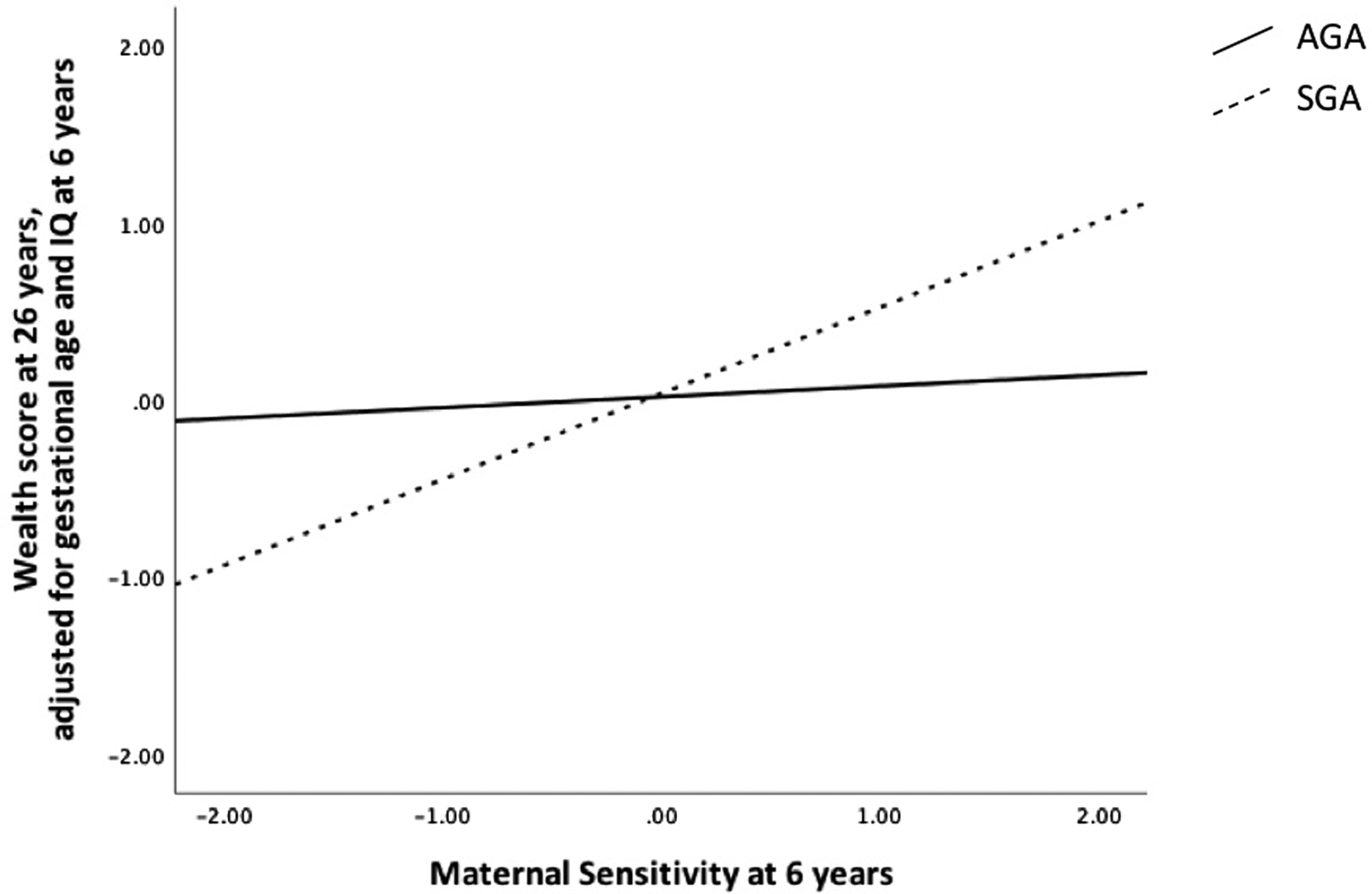
Differential susceptibility of SGA versus AGA children to sensitive parenting in childhood on adult wealth (N = 438).

Measures
Biological variables at birth
Gestational age was determined from maternal reports of the last menstrual period and serial ultrasounds during pregnancy. Birthweight was documented in the birth records. Infants were classified as SGA if they weighed less than the sex specific 10th percentile for their respective gestational age according to national standard weight charts (1985–1986) (Riegel, Ohrt, Wolke, & Österlund, Reference Riegel, Ohrt, Wolke and Österlund1995).
Maternal sensitivity
At age 6 years, maternal sensitivity was observed and rated during a structured dyadic cooperation task using a standardized coding system, the “Assessment of Mother-Child-Interaction with an Etch-a-Sketch” (Wolke, Rios, & Unzer, Reference Wolke, Rios and Unzer1995). Raters (psychologists) received extensive training, bimonthly feedback, and frequent refreshers. Rating scales consisted of three subscales for the mother (Verbal Control, Non-Verbal Control, and Criticism; all reverse-coded) and one subscale for mother-child joint behavior (Harmony) (Jaekel, Pluess, Belsky, & Wolke, Reference Jaekel, Pluess, Belsky and Wolke2015; Wolke et al., Reference Wolke, Jaekel, Hall and Baumann2013a). According to principal component and reliability analyses, they were combined into a comprehensive index of Maternal Sensitivity (Cronbach α = .58), reflecting a multidimensional construct that involves responsive, supportive, and prompt behaviors that are adapted to the child's needs. The Assessment of Mother-Child-Interaction with an Etch-a-Sketch coding system has established high inter-rater reliabilities (Jaekel et al., Reference Jaekel, Wolke and Chernova2012). The in vivo rated scores show excellent convergence with video-rated scores of Maternal Sensitivity (Wolke et al., Reference Wolke, Jaekel, Hall and Baumann2013a) (N = 565, intraclass correlation coefficient = .76, p < .001, for two master raters).
IQ
At age 6, children's intelligence was assessed with the German version of the Kaufman Assessment Battery for Children, Mental Processing Composite score (Melchers & Preuss, Reference Melchers and Preuss1991).
Adult wealth score
Wealth was a composite score derived from a life-course interview and questionnaires at 26 years of age, including information about participants’ financial independence, occupational stability, and qualifications. Example items that indicated poor economic success included “receiving social benefits,” “no secondary school or profession oriented educational qualifications,” and “unemployed at present or in the past” (see Appendix Table 1 for details). Items were binary coded and then summed into a comprehensive wealth index score. Scores were reverse coded for analysis (i.e., higher scores indicate higher wealth).
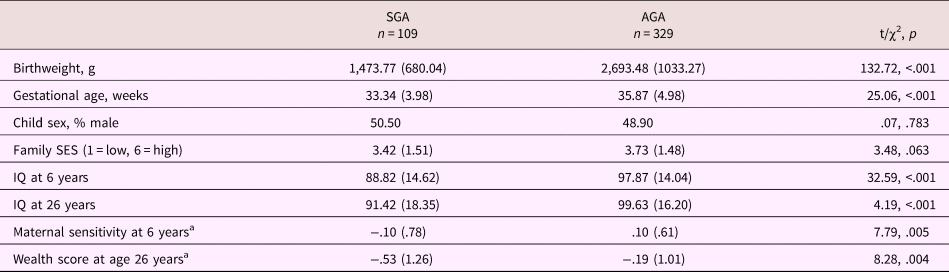
Bavarian Longitudinal Study adult participants’ descriptive characteristics according to SGA versus AGA birth (N = 438)

Note. Data are presented as mean (standard deviation) for interval scaled and percentages for categorical variables. SES = socioeconomic status.
az-standardized according to term-born participants’ scores.
Analytic approach
Analyses were conducted using SPSS 23 (SPSS Inc., Chicago, IL). Descriptive characteristics are reported according to SGA versus AGA birth status. Maternal sensitivity and adult wealth scores were z-standardized according to the term-born comparison participants in the sample. All reported regression slopes are unstandardized, but can be interpreted like betas based on z-standardized continuous scores; reported tests are two-tailed using α = .05. All models are controlled for gestational age and IQ at age 6. Exploratory regression models were used to identify the main effects for SGA birth and maternal sensitivity (Model 1). For Model 2, an interaction effect between SGA birth and maternal sensitivity was added. Confirmatory model testing was performed by fitting data to four different reparametrized regression models (Models 3A–D). This method systematically varies parameters to test how well DST versus diathesis stress explains the data (Widaman et al., Reference Widaman, Helm, Castro-Schilo, Pluess, Stallings and Belsky2012).
Both DST and diathesis stress models predict that a below average environment (i.e., low maternal sensitivity) will result in lower adult wealth for SGA adults compared with their AGA peers. DST predicts, however, that an above-average environment (i.e., high sensitivity) will result in significantly higher adult wealth for SGA compared with AGA adults who received similarly high levels of sensitivity in childhood. In contrast, diathesis stress predicts that an above-average environment will result in SGA adult wealth equal to AGA peers (i.e., catch-up). In addition, each theoretical model has a strong and a weak version: Strong DST (reparameterized regression Model 3A, respectively) and strong diathesis stress (Model 3C) predict that individuals born AGA are not affected by the environment (i.e., a regression line with a slope of 0). In contrast, weak DST (Model 3B) and weak diathesis stress (Model 3D) models predict that those born AGA are influenced by the environment but to a lesser degree than those born SGA. Finally, results of each model were compared to determine which model provides the best fit to the data.
Results
On average, SGA adults born at a lower gestational age and birthweight experienced lower maternal sensitivity, were more likely to suffer from cognitive impairment in childhood, and obtained lower adult wealth scores than AGA adults (Table 1).
Regression modeling confirmed that maternal sensitivity at age 6 predicted higher wealth at age 26 (B = .23, p = .002) for both AGA and SGA adults (Model 1). Adding the interaction effect between SGA birth and maternal sensitivity (Model 2) revealed that the positive effect of sensitivity on adult wealth was stronger among SGA compared with AGA adults (B = .44, p = .004).
Figure 1 depicts that adult wealth of individuals born AGA who experienced below average maternal sensitivity did not significantly differ from those born AGA who experienced above average maternal sensitivity. Individuals born SGA did worse than their AGA peers when experiencing below average maternal sensitivity, however, but did increasingly better than AGA peers when experiencing above average levels of maternal sensitivity.
Differential susceptibly versus diathesis stress model fitting
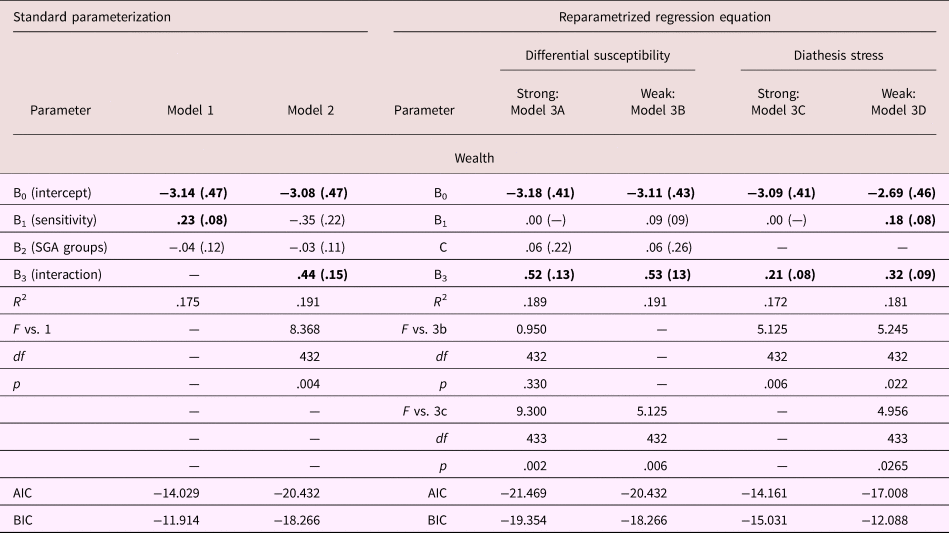
For Models 3A–D, data were fit to four reparametrized regression models to compare the fit of strong DST (Model 3A), weak DST (Model 3B), strong diathesis stress (Model 3C), and weak diathesis stress (Model 3D) in adults born SGA versus AGA. Model fit values indicated that DST (Models 3A and 3B) better fit the data than diathesis stress (Models 3C and 3D) (Table 2).
Results of alternate regression models for effect of maternal sensitivity at age 6 years on SGA versus AGA individual's wealth at 26 years (N = 438)

Note: Table values are parameter estimates with standard errors in parentheses. Significant parameter estimates are in boldface font. Effects are controlled for IQ (B = .020 to .021) and GA (B = .025 to .028) across Models 1–3d. All reported regression slopes are unstandardized, but can be interpreted like betas based on z-standardized continuous scores for maternal sensitivity and adult wealth. AIC = Akaike information criterion; BIC, Bayesian information criterion; df = degrees of freedom; F vs. 1 = F test of the difference in R 2 for Model 2 vs. Model 1; F vs. 3B = F test of the difference in R 2 for a given Model vs. Model 3B.
Although both DST models showed similar fit, the amount of variance explained by each model was not significantly different, thus suggesting that the more parsimonious DST strong model (Model 3A) had the best fit.
Discussion
This is the first study to show that individuals born SGA are more susceptible, not more vulnerable, to the long-term effects of sensitive parenting in childhood on wealth in adulthood compared with those born AGA. Confirmatory model testing showed that maternal sensitivity played a significant role in predicting the wealth outcomes of adults born SGA, whereas wealth of individuals born AGA was only minimally affected by parenting. SGA children who had received lower than average maternal sensitivity fared worse than AGA peers, but SGA children who had experienced higher than average maternal sensitivity attained higher wealth in adulthood than their AGA peers. These findings support the conclusion that individuals born SGA are highly susceptible, for better or worse, to environmental influences. In contrast, AGA-born individuals were little affected by the environmental influences tested here (i.e., maternal sensitivity at age 6 years).
Traditionally, SGA birth has been viewed as a vulnerability predisposing children to developmental difficulties. Indeed, just looking at the overall difference in wealth did show, on average, poorer outcomes for SGA compared with AGA adults. This is consistent with findings of cognitive and academic difficulties in childhood (Gutbrod et al., Reference Gutbrod, Wolke, Söhne, Ohrt and Riegel2000; Li et al., Reference Li, Eiden, Epstein, Shenassa, Xie and Wen2017) that may lead to lower educational attainment and adult wealth after SGA birth; however, others have found that SGA birth may not represent a risk factor for neurocognitive outcomes in adulthood (Eryigit Madzwamuse et al., Reference Eryigit Madzwamuse, Baumann, Jaekel, Bartmann and Wolke2015; Pyhala et al., Reference Pyhala, Lahti, Heinonen, Pesonen, Strang-Karlsson, Hovi and Raikkonen2011). According to the results presented here, these inconsistent findings may be explained by environmental variations within the SGA population. Because of SGA-born individuals’ heightened susceptibility to environmental influences, their long-term developmental trajectories are a complex product of early deficits, individual neurodevelopmental resources, and continued environmental influences. Understanding what environmental factors SGA individuals are susceptible to, over and above maternal sensitivity, will be an essential step in designing interventions that support life-course outcomes. Examples of potential environmental factors that may help SGA individuals to thrive include peer relationships, educational quality, and cognitive stimulation, but their protective effects in SGA children have not been investigated.
The current findings are consistent with the hypothesis that scarce intra-uterine conditions program those born SGA to be more adaptive to unstable postnatal environments (Pluess & Belsky, Reference Pluess and Belsky2011; van der Kooy-Hofland et al., Reference van der Kooy-Hofland, van der Kooy, Bus, van Ijzendoorn and Bonsel2012). Why may SGA birth, as a marker of IUGR, increase individuals’ ability to register and process stimuli (i.e., environmental sensitivity) (Pluess, Reference Pluess2015)? One may speculate that nature has created a mechanism that allows infants who experienced IUGR to respond and adapt to certain anticipated challenges and opportunities presented by their postnatal environments (Pluess et al., Reference Pluess, Assary, Lionetti, Lester, Krapohl, Aron and Aron2018). Such ontogenetic adaptation may be achieved, for instance, by small alterations of the complex interplay between central nervous system and endocrine system (i.e., the hypothalamic–pituitary–adrenal axis) (Windhorst et al., Reference Windhorst, Rippe, Mileva-Seitz, Verhulst, Jaddoe, Noppe and Bakermans-Kranenburg2017), ideally fine-tuning the organism's reaction to environmental cues (Ellis, Boyce, Belsky, Bakermans-Kranenburg, & van Ijzendoorn, Reference Ellis, Boyce, Belsky, Bakermans-Kranenburg and van Ijzendoorn2011; Pluess, Reference Pluess2015). Such prenatally programmed susceptibility/environmental sensitivity over time may then result in a stronger longitudinal effect of environmental conditions on susceptible individuals’ behavioral outcomes (Pluess, Reference Pluess2015; Pluess et al., Reference Pluess, Assary, Lionetti, Lester, Krapohl, Aron and Aron2018).
Thus, as predicted by DST, above average maternal sensitivity was positively associated with wealth among SGA born adults. When experiencing higher than average maternal sensitivity, those born SGA demonstrated higher adult wealth than their AGA adult peers. SGA children who experience highly sensitive parenting possibly thrive in later life because sensitive maternal behavior provides the support and scaffolding needed to avoid a trajectory of reduced life chances caused by the early neurodevelopmental risks associated with SGA birth. Although high maternal sensitivity works to improve life-course outcomes for those born with a neonatal risk, below average maternal sensitivity is detrimental to outcomes of highly susceptible SGA born individuals. This heightened reactivity to positive exposures of highly susceptible individuals suggests that they may be more receptive to interventions (Bakermans-Kranenburg & van IJzendoorn, Reference Bakermans-Kranenburg and van IJzendoorn2015; Belsky & van Ijzendoorn, Reference Belsky and van Ijzendoorn2015, Reference Belsky and van IJzendoorn2017; Lionetti et al., Reference Lionetti, Aron, Aron, Burns, Jagiellowicz and Pluess2018). The findings of this study point toward new strategies to identify target groups that may benefit most from childhood interventions that help support sensitive parenting of school-aged children born SGA (Jaekel, Reference Jaekel2016; McCormick, Reference McCormick1997).
Strengths and limitations
Previous studies have supported DST among SGA children born at term (van der Kooy-Hofland et al., Reference van der Kooy-Hofland, van der Kooy, Bus, van Ijzendoorn and Bonsel2012; Windhorst et al., Reference Windhorst, Rippe, Mileva-Seitz, Verhulst, Jaddoe, Noppe and Bakermans-Kranenburg2017), but DST has not been supported among other neonatal at-risk groups (Jaekel et al., Reference Jaekel, Pluess, Belsky and Wolke2015). The severity of neurodevelopmental risk and subsequent medical complications associated with very low birthweight and preterm birth might overpower the conflicting effect of potentially increased susceptibility, making it difficult to confirm high susceptibility among SGA children born preterm (Li et al., Reference Li, Eiden, Epstein, Shenassa, Xie and Wen2017). Those born SGA do not per se experience the same severity of cognitive impairments as other neonatal at-risk groups (Gutbrod et al., Reference Gutbrod, Wolke, Söhne, Ohrt and Riegel2000; Shah & Kingdom, Reference Shah and Kingdom2011) that may overshadow high susceptibility and limit developmental plasticity. Although 78% of the SGA individuals in our sample were also born preterm, we controlled our analyses for gestation and childhood IQ, thereby disentangling susceptibility across the full gestational range of SGA-born participants and conflicting cognitive deficits associated with preterm birth.
Those lost to follow-up did not differ from adult participants with regard to the rate of SGA birth, sex, and neonatal risk, however, as reported in most other longitudinal studies, low socioeconomic status families were less likely to continue participation studies (Hille, Elbertse, Gravenhorst, Brand, & Verloove-Vanhorick, Reference Hille, Elbertse, Gravenhorst, Brand and Verloove-Vanhorick2005). Our study used quality assessments such as our maternal sensitivity assessment, a reliable comprehensive observational measure with an excellent intraclass correlation coefficient, and a comprehensive composite wealth score at age 26. Nevertheless, maternal sensitivity was observed postinfancy, and despite its well-known long-term stability effects reported here, may differ from parenting assessed at earlier or later ages. Given significant changes in neonatal and obstetric care over the past three decades, there is room to wonder if our results are generalizable to neonatal at-risk children born today; however, so far there is little evidence that increased survival rates have led to higher quality of survival (Moore et al., Reference Moore, Hennessy, Myles, Johnson, Draper, Costeloe and Marlow2012; Pierrat et al., Reference Pierrat, Marchand-Martin, Arnaud, Kaminski, Resche-Rigon, Lebeaux and Ancel2017). Indeed, comparison of BLS findings with more recent cohorts have shown that the underlying processes and mechanisms do not differ as a function of time (Wolke et al., Reference Wolke, Strauss, Johnson, Gilmore, Marlow and Jaekel2015). This suggests that the findings presented here are valid; nevertheless, they require replication.
Conclusion
Individuals born SGA are more susceptible rather than vulnerable to sensitive parenting in childhood than their AGA peers. If maternal sensitivity was lower than average, SGA adults had lower wealth than their AGA-born peers, but when sensitive parenting was above average, they had higher wealth in young adulthood than those born AGA. Intrauterine malnourishment alters susceptibility to environmental experiences in a for-better-or-for-worse way. Interventions that can help increase parental sensitivity may be an important avenue aimed at improving life-long outcomes of children born SGA.
Supplementary material
To view the supplementary material for this article, please visit https://doi.org/10.1017/S0954579418001669
Acknowledgements
We are thankful to all current and former Bavarian Longitudinal Study Group members, pediatricians, psychologists and research nurses. Special thanks are extended to all study participants and their families.
Conflicts of interest
The authors declare no competing or potential conflicts of interest.
Financial support
This study was supported by grants from the German Federal Ministry of Education and Science (BMBF) PKE24, JUG14, 01EP9504 and 01ER0801. D. W. was supported by EU Horizon 2020 (733280; RECAP preterm). The contents of this article are solely the responsibility of the authors and do not necessarily represent official views of the BMBF or EU.