Introduction
This article explores a serendipitous research event—the collection of two unprompted versions of the same story, related by a mother and daughter in separate sociolinguistic interviews. Analysis of this data focuses on narrative construction of the (m)other, closely examining narrative content and the use of Appalachian grammatical features in order to highlight the ways in which content and grammar work together as a display of speaker stance. Though the stances enacted by each narrator reflect different ideas of what constitutes a “good” mother, both women's stories demonstrate that “mother” is other than “daughter.”
Theoretical background
We begin at the intersection of two parallel traditions in sociolinguistics. One tradition grew from the study of individual interactions and the microprocesses of language (c.f. Hymes Reference Hymes1964; Goffman Reference Goffman1974, Reference Goffman1981), the other from the quantitative study of the language use of a particular group or community—the macroprocesses of language (c.f. Labov Reference Labov1963; Weinreich, Labov, & Hertzog Reference Weinreich, Labov;, Herzog, Lehmann and Malkiel1968). These two traditions come together with the recent application of Agha's (Reference Agha2003, Reference Agha2005) theory of enregisterment to the sociolinguistic reality of dialect. Agha describes enregisterment as the “process through which a linguistic repetoire becomes differentiable within a language as a socially recognized register of forms” (2003:331), a recognition that reflects the “gradual sedimentation of habits of speech perception and production” of a particular group (2003:369). Johnstone, Andrus, & Danielson (2006) combine this idea with the process linked to Silverstein's (Reference Silverstein2003) orders of indexicality. This combination outlines a progression from sociolinguistic “fact” to social perceptions to the potential for social performance (performance made possible by perceptions of variants as “linked to” a particular place).
Johnstone and colleagues describe first-order indexicality as the “frequency of regional variants,” a frequency statistically correlated with speaker variables of region and social class, but unnoticed by the speakers themselves, because “everybody speaks that way” (2006:82). Second-order indexicality occurs when “speakers start to notice and attribute meaning to regional variants,” in other words, when speakers themselves note that certain features have local currency (2006:82). Finally, we have third-order indexicality, in which speakers, aware of second-order variation, use “regional forms… to perform local identity” (2006:83). It is through this process that the speech of a particular place or group becomes enregistered, a process pushed along by factors such as repetition (Kiesling Reference Kiesling and Jaffe2009) and commodification (Johnstone Reference Johnstone and Jaffe2009).
As a result of the enregisterment process, speakers are able to use linguistic features identified as “local” (or “group-associated”) to enact a particular stance. Du Bois (Reference Du Bois and Englebretson2007) defines stance as “a public act by a social actor, achieved dialogically through overt communicative means, of simultaneously evaluating objects, positioning subjects (the self and others), and aligning with other subjects with respect to any salient dimension of the sociocultural field” (163). Viewed in this manner, a dialect can be defined as a “set of stancetaking choices associated with places and/or associated social identities” (Johnstone Reference Johnstone and Jaffe2009:32). Stance becomes a means by which speakers create and signal their (dis)alignment with interlocutors and/or conversation content (Du Bois Reference Du Bois and Englebretson2007; Johnstone Reference Johnstone and Jaffe2009).
Keisling (2009) suggests that, over time, interactional stances become associated with a particular social group within a community and, once that association solidifies (in other words, once it reaches the level of second-order indexicality), individual speakers can use the language of that social group to enact a particular stance. Johnstone (Reference Johnstone and Jaffe2009:46) makes a similar point as she writes, “repeated stance-taking moves come together as a repeatable, locally noticeable style,” and this “style of stance comes to index not a social identity but a personal identity.” Thus, stance becomes a conduit through which speakers use the language variety(ies) at their disposal to create and express attitude and alignment, as well as to create and express personal identity, within an individual interaction. Personal style is thus an individual collection of stances and style-shifting a reflection of the multi-faceted “truth” of identity (Keisling Reference Kiesling and Jaffe2009:174).
Since the work of LePage & Tabouret-Keller (Reference Le Page and Tabouret-Keller1985) canonized the idea of language as an act of identity, sociolinguistic research has embraced the inclusion of identity as an important factor in language use, whether we see language as an indicator of group membership (Labov Reference Labov1972), a marker of social network membership (Milroy Reference Milroy1987) or as a means of styling (Coupland Reference Coupland2007). Throughout identity studies, it is understood that the self is discursive; it is co-constructed within individual interactions. As Haviland explains, the self “emerge[s] from a life of interlocution, mov[ing] through time as self-conceptions are constructed, ordered, reordered, contested, revised, pulled apart, and renewed during a person's lifetime” (Reference Haviland2005:82).
Again and again, we see examples of the performative nature of different aspects of identity (Butler Reference Butler and Nicholson1990; Thornborrow & Coates Reference Thornborrow and Coates2005). Butler (Reference Butler and Nicholson1990), for instance, presents gender as something that is “done” and “done again” with every interaction. Thus gender as an aspect of identity is not ever static, but is produced and reproduced as speakers perform an array of “masculinities” and “femininities” within everyday interactions.
Identity itself is now understood to be far from static; identity is the product of social and linguistic “work.” Bucholtz & Hall define identity as the “social positioning of self and other” (2005:586) and discuss identity as something that arises from interaction, thereby existing as an “emergent product” (2005:588). Thus, any discussion of language and identity must acknowledge the “multiplicity and interactivity” of identity work as well as the agency of the speakers who actively produce their identities (Kroskrity Reference Kroskrity2000:113).
Perhaps most keenly, we see the performance of different aspects of self through narrative (c.f. Bauman & Briggs Reference Bauman and Briggs1990). Coates, in her exploration of men, masculinity and storytelling, states:
Every aspect of story-telling contributes to our presentation of self: it is not only first-person accounts of our lives which do this. The characters we construct in our story-telling and their relationships with each other, our attitudes as narrators to the characters in our stories and their actions, the choices we use to animate characters in chunks of direct speech, all combine to express who we are. (Coates Reference Coates2003:7)
Coates' emphasis here on choices made in the “telling” of characters, relationships, and attitudes hints at the role that specific linguistic features can play in the construction of speaker stance. We also know that we don't do these things alone—the nature of conversation and the nature of the self is dialogic (Bahktin Reference Bakhtin, Holquist and Holquist1981). The things that we build in conversation—culture, gender, ethnicity, identity, morality—we build together.
The present study demonstrates the manner in which two women construct their identities as “mother” and as “other” through conversational narrative and the use of local dialect features. As such, this article addresses specifically the use of regional grammatical variables to enact speaker stances toward mothering, focusing on two women's independent recollections of a single incident and how these narratives dialogically construct the (m)other.
Constructing mother
As noted in Johnstone (Reference Johnstone1990, Reference Johnstone and Tannen1993), through storytelling people “create worlds in discourse, as they create selves, communities, and places” (1993:76). The present investigation extends the creative power of narrative to motherhood, focusing on the use of local linguistic resources to construct mother identities.
The social and linguistic resources available for the construction of “mother” are no less complex and varied than those used for the performance/construction of “feminine” or “masculine.” Mothers and motherhood are easy prey for media commentary and criticism due to the relentless repetition of the dominant discourse of motherhood in America: that mothers are (and should be) the primary parent and that playing the mother role is central, necessary, and all-consuming. Not only are women told that their goal is to be a “good” mother, they are also told (through various media outlets, including self-help books and parenting magazines) that, regardless of how they choose to mother, they are doing it wrong (for extensive discussion of motherhood in contemporary American society, in and out of the media, see Douglas & Michaels Reference Douglas and Michaels2004, Warner Reference Warner2005).
The upside of the contemporary scrutiny of mothering is that, in reality, there exists a multitude of mothering models available, ranging from “intensive mothering” models to “working mother” models to “childfree” models. For women who are mothers, the construction of the self as a “good” mother is accomplished, not just in day-to-day decisions about and interactions with children, but also through interactions with others. Mothers are thus made with words and deeds.
Holmes (Reference Holmes1997) looks at women constructing themselves as “good mother” and “good daughter” as one part of their construction of feminine identity. Henwood (Reference Henwood1993) discusses one aspect of motherhood discourse: mother-daughter closeness and how attitudes toward closeness change with age, as daughters pull away to gain independence and mothers feel that their identities as mothers are then threatened. This tension between independence and interdependence prefaces Henwood's exploration of the ideas of “good mother” as self-sacrificing and “bad mother” as possessive and dominant (1993:316). In looking at differences in mother-child talk in American and Samoan cultures, Ochs (Reference Ochs, Duranti and Goodwin1992) finds that white, middle-class American mothers de-emphasize the hierarchical distance between themselves and their children, while Samoan mothers exercise strict parental control in order to maintain their position. In each of these cases, the idea of “mother” arises from interaction, and the identities created—by mothers or for mothers—reflect different versions of a “good” (or “moral”) mother. The motherhood issues that are raised reflect concerns, not just of good or bad, but of closeness, dominance, and power.
Petraki, Baker, & Emmison (Reference Petraki, Baker;, Emmison, Bamberg, De Fina and Schiffrin2007) investigate the “moral identities produced in the intergenerational storytelling” of three women (grandmother, mother, daughter) in which “moral versions” (after Silverman Reference Silverman and Silverman1987; Baker & Keogh Reference Baker and Keogh1995) of “parent” and “child” are interactionally achieved. Within these interviews, the participants jointly produce “moral versions” of mother and daughter, coming to a general agreement on what constitutes a “good” mother and a “good” daughter. What Petraki and colleagues find is that these interview conversations construct “complementary versions” of mother and daughter that result in complementary pairs, such as teacher mother/receptive daughter, busy mother/helpful daughter, disciplining mother/obedient daughter, and courageous mother/admiring daughter (2007:117–19). These identities are emergent, negotiated “within the interaction and not necessarily as static attributes existing before the interaction” (2007:129).
The Petraki and colleagues interviews were framed specifically as a forum in which the women are asked to talk about their “experiences and relationships among each other” (2007:118) and, importantly, are given the opportunity to (or faced with the challenge of) building moral versions of themselves and each other while physically together.
The present data differs from that discussed above in a number of ways. First, the narratives under examination were obtained during individual interviews, and so the identities that are constructed are done so with me (the interviewer) as co-participant, not with each other. My conversations with these women were not framed as being about their relationships or their experiences as “mother” or “daughter.” Neither woman was asked specifically about the incident in question, and, to my knowledge, the incident had not been recently discussed. The stories that arose did so out of shared family ties. Perhaps because the mother and daughter stories were told separately, “complementary pairs” did not emerge, and what we see instead are conflicting versions of what constitutes a “moral” mother. For these women, during these conversations, the mother emerges as the “other,” as someone who is pointedly “not the daughter.”
An Appalachian backdrop
As Bucholtz & Hall (Reference Bucholtz and Hall2005) note, identity does not emerge from nowhere, but is instead crafted by speakers using the social and cultural discourses (and linguistic resources) available to them (2005:607). To that end, what follows is a brief outline of the Appalachian backdrop that frames the two speakers under investigation.
In 1999 and 2000, I conducted a number of sociolinguistic interviews with lifelong residents of Jefferson, a small town in the Blue Ridge mountains of western North Carolina. The interviewees were all members of my extended family (several were, as we calculated, fifth or sixth cousins) whom I asked to talk to me about our family and about the community of Jefferson. The present research focuses on the interviews I conducted with Ruth (my grandmother) and Linda (my aunt). All of the Jefferson speakers used features (phonological and grammatical) that one would classify as “Appalachian,” though they used these features to varying degrees. In a few of the interviews, the topic of language was discussed explicitly, with the interviewees noting differences between the speech of people from “off” and the “mountain” way of talking, the character of which, according to one of my Blue Ridge informants is “Elizabethan” in nature.
In his history of Appalachia, Williams (Reference Williams2002) suggests that, “Appalachia is both a real place and a territory of imagination, and social reality there lends credence to both aspects” (2002:398). This suggests that, as a near echo of our concept of the self, the notion of “place” is dually rooted, in reality as well as in the imagination. Much the same can be said of Appalachian English (AE); it is both a “real” language variety and a “territory of imagination.”
Since Wolfram & Christian's (Reference Wolfram and Christian1976) canonical work on AE, research has identified (approximately) thirty grammatical features and twenty phonological features associated with the variety, used to varying degrees and extents in different areas of Appalachia (c.f. Wolfram Reference Wolfram1988; Frazer Reference Frazer1990; Mallinson & Wolfram Reference Mallinson and Wolfram2002; Hazen & Fluharty Reference Hazen, Fluharty and Bender2004; Montgomery Reference Montgomery2004a, Reference Montgomery, Kortmann and Schneider2004b; Wolfram & Schilling-Estes Reference Wolfram and Schilling-Estes2006). The variation between speakers in different areas of Appalachia is great enough to suggest, as did Hazen & Fluharty (Reference Hazen, Fluharty and Bender2004), that this variety is more appropriately referred to as Appalachian Englishes, using this term in a manner parallel to that of World Englishes (Bhatt Reference Bhatt2001).
There can be no doubt that, on the whole, AE has undergone enregisterment, having reached third-order indexicality. Much like Johnstone (Reference Johnstone and Jaffe2009) found with Pittsburghese, there exist a plethora of publications, jokes, and commercial products that repeat, reflect, and recreate the existence of “mountain talk.” However, if we were to look at the Jefferson speakers by generation, we would find that the levels of indexicality correspond neatly to the three generations interviewed. The oldest generation (which, among my speakers, was age eighty and above) embodies first-order indexicality, as AE features go “unnoticed” by these speakers and appear in all manners of speech, including both narrative and nonnarrative passages. The middle generation (the children of the oldest generation) sits at second-order indexicality, as these speakers make overt comments about “mountain talk,” but still use AE features in both narrative and nonnarrative speech. The youngest generation (children of the middle generation) seemed conscious of how they used AE features, adopting what I call a community voice for performative purposes. These speakers were likely to employ a-prefixing and nonstandard past tense, for instance, only as part of storytelling (see Burkette Reference Burkette2007 for a discussion of AE grammatical features across three generations of speakers).
The present article examines two speakers' narratives and touches upon each woman's use of the four most frequent AE grammatical features present in the speech of the Jefferson interviewees: a-prefixing, nonstandard past tense, was-leveling, and multiple negation,Footnote 1 focusing specifically on one woman's use of a-prefixing as a stancetaking measure.
Speaker portraits
The two speakers examined here are a mother and daughter, Ruth (eighty-four years of age) and Linda (sixty-two), interviewed individually in their homes. As an interviewer, I enjoy the ultimate ethnographic vantage point; Ruth is my maternal grandmother and Linda my aunt. Most of my interview with Ruth was conducted on the living room floor, where we sat and sorted through a shoebox full of cards, newspaper clippings, and photographs. At one point, Ruth says, “If I didn't hate to, I would throw all these cards away but somebody might call me and say do you know what year so-and-so died,” a statement that hints at her role as a repository of community knowledge. Linda is Ruth's second-to-youngest child. She lives about two miles from her mother's house, talks to her several times a day, and visits once or twice a day. Often, Linda will bring Ruth some dinner, usually staying for a while to help open mail and to chat. As Linda is the only one of Ruth's children who lives in Jefferson, the responsibility of “looking after Mother” is often hers, which can lead to some mother-daughter tension, as we shall see in Linda's interview excerpts. Linda herself is both a mother and a grandmother; she has two grown children and one teenage granddaughter.
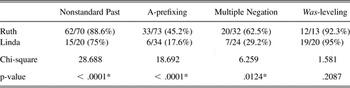
In the spirit of the Labovian-style search for correlations between speaker variables and linguistic ones, what follows is a brief, quantitative look at Linda and Ruth's use of the four, most frequent Jefferson grammatical features: nonstandard past tense, a-prefixing, multiple negation, and was-leveling. Table 1 contains the token/type counts and frequencies for these features for each woman, along with results of an intraspeaker comparison.
Ruth and Linda's use of four AE grammatical features.

*statistically significant
At a glance, it seems as though Ruth uses at least two of these features “more than” Linda does, and Chi-square tests confirm that Ruth's use of nonstandard past tense, a-prefixing, and multiple negation is statistically more frequent than that of Linda.
Table 2 addresses the differences within each woman's speech in terms of the distribution of AE grammatical features, between narrative and nonnarrative passages. This division seeks to discover whether the use of these community features is linked to some sort of storytelling style or performance associated specifically with narration. Chi-square tests show that neither woman's speech varies significantly between narrative and nonnarrative speech.
Ruth and Linda's use of four Jefferson features in narrative and nonnarrative passages.

Keisling (Reference Kiesling1998) demonstrates how the same linguistic variable can be used to enact different stances taken by different speakers, in other words, that the same linguistic feature can perform more than one function with an interaction. In the case of these two Jefferson speakers, we see the a-prefix being used in different ways by Ruth and Linda. For Ruth, a-prefixing is simply the way she talks. One can argue, being at the first order of indexicality, that a-prefixing functions simply as an indicator of community membership (Labov Reference Labov1972, Johnstone et al. Reference Johnstone, Andrus; and Danielson2006). For Linda, whose use of a-prefixing is much less frequent than her mother's (and whose use of the feature is not tied to any kind of narrative performance), this feature is most certainly being used to accomplish “social work” (Johnstone et al. Reference Johnstone, Andrus; and Danielson2006:82). This social work includes the construction of both herself and her mother as mothers and the stancetaking implicit in her evaluation of two different mothering styles.
The stories
“You're not going nowhere” is the story of the afternoon that Linda and one of her older sisters, Judy, attempt to go with dates to see “Horn in the West” (an outdoor drama that is still performed seasonally in Boone, NC). Coincidence (or serendipity) is the only explanation I have for the fact that both Ruth and Linda choose to relate this story during their interview conversations (which took place in the morning and afternoon of the same day). Let us look first at story content, noting strategic differences, speaker attitudes, and the “moral versions” of mother that each speaker creates.
Only the first twenty-eight lines of Ruth's version are included below, while Linda's, much shorter version is reproduced here in its entirety.
(1) Ruth's version of “You're not going nowhere”
1 they had planned
2 now the two boys had come
3 I don't remember Charlie
4 that he drank any
5 but the other boy that had the pickup
6 did
7 and I knowed I watn't going to let Judy and Linda go with them nowhere <quickly >
8 but they wanted to go [thunder] Horn in the West
9 you've heard tell of that
10 up towards Boone
11 and they wanted to go one night
12 and they come home from school
13 just excited to death .
14 see I didn't know anything about it
15 guess where we're going tonight <higher pitch>
16 and I said I have no idea.
17 they told
18 and who they's going with.
19 and I said did you tell them that you had to ask your mother
20 before you went?
21 no but we knowed you wouldn't care
22 and I said but I do <falling intonation>
23 and I wouldn't tell them the reason
24 on account of that ((and)) their drinking
25 I just said you all don't have no use a-going with them
26 you just wait'll you get older
27 and you'll know who to pick for your friends
28 and who not. <falling intonation>
The story continues for over 100 lines, detailing the girls' self-imposed exile in a hot, upstairs bedroom, their mortification upon hearing their mother turn the boys away at the door, and subsequent refusal to come down for dinner. Ruth concludes her narrative with the statement that she had caused her children to “think they've got the hatefullest mother” (line 122). Next is Linda's version, the first story in a narrative cycle centered on the theme of mother-daughter relationships.
(2) Linda's version of “You're not going nowhere”
1 but we started to see the Horn in the West
2 at Boone <mhm>
3 one time
4 we was uh
5 going out the road
6 and we hadn't asked to go
7 We was with Darl and Wade
8 she was with Wade Williams
9 and we met mother and daddy coming home
10 they was gone
11 so we met them out the road
12 and mother said
13 we met them and stopped
14 she said
15 ‘well where do you think you're a-going?’ <laughs>
16 and Judy said
17 ‘we're going to see Horn in the West’ <sing song>
18 you know
19 just so
20 like we're our own boss
21 and mother said
22 ‘you're not going nowhere’ <laughter>
23 she said
24 ‘you're going right back home’
25 so we went back home
26 and we've never seen Horn in the West
27 probably never will <laughs>
Mother as other
Both women's versions of this story position the mother as the other, the contrary force that curtails her daughter's attempt to go on a date with a boy (surely a universal teenage theme). However, by examining the plot variations that exist between the two versions—the details of who, where, and why—we see how each woman constructs the (m)other differently in terms of the underlying idea of “what a mother should be.” In short, the smaller, content-level variations reflect different stances toward motherhood and the “job” of the mother.
In Ruth's version of the story (example (1)), the complicating action hinges on her belief that the two boys have questionable reputations. Jefferson is located in a dry county, and many of its Southern Baptist residents believe that the consumption of alcohol is immoral; compound that belief with the dangers implicit in teen drinking (and driving), and you have the basis for Ruth's determination that her daughters would not be joining these young men on an outing (example (1), lines 3–5, 24). For Ruth, her responsibility as a parent is to protect her daughters until they are mature enough to “know who to pick” as friends (lines 27–28). In addition, as the mother, Ruth does not feel compelled to explain to her daughters why she will not let them go (line 23), exercising what can be though of as a “because I said so” explanation. In Ruth's version, the girls do not make it out of the house; though they have made plans without asking permission (lines 19–20), they are never out from under the protection (and control) of their mother. Ruth faces her daughters' would-be dates at the door and allows the girls to pout upstairs in an uncomfortably hot room (line 36). When the girls' father comes home, sees what is going on, and expresses concern that the girls might get hungry (lines 124–26), Ruth states that she tells him, “when they get hungry enough, they'll come down.” All of these factors work together to construct a “moral version” of a mother who, in order to do her “job” as a mother, protects her children without mitigation, explanation, or apology. In contrast to other cultural versions of “mother” that are available (e.g. patient teacher, nurturer, friend), Ruth enacts a stance of mother that is deliberately “other,” allowing her daughters to distance themselves from her emotionally and physically (i.e. allowing them to believe she is being “hateful”), in order to protect them.
In Linda's narrative (example (2)), the conflict stems from the girls' attempt at self-assertion (line 20) rather than who they were going with, which implies that their mother's declaration that they are “not going nowhere” is a direct counter to their belief that they were their “own boss.” This idea is furthered by a major discrepancy between the two versions of the story. In Linda's version, the girls' dates are “Darl” and “Wade,” not “Charlie” and the “other boy that had the pickup” (the one with the reputation for drinking). As it happens (and as Linda is fully aware that I know), Darl and Wade are the girls' future husbands, a fact that dilutes the potential threat and makes their mother's objections seem unreasonable; Ruth is thus portrayed as being needlessly strict. In Linda's version, the girls achieve a bit more autonomy; they make it out to the road with the boys before being “caught” by their parents (line 1, 4–5). In addition, Linda's version creates a mother with less-than-absolute power as it is not her sole authority that ends the girls' excursion: “we met mother and daddy coming home” (emphasis mine, line 9). The girls' father is silent but apparently acquiescent; their mother exercises parental authority, but the father is right there beside her as backup.
Linda's content-based construction of a “moral mother” is dually fashioned, both through narrative passages such as her version of “You're not going nowhere,” and through discussion portions of the interview conversation.Footnote 2 Examples of the latter include Linda's depictions of her relationship with her own daughter, about which she states, “I mean, we really joke and we tell each other everything.” A moral mother is a friend and confidant to her daughter. Linda also talks about her granddaughter (who was fourteen at the time) and her “new boyfriend,” stating that the two would often go to see a movie together or “go to church or something,” explaining that “yeah, she's old enough for that” and adding, “you have to turn loose sometime.” A moral mother is one that understands the importance of giving her children freedom. This “girlfriend” model of mothering stands in stark contrast to the mother depicted in her version of the “You're not going nowhere” story. Within the story, Linda also portrays her mother as the “other,” a person not like her self. Unlike the (m)other constructed by Ruth (who distances herself because, to her, that is what a mother has to do in order to protect her children), Linda's constructs a (m)other to stand in contrast with her own mothering persona.
The content-based enactment of Linda's stance toward (m)othering is echoed by her use of the AE grammatical variable of a-prefixing.
A-prefixing in context
Though distance between parent and child is at the heart of each “Nowhere” rendering, Ruth and Linda display cohesiveness on the language front: the linguistic features a-prefixing and multiple negation appear in both versions at pivotal moments as part of Ruth's reaction to her daughters' attempted excursion (Linda's version, example (2), lines 15, 22; Ruth's version, example (1), lines 25, 81). This moment of synchronicity seems to indicate that, at least for Linda (whose use of these features is statistically less frequent than that of her mother), these features are performing a stancetaking function. Linda uses an a-prefix only six times (compare this with Ruth's thirty-three instances of the same feature) and multiple negation appears seven times (versus twenty times in Ruth's speech). Because a-prefixing, as a feature associated with Appalachian English, carries second-order indexicality and can be said to index specifically the traditions and values of the older generations, Linda can use it for stancetaking and to further characterize her mother as “old-fashioned.”
Looking closely at Linda's version of the “Nowhere” story (example (2)), we see that she uses a-prefixing just one time, in speech attributed to her mother: “well where do you think you're a-going?” (line 15). This statement announces the onset of the narrative's complicating action, the showdown between mother and daughters, and evokes a “classic” parental register (compare “where are you going?” with “where do you think you're going?”). In addition, Linda uses a double negative once in this narrative, also in speech attributed to her mother, spoken as the story's climax: “you're not going nowhere” (line 22). Both of these lines of attributed speech are followed by laughter from Linda herself, which serves to offset the seriousness of the situation being described. Linda's use of these particular features in speech attributed to her mother does more than add “color” or “immediacy” to her story; it allows her to enact a stance toward her mother that expresses disalignment and evaluates her mother as “strict and old-fashioned,” in contrast to her own, more modern and “sensitive” approach to mothering.
The presence of these features within this story as attributed speech (and the absence of them otherwise) accomplishes a couple of things. First, it underscores a difference of orientation (to “tradition” versus to “change”) between Linda-as-storyteller and her mother. Second, these features allow Linda to say something about her mother without being overtly critical. Why avoid overt criticism? This is one of those instances where the dialogic nature of interview conversation becomes especially apparent. What Linda constructs must be constructed with my help and she knew she wouldn't be able to count on me, as Ruth's granddaughter, to participate in direct criticism. Thus, Linda would be motivated to avoid direct criticisms of Ruth because I was her interlocutor and because the whole conversation is being tape-recorded. A close look at the other occurrences of these features provides further evidence for Linda's use of a-prefixing features as a means of stancetaking and points toward the use of multiple negation as having its own purpose as well. First of all, Linda does use the a-prefix in what tends to be its stereotypical genre, as part of storytelling style. In example (3), we see the a-prefix as part of a narrative passage.
(3) “Sheet rock”
1 And one night upstairs
2 we was up there as usual
3 acting
4 doing things we shouldn't
5 and Judy says
6 you believe I can stand up on the wall
7 and I says no I don't,
8 she says
9 well watch me
10 so she takes off
11 and runs and jumps
12 up on the wall
13 and bursts the sheet rock.
14 a hole.
15 just the print of her went through
16 it was a-swinging too
17 you know
18 and you talking about scared
19 Mother liketa have had a fit
20 and Daddy didn't say not one word
21 “well I can fix that back”
22 but it was the print of her a-swinging
The brief narrative in (3) demonstrates what I call the “classic” use of the a-prefix, which in this context seems to function as an intensifier (Feagin Reference Feagin1979) and/or as a stylistic marker associated with storytelling (Wolfram Reference Wolfram1976, Reference Wolfram and Labov1980, Reference Wolfram1988; Feagin Reference Feagin1979). This classic interpretation is supported by the fact that “a-swinging” is repeated for dramatic effect and because the actual linguistic repetition underscores the semantic content of the verb to which the prefix is attached. This story continues Linda's content-based stancetaking, as it highlights a difference in temperment between Mother and Daddy—the former almost has “a fit” while the latter “didn't say not one word” (meaning that he didn't say anything negative) and in fact makes only a positive statement about being able to fix the hole in the wall.
Example (4) is also a narrative passage, one that Linda prefaces by saying to me, “you're not going to let mother hear this” (both a statement and a request). This excerpt is also from a mother vs. daughter narrative, and, though this is example is more immediate, it still enacts a modern stance for Linda, while positioning Ruth as old-fashioned and unreasonable.
(4) “Too old to wear shorts”
1 I went out there
2 and wore shorts
3 and she does not want me to wear shorts
4 for some reason
5 and I never
6 I don't
7 well she says
8 I'm too old to wear shorts
9 but I wear them here
10 but I don't go out in town
11 because she gets so mad
12 but I went out there
13 and this has been about two or three weeks ago
14 and I-
15 we was walking
16 and I thought
17 well I'll wear shorts
18 boy when I went in
19 she looked at me
20 and she says
21 “well what are you wearing shorts for ?”
22 and I said because it's so hot <rising intonation>
23 “well I don't want to see you a-wearing shorts out in public.
24 you surely didn't walk down the road in them”
25 I said
26 “yeah mother
27 it's so hot
28 I walked with shorts on”.
29 boy she didn't like it at all
The more recent conflict in example (4) centers on the fact that Linda wears shorts to walk to her mother's house even though she knows her mother thinks she is “too old to wear shorts.” Just as she did in “You're not going nowhere,” Linda relates her mother's admonition as attributed speech and that admonition contains an a-prefix, and, as before, an a-prefix occurs as the storyteller reports nonnarrative speech. Does the a-prefix, then, tell us about Linda (this is where she would use an a-prefix) or about Ruth (this is where Linda would hear an a-prefix)? Given the fact that Linda infrequently employs the a-prefix and that two of the six appearances of this feature in her speech occur in speech attributed to Ruth, it seems possible that Linda is using this feature to reference a generational identity. Further support for this suggestion is evident in Linda's remaining uses of the a-prefix.
For Linda, it is not only narrative passages that employ the a-prefix as stancetaking device; what follows in examples (5) and (6) are two occurrences of the a-prefix in Linda's speech that appear in nonnarrative passages. In both examples, Linda is once again talking about her mother.
(5)
1 Yeah
2 now Mother
3 she had a temper
4 and still has a temper
5 but . uh
6 She wasn't mean to us
7 But she was very strict
8 and she meant
9 I mean
10 she meant what she said
11 for instance
12 if we went out on a date
13 she said eleven o'clock
14 if we was five minutes late
15 she's a-standing at the door
16 waiting on us
(6) but she is always a-getting on me for something
The two nonnarrative utterances that specifically describe her mother's “strict” behavior both contain the a-prefixed verb forms. Both curfew enforcement (example (5)) and parental critique (example (6)) are thus positioned as old-fashioned. Example (7) contains the first occurrence of a-prefixing in Linda's interview data. This is also a family narrative, but this time the antagonist is Linda's brother, Billy, who is eight years her senior. Linda is telling a story about how she accidentally winds up in the back seat of a car that is parked in front of a “beer joint,” a place where she, as a high school student and a Southern Baptist, is definitely not supposed to be.
(7) “Out on the mountain”
1 so we got down here
2 and he goes out on the mountain
3 where the beer joint is
4 and they go in
5 and I was sitting in the back seat
6 scared to death
7 afraid somebody'd see me
8 and tell on me .
9 well .
10 in just a few minutes
11 Billy come out
12 he was in there
13 he come out
14 and stuck his head in the car
15 and said
16 “what are you a-doing out here”
17 I said
18 “I'm not doing nothing .
19 I'm waiting on them .
20 I's supposed to go home” . <laughs>
21 boy when he got home
22 he started saying
23 “if you don't do what I tell you
24 I'm going to tell Mother
25 where you was at”
The remainder of the story details the brother's demands over the next week until Linda “got tired of it” and tells her mother what happened. In this context, the brother's comment, “What are you a-doing here,” is threatening, and specifically, the a-prefixed statement threatens to tell “Mother.” In addition, that Billy is exiting the beer joint is not an issue—he can assume this position of relative authority because, as a young man in his twenties, Billy would not have faced the same social (or familial) disapprobation as his sister. Thus there exists a conflict of ideologies (what's acceptable for young women versus what's acceptable for young men), similar to that which follows within the mother-daughter stories. This initial use of a-prefixing sets up its subsequent use as a way to characterize someone else as “other.” Within our developing interview conversation, the a-prefix emerges as a way to enact a stance that involves ideological conflict.
Conclusion
In his classic Martha's Vineyard study, Labov (Reference Labov1963) describes the intergenerational social system that creates the means by which younger speakers can use specific linguistic features to create for themselves a Vineyard identity. The vowel centralization works as a linguistic symbol of Vineyard-ness because it was perceived by the younger speakers as typical of “old-timer” speech.
For younger members of the English descent group… the old timers and up-islanders in particular serve as a reference group. They recognize that the Chilmark fishermen are independent, skillful with many kinds of tools and equipment, quick-spoken, courageous and physically strong. Most importantly, they carry with them the ever-present conviction that the island belongs to them. If someone intends to stay on the island, this model will be ever present to his mind. If he intends to leave, he will adopt a mainland reference group, and the influence of the old timers will be considerably less. The differential effect in the degree of centralization used is a direct result of the opposition of values. (Labov Reference Labov1963:305)
The centralized vowels that are characteristic of the older residents' speech become associated with these values and are adopted by younger speakers wishing to overtly identify themselves as traditional-minded Vineyarders. Here we see the process by which linguistic features move through the orders of indexicality, or, in Labov's terms, from indicator to marker to stereotype (Labov Reference Labov1972).
The process described by Labov is the same process that Linda exploits in order to accomplish an indirect criticism of her mother. Not only do we see stancetaking accomplished through the manipulation of narrative content, but we also see an echo of that stance within her use of the a-prefix. Much like the younger Vineyarders, Linda and other Jefferson speakers have the oldest generation present as a linguistic “model,” which, for the most part, creates positive and community-oriented associations for the use of Appalachian linguistic features. Linda's use of a-prefixing demonstrates the complexity of this situation with her use of one feature to accomplish something generally held as “negative” (the criticism of an elder), something that she wouldn't be able to do unless there already existed a system that equates the a-prefix with older speakers who are understood to be “traditional” or “old-fashioned.”
The words dialogue and dialect share an etymological beginning, the Greek διαλέγεσθαι, composed of δια-, meaning “through, across” and λέγειν “to speak.” The historical connection of ‘dialect’ and ‘dialogue’ reminds us that there is a relationship between what is communicated by the language that moves across interlocutors as well as through the medium of a particular language variety. Grammar and content can work together as speakers express opinions, construct selves, and enact stances. Through content and grammar, we see the (m)other that is constructed in each version of the story stand apart from her daughters. We see how each storyteller uses her version of the “Nowhere” incident to create, define, and evaluate the positioning of mother as “other.” In the end, we have two lessons on motherhood and two suggestions as to what constitutes a good/moral mother: mother as a “strict protector” or as a “lenient friend”—versions of mother that merge both through and across language.