Introduction
Our understanding of language lateralization in the brain has evolved significantly over recent decades. Traditionally, it has been assumed that the left hemisphere (LH) is the main brain mechanism for language comprehension and production. However, in recent years, evidence has been accumulated suggesting that the right hemisphere (RH) has a unique contribution to the performance of complex semantic tasks, such as discourse comprehension and creative use of language (Beeman & Chiarello, Reference Beeman and Chiarello1998; Kahlaoui, Scherer & Joanette, Reference Kahlaoui, Scherer and Joanette2008; Lindell, Reference Lindell2006; Mitchell & Crow, Reference Mitchell and Crow2005). Consequently, numerous conceptualization efforts have been made in order to account for the asymmetric lateralization of language processing in the brain (for review, see Dien, Reference Dien2008).
Jung-Beeman (Reference Jung-Beeman2005) has suggested the BAIS (Bilateral Activation, Integration and Selection) model as a comprehensive theoretical framework for the recent findings on the hemispheric asymmetry in semantic processing. According to this model, bilateral semantic processes of activation, integration and selection interact in order to process language. These processes occur in qualitatively different ways in each hemisphere: while semantic activation in the LH is fine in its nature, i.e., rapidly focuses on dominant features which are tightly linked to the input, semantic activation in the RH is coarser, i.e., more diffused, and thus entails weak activation of multiple concepts remotely associated to the input. In the following semantic processing stages, integration and selection, these asymmetries are elaborated. The RH coarse semantic processing patterns are efficient for natural language comprehension, verbal creativity and similar high-order skills that require the comprehender to integrate distant and initially irrelevant information. Thus, according to Jung-Beeman, increased activity in the RH in higher-level linguistic tasks, such as inference drawing, metaphor and humor comprehension, as well as message-level comprehension tasks (deriving themes, generating optimal sentence endings, determining narrative sequence and inconsistencies) reflects the coarse semantic coding patterns (Jung-Beeman, Reference Jung-Beeman2005; on the notion of coarse and fine semantic coding, see also Beeman, Reference Beeman1998; Beeman, Friedman, Grafman, Perez, Diamond & Lindsay, Reference Beeman, Friedman, Grafman, Perez, Diamond and Lindsay1994).
Peleg and Eviatar (Reference Peleg and Eviatar2009) suggest a different account of the hemispheric lateralization in semantic processing. In their model for lateralization of reading, they attribute the differences in semantic lateralization to differences in functional architecture. Unlike semantic processing that is performed by both hemispheres, phonological and orthographical processing is considered to involve LH processing almost exclusively (Cohen, Dehaene, Naccache, Lehéricy, Dehaene-Lambertz, Hénaff & Michel, Reference Cohen, Dehaene, Naccache, Lehéricy, Dehaene-Lambertz, Hénaff and Michel2000; Vigneau, Beaucousin, Hervé, Jobard, Petit, Crivello, Mellet, Zago, Mazoyer & Tzourio-Mazoyer, Reference Vigneau, Beaucousin, Hervé, Jobard, Petit, Crivello, Mellet, Zago, Mazoyer and Tzourio-Mazoyer2011). Hence, claim the authors, in the LH there is interconnectivity between orthographic, semantic and phonologic mechanisms. Therefore, according to this account, in the LH, phonology and orthography mediate semantic processing, leading to fast and efficient activation of salient meanings. In the RH, where phonology and orthography are not interconnected, phonological information is less available at first, thus semantic activation is less focused, which results in the activation of less salient meanings and their retention over a longer period of time. According to this account, RH processing was found valuable when context demands use of less salient meanings (Peleg & Eviatar, Reference Peleg and Eviatar2008, Reference Peleg and Eviatar2009; Peleg, Manevitz, Hazan & Eviatar, Reference Peleg, Manevitz, Hazan and Eviatar2010).
Creative thinking is one of the longest studied abilities that is grounded in right hemisphere lateralized processes (e.g., Poreh & Whitman, Reference Poreh and Whitman1991; Torrance, Reference Torrance1982). Indeed, both of the models described above could account for the underlying mechanisms of the RH contribution to verbal creative thinking. Using the BAIS model's terms, creative thinking is grounded in the activation of widespread meanings, followed by the integration of distant activated concepts (Bowden, Jung-Beeman, Fleck & Kounios, Reference Bowden, Jung-Beeman, Fleck and Kounios2005; Jung-Beeman, Reference Jung-Beeman2005). The functional architecture account would argue that semantic processes in the RH are not biased initially to dominant solutions by phonologic and contextual information, allowing non-dominant solutions to be activated and retained in the RH (Peleg & Eviatar, Reference Peleg and Eviatar2009).
In recent years, verbal insight problem solving has been used as a popular task to evaluate the RH semantic processing contribution to verbal creativity (for review, see Bowden & Jung-Beeman, Reference Bowden and Jung-Beeman2007). Interestingly, this task integrates semantic and non-semantic processes related to creativity and problem solving (Bowden et al., Reference Bowden, Jung-Beeman, Fleck and Kounios2005), similar to real-life use of high-level linguistic processes, where semantic processes are integrated in complicated tasks and are not isolated.
To test insight problem solving, Bowden and Jung-Beeman (Reference Beeman1998, Reference Bowden and Jung-Beeman2003a, Bowden and Jung Reference Bowden and Jung-Beeman2007) have developed the Compound Remote Associates (CRA) set of problems, where each item consists of three prime words, each joins the target word to form a compound word or a two-word phrase (e.g., age/mile/sand form the compounds stone-age, milestone, and sandstone with the solution word stone). To solve these problems, participants are required to activate many meanings and phrases related to all three prime words, integrate the activated meanings and select only one solution word of all the activated concepts. Numerous studies have shown that when participants are trying to solve the problem, they are able to recognize the solution faster when it is projected to the right hemisphere using the divided visual field (DVF) paradigm, implying dominant involvement of the RH in the semantic aspects of this task (Bowden & Jung-Beeman, Reference Bowden and Jung-Beeman1998; Jung-Beeman & Bowden, Reference Jung-Beeman and Bowden2000). The essential involvement of the RH in this task was further confirmed by imaging studies (Jung-Beeman, Bowden, Haberman, Frymiare, Arambel-Liu, Greenblatt, Reber & Counios, Reference Jung-Beeman, Bowden, Haberman, Frymiare, Arambel-Liu, Greenblatt, Reber and Counios2004). These findings are in line with the predictions of both models discussed.
In Hebrew, this task demands an additional set of linguistic operations. Two-word phrases in Hebrew may differ from the single words composing them phonologically and orthographically (e.g., meticha “lift” and panim “face” form the phrase metichat-panim “facelift” by adding the suffix -t to the first word). Consequently, when solving CRA-like problems in Hebrew, additional linguistic processes are required. In particular, performing this task in Hebrew may require interaction between phonological and semantic processes. The demand for phonological and orthographic manipulations do not alter the predictions of BAIS model on the results of this task in Hebrew, i.e., that remote solution-related meanings will be integrated in the RH, leading to faster recognition of the solution when presented to the RH. However, the functional architecture model suggests that in this case, the left hemisphere could have an advantage, due to the interconnectivity of orthographic, phonological and semantic processes.
In order to evaluate semantic processes lateralization in complicated tasks where they are not isolated from non-semantic elements, we have developed a CRA version in Hebrew. RH advantage was measured as a comparison of response latencies to target words presented to the left and right visual fields, using the divided visual field paradigm, in a similar procedure to the one used in English (Bowden & Jung-Beeman, Reference Bowden and Jung-Beeman1998; Jung-Beeman & Bowden, Reference Jung-Beeman and Bowden2000). According to the traditional procedure, the comparison between the visual field conditions was done separately for target words that were the correct solution for the problem (“hit” responses, i.e., correct identification of the solution word) and target words that were distractors (“correct rejections”, i.e., correct identification of the word as a distractor). We tested two alternative predictions. First, we predicted RH response time advantage for both hits and correct rejections, as observed in English, indicating that the solution relevant information is being processed primarily by the RH, as derived from the BAIS model. Alternatively, we predicted a LH response time advantage for both response types, due to the interhemispheric interaction between semantic and phonologic/orthographic processing required by the task in Hebrew, thus indicating an advantage to activating the solution relevant information in the LH, as derived from Peleg and Eviatar's functional architecture model (Peleg & Eviatar, Reference Peleg and Eviatar2009).
Experiment 1
Methods
Participants
Fifty-six students (24 males) participated in the first experiment, voluntarily or for class credit (mean age: 25.13). All subjects were right handed, as assessed by the Edinburgh inventory (Oldfield, Reference Oldfield1971), native Hebrew speakers, with no diagnosed attention or learning disabilities.
Materials
A Hebrew version of the CRA including 176 problems was developed. The content of the Hebrew set was started from scratch, as these problems are language-specific and highly depend on phrases available in each language. Nonetheless, the items were structured following the original English set: each problem contained three prime words, and a solution word that joins each of the prime words to create a familiar phrase (Bowden & Jung-Beeman, Reference Bowden and Jung-Beeman2003a). Target length ranged between two and seven characters (M = 3.78, SD = 1.02). For each problem, an unrelated distractor word, equal in length to the solution word, was matched.
Due to the attributes of Hebrew phonology and orthography, the Hebrew items had unique additions compared to the English version. About half of the items (53.41%) included at least one phrase that was different from the single words composing it phonologically and orthographically (e.g., metichat panim “facelift” compared to the prime meticha “lift” and target panim “face”. Additionally, over two-thirds of the items included at least one homograph. Due to Hebrew deep orthography, without diacritic marks, many graphemes can be converted to phonemes in more than one way, thus many words might be considered as heterophonic homographs, that are ambiguous phonologically and semantically (e.g., the word gezer “carrot” could be read as gazar “cut” without punctuation). Therefore, Hebrew punctuation was used at least once in 67.61% of the items to disambiguate heterophonic homographs.
Normative data was collected on each item. Target and distractor frequency were gathered from a Hebrew word frequency corpus (Frost & Plaut, Reference Frost and Plaut2005). Target and distractor concreteness ratings were obtained in part from a Hebrew words norm database (Drori & Henik, Reference Drori, Henik, Henik, Rubinsten and Anaki2005). The procedure used to create the database was replicated to obtain norms on an additional 111 words that are not included in the database (n = 30). The rating task included an additional 38 words that were already rated on the norm study. The mean ratings by our subjects for these words, and norm ratings gathered by Drori and Henik (Reference Drori, Henik, Henik, Rubinsten and Anaki2005) were highly correlated, r = .94, p < .001.Phrases familiarity was also evaluated in a pre-test (n = 41), such that each phrase (composed of a single prime word and target) was rated by 13 participants on a seven-point familiarity scale.
In order to avoid long experimental sessions, the 176 problems were divided into two lists, each containing 88 problems. Some of the prime words appeared more than once, yet target words were never repeated on the same list, neither as primes nor as targets (correct solutions or distractors). From each list, four versions were composed, so that each problem would appear on each list once in a different condition (visual field (right/left) × response outcome (hits/correct rejections)). Each version was divided into four blocks, each block containing equal number of problems in each condition. The blocks did not differ in terms of target word length, F < 1.
Design and procedure
The design was 2 × 2, with visual field (VF; left VF (lvf), right VF (rvf)) and response outcome (hits/correct rejections) manipulated as within subjects factors. The subjects were randomly assigned to the eight stimuli versions (four versions for each of the two lists, 28 subjects to each list).
The task and procedure replicated the previous studies with the English CRA version (Bowden & Jung-Beeman, Reference Bowden and Jung-Beeman2007). The participants were comfortably seated in a quiet room, with a chin rest fixating their gaze at a distance of 50 cm from the screen. The screen sampling rate was 75 Hz. The stimulus display was controlled by E-prime 1.1 software (Psychology Software Tools, Inc., PA, USA). The participants were presented with short instructions on the screen, followed by six practice trials in which they received feedback on their response. Following a short debrief, the experiment began. The experiment included four blocks with 22 trials each. The blocks were presented in a random order, with a 30 seconds intermission between blocks.
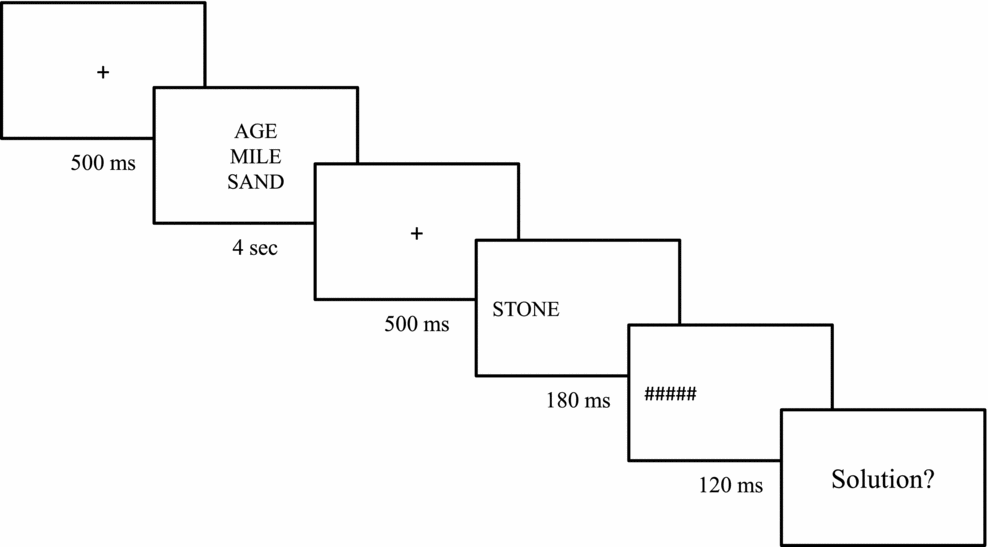
Each trial began with a central fixation cross, presented for 500 ms (see the experiment timeline in Figure 1). The three prime words were then presented simultaneously, above, at and below the center of the screen. The words remained on the screen for four seconds, which served as a time limit for early solution. During this time limit, the participants were asked to solve the problem. After a solution was indicated by a button press, or the time limit was exceeded, a fixation cross re-appeared for an additional 500 ms, followed by a brief flash of the target word to either the right or the left visual field (with equal proportions on each block). The target word appeared 4° from fixation for 180 ms, and was followed by a mask – an equal length string of number signs (#), appearing for 120 ms. Then the word “Solution?” appeared on the screen, and the participants were instructed to indicate by a button press whether the target word was the correct solution of the problem, or not. On one half of the trials, the target was the correct solution word, and on the other half – an unrelated distractor. The response was made by pressing a key with the index finger of either the left or right hand. Response hands were counter balanced across subjects, so that half of the participants indicated the correct solution by pressing the “m” key with their right index finger, and a distractor with their left index finger on “x”, and vice versa.
Sequence and timing of events within each trial.

Results
The data from one subject was excluded from the analyses since her accuracy rates were over 2.5 SDs below the average. Therefore, 55 subjects were included in the analyses. On average, subjects responded correctly to the target word on 79.50% of the trials (SD = 6.96). There was no effect of response hand on accuracy rates, F < 1, so response mode was ignored for the remaining analyses. In addition, results from all subjects, of both lists of stimuli, were analyzed together as no differences were found in performance between the two lists.
The subjects were able to solve on average 15.48% (SD = 9.99) of the problems within the four seconds time limit, as indicated by a button press during the duration of prime words presentation. This early solution rate fits the performance observed inthe English version of the CRA (higher than a 7.8% early solution average rate within a two seconds limit, and lower than a 22.9% average rate within a seven seconds limit, according to Jung-Beeman & Bowden, Reference Jung-Beeman and Bowden2000). Similarly to the English version, the accuracy of the generated solutions was not inspected.
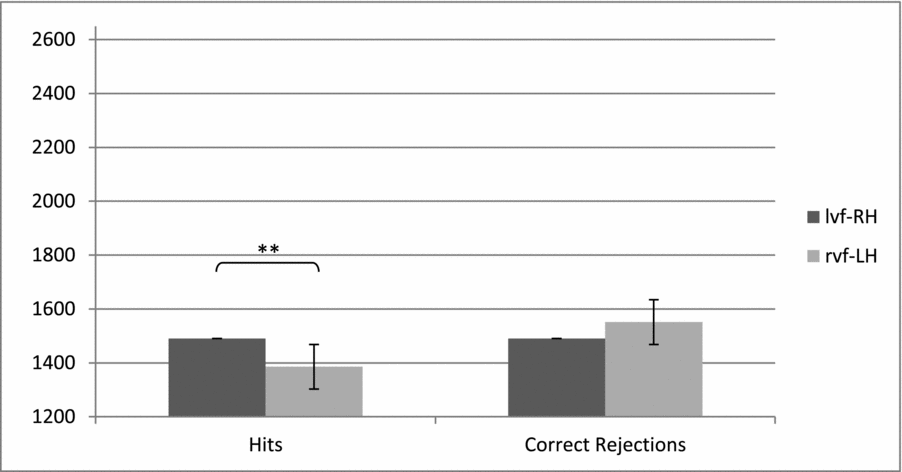
Latencies were analyzed only for correct responses on items that were not solved during the time limit. The latencies were calculated from the appearance of the question “Solution?”, i.e., 300 ms after the onset of the target word. Since response time (RT) distribution was skewed, the outliers were eliminated from the analysis (the lowest and highest percentiles – below 244 ms and above 4310 ms, respectively). Then, a repeated measures ANOVA was conducted with visual field (VF: rvf-LH/lvf-RH) and response outcome (hits/correct rejections) as within subject factors, and response latencies as dependent variable. Contrary to our predictions, the analysis showed no main effect for visual field, F < 1. Nevertheless, there was a near-significance main effect for response outcome, F(1,54) = 3.87, p = .054, so that responses to the correct solution word (hits) were faster than correct rejections of the distractors. Moreover, a significant interaction was found between VF and response outcome F(1,54) = 13.88, p < .001. Post-hoc comparisons revealed the source of interaction as a significant response time advantage to the rvf-LH upon correct identifications of the solution word (hits), t(54) = 3.34, p = .002, as opposed to a non-significant and smaller advantage to the opposite VF on correct rejections, t(54) = –1.91, p = .061. Mean latencies and standard errors are detailed on Figure 2.
Mean latencies and SE for correct responses to unsolved problems following four seconds time limit, by VF and response outcome. Error bars represent standard error of the mean, corrected for individual subject means (Cousineau, Reference Cousineau2005). **p = .002 < .01.
Following the analyses presented by Jung-Beeman and Bowden (Reference Jung-Beeman and Bowden2000), sensitivity analyses (d′) from signal detection theory were conducted to compare accuracy of responses between hemispheres. Sensitivity index (d′) was calculated per participant based on the individual hits and false alarm probabilities. As with response latencies, only items that were not solved within the time limit were included in the analysis. The analysis did not reveal any difference in sensitivity between the hemispheres, t(54) = 0.34, p = .733 – sensitivity in lvf-RH (mean d′ = 2.0, SD = 1.07) did not differ from sensitivity in rvf-LH (mean d′ = 1.9, SD = 0.96). It is interesting to note that sensitivity rates found in our experiment are similar to those found by Jung-Beeman and Bowden when they presented the items for two seconds; however, in our study we did not find greater sensitivity in the left hemisphere as reported for English speakers (Jung-Beeman& Bowden, Reference Jung-Beeman and Bowden2000, Experiment 2B).
Discussion
The main finding of Experiment 1 is the RT advantage to the left hemisphere on “hit” responses. These findings, attesting for activation of solution relevant information in the left hemisphere, are in line with the prediction derived from the functional architecture model. These results are clearly different from the lateralization patterns found with English speakers. Nonetheless, comparing the observed performance in the current study and the performance observed with the original CRA set in English implies that both sets are equally difficult. In fact, the fit between early solution rates, as well as the sensitivity (d′), in our sample and the rates reported in previous studies in English denies possible attribution of the differences in response patterns to differences in problem difficulty. The similarity in early solution rates also imply that our subjects understood the task well, and were equally capable of performing it.
However, the lack of lvf-RH advantage in the first experiment may be attributed to the short duration of prime presentation. Accumulated findings in English have demonstrated an increase in the lvf-RH response time advantage as the duration of prime presentation increased (Bowden & Jung-Beeman, Reference Bowden and Jung-Beeman1998; Jung-Beeman & Bowden, Reference Jung-Beeman and Bowden2000; Jung-Beeman et al., Reference Jung-Beeman, Bowden, Haberman, Frymiare, Arambel-Liu, Greenblatt, Reber and Counios2004). This possibility was examined in the second experiment, in which prime presentation was seven seconds, three seconds longer than in the first experiment. Based on findings from the English version, where the researchers did find a lvf-RH response time advantage using the seven seconds time limit variation (Jung-Beeman & Bowden, Reference Jung-Beeman and Bowden2000, Experiment 1B), and in accordance with BAIS model, we were expecting to see the same response latency pattern in our study: a lvf-RH RT advantage for both hits and correct rejections. Alternatively, replicating the rvf-LH advantage found in the first experiment would provide additional support to the model assuming interaction between orthography or phonology and semantic processing in the LH effects lateralization of semantic processing.
Experiment 2
Methods
Participants
Twenty-seven students (13 males) participated in the second experiment, voluntarily or for class credit (mean age: 24.78). All subjects were right handed, as assessed by the Edinburgh inventory (Oldfield, Reference Oldfield1971), native Hebrew speakers, with no diagnosed attention or learning disabilities.
Materials
For the second experiment, we used one of the lists prepared in the first experiment, including 88 problems from the Hebrew CRA version. The same four versions of the list prepared for the first experiment were used, and the allocation of problems to the four blocks also remained the same.
Design and procedure
The design and procedure were identical to the first experiment, except for a few modifications. The first and main difference was the time limit for solution, that is, the duration of presentation of the three prime words. In this experiment, the time limit was set to seven seconds (compared to four seconds in the first experiment).
Second, to replicate the procedure performed with English speakers (Jung-Beeman & Bowden, Reference Jung-Beeman and Bowden2000, Experiment 1B), in this experiment the response was made by pressing a button with either the index or middle fingers of the same hand. Response hand was counter balanced between subjects, so that half responded with their dominant right hand, and the others – with their left hand. Lastly, the experiment was carried on a different screen (screen sampling rate: 60 Hz). The subjects were seated 50 cm from the screen, therefore the distance of the nearest end of the target word from fixation was 2°.
Results
The data from one subject was excluded from the analyses since her accuracy rates were over 2.5 SDs below the average. Therefore, 26 subjects were included in the analyses. On average, subjects responded correctly to the target word on 82.09% of the trials (SD = 7.40). There were no significant effects or interactions with response hand on accuracy rates, F < 1.
Data from both experiments was analyzed together to inspect for a difference in early solution rates, that is, the percentage of problems solved by each participant during the presentation of the prime words (four seconds on the first experiment, and seven on the second). This was possible due to the fact that these responses are made at an early stage of each trial, before other methodological modifications between the experiments (such as response mode and lateralized display values) were evident. Consistent with previous findings and our predictions, analysis of variance (ANOVA) with presentation duration as between subject factor and early solution rate as dependent variable revealed that the conditions did differ in early solution rates, F(1,79) = 15.92, p < .001: On average, our subjects were able to solve only 15.48% (SD = 9.99) of the problems within the four seconds time limit, significantly less than the 25.13% of the problems solved in average (SD = 10.54) within the seven seconds time limit.
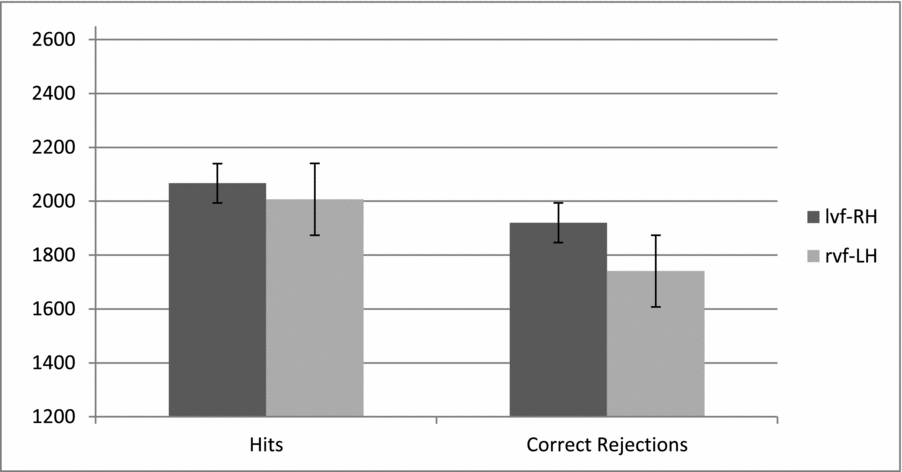
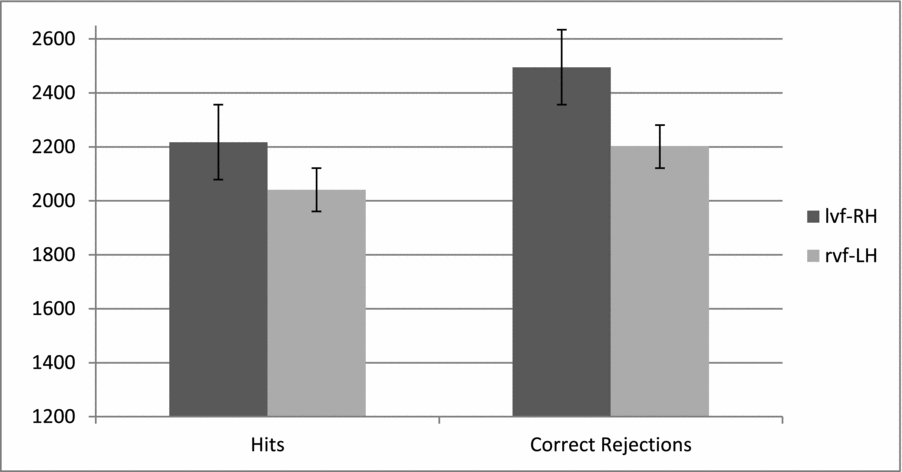
As in the first experiment, latencies were analyzed for correct responses on items that were not solved during the time limit, and calculated in the same manner. A repeated measures ANOVA with VF and response outcome as within subject factors and response latencies as the dependent variable, demonstrated a significant rvf-LH advantage, F(1,25) = 7.43, p = .012: responses to stimuli projected to the rvf-LH were significantly faster than responses made to the lvf-RH. Again, there was a response outcome main effect, F(1,25) = 5.95, p = .022, but unlike the first experiment, following a seven seconds time limit, correct rejections were significantly faster than hits. No significant interaction was found between VF and response outcome, F(1,25) = 2.12, p = .158. Mean latencies and standard errors are presented in Figure 3.
Mean latencies and SE for correct responses to unsolved problems following seven seconds time limit, by VF and response outcome. Error bars represent standard error of the mean, corrected for individual subject means (Cousineau, Reference Cousineau2005). *p = .012 < .05.
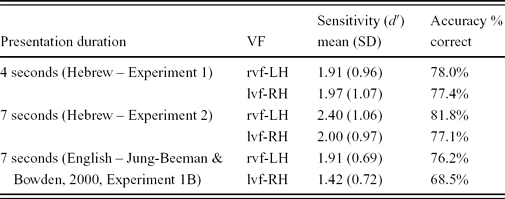
As in the first experiment, sensitivity analysis (based on signal detection theory), revealed no differences in sensitivity between the visual fields, t(25) = 1.44, p = .162. As can be seen in Table 1, sensitivity (d′) found in this experiment was slightly greater than found following four seconds time limit with Hebrew speakers (Experiment 1) or following seven seconds time limit with English speakers (Jung-Beeman & Bowden, Reference Jung-Beeman and Bowden2000, Experiment 1B).
Descriptive sensitivity and accuracy data by presentation duration and visual field (VF).
Discussion
In contrast with the classic findings in English, the current study in Hebrew demonstrated a left hemisphere advantage when encountering the CRA test. Specifically, the rvf-LH advantage found in the second experiment contradicts the outcomes of the CRA study in English using the identical procedure, and refutes the explanation that the advantage found on the first experiment on hit responses was due to the shorter duration of prime presentation. Moreover, the response time advantage increased and became more significant with the increase in presentation duration, an opposite pattern compared to the findings in English.
The conflicting patterns between the current findings and previous studies (in English) stand out in light of the consistency between the samples in early solution rates, which suggests that the item pool was equally difficult and that our subjects understood the task and made similar effort.
Thus, our results point at a different lateralization pattern in processing insight problems in Hebrew, compared to English – in line with the predictions derived from the functional architecture model, i.e., that semantic activation of solution-related information would occur in the left hemisphere, due to the additional requirement in phonological and orthographic processing added to the task in Hebrew.
It is important to note that in other tasks probing semantic processing in Hebrew using the divided visual fields paradigm, lateralization patterns observed were consistent with the BAIS model's predictions, as well as with converging evidence for semantic lateralization in English. In particular, RH involvement was evident in summation priming for divergent meanings in Hebrew (Faust & Kahana, Reference Faust and Kahana2002), as well as in English (Faust & Lavidor, Reference Faust and Lavidor2003), in comprehension of novel metaphors in Hebrew (Faust & Mashal, Reference Faust and Mashal2007) and in English (Faust & Mashal, Reference Faust and Mashal2007; Pobric, Mashal, Faust & Lavidor, Reference Pobric, Mashal, Faust and Lavidor2008), and in maintaining activation of less salient meanings of ambiguous words for longer durations in both languages (Burgess & Simpson, Reference Burgess and Simpson1988; Peleg & Eviatar, Reference Peleg and Eviatar2009).
Hence, the Hebrew version of the CRA test provided a novel perspective on interactions between semantic and non-semantic processes that are not required in English, or in other semantic tasks used before in Hebrew. Consequently, we aimed to further explore this interaction and the circumstances in which semantic activation of remote meanings is performed in the LH, as opposed to the RH were they are activated in simpler tasks and in English.
An item-analysis was conducted to explore whether lateralization patterns were affected by an item's phonological/orthographic characteristics. Items were classified into four subsets according to the number of phrases in each item that required phonological or orthographic changes when joining the prime and solution words to form a phrase. As each triplet comprised three items, it could have zero to three phrases that differ from their constituting words. However, no differences in response latencies were found depending on the number of changes. Moreover, the general response time lateralization pattern remained even when items with zero changes were analyzed separately.
Thus, activation of solution-related meanings in the LH was not only evident when phonological or orthographic changes were required in order to reach the solution. However, this finding does not eliminate the possibility that whenever phonological manipulations may be needed, the meanings are processed in the LH as a strategy. After all, half of the items did require these manipulations, hence this strategy would prove efficient in over 50% of the cases; perhaps when trying to solve all items, participants attempted phonological/orthographic manipulations, or made the meanings accessible for performing these manipulations if needed.
In order to test the hypothesis that solution-related meanings are only activated in the LH when phonological and orthographic manipulations may apply, we performed a third experiment on Hebrew–English bilinguals, using items from the original CRA set in English – where no phonological manipulations are required. We selected participants who acquired both languages at a young age, and are considered native speakers in both languages, but currently reside and study in a Hebrew-dominant environment. As native Hebrew speakers, these participants are undoubtedly exposed to the same semantic processing strategies, such as the strategy observed in the first two experiments, of activating remote solution-related meanings in the LH. The interesting question was whether they would use the same strategy when solving insight problems in English, i.e., when semantic and phonological or orthographic interactions are not relevant to the task at hand. We predicted that these participants would present English-like response patterns when performing the CRA task in English, attesting that when semantic phonological processes do not necessarily interact to reach solution, solution-related meanings would be activated in the RH, as seen in previous studies (Bowden & Jung-Beeman, Reference Bowden and Jung-Beeman1998; Jung-Beeman & Bowden, Reference Jung-Beeman and Bowden2000).
Experiment 3
Methods
Participants
Seventeen Hebrew–English bilinguals, currently living in Israel, participated in this part of the study (eight males, mean age: 27.71). We included only early bilinguals, meaning all participants were exposed to both English and Hebrew in their home environments before entering elementary school. To ensure that the subjects could handle the task at hand, which requires previous exposure to many compound words and phrases, participants were screened according to self-reports of language proficiency and a short vocabulary test. Participants were only included in the study if they reported being proficient in both languages, and using both in their daily life throughout the years (e.g., talking, reading books and writing in both languages). In addition, only participants who were able to provide appropriate interpretations to the three most difficult items in the WAIS-III test on each language were included. Finally, all participants had no diagnosed attention or learning disabilities.
Due to low availability of participants meeting the inclusion criteria, left handed participants were also included, assuming that their language lateralization is more likely to be typical than reversed (Pujol, Deus, Losilla & Capdevila, Reference Pujol, Deus, Losilla and Capdevila1999; Szaflarski, Binder, Possing, McKiernan, Ward & Hammeke, Reference Szaflarski, Binder, Possing, McKiernan, Ward and Hammeke2002). Fifteen of the participants were right handed, two were left handed, as assessed by the Edinburgh inventory (Oldfield, Reference Oldfield1971). The subjects were paid for their participation.
Materials
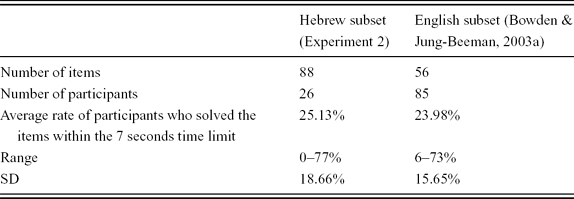
Fifty-six problems in English were taken from the CRA set composed by Bowden and Jung-Beeman (Reference Bowden and Jung-Beeman2003b). To allow comparison between the experiments in Hebrew and English, difficulty level of the English CRA subset was matched according to early solution rates to the list of Hebrew items tested on the second experiment (see Table 2). No differences in average solution rates were found between the subsets, F < 1.
Comparison of early solution data for the Hebrew and subsets of Compound Remote Associates (CRA) items, used in Experiments 2 and 3, respectively.
Identically to the materials used in the first two experiments, each problem contained three prime words, and a solution word that joined each of the prime words to create a familiar phrase. For half of the problems, an unrelated distractor word, equal in length to the solution word, was matched. Target words were never repeated, neither as primes nor as targets (correct solutions or distractors). The problems were divided into two blocks, each block containing 23 problems. Half of the 56 problems (in the two blocks) were paired with the correct solution – and half with distractors.
Design and procedure
The design and procedure were similar to those in the second experiment, in which time limit for solution was seven seconds. Few modifications were performed in order to replicate the procedure reported by Jung-Beeman and Bowden (Reference Jung-Beeman and Bowden2000, Experiment 1B), to facilitate the comparison between the early-bilinguals’ performance in the current study to English native speakers’ performance as reported in that study.
Unlike our two experiments in Hebrew, in this experiment, a single version of the problem set was used. For each subject, each problem was randomly presented to the left or right visual field. The problems were presented in two blocks with 23 problems each. The blocks were presented in a random order, with a 30 seconds intermission between blocks. Finally, the location of lateralized target word was modified according to the exact parameters used with English native speakers (Jung-Beeman & Bowden, Reference Jung-Beeman and Bowden2000) so that the distance of the nearest end of the target word from fixation was 1.5°.
Results
On average, subjects responded correctly to the target word on 77.10% of the trials (SD = 11.98). They were able to solve 12.18% of the problems within the seven seconds time limit on average (SD = 10.38).
As in the first two experiments, latencies were analyzed for correct responses on items that were not solved during the time limit. A repeated measures ANOVA was conducted, with VF and response outcome as within subject factors and response latencies as dependent variable. Contrary to our predictions, the analysis yielded a significant rvf-LH advantage, F(1,16) = 11.23, p = .004: responses to stimuli projected to the rvf-LH were significantly faster than responses made to the lvf-RH. No response outcome effect was found, F(1,16) = 1.87, p = .191, nor an interaction between VF and response outcome, F < 1. It is important to note that the rvf-LH advantage in average response latencies was consistent across most participants, i.e., observed in 14 of the 17 participants (including the two left handed participants). Mean latencies and standard errors are presented in Figure 4.
Mean latencies and SE for bilinguals’ correct responses to unsolved problems in English following seven seconds time limit, by VF and response outcome. Error bars represent standard error of the mean, corrected for individual subject means (Cousineau, Reference Cousineau2005). **p = .004 < .01.
In contrast to Jung-Beeman and Bowden's findings with English native speakers (Jung-Beeman & Bowden, Reference Jung-Beeman and Bowden2000, Experiment 1B), sensitivity analyses (based on signal detection theory), did not detect any differences in sensitivity between the visual fields, t(16) = 1.45, p = .166) with bilinguals. Sensitivity (d′) found in this experiment for lvf-RH (mean d′ = 2.0, SD = 1.43) and rvf-LH (mean d′ = 2.6, SD = 1.61) resembled the levels found with Hebrew native speakers following the same time limit for solution (Experiment 2), and was slightly greater than reported for English native speakers (Jung-Beeman & Bowden, Reference Jung-Beeman and Bowden2000, Experiment 1B), as detailed in Table 1.
Discussion
Contrary to our predictions, when tested in English, Hebrew–English bilinguals demonstrated response patterns which resonate with the patterns seen in Hebrew, and not in English. These findings suggest that the LH advantage in solving insight problems observed with Hebrew speakers is not stimuli- or task-specific – solution-related information was activated in the LH even when phonological or orthographic manipulations were not required. These findings raise interesting questions about the manner in which exposure to one language as a mother tongue can shape lateralization of linguistic processing in other languages. However, before we interpret the contradiction found in our study as stemming from exposure to a specific language, alternative explanations for this contradiction should be addressed.
First, as we did not aim to replicate the RH advantage with monolingual English speakers, we rely on the reports by Bowden and Jung-Beeman to establish a contradiction. Thus, based on our data, we cannot rule out the possibility that the RH advantage for insight problem solving in English cannot be replicated. However, these researchers demonstrated the RH involvement in this task numerous times, using different converging methods, across hundreds of participants (Bowden & Jung-Beeman, Reference Bowden and Jung-Beeman1998, Reference Bowden and Jung-Beeman2003a, Reference Bowden and Jung-Beemanb; Jung-Beeman & Bowden, Reference Jung-Beeman and Bowden2000; Jung-Beeman et al., Reference Jung-Beeman, Bowden, Haberman, Frymiare, Arambel-Liu, Greenblatt, Reber and Counios2004; Kounios, Frymiare, Bowden, Fleck, Subramaniam, Parrish & Jung-Beeman, Reference Kounios, Frymiare, Bowden, Fleck, Subramaniam, Parrish and Jung-Beeman2006; Subramaniam, Kounios, Parrish & Jung-Beeman, Reference Subramaniam, Kounios, Parrish and Jung-Beeman2009). Hence, we find the possibility that these findings cannot be replicated highly unlikely, and conclude that our findings do contradict the patterns found with native English speakers.
Second, the early-bilinguals sample differs from native English speakers not only in their exposure to Hebrew as a mother tongue – there might be some inherent characteristic of being early bilingual that may have affected our results. For instance, comparing the bilingual early solution rates to those of other participates in both languages (with the same time limit for solution – seven seconds), it seems that the early bilinguals had lower rates (12.18% compared with 21.6% reported with English native speakers (Jung-Beeman & Bowden, Reference Jung-Beeman and Bowden2000, Experiment 1B) and 25.13% reported with Hebrew native speakers (Experiment 2)). This bilingual disadvantage converge with findings from different paradigms, for instance, bilinguals’ lower performance in semantic verbal fluency task, also performed under time constraints (Gollan, Montoya & Werner, Reference Gollan, Montoya and Werner2002).
The inferior performance could be explained by numerous semantic processing phenomena observed in bilinguals, e.g., an increased load due to activation of word-related information in both languages, regardless of the language-specific task requirements (for reviews, see Brysbaert, Reference Brysbaert1998; de Groot, Reference de Groot, Frost and Katz1992, Reference de Groot, Schreuder and Weltens1993). Such phenomena affect different language processing layers, including semantic processing – for example, Hermans, Bongaerts, De Bot and Schreuder (Reference Hermans, Bongaerts, Bot and Schreuder1998) demonstrated direct competition between cross language associations. Another, conceivably related, phenomenon is smaller productive vocabulary, experienced by adult bilinguals as lower accessibility to lower-frequency words (for a short review of findings, see footnote 1 in Gollan et al., Reference Gollan, Montoya and Werner2002), which may affect familiarity of the target phrases or solution word.
Based on these explanations we would expect to see lower accuracy rates for bilinguals, assuming that they would have to guess in more trials due to a lack of familiarity with some of the words, or having trouble accessing them. However, the bilinguals in our experiment exhibited no lesser performance rates compared with monolinguals. Accuracy rates for unsolved problems in English was slightly higher for bilinguals than monolinguals: in unsolved trials, bilinguals responded correctly to 79.6% of the target words presented to the rvf-LH and 73.3% of words presented to the lvf-RH; while reported rates for native speakers were lower: rvf-LH: 76.2%, lvf-RH: 68.5% (Jung-Beeman & Bowden, Reference Jung-Beeman and Bowden2000, Experiment 1B). In addition, bilinguals demonstrated the greatest sensitivity (lvf-RH: d′ = 2.0; rvf-LH: d′ = 2.6) – slightly higher than monolingual Hebrew speakers (lvf-RH: d′ = 2.0; rvf-LH: d′ = 2.4, see Experiment 2), and incrementally higher than native English speakers (rvf-LH: d′ = 1.9; lvf-RH: d′ = 1.4, see Jung-Beeman & Bowden, Reference Jung-Beeman and Bowden2000, Experiment 1B).
In conclusion, bilinguals’ performance on accuracy measures implies they did not have any general difficulty due to the fact they were early bilinguals. The above comparisons could, however, indicate that early bilinguals encounter more difficulties in generating a solution, but when presented with a possible solution their performance is intact. One possible explanation for this distinction is that exposure to the solution word provided sufficient semantic context to allow suppression of non-relevant cross-language information (Schwartz & Kroll, Reference Schwartz and Kroll2006).
Another possible explanation is a more general dissociation between production and comprehension observed with bilinguals. This explanation is supported by recently published findings from English–Spanish bilinguals, showing dissociation between bilingual disadvantage in production and comprehension: sematic processing had more effect on producing words than reading and comprehending them (Gollan, Slattery, Goldenberg, Van Assche, Duyck & Rayner, Reference Gollan, Slattery, Goldenberg, Assche, Duyck and Rayner2011). Another study, with English–Hebrew bilinguals, provides further support for this dissociation between active production and more passive confirmation. The study revealed higher prevalence of tip-of-the-tongue (TOT) states than observed with monolinguals (Gollan & Silverberg, Reference Gollan and Silverberg2001). Gollan and Silverberg found that in English, Hebrew–English bilinguals had more TOT states compared to English monolinguals. Interestingly, they also found that the bilinguals benefited more than monolinguals from cued recall of the target words.
Taking into consideration the findings of the first two experiments, as well as the arguments presented here, it could be concluded that while using an early-bilingual sample is prone to alternative explanations, it is plausible to assume that the contradiction between the patterns observed in the current study and the patterns reported with native English speakers can be attributed to the different mother tongues participants were exposed to, and not to the stimuli, the task or the use of early-bilinguals as subjects.
General discussion
Summary of findings
The results from our three experiments converge, showing left hemisphere advantage for native Hebrew speakers in solving insight problems. This lateralization pattern was found to be consistent for Hebrew speakers across different experimental conditions (Experiments 1 and 2) and languages (Experiment 3), namely, regardless of specific stimuli and task requirements. Interestingly, the LH advantage found in the current study with Hebrew speakers conflicts with BAIS model predictions, as well as the RH advantage in solving insight problems observed repeatedly with native English speakers using exactly the same paradigm (Bowden & Jung-Beeman, Reference Bowden and Jung-Beeman1998, Reference Bowden and Jung-Beeman2003a; Jung-Beeman & Bowden, Reference Jung-Beeman and Bowden2000; Jung-Beeman et al., Reference Jung-Beeman, Bowden, Haberman, Frymiare, Arambel-Liu, Greenblatt, Reber and Counios2004). Moreover, the LH advantage cannot be directly explained by the functional architecture model, as it appears steadily, not only when stimuli or task require phonological manipulations to solve the problem.
Compared to the previous findings, our results suggest a qualitative difference in semantic processing. Using an early-bilingual population, we have discovered that the lateralization pattern characterizing Hebrew speakers is not dependent on linguistic context – even when tested in English, using the same stimuli used in the past to test non-Hebrew speakers, our subjects demonstrated a LH advantage. Thus, our findings provide evidence that exposure to different mother tongues shaped the lateralization patterns of semantic processing.
As the current study focused on Hebrew speakers, and the only available comparison is English speakers, the source for the different patterns found cannot be unequivocally attributed to either language. Nonetheless, these findings join previous evidence for language induced differences in linguistic processes, and together provide strong support to the conclusion that such differences exist. Specifically, our findings complement previous studies with Hebrew speakers, which have also pointed to specific language induced differences compared to English, in different levels of linguistic processing – including perceptual aspects of reading (Nazir, Ben-Boutayab, Decoppet, Deutsch & Frost, Reference Nazir, Ben-Boutayab, Decoppet, Deutsch and Frost2004), morphological processing (Bick, Goelman & Frost, Reference Bick, Goelman and Frost2011), and even semantic processing (Frost & Bentin, Reference Frost and Bentin1992). Reviewing these findings in detail shows that language-specific strategies may stem from specific linguistic characteristics of the different languages, and that similarly to the current findings, they may transfer between languages, even when these characteristics do not apply.
On the perceptual level, lateralization patterns are language dependent. Considering that Hebrew and English differ in reading direction (Hebrew is read from right to left), Nazir et al. (Reference Nazir, Ben-Boutayab, Decoppet, Deutsch and Frost2004) compared lateralization patterns found with monolingual English speakers using their native script (as measured by eye tracking) to those found with native Hebrew speakers, who were late Hebrew–English bilinguals. The Hebrew speakers demonstrated an L1 (Hebrew) characteristic VF pattern when using Hebrew (L1) or English (L2) scripts. That is, late Hebrew–English bilinguals used an L1 strategy even for L2 linguistic context, expressed in reversed lateralization patterns for Hebrew speakers even in English, just as seen in the current study. However, the different perceptual strategy found with Hebrew speakers did not modulate higher linguistic processes: on behavioral measures of recognition accuracy, lateralization patterns were linguistic-context–dependent, i.e., same lateralization patterns were observed with Hebrew and English native speakers when reading English script, as opposed to a reversed pattern observed with Hebrew speakers when reading Hebrew scripts (Nazir et al., Reference Nazir, Ben-Boutayab, Decoppet, Deutsch and Frost2004).
At the level of word recognition, morphological processing patterns are also language dependent: Hebrew and English differ in the basic morphological attributes of words (Hebrew morphology is more systematic, such that most words contain derivations). Using brain imaging data, acquired by an fMRI scanner, Bick at al. (Reference Bick, Goelman and Frost2011) revealed a semantic modulation of morphologic processing in English, but not in Hebrew, attesting that interactions between different linguistic processes may be modulated by language-specific attributes such as word structure.
Most relevantly, even properties of semantic activation are influenced by language-specific attributes. As reviewed above, Hebrew has a deep orthography and consequently has widespread homography, compared to English. Frost and Bentin (Reference Frost and Bentin1992) reported that Hebrew speakers retain less salient meanings of homographs for longer periods of time, a different semantic processing time course compared to the patterns observed with English speakers. The authors suggested that Hebrew speakers are used to having many lexical entries activated, and expect to disambiguate the homograph using available context later in the sentence – thus suggesting that Hebrew speakers have different semantic processing strategies, induced by the orthographic attributes of the language (Frost & Bentin, Reference Frost and Bentin1992).
Specific language-induced strategies
Our findings converge with other evidence found in the literature for specific language-induced strategies. However, the source for the specific strategy leading to semantic activation of the solution-related information in the left or right hemisphere remains unknown. We initially proposed that activating the relevant concepts in the LH would be advantageous when phonological or orthographic manipulations are also required. However, the LH advantage observed with Hebrew speakers in English refuted this account, suggesting that the different lateralization patterns stem from a different reason.
Redundancy of coarse coding between the hemispheres could be such a reason. Frost and Bentin's (Reference Frost and Bentin1992) suggestion that Hebrew speakers maintain more meanings for a longer period of time implies that coarse coding is more frequently effective in Hebrew, compared to English. Hence, it could be postulated that the left hemisphere is more proficient in this type of semantic processing in Hebrew. Considering the current findings of remote association activation in the LH, together with other studies that did demonstrate activation of remote meanings in the RH in Hebrew (e.g., Faust & Kahana, Reference Faust and Kahana2002; Peleg & Eviatar, Reference Peleg and Eviatar2009), suggests that in Hebrew, on some conditions some type of coarse coding could be performed in the left hemisphere, and under other conditions – in the right one. This redundancy could account for additional findings in Hebrew, including the results of native Hebrew speakers with right brain damage, in a Hebrew version of the “Right Hemisphere Communication Battery” (Gardner & Brownell, Reference Gardner and Brownell1986). The participants did not show a selective impairment in the same tasks that are considered to be based on selective RH involvement in English (Zaidel, Kasher, Soroker & Batori, Reference Zaidel, Kasher, Soroker and Batori2002). This hypothesis is further supported by Peleg and Eviatar's conclusion that both hemispheres are more similar than postulated by other models, and can both perform the same operations, leaning on the same types of linguistic information – a conclusion based on their semantic research in Hebrew (Peleg & Eviatar, Reference Peleg and Eviatar2009).
Future studies and open questions
Future studies of semantic processing in Hebrew may shed more light on the lateralization patterns in Hebrew, testing our suggested interpretation of redundancy and exploring the factors that determine when remote associations will be activated in the left or right hemisphere. Based on our current findings with the insight problem solving paradigm, we would like to discuss one possible factor that could influence the preference for semantic activation between the hemispheres – interaction between semantic processes and executive processes.
Studies in English and Hebrew show that left Dorsolateral Prefrontal cortex (DLPFC) executive control modulates semantic processing of verbal insight problems (Cerruti & Schlaug, Reference Cerruti and Schlaug2009; Metuki, Sela & Lavidor, Reference Metuki, Sela and Lavidor2012). Specifically, both studies demonstrated that solving CRA problems could be enhanced by stimulating the left DLPFC, and the study in Hebrew also revealed that this stimulation is mostly effective for difficult problems – when the cognitive demand is higher. These findings indicate that solving verbal insight problem is a complicated task, placing high load on executive functions. Therefore, it could be postulated that when demand on cognitive control processes is high, there is a preference to perform the semantic processing in the same hemisphere where control mechanisms are already active. This preference of course is only applicable when the relevant type of processing is available in both hemispheres, which is the case in Hebrew according to the redundancy hypothesis, and the supporting evidence presented here. This account can be seen as an expansion of the functional architecture model to inter-hemispheric connectivity between linguistic and non-linguistic components: the exposure to Hebrew leads to redundancy between the hemispheres in coarse coding, which in turn affect the functional architecture. If so, when a task recruits non-linguistic processes in the LH, as well as linguistic processes – performing the linguistic processes in the LH would be more efficient. Hence, Hebrew speakers who developed the redundant ability to perform coarse semantic processing in both hemispheres show LH advantage when solving insight problems in either Hebrew or English (due to the load on the executive processes in the LH in both languages), while non-Hebrew speakers show predominance of the RH, as a result of the different functional architecture, namely – the lack of inter-hemispheric connection between linguistic and non-linguistic processes involved in the task.
The observed LH dominance in solving insight problem among native Hebrew speakers indicates that there is an influence of specific language exposure on lateralization patterns of semantic processes. It has been shown that these unique patterns are not linguistic-context–specific, but are exhibited by native Hebrew speakers when processing stimuli in other languages as well. Our findings add to a series of reports on specific strategies developed as a consequence of exposure to linguistic characteristics of one's mother tongue, and demonstrate how these strategies can shape brain lateralization patterns in complex semantic processing.
Our findings also add to a few other findings in Hebrew, showing redundancy between the hemispheres in coarse coding, a strategy that may emerge from a more frequent requirement for this type of processing in a language with deep orthography such as Hebrew. It has been suggested that interaction between executive functions and semantic processes, given this redundancy, may dictate the location of semantic activation, such that with verbal insight problem solving, where LH executive functions are recruited, the semantic activation of solution-related concepts will occur in the left hemisphere.
Our findings elicit more questions regarding semantic processing patterns in the brain, under complex tasks requiring semantic and non-semantic interaction. More research is needed in Hebrew and other languages, to explore how profound the influence of exposure to Hebrew or other mother tongues is on the way we process language. It would be highly interesting to follow this research with more direct measures of neural activity, as well as different paradigms with different constraints of time course and processing load – to better characterize the unique involvement of each hemisphere in semantic processing, before and after linguistic information is shared through the corpus callosum. In addition, our bilingual participants demonstrated transference of linguistic strategies between languages. The question remains whether transference of linguistic processing strategies between languages is adaptive or not, and if there is any way to create more flexible use of language-specific strategies for early and late bilinguals.