1. Introduction
Theories or models of population structure are central to two lines of research in evolutionary biology. First, for the last 40 years or so, biologists have been exploring various models of selection in structured populations, such as models of kin selection and trait group selection, and their work is extensively discussed by philosophers of biology (see Sober and Wilson Reference Sober and Wilson1998, Kerr and Godfrey-Smith Reference Kerr and Godfrey-Smith2002, Godfrey-Smith Reference Godfrey-Smith2008, and references therein). Second, population geneticists have been exploring various models of population structure, such as the isolation-by-distance model and the stepping-stone model, and methods for detecting structures in natural populations (reviewed in Slatkin Reference Slatkin1985, Epperson Reference Epperson2003, Rousset Reference Rousset2004, and Waples and Gaggiotti Reference Waples and Gaggiotti2006). Unfortunately, this line of research is largely neglected by philosophers of biology.
My aim in this paper is to start filling this gap by discussing two highly influential theories of isolation by distance: Sewall Wright's statistical theory and Gustave Malécot's probabilistic theory. No apology is necessary for focusing on Wright, but why Malécot? One reason is that he is unjustifiably neglected in the history and philosophy of biology, given how population geneticists have recognized the influence and importance of his ideas. For example, James Crow (Reference Crow1987) considers Malécot, along with Motoo Kimura, one of the two most important population geneticists after R. A. Fisher, Sewall Wright, and J. B. S. Haldane. J. F. C. Kingman, an architect of the coalescent theory, notes that his theory is based on the generalization of Malécot's concept of identity by descent (Kingman Reference Kingman2000, 1461). Moreover, a recent collection of papers by population geneticists shows that Malécot's ideas remain relevant to research in contemporary population genetics (Slatkin and Veuille Reference Slatkin and Veuille2002). (For summaries of his extraordinary career, including his interview, see Nagylaki Reference Nagylaki1989, Malécot Reference Malécot1996, Epperson Reference Epperson1999, and Gillois Reference Gillois2002.)
Another reason to discuss Malécot's theory is that Malécot credited Wright as his inspiration, identifying himself as one of Wright's pupils, one who departed, in both senses of the word, from his master's work. In an interview, Malécot recounted his 1973 conversation with Wright as follows:
Staying within the limits of sobriety, I said to Wright, “You know I departed from your formulas, you know what I developed since then; but you are the man who influenced me the most, I’m one of your pupils.” (Malécot Reference Malécot1996, 113; my translation)
According to Malécot, after hearing these words, Wright smiled but seemed uninterested.
Malécot thought that his theory was inspired by but mathematically quite different from Wright's theory. Wright also claimed that there is “no obvious mathematical relationship” between Malécot's theory and his own (Reference Wright1978, 205), although both theories invite similar conclusions about population structure (205–207). So what is the difference between these theories, and why do they invite similar conclusions? I address these questions in turn. First, I argue that Wright's theory concerns what I call ecological isolation by distance, whereas Malécot's concerns what I call genetic isolation by distance (Section 2). Second, I suggest that if Wright's theory is interpreted appropriately, a previously unnoticed connection between the two theories emerges that explains why they invite similar conclusions (Sections 3–5).
2. Two Concepts of Isolation by Distance
There are two different concepts of isolation by distance that are not clearly distinguished by population geneticists. The first may be called ecological isolation by distance, which refers to local interaction among individuals, and the second genetic isolation by distance, which refers to a population genetic pattern in which genetic differentiation between individuals increases as the geographical distance between them increases. For Wright, as I show below, isolation by distance is ecological, but for Malécot, it is genetic.
In his seminal 1931 paper, “Evolution in Mendelian Populations,” Wright introduced one of the simplest models of population structure. In this “island model” (Wright Reference Wright1943, 114), the total population is divided into distinct subpopulations (islands). Each subpopulation is panmictic but exchanges some of its members with migrants drawn randomly from the total population. Immediately after introducing this model, Wright added:
The conditions postulated above are rather artificial since, in an actual species, subgroups exchange individuals with neighboring subgroups rather than with a random sample of the whole species. (Reference Wright1931, 100–101)
In other words, for Wright, the island model is too idealized: it ignores the fact that most individuals disperse over relatively short distances from their birthplaces. His subsequent work on population structure, especially his theory of isolation by distance, can be understood as an attempt to develop a more realistic model.
In his 1943 paper “Isolation by Distance,” Wright introduced a model of population structure that takes short-distance dispersal into account (for a historical discussion, see Provine Reference Provine1986, 370–381). He said:
At the opposite extreme from the island model is that in which there is complete continuity of distribution [of individuals], but interbreeding is restricted to small distances by the occurrence of only short range means of dispersal. Remote populations may become differentiated merely from isolation by distance. (Reference Wright1943, 117; original emphasis)
Unlike the island model, a population in this model is not subdivided into geographically discrete subpopulations but is composed of individuals distributed continuously over space. Even so, because of short-distance dispersal of individuals, remote individuals are isolated by distance in the sense that they are not likely to mate with one another. For Wright, isolation by distance is an ecological process in a population, namely, mating among spatially close individuals due to short-distance dispersal. His concept of isolation by distance can thus be called ecological isolation by distance. According to Wright, it can produce genetic differentiation among subpopulations. Ecological isolation by distance is a cause of evolutionary change.
On the other hand, Malécot and his followers use the term ‘isolation by distance’ to refer to a particular pattern of local genetic differentiation. For example, Malécot describes isolation by distance as follows:
In a natural population, the probability of two individuals I and J bearing, in randomly chosen homologous chromosomes, two identical loci decreases when their distance increases because the probability of common ancestors decreases. It is the phenomenon of isolation by distance, going up to racial unlikeness if the distance is so large that there are very few identical loci between I and J. (Reference Malécot, Le Cam and Neyman1967, 318)
For Malécot, isolation by distance refers to a population genetic pattern in which genetic relatedness between individuals decreases as a function of distance apart. In other words, genetic differentiation between individuals increases as the geographical distance between them increases. Similarly, François Rousset says:
But, in nature, dispersal is generally localized in space, and one expects that genetic similarity will be larger between individuals from closer subpopulations. This expected genetic consequence of localized dispersal is known as “isolation by distance.” (Reference Rousset2004, 23; my emphasis)
Isolation by distance in this sense is not the cause of evolutionary change, but the evolutionary consequence of short-distance dispersal. To distinguish between isolation by distance in this sense and Wright's ecological isolation by distance, Bryan Epperson's term “genetic isolation by distance” is useful (Reference Epperson2003, 14), although Epperson attributes it to Wright!
The distinction between ecological and genetic isolation by distance is important for understanding Wright's statistical and Malécot's probabilistic theories. Wright's theory concerns population genetic consequences, measured by F-statistics, of ecological isolation by distance. Malécot's theory concerns stochastic processes that will, at equilibrium, produce genetic isolation by distance in a population. Let us turn to these theories.
3. Sewall Wright on Isolation by Distance
A population is said to be under ecological isolation by distance when individuals disperse over short distances and mate only with individuals around them. In this case, there is a local population of breeding individuals that is much smaller than the total population, and reproduction occurs within this local population. According to Wright, “an essential property” of this local population “is that the individuals are neighbors in the sense that their gametes may come together” (Reference Wright1946, 39). Thus he calls this local population a “neighborhood” (39). Neighborhood size is an important quantity in Wright's theory of isolation by distance, but to interpret it properly, we must understand how it is related to the variance in dispersal distance and neighborhood area and density.
Following Wright (Reference Wright1943, 117; Reference Wright1946, 39; Reference Wright1969, 299), consider a two-dimensional habitat in which individuals are distributed uniformly and continuously. Assume that individuals disperse equally along horizontal and vertical axes, and the distribution of their birthplaces relative to their reproductive sites (i.e., birthplaces of their offspring) is approximately normal. The variance  $\sigma ^{2}$ of this distribution is the variance in dispersal distance. Neighborhood area can then be defined as an area occupied by neighbors,
 $4\pi \sigma ^{2}$, which is a circle, and reproduction occurs at its center. Neighborhood density d is the density of individual neighbors in a unit area. Neighborhood size is the number of neighbors in neighborhood area, which can be obtained by multiplying neighborhood area by neighborhood density:
 $4\pi \sigma ^{2}d$ (Wright Reference Wright1969, 303). Since 4π is a constant, neighborhood size can also be interpreted as a function of dispersal variance and neighborhood density. Some of these concepts are visualized in Figure 1 (see also Hamilton Reference Hamilton, Eisenberg and Dillon1971, 75).
A Wright neighborhood. The larger dots represent neighbors, the solid arrows actual mating between them, the dotted arrows potential mating, and the smaller dot a zygote. The lengths of the arrows represent dispersal distances. Neighborhood area is the area of the circle; neighborhood size is the number of neighbors in it.

Neighborhood size is an important quantity used to explore the extent of ecological isolation by distance. The extent of ecological isolation by distance depends on the extent of short-distance dispersal, which is measured by dispersal variance, and neighborhood size depends on dispersal variance and neighborhood density. Therefore, if neighborhood density is fixed, change in neighborhood size can be used to represent change in dispersal variance and the extent of ecological isolation by distance.
As noted in Section 2, for Wright, ecological isolation by distance is a cause of local genetic differentiation. His statistical theory of isolation by distance gives a quantitative measure of the effect of this cause. From a population genetic perspective, inbreeding and population subdivision (ecological isolation by distance) both increase homozygosity. However, Wright notes that these are two different components of the inbreeding coefficient F:
The inbreeding, measured by F, may be of either of two extreme sorts: sporadic mating of close relatives with no tendency to break the population into subgroups, and division into partially isolated subgroups, within each of which there is random mating. The latter is the case in which we are primarily interested here. (Reference Wright1943, 116)
Thus Wright tries to determine a component of inbreeding coefficient F that depends on ecological isolation by distance. In his later symbolism, this component is symbolized as  $F_{ST}$, and it represents the correlation of randomly uniting gametes within a subpopulation relative to those of the total population (Reference Wright1969, 294). Higher
 $F_{ST}$ means greater local genetic differentiation.
Wright derives the quantitative expression for  $F_{ST}$ as follows (Reference Wright1943, 116; Reference Wright1969, 294–295). First, he notes that the frequency of the heterozygote within a total population is

where  $q_{T}$ is the allele frequency within the total and F the inbreeding coefficient of individuals relative to the total population. Second, he assumes that the total population consists of K subpopulations each of which is composed of a certain number of neighborhoods. He also assumes that mating is nearly random within each neighborhood. Then the heterozygosity within a subpopulation is
 $2q_{ST}( 1-q_{ST}) $, where
 $q_{ST}$ is the allele frequency within the subpopulation, and the heterozygosity of the total population is the average over K subpopulations:

The variance in the distribution of  $q_{ST}$ is given by

From (2) and (3), Wright derives Wahlund's formula (Reference Wahlund1928) modified for subpopulations within the total:


This F is the inbreeding coefficient of subpopulations relative to the total, that is,  $F_{ST}$. Thus

To explore various effects of ecological isolation by distance, Wright investigates how change in neighborhood size affects  $F_{ST}$. He has shown, among other things, that
 $F_{ST}$, which measures the extent of local genetic differentiation, decreases as the size of neighborhoods in a subpopulation increases, provided that there is no selection, long-distance dispersal, or mutation (Reference Wright1943, 122, 127). It is not difficult to see why this happens: In this case, the change in allele frequency in each neighborhood is random and is influenced only by neighborhood size. As neighborhood size increases, random fluctuations in allele frequency become less severe in each neighborhood, decreasing
 $\mathrm{Var}\,( q_{ST}) $, the variance in the distribution of allele frequencies in a subpopulation. As
 $\mathrm{Var}\,( q_{ST}) $ decreases,
 $F_{ST}$ decreases (see equation [6] above). According to Wright, if neighborhood size is as large as 10,000, the subpopulation “is substantially the same as if there were panmixia throughout any conceivable range” (Reference Wright1943, 124).
So Wright has shown that change in neighborhood size affects the extent of local genetic differentiation. There is more than one way, however, to interpret change in neighborhood size because neighborhood size is a function of two, not one, variables, namely, dispersal variance and neighborhood density. In Section 5, I argue that interpreting change in neighborhood size as change in dispersal variance allows us to see a connection between Wright's and Malécot's theories of isolation by distance. But before doing so, I need to introduce Malécot's theory.
4. Gustave Malécot on Isolation by Distance
As noted in Section 2, for Malécot, isolation by distance refers to genetic isolation by distance, which is a pattern in which genetic relatedness of individuals decreases as a function of distance apart. His probabilistic theory of isolation by distance shows that if migration probabilities depend only on distances between birthplaces of offspring and their parents, a population will, at equilibrium, exhibit genetic isolation by distance.
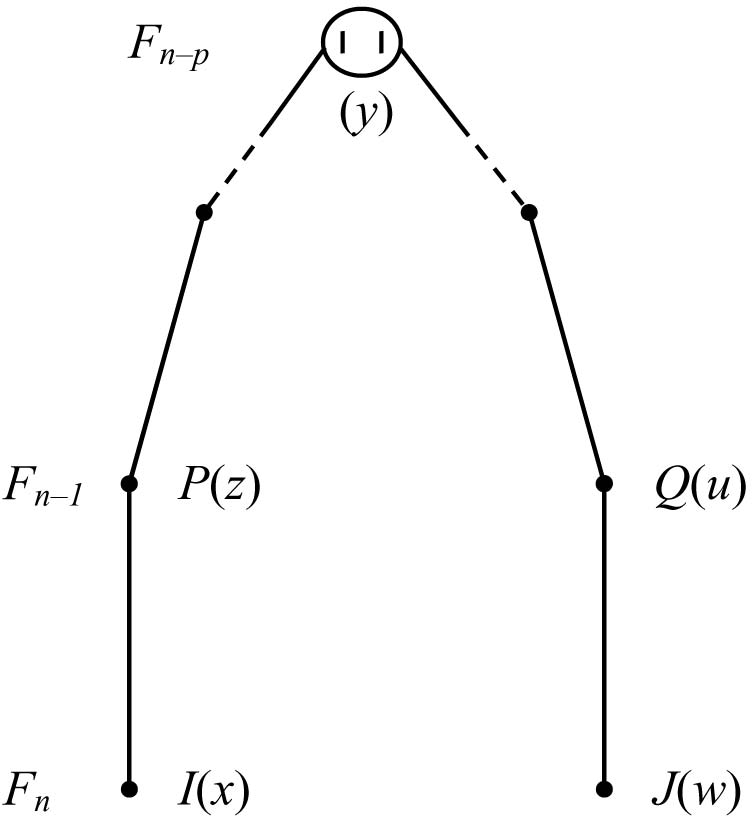
Malécot's theory involves such concepts as identity by descent, the coefficient of kinship, the gametic kinship chain, and migration probabilities, which he developed over the years (see, e.g., Malécot Reference Malécot1948, Reference Malécot1950, Reference Malécot, Le Cam and Neyman1967, Reference Malécot and Yermanos1969, Reference Malécot1971, Reference Malécot1972, Reference Malécot1973, Reference Malécot1975). Here I introduce them by referring to Figure 2.
A kinship chain. The black dots represent homologous loci; two homologous loci, one in an individual I born at location x and the other in J at w in generation  $F_{n}$, are descended from the same locus in their diploid common ancestor born at y in
 $F_{n-p}$. (Redrawn, with modifications, from Malécot Reference Malécot1973, 340.)

Consider a locus chosen from an individual I born at location x in generation  $F_{n}$ and the same locus chosen from a different individual J at w in the same generation. These two loci are called identical by descent if they are descended from the same locus in their diploid common ancestor at y in generation
 $F_{n-p}$. If no mutation has occurred in loci that are identical by descent, then they must also be homologous, that is, occupied by replicas of the allele that occupied the same locus in their common ancestor (Malécot Reference Malécot1948, 7; Reference Malécot and Yermanos1969, 8). The coefficient of kinship,
 $\varphi _{n}( x,\,w) $, is the probability that two homologous loci chosen in the way just described are identical by descent (Malécot Reference Malécot1973, 344). If a mutation occurs in either locus, the coefficient of kinship will be zero.
Let us call those gametes that actually produce individuals for generation  $F_{n}$ the “useful gametes” for
 $F_{n}$ (Malécot Reference Malécot1971, 258), and consider two randomly chosen useful gametes, one for an individual at x and the other for an individual at w. The probability that two loci in these two gametes are descended from the locus in their common ancestor in
 $F_{n-p}$ is called the gametic kinship chain and symbolized by
 $\pi _{p}( x,\,w) $ (Malécot Reference Malécot1973, 339). If the gametic kinship chain is zero, the coefficient of kinship is also zero.
Thus, the coefficient of kinship is a function of the mutation rate and the gametic kinship chain:

where k is the mutation rate, and the summation extends over the number p of generations from individuals at x and w to their common ancestor (Malécot Reference Malécot1973, 345).
The gametic kinship chain depends on migration probabilities. Let  $l_{xz}$ be the probability that a gamete drawn randomly from the useful gametes that produce individuals at x comes from a parent born at z (Malécot Reference Malécot1973, 334). This is the probability of migration from z to x. According to Malécot (340), the gametic kinship chain is given by

where N is the population size and the summation extends over all individuals at z and u ( $u\neq z$). From (7) and (8), he derives his basic recurrence equation for the coefficient of kinship (346):

The coefficient of kinship is a function of the mutation rate, the migration probabilities, the kinship coefficient of the previous generation, and the population size. The second term in the brackets is the added probability that the loci come from the same individual born at z.
To find an asymptotic behavior of equation (9), Malécot assumes that migration probabilities depend only on distances between birthplaces of offspring and their parents. In this case, migration probabilities and kinship coefficients change as follows:  $l_{xz}=l( y) $, where
 $z-x=y$;
 $\varphi ( z,\,z) =\varphi ( 0) $; and
 $\varphi ( x,\,w) =\varphi ( r) $, where
 $w-x=r$ (Malécot Reference Malécot1973, 347). The variance
 $\sigma ^{2}$ of migration is defined as
 $\sigma ^{2}=\sum y^{2}l( y) -[ \sum yl( y) ] ^{2}$ (349). Assuming k is small, Malécot has shown that in a one-dimensional habitat the kinship coefficient of individuals born at the same location is given by

and that the kinship coefficient decreases as the distance r between individuals increases:

where σ is the standard deviation of migration (351). A two-dimensional case is more difficult to solve, but the kinship coefficient still decreases as a function of distance.
Thus Malécot has shown that if migration probabilities depend only on distances between birthplaces of offspring and their parents, a population will, at equilibrium, exhibit a pattern in which genetic relatedness of individuals decreases as the distance between them increases. This, of course, is the pattern of genetic isolation by distance.
5. Neighborhood Size and Migration Probabilities
Recall that Wright has shown that change in neighborhood size affects the extent of local genetic differentiation, measured by  $F_{ST}$. But Malécot argues that neighborhood size does not measure the extent of local genetic differentiation because a decrease in the kinship coefficient, as shown by equation (11), does not depend on neighborhood size (Malécot Reference Malécot1948, 61; Reference Malécot and Yermanos1969, 76; see also Slatkin Reference Slatkin1985, 400). Wright apparently agrees that a decrease in the kinship coefficient is independent of neighborhood size (Reference Wright1951, 335–336). So is Malécot's theory independent of Wright's? I think not, because there is a subtle connection between Wright's neighborhood size and Malécot's migration probabilities.
To make this connection, an appropriate interpretation of neighborhood size is necessary. In his criticism of neighborhood size, Malécot interprets effective population size and hence neighborhood size as the size of breeding individuals occupying a very small area of a population (Malécot Reference Malécot1948, 61; Reference Malécot and Yermanos1969, 76; see also Slatkin Reference Slatkin1985, 400). On this interpretation, change in neighborhood size represents change in neighborhood density. As I noted above, however, this is not the only possible interpretation of change in neighborhood size. Indeed, this is a rather uncharitable interpretation, because Wright's ecological isolation by distance refers not to population density but to localized mating due to short-distance dispersal. His theory quantifies the effect of ecological isolation by distance on the distribution of allele frequencies in a population. It is thus more charitable to interpret change in neighborhood size as change in dispersal variance rather than in neighborhood density.
This interpretation suggests a subtle connection between Wright's and Malécot's theories. Migration probabilities in Malécot's theory (see equation [9] above) are random variables, which have certain probability distributions. Probability distributions in turn have variances. For simplicity, assume that all migration probabilities have the same probability distribution. Now, dispersal variance in Wright's theory can be understood as the variance of the probability distribution associated with migration probabilities because dispersal, in Wright's theory, has to do with mating and hence the movement of gametes from one place to another, which is what migration probabilities account for. So, in my view, change in neighborhood size can be understood as change in the variance of the probability distribution associated with migration probabilities. Since the standard deviation of migration probabilities appears in equation (11) above, decrease in the kinship coefficient depends not only on the distance between two individuals but also on neighborhood size.
Consider, for example, the ratio,  $r/ \sigma $, between the distance between two individuals and the standard deviation of migration probabilities in equation (11). If neighborhood size is so large that
 $\sigma \gg r$, then the kinship coefficient will not decrease as a function of r. This makes sense because a large neighborhood, as Wright has shown, is analogous to a large panmictic population in which migration occurs nearly independently of distances between individuals. On the other hand, if neighborhood size is so small that
 $\sigma \ll r$, then the kinship coefficient will decrease as a function of r. This also makes sense because, as we saw above, the smaller the neighborhood size, the greater the differentiation between individuals in remote regions of a population. That is, individuals separated by r are less likely to be relatives.
6. Conclusion
There are two concepts of isolation by distance: ecological isolation by distance and genetic isolation by distance. Ecological isolation by distance refers to short-distance dispersal and mating among spatially close individuals. For Wright, this is an important cause of evolutionary change, and he has shown how neighborhood size affects the extent of local genetic differentiation, measured by  $F_{ST}$. Genetic isolation by distance, used by Malécot and others, refers to a population genetic pattern in which genetic relatedness of individuals decreases as a function of distance apart. Malécot has shown how genetic isolation by distance appears as an asymptotic behavior of a population in which migration probabilities depend only on distances between birthplaces of offspring and their parents.
Malécot argues that neighborhood size is not important for a theory of population structure because it does not account for genetic isolation by distance. This argument, however, depends on a rather uncharitable interpretation that change in neighborhood size is change in neighborhood density. It is more charitable to interpret change in neighborhood size as change in dispersal variance because this interpretation is consistent with the fact that Wright's theory is about population genetic consequences of short-distance dispersal. Moreover, this interpretation suggests a connection between Wright's and Malécot's theories: in Wright's statistical theory of isolation by distance, change in neighborhood size is change in dispersal variance; in Malécot's probabilistic theory, this change corresponds to change in the variance of the probability distribution associated with migration probabilities. When aligned in this way, we can see more clearly why both theories invite similar conclusions about how dispersal variance and migration probabilities contribute to the extent of local genetic differentiation and the coefficient of kinship.