INTRODUCTION
Transcranial direct current stimulation (tDCS) is a method of non-invasively modulating brain activity via a weak direct current that flows between cathodal and anodal electrodes that are placed on the scalp. Depending on the electrical polarity, the current appears to cause the depolarization or hyperpolarization of neuronal resting membrane potential (Nitsche & Paulus, Reference Nitsche and Paulus2000). tDCS is thought to be capable of increasing or decreasing the excitability of a neuronal population and possibly influence higher order processing (Nitsche et al., Reference Nitsche, Cohen, Wassermann, Priori, Lang, Antal and Fregni2008). This study examined the effects of anodal tDCS (a-tDCS) on spoken sentence and word comprehension in healthy adults.
Data from fMRI research implicate the left inferior frontal gyrus in sentence comprehension. Rodd, Vitello, Woollams, and Adank (Reference Rodd, Vitello, Woollams and Adank2015) used activation likelihood estimation analysis to synthesize data from 54 neuroimaging studies investigating sentence comprehension. Findings showed the left inferior frontal gyrus to be most reliably active during sentence comprehension. For single word comprehension, previous fMRI research has shown that peak activation reliably occurs within the left temporal lobe (e.g., Turkeltaub, Eden, Jones, & Zeffiro, Reference Turkeltaub, Eden, Jones and Zeffiro2002). Based on the aforementioned research, electrically stimulating the left inferior frontal gyrus may have an observable effect on sentence, but not word comprehension.
To our knowledge only one study has examined the effects of a-tDCS on sentence comprehension in healthy adults. Giustolisi, Vergallito, Cecchetto, Varoli, and Lauro (Reference Giustolisi, Vergallito, Cecchetto, Varoli and Lauro2018) found a-tDCS over the left inferior frontal gyrus led to higher accuracy on a sentence comprehension task compared to sham stimulation. This study also found evidence suggesting the stimulation had a language specific effect. No significant differences between groups were found on a control task involving visuo-spatial processing.
The aim of the current study was to further test the specificity of a-tDCS over the left inferior frontal gyrus on sentence comprehension. In this study participants were presented with two tasks whilst receiving either a-tDCS or sham stimulation. One task required participants to comprehend sentences and the other task, comprehension of single words. Both accuracy and reaction times (RTs) were recorded. The hypothesis tested was that a-tDCS over the left inferior frontal gyrus would enhance performance on the sentence comprehension task but not the word comprehension task.
METHOD
Participants
A total of 36 right handed healthy monolingual English-speaking adults participated in the study. Participants were pseudo-randomly allocated to receive either a- tDCS (n=18; n female=10; M Age Years=23.0 SD Age Years=2.1) or sham stimulation (n=18; n female=10; M Age Years=22.7 SD Age Years=2.8). The allocation procedure ensured participants in each condition were comparable with respect to age and female:male ratio. Participants were blind to their allocated stimulation condition. None of the participants had contraindications for tDCS as determined using a questionnaire. The study received ethical approval from the Deakin University Human Ethics Committee.
Materials
Sentence comprehension task
Sentence comprehension was tested using a version of a sentence-picture matching task outlined by Waters, Caplan, and Rochon (Reference Waters, Caplan and Rochon1995). On the task, participants were auditorily presented with sentences, and their goal was to select a picture that matched the sentences’ semantics from an array of distractors. Sentences were pre-recorded by an adult female and presented to participants via two computer speakers (Logitech X-140) at a comfortable listening volume (around 60 dbA). The pictures were presented on a 17” monitor. Before receiving stimulation, participants were presented with 25 sentences. Performance on these trials were used as baseline data. During stimulation, participants were presented with 52 sentences.
Presentation of each sentence commenced with a visual fixation point (“+” sign) that appeared in the center of the display for 200 ms. After this time, four pictures then appeared in each quadrant of the display. After a period of 100 ms, the mouse cursor appeared in the middle of the display and a stimulus sentence was presented via the speakers. Using a computer mouse (Lenovo Optical Wheel Mouse), the participants’ task was to select the picture that matched the sentence. Participants were instructed to respond after the sentence ended.
The sentences created for the task were intended to be easily understood by the participants, ensuring responses could be made within 1–2 s after the sentence had been presented. This was necessary to ensure this task as well as the word comprehension task (described below) could be completed within the stimulation period. The syntactic frames and sentences used in the task were based on those used by Waters et al. (Reference Waters, Caplan and Rochon1995). Example sentences were “The girl followed the woman and the man”, “The woman pushed the boy to the man”, “The woman hugged the boy that touched the dog”, and “The girl looked at the cat and pushed the boy”.
Word comprehension task
Word comprehension was assessed using a word-picture matching task. This task was also presented before and during stimulation. On the task a word was presented to participants via the computer speakers. The words were pre-recorded by an adult female (the same person presenting stimuli on the sentence comprehension task). Participants were instructed to respond after the word had been presented.
Presentation of each item followed the same format as for the sentence comprehension task. Each trial commenced with the appearance of a visual fixation point (“+” sign) presented in the center of the computer display for 200 ms. Four pictures appeared in each quadrant of the display. Following a period of 100 ms, the mouse cursor appeared in the middle of the display and a stimulus word was presented via the speakers. Using the mouse, participants selected the picture that matched the word. The pictures remained on the screen until a response was made. The target words used on the task were nouns, likely to be known by the participants, depicting animals (e.g., “rabbit”), foods (e.g., “potatoes”) and commonly used objects (e.g., “teapot”). The words were selected from Cipolotti and Warrington (Reference Cipolotti and Warrington1995). Before receiving stimulation, participants were presented with 25 words and data from these trials were used as baseline data. During stimulation, participants were presented with 52 words.
Dependent Variables
For each participant the proportion of correct responses was computed separately for baseline and stimulation periods. RT, recorded in ms, measured the time taken to select the picture after the sentence or word had been presented. Only RTs associated with a correct response were included. For each participant, mean RTs were computed separately for baseline and stimulation periods.
Transcranial Direct Current Stimulation Protocol and Electrode Placement
tDCS was administered using a Neuroconn (NeuroConn, Ilmenau, Germany) battery driven constant current stimulator connected to a pair of saline soaked sponge-surrounded rubber electrodes. The anode electrode was 5×5 cm in size and cathode 5×7 cm. The larger cathode electrode aimed to reduce inhibitory effects of the negative charge on cortical functioning (e.g., Ouellet et al., Reference Ouellet, McGirr, Van den Eynde, Jollant, Lepage and Berlim2015). The cathode was placed on the right supraorbital area. The electrodes delivered a constant current of 1.0 mA to the scalp.
The placement of the anode electrode was determined using the EEG 10–20 system. For inferior frontal gyrus stimulation, the anode electrode was centered at the intersection between T3-Fz and F7-Cz. In past tDCS research, this site has been used to stimulate the left inferior frontal gyrus and found to improve speech fluency (Volpato et al., Reference Volpato, Cavinato, Piccione, Garzon, Meneghello and Birbaumer2013). For participants receiving a-tDCS, the current ramped up to 1.0 mA over a 30-s period. After 2 min had elapsed, the tasks were presented. Stimulation lasted for 15 min, which for all participants, comprised the time required to complete both language tasks. After this time, the stimulation ramped down over a 30-s period. For sham stimulation, participants received 30 s of stimulation at the start of the stimulation period. After the 30 s, stimulation was turned off.
The effectiveness of the blinding was assessed. After testing participants guessed whether they received “real” or “sham” stimulation. Participants in the a-tDCS group were more likely to indicate they received real stimulation compared to participants in the sham group (61.1% vs. 27.7%). However, this difference was not significant (χ2(1)=0.022; p=.882).
Procedure
Before stimulation, participants completed the baseline version of the sentence and word comprehension tasks. a-tDCS or sham stimulation was then administered and participants completed the sentence and word comprehension tasks. The order the tasks were administered was counterbalanced.
RESULTS
Analyses of Accuracy Data
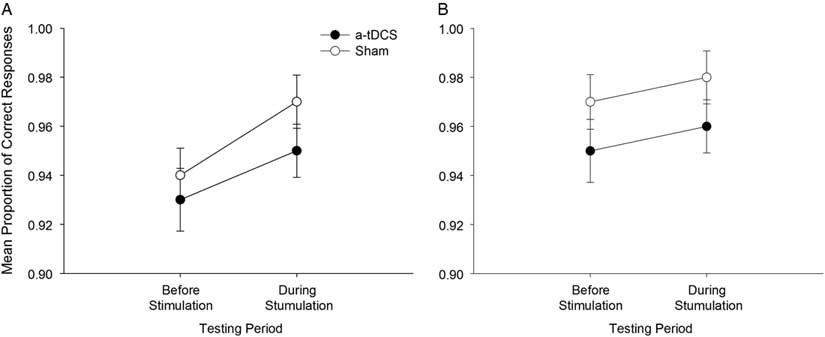
Figure 1 shows mean accuracy reported by stimulation condition (a-tDCS, sham) and testing period (before stimulation, during stimulation). Panel A in Figure 1 shows accuracy from the word comprehension task, and Panel B shows the corresponding data from the sentence comprehension task. For both groups, accuracy was close to ceiling on the word and sentence comprehension tasks before and during stimulation. The effects of the tDCS on accuracy were examined using a 2 (Stimulation Condition: a-tDCS, Sham)×2 (Task: Sentence Comprehension Task, Word Comprehension Task)×2 (Testing Period: before stimulation, during stimulation) Mixed Design Factorial analysis of variance (ANOVA). An arcsine transformation was applied to the accuracy data to correct for non-normality before undertaking this analysis. There was no effect of Stimulation Condition on accuracy on either task as evidenced by non-significant 2-way (F(1,34)=.016; p=.900; partial η2=.001) and three-way interactions (F(1,34)=.189; p=.666; partial η2=.008) that included Stimulation Condition in the model.
Mean accuracy of participants receiving either a-tDCS or sham stimulation. Panel A shows means for the word comprehension task. Panel B shows means for the sentence comprehension task. Error bars show standard error.

Analyses of RT Data
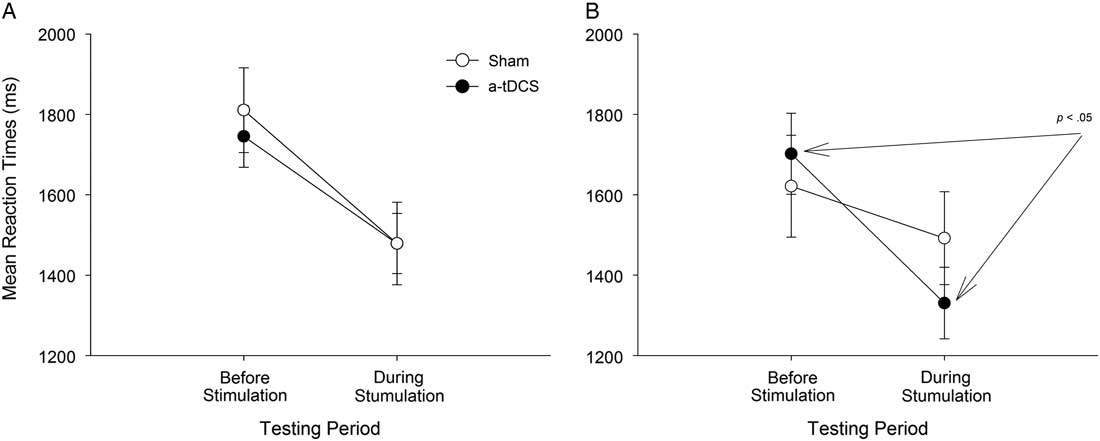
Figure 2 shows mean RT reported by stimulation condition (a-tDCS, sham) and testing period (before stimulation, during stimulation). Panel A in Figure 2 shows RT data for the word comprehension task, and Panel B shows RT data from the sentence comprehension task. The effects of tDCS on RT were also examined using a 2 (Stimulation Condition: a-tDCS, sham)×2 (Task: Sentence Comprehension Task, Word Comprehension Task)×2 (Testing Period: before stimulation, during stimulation) Mixed Design ANOVA. A significant three-way interaction between Stimulation Condition, Task and Testing Period was observed (F(1,34)=5.748; p=.022; partial η2=.187).
Mean reaction times of participants receiving either a-tDCS or sham stimulation. Panel A shows means for the word comprehension task. Panel B shows means for the sentence comprehension task. There is a significant decrease in reaction time before and during stimulation following a-tDCS. This difference is not observed following sham stimulation. Error bars show standard error.

To examine the source of the three-way-interaction, separate 2 (Stimulation Condition: a-tDCS, sham)×2 (Testing Period: before stimulation, during stimulation) ANOVA’s were undertaken. The first ANOVA indicated no significant effect of stimulation condition on RT from the word comprehension task as evidenced by a non-significant Stimulation Condition × Testing Period interaction (F(1,34)=0.599; p = .444; partial η2 = .022). The second ANOVA revealed a significant effect of stimulation on RT obtained from the comprehension task. Specifically, a significant Stimulation Condition × Testing Period interaction for RT from the sentence comprehension task was observed (F(1,34)=4.929; p=.033; partial η2=.165).
To explore the interaction further, pairwise comparisons between means were conducted with p-values corrected using the Bonferroni procedure (i.e., observed p-values were multiplied by four). For the sham group, there was no change in RT before and during stimulation (p=.228). However, for the a-tDCS group, RT were significantly faster during stimulation compared to RT recorded before the stimulation was administered (p = .009). There were no significant differences between the a-tDCS and sham groups in RT between the groups before (p=.999) or during stimulation (p=.999).
DISCUSSION
This study examined the effects of a-tDCS on spoken sentence and word comprehension. The key result to emerge from this study was that a-tDCS had an effect on sentence comprehension. RT of the participants receiving a-tDCS over the left inferior frontal gyrus became significantly faster following stimulation on the sentence comprehension task compared to baseline. There was no significant change in RT between baseline and stimulation periods for participants in the sham condition. However, we noted a trend toward faster RT for the sham group from baseline to stimulation. This may reflect practice effects as participants become more accustomed to listening to a sentence and then providing a manual response. Given this, the decrease in RT observed for participants receiving a-tDCS may be the product of both electrical stimulation and task-related practice effects.
The effects of the a-tDCS were specific to the sentence comprehension task. a-tDCS did not have a reliable effect on the word comprehension task. This latter finding also discounts the possibility that the effects of a-tDCS on sentence comprehension can be explained with reference to non-specific stimulation effects. For example, the stimulation may have enhanced motor response speeds or auditory/perceptual processing (e.g., Summers, Kang, & Cauraugh, Reference Summers, Kang and Cauraugh2016). However, if this were the case, one would expect participants receiving a-tDCS to have faster RT on the word comprehension task. But this result was not found. Overall, these data are consistent with neuroimaging data (Rodd et al., Reference Rodd, Vitello, Woollams and Adank2015) implicating the left inferior frontal gyrus in sentence comprehension.
The results of this study are also consistent with the findings of Giustolisi et al. (Reference Giustolisi, Vergallito, Cecchetto, Varoli and Lauro2018). In that study, a-tDCS over the left inferior frontal gyrus enhanced the accuracy of sentence comprehension in healthy adults. However, we note two differences between the findings of Giustolisi et al. and those of the current study. First, unlike Giustolisi et al., we did not find that a-tDCS affected accuracy. This discrepancy may be explained with reference to the low complexity of the sentences used. In the current study, accuracy approached ceiling before stimulation was administered. As a consequence, no additional benefits of the stimulation could be observed. The use of readily comprehendible sentences is a limitation of the current study. a-tDCS might be able to influence comprehension accuracy in healthy adults. However, this might only be observed when comprehending syntactically complex sentences.
Second, unlike Giustolisi et al. (Reference Giustolisi, Vergallito, Cecchetto, Varoli and Lauro2018), we did not find a between-subject effect of stimulation. That is, participants receiving a-tDCS did not have significantly faster RT compared to participants receiving sham stimulation during stimulation. Differences in current density may explain the discrepant findings. The current density used by Giustolisi et al.’s study was 0.08, whereas in the current study it was 0.04. Another possibility is the duration tDCS was administered. Giustolisi et al. administered stimulation for 30 min. In the current study, the stimulation was administered for 15 min. This opens up the possibility of a dose-response effect with respect to the effects of a-tDCS on language comprehension. A reliable difference between stimulation and sham groups may be observed at stronger currents and/or when stimulation is administered for longer periods of time.
The main limitation associated with the current study is that tDCS has poor spatial resolution with respect to the focality of the stimulation (Datta et al., Reference Datta, Bansal, Diaz, Patel, Reato and Bikson2009). This was the case in the current study. Our modeling (see Supplementary Material) of the montage used in the current study revealed the electrical stimulation maximally affected the left inferior frontal gyrus but also, the left prefrontal cortex more generally. Thus, it is possible that tDCS may have enhanced sentence comprehension by stimulating multiple regions within the left prefrontal cortex.
CONCLUSION
This study demonstrates that a-tDCS over the left inferior frontal gyrus can improve the speed of sentence comprehension compared to baseline. These results may have clinical implications. The data presented in the study indicate that tDCS might be able to improve the comprehension skills of individuals with impaired language ability. However, this will need to be tested in future research.
ACKNOWLEDGMENTS
No conflicts of interest to declare. Peter Enticott is supported by an ARC Future Fellowship (FT160100077).