Introduction
The status of the cervical lymph nodes is the single most important tumour-related prognostic factor for head and neck carcinoma. Therefore, the exact degree of neck node involvement is of great importance for optimal treatment planning.Reference Leemans, Tiwari, Nauta, Van der Waal and Snow1, Reference Snow, Annyas, van Slooten, Bartelink and Hart2 It is well known that palpation of neck nodes is inaccurate; histopathological evaluation has demonstrated that the resulting false positive and false negative rates are unacceptably high, causing over- or undertreatment in many patients.Reference Ali, Tiwari and Snow3
In cases of head and neck carcinoma, there is general agreement that treatment of the neck is indicated, not only when there are clinically apparent cervical lymph node metastases, but also when the neck needs to be entered for surgical treatment of the primary tumour and reconstruction.
The management of the clinically negative neck (i.e. node (N) stage zero) is controversial. There is general agreement that elective treatment of the neck is indicated: when there is a high likelihood of occult, clinically undetectable lymph node metastases; when the neck is involved in surgical treatment of the primary tumour; or when the patient will be unavailable for regular follow up. When there is merely a high likelihood of occult lymph node metastases, the choice is elective treatment versus ‘watchful waiting’. This question certainly arises in cases of smaller carcinomas of the oral cavity and oropharynx (i.e. tumour (T) stages T1 and T2), as these can usually be excised adequately via the transoral route.
The rationale for elective treatment is based on the following premises. Firstly, occult metastases will inevitably develop into clinically manifest disease. Secondly, despite regular follow up, some patients will go on to develop extensive or even inoperable neck disease following a ‘watch and wait’ policy. Finally, untreated neck disease may give rise to distant metastases, even before cervical lymph node metastases have grown to a clinically detectable size.
The arguments against elective treatment of the neck are as follows. Firstly, a large proportion of patients are subjected to treatment that they do not require. Secondly, such treatment may remove or destroy a barrier to cancer spread in cases of local recurrence or a second primary tumour. Finally, elective treatment of the neck is associated with morbidity; shoulder pain after neck dissection is clinically present in 70 per cent of patients, and this pain has a considerable impact on activities of daily living. Also, the range of neck and shoulder movement is significantly affected by neck dissection.Reference Dijkstra, Wilgen, van Buijs, Brendeke, de Goede and Kerst4
There are two approaches to avoiding futile elective treatment of the neck: (1) risk assessment based on the characteristics of the primary tumour (in clinical terms its site, size and thickness, and in histopathological terms its vasoinvasive growth, markers and gene expression patterns); and (2) improved diagnostic accuracy in the detection of lymph node metastases.
The method of neck treatment (e.g. neck dissection or irradiation) is usually dependent on the treatment modality of the primary tumour. Since most oral tumours are primarily treated by surgery, treatment of the neck mostly consists of neck dissection. Because small oropharyngeal tumours are frequently primarily treated by radiotherapy, dissection is not always the method of choice for elective neck treatment.
Elective neck dissection potentially removes occult cancer at an early stage. Furthermore, elective neck dissection specimens provide additional information to aid planning of adjuvant treatment, e.g. irradiation. Whereas in the past, elective surgical treatment of the neck always consisted of a (modified) radical neck dissection, currently staging is performed using elective, selective neck dissections with minimal morbidity.Reference Mira, Benazzo, Rossi and Zanoletti5
The aim of this study was to investigate the influence of a variety of tumour characteristics and diagnostic modalities on the decision of whether or not to perform an elective neck dissection. In order to investigate the neck management of patients with early (T1 or T2) oral and oropharyngeal cancers, a questionnaire was sent to the eight head and neck cancer centres of the Dutch Head and Neck Oncology Cooperative Group (Nederlandse Werkgroep Hoofd-Halstumoren).
Materials and methods
In August 2006, a questionnaire on neck management in cases of early oral and oropharyngeal cancer was sent to all eight head and neck cancer centres of the Dutch Head and Neck Oncology Cooperative Group. The questionnaire consisted of two parts: the first concerning the factors influencing the decision of whether or not to perform an elective neck dissection, and the second concerning a case example (as used previously by Dünne et al.).Reference Dünne, Folz, Kuropkat and Werner6
Part one of the questionnaire included the following questions. ‘Which examinations would you perform in a palpably N0 neck to detect occult metastases?’ ‘How much do you rely on a positive result to perform a neck dissection?’ ‘How much do you rely on a negative result to avoid a neck dissection?’ ‘How important are the following characteristics of the primary tumour when deciding whether or not to perform a neck dissection?’ ‘What is the minimal primary tumour size required to prompt elective neck dissection?’ ‘How do you determine tumour thickness?’ ‘What is the minimal tumour thickness required to prompt elective neck dissection?’ ‘Which histopathological characteristics do you use when deciding whether or not to perform an elective neck dissection?’ Finally, the timing of (discontinuous) neck dissection relative to transoral excision of the primary tumour was queried, i.e. simultaneously or after a certain interval.
Part two comprised a case example of a 52-year-old, male patient with a moderately differentiated head and neck squamous cell carcinoma (G2), without lymphangiosis carcinomatosis and with a clinically N0 neck. Respondents were instructed that, if they considered surgery to be the appropriate primary therapy for the various oral cavity and oropharynx tumours stated, then they were to indicate the procedures considered appropriate for treatment of the cervical lymphatics. Respondents could opt for observation (i.e. watchful waiting), a modified radical neck dissection or a selective neck dissection. If respondents chose selective neck dissection, then they were required to indicate the excised lymph node level(s).
Results
All eight questionnaires were returned completed.
The following answers were given for part one.
In response to the question ‘which examinations would you perform in a palpably N0 neck to detect occult metastases?’, no centres chose no examination, three chose ultrasound (US), seven chose US-guided fine needle aspiration cytology (FNAC), four (50 per cent) chose computed tomography (CT), four chose magnetic resonance imaging (MRI), one chose fluorodeoxyglucose positron emission tomography (PET), and none chose sentinel node biopsy.
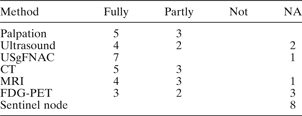
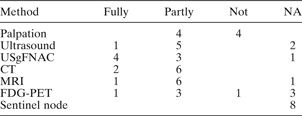
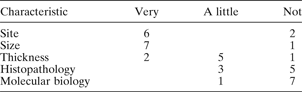
Tables I to III show respondents’ answers to the questions ‘how much do you rely on a positive result to perform a neck dissection?’, ‘how much do you rely on a negative result to avoid a neck dissection?’ and ‘how important are the following characteristics of the primary tumour when deciding whether or not to perform a neck dissection?’ In general, most centres considered a positive result of a diagnostic technique to be more reliable, compared with a negative result. There was no diagnostic technique for which a negative result was considered completely reliable by all centres. Only four centres indicated that they would rely completely on a negative US-guided FNAC result to avoid a neck dissection.
Answers to ‘how much do you rely on a positive result to perform a neck dissection?’

Data represent number of respondents. NA = not applicable; USgFNAC = ultrasound-guided fine needle aspiration cytology; CT = computed tomography; MRI = magnetic resonance imaging; FDG-PET = fluorodeoxyglucose positron emission tomography
Answers to ‘how much do you rely on a negative result to avoid a neck dissection?’

Data represent number of respondents. NA = not applicable; USgFNAC = ultrasound-guided fine needle aspiration cytology; CT = computed tomography; MRI = magnetic resonance imaging; FDG-PET = fluorodeoxyglucose positron emission tomography
Answers to ‘how important are the following characteristics of the primary tumour when deciding whether or not to perform a neck dissection?’

Data represent number of respondents.
In response to the question ‘what is the minimal primary tumour size required to prompt an elective neck dissection?’, seven centres indicated that they considered size to be important when deciding whether or not to perform an elective neck dissection, as follows: three centres chose 1.0 cm, three chose 2.0 cm and one chose 2.5 cm.
In response to the question ‘how do you determine tumour thickness?’, the following answers were given: palpation (six centres), endo-oral US (one centre), CT (four centres), MRI (six centres) and histopathology (three centres). Of the six centres which indicated that tumour thickness was important, responses to the question ‘what is the minimal tumour thickness required to prompt elective neck dissection?’ were as follows: 2 mm (one centre), 5 mm (three centres) and 20 mm (two centres). Of the three centres which indicated that histopathological characteristics were important, responses to the question ‘which histopathological characteristics do you use when deciding whether or not to perform an elective neck dissection?’ were answered as follows: degree of differentiation (one centre), invasive growth pattern (two centres), vasoinvasive growth (two centres) and perineural invasion (three centres).
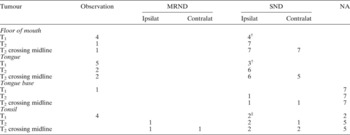
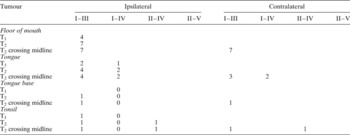
Tables IV and V show respondents’ answers regarding part two, concerning the management of the clinically negative neck of a 52-year-old, male patient with a head and neck squamous cell carcinoma (G2) without lymphangiosis carcinomatosis, at a certain site and stage.
Answers to part 2 of questionnaire*: cervical node management

Data represent number of respondents.
* That is, procedures considered appropriate for management of cervical lymph nodes in a 52-year-old, male patient with a moderately differentiated head and neck squamous cell carcinoma, without lymphangiosis carcinomatosis and with a clinically negative neck, if surgery was considered to be the primary therapy for the tumour. †n = 2 (25 per cent) when <1 cm on palpation; ‡n = 1 (13 per cent) when <1 cm on palpation. MRND = modified radical neck dissection; SND = selective neck dissection; NA = not applicable (because primary tumour not treated by surgery); ipsilat = ipsilateral; contralat = contralateral; T = tumour stage
Levels dissected, when a selective neck dissection was indicated for part 2

Data represent number of respondents. T = tumour stage
Five centres indicated that discontinuous neck dissection was always performed simultaneously with transoral excision. The remaining three centres indicated that neck dissection was sometimes performed simultaneously and sometimes after a certain interval. Details on this interval were not assessed in this survey.
Discussion
Our questionnaire responses indicated a lack of uniformity regarding the diagnosis and treatment of the clinically negative neck in patients with head and neck cancer, probably due to lack of evidence. In the Dutch national guidelines for treatment of oral cavity and oropharyngeal carcinomas (developed by the Nederlandse Werkgroep Hoofd-Halstumoren), the problem of detecting occult metastases is addressed but solid directives on the management of the clinically negative neck are lacking.7 Similarly, a study analysing data from 39 German hospitals found no uniform therapeutic strategy for the treatment of cervical lymph nodes in patients with carcinoma of the upper aerodigestive tract, based on the site and stage of the primary tumour.Reference Dünne, Folz, Kuropkat and Werner6 In the United States, a survey of 313 board-certified otolaryngologists found substantial variation in the management of the clinically negative neck in patients with T2 tongue carcinoma.Reference Werning, Heard, Pagano and Khuder8
Influence of primary tumour factors on decision-making
In the present study, the site and size of the primary tumour were the most important clinicopathological characteristics in the decision of whether or not to perform an elective neck dissection. The minimal primary tumour size required to prompt an elective neck dissection was mostly 1 or 2 cm. The importance of tumour size was also reflected by the greater number of respondents opting for observation of the neck in T1 tumours, compared with T2 tumours; a similar finding was observed in the German study.Reference Dünne, Folz, Kuropkat and Werner6
In general, prediction of tumour behaviour and, consequently, choice of treatment are mainly based on tumour-node-metastasis (TNM) staging. In general, T2 tumours have a higher risk of lymph node metastasis, compared with T1 tumours of the same site.Reference Kligerman, Lima, Soares, Prado, Dias and Freitas9, Reference Sparano, Weinstein, Chalian, Yodul and Weber10 Tongue tumors of 3 cm or larger have a higher risk of metastasis as compared to smaller tongue tumors.Reference Kurokawa, Yamashita, Takeda, Zhang, Fukuyama and Takahashi11
Some authors have found that the site and stage of the primary tumour alone were sufficient criteria to enable reliable selection of patients for elective treatment of the neck.Reference O'Brien, Taynor, McNeil, McMahon and Chaplin12 However, most authors have found these clinical criteria insufficiently reliable when making this decision.Reference De Zinis, Bolzini, Piazza and Nicolai13
While site and size are incorporated in the TNM staging system, thickness and other factors are not. Tumour behaviour may differ widely within these staging categories. Intrinsic tumour features may enable more accurate prediction of the presence of lymph node metastases. Various histopathological features have been found to have possible relevance in predicting nodal disease, namely: differentiation (in the deep portion), growth pattern (i.e. invasive versus noninvasive), thickness, depth of muscle invasion, vasoinvasive growth (i.e. angiolymphatic invasion), perineural invasion, and degree of inflammatory reaction surrounding the tumour.Reference Sparano, Weinstein, Chalian, Yodul and Weber10, Reference Kurokawa, Yamashita, Takeda, Zhang, Fukuyama and Takahashi11, Reference Sheahan, O'Keane, Sheahan and O'Dwyer14–Reference Shingaki, Suzuki, Nakajima and Kawasaki16 A minority of the Dutch centres surveyed used histopathological features (i.e. grade of differentiation, perineural spread, vasoinvasive growth and growth pattern) for this purpose.
Tumour thickness is a highly significant prognostic factor.Reference O'Brien, Lauer, Fredericks, Clifford, McNeil and Baia17 Most centres surveyed indicated that tumour thickness was important when deciding whether to perform an elective neck dissection. The minimal tumour thickness required to perform an elective neck dissection was 5 mm in most centres. However, tumour thickness was determined in different ways (e.g. palpation, US, CT, MRI and/or histopathology), making uniformity of approach difficult. Moreover, there was no consensus on how to measure thickness (e.g. central, maximal or corrected for ulceration). The precision of some techniques (e.g. palpation) is debatable. Various studies have reported cut-off points of ≥4 mm,Reference Sparano, Weinstein, Chalian, Yodul and Weber10, Reference Kurokawa, Yamashita, Takeda, Zhang, Fukuyama and Takahashi11, Reference O'Brien, Lauer, Fredericks, Clifford, McNeil and Baia17 >4 mm,Reference Kligerman, Lima, Soares, Prado, Dias and Freitas9, Reference Lim, Zhang, Ishii, Endoh, Kodama and Miyamoto15, Reference Fakih, Rao, Borges and Patel18 >5 mm14 or >8 mm16 as indicating increased risk of lymph node metastasis. However, there is currently no standardised technique of measuring tumour thickness, making comparison of studies difficult.Reference O'Brien, Lauer, Fredericks, Clifford, McNeil and Baia17 Moreover, as with other histopathological characteristics, measurement of primary tumour thickness is often performed on the excised surgical specimen, limiting its usefulness in pre-operative treatment planning.
Biomarkers have also been studied as indicators of tumour behaviour, based on the idea that molecular alteration of the primary tumour and surrounding tissues may supply information on the metastatic potential of the primary tumour. Unfortunately, studies assessing the correlation between biomarker expression and nodal metastasis have had conflicting results.Reference Takes, Baatenburg de Jong, Alles, Meeuwis, Marres and Knegt19 Roepman et al. Reference Roepman, Wessels, Kettelarij, Kemmeren, Miles and Lijnzaad20 found a predictive gene expression profile for the diagnosis of lymph node metastases from head and neck squamous cell carcinoma. However, deoxyribonucleic acid microarray gene expression analysis is not yet used in daily clinical practice. Only one Dutch centre currently uses molecular biology findings in clinical decision-making.
Diagnostic techniques for the neck
Modern imaging techniques such as CT, MRI, PET and US are more reliable than palpation. The capability of all of these techniques to detect small tumour deposits (micrometastases) is limited. Ultrasound-guided FNAC has been proven superior to other current imaging techniques for this purpose.Reference Van den Brekel, Castelijns, Stel, Golding, Meyer and Snow21 In the clinically negative neck, fluorodeoxyglucose (FDG) PET was not superior to conventional imaging techniques.Reference Brouwer, de Bree, Comans, Castelijns, Hoekstra and Leemans22, Reference Wensing, Vogel, Marres, Merkx, Postema and Oyen23 Ultrasound-guided FNAC, CT and MRI were the most frequently used diagnostic techniques in our survey. Fluorodeoxyglucose-PET was used for the detection of occult metastasis in only one centre.
When undertaking US-guided FNAC, selection of the most suspicious lymph nodes for aspiration is crucial. Such selection is based on: clinical information on the primary tumour; knowledge about patterns of metastasis from tumours at specific anatomical subsites; and US criteria regarding size, shape and reflection patterns. In the N0 neck, the specificity of US-guided FNAC has been reported to be 100 per cent, and the sensitivity has been reported to vary between 42 and 73 per cent.Reference Van den Brekel, Castelijns, Stel, Golding, Meyer and Snow21, Reference Righi, Kopecky, Caldemeyer, Ball, Weisberger and Radpour24, Reference Takes, Righi, Meeuwis, Manni, Knegt and Marres25
A Dutch multicentre trial showed that the accuracy of US-guided FNAC depends greatly on the experience of the ultrasonographer.Reference Takes, Righi, Meeuwis, Manni, Knegt and Marres25 The present study shows only half of the centres in The Netherlands rely completely on US-guided FNAC when deciding to refrain from elective neck dissection.
In an attempt to select more reliably those lymph nodes potentially containing metastases, the concept of the sentinel lymph node was introduced. Whereas conventional US-guided FNAC uses the above-mentioned criteria, the sentinel lymph node concept is based on the theory of orderly spread of tumour cells within the lymphatic system. The first lymph node in a regional lymphatic basin which receives lymphatic flow from a tumour is considered to be the sentinel lymph node. The sentinel lymph node concept assumes that lymphatic metastases, if present, can always be found at least in the sentinel lymph node. A tumour-negative sentinel lymph node would thus preclude the presence of malignant lymphatic involvement elsewhere in the neck. Oral cancer is eminently suitable for sentinel node evaluation, as metastasis takes place through lymphatic corridors to specific areas of the neck, depending on the site of the primary tumour.Reference Koch, Choti, Civelek, Eisele and Saunders26–Reference Ross, Shoaib, Soutar, MacDonald, Camilleri and Bessent30 In a multi-institutional study by Ross et al.,Reference Ross, Shoaib, Soutar, MacDonald, Camilleri and Bessent30 the sensitivity of this technique in head and neck cancer was estimated as 94 per cent. None of the centres participating in the current study used the sentinel node procedure routinely.
Elective neck dissection versus observation
The treatment of early oral and oropharyngeal cancer is controversial; the patient's options are either elective neck dissection or watchful waiting (i.e. observation) with salvage surgery for delayed lymph node metastases.
One participating centre indicated that they did not perform elective neck dissection when the observation strategy incorporated US-guided FNAC during follow up. All other centres performed elective neck dissections depending on the site and stage of the primary tumour. In cases of T1 tumour, most centres observed the neck, whereas in T2 tumours most centres performed an elective neck dissection. In the German hospitals surveyed by Dünne et al., an observation strategy was more often employed in T1 than T2 tumours; however, even in T1 tumours elective neck dissection was more often undertaken than observation.Reference Dünne, Folz, Kuropkat and Werner6
Werning et al. Reference Werning, Heard, Pagano and Khuder8 questioned United States otolaryngologists on how they would manage a patient with T2 tongue carcinoma and a clinically negative neck; 66 per cent stated they would perform an elective neck dissection, 19 per cent would treat the neck with radiotherapy, 13 per cent preferred to observe the neck for subsequent development of nodal metastases, and 1 per cent would manage the neck in another way. In the current, Dutch study, 75 per cent of centres surveyed would treat this patient with elective neck dissection, while 24 per cent would opt for observation. Faced with the same patient, 92 per cent of German otolaryngologists would choose elective neck dissection and 8 per cent observation.Reference Dünne, Folz, Kuropkat and Werner6
A number of mostly retrospective studies have shown better regional control in oral cancer patients treated with elective neck dissection or irradiation, compared with observation.Reference Dias, Kligerman, Matos de Sã, Arcuri, Freita and Farias31–Reference McGuirt, Johnson, Myers, Tothfeosl and Wagner37 The results of surgery after watchful waiting observation are generally poor, and often more extensive than elective treatment.Reference Kligerman, Lima, Soares, Prado, Dias and Freitas9, Reference Dias, Kligerman, Matos de Sã, Arcuri, Freita and Farias31, Reference Capote, Escorial, Muňoz-Guerra, Rodríguez-Campo, Gamallo and Naval32, Reference Kowalski38 However, most studies have not shown improved survival following elective neck dissection.Reference Fakih, Rao, Borges and Patel18, Reference Yii, Patel, Rhys-Evans and Breach34, Reference Vandenbrouck, Sancho-Garnier, Chassagen, Saravane, Cachin and Micheau39–Reference Duvvuri, Simental, D'Angelo, Johnson, Ferris and Gooding42 Only a few studies found a survival benefit in patients treated with elective neck dissection.Reference Yuen, Wei, Wong and Tang33, Reference McGuirt, Johnson, Myers, Tothfeosl and Wagner37 One study found improved survival following elective neck dissection, but only in patients with T2 oral tongue carcinoma.Reference Capote, Escorial, Muňoz-Guerra, Rodríguez-Campo, Gamallo and Naval32 It may be possible that the survival advantage conferred by elective treatment is small, and that the sample size of most studies does not afford sufficient power to adequately demonstrate this difference.Reference Duvvuri, Simental, D'Angelo, Johnson, Ferris and Gooding42
In addition to its therapeutic role, neck dissection can also be considered to be a staging procedure. Elective neck dissection may provide valuable additional information which assists patient counselling and adjuvant treatment planning (e.g. post-operative radiotherapy with or without chemotherapy).
Observation of the neck has a role in early stage disease in patients in whom the risk of cervical metastasis is low. It is important that these patients are closely monitored for recurrence, in order to reduce the risk of delayed detection of advanced lymph node metastases. If a patient is likely to comply poorly with follow up, then elective neck dissection is favoured. In almost all studies, the meaning of ‘observation’ is poorly defined. In most studies, it is likely to mean follow up with palpation of the neck. One would expect that an observational strategy with more rigorous follow up (e.g. including imaging techniques) would have better results for delayed neck dissection, compared with follow up involving palpation only. In a retrospective study of 161 patients with an US-guided FNAC negative neck who were intensively followed up at six-weekly intervals, and who underwent US-guided FNAC three-monthly in the first year after tumour excision, 34 (21 per cent) patients developed lymph node metastases during follow up, without a local recurrence. Twenty-seven of these 34 (79 per cent) patients who were treated by neck dissection were cured.Reference Nieuwenhuis, Castelijns, Pijpers, van den Brekel, Brakenhoff and van der Waal43
Modified radical versus selective neck dissection
Radical neck dissection would seem unacceptable for patients with a clinically negative neck because of its morbidity (e.g. pain, shoulder disability and adverse cosmetic effects). Modified radical neck dissection has less morbidity and is considered just as effective as radical neck dissection in the treatment of the clinically negative neck. In general, patients with multiple lymph node metastases or extracapsular spread are given radiotherapy to the neck after the neck dissection. If a single lymph node metastasis is identified in the absence of extracapsular spread, adjuvant radiotherapy is usually not recommended. There is a dilemma if this latter situation is found during selective neck dissection; should one treat only with observation, employ adjuvant radiotherapy of the whole neck, or go on and complete the neck dissection? On most occasions, adjuvant radiotherapy will be given, increasing morbidity to an extent probably greater than that produced by a modified radical neck dissection.
In our survey, only one centre indicated that they would perform an elective modified radical neck dissection in a patient with T2 tonsil carcinoma. In cases of T1 or T2 oral or oropharyngeal carcinoma, none of the centres reported use of a modified radical neck dissection in elective treatment of the neck. For cases of oral carcinoma, respondents would undertake selective neck dissection of levels I–III, sometimes extended to level IV. For oropharyngeal carcinoma, selective neck dissection of levels I–III and levels II–IV would be performed.
Of the United States otolaryngologists questioned by Werning et al. on what type of elective neck dissection they would employ in a patient with T2 tongue carcinoma, 21 per cent chose modified radical neck dissection and 79 per cent selective neck dissection.Reference Werning, Heard, Pagano and Khuder8 If a selective neck dissection was to be performed, 3 per cent of Werning and colleagues’ respondents would dissect only level I, 8 per cent would dissect levels I–II, 91 per cent would dissect levels I–III, 56 per cent would dissect levels I–IV, and 4 per cent would dissect other levels. If such a patient were to be treated at the Dutch centres surveyed in the current study, elective treatment would always consist of a selective neck dissection, involving levels I–III in 67 per cent and levels I–IV in 33 per cent. In Germany, the same patient's treatment strategy would be modified radical neck dissection in 25 per cent and selective neck dissection in 75 per cent, involving dissection of levels I–III in 68 per cent, levels I–IV in 26 per cent and levels II–V in 5 per cent.Reference Dünne, Folz, Kuropkat and Werner6 Thus, respondents to all three studies indicated that, in a patient with T2 tongue carcinoma and a clinically negative neck, selective neck dissection would be performed more frequently than modified radical neck dissection, and that such dissection would most frequently involve levels I–III, sometimes extended to level IV.
Nowadays, there is a tendency to use selective neck dissection in the treatment of the clinically negative neck. The main advantage of selective neck dissection is that it removes only the nodes at greatest risk of metastasis, and thus decreases morbidity.Reference Medina and Byers44 However, the effectiveness of selective neck dissection is controversial. Also, the role of selective neck dissection in early oral cancer treatment is controversial. Since some studies did not find any difference in regional control and in overall and disease-free survival, comparing selective and modified radical dissection of oral carcinomas,Reference Yu, Li, Li, Zhang and Zhao45, Reference Majoufre, Faucher, Laroche, De Bonfils, Siberchicot and Renaud-Salis46 some authors have suggested that selective neck dissection has therapeutic value.Reference Kerrebijn, Freeman, Irish, Witterick, Brown and Rotstein47 However, others have suggested that selective neck dissection is no more than a staging procedure, which may be used to select patients for further treatment.
If cervical lymph node metastases of oral tongue carcinoma are present, they usually progress in an orderly progression from level I to subsequent levels. However, ‘skip metastases’ may occur in which the disease bypasses levels I or II or both and goes directly to levels III or IV. Occasionally, the tumour drains via ‘fast tracks’ to a level III or IV node as the only manifestation of metastatic disease.Reference Byers, Weber, Andrews, McGill, Kare and Wolf48 However, metastases are still possible in levels I and II of the apparently clinically negative neck, where false negative results have been reported.
Since level V is affected in only 0–2 per cent of patients,Reference Dias, Kligerman, Matos de Sã, Arcuri, Freita and Farias31, Reference Shah, Candela and Poddar49–Reference Wing, Lam, Chan, Wei, Lam and Ho51 selective neck dissection is generally sufficient in patients with a small oral cancer and a clinically negative neck. Level V involvement is always associated with clinically evident nodal disease in other neck levels.Reference Dias, Kima, Kligerman, Farias, Soares and Manfro50 Dissection of level IV in oral cancer patients is controversial.Reference Khafif, Lopez-Garza and Medina41, Reference Ferlito, Mannara, Rinaldo, Politi, Robiony and Costa52
A selective neck dissection of levels I–III seems appropriate in patients with oral carcinoma and a clinically negative neck, because of the low incidence of lymph node metastases to level IV in such patients; metastases have been detected in only 0–10 per cent of such patients,Reference Dias, Kligerman, Matos de Sã, Arcuri, Freita and Farias31, Reference Khafif, Lopez-Garza and Medina41, Reference Byers, Weber, Andrews, McGill, Kare and Wolf48–Reference Wing, Lam, Chan, Wei, Lam and Ho51, Reference Crean, Hoffman, Potts and Fardy53 and isolated metastases in only 0–2 per cent.Reference Khafif, Lopez-Garza and Medina41, Reference Shah, Candela and Poddar49, Reference Dias, Kima, Kligerman, Farias, Soares and Manfro50 In T1 tongue and floor of mouth carcinoma, some studies have found no lymph node metastases outside levels I–III, upon elective neck dissection.Reference Dias, Kima, Kligerman, Farias, Soares and Manfro50, Reference Wing, Lam, Chan, Wei, Lam and Ho51 Byers et al. Reference Byers, Weber, Andrews, McGill, Kare and Wolf48 have recommended that, based on a ‘skip metastasis’ incidence of 15.8 per cent in patients with oral tongue carcinoma, elective neck dissection should include level IV. However, their conclusion was based on a series which also included clinically positive necks. Another strategy for patients with oral cancer and a clinically negative neck was reported by Van den Hoogen and Manni;Reference Van den Hooghen and Manni54 during elective, selective neck dissection of levels I–III, if intra-operative frozen section of the most suspect and largest lymph node in the jugulodigastric region and the most distal jugulo-omohyoid lymph node showed metastases, then the surgical procedure was converted to a modified radical neck dissection. Khafif et al. Reference Khafif, Lopez-Garza and Medina41 proposed a strategy in which level IV was dissected only when there was intra-operative suspicion of metastases in level II or III. Dissection of level IV added only minimal extra morbidity to a level I–III dissection.
In patients with oropharyngeal carcinoma, occult lymph node metastases are mostly found in levels II and III. Elective dissection of level I and IV is controversial; whereas one study found no lymph node metastases in level I, and level IV metastases in 11 per cent of patients, and advocated dissection of levels II–IV,Reference Youssef, Chuba, Salib, Yoo, Penagaricano and Ezzat55 another study found level I metastases in 6 per cent of patients and level IV metastases in none, and advocated dissection of levels I–III.Reference Vartanian, Pontes, Agra, Campos, Gonçalves-Filho and Carvalho56 In recent years, the need to dissect sublevel IIb has been investigated. Most authors have agreed that dissection of sublevel IIb is not necessary in oral cancer, while it should be included in selective neck dissection in oropharyngeal cancer.Reference Paleri, Kumar Subramaniam, Ozeer, Rees and Krishnan57 Unfortunately, the present survey included no questions regarding sublevel IIb.
It appears that the sentinel node concept in its current form cannot provide a substitute for elective neck dissection; however, a novel approach may be a sentinel node guided, superselective neck dissection. In this approach, only the lymphatic structures surrounding the sentinel node (i.e. one level), identified by scintigraphy and/or peri-operative gamma probe, are dissected.Reference Werner58
Unilateral versus bilateral treatment
In general, unilateral treatment of the neck is predominantly recommended for cases of clearly lateral localisation, whereas extension to the midline would require bilateral neck treatment. The incidence of contralateral lymph node metastases in early tongue and tonsil carcinoma is only 3–8 per cent.Reference Lim, Zhang, Ishii, Endoh, Kodama and Miyamoto15, Reference Vartanian, Pontes, Agra, Campos, Gonçalves-Filho and Carvalho56, Reference Zbären, Nuyens, Caversaccio and Stauffer59 No survival benefit was found for patients who underwent contralateral elective neck dissection in place of observation.Reference Lim, Lee, Koo, Kim, Kim and Choi60 In the present study, contralateral neck dissection would only have been performed for tumours crossing the midline. In the German study, bilateral neck dissection would have been performed more frequently, including cases of T1 tumours not crossing the midline.Reference Dünne, Folz, Kuropkat and Werner6
Timing of neck dissection
In most centres, a discontinuous neck dissection would always be performed simultaneously with the transoral excision. In some centres, an elective neck dissection was sometimes performed at a later stage. Therefore, one may ask when discontinuous elective neck dissection is best performed, in relation to transoral excision of the primary tumour. This issue was not addressed in the present survey. Such timing may be dependent on the time taken for a tumour cell to travel from the primary tumour to the lymph nodes.Reference Leemans, Tiwari, Nauta and Snow61, Reference Chiesa, Tradati and Calabrese62 In pathologically negative necks which have undergone surgery, regional recurrences have been reported. Possible reasons for this are: inappropriate dissection of the neck; pathological understaging of the neck due to micrometastasis missed on routine histopathological examination (and withholding of adjuvant treatment); and inadequate removal of the lymphatic network if the operation was not performed in continuity.
The clinically negative neck
One of the major problems in reviewing reports on the management of the clinically negative neck is the potential differences in inclusion criteria used in different studies. In most studies, the exact definition of a clinically negative neck is not specified, although a palpably negative neck will usually be meant. Since palpation of the neck is not reliable, substantial inter-observer variance may be expected, limiting comparability between studies.
Another factor which complicates the evaluation of diagnostic and treatment studies is the high incidence of missed (micro)metastases during routine histopathological examination of the specimen.Reference Ferlito, Shaha and Rinaldo63 For example, some studies have reported that FDG-PET has a very high sensitivity for foor detecting lymph node metastases in the clinically negative neck, whereas other studies have found a low sensitivity. This difference may be caused by the use of different ‘gold standards’, e.g. routine histopathological examination, versus more detailed examination using step serial sectioning and immunohistochemistry.Reference Brouwer, de Bree, Comans, Castelijns, Hoekstra and Leemans22
• Different strategies are available to manage patients with early (i.e. T1 or T2) oral or oropharyngeal carcinoma and a clinically negative neck
• These authors distributed a questionnaire surveying factors influencing the decision of whether to perform an elective neck dissection; the questionnaire also enquired about neck staging procedures and types of neck dissection undertaken
• Depending on the site and stage of the primary tumour, in the different cases 3–7 of the centres would perform an elective neck dissection
• This study found no uniformity amongst Dutch head and neck cancer centres regarding management of the clinically negative neck in early stage oral and oropharyngeal carcinoma
Uniformity
As observed in GermanyReference Dünne, Folz, Kuropkat and Werner6 and the United States,Reference Werning, Heard, Pagano and Khuder8 the current study of Dutch head and neck cancer centres found no uniform diagnostic and therapeutic strategy for the management of cervical lymph nodes in the clinically negative neck of patients with early oral or oropharyngeal carcinomas. Dünne et al. Reference Dünne, Folz, Kuropkat and Werner6 have suggested that a uniform, widely adopted management strategy is the basic prerequisite for the initiation and realisation of multicentre studies. In turn, these multicentre studies will contribute further to the evolution of uniform management strategies. Because of this lack of uniformity, Dünne et al. Reference Dünne, Folz, Kuropkat and Werner6 have in Germany advocated comprehensive oncological care within oncological centres, as per the Dutch system. In the United States, Werning et al. Reference Werning, Heard, Pagano and Khuder8 found a relationship between the number of patients treated and the management of the clinically negative neck. Otolaryngologists who routinely treat patients with head and neck cancer tend to demonstrate a lower treatment threshold for the clinically negative neck.Reference Werning, Heard, Pagano and Khuder8 More recent specialty graduates also tend to manage the clinically negative neck in a more aggressive manner.Reference Werning, Heard, Pagano and Khuder8 Because this information was identified only from a survey, its importance remains unclear. However, in the absence of consensus on the management of the clinically negative neck, patients with early oral or oropharyngeal cancer should be treated in oncological centres, in order to facilitate data collection (perhaps using randomised clinical trials) and thence to finally reach consensus on the management of the clinically negative neck. In the present study, experienced representatives of the eight Dutch head and neck cancer centres were asked to complete a questionnaire, using their institutional guidelines. Therefore, the influence of experience and training on the management of the clinically negative neck could not be determined.
Conclusion
In The Netherlands, there is currently no uniformity regarding the management of patients with early stage oral or oropharyngeal carcinoma and a clinically negative neck. A nationwide, multicentre study may yield further evidence, which can be used to reach consensus on the diagnostic investigation and treatment of such patients
Acknowledgements
The authors would like to thank Prof Dr J L N Roodenburg, Dr M W M van den Brekel, Dr H Lubsen, Dr A P M Langeveld, Dr L-A van der Velden, Dr R P Takes and Prof Dr B Kremer for completing the survey questionnaire, as representatives of their respective head and neck cancer centres.