Introduction
The word ‘crisis’ in Chinese is called ‘危机 Wei Ji’, which means a threat (Wei) and an opportunity (Ji). The COVID-19 crisis heavily impacted the global economy, but it also created opportunities, and brought forth new applications and prospects for high-tech products in volatile markets (Meyer, Prashantham, & Xu, Reference Meyer, Prashantham and Xu2021; Puliga & Ponta, Reference Puliga and Ponta2022; Zeng, Chen, & Lew, Reference Zeng, Chen and Lew2020), such as accelerated digitalisation, innovative products to protect from contagion, and the creative usage of social robots. Previous studies have shown that such crisis facilitates innovation through the provision of new products by high-tech small- and medium-sized enterprises (SMEs) (Colombo, Piva, Quas, & Rossi-Lamastra, Reference Colombo, Piva, Quas and Rossi-Lamastra2021). Although SMEs account for 90% of market players and contribute 68.4% of patent R&D in China (Financial Research Centre, 2022), their liability of smallness and coincidence with fewer resources makes them more vulnerable to environmental shocks. Nevertheless, smallness also implies that they tend to be rather flexible, enabling SMEs to achieve both more innovation and an increased share of growth than larger firms when they encountered opportunities or threats during the COVID-19 crisis (Clampit, Lorenz, Gamble, & Lee, Reference Clampit, Lorenz, Gamble and Lee2022).
With respect to seizing opportunities, researchers have analysed the ability to integrate resources, and the dynamic capability (DC) perspective has been widely adopted (Eisenhardt & Martin, Reference Eisenhardt and Martin2000; Teece, Reference Teece2007). A recent case study indicates that the DC that characterises SMEs enables better adaptation and market fit, under COVID-19 uncertainties (Zahoor, Golgeci, Haapanen, Ali, & Arslan, Reference Zahoor, Golgeci, Haapanen, Ali and Arslan2022). However, we have little knowledge of the certain processes and capacities that high-tech SMEs developed in response to pandemic-induced market changes (Dejardin et al., Reference Dejardin, Raposo, Ferreira, Fernandes, Veiga and Farinha2023), so more empirical exploration is needed (Puliga & Ponta, Reference Puliga and Ponta2022; Wang, Hong, Li, & Gao, Reference Wang, Hong, Li and Gao2020; Zahoor et al., Reference Zahoor, Golgeci, Haapanen, Ali and Arslan2022). Considering that DC enhances a firm’s innovation by enabling higher competence in creating, extending, and modifying resource bases (Helfat et al., Reference Helfat, Finkelstein, Mitchell, Peteraf, Singh, Teece and Winter2007), this study specifically examines the potential organisational capacities for exploitative and exploratory innovations (Birkinshaw, Zimmermann, & Raisch, Reference Birkinshaw, Zimmermann and Raisch2016; Ferreira, Coelho, & Moutinho, Reference Ferreira, Coelho and Moutinho2020; Xie & Wang, Reference Xie and Wang2021). By conceptualising certain activities as specific DC processes, firms can operationally apply DCs to drive changes and revitalise products in unstable environments.
In recent years, scholars have begun to consider the following research question: Why do some firms develop DC better than others (Bendig, Strese, Flatten, da Costa, & Brettel, Reference Bendig, Strese, Flatten, da Costa and Brettel2018)? Specifically, the characteristics of top managers (i.e., the DC micro-foundation) are intriguing. The upper echelon theory states that firms’ behaviours and strategic choices are often a reflection of top managers’ characteristics, values, and psychological attributes (Hambrick & Mason, Reference Hambrick and Mason1984). Because top managers are more directly responsible for strategic processes, the influence of such attributes and characteristics is quite significant in SMEs (Bennat & Sternberg, Reference Bennat and Sternberg2022). However, the topic of top managers’ psychological attributes, which represent the predominant basis for deploying DC in SMEs, is still under researched (Bendig et al., Reference Bendig, Strese, Flatten, da Costa and Brettel2018; Chang, Bai, & Li, Reference Chang, Bai and Li2015; von den Driesch, Da Costa, Flatten, & Brettel, Reference von den Driesch, Da Costa, Flatten and Brettel2015). To further explore the relationship between the upper echelon and DC, we analyse the influence of entrepreneurial passion (EP) (Cardon, Wincent, Singh, & Drnovsek, Reference Cardon, Wincent, Singh and Drnovsek2009) on DC and innovation in SMEs. EP is the core attribute that motivates entrepreneurs to overcome difficulties and persevere when they are subjected to considerable obstacles (Cardon et al., Reference Cardon, Wincent, Singh and Drnovsek2009).
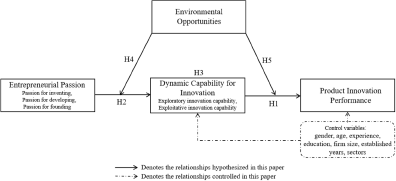
Although prior studies that introduced EP to the upper echelon perspective (Cai, Wu, & Gu, Reference Cai, Wu and Gu2020; Kiani, Yang, Ghani, & Hughes, Reference Kiani, Yang, Ghani and Hughes2021; Strese, Keller, Flatten, & Brettel, Reference Strese, Keller, Flatten and Brettel2018) have noted positive relationships between EP and firm innovation, the mechanism underlying this link is conspicuously underexplored (Kiani et al., Reference Kiani, Yang, Ghani and Hughes2021). To gain a deeper understanding of how EP is transformed into firm innovation, we explored the mediating role of DC and postulate that DC is crucial in realising the potential benefits of EP. Moreover, environmental conditions are crucial for both DC and EP, and researchers often adopt environmental dynamism as a contingency (Baron & Tang, Reference Baron and Tang2011; Colombo et al., Reference Colombo, Piva, Quas and Rossi-Lamastra2021). According to Meyer, Prashantham, & Xu (Reference Meyer, Prashantham and Xu2021), the impacts of the COVID-19 pandemic do not only increase environmental risks but also provide opportunities for entrepreneurs to expand production and to innovate. However, the effect of opportunity on the interaction between entrepreneurs and their firm’s innovation is still not known (Meyer, Prashantham, & Xu, Reference Meyer, Prashantham and Xu2021). Following the gaps discussed above, we aim to answer the following research question (Fig. 1 depicts the research model): Does EP affect innovation performance through the mediating effect of DC in SMEs, such that COVID-19 is characterised as presenting more opportunities for them?
The research model.

By testing the research question, this study contributes to the literature in several ways. First, we contribute to the literature on DC by quantitatively examining certain DC processes that characterise the COVID-19 context (Dejardin et al., Reference Dejardin, Raposo, Ferreira, Fernandes, Veiga and Farinha2023; Wang et al., Reference Wang, Hong, Li and Gao2020; Zahoor et al., Reference Zahoor, Golgeci, Haapanen, Ali and Arslan2022). We also incorporate the contextual effect of market changes, which helps to clarify when DC would be more likely to facilitate product innovation. Second, by proposing EP as an antecedent of DC, we complement the lack of emotional attributes as top managers’ characteristics are at the intersection of upper echelon theory and the DC view (Bendig et al., Reference Bendig, Strese, Flatten, da Costa and Brettel2018). This also contributes to the limited exploration of antecedents pertaining to the DC that characterises SMEs (Durán & Aguado, Reference Durán and Aguado2022; Teece, Reference Teece2012). Third, this study reveals DC as a mediator in the relationship between EP and innovation, extending our knowledge of the mechanism of top managers’ EP influence on firm-level innovation (Baron & Tang, Reference Baron and Tang2011; Drnovsek, Cardon, & Patel, Reference Drnovsek, Cardon and Patel2016; Kiani et al., Reference Kiani, Yang, Ghani and Hughes2021). Finally, investigations on the interactions between environmental issues and managers’ positive emotions towards firm innovations so far have merely explored environmental dynamism (turbulence) (Adomako, Mole, Franklin, & Murnieks, Reference Adomako, Mole, Franklin and Murnieks2023; Baron & Tang, Reference Baron and Tang2011; Cai, Wu, & Gu, Reference Cai, Wu and Gu2020). We extend this literature by investigating opportunities brought by the recent pandemic. In this way, we will be able to understand when EP predicts product innovation via DC. This helps to explain the phenomenon that during COVID-19 that some companies were able to achieve superior growth while others did not (Galindo-Martín, Castaño-Martínez, & Méndez-Picazo, Reference Galindo-Martín, Castaño-Martínez and Méndez-Picazo2021; Meyer, Prashantham, & Xu, Reference Meyer, Prashantham and Xu2021).
Following the introduction, a literature review and hypothesis development are presented in the second section. We then proceed to the methodology in the third section, and the empirical results are illustrated. Finally, a summary of the findings, theoretical contributions, practical implications, limitations, and suggestions for future research are presented.
Theory and hypotheses
Upper echelon theory and EP
Upper echelon theory suggests that organisational performance is often related to the characteristics of top managers (Hambrick & Mason, Reference Hambrick and Mason1984). Initially, the theory takes narrow views by focusing on top managers’ demographics, including age, gender, tenure and education, to explain ‘why do organisations act as they do?’ (Hambrick & Mason, Reference Hambrick and Mason1984; von den Driesch et al., Reference von den Driesch, Da Costa, Flatten and Brettel2015). However, these observable characteristics are often considered imprecise and incomplete proxies of cognitive bases (Bennat & Sternberg, Reference Bennat and Sternberg2022). Therefore, recent studies have shed more light on non-observable characteristics, such as psychological attributes and social processes, as determinants of firms’ strategic choices and performance (Bendig et al., Reference Bendig, Strese, Flatten, da Costa and Brettel2018; Hambrick, Reference Hambrick2007; Strese et al., Reference Strese, Keller, Flatten and Brettel2018).
Although this perspective is primarily leveraged among large organisations, emerging works based on SMEs have grown in popularity (for review, see White & Borgholthaus, Reference White and Borgholthaus2022). For instance, Strese et al. (Reference Strese, Keller, Flatten and Brettel2018) and Kiani et al. (Reference Kiani, Yang, Ghani and Hughes2021) found that top managers’ EP facilitate SMEs’ technological innovations. EP is defined as intense positive feelings experienced by engagement in entrepreneurial activities associated with meaningful and salient roles in self-identities, such as founder, inventor, and developer (Cardon et al., Reference Cardon, Wincent, Singh and Drnovsek2009; Murnieks, Mosakowski, & Cardon, Reference Murnieks, Mosakowski and Cardon2014). Although the upper echelon perspective has been applied to top managers’ passions for specific entrepreneurial activities, researchers have recently inquired about how and why top managers’ EP can be translated into superior innovation in SMEs, given their constraints such as fewer resources and limited budgets to collaborate with formal R&D institutions (Baron & Tang, Reference Baron and Tang2011; Bennat & Sternberg, Reference Bennat and Sternberg2022; Drnovsek, Cardon, & Patel, Reference Drnovsek, Cardon and Patel2016; Kiani et al., Reference Kiani, Yang, Ghani and Hughes2021).
The current study explains that passionate entrepreneurs are better positioned for configurating resources and aligning innovation activities with changing environments. Entrepreneurs often put considerable effort into overcoming extreme hardships in their venture journeys (Foo, Uy, & Baron, Reference Foo, Uy and Baron2009), which have become more challenging when they encounter environmental crises. Highly passionate entrepreneurs actively search for information and collect feedback when facing environmental turbulence, enabling firms to adjust and invent products and processes promptly. In addition, EP promotes one’s commitment and perseverance to their goals (Drnovsek, Cardon, & Patel, Reference Drnovsek, Cardon and Patel2016) and improves persistence (Cardon & Kirk, Reference Cardon and Kirk2015), which may offer substantial motivation for SMEs to move forward. Moreover, passionate entrepreneurs are more likely to receive support from stakeholders, such as co-operators’ support (Cai, Wu, & Gu, Reference Cai, Wu and Gu2020), project funding (Murnieks, Cardon, Sudek, White, & Brooks, Reference Murnieks, Cardon, Sudek, White and Brooks2016), and employees’ reciprocated passion responses (Hubner, Baum, & Frese, Reference Hubner, Baum and Frese2020).
DC for innovation
DC is defined as a firm’s ability to assess the business environment presciently and sustain competitiveness through the continuous reconfiguring of internal and external competencies (Teece, Reference Teece2007, Reference Teece2014). DC is likely to be more critical in highly volatile contexts because it is specifically associated with changes (Eisenhardt & Martin, Reference Eisenhardt and Martin2000; Teece, Reference Teece2014). Given that the opportunities and threats embedded in COVID-19 for high-tech SMEs to operate innovatively represent a high degree of uncertainty, DC has become a necessary component of innovation. However, the extant literature has pointed out that it is not possible to identify a generic set of DCs that can be applied in all settings (Birkinshaw, Zimmermann, & Raisch, Reference Birkinshaw, Zimmermann and Raisch2016), as external challenges vary from time to time. Here, we focus on explaining how SMEs explore new opportunities while continuing to exploit existing markets and resources. Following Birkinshaw, Zimmermann, & Raisch (Reference Birkinshaw, Zimmermann and Raisch2016), DC is known as the exploratory innovation and exploitative innovation capabilities of a firm, equating sensing capability with exploration and seizing capability with exploitation, leaving the reconfiguring capability to allow sensing and seizing to transpire. Exploratory innovation capability indicates a firm’s ability to generate or adopt new technologies to produce novel products or services, whereas exploitative innovation capability indicates a firm’s ability to utilise existing knowledge to eventually produce modified products or services (Limaj & Bernroider, Reference Limaj and Bernroider2019; Xie & Wang, Reference Xie and Wang2021). In line with DC, exploratory and exploitative innovation capabilities represent a firm’s competence to perform innovative activities. This interpretation is consistent with the theoretical perspective of ambidexterity (Birkinshaw, Zimmermann, & Raisch, Reference Birkinshaw, Zimmermann and Raisch2016; Teece, Reference Teece2014).
However, contributions of DC based on the SME context have been mainly conceptual or literature reviews (Hernández-Linares, Kellermanns, & López-Fernández, Reference Hernández-Linares, Kellermanns and López-Fernández2021; Vogel & Güttel, Reference Vogel and Güttel2013), focusing on explaining the essential nature of DC. According to Vogel and Güttel (Reference Vogel and Güttel2013), there are two primary streams of study. One focuses on specific processes, mostly related to products or technology (Lisboa, Skarmeas, & Lages, Reference Lisboa, Skarmeas and Lages2011) and knowledge-related processes (Makkonen, Pohjola, Olkkonen, & Koponen, Reference Makkonen, Pohjola, Olkkonen and Koponen2014). These studies identify boundary conditions such as environmental crises (Zouaghi, Sánchez, & Martínez, Reference Zouaghi, Sánchez and Martínez2018) and firm size (Battisti & Deakins, Reference Battisti and Deakins2017; Clampit et al., Reference Clampit, Lorenz, Gamble and Lee2022). This stream presents equivocal empirical evidence that the influence of DC on SMEs seems context-dependent. For example, Clampit et al. (Reference Clampit, Lorenz, Gamble and Lee2022) declared that the positive link between DC and performance was more salient in smaller firms during COVID-19. Another stream focuses on the antecedents of DC, such as resource stock and firm strategy (Monferrer, Moliner, Irún, & Estrada, Reference Monferrer, Moliner, Irún and Estrada2021). However, our knowledge of the antecedents of DC remains limited. In particular, the role played by the top managers (Durán & Aguado, Reference Durán and Aguado2022; Vogel & Güttel, Reference Vogel and Güttel2013), as proposed by Eisenhardt and Martin (Reference Eisenhardt and Martin2000), and Teece (Reference Teece2014), is one of the most important factors of DC.
DC and product innovation performance
Environmental crises often jeopardise firms’ resources (Battisti & Deakins, Reference Battisti and Deakins2017). In the case of the COVID-19 pandemic, most of the firms faced supply shortages and losses of key customers due to mandatory lockdowns, causing managers and staff to experience greater mental health risks (e.g., stress, anxiety, fear of dismissal) and therefore slowed down firms’ innovation (Zahoor et al., Reference Zahoor, Golgeci, Haapanen, Ali and Arslan2022). Nevertheless, COVID-19 also opened up new opportunities (Wang et al., Reference Wang, Hong, Li and Gao2020), such as the growing demand for healthcare products, widely adopted virtual meetings, robotic usage, and big data technologies (Zahoor et al., Reference Zahoor, Golgeci, Haapanen, Ali and Arslan2022). Thus, high-tech firms were allowed to take advantage by offering new products to fulfil growing market demands, as well as upgrading operational processes by using digital technologies (Meyer, Prashantham, & Xu, Reference Meyer, Prashantham and Xu2021).
DC is particularly useful when firms face such challenges, as it enables firms to create, extend and modify resource bases (Helfat et al., Reference Helfat, Finkelstein, Mitchell, Peteraf, Singh, Teece and Winter2007). In particular, high-tech SMEs that have not yet developed formalised routines or suffer from organisational inertia are better positioned to quickly implement product innovation through DC (Clampit et al., Reference Clampit, Lorenz, Gamble and Lee2022; Dejardin et al., Reference Dejardin, Raposo, Ferreira, Fernandes, Veiga and Farinha2023). In line with Birkinshaw, Zimmermann, & Raisch (Reference Birkinshaw, Zimmermann and Raisch2016), exploration and exploitation are two specific DC processes. Exploration refers to managerial improvisation, emergent technologies, learning, and experimentation with new alternatives (Atuahene-Gima, Reference Atuahene-Gima2005; March, Reference March1991). Facing more opportunities, high-tech SMEs can reap benefits from exploratory DC by improving day-to-day operational processes and reconsidering product offerings. As explorative firms value breakthrough technologies and experimentation, they are more likely to apply emergent technologies to their work processes than firms with low exploratory capabilities (Coreynen, Matthyssens, Vanderstraeten, & van Witteloostuijn, Reference Coreynen, Matthyssens, Vanderstraeten and van Witteloostuijn2020). According to high-tech SMEs in Finland, such adoption of emergent technologies, such as smart offices, internet of things, and big data analytics, can help them comfort employees’ mental strain, gain new customers more easily and detect changes in customers’ needs (Zahoor et al., Reference Zahoor, Golgeci, Haapanen, Ali and Arslan2022). Therefore, exploratory DC may help SMEs renew resources to mitigate COVID-19-induced resource destruction while spotting opportunities in market needs.
Once opportunities are sensed, SMEs also need exploitative DC to seize opportunities in a restricted resources situation (Battisti & Deakins, Reference Battisti and Deakins2017; Colombo et al., Reference Colombo, Piva, Quas and Rossi-Lamastra2021; Hernández-Linares, Kellermanns, & López-Fernández, Reference Hernández-Linares, Kellermanns and López-Fernández2021). The Ford Motor Company leveraged their vehicle fan and three-dimensional printing technologies to produce simplified versions of respirators, and plastic face shields for critical needs in 2020 (Mich, 2020) providing a good example of exploitation. Exploitation means that innovation relies on cultivating existing technologies that increase productivity, efficiency, and reliability in product development activities (Atuahene-Gima, Reference Atuahene-Gima2005; March, Reference March1991). Such incremental changes help firms seize opportunities by improving their established designs and expanding their existing technology to fulfil emerging market needs (Jansen, Van Den Bosch, & Volberda, Reference Jansen, Van Den Bosch and Volberda2006). In the context of COVID-19, DC involves the ability of organisations to modify and renew their technologies and work processes in conjunction with the deployment of existing resources. Therefore, exploratory and exploitative DCs are both significant for high-tech SMEs’ product innovation. Thus, we propose the following hypothesis:
Hypothesis 1: The DC of high-tech SMEs for innovation is positively related to their product innovation performance.
EP, DC, and product innovation performance
Prior literature on DC and upper echelons (Hambrick & Mason, Reference Hambrick and Mason1984; Helfat et al., Reference Helfat, Finkelstein, Mitchell, Peteraf, Singh, Teece and Winter2007; Teece, Reference Teece2014) highlighted the particular influence of top managers on firms’ development of DCs. Until recent years, empirical studies identified top managers’ characteristics, such as demographics (von den Driesch et al., Reference von den Driesch, Da Costa, Flatten and Brettel2015), core self-evaluation (Bendig et al., Reference Bendig, Strese, Flatten, da Costa and Brettel2018; von den Driesch et al., Reference von den Driesch, Da Costa, Flatten and Brettel2015), and transformational leadership (Chang, Bai, & Li, Reference Chang, Bai and Li2015; Friedman, Carmeli, & Tishler, Reference Friedman, Carmeli and Tishler2016), as critical micro-foundations of DCs. These studies revealed that top managers influence DC primarily in three ways: their behaviours and cognitions as essential motivations for DC development; their influence on social processes inside and outside of organisations and organisational climate building. However, the understanding of the emotional attributes that influence DC remains limited (Bendig et al., Reference Bendig, Strese, Flatten, da Costa and Brettel2018), especially in SMEs. Through the concept of EP, our study fills this gap, arguing that EP can facilitate the above-mentioned three paths, and, in turn, strengthens DCs of high-tech SMEs.
From the motivation perspective, managers with a high passion for entrepreneurial activities often set up challenging goals and put in numerous efforts (Drnovsek, Cardon, & Patel, Reference Drnovsek, Cardon and Patel2016), even when encountering unforeseen impediments (Cardon et al., Reference Cardon, Wincent, Singh and Drnovsek2009), such as COVID-19. To realise entrepreneurial goals, passionate entrepreneurs search substantial information about new technologies and changes in market needs (Kars-Unluoglu & Kevill, Reference Kars-Unluoglu and Kevill2021; Ma, Gu, & Liu, Reference Ma, Gu and Liu2017). Therefore, their firm’s strategies value exploration and radical innovation (Cai, Wu, & Gu, Reference Cai, Wu and Gu2020; Luu & Nguyen, Reference Luu and Nguyen2021; Strese et al., Reference Strese, Keller, Flatten and Brettel2018), which puts them in a better position to sense opportunities. Meanwhile, EP also enhances entrepreneurs’ cognitive flexibility and creative thinking (Baron & Tang, Reference Baron and Tang2011; Fredrickson, Reference Fredrickson2001), enabling them to create unusual associations between resources (Klaukien, Shepherd, & Patzelt, Reference Klaukien, Shepherd and Patzelt2013). Thus, it allows firms to recombine and configure the resources at hand to exploit sensed opportunities, thus manifesting enhanced DC.
From the social process perspective, EP influences DC by facilitating resource bases. Investors value the spirit of passion because passionate entrepreneurs often display innovation-friendly leadership (Murnieks et al., Reference Murnieks, Cardon, Sudek, White and Brooks2016). Thus, they are likelier to receive investments than those with low passion. Network partners also tend to cooperate with passionate entrepreneurs (Cai, Wu, & Gu, Reference Cai, Wu and Gu2020). These investments and cooperation offer SMEs timely funding and market insights. Moreover, the contagious nature of positive emotions could transfer top managers’ passions to employees (Cardon, Reference Cardon2008), which arouses staff members’ passion responses (Hubner, Baum, & Frese, Reference Hubner, Baum and Frese2020). Such a transition promotes employees’ identification with top managers’ passion-directed goals, enabling goal clarity, creativity, and commitment (Hubner, Baum, & Frese, Reference Hubner, Baum and Frese2020; Makino, Caleb, Li, & Li, Reference Makino, Caleb, Li and Li2020). This, in turn, helps develop an innovation-friendly atmosphere and constantly evolve within organisations, which prevents firms to stick with past strategies (Bennat & Sternberg, Reference Bennat and Sternberg2022; Lee & Kelley, Reference Lee and Kelley2008; von den Driesch et al., Reference von den Driesch, Da Costa, Flatten and Brettel2015). Based on the preceding arguments, we propose the following hypothesis:
Hypothesis 2: Managers’ or entrepreneurs’ EP is positively related to high-tech SMEs’ DC for innovation.
Drawing on DC and upper echelon theory, we hypothesise that top managers’ EP will help SMEs achieve better product innovation via sensing and seizing opportunities during COVID-19. Prior research has argued that EP might indirectly affect firm innovation (Baron & Tang, Reference Baron and Tang2011; Kiani et al., Reference Kiani, Yang, Ghani and Hughes2021). For example, Baron and Tang (Reference Baron and Tang2011) examined the full mediating role of entrepreneurs’ creativity, and Kiani et al. (Reference Kiani, Yang, Ghani and Hughes2021) found a partial mediating role of entrepreneurial orientation at the firm level. However, this understanding is still limited. Although passionate entrepreneurs tend to be sensitive to opportunities, competitors may also notice the same opportunities. However, firms with stronger DC are more likely to seize opportunities, and such capability is often difficult to imitate by their counterparts (Hernández-Linares, Kellermanns, & López-Fernández, Reference Hernández-Linares, Kellermanns and López-Fernández2021; Lisboa, Skarmeas, & Lages, Reference Lisboa, Skarmeas and Lages2011). Furthermore, resources brought out by passionate entrepreneurs may not help them develop popular products automatically. Nevertheless, firms with DC are more likely to develop competitive products and market growth because they offer a transfer process for firms to integrate and refine knowledge and technologies and supplement complementary resources. Consequently, EP can strongly increase SMEs’ product innovation performance by developing DC. Thus, we propose the following hypothesis:
Hypothesis 3: The relationship between managers’ or entrepreneurs’ EP and high-tech SMEs’ product innovation performance is mediated by DC for innovation.
Moderating role of environmental opportunities
As proposed above, an indirect relationship between EP and product innovation performance through DC for innovation may exist in SMEs. However, both upper echelon theory (Hambrick & Mason, Reference Hambrick and Mason1984) and DC view (Eisenhardt & Martin, Reference Eisenhardt and Martin2000) highlight contextual issues. With the influence of COVID-19, we focus on the opportunities derived from it. To some extent, these opportunities, such as accelerated digitalisation, growing demands for no-touch service, and critical needs of contagion-protection products, benefit SMEs heterogeneously (Galindo-Martín, Castaño-Martínez, & Méndez-Picazo, Reference Galindo-Martín, Castaño-Martínez and Méndez-Picazo2021). For example, companies that primarily operate in contagion-protection, service robots, and home delivery businesses were better positioned to reap the rewards. It is thus impossible to apply a specific opportunity to all SMEs since they view opportunities multifariously. Instead, the current study is in line with Yuan, Bao and Olson (Reference Yuan, Bao and Olson2017) and defines opportunity from a broad angle: ‘a positive situation in which gain is likely and over which one has a fair amount of control’ (p. 313). There are grounds for predicting that opportunities moderate both the link between EP and DC and the link between DC and product innovation.
In terms of the relationship between EP and DC, previous research suggested environmental issues can affect entrepreneurial managers in the processes of dealing with information, relational support, and resource deployment (Baron & Tang, Reference Baron and Tang2011; Lee & Kelley, Reference Lee and Kelley2008). Positive feelings are approach-oriented emotions (Welpe, Spörrle, Grichnik, Michl, & Audretsch, Reference Welpe, Spörrle, Grichnik, Michl and Audretsch2012), which can promote information-seeking activities under turbulent markets (Cai, Wu, & Gu, Reference Cai, Wu and Gu2020). The searching processes generate sufficient market information which enable the managers to filter opportunities and analyse market trends. With less ambiguous understandings, SMEs can enhance their growth through exploratory and exploitative innovations to match emerging demands in the market, while reducing resource wastes caused by trial and error (Santos-Vijande & Álvarez-González, Reference Santos-Vijande and Álvarez-González2007). Moreover, opportunities provide signals for SMEs’ stakeholders with a sense of hope and direction, such an inspiration fosters the willingness of co-operators and project leaders to engage in more cooperative innovation activities. Thus, compared with firms that encounter fewer opportunity in COVID-19, firms exposed to more opportunities will experience greater EP effects on DC.
In terms of the relationship between DC and product innovation performance, this link also may be moderated by opportunities. The success of product innovation in a turbulent environment depends on whether SMEs can buffer and shape new values of resources (Sheng, Reference Sheng2017). However, as Furr and Eisenhardt (Reference Furr and Eisenhardt2021) outlined, resource values are relatively unstable and ambiguous in high-uncertainty contexts, due to incomplete information. Thus, market opportunities can serve as guidelines, which makes them invaluable resources. For example, SMEs can exploit their existing technology by combining it with a new one to form technological hybrids or apply them to other projects. Also, the opportunities can enlighten SMEs to explore product portfolios and reduce the possibility of falling into the trap of trial-and-error experiments. Thus, we propose the following hypotheses:
Hypothesis 4: Environmental opportunities moderate the positive relationship between EP and DC for innovation, such that this relationship is stronger in SMEs with more opportunities.
Hypothesis 5: Environmental opportunities moderate the positive relationship between DC for innovation and product innovation performance, such that this relationship is stronger in SMEs with more opportunities.
Hypothesis 6: Environmental opportunities moderate the strength of the mediated relationship between EP and product innovation performance via DC for innovation, such that this indirect relationship is stronger in SMEs with more opportunities than those with fewer opportunities.
Methods
Sampling
To test these hypotheses, a survey, which considered high-tech SMEs in Shanghai, Guangdong, Jiangsu, Zhejiang, and Fujian provinces in China, was conducted. Due to their strong innovation capabilities and leading positions in R&D investment (From Communiqué on national expenditures on science and technology in 2021, by National Bureau of Statistics (2022) (http://www.stats.gov.cn/english/PressRelease/202209/t20220901_1887829.html)), the southern coastal region provides a good research setting to test our hypotheses. China, as the world’s second-largest economy and one of the first countries to be affected by the COVID-19 crisis (Wang et al., Reference Wang, Hong, Li and Gao2020), is able to recover faster than other economies (Meyer, Prashantham, & Xu, Reference Meyer, Prashantham and Xu2021). With the promulgation of the Entrepreneurship Promotion Law in China, SMEs have become the major market players (90%) (Financial Research Centre, 2022). These firms account for a large share of economic growth, and are the leading group for innovation, contributing 68.4% of patent R&D and more than 60% of the national GDP (Financial Research Centre, 2022). In this sense, the capabilities that SMEs have developed to innovate under volatile situations (e.g., COVID-19 pandemic) are the crucial factors for addressing emerging market needs and ensuring economic recovery (Colombo et al., Reference Colombo, Piva, Quas and Rossi-Lamastra2021; Meyer, Prashantham, & Xu, Reference Meyer, Prashantham and Xu2021). In this study, privately owned SMEs with fewer than 300 employees (From Measures for the classification of large, medium, small and micro enterprises in statistics, by National Bureau of Statistics (2018) (http://www.stats.gov.cn/sj/tjbz/gjtjbz/202302/t20230213_1902763.html)) will be included.
To avoid linguistic bias in our survey, a preliminary test was conducted. We initially prepared the questionnaire in English. Two doctoral students in management were invited to translate it into Chinese independently, and two experts in management research modified the accuracy of the translation. The questionnaire was piloted with 13 managers in the high-tech industry to ensure the comprehensiveness of the items. After several rounds of modification, a snowball sampling technique was employed. The researchers contacted administrators from high-tech industrial parks or high-tech incubators via their social network (guanxi) (Chen & Chen, Reference Chen and Chen2004); thus, they issued online questionnaires to top managers who were the founders or venture team members of SMEs. With the help of these participants, the researchers were able to further contact their business partners for the participation (77.9% were CEO and 22.1% were CMO or CTO) in the study. This sampling approach has also been applied in previous crisis-context studies (Maher & Mady, Reference Maher and Mady2010).
To sum up, a total of 507 top managers were invited to participate in the study between October and December 2021. We obtained data from 291 firms, with a response rate of 57.4%. We further checked the respondents’ answers; 96 responses were eliminated owing to missing data and participants being middle managers. Finally, 195 samples were used, which is comparable to previous EP studies conducted in China (Cai, Wu, & Gu, Reference Cai, Wu and Gu2020; Ma, Gu, & Liu, Reference Ma, Gu and Liu2017). The descriptive results report the background information of managers and their SMEs. In terms of managers, the majority were male (74.4 %), aged between 28 and 40 (84.1 %), and had one to two venture experiences (84.6 %). A total of 91.8 % of their education was university (16 years). In terms of firms, 89.7% were new ventures (<8 years), with a mean value of 4.8 years and a mean size of 78 full-time employees. Of these, six high-tech industries were included: electronics and communication (39.0%), computer and office equipment manufacturing (16.4%), medical instrument manufacturing (15.9%), information service (17.9%), e-commerce (7.2%), and supply chain (3.6%). These industries were then categorised into high-tech manufacturing (71.3%), service (25.1%), and other high-tech-related sectors (3.6%) based on the sector classifications set by the National Bureau of Statistics of China on high-tech firms.
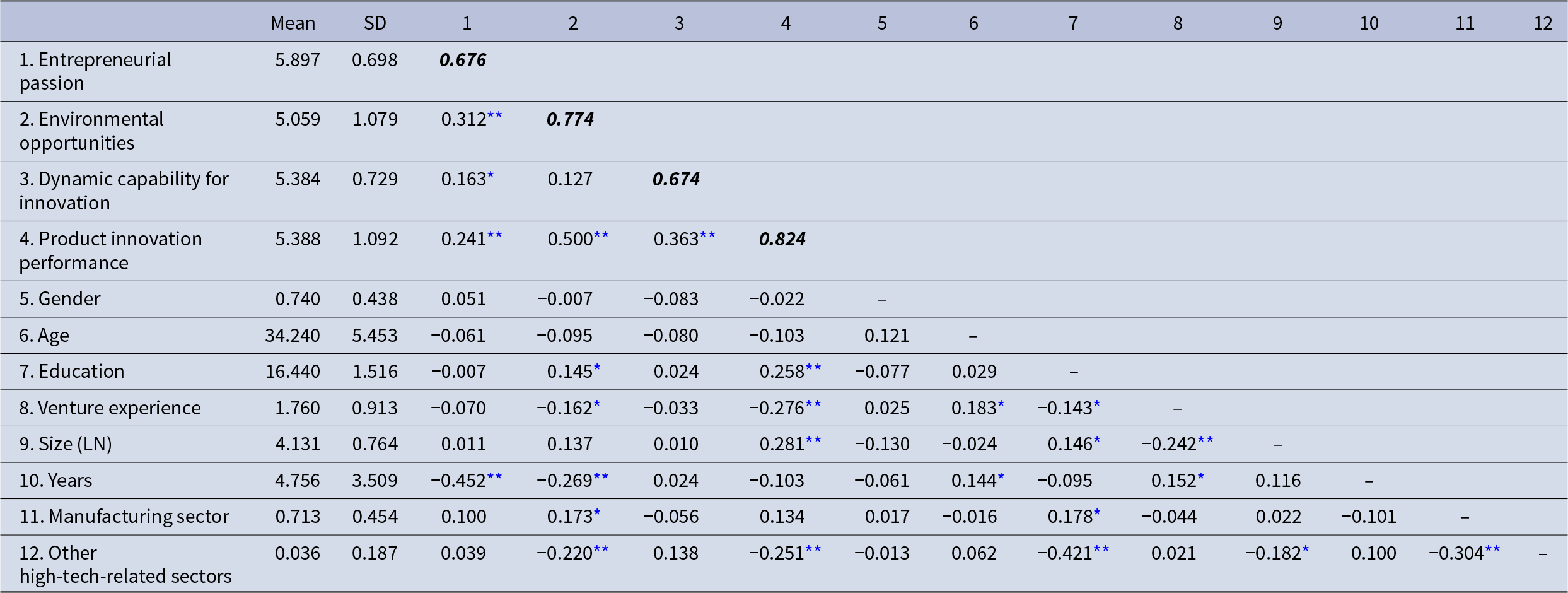
To test for the non-response bias, we compared the difference between one-third of the earlier respondents and one-third of the last responses (Armstrong & Overton, Reference Armstrong and Overton1977). t-Tests for independent samples indicated no statistically significant difference in the industries that each high-tech SMEs belonged to (P > 0.05), firm sizes (P > 0.05), or established years (P > 0.05). Therefore, we concluded that the data set was robust against non-response bias. Table 1 summarises the mean values, standard , and correlation statistics of the variables.
Descriptive and correlation analysis

Note: N = 195. SD, standard deviation. Size (LN), natural logarithm of numbers of employee. Along-diagonal (italic), square root of average variance extracted.
* p < .05, **p < .01.
Measures
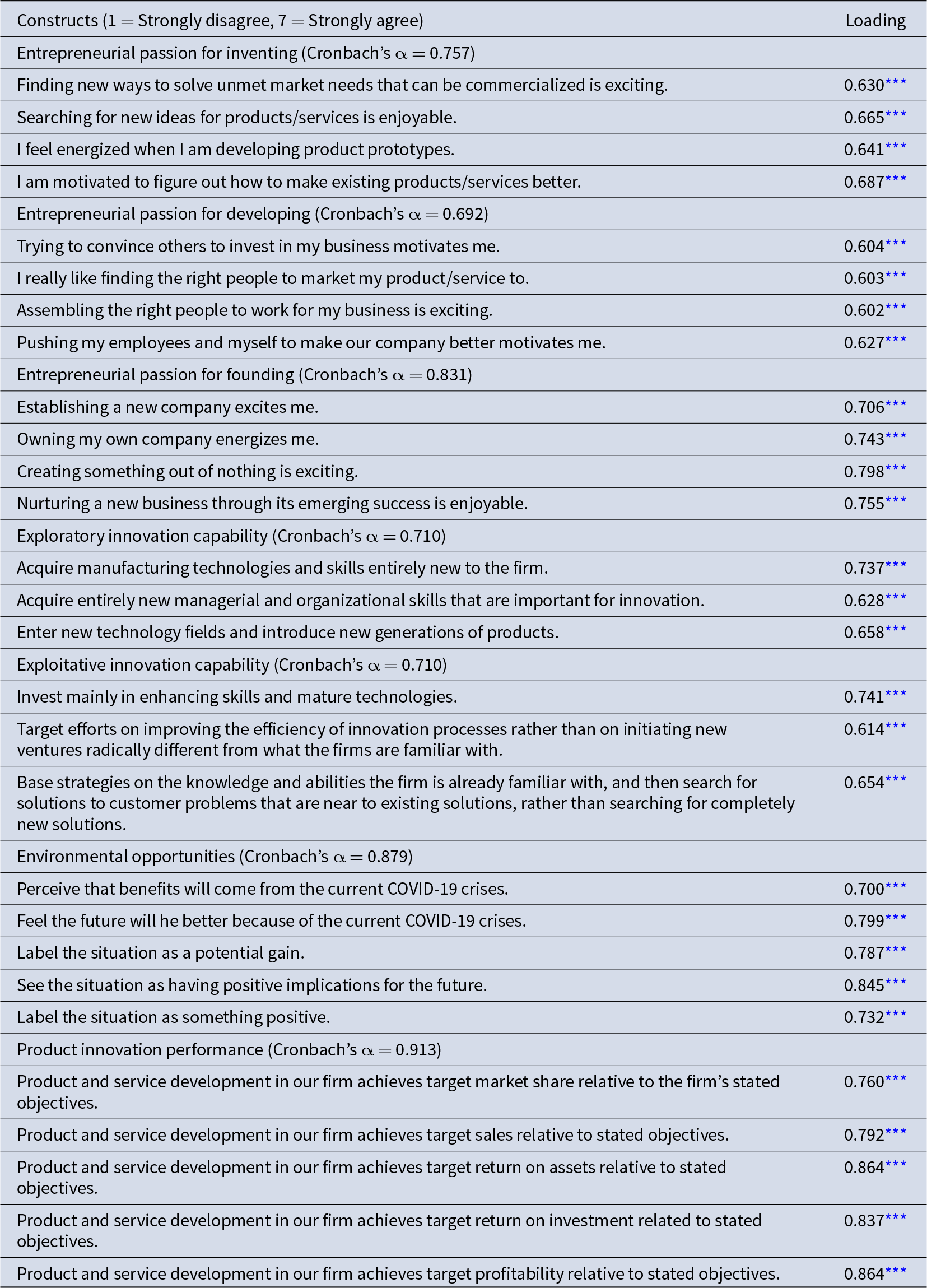
All variables were measured on a 7-point Likert scale ranging from 1 = strongly disagree to 7 = strongly agree. The details of the items are listed in Table 2.
Measurement items and factor loadings

Note: N = 195.
*** p < .001.
Entrepreneurial passion
The independent variable was measured using the scale developed by Cardon, Gregoire, Stevens, and Patel (Reference Cardon, Gregoire, Stevens and Patel2013), with 10 items capturing three specific domains of positive feelings. There are passions for inventing, founding, and developing firms. We adopted Drnovsek, Cardon, & Patel (Reference Drnovsek, Cardon and Patel2016)’s updated version for the high-tech context with five additional items derived from an exploratory factor analysis (see Drnovsek, Cardon, & Patel, Reference Drnovsek, Cardon and Patel2016, pp. 203, 213). In total, 15 items were included for measuring three domains of passion. However, we excluded three items (one for each dimension) due to poor factor loadings in the confirmatory factor analysis (CFA). The remaining 12 items make up our final measuring instrument for EP. Each type of passion was averaged to reflect an entrepreneur’s intense positive feelings. The overall EP intensity was represented by the mean value of the three dimensions. Cronbach’s α for the three dimensions was 0.88. Passion for inventing was 0.76, passion for founding was 0.83, and passion for development was 0.69.
DC for innovation
The mediator was measured by six items (Xie, Gao, Zang, & Meng, Reference Xie, Gao, Zang and Meng2020; Xie & Wang, Reference Xie and Wang2021), including two dimensions: three items for exploratory innovation capability, representing the extent to which SMEs obtain new technologies and managerial skills to penetrate new markets. Another three items for exploitative innovation capability capture how SMEs improve the quality of existing technology and innovation processes to seek solutions to consumers’ demands. The Cronbach’s α for each dimension was 0.71.
Environmental opportunities
Moderator was measured by a 5-item scale adopted from Yuan et al. (Reference Yuan, Bao and Olson2017). Originally, Yuan et al., who considered a broad angle, defined opportunity by asking top managers to provide a subjective interpretation of the environment. They had applied this approach to the global economic crisis in the late 2000s. The following sample items were utilised: ‘Perceive that benefits will come from the current economic crises’ and ‘Feel the future will be better because of the current economic crises’. With the following reasons, this measure was then modified to test a COVID-19 context in this study: first, COVID-19-induced opportunities which are different from the traditional environmental opportunities may have heterogeneous impact on all individual SMEs. It is thus not possible to apply a specific opportunity measure, including digitalisation, marketing, technological production, etc. to all SMEs. Defining opportunity with a broad angle perspective enables us to include all SMEs during COVID-19; second, top managers often possess the most comprehensive overview of the entire firm, and their interpretation can precisely present the degree to which their firms encounter COVID-19-induced opportunities. Sample of our modified items were ‘Perceive that benefits will come from the current COVID-19 crises’ and ‘Feel the future will he better because of the current COVID-19 crises’. The Cronbach’s α was 0.88.
Product innovation performance
The dependent variable was measured using a 5-item scale developed by De Luca and Atuahene-Gima (Reference De Luca and Atuahene-Gima2007), which evaluates performance based on how good SMEs’ product innovation meets their stated objectives. Cronbach’s α for the five items was 0.91.
Control variables
At the firm level, we controlled for the sector, firm size, and year of establishment. Sectors were used to control product features, and were divided into high-tech manufacturing, high-tech service, and other high-tech-related sectors (i.e., high-tech-related supply chain). Firm size and established years may relate to the accessibility of resources in innovations. We measured firm size using the natural logarithm of the current number of full-time employees (Strese et al., Reference Strese, Keller, Flatten and Brettel2018). Meanwhile, in line with previous EP studies from the perspective of upper echelon (Cai, Wu, & Gu, Reference Cai, Wu and Gu2020; Kiani et al., Reference Kiani, Yang, Ghani and Hughes2021; Strese et al., Reference Strese, Keller, Flatten and Brettel2018), we controlled for top managers’ age, gender, education, and prior venture experience to rule out the alternative explanations for the proposed relationships because these managerial attributes can also influence firm DCs and innovation (von den Driesch et al., Reference von den Driesch, Da Costa, Flatten and Brettel2015). Top managers’ education and age may relate to resources acquired from their social networks. Their problem-solving styles and thinking modes may vary based on gender. The experience of entrepreneurs was also controlled, as experienced entrepreneurs may be more effective in resource configuration (von den Driesch et al., Reference von den Driesch, Da Costa, Flatten and Brettel2015), and was measured by the number of entrepreneurs engaged in entrepreneurial activities.
Results
Reliability and validity
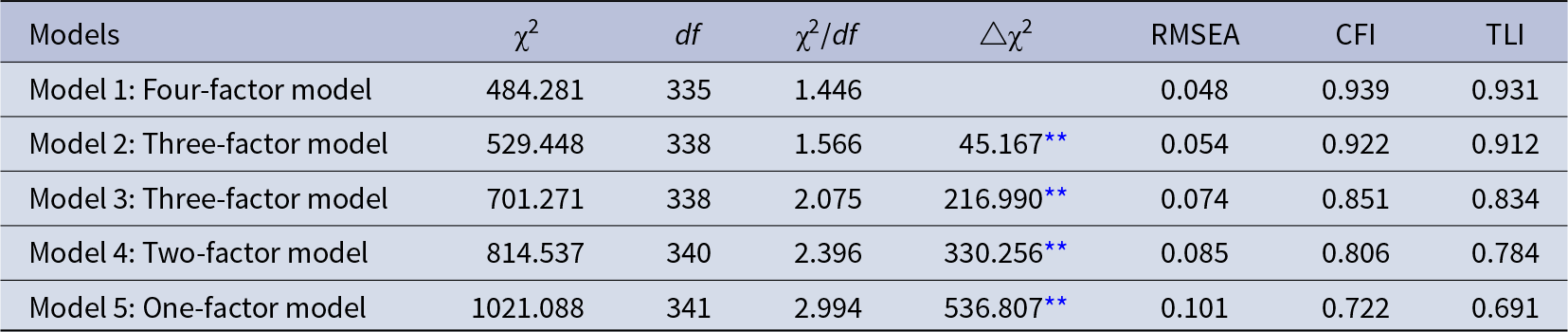
We used AMOS v.24 to conduct CFA. All standardised factor loadings (range from 0.602 to 0.864) for each item were above the necessary threshold of 0.5 (Hair, Anderson, Babin, & Black, Reference Hair, Anderson, Babin and Black2010) and were significant at the 0.001 level. Using the maximum likelihood estimator, the model fit indices indicate that our hypothesised model fits the data well (ꭓ2/df = 1.446 < 3; CFI = 0.939 > 0.9; TLI = 0.931 > 0.9; RMSEA = 0.048 < 0.08). Items included in our questionnaire were selected from the scales developed previously, and all statements were modified with suggestions from research scholars and managers, which secured construct validity. We further calculated composite reliability (CR) and average variance extracted (AVE) for each construct. All four variables showed excellent CR, EP (0.90), environmental opportunities (0.88), DC (0.83), and product innovation performance (0.91), higher than the 0.7 cut-off value (Fornell & Larcker, Reference Fornell and Larcker1981). The AVE values for product innovation performance (0.68) and environmental opportunities (0.60) reached the 0.5 cut-off value (Fornell & Larcker, Reference Fornell and Larcker1981), but EP’s 0.46 and DC for innovations 0.45 were below the cut-off value. However, the square root of AVE of EP and DC was higher than their correlation coefficients with other constructs (as present in Table 1), which indicated that items of EP and DC explained their variance more than other constructs. Additionally, the measurement models were compared, as presented in Table 3. Upon comparing the hypothesised model to the four alternative models, the fit indices indicated that our hypothesised model best fit the data. Chi-square differences between the hypothesised model and alternatives were significant, supporting discriminant validity. Thus, we conclude that the four measurements have acceptable reliability and validity.
Measurement model comparison

Note: N = 195. Model 1: hypothesized four-factor model; Model 2: combine entrepreneurial passion and dynamic capability for innovation; Model 3: combine entrepreneurial passion and environmental opportunities; Model 4: combine environmental opportunities, dynamic capability for innovation and product innovation performance; Model 5: combine all variables;
** p < .01.
Furthermore, our data from a cross-sectional survey may suffer from common method variance (CMV) (Podsakoff, MacKenzie, Lee, & Podsakoff, Reference Podsakoff, MacKenzie, Lee and Podsakoff2003). We tested this with Harman’s single-factor test (Podsakoff & Organ, Reference Podsakoff and Organ1986) and a common latent factor analysis (Podsakoff et al., Reference Podsakoff, MacKenzie, Lee and Podsakoff2003). The Harman’s test showed that all items accounted for 63.5% of the variance. The first factor only accounted for 26.6% of the variance; by restricting all items of the model to load on a common single factor, the common latent factor did not provide a good fit for the data: ꭓ2/df = 2.994; RMSEA = 0.101; CFI = 0.722; TLI = 0.691. This suggests that CMV was unlikely to be a serious concern in our study.
Hypothesis testing
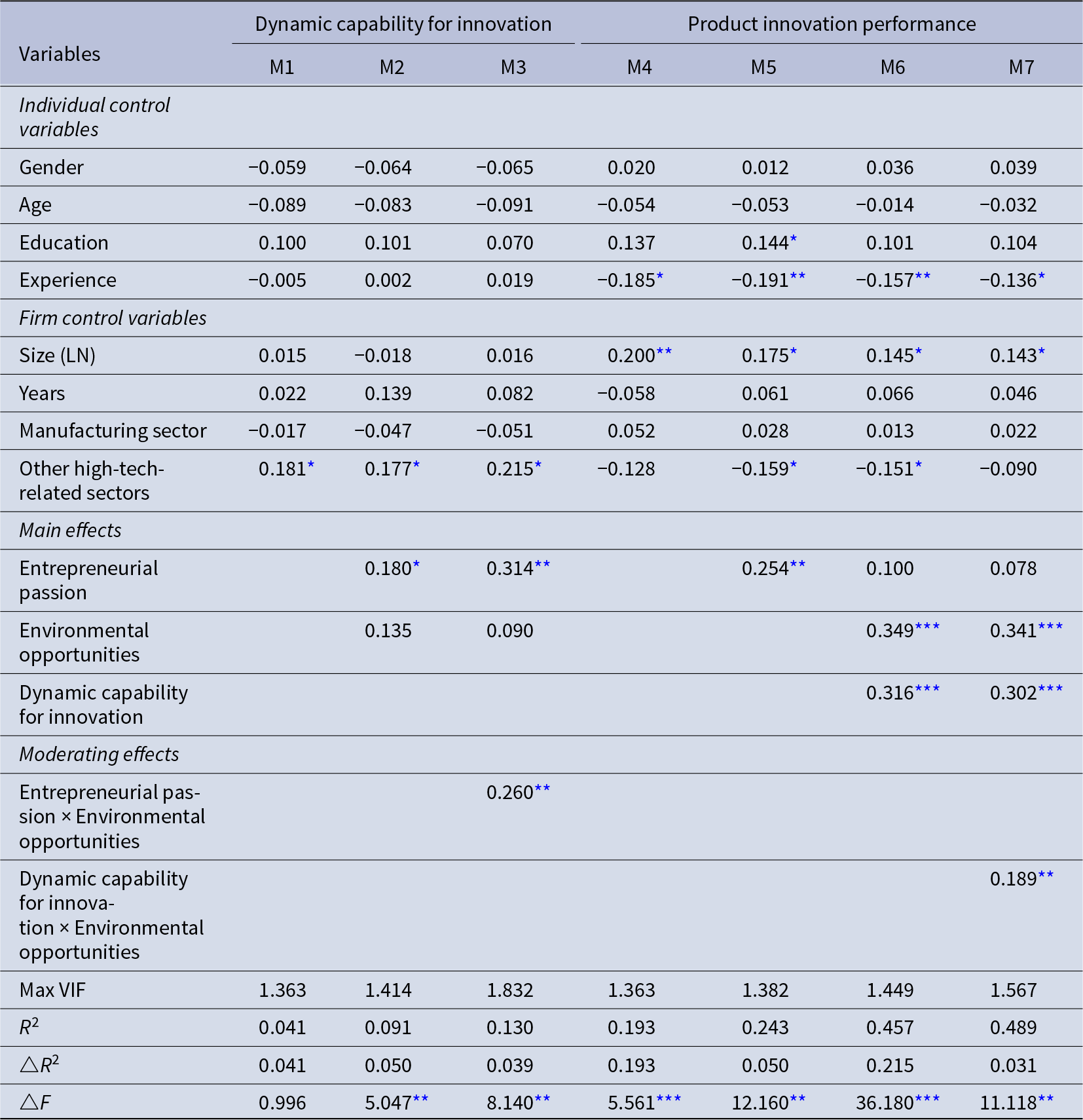
Simple correlation analysis showed that all variables were positively correlated (except the relationship between mediator and moderator), lending preliminary support to our hypotheses. Then, we first assessed the variables’ relationship by using hierarchical regression analyses in SPSS v.25; the results are presented in Table 4. The maximum variance inflation factor (VIF) across all regression models in our results was 1.832 (<2), indicating that multicollinearity was not a problem (Hair et al., Reference Hair, Anderson, Babin and Black2010).
Regression analysis

Notes: N = 195. Standardized regression coefficients were reported. Gender, male = 1, female = 0. Size (LN), natural logarithm of numbers of employee. Sector, manufacturing = 1, other high-tech-related sectors = 1, service = 0.
* p < .05, **p < .01, ***p < .001.
DC for innovation is the dependent variable. We included firm (established years, firm size, sector) and individual (age, gender, education, experience) information as control variables in M1; only other high-tech-related sectors had a significant coefficient. When the independent variable (EP) and moderator (environmental opportunities) were added to M2, the R 2 value increased from 0.041 for M1 to 0.091, and the F-value changed significantly. The results show that EP has a positive association (β = 0.180, p < .05) with DC for innovation, while the moderator has not, confirming Hypothesis 2. We further added the interaction between EP and environmental opportunities into M3, yielding a significant F-value change, and a significant moderating effect was found (β = 0.260, p < .01), confirming Hypothesis 4.
Among the control variables (age, gender, education, experience, established years, firm size, sectors), firm size (β = 0.200, p < .01) was positively and significantly related to product innovation performance in M4, while entrepreneurial experience presented a negative relationship (β = −0.185, p < .05). This negative relationship could be explained by Herrmann and Nadkarni’s (Reference Herrmann and Nadkarni2014) argument that experienced managers are more committed to the status quo than those with less experience. After adding EP (independent variable) to M5, R 2 increased by 0.050, and the F-value also changed significantly. A positive association was found between EP and product innovation performance (β = 0.254, p < .01). Further, we added DC for innovation (mediator) and environmental opportunities (moderator) to M6, and a significant positive association was found between DC for innovation and product innovation performance (β = 0.316, p < .001) after controlling for other exogenous variables. Thus, Hypothesis 1 received support. Finally, the interaction between mediator and moderator was added into M7, yielding a significant moderating effect of opportunities on the relationship between DC and product innovation performance (β = 0.189, p < .001), which supported our Hypothesis 5. Meanwhile, the regression coefficient between EP and product innovation performance decreased and became insignificant when DC and environmental opportunities were added to the regression model. This led us to further estimate the mediating role of DC for innovation and conditional mediation effects.
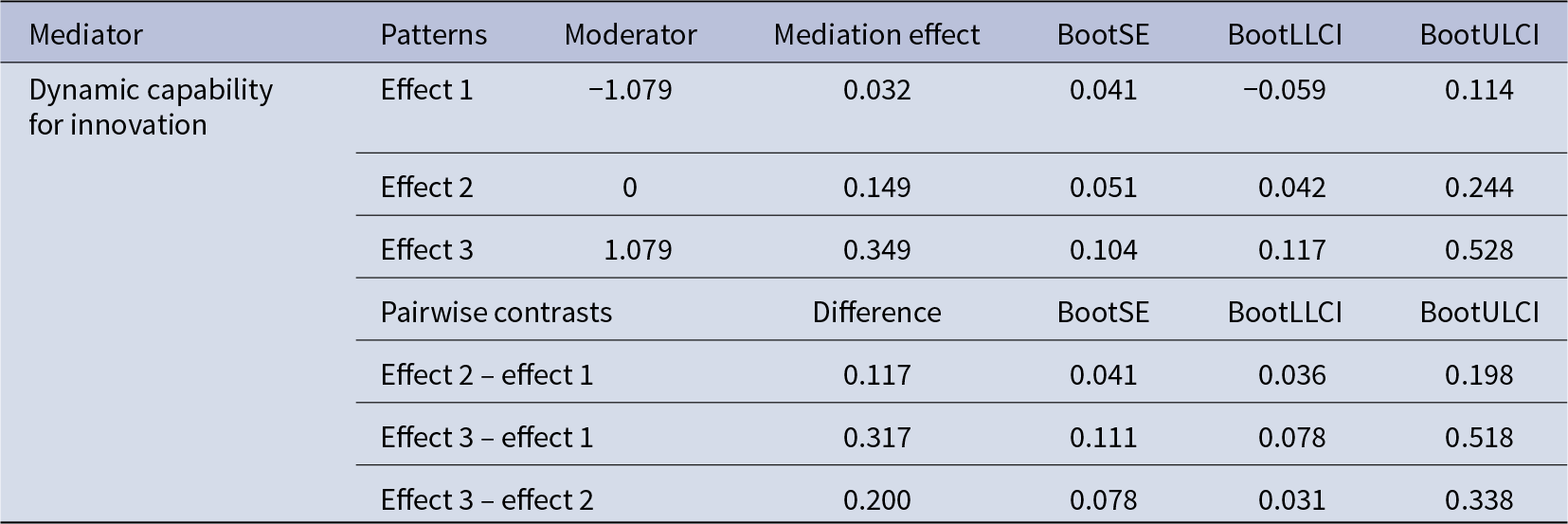
To test our mediation hypothesis, we first ruled out the contextual effect of COVID-19 (moderator). Following the suggestion of Preacher and Hayes (Reference Preacher and Hayes2008), we performed the bias-corrected bootstrapping procedure to further test Hypothesis 3 in the PROCESS macro (bootstrapping = 5,000) (Model 4; Hayes, Reference Hayes2017). The total effect of EP on product innovation performance is 0.397 (95% CI [0.172, 0.621]). The indirect effect of EP on product innovation performance via DC was also positive, with an unstandardised indirect effect of 0.119 (95% CI [0.010, 0.269]). Therefore, Hypothesis 3 is supported. After that, we included the contextual effect of COVID-19 (moderator) and conducted another resampling test in the PROCESS macro (Model 58, bootstrapping = 5,000). We tested the conditional indirect effect of DC for innovation by operationalising environmental opportunities at low, medium, and high levels (mean, mean ± 1SD). Table 5 shows that the conditional indirect effects of EP on product innovation performance via DC were significant in both moderate and high levels of opportunity conditions (indirect effect = 0.149 and 0.349), but insignificant when opportunities are relatively scarce (indirect effect = 0.032). The pairwise contrasts showed significant differences among the three patterns, which supported our moderated mediation Hypothesis 6.
Moderated mediation test

Notes: N = 195. Bias-corrected bootstrapping = 5,000. SE, standard error. CI, confidence interval, LL, lower limit, UL, upper limit.
Discussion
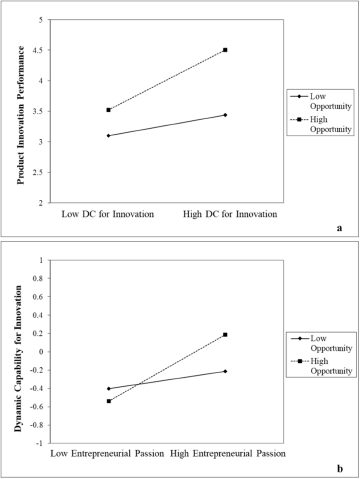
Drawing from the upper echelon theory (Hambrick, Reference Hambrick2007; Hambrick & Mason, Reference Hambrick and Mason1984) and DC literature (Eisenhardt & Martin, Reference Eisenhardt and Martin2000; Teece, Reference Teece2014), this study shows how and when top managers in SMEs can facilitate product innovation through the existence of EP and DC. Drawing from 195 Chinese high-tech SMEs under the COVID-19 pandemic, our data show four important findings: First, the results, which are consistent with recent theoretical arguments (Puliga & Ponta, Reference Puliga and Ponta2022; Wang et al., Reference Wang, Hong, Li and Gao2020) indicate that the DC of high-tech SMEs is significantly related to product innovation performance (Hypothesis 1). Second, as we have expected, top managers’ positive emotions towards entrepreneurial activities are critical micro-foundations to DC in crisis context (Hypothesis 2). Third, the preceding observations indicate that EP exerts a potentially indirect impact on firm-level innovation, which is consistent with prior studies (Baron & Tang, Reference Baron and Tang2011; Kiani et al., Reference Kiani, Yang, Ghani and Hughes2021). In our primary mediation test, we found a significant direct effect of EP on product innovation, which leads to a partial mediating role of DC (Hypothesis 3). However, when adding the environmental opportunity variable, DC fully mediates the relationship between EP and innovation. Fourth, we further tested the moderating role of environmental opportunity; the results indicate that opportunities enhance the strength of both DC–product innovation, and that of the EP–DC relationship. To explicate the moderating effect, we plotted the simple slopes of environmental opportunity, and the scores were 1SD below and above the mean. As depicted in Fig. 2a and b, the slopes between DC and product innovation, as well as EP and DC, are notably steeper when the level of opportunity is high (Hypothesis 5 and Hypothesis 4). Furthermore, our moderated mediation test shows that the mediating effect of DC in the relationship between EP and product innovation is supported when the level of opportunities is high, but not when it is low (Hypothesis 6). It means that even when managers have high EP, firms with fewer opportunities during COVID-19 may have less competitive advantages when compared with firms facing more opportunities (Adomako et al., Reference Adomako, Mole, Franklin and Murnieks2023), making them less likely to accomplish the goals and deploy resources efficiently.
(a) Two-way interaction of dynamic capability for innovation and environmental opportunities on product innovation performance; (b) Two-way interaction of EP and environmental opportunities on dynamic capability for innovation.

Theoretical contributions
Our study makes four theoretical contributions to the literature: First, in regard to the innovation that characterises high-tech SMEs during crises, the study highlights the importance of DCs. Although prior theoretical proposals have acknowledged the crucial effect that DC exerts on innovation, which is occasioned by its ability to stimulate firms to recombine resources as a method of adapting to COVID-19-induced market changes (Puliga & Ponta, Reference Puliga and Ponta2022; Wang et al., Reference Wang, Hong, Li and Gao2020), the quantitative tests pertaining to certain processes or organisational capacities are still limited (Dejardin et al., Reference Dejardin, Raposo, Ferreira, Fernandes, Veiga and Farinha2023; Wang et al., Reference Wang, Hong, Li and Gao2020; Zahoor et al., Reference Zahoor, Golgeci, Haapanen, Ali and Arslan2022). This study fills this research gap by testing the combination of exploration and exploitation, which represent the processes through which DC stimulates innovation, and we observed that with regard to SMEs, DC positively influenced product innovation. This study, which equates exploration to sense capability and exploitation to seize capability (Birkinshaw, Zimmermann, & Raisch, Reference Birkinshaw, Zimmermann and Raisch2016), corresponds with that of Clampit et al. (Reference Clampit, Lorenz, Gamble and Lee2022) who state that to respond to crisis-induced opportunities through proactive learning and resource integration, small firms utilise DC.
Second, using the concept of EP, this study contributes to the research topic of antecedents that characterise DC of SMEs (Durán & Aguado, Reference Durán and Aguado2022; Teece, Reference Teece2014). The upper-echelon studies have recently examined the characteristics of top managers, who represent the micro-foundations of a firm’s DC (von den Driesch et al., Reference von den Driesch, Da Costa, Flatten and Brettel2015). Although some of the characteristics have been identified (Bendig et al., Reference Bendig, Strese, Flatten, da Costa and Brettel2018; Chang, Bai, & Li, Reference Chang, Bai and Li2015; Friedman, Carmeli, & Tishler, Reference Friedman, Carmeli and Tishler2016; von den Driesch et al., Reference von den Driesch, Da Costa, Flatten and Brettel2015), none of these studies consider the SME perspective, and the managers’ emotional attributes have been insufficiently considered (Bendig et al., Reference Bendig, Strese, Flatten, da Costa and Brettel2018). Therefore, the current study extends this study by exploring top managers’ passion for the entrepreneurial activities that characterise high-tech SMEs, and a positive relationship between EP and DC was found. This is in line with Arend’s (Reference Arend2014) argument that SMEs possess DCs which are generated by their top managers.
Third, this study identifies the mechanism that links managers’ passion and DC with innovation. Although some researchers have studied entrepreneurial emotion on firm innovations (Baron & Tang, Reference Baron and Tang2011; Cai, Wu, & Gu, Reference Cai, Wu and Gu2020; Kiani et al., Reference Kiani, Yang, Ghani and Hughes2021; Luu & Nguyen, Reference Luu and Nguyen2021), few empirical studies have proved the opinion that top managers’ positive emotions affect firm innovation indirectly (Baron & Tang, Reference Baron and Tang2011; Foo, Uy, & Baron, Reference Foo, Uy and Baron2009). Our results not only support previous indirect postulations but, more importantly, we duplicate both the results of Kiani et al. (Reference Kiani, Yang, Ghani and Hughes2021) and Baron and Tang (Reference Baron and Tang2011) and have some new findings. For Kiani et al.’s observations, the utilised model negates the environmental factor, and we observe a partially mediated EP influence. By contrasting Baron and Tang’s, we considered environmental opportunity as a contingency, and a fully mediated EP influence is found. These results indicate that EP researchers should carefully consider environmental factors, namely as control variables or moderators.
Finally, through analysing the positive effect of those firms with more opportunities during COVID-19, we may understand the emerging phenomenon of the high-tech SMEs (e.g., accelerated digitalisation, the growing demand for high-tech products, and the critical need for healthcare products) (Meyer, Prashantham, & Xu, Reference Meyer, Prashantham and Xu2021). In regard to explaining the role of positive emotions and DCs, environmental factors are crucial. However, the researchers’ comprehension of contextual issues, which represent boundary conditions, have not been sufficiently analysed (Baron & Tang, Reference Baron and Tang2011; Colombo et al., Reference Colombo, Piva, Quas and Rossi-Lamastra2021). Specifically, the current study was designed to explicate the mechanism pertaining to environmental opportunities, and we note that DC profoundly influences the EP–innovation relationship when firms encounter more opportunities than when they encounter less opportunities. We encourage future research to explore additional contextual insights.
Practical implications
This study has some implications for managers. First, challenges such as COVID-19 typically lead to not only threats but also opportunities; DC is a crucial organisational capacity that enables firms to mitigate the impact of threats (Ayoko, Caputo, & Mendy, Reference Ayoko, Caputo and Mendy2021; Clampit et al., Reference Clampit, Lorenz, Gamble and Lee2022) while exploiting opportunities. More specifically, because both exploratory and exploitative innovation capabilities affect resource bases along different influence paths, managers should focus on developing these two capabilities. Due to the dramatic changes in market demands and those pertaining to the manner in which business was conducted during the COVID-19 era, these two innovation capabilities enable firms to utilise emergent technologies and available resources more efficiently, and in a timely manner. Second, through this study, managers can obtain novel insights into the manner in which they can develop DCs in SMEs. Instead of launching investments pertaining to acquiring tangible capital, the results of this study propose that senior managers’ passion for entrepreneurial activities crucially influence the DC of SMEs. Top managers’ EP not only affects their creative thinking and discovery but also that of their subordinates and other stakeholders. Through these psychological and social processes, SMEs can obtain intellectual capital, which better equips them to rationalise market changes and generate adaptive solutions. Third, managers should understand the critical role of EP in innovation. Our results indicate the immensely positive effect of EP on innovation, which is dependent on DC, when firms are exposed to opportunities. Therefore, we propose that when facing potential opportunities, managers and their counterparts should highly value DC practices to enhance their EP. For instance, managers or entrepreneurs can participate in entrepreneurship training programmes that provide meaningful theoretical and practical courses to cultivate positive emotions towards entrepreneurial activities.
Limitations and future research
Our study has three limitations. First, the cross-sectional design may have precluded us from drawing causal conclusions. According to self-regulation theory (Bandura, Reference Bandura1997), a firm performance produced by entrepreneurs’ efforts reduces the discrepancy between their current state and the stated goal, enabling the entrepreneur to feel positive emotions and passion (Gielnik, Spitzmuller, Schmitt, Klemann, & Frese, Reference Gielnik, Spitzmuller, Schmitt, Klemann and Frese2015). Following this logic, we encourage future research to employ longitudinal designs to investigate the relationship proposed in our model and establish the direction of causality. Second, emotional experience may largely be culturally determined (Tsai, Knutson, & Fung, Reference Tsai, Knutson and Fung2006). Our results could be context-dependent, as we drew samples from China only. We suggest that the research be replicated in Western countries or that a cross-country analysis be conducted to compare the differences among the results. As mentioned in the previous literature, cultures in Eastern and Western societies influence managers’ decision-making logic accordingly; therefore, interesting findings can be observed as multiple research contexts are included. Third, our research measured DC by adopting items from the literature. Future research should consider the scale development of DC (Grant & Verona, Reference Grant and Verona2015), a crucial step for providing solid empirical support rather than theoretical discussions.
Financial Support
This work was funded by Macao Foundation of the Macao SAR Government (MF-23-009-R).
Competing interests
The authors declare none.
Shi Yongdong (PhD in Huazhong University of Science and Technology) is an Associate Professor in Macau University of Science and Technology. His area of research includes strategic management, entrepreneurship and consumer behavior. His research has been published in journals including International Journal of Hospitality Management, Journal of Gambling Studies, Journal of Cleaner Production, Global Challenges, International Journal of Environmental Research and Public Health.
Liu Yu-xiao (PhD in Macau University of Science and Technology) is a PhD candidate in the School of Business at Macau University of Science and Technology. His area of research includes strategic management and entrepreneurship. His work has been published in journals including Science and Technology Management Research (CSSCI-EXPANDED; 2020 B rated journal) and Studies in Science of Science (CSSCI; 2020 A rated journal).
Fong, Veronica Hoi In (PhD in University of Macau) is an Associate Professor in the School of Business at Macau University of Science and Technology, Macau, China. Her area of research includes strategic management and Chinese studies in the global context. Her work has been published in journals including Tourism Management, International Journal of Hospitality Management, International Journal of Contemporary Hospitality Management and Journal of Hospitality Marketing and Management.
Lan Ya (PhD in Macau University of Science and Technology) is a PhD candidate in the School of Business at Macau University of Science and Technology. Her area of research includes serial entrepreneurship and female entrepreneurship. Her research has been published in journals including Studies in Science of Science (CSSCI; 2020 A rated journal) and Science and Technology Management Research (CSSCI-EXPANDED; 2020 B rated journal).