


Introduction
Depression is a global public health problem and possibly the leading cause of disease related disability among women (Kessler, Reference Kessler2003). It is recognized that the prevalence of depressive disorders is high in low income countries, where they are reported to become the third most common cause of Disability Adjusted Life Years (DALYs) by 2030 (Mathers and Loncar, Reference Mathers and Loncar2006). The rates of depression in women are very high in Pakistan (Husain et al., Reference Husain, Chaudhry, Jafri, Niaz, Tomenson and Creed2008, Husain, Chaudhry, Afridi, Tomenson and Creed, Reference Husain, Chaudhry, Afridi, Tomenson and Creed2007; Husain, Creed and Tomenson, Reference Husain, Creed and Tomenson2000). Efficacy data from the West show that the antidepressants and psychological interventions are both more effective than the control conditions in treating depressive disorder (Dowrick et al., Reference Dowrick, Dunn, Ayuso-Mateos, Dalgard, Page and Lehtinen2000; Mynors-Wallis, Gath, Lloyd-Thomas and Tomlinson, Reference Mynors-Wallis, Gath, Lloyd-Thomas and Tomlinson2000; NICE, 2004). Although, psychological treatments have been shown to be effective in several low and middle income countries, including Pakistan (Araya et al., Reference Araya, Rojas, Fritsch, Gaete, Rojas and Simon2003; Rojas, Fritsch and Solis, Reference Rojas, Fritsch and Solis2007; Rahman, Malik, Sikander, Roberts and Creed, Reference Rahman, Malik, Sikander, Roberts and Creed2008; Bolton et al., Reference Bolton, Bass, Neugebauer, Verdeli, Cloughterty and Wickramaratne2003), we are not aware of a study comparing group psychosocial treatments with antidepressants from a low and middle income country. One study from India has reported that only antidepressant medication, and not individual CBT, was better than placebo (Patel et al., Reference Patel, Chisholm, Rabe-Hesketh, Dias-Saxena, Andrew and Mann2003).
It has been suggested that research priorities in depression in the developing world should include cost-effectiveness trials of new and simple cognitive behavioural strategies for treatment of common mental disorders, which can be administered in primary and secondary care by general physicians and community health workers (Patel et al., Reference Patel, Araya, Chatterjee, Chisholm, Cohen and De Silva2007). In order to plan a large cost effectiveness trial for the treatment of depression in Pakistan, we performed a preliminary study to assess the feasibility of, and to compare the efficacy of an antidepressant and a psychosocial intervention for low income women attending primary care in Karachi. We wanted to compare the efficacy of a locally adapted group psychosocial intervention based on principles of cognitive behaviour therapy against the more established antidepressant medication.
Aims
The aims of this study were to conduct a feasibility trial to compare the efficacy of an antidepressant to a group psychosocial intervention for low income women attending primary health care in Karachi, Pakistan, and to collect outcome data to calculate sample size for a later definitive trial. Our hypothesis was that culturally acceptable group CBT is as effective as antidepressants (SSRI) in this setting.
Method
Study area and population
This study was conducted from March 2008 to March 2009 at Bilal Colony, a deprived urban area in Karachi, the largest city in Pakistan with a population of more than 15 million. Bilal Colony is an urban locality in the north of Karachi and has a population of about 70,000 adults. The study was conducted in one primary care clinic.
Participants
We approached all women waiting for consultation at the clinic, and all eligible women aged 16–65 years were screened for depression, using the Self Reporting Questionnaire (SRQ) (WHO, 1994). Within 2 weeks of the initial screening, women scoring 9 or above on the SRQ were invited to a baseline clinical assessment. This included the Clinical Interview Schedule Revised (CIS-R) (Lewis, Pelosi, Araya and Dunn, Reference Lewis, Pelosi, Araya and Dunn1992) as well as other baseline measures. Women meeting criteria for caseness (CIS-R score >= 12) were potentially eligible for the trial. We excluded women who had a significant physical or learning disability, who were pregnant, or had psychotic symptoms, serious suicidal risk, history of mania, or alcohol or drug abuse. We also excluded women who had received any form of treatment for depression in the previous month and those who intended to leave the study area during the following 6-month period.
The Ethics Committee of Pakistan Institute of Learning and Living and the Institutional Review Board of the Welfare Trust responsible for the primary care setting granted approval (PILL/EC/106/08). Because the literacy rate is very low in this area informed consent was obtained by reading the consent form to the participants. If the individual agreed to participate in the trial the interviewer and one of the staff members at the practice signed the form as a witness. All participants gave informed consent for screening and separate consent for random assignment.
Interventions
Group psychosocial intervention
The psychosocial intervention consisted of 10 group sessions; eight weekly sessions and two fortnightly sessions, each session lasting 60–90 minutes, provided over a 12-week period. Each group included 11 participants. The intervention was guided by the adapted CBT manual for non-CBT trained professionals developed for low income English and Spanish speaking medical patients in the USA (Miranda et al., Reference Miranda, Chung, Green, Krupnick, Siddique and Revicki2003; Munoz and Miranda, Reference Munoz and Miranda1986; Miranda et al., Reference Miranda, Woo, Lagomasino, Hepner, Wiseman and Munoz2006).
The groups followed a structured format with plenty of time for sharing experiences. Group activities were informed by a focus group (during the preparatory session) including all women who took part in the study. At the first session, the participants were given an introduction to the intervention, the importance of confidentiality and a schedule of indoor and outdoor activities.
Topics covered in the sessions included: information on symptoms of depression, causes of stress, depression treatment options and the likely outcomes, getting involved in pleasant activities, cognitive therapy and problem solving techniques, and improving relationships. The groups were jointly led by two group leaders. Of these one was a psychologist, who was already trained in CBT, and the other was a health visitor who had received 2 weeks training in the use of the treatment manual (Miranda et al., Reference Miranda, Chung, Green, Krupnick, Siddique and Revicki2003; Munoz and Miranda, Reference Munoz and Miranda1986; Miranda et al., Reference Miranda, Woo, Lagomasino, Hepner, Wiseman and Munoz2006). The health visitor had previous experience of running mothers’ groups in our Learning through Play Programme (Rahman, Iqbal, Roberts and Husain, Reference Rahman, Iqbal, Roberts and Husain2009). The group leaders received weekly supervision by a senior psychologist and a psychiatrist.
Great attention was paid to ensuring that the intervention was culturally acceptable. This meant that the venue for group sessions was closer to the participants’ homes and that the sessions that involved outings took place at a venue that was acceptable to the participants and their families. Attendance was high at the sessions and out of 33 participants randomly allocated to this intervention only one woman dropped out, and 73% of the participants attended 7 or more sessions.
There was a special emphasis on using “terminology free” language; however, when it was essential we used locally acceptable “jargon”. Patients focus on physical symptoms and therefore frank discussion of physical symptoms was encouraged in initial sessions. Culturally acceptable homework assignments were selected. Similarly, therapists used folk stories and religious examples. These strategies have been used effectively in delivering culturally sensitive psychological interventions. (Naeem, Waheed, Gobbi, Ayub and Kingdon, Reference Naeem, Waheed, Gobbi, Ayub and Kingdon2011).
Antidepressant treatment
Participants randomly allocated to receive antidepressants were offered the treatment by the research doctor, who was one of the primary care physicians and who received training over 2 days to enable him to deliver protocol guided antidepressant treatment. The training included structured assessment of depression, assessment of suicidal ideas, and a check list for side effects of medication. He performed this assessment at each visit for patients assigned to the antidepressant group. The choice of drug was fluoxetine, which was supplied free for the trial by Remedial Centre for up to 6 months. The research doctor received weekly supervision from a consultant psychiatrist (RR).
Women in the antidepressant group received medical appointments every 2 weeks for the first 3 months. A trained community worker monitored attendance at consultations for antidepressants and provided support and advice about the antidepressant use under the guidance of the research primary care physician.
Assessment and outcomes
Primary outcome measures
The primary outcome measure was severity of depression assessed with the Hamilton Rating Scale for Depression (HDRS; Hamilton, Reference Hamilton1967), a 17-item interview performed by a trained clinician. HDRS has been reported to give valid and reliable results in the primary care setting. We used the Urdu language version that was used earlier in our MRC funded study in Manchester with British women of Pakistani origin (Gater et al., Reference Gater, Waheed, Husain, Tomenson, Aseem and Creed2010). Outcome was expressed as improvement (50% reduction of HDRS) and remission (<8).
Psychological distress was measured using the Self Reporting Questionnaire SRQ (WHO, 1994; Harding et al., Reference Harding, de Arango, Baltazar, Climent, Ibrahim and Ladrido-Ignacio1980). This standardized screening instrument measures psychological and somatic symptoms in the past 30 days. Each of the 20 questions on the scale can be given a “yes” or “no” response, with a maximum score of 20. The SRQ-20 was developed specifically for use by health workers in developing countries, and can be verbally administered to non-literate persons. It has been used widely and has good psychometric properties in Pakistani population (Husain et al., Reference Husain, Chaudhry, Afridi, Tomenson and Creed2007).
Psychiatric disorder was assessed using the Revised Clinical Interview Schedule. We used a cut-off of >= 12 to indicate “caseness” (Lewis et al., Reference Lewis, Pelosi, Araya and Dunn1992).
Secondary outcome measures
Disability was assessed using the Brief Disability Questionnaire (BDQ), which includes 6 items from the SF-36 (Ware and Sherbourne Reference Ware and Sherbourne1992), asking participants whether they had been limited in various everyday activities during the last month and four questions concerning daily functioning (Von Korff, Ustun, Ormel, Kaplan and Simon, Reference Von Korff, Ustun, Ormel, Kaplan and Simon1996). Two additional items were added concerning inability to carry out usual activities fully and staying in bed because of illness or injury. Each item is scored on a 3-point scale (no/not at all, yes/sometimes and yes/moderately or definitely). We used the Urdu language version we had used previously in Pakistan (Husain et al., Reference Husain, Chaudhry, Jafri, Niaz, Tomenson and Creed2008).
Health-related quality of life was measured using the EuroQoL-5 Dimensions (EQ-5D; Brooks, Reference Brooks1996). This is a standardized instrument that measures five health dimensions (mobility, self-care, usual activities, pain/discomfort, and anxiety/depression), each scored from 1 to 3 indicating “no problem” to “severe problems”. In both the visual analogue scale, and the standardized valuation score, lower scores indicate poorer QOL. We used the Urdu language version of the EQ-5D in South Asian patients that we used previously in the UK (Duddu, Husain, and Dickens, Reference Duddu, Husain and Dickens2008).
As literacy levels were expected to be low, all questionnaires were read to the participants in a standardized way by the researchers. For the purpose of this trial we are reporting on the EQ-5D descriptive system for the five dimensions (Misajon et al., Reference Misajon, Manderson, Pallant, Omar, Bennett and Rahim2006) as, to our knowledge, there is currently no available normative data for Pakistan.
Timing of the follow-up assessment
Assessments were carried out at baseline, end of the interventions (3 months after baseline), and follow-up (6 months after baseline). The baseline assessment included basic demographic data, the Hamilton Depression Rating Scale (Hamilton, Reference Hamilton1967), Brief Disability Questionnaire (Von Korff et al., Reference Von Korff, Ustun, Ormel, Kaplan and Simon1996), and the EuroQol (Brooks, Reference Brooks1996).
The follow-up assessments repeated the baseline instruments (excluding demographics and previous psychiatric history) and the participants rated their satisfaction with treatment on a 3-point ordinal scale based on Verona Satisfaction Scale (Ruggeri and Dall’Agnola Reference Ruggeri and Dall’Agnola1993) that rated 6 items from 1 (definitely not satisfied) to 4 (very satisfied); maximum possible score, 6-24.
Randomization
Participants who scored 18 or above on the HRSD were randomly assigned to the group psychosocial intervention or to the antidepressants. The randomization was individually based with use of computer generated random numbers (www.randomization.com). The research staff recruiting patients were not involved in the procedure to generate allocations.
Interviewer blinding (masking)
Outcome assessments were carried out by researchers independent of those providing the intervention and blind to the intervention allocation and compliance.
Statistical methods
Baseline characteristics of the two groups were compared using χ2 tests or Fisher's exact test, as appropriate, for categorical variables and t-tests for continuous variables. Normality was assessed using Kolmogrov-Smirnov test. Mean follow-up scores in depression, quality of life and disability in the two intervention groups are presented. Differences between the psychosocial intervention and the antidepressant groups at the two follow-ups were assessed using a mixed-design analysis of covariance (ANCOVA), with baseline scores being used as covariates to account for the initial differences. This method explored both differences within subjects (times), between subjects factors (intervention group), and the interaction between time and group. This last statistic is the one of interest, as a significant interaction would indicate a significantly different pattern across time for the two groups. The number of participants who improved (≥50% reduction of baseline HDRS score) or recovered (HDRS score reduction to <8) in both study arms was calculated at both 3- and 6-month follow-ups, and the two groups were compared using Fisher's exact test.
An intention to treat analysis was used to assess outcome of the trial. For participants whom we failed to re-interview, we used an end-point analysis, a method widely used in clinical trials of depression (details on CONSORT Statement website). The trial is registered with www.controlled-trials.com number ISRCTN64846643.
Results
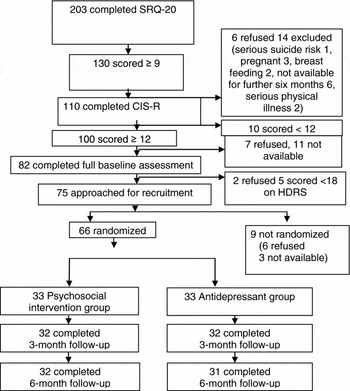
Figure 1 shows the trial profile; 203 consecutive female patients completed initial screening. A total of 130 (66.7%) scored 9 or more on the SRQ-20 and were invited for CIS-R interview within two weeks, but only 110 were interviewed. Six refused and a further 14 were excluded from further assessment because of serious suicide risk pregnancy, breast feeding not available for further six months and serious physical illness. All the participants with established ‘caseness’ (n = 100) on CIS-R (12 or more) were invited for full baseline assessment.
Trial profile

Baseline data
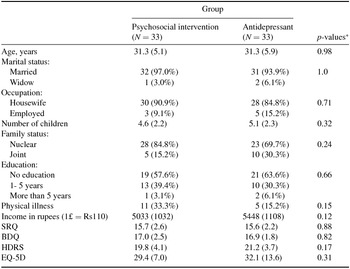
A total of 100 potentially eligible women were identified; 82 were assessed and 75 were approached for inclusion; 66 of these consented to be randomized (Figure 1). Recruited and non-recruited patients had similar SRQ-20 scores (15.6 (SD 2.4) and 15.8 (SD 2.7). The mean age (SD) of the participants was 31.3 (SD 5.5), 63 (95.5%) were married, and 58 (87.9%) were housewives (Table 1). A previous depressive episode was reported by only one woman and 16 (24.2%) had been diagnosed with a chronic physical illness. More than half of the women were illiterate (60.6%, n = 40) and one third (34.8%, n = 23) ceased formal education before completing primary school. Most women had four or more children. There were no statistically significant differences between the two groups at baseline (Table 1).
Differences between the two groups at baseline. All values are mean (SD) except marital status, occupation, family status, education and physical illness, which are number (%)

*p-values used t-test for age, number of children, income, SRQ, BDQ, HDRS and EQ-5D, Fisher's exact test for marital status, occupation and family status and physical illness, and corrected chi-squared test for education.
In the psychosocial intervention group all 33 women attended one or two sessions; 31 (93.9%) attended at least three; 28 (84.8%) at least five, 24 (72.7%) at least seven, and 14 (42.4%) attended 9 or 10 sessions. The mean number of sessions attended was 6.3 (SD 2.2). Of 66 women randomized, 64 were followed up at 3-months and 63 at 6-months.
Outcomes and estimation
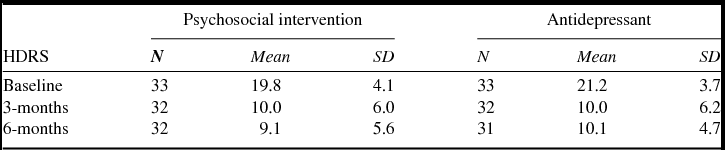
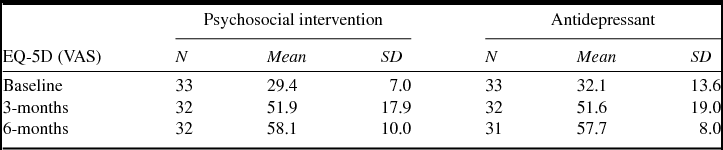
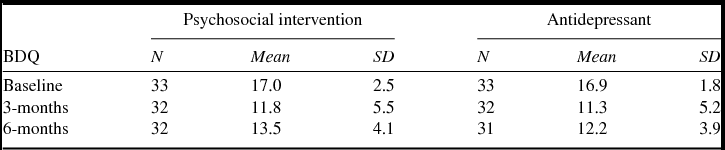
There were no significant differences between the two groups for HDRS (F = 0.89, df = 1,60, p = .35) or for group by time interaction (F = 0.10, df = 1,60, p = .76), for BDQ (F = 0.46, df = 1,60, p = .50), interaction (F = 1.15, df = 1,60, p = .29), or for EQ-5D (F<0.1, df = 1,60, p = .99) or interaction (F = 1.8, df = 1,60, p = .19). These differences were still not significant when ITT end-point data analysis was conducted (see Tables 2, 3 and 4).
Mean and SD for HDRS at baseline, 3-months and 6-months in each of the two intervention groups

Mean and SD for EQ-5D at baseline, 3-months and 6-months in each of the two intervention groups

Mean and SD for BDQ at baseline, 3-months and 6-months in each of the 2 intervention groups

There were no statistically significant differences between two groups for improvement at 3-months (psychosocial intervention n = 18 out of 32 (56.2%), antidepressants n = 19 out of 32 (59.4%) (Fisher's exact p = 1.0), or at 6-months (psychosocial intervention n = 20 out of 32 (62.5%), antidepressant n = 21 out of 31 (67.7%) (p = .79), or for remission from depression at 3-months (psychosocial intervention n = 11 (34.4%), antidepressants n = 12 (37.5%) (p = 1.0), or at 6-months (psychosocial intervention n = 13 (40.6%), antidepressant, n = 7 (22.6%) (p = .18).
Satisfaction
At the end of the trial, 32 patients in each group completed the satisfaction questionnaire. There were high levels of satisfaction in both groups, but no significant differences between the two groups. Using this questionnaire we were able to confirm that the participants did not receive any other psychiatric treatment during the period of the trial.
Discussion
To our knowledge this is the first study examining the efficacy of a group psychosocial intervention for depression compared to antidepressants in primary care in an urban slum of Pakistan (Karachi). The study was conducted in a typical primary care clinic in a deprived urban area of Pakistan. Our results show a marked improvement in both the psychosocial intervention and the antidepressant groups compared to baseline scores. The importance of this trial lies in the context in which it was performed.
The main innovative element of this trial was to increase the role of non-medical clinicians who are currently not involved in the treatment of depression but can be made available in the local health care facilities. These workers were trained to deliver the group psychosocial intervention effectively and to monitor treatment progress. These features are all very important in modern ways of working in health care setting across the world but particularly in the developing countries considering the scarcity of medical resources (Saxena, Thornicroft, Knapp and Whiteford, Reference Saxena, Thornicroft, Knapp and Whiteford2007).
We decided to include in this trial a high risk group of socially disadvantaged women with low literacy. The participants for the antidepressants and psychosocial intervention groups reported high satisfaction with the programme; the vast majority in both groups considered that the services they received have helped them deal more effectively with their problems. The women participated satisfactorily in their own health management in the psychosocial groups.
Strengths of our study included a fairly high recruitment and retention rate in both treatment arms. Although the number of participants was small, we had comparable groups after randomization, we used blind outcome assessments, and there were high rates of follow-up. Our measures have been standardized and validated for use in this population and we used a clinician-rated (HDRS) outcome measure. We did not design the trial to introduce major changes to the established practice and we found the method was feasible and could be used in a larger cost-effectiveness trial.
There are very limited high quality intervention studies from the developing world (Jamison et al., Reference Jamison, Breman, Measham, Allyene, Claeson and Evans2006). These trials have used different methods of sample selection, variety of interventions, and different measurement of psychiatric outcome and with quite different cultural and socio-demographic characteristics of the population. Our findings of response to the psychosocial treatment are similar to another recent study from Pakistan (Rahman et al., Reference Rahman, Malik, Sikander, Roberts and Creed2008) and the primary care studies from Chile (Araya et al., Reference Araya, Rojas, Fritsch, Gaete, Rojas and Simon2003; Rojas et al., Reference Rojas, Fritsch and Solis2007). Our results are also similar to the studies in the West, which have shown that antidepressants and psychological treatments are equally effective (Mynors-Wallis, Gath, Lloyd-Thomas and Tomlinson, Reference Mynors-Wallis, Gath, Lloyd-Thomas and Tomlinson1995). The results are, however, in sharp contrast to one study from India (Patel et al., Reference Patel, Chisholm, Rabe-Hesketh, Dias-Saxena, Andrew and Mann2003), which reported that psychological intervention was not better than placebo. The adherence rates in our study as measured by attendance for repeat prescription were much higher than reported by Patel et al. (Reference Patel, Araya, Chatterjee, Chisholm, Cohen and De Silva2007) in India. The women in our study attended the clinic to see the research GP every 2 weeks and they also received a visit by the community guide in between.
The combination of depressive illness, low literacy, poverty and scant resources has led to quite discouraging views from the physicians and policy makers from the low income countries. Our results offer some optimism that relatively low cost interventions can have a significant effect on the severity of depression and quality of life. The positive effects of our trial are similar to the results in Chile (Araya et al., Reference Araya, Rojas, Fritsch, Gaete, Rojas and Simon2003) but exceed those seen with similar interventions in settings with less deprivation and more resources (NICE, 2004). Other researchers (Araya et al., Reference Araya, Rojas, Fritsch, Gaete, Rojas and Simon2003; Rahman et al., Reference Rahman, Malik, Sikander, Roberts and Creed2008; Patel et al., Reference Patel, Chisholm, Rabe-Hesketh, Dias-Saxena, Andrew and Mann2003) have also reported that socially disadvantaged patients, particularly in the low income countries, might gain most from relatively low cost investments in a structured treatment of depression.
The DCP2 report (Jamison et al., Reference Jamison, Breman, Measham, Allyene, Claeson and Evans2006) has recommended proactive care of depression in primary care with the generic selective serotonin inhibitors (SSRIs). Considering the huge public health significance of depression our findings may have implications for urban primary care settings in other low income countries. The choice of fluoxetine was based on our recent survey with psychiatrists in Pakistan who favour SSRIs, particularly fluoxetine, as a first line treatment of depression because of low costs, efficacy and better side effects profile (Chaudhry et al., Reference Chaudhry, Rahman, Minhas, Chaudhry, Taylor and Ansari2011) . However, the cost of fluoxetine may differ in other low income countries in which case some other antidepressants might be a better option. Differences in health systems and other environmental factors may limit the generalizability of our findings to other settings.
Our study has some limitations, which include lack of a placebo arm and lack of control for the psychosocial treatment. The study has a small sample size. For obvious reasons participants could not be blind to treatment. All patients in the antidepressant group received fortnightly clinical visits from the research primary care doctor, which could have been perceived by the patients as supportive psychotherapy and this may have had a confounding effect. However, these visits were focused to monitor the progress and the side effects and efforts were made not to engage in any counselling. The outcome assessors were aware that both groups received some intervention; however, they were strongly advised not to enquire about the treatment.
In line with the recommendations of the Global Mental Health Group (Patel et al., Reference Patel, Araya, Chatterjee, Chisholm, Cohen and De Silva2007) we will use the results of this study to design a larger trial that would test the cost-effectiveness of psychosocial treatment compared to antidepressant treatment and also antidepressant added to the psychosocial treatment.



Comments
No Comments have been published for this article.