1. INTRODUCTION
The founding and effective functioning of charitable activities for the English poor during the later medieval years (1350–1500) and the sixteenth century were sometimes hampered by what a contemporary statute described as ‘frauds, breaches of trust, and negligence’.Footnote 1 The informal nature of many projects and weak supervision over them permitted careless administration and created a fertile field for illegitimate personal profit. Executors and heirs might not deliver bequests; administrators, feoffees and renters of property could find ways to gain benefits for themselves; and governors sometimes failed to act or promoted their own ends rather than the good of the project.Footnote 2 The charitable activities that experienced such problems covered a wide range, from a little money or food to be distributed to the poor over several years by a testator's heir through ongoing projects run by feoffees or parishes and up to large hospitals and almshouses supported by landed endowments and supervised by external visitors. Beneath the specific problems caused by the negligence or greed of particular individuals lay several generic legal obstacles that made it difficult to manage a charitable project with appropriate rigor and to bring those responsible for wrongdoing to account. Although Parliament discussed and occasionally tried to remedy maladministration of hospitals at several times during the fifteenth and sixteenth centuries, such measures proved ineffective even for those institutions.Footnote 3 By the late sixteenth century, thoughtful observers recognised that changes must be made in the laws if charities were to play their part in addressing the increasingly severe problems of poverty that troubled England. The Poor Laws of 1598 and 1601 created a clear legal status for charitable trusts and those who operated them, defined the scope of such activities and introduced a new mechanism through which malfeasance could be corrected. In so doing, the late Elizabethan legislation provided the basis for more efficient operation and careful supervision of charitable projects in the following centuries, facilitating the expansion of philanthropy.
This paper examines the kinds of problems that handicapped the operation of late medieval and sixteenth-century charitable activities for the poor – both those caused by individual human failings and systemic ones – and describes how the late Elizabethan Poor Laws addressed them. The analysis is based on 187 references encountered over a period of several decades while information about poor relief between 1350 and 1603 was being gathered.Footnote 4 Manuscripts held in scores of local archives or the printed versions of such documents provide information about the actions of parishes, church courts and visitations, boroughs and guilds, special commissions and residential institutions for the poor. Other material comes from the records of the central equity courts and a sample of 49 complaints heard by Commissions for Charitable Uses between 1598 and 1603.Footnote 5 The role of the crown and Privy Council was examined primarily through printed calendars. For purposes of analysis the 187 entries have been divided into 4 categories of problems that impeded the functioning of charitable activities. The first group concerned the creation of a new project and the difficulty of forcing payment of bequests (31 references, or 17 per cent of the 187 entries). The largest category consisted of existing charities that were troubled by financial wrongdoing (81 references, 43 per cent). In other instances, the administration of projects – including the actions of masters or governors of residential institutions – was faulty (39 references, 21 per cent). A final cluster alleged improper appointment or support of people living in hospitals and almshouses or serious misbehaviour by those residents (36 references, 19 per cent).
Although interest in many aspects of medieval and early modern charitable provision has been lively during the past 25 years, current historiography tells us almost nothing about the practical problems faced by those who operated projects for the poor between 1350 and 1603.Footnote 6 Nor do we know how people upset by the misdeeds of those responsible for charities brought their complaints to public attention. While primary sources sometimes record when activities for the poor were founded and by whom, and we have copies of the statutes of some residential institutions, we seldom learn how their administration actually functioned. Thus, accounts may show a declining income but do not explain why that happened. Likewise, modern descriptions of the development of laws pertaining to charitable activities reveal little about the daily challenges that confronted such projects.Footnote 7 Nor have previous analyses of the Poor Laws of 1598 and 1601 explored such questions. This paper helps to fill out the picture, shedding especially valuable light on small, informal projects that are normally invisible to us. We observe some of the ways in which the Reformation affected the operation of charitable activities and note the importance of effective administration, record keeping, accounting and oversight. Heightened attention to the latter issues is visible also among founders of new almshouses and hospitals after 1540 and in the system of parish-based assistance to the poor that developed across the second half of the sixteenth century.Footnote 8 Such concerns may have been influenced by a reformed Protestant emphasis on appropriate discipline and stewardship of wealth.
2. COMPLAINTS CONCERNING CHARITABLE PROJECTS FOR THE POOR
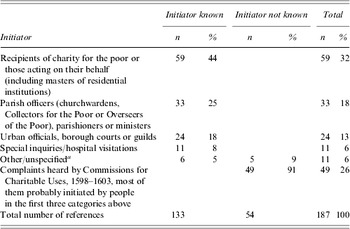
Many local officials, private people and supervisory bodies reported problems with the operation of charities (see Table 1).
Initiators of the complaints, legal actions and orders included in the present study

a ‘Other’ includes four initiated by the Privy Council, one by a bishop and one by a university college.
If we set aside the instances in which the submitters of the complaint are not clearly described, including the cases heard by Commissions for Charitable Uses between 1598 and 1603, 44 per cent of the remaining references were initiated by potential or actual recipients of charity or by someone acting on their behalf. Poor individuals or ‘the poor of a given community’ were occasionally the nominal complainants, but people of somewhat higher status usually spoke for them. Similarly, although current residents of hospitals and almshouses sometimes lodged objections, it was more common for a master or the governors to act for the house. Churchwardens, Collectors for the Poor (starting in 1552), Overseers of the Poor (starting in 1598), the parishioners of a given church and a few ministers mentioned the problem in a quarter of the entries. Complaints by Elizabethan parish officers were presumably motivated by a desire to ensure the effective operation of existing charities and demand payment of new gifts and bequests in order to hold down the amount that had to be raised by obligatory assessments within the parish.Footnote 9 Another 18 per cent are known through the actions of urban officials, borough courts or guilds, while 8 per cent came to notice at visitations of hospitals or ad hoc inspections of charities appointed by the crown, Parliament or the Duchy of Lancaster. The remaining 5 per cent were triggered by the Privy Council, a bishop or a university college.
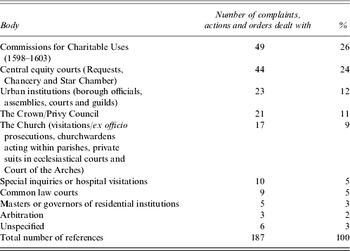
As Table 2 shows, complaints about neglect or malfeasance could be submitted to diverse bodies.Footnote 10 The church courts heard certain private suits through their jurisdiction over bequests. From the mid-sixteenth century, the articles submitted to churchwardens and ministers at the periodic visitations of the parishes held by ecclesiastical officials commonly asked whether donations for charitable purposes were being properly distributed and whether residential institutions were operating in accordance with their founders' intent.Footnote 11 Churchwardens or clergymen might note and respond to problems themselves, without invoking the assistance of outside bodies. After the Reformation, appeals were sometimes taken to the Court of the Arches, the highest church court in England.
Bodies that dealt with the complaints, legal actions and orders shown in Table 1

Secular bodies too were willing to receive complaints. The common law sometimes heard private suits about such issues, but prior to 1598 it would not accept cases involving feoffees who held property for charitable uses; further, its writs and procedures – including a requirement for written evidence – were often disadvantageous to those who represented the poor.Footnote 12 The equity courts provided more helpful venues, for they offered a legal remedy in situations where the common law did not. Throughout the span considered here, the Lord Chancellor was willing to receive petitions alleging wrongdoing in the operation of charities; his Court of Chancery was joined in the sixteenth century by the Court of Requests and occasionally by the Court of Star Chamber.Footnote 13 Beginning in 1598, the specialised new Commissions for Charitable Uses, appointed for individual counties, were authorised to provide a form of equity justice for such activities. Some towns and cities received notice of problems with projects for the poor and took steps to ameliorate them. The monarch or – in the later Tudor period – the Privy Council sometimes submitted or responded to complaints that charitable functions were not being properly performed.
The volume of the evidence and the bodies who produced it changed over time. In the course of the research an average of just over one reference per decade was encountered between 1350 and 1489, with two per decade between 1490 and 1529. During those periods, most problems were reported to supervisory bodies external to charitable projects, especially visitations or special inquiries by ecclesiastical or royal officials, plus a few petitions to Chancery. The number of entries then rose sharply. The average number of clearly dated references was 13 per decade between 1530 and 1579 and 25 per decade from 1580 to the end of the century. Most of the 22 equity court cases with unspecified dates in Elizabeth's reign probably come from those later decades, joined by the sample of complaints heard by Commissions of Charitable Uses between 1598 and 1603. Part of that growth is due to better preservation of later records and the availability of the new option offered by the Commissions, but increased activity also reflects a greater willingness of people unhappy about the operation of charitable activities to act on their concerns. Thus, the beneficiaries or representatives of projects who commonly initiated actions during the later sixteenth century made heavy use of the existing equity courts even before the introduction of the specialised Commissions.
The amount we learn from the various sources used for this study varies greatly. In some instances one is told only that urban or parish officers had received a report about the malfunctioning of a charitable activity, with a brief note of what the problem was and perhaps of the action taken. At the opposite end of the spectrum are the petitions and responses prepared by parties to private suits heard by the equity courts and the rich records of the Commissions for Charitable Uses. These materials tell us a good deal about particular problems and their background. Yet none of the sources should be taken at face value. Allegations of wrongdoing may often have been exaggerated in favour of those making the complaint; wider disputes over political and social power among the patrons, administrators or lessees of these projects may have underlain some accusations. The evidence taken as a whole nevertheless provides valuable information about what were regarded as actionable types of charitable misconduct. We will now consider the four categories of common problems before turning to the underlying legal obstacles and the late Elizabethan Poor Laws.
3. TYPES OF OPERATIONAL PROBLEMS
3.1 Obstacles to founding new projects and receiving bequests
The generous intent of people who attempted to provide assistance to the poor through their wills was sometimes ignored, sidestepped or challenged by executors/-trices, heirs or other kin of the deceased. Some delays were legitimate, for bequests could not be paid until all debts had been settled. Executors had first to prepare an inventory of the testator's possessions, collect any sums due to him or her, and pay whatever was owed to others, under the general supervision of overseer(s) named in the will.Footnote 14 Especially if the deceased person held property in diverse counties and was involved in multiple credit relationships, these tasks might take months or even years to accomplish. Further, heirs sometimes received land under the condition that some part of its income be used for charitable ends. In those cases, the money had to be accumulated before it could be disbursed. However, because executors or heirs commonly had use of the deceased's property – land, cash and personal possessions – until it was handed over to the designated beneficiaries, they had a strong incentive to avoid distribution as long as possible or to try to escape their obligation entirely. This problem affected modest bequests as well as large donations of land or money.Footnote 15
Executors/-trices were sometimes charged with wrongdoing for having detained or appropriated for their own use property or goods bequeathed to the poor. The parishioners of Wash in the North Riding of Yorkshire brought suit in the ecclesiastical court of York in 1566 against John Slakke, executor of William Hobsone's will.Footnote 16 They claimed that Slakke had not distributed Hobsone's bequests, including £3 that were to be given ‘to the marriages of poor maidens’ in two parishes during the three years after his death. Late in Elizabeth's reign, the churchwardens, Collectors for the Poor and a gentleman of the parish of Minster, Kent, acting on behalf of the poor people of their parish, petitioned the Court of Requests against Edmund and Sarah Abdye.Footnote 17 They alleged that in his 1591 will, John Ventre, gentleman, had instructed Sarah, his widow and executrix, to give £10 to the poor of Minster, the money to come from the sale of a stated piece of land. Sarah had subsequently married Abdye, but the couple had not conveyed the £10, which ‘would have been a very great relief and comfort unto the said poor in this time of scarcity and dearth of corn [i.e. grain] and other victuals’.
Especially in cases involving larger bequests, lengthy legal action might be required to force payment. Among the many charitable bequests of Thomas Oken, a prosperous mercer of Warwick who died in 1573, were £100 left to the town of Warwick and £40 each to the towns of Stratford-upon-Avon and Banbury. Oken stipulated that the money be loaned out at interest or used to buy land, with the income going to the poor.Footnote 18 Immediately after his death, however, his two executors and one of his overseers went to his house and began dividing up his gold, silver and jewels, which they took to their own houses, over the protests of Oken's female servant. When Warwick's officials later demanded payment of the £100 due to them, the executors said they could not pay because they had not yet collected all the debts owed to Oken. This dispute led eventually to cases before the Court of Chancery, the Court of the Arches, the Court of Requests (after arbitration failed), and the Courts of Queen's Bench and Star Chamber.
In some instances it was the heirs or other relatives of a deceased person who were cited for refusal to deliver legacies. In 1511–1512, the church of Cranbrook, Kent, reported that John Robert had left houses and land for the support of seven poor men of the parish, but Walter Robert, his heir, refused to fulfil the bequest.Footnote 19 An official of the bishop of Ely pleaded against several men from Wimpole, Cambridgeshire, in 1569 concerning bequests they were withholding from the poor: 20 shillings left by a sister of the first man, 10 shillings from the second man's servant and 10 shillings from the third man's uncle.Footnote 20 When John Wetherhead of Broughton, Yorkshire, was reported to a visitation of his diocese in 1575 for non-delivery of a bushel of wheat bequeathed by his mother to the poor eight years before, he explained – and brought witnesses to confirm – that the wheat had been baked into bread and distributed to the poor in accordance with her wishes.Footnote 21
The endowment of residential institutions was often problematic. Agnes, the widow of John Wynchestre, barber, appeared before a convocation in the city of Salisbury in 1457 concerning a corner tenement in front of the Poultry Cross where a grocer then lived.Footnote 22 Agnes alleged that the tenement ought to belong to the almshouse founded in Salisbury by the will of her late husband, but William Swayne, a merchant, falsely claimed that he held a title to the property through Agnes's gift and grant. She therefore made a public declaration on oath that although Swayne had tried to persuade her to sign over a deed to the property, she had refused to do so. Early in Elizabeth's reign, the bailiffs, burgesses and commonality of Ipswich complained to the Court of Requests against the executors of the will of Henry Tooley, a merchant of their town who had died in 1550–1551.Footnote 23 In his will, Tooley had ordered his executors to set up an almshouse in Ipswich, to be supervised by town officials, for ‘ten lame or impotent poor persons to be there sustained forever’. Tooley left lands worth £100 whose income was to support the almshouse, but although his executors had obtained letters patent authorising them to establish the house, they had not proceeded to do so.
Officers of newly founded charitable institutions sometimes took the lead in attempting to obtain the support assigned to them. Thomas Cartwright, the first master of the Earl of Leicester's Hospital in Warwick, listed various obstacles when soliciting Lord Burghley's assistance in establishing the house as Leicester had intended.Footnote 24 Writing in 1590, two years after the earl's death, Cartwright complained that although land had been assigned to the hospital, he had been unable to extract from the Countess of Leicester the £200 in cash that should have formed a stock to cover the hospital's operating expenses; a rich citizen of London was withholding £20 in rents; and an annuity granted to Cartwright by Leicester was not being paid.
3.2. Financial problems with existing charities
The largest group of entries described some kind of financial difficulty after a charitable project had started operation. Many alleged that tenants of land or other property were not paying rent or dues that should have been used to help the poor. A visitation of the Hospital of St Giles in Holborn, Middlesex, ordered by the king in 1390 reported that some 50 religious bodies and private individuals were no longer paying the rents owed for tenements and other property held from the hospital.Footnote 25 Most of the delinquent rents were between 5 and 20 years in arrears. In the mid-1550s, the wardens of a conjoined guild of mercers, goldsmiths and ironmongers in Shrewsbury petitioned the Court of Chancery against alderman John Mackworth, who held from them a lease of the Mercers' Hall.Footnote 26 His rent was supposed to be distributed to 13 poor people living in an almshouse located in the churchyard of St Chad, but recently Mackworth had refused to pay. When the wardens tried to lock him out of the building, he broke down the door and resumed his occupancy. A house and grounds in Basing, Hampshire had traditionally provided two bushels of wheat annually to be baked into bread for the poor, but when the property was acquired by new owners in Elizabeth's reign, they were unwilling to continue the deliveries.Footnote 27
Some individuals claimed land that had formerly belonged to a charitable institution as their own private property. In 1431–1432, John la Whier submitted a petition to the Chancellor concerning land in Nunhead, Somerset.Footnote 28 He alleged that the property had previously been granted by Thomas Chiple to a group of feoffees under the condition that they give its annual rental income to four ‘loyal men of the parish’ of Nunhead to be distributed to the poor. The defendants, however, had forcibly gained possession of the land for their own use. In 1453–1454, Randolph Byrd, master of St Mary Magdalene's Hospital in Ripon, West Yorkshire (West Riding of Yorkshire), petitioned the Chancellor against Thomas Ledis, esquire.Footnote 29 Byrd said that he and his predecessors were possessed of the lordship of Mulwith, West Yorkshire, in the right of the hospital, but recently Ledis had claimed title to some of that property, entering it by force. The loss of the land was causing a reduction in services at the hospital, but Ledis threatened to beat or slay anyone who interrupted his possession of it. Because Byrd was afraid to bring suit against him in the common law (a standard justification for equity petitions), he sought redress from the Chancellor.
Ongoing payments due to the poor might be awarded initially but then forgotten or denied. In 1598, parish officials from Waltham Holy Cross, Essex, complained to the Court of Requests against several people for failure to continue distributing sums to the poor as required by properties they held.Footnote 30 About 13 years before, John Rigbie, a gentleman of Waltham who was ‘very godly and charitably disposed towards the relief of the said poor people, being now in number about 400 persons’, had bequeathed to the poor a payment of 40 shillings per year out of the rental income of a house he held there. After his death, his widow took possession of the property, but she then moved to Kent and sold the house, whereupon the charitable payments ceased. A second issue in Waltham concerned a local yeoman who had left 20 shillings to the churchwardens to provide bread for needy local people every Sunday, to be paid from the rent of his house; a third man had bequeathed 10 shillings yearly to the poor, provided from the profits of his tenements. In the latter two cases, the sums designated for poor folk had at first been distributed as required but were no longer being paid, ‘contrary to all good conscience, charitable meaning, and godly disposition of all the said testators, and to the great damage of the said poor, being many in number and diverse of them ready to starve for want of relief’.
Although the heads of almshouses and hospitals were supposed to keep a close eye on institutional income, sums due to their houses were commonly withheld or lost. At the end of Elizabeth's reign, ‘the poor lazar people of the house called the Magdalen’ in Totnes, Devon, together with the residents of Totnes Almshouse, appealed for help from the Court of Requests against a list of men.Footnote 31 They alleged that pieces of property that should have supported the two institutions were not yielding the stipulated rents. Some tenants who owed sums to the Magdalen had refused to pay their dues for 30 or 40 years, resulting in a total of £40 withheld; land bequeathed to 3 men under condition that they deliver the annual rents from the property to the mayor of Totnes for relief of the institutions was no longer rendering any money at all; and two previous mayors of the town had awarded leases of tenements belonging to the Magdalen in such a way that no profit was coming to the house. The huge file that records this case includes the answers of the defendants plus the interrogatories and depositions of 11 local witnesses for the complainants and 12 for the defendants, many of them older merchants but also 2 widows. The additional documents reveal the complexity of the dispute, including uncertainty about which properties belonged to the houses, whether earlier grants had been made with the approval of the proper officials and whether the Statute of Uses of 1536 invalidated some of the bequests.
Leases of the property that supported charitable projects frequently caused problems. Feoffees or masters might line their own pockets by demanding a fee at the time they awarded a new lease, or they might grant land to their own friends and relatives for an unduly low rent or an inappropriately long period. One of the most important contributions of John Watson, master of Saint Cross Hospital in Winchester, 1559–1583, was to obtain annulment – eventually requiring an act of Parliament – of the illegal leases made by his predecessor of some of the institution's central buildings.Footnote 32 Most of the under-the-table income received by the master of the Charterhouse or God's House in Hull prior to 1571 had come from entry payments for extended leases of land or tenements. Another possibility for personal profit came from awarding reversions of leases (promises of future grants of property that was currently held by someone else, in return for a cash payment right away). Leases were sometimes coupled with an agreement to give an annual payment or pension to stated individuals, and grants could become particularly troublesome if the crown expressed a preference about who should receive them.Footnote 33
Many of the dangers of leases were described in a letter from James Pilkington, Bishop of Durham, to William Cecil in 1568 about Sherburn Hospital.Footnote 34 The bishop reported that the institution ‘is so entangled with leases and burdened with pensions and fees’ that unless Cecil intervened on its behalf, its master, Thomas Lever, would be unable to keep the house going. The hospital's buildings and demesne land had been leased out, together with a reversion of the house extending 80 years into the future. The master was being sued by Sir Richard Reade in the Court of King's Bench for a pension of £40 annually which he claimed the hospital owed him, plus 14 years of arrears.Footnote 35 The ‘grand lease’ of the hospital was simultaneously under dispute in the Court of Requests and in the common law at Durham, and Pilkington thought that both courts were likely to rule against Lever. All of the questionable leases, he said, had been made by previous masters to their own kinsfolk, thereby impoverishing the inmates maintained in the house. We know that the warden of Sherburn Hospital had indeed been granting annuities to people who were not residents of the house since at least the mid-sixteenth century, so Pilkington's claims were probably justified.Footnote 36
Uncertainty concerning the legal status of an endowment might hamper efforts to assist the needy. When ‘the poor people of the town’ of Sutterton, Lincolnshire, complained to the Court of Requests around 1590 concerning a bequest of land by John Elsam, they alleged that the property had initially been conveyed to the Collectors for the Poor of the parish, who distributed its rental income to the poor, in accordance with Elsam's wishes.Footnote 37 However, four years later, a male cousin of Elsam's entered the property and leased it to someone else, ‘meaning thereby to bring in question at the common law the validity of the bequest … to the utter undoing and impoverishing of the said poor people’. The cousin claimed that Elsam's will was not authentic, but several witnesses testified that it was genuine, adding that they had heard Elsam say explicitly that he wanted the land to go to the poor, not to his cousin.
The changes of the Reformation period affected the financial situation of many charitable activities. With the closing of the monasteries, chantries and fraternities in the mid-sixteenth century, the associated properties that had supported diverse charitable projects were appropriated by the crown and later sold into private hands. It might be genuinely unclear whether the new owners were obligated to continue payments that had previously assisted the poor, and such confusion at least provided a good excuse for ceasing to render former dues. Even if charities were able to continue operating, they might find their income lowered. Protestant changes in belief and practice were cited by Thomas Bond to justify his reduction of support for Bond's Hospital in Coventry, an almshouse founded by his grandfather in 1506.Footnote 38 In a suit brought against him in the Court of Chancery by the mayor, bailiff and commonalty of Coventry in 1548, the town charged that although the younger Bond had sworn a corporal oath on a Bible at his father's deathbed in 1540 that he would maintain the hospital, he had not done so. In the past few years he had failed to appoint the full number of residents, reduced their cash stipends and the amount of cloth and wood they received, and withheld most of the salary due to the institution's preacher. He had also sold parcels of the land left by his grandfather for support of the house. In response, Bond argued that the original requirements were no longer valid, for several aspects of its foundation were ‘superstitious’. They included prayers for the dead and the fasting required of the residents as well as the stipulation that the poor men and preacher be chosen from among members of the Holy Trinity Guild or the Corpus Christi Guild in Coventry, both of which had been dissolved. After the court interviewed witnesses, the Chancellor finally issued a decree in 1552. His compromise continued the hospital, ordering that its lands be conveyed to 24 feoffees, but it reduced the amount of property Bond was obliged to assign to them, allowing him to keep the rest. The house's income was henceforth only £21 annually, not the £50 that the founder had intended.
Stocks of land, animals or cash held by parishes to the use of the poor were the focus of other complaints. Some stocks were loaned directly to poor people, for little if any rent or interest. Because the recipients often found it difficult to repay their loans, the value of the stock might gradually diminish over time. That problem is illustrated by two cash funds in the cathedral church of Lichfield, Staffordshire, during the second half of the fifteenth century.Footnote 39 Sometime before the 1450s, John Herwood, a canon of the church, had founded an ‘alms chest’ in Our Lady's Chapel. Poor men were allowed to borrow sums from the £20 that Herwood put into the chest, but they were supposed to submit some kind of a gage or pledge to guarantee repayment of the debt. In 1457–1458, another canon gave £20 for a second alms chest. At a visitation in 1486, however, the dean of the cathedral discovered that no money was left in either chest, and the gages placed into them were worth only £13. Attributing the blame for this problem to the negligence of previous keepers of the keys of the chests, the dean launched an investigation and was able to recover £20 of the missing money. He then contributed £7 from his own resources to bring the total, including the gages, back up to £40. Consolidating the two chests into one, he laid out detailed rules for how the money was henceforth to be loaned.
Stocks leased out to more prosperous local people with the interest devoted to the poor might likewise decrease in value. The churchwardens of St Mary's, Ely, noted in 1581 that although some of the people who rented units of the parish's stock of £43 5s held ‘by obligation’ (having signed some kind of written agreement or bond), others had given no surety for repayment.Footnote 40 The wardens reported 3 years later that although the nominal total value of the stock had increased, with 29 people holding cash totalling £53 12s, 17 of the men were in arrears on their interest payments. In 1596–1597, when £65 15s had been loaned out in 19 units ranging from 15s to £10 each, the churchwardens described 11 other loans of between 12d and 52s 6d as ‘old and almost desperate debts’ they were unlikely ever to recover.
A final batch of financial problems alleged serious neglect of the buildings of a residential institution. A complaint to Gloucester's officials in 1564 from the poor people living in St Bartholomew's Hospital led to a survey that found the institution's chapel and other buildings so decayed that it would take more than £300 to re-build them.Footnote 41 In response, Queen Elizabeth granted the hospital to the mayor and burgesses of Gloucester, who agreed to repair the buildings at the city's cost and henceforth maintain its poor residents and staff. The provost of God's House in Southampton acknowledged in 1585 that the main building was ruinous, though the almsmen were still receiving regular allowances.Footnote 42 He blamed the house's problems in part on Queen's College, Oxford, whose bursars had not rendered their overdue payments. In extreme cases, the neglect or destruction was so great that the buildings or institutions could not be restored to their original purpose at all. In Maidstone, Kent, the city fathers decided in 1600 that because the almshouses in Pudding Lane were ‘in great decay’, the property should be conveyed into private hands for a yearly rent; the income ‘shall be used to provide otherwise for the poor’.Footnote 43 In 1593, the queen wrote to the Archbishop of York and other officials in the North, asking for a report on all hospitals and almshouses.Footnote 44 She had been informed that many institutions created ‘for the charitable relief of poor, aged, and impotent people’ had lately decayed; their possessions were now employed for uncharitable purposes by ‘greedy and covetous persons’, contrary to the godly intent of the founders. When officials for Westmoreland submitted their report, they claimed that ‘there is not within the said county of Westmoreland any colleges, hospitals, almshouses, or other houses and places whatsoever ordained or appointed for the relief of the poor’.Footnote 45
3.3. Maladministration
A third cluster of difficulties concerned the administration or operating practices of a charity. Although problems of this kind were present long before the mid-sixteenth century, heightened concern with responsible leadership, tight administrative practices and careful accounting may have been influenced by reformed Protestant concern with good order and the proper employment of God-given resources, especially those donated to charitable ends.Footnote 46 People who held property as feoffees for a charity sometimes sought their own personal gain. In Aylesbury, Buckinghamshire, 12 feoffees were appointed in the late 1520s to hold land for Bedford's Charity, founded in 1494 to provide alms for the poor.Footnote 47 As those men died off, their number dwindled to just two. When the inhabitants of the town pushed in 1559 to have a new group of feoffees named, Richard Collingbourne, one of the surviving feoffees who already held a lease of some of the charity's properties, engaged in a collusive transaction which granted him a long-term hold on the land. He and several others were taken to Chancery by the incoming feoffees. Sir George Monoux named six feoffees for his almshouse in Walthamstow, Essex, in 1544, but by 1561 only one of them – attorney Richard Vaughan – was still active.Footnote 48 Vaughan had by then gained possession both of the London tenements that were supposed to provide income for the institution and of a residence in Walthamstow that adjoined the almshouse, which he had attempted unsuccessfully to convert into a stable. He was later evicted by a younger relative of Monoux's acting as patron.
Many complaints focused on the masters (or wardens or keepers) of residential institutions, alleging that they had not performed their duties, had granted leases for their own private profit, or had allowed damage through neglect. Because medieval foundations rarely insisted that their heads be present in person, it was possible to hold the masterships of several institutions simultaneously or to combine those positions with additional offices. If masters were not required to submit formal accounts or justify why they had selected particular residents or servants for the house, lax or dishonest administration was invited. In an extreme case, Sir Roger de Cloune, who had become master of Saint Cross Hospital in Winchester in the mid-fourteenth century after a series of disputes and unscrupulous exchange of offices, ‘set out to enrich himself at the Hospital's expense’. He sold all of its movable goods, pulled down buildings to get their bricks and wood and failed to carry out the institution's obligations to the poor.Footnote 49 After an inquiry, Bishop William of Wykeham laid out a new set of rules for the hospital in 1370, including a requirement that the master reside there personally. An episcopal visitation of St Katherine's Hospital in Ledbury, Herefordshire, in 1397 was told that William Pykesley, its master, was utterly failing in his duties.Footnote 50 He had ceased paying the stipends of the 13 residents of the house, who were forced to beg on the streets, nor did he distribute the customary twice-weekly dole to the poor of the town. Pykesley was remiss in spiritual terms too, appointing only two chaplains instead of the stipulated five. In response, John Prophet, Dean of Hereford, named a new master and imposed a series of reforms. At London's Bethlehem Hospital, which housed ‘lunatics’ and sick people, a visitation of 1403 found that the master (a royal nominee) was seldom present, leaving a porter in charge; the latter had abused the patients, embezzled the institution's goods and failed to maintain regular divine services in the chapel.Footnote 51
Masters were scrutinised more closely after the mid-sixteenth century. In 1570, a royal commission to visit the Savoy Hospital in London found serious ‘misgovernment and abuses’ on the part of Thomas Thurland, its master.Footnote 52 Because he had sold lands belonging to the hospital, burdened it with long-term obligations and misappropriated other funds, Thurland was deprived of his office. An official acting on behalf of the bishop of Durham prosecuted John Kingsmill, warden of the hospital of St Mary in Greatham, for a variety of offences in 1578.Footnote 53 Kingsmill had not provided adequately for the poor but instead converted the institution's property and income to his own use; he had allowed the structures to become ruinous and did not live regularly in the hospital as required. One of the witnesses, a resident of the institution, testified that since Kingsmill's appointment seven or eight years before (through a proctor who represented him), he had been ‘more absent than present’ and had not come to the hospital at all in the past two years.
Allegations of religious non-conformity complicated some post-Reformation complaints. Charges brought in the court of the archbishop of York in 1567 against John Reynes, master of the West Spittell in Newcastle upon Tyne, said that since assuming the position Reynes had taken for his own benefit the rents and other profits of the hospital, amounting to a total of £1,000.Footnote 54 He had let the buildings become so decayed that more than £100 would be needed to repair them adequately. Even more damning, Reynes was ‘a misliker of Christ's holy religion … and hath absented him self from the hospital because he would not receive [communion] and be obedient unto the laws and statutes of this realm of England’. Reynes, answering that there was ‘no statute or ordinance of foundation that doth bind or constrain the said master to be resident upon the said hospital’, claimed that the buildings of the hospital were in good repair and that the 8 ‘poor and impotent folks’ living in the house had been as well provided for during his mastership as under any previous head within the last 20 to 50 years. He denied, in carefully chosen words, that he had been declared an opponent of England's official religion by any public authority in the realm. The reason for his absence was that he was a student and scholar at the University of Louvain: he ‘went forth of this realm of England for cause of study and learning and hath license [from the Queen] for such his passage forth of this realm’. (The latter claim seems improbable, as Louvain was known as a centre of Catholic teaching and scholarship.) In 1591, Thomas Cartwright, master of Lord Leicester's Hospital in Warwick who was at the time confined to the Fleet prison for his radical Puritan views, claimed that he had been falsely accused of allowing a man to utter ‘undutiful speeches against the Council, magistrates, and judges of the realm’ while offering prayers before the poor men of the hospital.Footnote 55
The governors of a foundation might contribute to administrative problems. Sometimes they fell into disagreement amongst themselves, hampering their ability to act collectively for the good of the project. The unusually detailed records of Christ's Hospital, an almshouse in Abingdon, Berkshire, run by 12 town leaders, illustrate the kinds of difficulties that could arise. In December 1585, one of the governors entered into the minutes of their assembly a note that Anthony Bostocke, another governor, had been removed from his place after previous admonition ‘for dissention, strife, and variance for matters touching the said Hospital as also touching his unquiet behaviour’.Footnote 56 Subsequent notes, including ones attacking the author of the first entry, reveal that Bostocke's expulsion had grown out of a bitter dispute between him and another governor over the lease of a piece of land held by the hospital. During the following year, controversy continued, with eight of the governors in favour of Bostocke's removal but four supporting him. The dispute was finally settled in spring 1587, with the governors brought back into harmony.
A more serious conflict erupted in Abingdon a decade later over two questions: was it necessary for the men chosen as governors of the almshouse to be resident within the town, as its founding statutes dictated; and when a man was named to complete the unfinished term of a master who died in office, would he hold that position for only a single year or the full remaining term?Footnote 57 Contention became so heated that the master and several of the governors appealed to the house's visitor, Lord Egerton, Keeper of the Great Seal, asking him to appoint a commission to examine and rule upon the problems. Egerton sent a group composed of the Vice Chancellor of Oxford, a Doctor of Civil Law, and four esquires to the almshouse, where they read the charter and statutes and heard all the allegations before issuing their judgement. Immediately thereafter, the majority of the governors charged one of their fellows with being ‘an unquiet person’ and dismissed him from office.
Uncertainty about who was responsible for an institution underlay other disputes, especially if the house had previously changed from one type of control to another. In 1530, the court of the Duchy of Lancaster commissioned a group of knights and esquires to inquire into maintenance of St Leonard's Hospital in Lancaster.Footnote 58 The mayor and burgesses of the town complained that in the distant past, the hospital had taken in lepers and sick folk, run an almshouse for old people who could not work and had fallen into poverty, and maintained a chapel. All the residents had received relief through the hands of the master of the hospital, who was appointed with the approval of the burgesses of Lancaster. In 1356, however, the hospital and its lands had been granted by the Duke of Lancaster to the prioress and nuns of Seton, with the proviso that they maintain the buildings, hold services and pay alms as accustomed. The town's officials alleged in 1530, however, that although the master of the hospital continued to receive an income of £6 13s 4d, the convent had allowed the lazar house, its chapel and other buildings to fall down; nor were the nuns giving any alms to the poor. The burgesses asked that the hospital be restored to its former condition. When the prioress of Seton failed to respond to a summons to appear, the court inspected the 1356 charter and confirmed its requirement that the convent maintain the hospital. In Hull, where the old Maison Dieu founded in 1365 had been restructured during Edward VI's reign as the Charterhouse or God's House, a complaint in 1571 to the Archbishop of York and the Commissioners in Ecclesiastical Causes about the master's wrongdoing led to belated recognition by urban officials that they were now the governors of the institution and should have been supervising its operation.Footnote 59
Effective administration of a charitable activity required good record keeping and protection of the documents needed to establish title to its property and demonstrate its rights. Hospitals and almshouses, like most parish churches, commonly kept their records in a locked chest on site. In 1455, God's House at Ewelme, Oxfordshire, stored its money and documents in a chest in the common hall, closed with three locks.Footnote 60 Such containers did not always provide sufficient security, however. The master of Killingwoldgraves Hospital in the East Riding of Yorkshire petitioned Cardinal Wolsey as Lord Chancellor sometime after 1524.Footnote 61 In what was apparently part of a dispute over the institution's landed property, a clerk had entered the hospital in the middle of the night and stolen from its chest some charters and other records, which he subsequently refused to return. The refounding and incorporation of Sherburn Hospital in Durham in 1575 was said to be necessary in part because ‘its deeds have been embezzled through the negligence of the governors’.Footnote 62
An important negative consequence of lost or incomplete records was that charitable activities could not bring suit or defend themselves against actions in the common law. The parson and inhabitants of Dennington, Suffolk, petitioned Chancery in the later 1550s against a woman who refused to return important records to the church.Footnote 63 They claimed that a stock of £20 had been kept in the church, to be loaned to ‘the poorest and neediest persons’ of the community who lacked seed to plant grain for bread. The poor who received seed money were required to give a written bond to church officials. After parish officials decided to go to court against some people who had failed to repay their loans, the relevant documents were removed from the church chest and given to John Holdyche, ‘to the intent that he, being towards in the law and commonly using in the term time to repair to London, should put the said obligations in suit against such persons as were bound therein’. However Holdyche died suddenly, with the documents still in his possession, whereupon they came into the hands of his widow, who was unwilling to return them. When the residents of the Magdalen and Totnes Almshouses in Devon submitted their complaint to the Court of Requests sometime after 1580, they said they could not proceed in the common law against the heirs of a man who had left property to the use of the poor in those institutions because they did not have a copy of his will.Footnote 64
Going to court might indeed be necessary to protect the possessions and income of a charity. People who were thinking about initiating a suit had to weigh the immediate costs of legal action against the chances of longer-term gain. If sued themselves, they had no choice but to respond. In 1583, the master and governors of Christ's Hospital in Abingdon laid out nearly £20 while defending the house against a complaint submitted to the Court of Chancery: they paid attorneys and spent additional sums for court fees, gifts to officials of the court and travel expenses.Footnote 65 At the Dean of Salisbury's visitation of Heytesbury Hospital in 1597–1598, the parishioners reported that one of the causes of the institution's decreased revenues was ‘the suits in law’ it had been obliged to pursue.Footnote 66 When the 12 governors of the town lands of Wantage, Berkshire, wrote in 1597 to Dr Bennett, Dean of Windsor, asking him to work with them in resolving amicably a dispute over an almshouse situated on land belonging to the dean's parsonage, they ended with a rhetorically charged plea:
Our claim is to the benefit of the poor to whom this house was truly meant, and we affirm that you have no colour of title to it by law. Therefore we pray you without suit or expense (which must come out of the stock of the poor) you will … [yield] it to us quietly. Otherwise we must sue for it, which will not be suitable and to your disposition nor ours, our claim being for the poor, and yours for the church.Footnote 67
3.4. Institutional residents
The last category of problems concerned the residents of charitable institutions. Most of these entries alleged wrongdoing in how inmates were appointed to almshouses or hospitals or how they were supported once there; a smaller fraction alleged serious misbehaviour on the part of residents.Footnote 68 The ordinances of the almshouse in Saffron Walden, Essex, from 1400 tried to preclude favouritism by stipulating that its 13 poor residents were to be chosen by the male and female keepers of the house, after consultation with 2 or 3 senior men of the town, ‘with impartiality and without any bribe or carnal affection’.Footnote 69 A controversy in Bath in 1534 that pitted a citizen of the town against the prior of the cathedral church and monastery over the right to grant places in the Hospital of St John led to assaults and riots and eventually to a long case heard by the Court of Star Chamber. When the Dean of Salisbury's visited Heytesbury Hospital in 1576, it was reported that two married men had been admitted to the house, contrary to the institution's statutes.Footnote 70 Some people alleged that they – or a relative – had not been given a place promised to them. In an Elizabethan case from Tamerton Foliot, Devon, Juliane Raddon complained against Christopher Copleston, esquire.Footnote 71 She said that her late uncle, John Raddon, when enfeebled by age and living in poverty, had conveyed his lands and burgages in Tamerton to Copleston, who had assured Raddon that he would find him a place in an almshouse in Exeter. Copleston did not provide for him, however, and a witness said that Raddon had ‘died very poorly and nigh famished for lack of relief and died in miserable case for lack of clothing and other necessary looking unto’. Almshouse places might also be contested by several potential recipients.Footnote 72
Some complaints alleged threats to expel a current resident from his or her place. In the mid-1530s, Henry Bruwester, a 67-year-old bedesman in the Hospital of St John the Baptist in Exeter who was lame and unable to work, submitted a petition to Chancery against Richard Harreys, an official of the house.Footnote 73 Bruwester alleged that about 4 years before, he had been admitted to the hospital by the former master as 1 of its 13 poor men. Later, however, a dispute arose between the master and brethren of the house on the one side and the chancellor to the bishop of Exeter and Harreys on the other. One issue was the new people to whom Harreys had granted places in the hospital, including a gentleman living in London and five other men who were said to be worth at least £40. The case was taken eventually to the Court of the Arches, where Bruwester was summoned as a witness and forced to give evidence under oath. Because his statement favoured the position of the master and bedesmen, Harreys angrily arranged to have Bruwester removed from the hospital and indeed to be imprisoned. An Elizabethan almsman of Whittington College in London, run by the Mercers' Company, complained against a woman who had taken care of him during an illness but had also – he said – stolen £20 from his room.Footnote 74 Several London merchants who tried to force him to accept arbitration had threatened that if he proceeded with legal action, ‘they would turn your said poor subject forth of the said College and the place he there enjoyed’.
Because positions in some of the wealthier institutions that provided good stipends were highly desirable, current residents who needed cash might be tempted to rent or even sell their position to someone else. George Bonor of Rochester, Kent, petitioned the Court of Requests against the Dean of Rochester sometime in Elizabeth's reign.Footnote 75 Bonor said that in reward for his service to the queen, his injuries and his great impoverishment, he had been granted a place in an almshouse in Rochester for life. He moved into the house, but then, because he had many debts and needed money to support his wife and children, he conveyed his place to Richard Wattes in return for an initial payment and an annual rent. The condition of the lease was that if Bonor outlived Wattes, he was to resume his position in the almshouse for the rest of his own life. Wattes stayed in the house until his death some years later, but when Bonor went to Rochester to enter back into his place and receive its pension, he was told that the dean had granted the opening to another person, a man named Germyn. Although Bonor and Germyn then reached a compromise in which Bonor would be allowed to occupy the place but would pay 6s 8d annually to Germyn, the dean refused to accept that agreement. Further problems arose from the practice whereby people named to a place in some institutions, particularly those that provided corrodies, had to offer a payment.Footnote 76 Entry fees of any kind undermined the ability of houses to care for the genuinely needy, and corrodies were especially open to abuse.
The level of payment or the non-payment of stipends to the residents of almshouses and hospitals led to additional complaints. In 1564, the poor people of St Bartholomew's Hospital in Gloucester alleged that although they ought to receive 7 pence each per week, they were only getting 4 ¾ pence.Footnote 77 Residents of the Hospital of Mary Magdalen near Gloucester were said in 1576 to be ‘left in miserable state for want of relief’ when the man who had wrongly gained possession of the institution's lands detained their benefits.Footnote 78 In 1582, an official of the York High Commission pleaded against the current and former wardens of Hemsworth Hospital in West Yorkshire. The officers of the house, accused of not paying annually the full 4 marks (a sum equivalent to £2 13s 4d) that should have been given to the 20 poor folk in the house, replied that the amount paid to the poor had already declined to £2 during the time of previous masters.
A specialised set of problems arose from the practice whereby later Tudor monarchs appointed maimed soldiers to ‘alms rooms’ in cathedrals and certain other institutions.Footnote 79 These grants, which provided a pension and usually housing, sometimes met with resistance from the hosting bodies, which expected to award at least some of the places themselves. During the reign of Mary I, Thomas Wood, a former gunner of the king's great ordinance, petitioned the Court of Requests against the dean of ‘the cathedral church called King's College’ in Oxford concerning an alms room there.Footnote 80 Wood claimed that after working for Henry VIII and Edward VI on land and sea for 19 or 20 years, he had been permanently disabled. The crown had therefore granted him a place in Oxford in 1552. The dean, however, refused to acknowledge the award but rather ‘by affection and favour placed others his friends’, even though their grants were later than Wood's. He had complained previously to Cardinal Wolsey and the Court of Requests, who had ordered the dean to put him into an alms room, but that had not been done.
Disputes mounted after 1588, now handled mainly by the Privy Council. In 1591, the Council wrote to the officers of the hospital run by the cathedral church of Chester, where Elizabeth had awarded the reversion of an alms room to a poor maimed soldier.Footnote 81 Because the dean and chapter had given the next vacant position to someone else, allegedly by ‘some undue means’, the Council ordered the hospital to inspect the grants of both men, determine whose bore the earlier date, and install that person into the place. Two years later, the Vice Chancellor of Cambridge, the master of King's College and a doctor were instructed by the Privy Council to call the fellows of Trinity College before them to determine the truth of a complaint that the college had withheld alms places from five soldiers to whom the queen had granted positions.Footnote 82 Thomas Kettlewell, a maimed soldier assigned an almsman's room in Queen Elizabeth's Hospital in Donnington, Berkshire, in 1598, found that the place he should have occupied had been sold by its previous tenant before his death.
4. UNDERLYING LEGAL PROBLEMS AND THE POOR LAWS OF 1598 AND 1601
Whereas the problems described above arose primarily from the negligence or greed of particular individuals, wrongdoing was facilitated by several generic legal factors that restricted the ability of charitable activities to function as intended and made it difficult for people to lodge complaints when projects were not operating properly. The first issue concerned the legal status of charitable projects and those who ran them. Until 1598, the common law did not recognise charitable ‘uses’ (in which feoffees held property on behalf of a designated purpose), nor had charitable trusts been defined and given a secure standing in the courts.Footnote 83 If projects for the poor were controlled by a parish or incorporated borough, their operators could plead for them in any court, for those parent bodies had a legal identity. Residential institutions could potentially pursue incorporation, but that was an expensive and time-consuming process. Many other charitable activities, those with less formal governance, were caught in a legal limbo. If rents were being withheld or if those responsible for the project were appropriating resources for their own use, who had the authority to bring charges against the offenders?
By the Elizabethan period such problems were especially acute for the feoffees who held land for and operated many charitable projects, including small, local ones. Charitable feoffees had become increasingly popular across the later fifteenth and sixteenth centuries, a development illustrated by residential institutions. Of 561 hospitals and almshouses founded prior to 1540 listed in a database compiled by myself (M.K.M.), only 11 per cent were run by private, lay feoffees or governors; 70 per cent were operated by a monastic house or were entirely self-governing, with no outside supervision.Footnote 84 Of 154 institutions founded between 1540 and 1599, however, 55 per cent were in the hands of feoffees or governors. Yet because feoffees and charitable uses had no standing in the common law, these de facto trustees could seek redress only through a petition to one of the central equity courts. In addition, there was no special mechanism available whereby complaints about the malfunctioning of charitable activities could be conveniently submitted and addressed.
The Poor Laws of 1598 and 1601 tackled these underlying issues. Acts in both years defined projects operated by a group of individuals (the former feoffees) for the benefit of the poor as charitable trusts, a subset of all ‘uses’.Footnote 85 Their trustees were henceforth allowed to plead in all courts. The statutes also listed the types of projects that fell within the scope of charitable activity, moving from a fairly narrow conception in 1598 to a far more extensive one in 1601.Footnote 86 The latter remained in effect into the twentieth century. Finally, the Poor Laws established a new and more forceful legal process whereby charitable projects could be enabled or forced to carry out their intended functions. The 1598 act commented that many funds for relief of the poor, among other worthy causes, ‘have been and are still like to be most unlawfully and uncharitably converted to the lucre and gain of some few greedy and covetous persons’.Footnote 87 That measure and the fuller version passed in 1601 permitted the Lord Chancellor to appoint commissions within the counties to inquire whether charitable endowments of land, money or movable goods were being properly employed. The assignment given to these commissions reflects the types of operational problems we have already observed: they were to investigate ‘any abuses, breaches of trusts, negligences, misemployments, not employing, concealing, defrauding, misconverting, or misgovernment’ concerning any property given to charitable activities.Footnote 88
Commissions for Charitable Uses, which went into immediate use in 1598, were popular not only because they sat locally but also because they offered a sympathetic hearing and a modified set of equity procedures that benefited the claims of charitable activities as against those who sought private profit from them.Footnote 89 When they issued orders for correction, they had the force of the central government behind them. During the reign of James I (1603–1625), Commissioners sitting in individual counties sent out more than 1,000 decrees, some of them covering multiple projects; an additional 2,800 decrees had been promulgated by 1688.Footnote 90 The Commissions probably contributed indirectly as well: even the threat of a report to one of them may well have inspired greater diligence on the part of donors, lessees and operators of charitable projects.
Improved legal security contributed to the considerable growth of private philanthropy over the next few centuries and to the longevity of charitable foundations. Although personal negligence and greed had not disappeared, most projects now enjoyed a recognised legal standing, able to function as independent entities in both common law and equity courts. Should problems arise, concerned people could readily seek correction, either in one of those venues or by submitting a complaint to a Commission for Charitable Uses. While many activities for the poor, including those run by urban bodies and parishes, continued to face at least occasional challenges in the form of withheld payments, lost revenues or incompetent heads during subsequent centuries, some projects founded prior to 1603 managed to survive for hundreds of years beyond that time. If, for example, we consider the residential charities whose problems have been mentioned in this paper, we find that such diverse institutions as the Charterhouse in Hull, the town almshouses in Saffron Walden, Christ's Hospital in Abingdon, God's House in Ewelme, the Hospital of St John in Heytesbury and Whittington College are still sheltering elderly people in 2012. The Poor Laws of 1598 and 1601 helped these and many other charitable activities to overcome the obstacles that had previously hampered their work and thereby to achieve long-term financial and administrative stability.
ACKNOWLEDGEMENTS
The research for this project was generously supported by a Research Fellowship from the National Endowment for the Humanities and the Visiting Research Fellowship in the Arts at Newham College, Cambridge, 1983–1984; a Visiting Research Fellowship at the Borthwick Institute for Historical Research, University of York, summer 1992; a Fellowship from the John Simon Guggenheim Memorial Foundation, 1995–1996; and multiple grants from the Committee on Research and Creative Work, the Graduate Committee on the Arts and Humanities, and the Distinguished Professor program at the University of Colorado at Boulder, 1984–2010.