


INTRODUCTION
The need for sustainable food production systems, combined with increased awareness of environmental degradation, has induced a gradual shift away from intensive plough- and hoe-based tillage systems in the developing world (Derpsch, Reference Derpsch2007; Jat et al., Reference Jat, Gathala, Ladha, Saharawat, Jat, Kumar, Sharma, Kumar and Gupta2009; Kassam et al., Reference Kassam, Friedrich, Shaxson and Pretty2009). Conventional tillage techniques are regarded as a cause of soil degradation in terms of loss of top soil and nutrients, decrease in organic matter content, and formation of hardpans (Derpsch et al., Reference Derpsch, Sidiras and Roth1986; Reference Derpsch, Roth, Sidiras and Köpke1991; Kassam et al., Reference Kassam, Friedrich, Shaxson and Pretty2009; Lal, Reference Lal1974a; Stagnari et al., Reference Stagnari, Ramazzotti, Pisante and Lichtfouse2010). When coupled with increased costs of production (e.g. for fuel, labour and fertiliser), conventional tillage methods may not be economically and environmentally sustainable in the long run (Govaerts, Reference Govaerts, Verhulst, Castellanos-Navarrete, Sayre, Dixon and Dendooven2009; Patzek, Reference Patzek2008; Verhulst et al., Reference Verhulst, Govaerts, Verachtert, Castellanos-Navarrete, Mezzalama, Wall, Chocobar, Deckers, Sayre, Lal and Stewart2010). Kumwenda (Reference Kumwenda, Waddington, Snapp, Jones, Blackie, Byerlee and Eicher1998) and Wall (Reference Wall2007) raise serious concerns that the continuous decline in organic matter on arable land makes it difficult to maintain productive cropping systems. In many areas of sub-Saharan Africa, soil organic matter levels have diminished to unsustainably low levels leading to further physical, chemical and biological degradation of the soil (Sanginga and Woomer, Reference Sanginga and Woomer2009; Thierfelder et al., Reference Thierfelder, Mutenje, Mujeyi and Mupangwa2014a, Reference Thierfelder, Rusinamhodzi, Ngwira, Mupangwa, Nyagumbo, Kassie and Cairns2015b).
CA was developed in the 1960s in the Americas and Australia and is now defined as a cropping system based on (i) minimum soil disturbance, (ii) surface crop residue retention (mulching) of living or dead plants and (iii) diversification through crop rotations and crop associations (Bolliger et al., Reference Bolliger, Magid, Amado, Scora Neto, Dos Santos Ribeiro, Calegari, Ralisch and De Neergaard2006; Derpsch, Reference Derpsch2007; FAO, 2002). These three basic principles of CA are supported by other improved agriculture practices and technologies to enhance agronomic and economic benefits (Figure 1). The integration of agroforestry or soil and water conservation measures such as contour vetiver grass (Vetiveria zizanioides L.) hedgerows can further enhance its environmental benefits (Bunderson et al., Reference Bunderson, Jere, Chisui, Museka, Mbale and N’goma2011; Garrity et al., Reference Garrity, Akinnifesi, Ajayi, Sileshi, Mowo, Kalinganire, Larwanou and Bayala2010). To date, the adoption of CA-based systems has occurred mainly on large commercial farms, with some exceptions of sustained practice by smallholder farmers in Brazil, Ghana, Zambia, Zimbabwe and the Indo-Gangetic plains (Bolliger et al., Reference Bolliger, Magid, Amado, Scora Neto, Dos Santos Ribeiro, Calegari, Ralisch and De Neergaard2006; Ekboir et al., Reference Ekboir, Boa, Dankyii, Garcia-Torres, Benites, Martinez-Vilela and Holgado-Cabrera2002; Erenstein, Reference Erenstein2009; Erenstein and Laxmi, Reference Erenstein and Laxmi2008; Erenstein et al., Reference Erenstein, Sayre, Wall, Hellin and Dixon2012; Haggblade and Tembo, Reference Haggblade and Tembo2003; Thierfelder and Wall, Reference Thierfelder and Wall2012; Wall, Reference Wall2007; Wall et al., Reference Wall, Thierfelder, Ngwira, Govaerts, Nyagumbo, Baudron, Jat, Sahrawat and Kassam2013).
Core principles of conservation agriculture and complementary practices as promoted by Total LandCare in Malawi. Source: Bunderson, et al. (Reference Bunderson, Jere, Chisui, Museka, Mbale and N’goma2011).

However, CA is not a new agriculture system but it attempts to address the unsustainable parts of conventional systems by: (i) moderating soil movement with no-tillage; (ii) decreasing the rate of organic matter breakdown; (iii) retaining previous crop residues on the field to capture more rainfall, conserve soil moisture and reduce loss of top soil during heavy rainfalls; (iv) increasing organic matter input and biological activity, and (v) replacing monoculture with locally adapted and diversified crop rotations and intercropping systems to reduce pest and diseases and accelerate nutrient cycling (Wall, Reference Wall2007).
The major objective of introducing CA to smallholder farmers in southern Africa was to reduce the negative on- and off-site externalities of conventional systems. Increasingly, it has also been promoted as a ‘climate smart agriculture’ (CSA) technology (Cairns et al., Reference Cairns, Hellin, Sonder, Araus, MacRobert, Thierfelder and Prasanna2013; IPCC5, 2014).
The suitability of CA for smallholder farmers in sub-Saharan Africa has been challenged with claims that CA would only benefit farmers under very specific circumstances (Andersson and D’Souza, Reference Andersson and D’Souza2014; Baudron et al., Reference Baudron, Andersson, Corbeels and Giller2012a; Bolliger, Reference Bolliger2007; Giller et al., Reference Giller, Witter, Corbeels and Tittonell2009). Giller et al. (Reference Giller, Corbeels, Nyamangara, Triomphe, Affholder, Scopel and Tittonell2011) further highlighted that there is insufficient empirical evidence supporting the economic and environmental advantages of this cropping system for widespread promotion, which reflects the need to increase documentation of recent research results in southern Africa. Since the first critical papers on CA research and extension in sub-Saharan Africa by Giller et al. (Reference Giller, Witter, Corbeels and Tittonell2009), there has been increased efforts to summarise the state of knowledge in southern Africa (Thierfelder et al., Reference Thierfelder, Rusinamhodzi, Ngwira, Mupangwa, Nyagumbo, Kassie and Cairns2015b). However, significant gaps remain in the assessment of the economic benefits of CA systems in southern Africa (e.g. economic effects on labour, net benefits, gender, etc.).
Previous work from southern Africa has highlighted bio-physical benefits of CA such as increased water infiltration and soil moisture (Thierfelder and Wall, Reference Thierfelder and Wall2009) which moderate the risk of crop failure due to seasonal droughts (Thierfelder and Wall, Reference Thierfelder and Wall2010a) while improving the agronomic, economic and environmental benefits of CA systems (Mazvimavi, Reference Mazvimavi2011; Mazvimavi and Twomlow, Reference Mazvimavi and Twomlow2009; Mazvimavi et al., Reference Mazvimavi, Twomlow, Bell and Howe2008; Nyamangara et al., Reference Nyamangara, Nyengerai, Masvaya, Tirivavi, Mashingaidze, Mupangwa, Dimes, Hove and Twomlow2014c; Wall and Thierfelder, Reference Wall and Thierfelder2009). Despite positive research findings associated with CA, constraints and challenges of its promotion and widespread adoption remain at the field, farm and community levels.
Reversing the belief that maize production is not possible without ridging or soil tillage is very difficult if cultural sensitivity and tradition are not taken into account (Bunderson et al., Reference Bunderson, Jere, Chisui, Museka, Mbale and N’goma2011). Other challenges in some parts of southern Africa are the dearth of livestock feed during the dry season, which exacerbates competition for crop residues for use as feed or for in-situ surface mulch retention (Erenstein, Reference Erenstein2002; Mupangwa and Thierfelder, Reference Mupangwa and Thierfelder2014; Mupangwa et al., Reference Mupangwa, Twomlow and Walker2012); limited weed control strategies under CA systems (Muoni et al., Reference Muoni, Rusinamhodzi, Rugare, Mabasa, Mangosho, Mupangwa and Thierfelder2014; Nyamangara et al., Reference Nyamangara, Mashingaidze, Masvaya, Nyengerai, Kunzekweguta, Tirivavi and Mazvimavi2014b; Vogel, Reference Vogel1994); the availability of suitable equipment and inputs (Hobbs, Reference Hobbs2007; Johansen et al., Reference Johansen, Haque, Bell, Thierfelder and Esdaile2012; Sims et al., Reference Sims, Thierfelder, Kienzle, Friedrich and Kassam2012); skilled extension workers; and functional input/output markets (Harrington and Erenstein, Reference Harrington, Erenstein, Abrol, Gupta and Malik2005; Thierfelder et al., Reference Thierfelder, Rusinamhodzi, Ngwira, Mupangwa, Nyagumbo, Kassie and Cairns2015b).
For CA to succeed, it must be implemented and sustained at specific levels of intensity and standards (Bunderson et al., Reference Bunderson, Jere, Thierfelder, Gama, Mwale, Ng’oma, Museka, Paul, Mbale, Mkandawire, Tembo, Mkwomwa and KassamIn press). Basic management strategies including timely planting, adequate and appropriate use of fertilisers, as well as optimal weed control are crucial for successful long-term implementation (Bunderson et al., Reference Bunderson, Jere, Chisui, Museka, Mbale and N’goma2011; ZCATF, 2009). Positive effects of CA are often attributed to the interactions between different components (minimal soil disturbance, crop residues retention, optimal nutrient levels, weed control and crop rotations) than to their individual effects. Integration of these components is therefore critical for sustained success and requires knowledge about the CA system.
While this appears to make CA complex, implementation can be achieved with training and capacity building modules to equip farmers and extension agents with the skills needed to identify problems associated with locally adapted CA systems and their potential solution. In Latin America and South Asia, innovation networks have proved to be an efficient way for the development and adoption of complex agricultural change, which finally resulted in the uptake of new practices. CA technologies and their extension through innovation networks have been tested in target communities of Malawi. The lessons learned from this experience will be discussed in the following sections.
DEVELOPMENT OF CA SYSTEMS IN MALAWI
Malawi is a sub-tropical country situated between latitude 9° and 18° S and 33° and 36° in South Eastern Africa. The country is divided into three main regions: North, Central and South and agriculture contributes to nearly 35% of the gross domestic product (GDP) employing more than 80% of the total labour force mostly in the smallholder farming sector. Malawi is one of the poorest countries in the world and it is estimated that 80% of the rural population lives below the poverty line (Ellis et al., Reference Ellis, Kutengule and Nyasulu2003). Averaged across Malawi, smallholder farms are approximately 1 ha in size with a range of 0.2 to 3 ha (Ellis et al., Reference Ellis, Kutengule and Nyasulu2003). Maize is the main food crop occupying approximately 75–85% of arable land area under cultivation (Smale et al., Reference Smale, Kaunda, Makina, Mkandawire, Msowoya, Mwale and Heisey1991). Other important crops grown are tobacco (Nicotiana tabacum L.), groundnuts (Arachis hypogaea L.) soya beans (Glycine max L.) and cassava (Manihot esculenta Crantz). Other legume species such as pigeon peas (Cajanus cajan L.) and cowpeas (Vigna unguiculata L.) are planted mainly as intercrops with maize.
CA was introduced in Malawi in 1998 by Sassakawa Global 2000 (SG 2000) supported by the Malawian Government through a targeted input program (TIP) funded by various donor organisations (Ito et al., Reference Ito, Matsumoto and Quinones2007). The major driver behind this initiative was a set of management practices such as improved recommendations on plant populations, herbicides for weed control (supported by Monsanto) and adequate fertilisation, which was closely associated with an emphasis on input support. A direct consequence of the shift to higher input agriculture and increased plant population densities were increases in maize grain yield over time (Ito et al., Reference Ito, Matsumoto and Quinones2007). However, these increases were not directly linked to the CA technology but to the high-input package. The approach was not sustainable because much of the SG 2000 promotion was conducted in a linear top-down approach ignoring the need to build supportive bottom-up networks to facilitate improved and sustained access to inputs.
In 2004, CA was reintroduced in some target communities around Balaka (south), Dowa (central) and Mzimba (north) through collaborative efforts between the International Maize and Wheat Improvement Centre (CIMMYT) and the Research and Extension Departments of the Malawi government. This work was later expanded to other districts in collaboration with Total LandCare (TLC), a non-governmental organisation (NGO) registered in Malawi, Tanzania, Mozambique, Zambia and Switzerland. From 2005 onwards, detailed on-farm research was carried out in the following districts (from South to North): Zomba, Machinga, Balaka, Dowa, Salima, Nkhotakota, Kasungu and Mzimba.
The research summarised in this paper focused on the experiences gained through ten years of research with TLC in Zidyana and Mwansambo in the Nkhotakota district from 2005 to 2014. Agronomic and economic results are presented along with the challenges to CA implementation and the key lessons learned from the development of innovation networks in the two target communities.
MATERIALS AND METHODS
Study area
This study was conducted over ten years (2005–2014) in the Zidyana (−13.11, 34.15, 517 m.a.s.l.) and Mwansambo (−13.29, 34.13, 624 m.a.s.l.) Extension Planning Areas (EPAs) in Nkhotakota District, Malawi (Figure 2). Both sites are characterised by soils described as Luvisols and Lixisols (WRB, 1998) and an average growing season temperature of 27 °C. The sites have a unimodal rainfall distribution from November to April with mean annual rainfalls of 991–1547 mm a−1 (Table 1).
Total annual rainfall (mm) in Zidyana and Mwansambo, Nkhotakota District, Malawi, 2005–2014.

Map of target areas displaying Mwansambo and Zidyana, EPA in Malawi.

Experimental design
On-farm validation trials were established on six farms spread across one village in each of the two sites with one replicate per farm. The treatments in each field were:
-
1. Conventional practice (CPM), ridges and furrows made by hand hoes under continuous sole maize (Zea mays L.);
-
2. No-till with sole maize (CAM) planted using a dibble stick with the retention of crop residues evenly distributed over the ground surface and
-
3. No-till as in (2) but under simultaneous maize-cowpea (Vigna unguiculata L.) intercropping (CAML). The intercropped cowpea was planted at the same time as the maize.
Crop management
Commercial hybrid maize varieties such as DKC 8053 (medium maturing variety, 130–135 days to maturity) were planted on the trials except for the last two years, when five maize varieties (DKC 8053, ZM523, PAN53, MH30, SC719) were used. In those two years, yield data were averaged across all maize varieties from the plot. Maize was planted at the same spacing for all treatments with 75 cm between rows and 25 cm between stations with 1 seed per station for a plant population density of 53,333 plants ha−1. The main plot sizes were 1000 m2 for each treatment. In the last three cropping seasons (2011/12, 2012/13 and 2013/14), all maize plots were split and fully rotated with groundnuts. However, only the maize harvest yields are reported in this paper. The cowpea variety (Sudan) used in treatment 3 (CAML) had a plant spacing of 75 cm between rows and 40 cm between stations seeded between maize rows for a plant population of 33,333 pl ha−1.
The experiments were managed by farmers supported by TLC and governmental extension field staff while researchers provided technical backstopping. All plots were planted when rainfall greater than 30 mm had been received after the 15th November in each year. All treatments received the same fertiliser rates of 69 kg ha−1 N: 21 kg ha−1 P2O5:4 kg ha−1 S supplied in form of a basal dressing at planting and a top dressing with urea at four weeks after planting. The fertiliser rate followed the general fertiliser recommendations of the Ministry of Agriculture based on results of soil analyses for this area.
The CPM weeding followed conventional methods such as hoe weeding and banking of ridges, a practice to rebuild the ridges after several weeks of rain. In CAM, a mixture of 2.5 l ha−1 glyphosate (N-(phosphono-methyl)glycine) and 6 l ha−1 of Bullet® (25.4% Alachlor (2-chloro-N-(2,6-diethylphenyl)-N-(methoxymethyl) acetamide) and 14.5% atrazine (2-Chloro-4-ethylamino-6-isopropylamino-1,3,5-triazine) was applied as a pre-emergence herbicide after planting in seasons 1–3. In season 4, the application rate of bullet was reduced to 2.5 l ha−1 based on observations that this level was adequate to control weeds. In 2010, bullet was replaced by the residual herbicide Harness® (acetochlor (2-ethyl-6-methylphenyl-d11)) at a rate of 1 l ha−1. In CAML, only 2.5 l ha−1 of glyphosate was applied post-planting followed by manual weeding as in CPM.
Harvest procedures
Yield samples were taken from 10 random samples of 9 m2 in each treatment and site. Fresh cob and biomass weights were measured in the field. A sub-sample of 20 cobs and 500 gr of biomass were dried, shelled and the dry grain weight measured. The grain yield was calculated and extrapolated to an area basis based at 12.5% moisture percentage. The grain of all cowpeas was harvested, shelled, dried and extrapolated to an area basis based at 12.5% moisture percentage. These data were only included in the economic analysis.
Bio-physical data analysis
Yield data were analysed using analysis of variance (ANOVA) in Statistix (Statistix, 2008) using farmers as different blocks in a completely randomised block design. When the F-test was significant, an LSD test (p ≤ 0.05) was used to separate the means.
Yield data were further subjected to an analysis of yield benefits in 1:1 graphs, where CA treatments are plotted against their conventional control treatment at each site to better understand their relative performance (Thierfelder et al., Reference Thierfelder, Matemba-Mutasa and Rusinamhodzi2015a).
Yield advantage of CA was calculated as the mean difference in yield between the treatment and their control (Eq. 1) because of its ease of interpretation and the relevance for comparing potential gains (Ried, Reference Ried2006; Sileshi et al., Reference Sileshi, Akinnisfesi, Ajayi and Place2008)
 $$\begin{equation}
{\rm Mean}\;{\rm difference}\;({\rm MD}) = {\rm mean}_{{\rm treated}} - {\rm mean}_{{\rm control}}\end{equation}$$
Economic data analysis
A comparative analysis of the economic performance of the two agricultural practices in the maize-legume based farming systems was done using gross margin analysis (CIMMYT, 1988). The analysis was performed using labour data and prices of all applied inputs (seed, herbicides, fertilisers, etc.) from each of the plots in the last three years (2011/12 to 2013/14). Labour data (in person hours and minutes) for the three treatments per site were obtained from the standardised farmer’ protocols recorded with the help of the resident TLC and the Ministry of Agriculture extension officer and/or lead farmer. Labour data and prices for inputs were recorded for each treatment separately. All family labour resources were standardised using the adult man equivalents to minimise the quantity, quality and customs dimension following recommendations by McConnell and Dillon (Reference McConnell and Dillon1997). Labour was valued at prevailing local market prices for casual labour in order to avoid distortions when farmers used family labour. The value of crop residues or other plant materials used as soil cover and the effects of crop rotation on crop yields were taken into consideration in the economic analysis. The shadow price of the crop biomass was incorporated in the economic analysis. The gross return, total variable costs and net benefits were calculated as follows (Eq. 2);
 $$\begin{equation}
GR_{ijk} = \left[ {(Q_i *P_i Q) + (Yi\;PiY) + (NL\;1/a*PiN)} \right]\end{equation}$$
Where GRijk is the gross revenue for farmer i, technology j in agro-ecological region k, Qi is the quantity of grain, P is the prevailing market price.
Total variable costs were calculated as the sum of all costs incurred during cropping (i.e. input and labour costs). The net benefits (gross margin) were then calculated by subtracting the total variable costs from the gross revenue.
The returns to labour for the different tillage systems were calculated as gross receipts less the other material costs rather than just dividing labour by the labour cost (Eq. 3);
 $$\begin{equation}
{\rm Returns}\;{\rm to}\;{\rm labour}\;({\rm USD}) = ({\rm Gross}\;{\rm receipts} - ({\rm TVC} - {\rm labour}))/{\rm labour}\end{equation}$$
Similarly, the return to every dollar invested was calculated by dividing the gross margin by the total variable cost (Eq. 4);
 $$\begin{equation}
{\rm Returns}\;{\rm to}\;{\rm TVC}\;({\rm in}\% ) = {\rm Gross}\;{\rm margin}/{\rm TVC} \times 100\end{equation}$$
In order to compare the stream of net return occurring at different times a discount rate of 30% was applied, using 2011/12 season as the base year. The prevailing commercial bank prime lending interest rate was selected for the analysis because it was assumed that this reflects the farmer’ time preference for his money and also what the farmer would seek from an investment with risk. Expressing the net return in real terms yielded the net present value of the two different agricultural practices enabling comparison of the two cropping options using t test. Non-parametric procedures (Kolmogorov–Smirnov test for two groups (Wilcox, Reference Wilcox and Salkind2006)) and descriptive statistics were used to compare the empirical distributions of the cultivation technology in the sample of Mwansambo and Zidyana (n = 36) from 2011/12 to 2013/14.
RESULTS
Long term crop yields
CA and conventionally tilled systems exhibited similar trends in maize yields among treatments across seasons and showed a strong response in overall yield to seasonal variation in rainfall (Figures 3 and 4). In Mwansambo, significant differences in maize grain yield were observed in the first and after the fifth cropping seasons. From 2010/11 onwards, both CA treatments showed a consistent trend of out-yielding the conventional control treatment (Figure 3). At Zidyana, the trend was more variable in the initial years (Figure 4), but from the fifth cropping season onwards both CA treatments showed a consistent yield benefit over the conventional control (Figure 4).
Effect of conservation and conventional agriculture on maize grain yield in Mwansambo over nine cropping seasons (2006–2014). Error bars show the standard error of the difference (SED) at P < 0.05.

Effect of conservation and conventional agriculture on maize grain yield in Zidyana over nine cropping seasons (2006–2014). Error bars show the standard error of the difference (SED) at p < 0.05.

Greatest yield differences between CPM and CA treatments were recorded in Mwansambo in 2005/2006 (3303 and 3423 kg ha−1 for CAM and CAML), which was unexpected and against the normal trend, as initial management difficulties with components of CA normally result in a slight depression of maize yields in the first year(s). Yield benefits of between 332 kg ha−1 and 1393 kg ha−1 were achieved after the 2009/10 cropping season onwards (Figure 3).
At Zidyana, the greatest yield differences between CA treatments and CPM were recorded in 2010/11 (1761 kg ha−1 for CAM and 1957 kg ha−1 for CAML) and 2012/13 (1653 kg ha−1 for CAM and 2140 kg ha−1 for CAML), respectively (Figure 4). 2009/2010 was the only season where a significant difference was recorded between CAM and CAML.
Although effects of season and site were apparent, both CAM and CAML were overall superior to CPM (Figure 5a). There were no substantial yield losses of maize due to intercropping with cowpea (Figure 5b). To the contrary, in most comparisons there was a positive but small yield response to intercropping which therefore provided an extra yield benefit (Figure 5b). Relative advantages of CAM and CAML differed between sites and between seasons (Figure 5c and 5d). In Mwansambo (Figure 5c), CAM and CAML yields were significantly greater than CPM by a wide margin, especially in the first year for all fields. However, in 2008, yields of CAM and CAML were somewhat depressed compared with CPM across all the sites. This changed after the fifth cropping season. A positive increase in yield with increased years of trial was observed in Zidyana (Figure 5d) and also in Mwansambo (Figure 5c) in later years.
Yield benefits of CAM and CAML over CPM (a); yield penalty due to intercropping in CA systems (b), relative yield advantage of CAM and CAML over CPM as affected by different fields in Mwansambo sites (c) and Zidyana (d). Note: CPM = conventional practice with maize; CAM = conservation agriculture with maize; CAML = conservation agriculture with maize cowpea intercropping.

Economic analysis of CA systems
The partial budget analysis done in Mwansambo and Zidyana for the three years 2011/2012 to 2013/2014 showed a clear result (Tables 2 and 3 and Figure 6). Farmers in Mwansambo and Zidyana spent less labour to produce crops under CA (up to 39 days ha−1 or 70 US$ less for CAM and 36 days ha−1 or US$63 less for CAML) compared with the conventional tillage practice (Tables 2 and 3). Most of the increased labour spent in CPM was used on land preparation (30.7 days) and increased need for manual weeding (banking) which accounted for 10.3 days in CPM (Figure 6). There were some labour components unique to both CA systems (i.e. 5.0–5.4 labour days for distributing the mulch across the ground surface and an additional 0.8 days for herbicide application). However, on average this was far lower than the labour spent on CPM (Figure 6) indicating a clear labour benefit for CA. Labour reductions in CA treatments ranged from 49 to 64% in Mwansambo and 46 to 60% in Zidyana.
Net present benefits (in US$ ha−1), returns to labour (US$ ha−1) and returns to total variable costs (in%) for three cropping season in Mwansambo, Malawi, 2011–2014.

Note: TVC = Total Variable costs; CPM = conventional practice with maize; CAM = conservation agriculture with maize; CAML = conservation agriculture with maize cowpea intercropping; discount rate used was 30%, the prevailing prime lending rate in Malawi.
Net present benefits (in US$ ha−1), returns to labour (US$ ha−1) and returns to total variable costs (in%) for three cropping season in Zidyana, Malawi, 2011–2014.

Note: TVC = Total Variable costs; CPM = conventional practice with maize; CAM = conservation agriculture with maize; CAML = conservation agriculture with maize cowpea intercropping; discount rate used was 30%, the prevailing prime lending rate in Malawi.
Labour distribution in general farmer operations from land clearing to harvest. Note CPM = conventional practice with maize; CAM = conservation agriculture with maize; CAML = conservation agriculture with maize cowpea intercropping.

Total input costs at both sites were higher in CA systems compared with conventional tillage (up to US$336–389 in CAM and CAML versus US$310–342 in CPM) mainly due to higher herbicide costs for spraying and the extra work for intercropping.
Nevertheless, CA systems resulted in greater net benefits of CAM and CML compared with CPM (Tables 2 and 3). On average, maize net benefits were highest under the CAML (US$1363–1692 in Mwansambo and US$609–1577 in Zidyana), followed by CAM (US$1125–1357 in Mwansambo and US$437–1613 in Zidyana) and lastly by CPM (US$829–1079 in Mwansambo and US$160–969 in Zidyana) (Tables 2 and 3). This led to significant extra benefits of up to USD 851 on CAML in Zidyana in 2012/2013 and up to US$645 on CAM in Zidyana 2013/2014. Discounting net benefits with 30% reduced the extra net present benefit of CA system to USD 248–314 and USD 173–182 in Mwansambo in 2012/13 and 2013/14, respectively. In Ziydana, the extra net present benefit was USD369–658, and USD 257–385 in the two years respectively (Tables 2 and 3).
For every labour hour invested, farmers could get up to 42 US$ and 35 US$ in return on CAM and CML compared with 11 US$ on CPM. For every dollar invested for inputs, farmers would gain up to 3.79 US$ and 3.69 US$ on CAM and CAML compared with up to 2.38 US$ on CPM.
The Kolomogorov–Smirnov test with two groups suggest that observed differences in net benefits ha−1 were highly significant (p ≤ 0.01) between CAM and CPM as well as between CAML and CPM (Table 4). However, between CAM and CAML there was no significant difference.
Summary statistics comparing net returns ha−1 for conventional (CPM), conservation agriculture (CAM), and CA + cowpea intercropping (CAML) technologies, Mwansambo and Zidyana 2006–2014.
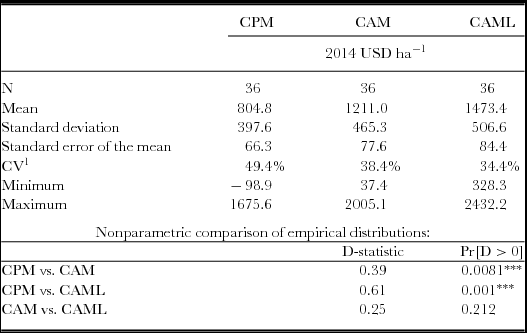
Notes: 1Coefficient of Variation; 2 Distance statistics, *** = significant at p < 0.01, ** significant at p ≤ 0.05, Kolmogorov-Smirnoff nonparametric test of equality between empirical distributions. CPM = conventional control plot with sole maize, CAM = conservation agriculture with sole maize, CAML = conservation agriculture with maize with cowpea intercropping.
DISCUSSION
Yield response to CA
Bio-physical responses of CA on maize grain yield are evident from this long term research project in Malawi from 2005 to 2014. CA is often credited for its environmental effects on soil and water, erosion control and soil temperature (Kassam et al., Reference Kassam, Friedrich, Shaxson and Pretty2009; Lal, Reference Lal1974b; Thierfelder and Wall, Reference Thierfelder and Wall2009). The results of this study also show that grain yields in no-tillage systems were higher than from ridge-tilled systems (Ngwira et al., Reference Ngwira, Aune and Mkwinda2012; Reference Ngwira, Thierfelder and Lambert2013; Owenya et al., Reference Owenya, Mariki, Kienzle, Friedrich and Kassam2011). Baudron et al. (Reference Baudron, Tittonell, Corbeels, Letourmy and Giller2012b), summarising results from Zimbabwe state that yield performance under CA is dependent on seasonal quality (high/low rainfall) and soil type. Our results from higher potential areas of Malawi with average annual rainfalls >1000 mm on fertile soils showed that CA performed well in both relatively wet and dry years. At both sites, we recorded increased productivity after 4–5 cropping seasons on CA treatments, which shows that yield benefits may accrue in the medium term despite previous suggestions that yield responses take 10–15 years (Giller et al., Reference Giller, Witter, Corbeels and Tittonell2009; Reference Giller, Corbeels, Nyamangara, Triomphe, Affholder, Scopel and Tittonell2011). Results also suggest that after years of practising CAM and CAML, the chances of yield benefits over CPM will increase, which confirms previous results from Malawi and Zimbabwe (Nyamangara et al., Reference Nyamangara, Masvaya, Tirivavi and Nyengerai2013; Reference Nyamangara, Marondedze, Masvaya, Mawodza, Nyawasha, Nyengerai, Tirivavi, Nyamugafata and Wuta2014a; Thierfelder and Wall, Reference Thierfelder and Wall2012; Thierfelder et al., Reference Thierfelder, Chisui, Gama, Cheesman, Jere, Bunderson, Eash, Ngwira and Rusinamhodzi2013). This is also supported by the result of a global meta-analysis carried out by Rusinamhodzi et al. (Reference Rusinamhodzi, Corbeels, van Wijk, Rufino, Nyamangara and Giller2011). With time, we expect farmers to improve management based on a better understanding of CA needs, which will likely increase yields further (Wall, Reference Wall2007).
Despite competition in intercropping systems, results suggest that there was no significant yield penalty on the main maize crop because the cowpea intercropping option (CAML) produced higher yields and were suitable for the local farming system. This result is especially important and it provides a pathway to sustainable intensification to address food insecurity with greater returns to land, labour and capital. The yield advantages of intercropping are often attributed to interspecific root interactions that lead to improved nitrogen and phosphorus acquisition compared with monocropping (Zhang and Li, Reference Zhang and Li2003). When the intercrops have different maturity dates, after the main crop is harvested, the companion crop normally recovers so that the final yields are maintained or improved compared with corresponding sole crops (Zhang and Li, Reference Zhang and Li2003). Establishing cowpeas as intercrops in CA fields can be difficult when the maize row spacing is very narrow (75 cm) which is the current recommended practice in Malawi. For this reason, many farmers prefer intercropping pigeon-peas because its yield is normally not affected by its late maturity (Myaka et al., Reference Myaka, Sakala, Adu-Gyamfi, Kamalongo, Ngwira, Odgaard, Nielsen and Høgh-Jensen2006; Sakala, Reference Sakala1994).
Economic effects of CA
If the yield benefits accrue after a lag period of only 3–5 years, there is need for an immediate short term benefit to make CA attractive to farmers. Where this is missing, it can affect spontaneous and widespread adoption. The knowledge about economic benefits of CA in maize-based systems has been low to date due to the limited number of studies with quality data, especially on labour. Very few attempts have been made to capture this important aspect in southern Africa (Mazvimavi, Reference Mazvimavi2011; Mazvimavi and Twomlow, Reference Mazvimavi and Twomlow2009; Ngwira et al., Reference Ngwira, Thierfelder and Lambert2013; Umar et al., Reference Umar, Aune, Johnsen and Lungu2012) and results are controversial and often contradictory (Grabowski and Kerr, Reference Grabowski and Kerr2014).
From this research, it appears that CAML was the economically most advantageous cropping system followed by CAM. The expected monetary pay-off of both CA treatments was higher compared with the conventional CPM control treatment, which was confirmed by the two-sample Kolmogorov–Smirnoff test. Similar results have been previously found by Sorrenson et al. (Reference Sorrenson, Duarte and Lopez Portillo1998) in Paraguay although their evaluations were made on large-scale mechanised farms.
The greatest CA benefits from our assessment were found in reduced farm labour for preparing ridges and/or for weeding. Reductions in farm labour of 36–39 labour days per hectare, such as experienced with CAM and CAML, can be an important factor in labour constrained households affected by HIV/AIDS in southern Africa. Reductions in farm labour through CA in Malawi can also preferentially benefit women and children who are often assigned with the laborious tasks of ridging and weeding. However, if farmers are cash constrained and family labour is sufficiently available, farmers will often decide to make use of this ‘free’ family labour instead of purchasing ‘expensive’ inputs such as herbicides for weed control. Labour figures therefore have to be viewed in the context of the farmers’ situation. The results of this study showed that input costs were higher in CA treatments mainly due to the expensive herbicides. However, decreased labour costs and increased gross receipts turned this into a substantial monetary benefit to farmers. For every labour hour or dollar invested for inputs, there was a greater return to CA than in conventionally ridge tillage systems which makes CA more profitable.
Challenges to the widespread adoption of CA
Although bio-physical and economic benefits were evident in this study, a number of challenges may hinder the successful implementation and uptake of CA (Thierfelder et al., Reference Thierfelder, Rusinamhodzi, Ngwira, Mupangwa, Nyagumbo, Kassie and Cairns2015b; Wall, Reference Wall2007) (Table 5). CA systems have been adopted, continued and dis-adopted in some cases. For example, CA promotion in the past has often been driven by the agenda of development projects (Andersson and D’Souza, Reference Andersson and D’Souza2014) and once the project ends, farmers may go back to their age-old practices. Furthermore, the CA system promoted do not always match the resource endowment and cropping system of the farmer (Arslan et al., Reference Arslan, McCarthy, Lipper, Asfaw and Cattaneo2014; Umar, Reference Umar2014). A classic example of a mismatch is the promotion of manual basins systems to farmers that own spans of oxen and are interested to prepare their land and control weed with animals (Andersson and D’Souza, Reference Andersson and D’Souza2014). In such cases farmers will reject basins as they will increase their labour burden, despite possible yield benefits in the long-term (Grabowski et al., Reference Grabowski, Kerr, Haggblade and Kabwe2014).
Challenges of implementing CA in Malawi that still persist.

Crop residue retention
Retaining crop residues on smallholder farmers’ fields is reported as one of the greatest challenges to the adoption of CA at the farm level in Zambia and Zimbabwe (Mupangwa and Thierfelder, Reference Mupangwa and Thierfelder2014; Mupangwa et al., Reference Mupangwa, Twomlow and Walker2012; Valbuena et al., Reference Valbuena, Erenstein, Homann-Kee Tui, Abdoulaye, Claessens, Duncan, Gérard, Rufino, Teufel, van Rooyen and van Wijk2012). The reason is that there are competing uses for crop residues with livestock, which are an important asset for smallholder farmers; i.e. as insurance in times of drought, as a source for draft power, as a N-source in manure, as a status symbol in the community and as a sign of wealth (Mueller et al., Reference Mueller, Pezo, Benites, Schlaepfer, Garcia-Torres, Benites and Mart¡nez-Vilela2001). The situation may be slightly different in Malawi because stocking density is comparatively low. However, this might change in the near future as increasing intensification often requires animals, for instance dairying and goat meat production both being promoted in Malawi. The competition for crop residues is therefore likely to increase. Keeping residues on farmer’ fields is generally possible if farmers are convinced of their benefits. However, some non-CA farmers have burned the residues of good CA farmers out of spite and jealousy. In other cases, mice hunters burn dry weeds and crop residues on fields to drive the mice into their holes where they can be easily caught. This is generally regarded as an acceptable cultural practice in the central region of Malawi where mice are an important protein source. In the past, farmers would also invite other farmers to collect residue from their fields for use as fuel or for fencing and roofing material. Today, residues have become a valuable resource for Malawian farmers and are more frequently available in village markets. In some areas, the incidence of termites has increased, which has led to astonishing rapid disintegration of residues during the cropping season. In tobacco growing areas, farmers also use the residues to sterilise tobacco seed beds and the remaining amounts are insufficient to cover the soil. Overall, the lack of adequate biomass for protecting the soil compromises environmental benefits and services (Thierfelder and Wall, Reference Thierfelder and Wall2009), leading to soil crusting and sealing, increased risks of water run-off, loss of valuable top soil and limited recharge of critical ground water supplies. Results from Mexico clearly show that no-tillage systems without adequate residue retention rapidly degrade (Govaerts et al., Reference Govaerts, Mezzalama, Sayre, Crossa, Nicol and Deckers2006; Reference Govaerts, Sayre, Lichter, Dendooven and Deckers2007).
Weed control
A second significant challenge in implementing CA has been the need for effective weed control after tillage is abandoned (Table 5). When CA was introduced in Malawi, it was strongly associated with a high-input package that included herbicides (Ito et al., Reference Ito, Matsumoto and Quinones2007). The control of weeds through herbicides on CA fields is very effective and cost saving (Muoni et al., Reference Muoni, Rusinamhodzi and Thierfelder2013; Reference Muoni, Rusinamhodzi, Rugare, Mabasa, Mangosho, Mupangwa and Thierfelder2014) as can be seen from the partial budgets in this study — farmers use different types of herbicides for different weed species and in different crops. Most common in maize production is the use of glyphosate, Bullet® and Harness® — herbicides that were also used in the target villages described above. TLC associated its CA intervention with input suppliers at an early stage so that this critical input was always available. In the longer term, a different approach is needed to control weeds to reduce the effect of such chemicals on the environment. This was one of the key reasons behind TLC's decision to switch from Bullet® to Harness® since the latter was viewed as less harmful to the environment. In the past two years, TLC has also stopped using Harness in favour of Stellar Star®. In summary, the control of weeds should be handled in an integrative manner to avoid complete reliance on herbicides. Strategies at hand are: (i) careful manual weed control, (ii) judicious use of herbicides (or combinations of herbicides and manual weed control), (iii) the use of good mulch cover to suppress weeds and (iv) smothering of weeds through intercrops or green manure cover crops (GMCCs) to increase competition and suppression of weeds (Mhlanga et al., Reference Mhlanga, Cheesman, Maasdorp, Muoni, Mabasa, Mangosho and Thierfelder2015). Another important aspect of weed control is the emphasis on year round weed free fields, which can effectively suppress the weeds if they do not set seed. After 4–5 years of continuous control through CA with herbicides, reductions in the weeds and weed seed bank on fields were reported (Muoni et al., Reference Muoni, Rusinamhodzi, Rugare, Mabasa, Mangosho, Mupangwa and Thierfelder2014; Mwale, Reference Mwale2009).
Pest and diseases
Malawi farmers have a strong focus on producing maize for food security and as the major source of their caloric intake (Dowswell et al., Reference Dowswell, Paliwal and Cantrell1996). It is therefore difficult to convince farmers to dedicate more land to rotational crops (Thierfelder and Wall, Reference Thierfelder and Wall2010b). However, continuous monocropping with maize has been reported to increase pests such as striga (Striga asiatica L.), white grubs (Phyllophaga spp.), cutworms (Agrotis segetum Denis and Schiefermüller), stalk and grain borers (Busseola fusca Fuller) and various blights which demand urgent attention to introduce rotations to reduce common pests and diseases in maize (Thierfelder et al., Reference Thierfelder, Rusinamhodzi, Ngwira, Mupangwa, Nyagumbo, Kassie and Cairns2015b). Some farmers resort to using intercrops such as pigeon-pea or cowpea to increase productivity (Sakala, Reference Sakala1994; Reference Sakala1998), but their effectiveness at reducing pest and diseases is uncertain. Some of the crops grown in Malawi such as tobacco and/or cassava have never been grown under CA. It is therefore important to develop methods and strategies to integrate these crops into CA farming systems.
Soil degradation
Continuous cropping with the ridge and furrow system has led to an increase in structural degradation of soils in some areas. The ridges are formed with a hand hoe and the soil in the furrow is scratched by the implement and exposed to the elements (Bunderson et al., Reference Bunderson, Jere, Thierfelder, Gama, Mwale, Ng’oma, Museka, Paul, Mbale, Mkandawire, Tembo, Mkwomwa and KassamIn press). In the following season, the ridges are split and new ridges are formed in the location of the previous furrows. This practice has been reported as leading to the formation of a shallow hardpan just below the bottom of the ridge (Aagaard, Reference Aagaard2011). Introducing CA on such soils can be quite challenging. In many cases, the hard pan can be broken using animal traction ripper and sub-soilers or a rotation with deep rooting crops such as pigeonpeas, cowpeas and various agroforestry species to help reverse the structural degradation.
Waterlogging
Along parts of the lake shore area of Malawi, CA adoption is constrained because the water table is very high-leading to frequent waterlogging during the cropping season. Permanent raised beds may be an appropriate way of planting in this situation (Govaerts et al., Reference Govaerts, Sayre and Deckers2005; Reference Govaerts, Mezzalama, Sayre, Crossa, Nicol and Deckers2006). However, once the beds are formed they should remain permanently at their position with minimal soil disturbance and limited maintenance of the sides of the beds.
Input and output markets
At the farm level, functional input and output markets are critical. Often, access to and availability of improved seed, fertiliser and herbicides are huge constraints to farmers’ uptake although Malawi has relatively well developed input markets. In rotations with specific legumes, such as pigeonpeas or cowpeas, there is need for good markets to sell the produce and to justify a shift to replace some maize with legumes. In many cases, farmers prefer maize for two main reasons — it offers better food security and the market for maize grain is well developed. Another common limitation is the price for the rotation crop. Rotations must be evaluated over longer periods taking into account market prices, effects on soil fertility (e.g. on the maize), effects on pest control and total net benefits from all crops (Thierfelder and Wall, Reference Thierfelder and Wall2010b). Farmers should receive the same range of benefits or more from a rotation than from monocropping of maize, otherwise they will not make the needed shift.
Credit markets
The unavailability of functional credit markets in Malawi has been a major challenge because most farmers lack the cash at the onset of the farming season to buy critical inputs and farm equipment. In the absence of a credit facility to provide loans at reasonable interest rates, TLC previously offered interest-free loans to farmers through a standard input pack of improved seed and herbicides with a deposit upfront and agreement to repay the value of the input pack after harvest. Although successful in overcoming some of the input constraints faced by farmers, it has led to other challenges: (i) farmers associate CA with the input pack which became the driving focus for participation rather than the actual practice of CA; (ii) the provision of input loans and collection of payments compromises TLC's primary function of delivering extension services. TLC is addressing these issues in three ways: (i) restricting input packs of improved seed and herbicides to lead farmers for undertaking trainings, demonstrations and field days on their own farms; (ii) for follower farmers, inputs are limited to a small pack of legume seeds on a pass-on system due to poor access to quality legume seed, and (iii) working on pilot projects with micro-finance institutions to provide input loans to selected groups of farmers evaluated as low risk for repaying the loans.
Extension systems
While CA appears to be complex, implementation can be achieved with training and capacity building modules to equip farmers and extension agents with the skills needed to improve and adapt CA to local circumstances based on priority needs and interests. Innovation networks have been proposed by various authors to understand and overcome the complexity of CA systems at the field and farm scale (Ekboir, Reference Ekboir2002; Ekboir et al., Reference Ekboir, Boa, Dankyii, Garcia-Torres, Benites, Martinez-Vilela and Holgado-Cabrera2002; Rycroft and Kash, Reference Rycroft and Kash1994). Innovation networks make use of complex interactions between stakeholders, leveraging their particular comparative advantages and facilitate knowledge and information sharing (Thierfelder and Wall, Reference Thierfelder, Wall, Bationo, Waswa, Okeyo, Maina and Kihara2011). In Latin America and South Asia, innovation networks have proved to be an efficient way for the development and adoption of complex agricultural change, which finally resulted in the uptake of CA.
Successful extension of CA systems by TLC in innovation systems approaches has led to large outscaling of this technology to more than 30,000 farmers on more than 14,000 hectares in Malawi in the last decade (Figure 7), which is expected to increase as CA has become a released technology in Malawi with full support from the Ministry of Agriculture.
Farmers Practicing CA under TLC Programs, 2005/06 to 2013/14; (data in graph are annual figures, not cumulative across years). Source: adapted from Bunderson et al. (Reference Bunderson, Jere, Thierfelder, Gama, Mwale, Ng’oma, Museka, Paul, Mbale, Mkandawire, Tembo, Mkwomwa and KassamIn press).

In summary, CA systems have the potential in Malawi to outperform conventional ridge and furrow systems both in terms of yield, labour and economic benefits. However, critical constraints for the successful implementation need to be addressed through adaptive research to overcome local challenges at the field, farm and community level.
CONCLUSION
The performance of different CA systems on productivity and profitability was tested in two on-farm communities of Malawi from 2005 to 2014. CA has led to a gradual increase in maize yields over time. In both communities, a clear trend of higher maize yields was recorded after the fifth cropping season. Economic returns suggest that moving away from a labour intensive ridge and furrow systems has significant benefits for smallholder farmers. The CA system currently practiced saves substantial manual labour by eliminating the need for constructing ridges, weeding and banking through the use of a dibble stick for seeding and backpack sprayers for applying herbicides. The labour savings provided an immediate benefit that was greatly appreciated by farmers. However, some farmers are reluctant to change from traditional farming practices due to the long history of making ridges with clean fields. Other challenges for moving away from traditional farming include retaining residues, although this is less of a problem in Malawi due to low livestock numbers; the control of weeds without herbicides; pest and diseases in monocropping maize; the introduction of crop rotations due to the perception that CA is applicable only to maize; and undeveloped markets for inputs and outputs. All these challenges need to be addressed through adaptive research and targeted extension approaches such as innovation networks.
Although CA is not a totally new way of farming in Malawi, it removes some of the unsustainable elements of traditional farming, notably the high level of water run-off and loss of top soil, reliance on monocropping with intensive soil movement, and the burning or removal of crop residues. With increased market linkages, adaptive research and innovative extension networks, many of these remaining challenges may be minimised leading to sustainable intensification and widespread adoption of this cropping system.
Acknowledgements
We wish to thank the farmers, TLC staff and Agricultural Extension Development Officers (AEDOs) of Nkhotakota District for their enthusiasm, collaboration and support during project implementation phase. This work has been embedded in the MAIZE CGIAR Research Program. We wish to acknowledge the financial support of the German Ministry of Economic Cooperation and Development (BMZ), the German Technical Cooperation (GIZ) and International Fund for Agriculture Development (IFAD) for funding project activities from 2005 to 2014. Special thanks go to Dayton Lambert and Leonard Rusinamhodzi for their good suggestions and ideas during the development of this publication.



