INTRODUCTION
Over recent years, acutely mentally unwell patients who have behaved, or are at risk of behaving in a way that places themselves and/or others at risk have been managed within PICUs. Despite national guidance (Department of Health, 2002) there is considerable variation between PICUs in their approach to the use of containment strategies. A recent study of seven different PICUs (Dye et al. Reference Dye, Brown and Chhina2009) found a nearly fivefold variation between the highest and lowest unit in episodes of physical restraint, and a sixfold variation in the total time patients spent being physically restrained. In units where seclusion was used (four of the seven), there was a 50% variation in its use. The same units also varied greatly in their use of rapid intramuscular tranquillisation (Brown et al. Reference Brown, Chhina and Dye2010).
‘If someone had of sat down and talked to me and explained what was going to happen it would probably have been different… On the odd occasion they’ve let me get to the point where I’ve been restrained and they’ve told me later that was what they were going to do.’ This was a comment made by one patient in the book Experiences of Mental Health In-patient Care (Ockwell et al. Reference Ockwell, Gournay, Turner, Hardcastle, Kennard, Grandison and Fagin2007). Many patients have shared these views when discussing an episode that has required rapid tranquillisation, restraint or seclusion.
Attitudinal features surrounding management of aggression have revealed a clear distinction between views of staff and patients (Duxbury, Reference Duxbury2002): patients viewed staff approaches as ‘controlling’ and believed that a restrictive environment and poor communication factors underpinned aggressive behaviour. Staff, conversely, attributed aggressive behaviour to internal patient psychopathological factors and also a poor environment. This disparity led to a large number of ‘reactive aggressive incidents’ precipitated by patients, and reliance upon the use of approaches that were reactive by staff. Meehan et al. (2004) also reported that patients believed seclusion was used for minor disturbances as a means of staff exerting power and control. It has been stated that the use of restrictive methods to manage aggression may magnify psychotic symptoms, may have a damaging impact upon relationships and could lead to further violent behaviour, prompting use of more restrictive measures (Nijman et al. Reference Nijman, à Campo, Ravelli and Merckelbach1999).
In the UK, the most recent National Audit of Violence within working age adult psychiatric services (Healthcare Commission, 2008) stated that ‘although the nature, level and severity of violence on wards have increased, the effectiveness with which staff teams prevent and manage incidents has also increased… There is clear evidence that the majority of services are now adopting proactive and preventative strategies to tackling violence in inpatient services.’ Despite this, it revealed that members of PICU clinical teams were the most likely to have been threatened or made to feel unsafe, and the risk of physical assault for nurses, clinicians and patients was greatest in PICUs. Across ward types, patients in PICUs were most likely to feel that medication, seclusion and hands-on restraint were being used too quickly.
Over recent years, the use of more non-controversial strategies such as verbal de-escalation, conflict resolution, use of multisensory rooms (Champagne & Stromberg, Reference Champagne and Stromberg2004) and patient engagement strategies has been advocated. Anecdotal reports from the Star Wards initiative (aiming to help create inpatient stays that are actively therapeutic; Janner, Reference Janner2007) have indicated that violence has decreased on wards that have embraced the scheme, indicating that one area for improvement is that of patient involvement.
The UK Department of Health has placed the onus upon service providers to deliver appropriate interventions in a transparent and measurable fashion (NIMHE, 2004; HSE, 2006) and patient engagement can be expanded to patients’ preferences for how to be managed in the event of becoming disturbed or violent. Many patients have a clear preference regarding this (Veltkamp et al. Reference Veltkamp, Nijman, Stolker, Frigge, Dries and Bowers2008; Van Citters et al. Reference Van Citters, Naidoo and Foti2007) and the concept has been advocated within UK national guidance (NICE, 2005) that has outlined a framework for engagement of patients. This states that patients should have access to information in a suitable format about what may happen if they become disturbed or violent and that although no studies had been identified, ‘it is a legal right that detained service users are given this information’. The guidance further asserts that ‘Service users identified to be at risk of disturbed/violent behaviour should be given the opportunity to have their needs and wishes recorded in the form of an advance directive (sic).’ which ‘should…clearly state what intervention(s) they would and would not wish to receive.’ Again, no studies were identified that specifically addressed the issue of advance statements but the guidance opined that discussing these issues with ‘appropriate service users’ would not cause unnecessary anxiety.
A formal method of recording patients’ preferences if they display disturbed behaviour was introduced within one PICU. This paper describes an audit of its use and examines if, following admission to PICU, patient preferences regarding management of their disturbed behaviour are taken into account and acted upon.
METHOD
A process of discussing with patients procedures for managing disturbed behaviour was introduced within a 10-bed mixed sex PICU. This consisted of, at the earliest reasonable opportunity following transfer or admission, a member of the multi-disciplinary team (medical or nursing) interviewing the patient and providing information about rapid tranquillisation, seclusion and physical restraint. The process also included the member of staff completing, with the patient, a form outlining the patient’s preferences of management should they become disturbed (Appendix 1, online at http://journals.cambridge.org/jpi). Although PICUs admit extremely unwell individuals, the statement within NICE guidance regarding ability to understand these procedures and the principle that everybody should be assumed to have capacity unless proved otherwise was followed. Should the patient display obvious lack of capacity to understand, it was decided to regularly review this on an at least daily basis. The form was used as a basis for discussion and as evidence that a patient had received relevant information.
Three months following introduction of this process, it was decided to audit its usage with the following standards:
1. All patients admitted should receive the opportunity to complete the advance statement documentation.
2. If displaying a need for management of disturbed behaviour that is above de-escalation measures, a patient’s wishes (as completed on the form) should be followed as far as possible.
It was decided to measure the use of the form upon 15 consecutive patients following their discharge/transfer from the PICU. After completion of the first cycle, it was also decided to re-audit six months following implementation of any proposed changes.
RESULTS
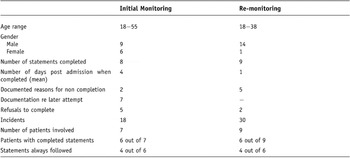
These can be seen in Table 1.
Initial and follow up results of audit

Initial monitoring
This revealed that advance statements were performed in eight of the fifteen patients admitted (53%). They were performed at an average of 4 days post admission and when completed, patients’ wishes were followed on two thirds of occasions where incidents required interventions beyond de-escalation.
Changes to practice
After completion of initial monitoring, the following recommendations for change were made:
1. Staff to handover the outstanding advance statements in each shift and the task to attempt completion with the patient to be allocated.
2. To document reasons when not completed.
3. To attach a copy of the completed advance statement with the prescription card as an aide memoire in case of an incident.
Re-monitoring
This revealed that advance statements were performed in nine of the fifteen patients admitted (60%). These were performed at an average of 1 day post admission and when completed, patients wishes were followed on two thirds of occasions where incidents required interventions beyond de-escalation.
DISCUSSION
This small one cycle audit demonstrates that it is possible to engage with extremely unwell patients regarding their management preferences related to disturbed behaviour. Although improvements in practice were minimal, the fact that over half of patients admitted to this PICU managed to complete an advance statement with assistance implies that through sustained engagement, patients can be given appropriate information and empowered (as much as possible) regarding their care in traumatic and at times risky processes. It is sometimes difficult to strike a balance between what could be construed by patients as ‘continued pestering’ but if an individual adamantly refuses to engage, a further opportunity arises should they require interventions to manage disturbed behaviour through debriefing of the event. Following acts of disturbed behaviour there must be a range of services available that provide post-incident support, debriefing and review. This audit did not address this particular issue but it is one that NICE has recommended and is standard practice amongst PICUs (Dye et al. Reference Dye, Johnston and Pereira2005).
Another limitation of this audit is the small number of patients involved, and thus it did not examine the relationship between completion of an advance statement and the need for subsequent intervention. It could be hypothesised that through discussing and engaging with individuals at an early opportunity, amounts of disturbed behaviour would decrease (as implied by the statement of a patient quoted in the introduction).
Methods to reduce use of restraint and seclusion have included change of policies (Hellerstein et al. Reference Hellerstein, Staub and Lequesne2007; Hucksorn, Reference Hucksorn2006), environmental improvement (Champagne & Stromberg, Reference Champagne and Stromberg2004) and increased training (Farrell & Cubit, Reference Farrell and Cubit2005). Introductions of control and restraint training to one unit (Parkes, Reference Parkes1996) and training around issues of prevention of aggression in another (Forster et al. Reference Forster, Cavness and Phelps1999) have been shown to reduce seclusion episodes, although Bowers et al. (2007) reported that some aspects of training courses might actually exacerbate rather than reduce conflict rates. The appropriate use of medication has also been proposed as a method of reducing seclusion episodes (Klinge, Reference Klinge1994), and one participating PICU within a governance network (Dye et al. Reference Dye, Johnston and Pereira2005) demonstrated a reduction following introduction of pharmacy education and regular team meetings. Introduction of the Productive Wards initiative (NHS Institute for Innovation and Improvement, 2008) that aims to help improve ‘the effectiveness, safety and reliability of mental health wards’ provides an opportunity to measure its effect upon reduction in disturbed behaviour.
Therefore, many factors must be examined when attempting to reduce use of more controversial containment strategies. It has been shown that through a process of audit and effective change management, episodes of violence can be reduced (e.g. Mortimer, Reference Mortimer1995). The introduction of specific nurses on wards to assist in change implementation led to reductions in aggression, absconding and self-harm but no significant change in containment method use (Bowers et al. Reference Bowers, Brennan, Flood, Lipang and Oladapo2006). Increased staffing levels are highly significant in reducing seclusion use (Outlaw & Lowery, Reference Outlaw and Lowery1992; Morrison & Lehane, Reference Morrison and Lehane1995) but this may possibly be because the increased availability of staff leads to increased use of restraint. Palmstierna & Wistedt (1995) concluded that higher staff numbers decreased the severity of violent incidents, but not their frequency.
One disappointing result from the re-audit is that there was only a minimal increase in number of forms completed. This may have been due to patient mental capacity issues or lack of senior staff giving the information to patients and completing the form with them. Further changes to practice could have addressed this. Another cycle could also have formally examined individual incidents to discover why an individual’s advance statement was not followed following incidents of disturbed behaviour. This could also have led to a formal organisational policy review and change to include specific use of such advance statements. Unfortunately further improvement was not possible as, due to service re-organisation in a large mental healthcare provider, this PICU was closed.
Prominent guidance outlining standards for seclusion, physical intervention and rapid tranquillisation use (NICE, 2005) has been accompanied by cross-governmental working parties (NIMHE, 2004) and will be supplemented by further Royal College guidance replacing outdated versions in management of violence (Royal College of Psychiatrists, 1998). It is difficult to establish the impact of such measures upon practice without any appropriate reference data and well-designed studies are difficult to perform. This highlights the need for successful policies to be locally disseminated, adhered to and shared with others as well as for effective auditing of interventions. One way to improve patient engagement, provide information and reduce the need for emergency interventions is by the use of advance statements. This audit has introduced one way of performing this measure.
SUMMARY AND CONCLUSIONS
‘Those of us who have experienced being restrained seem to be left wondering why things happened as they did.’ (Ockwell et al. Reference Ockwell, Gournay, Turner, Hardcastle, Kennard, Grandison and Fagin2007; a further quote from a different patient). This paper has described the use of an advance statement system aimed to address this concern. Hopefully, interventions similar to the one described will decrease the number of comparable quotes.
Methods to manage disturbed behaviour must be viewed in a systemic fashion and a multi-faceted approach must be undertaken (Fisher, Reference Fisher2003; Gaskin et al. Reference Gaskin, Caderyn, Elsom and Happell2007; Antonelli, Reference Antonelli2008). Nationally, this has been adopted in the UK through publication of several documents that address the management of disturbed behaviour, and give organisations a framework for delivering and measuring service improvement. PICU staff are experienced in the management of disturbed behaviour, and should be at the forefront of the debate in these initiatives. Research should now focus upon best practice and governance surrounding use of such measures. We need to continue the progression of collecting valid data about actual day-to-day clinical activity in order to identify and promote good (and reduce poor) practice in what are controversial, distressing and at times dangerous interventions.
Acknowledgement
The author would like to acknowledge the assistance of Marek Fatek and Sarika Kakwani who helped with data collection.