Zamorano cheese is a Spanish traditional cheese which has had Protected Designation of Origin status (PDO) status since 1993 (B.O.E., 1993). This is a hard cheese variety made from raw or pasteurised ewes' milk obtained from the Churra and Castellana breeds, using animal rennet as a coagulant and depending on the total ripening time, two types of PDO cheeses can be found: mature cheese, matured for 4–6 months, and old cheese, ripened for 12–15 months. The milk source, the type of rennet used, and technological factors classify the Zamorano cheese in a distinct group from other PDO cheeses manufactured in the Iberian peninsula (Freitas & Malcata, Reference Freitas and Malcata2000) and have led to important differences in the sensory characteristics of ewes' cheeses (Barron et al. Reference Barron, Redondo, Flanagan, Pérez-Elortondo, Albisu, Nájera, de Renobales and Fernández-García2005). Thus, cheeses made from milk of other breeds, like Assaf breed, although using the Zamorano cheese-making protocol may lead to important differences in the sensory characteristics of the cheese. Assaf is a foreign breed characterized by its higher milk production that has replaced the local breeds in many flocks and currently represents 49% of dairy ewes in Spain (Martínez et al. Reference Martínez, Ruiz, Chico, Anel, Alvarez, Jurado, Díaz, Pérez and Aparicio1999).
Sensory quality is now one of the most important attributes for the successful marketing of ewes' milk cheeses. During recent years, the odour and flavour attributes of other Spanish PDO ewes' milk cheeses have been studied in detail, reporting changes in their sensory properties due to the various changes that have been introduced in technological processes and to changes in milk composition (Ortigosa et al. Reference Ortigosa, Torre and Izco2001; Fernández-García et al. Reference Fernández-García, Carbonell and Núñez2002; Virto et al. Reference Virto, Chávarri, Bustamante, Barron, Aramburu, Vicente, Pérez-Elortondo, Albisu and de Renobales2003; Muñoz et al. Reference Muñoz, Ortigosa, Torre and Izco2003).
However, less attention has been paid to the effect of Somatic Cell Counts (SCC) on the sensory properties of ewes' milk cheese. Some authors have suggested that if ewe's milk has an elevated SCC the cheeses presented some sensory defects, mainly in texture (Pirisi et al. Reference Pirisi, Piredda, Corona, Pes, Pintus and Ledda2000; Jaeggi et al. Reference Jaeggi, Govindasamy-Lucey, Berger, Johnson, McKusick, Thomas and Wendorff2003; Albenzio et al. Reference Albenzio, Caroprese, Santillo, Marino, Taibi and Sevi2004; Revilla et al. Reference Revilla, Rodríguez-Nogales and Vivar-Quintana2007). Despite the importance of this factor, to our knowledge no detailed investigations have addressed the effect of SCC on the sensory characteristics of cheeses using descriptive quantitative analyses.
The levels of SCC in ewe's milk fluctuates considerably and is affected by a lot of factors such as age, animal husbandry practices used, climate and the health status of animal's udders (Duling et al. Reference Duling, Paape, Schultze and Weinland1983). In the case of sheep the criteria for hygienic and bacteriological quality are outlined in the European Community directive 853/2004 but this directive do not establish a limit for SCC. It has been suggested that a SCC value equal to 2 000 000 can be considered normal (Konig et al. Reference Konig, Fieten and Gelling1985), however Boyazoglu & Morand-Fehr (Reference Boyazoglu and Morand-Fehr2001) suggested a threshold level for subclinical mastitis in sheep close to 1 500 000 cell ml−1 while Gonzalo et al. (Reference Gonzalo, Tardáguila, Ariznabarreta, Romeo, Monitoro, Pérez-Guzmán and Marco2000) have proposed that ovine flocks with SCC >1 000 000 should pertain to a bad sanitary category with an infection rate of over 45%. However the effects of SCC on the suitability of ewes' milk for cheese manufacture has been inconclusive partially because the incidence of subclinical mastitis and clinical infections in ovine udders is less than in bovine udders (Boyazoglu & Morand-Fehr, Reference Boyazoglu and Morand-Fehr2001).
The aim of the present work was to study the effect of SCC levels and breed on the physico-chemical and sensory characteristics of 12-month-old Zamorano cheese and to establish the existence of significant correlations between the considered variables and with the preference showed by consumers.
Materials and Methods
Milk
Different milk samples were taken from bulk milk with three somatic cell counts (less than 500 000, between 1 000 000 and 1 500 000, and more than 2 500 000 cells ml−1). The use of bulk tank milk is more realistic from an industrial point of view and previous results have revealed that the changes in chemical composition due to the different SCC levels are similar to those found when the milk is taken individually and blended to give bulk milk with the previously established SCC thresholds (Vivar-Quintana et al. Reference Vivar-Quintana, Beneitez de la Mano and Revilla2005). The upper and lower limits were set according to the highest and lowest SCC values found in the region through the year. Following this, the groups were made up according to the recommendations of the veterinary services of the Sheep Improvement Consortium and previous works (Pirisi et al. Reference Pirisi, Piredda, Corona, Pes, Pintus and Ledda2000), reporting significant differences in milk quality and technological properties among these groups.
Raw ewes' milk was collected from three herds of Assaf breed sheep, three herds of the Churra breed, and two herds of the Castellana breed because it was not possible to find herds with SCC higher than 2 500 000 cells ml−1 owing to their higher resistance to mastitis (Gonzalo et al. Reference Gonzalo, Carriedo, Blanco, Beneitez, Juárez, De la Fuente and San Primitivo2005). All the herds were bred in Zamora (Spain) under identical husbandry systems and feeding regimes. The herd size was between 300 and 500 dams and all of them were in the mid-lactation stage. During the autumn and winter, the herds were kept in stables, fed with concentrates composed of beetroot pulp, alfalfa, barley, corn, soy and cotton and were machine-milked.
The herds were selected on the basis of the milk SCC recorded twice weekly during the 12 previous months, choosing herds that always showed SCC within the limits of each group. Two samples were taken from each herd, these samples were collected on two different days in the same week and transported to the pilot plant of Food Technology where cheeses were manufactured on the day of collection. Milk samples (16=8 milk types×2 trials) were collected from the first week of November until the first week of December of 2006. A sample was submitted for Fossomatic SCC analyses at the certified laboratory of the Junta de Castilla y León (Spain; LILCYL).
Cheese-making procedure
Two trials of each milk type were performed in accordance with the Regulatory Board of the Zamorano Cheese Designation of Origin (B.O.E., 1993). Raw milk (40 l), not standardized, was incubated with 15 mg l−1 direct-vat-set starters made of Streptococcus lactis, Strep. cremoris and Strep. diacetilactis (MA400, Choozit, Danisco, Sassenage, France) at 30°C. After 30 min at 32°C, when the pH was 6·5–6·6, 12·5 mg l−1 calf rennet (90% chymosin, 10% pepsin, 1:150 000 strength) was added to each vat. Coagulation was allowed to take place over 20–70 min. When the coagulum had developed the desired firmness, evaluated subjectively, the curds were cut with a cheese harp until pieces similar in size to a grain of rice were obtained. Then, the curd was stirred for 30 min, and heated for 10 to 20 min at 36°C until it had reached the desired consistency to improve its drainage with sieves. The curd was packed in round hoops (1 kg) and pressed for 5 h at 1·5 kg cm−2 at 20°C. After pressing, the cheeses were salted by soaking them in sodium chloride brine (16° Baumé) at 18°C for 12 h. The cheeses were then moved to a drying chamber where temperature (15°C) and relative humidity (70%) were controlled. For each manufacturing process, two cheeses were removed from each vat for analysis after 12 months of ripening.
Analytical methods
All compositional analyses were carried out in triplicate. Milk and cheese samples were analysed for pH (potentiometric method, CRISON Basic20) and total nitrogen (A.O.A.C., 1995) that was determined using the Kjeldahl method and expressed as protein equivalents (TN×6·38) on the basis of dry extract. Titratable acidity (Dornic method; Tamine & Robinson Reference Tamine and Robinson1999), total solids (International Dairy Federation (IDF), 1987), lactose (IDF, 1974) and fat (Gerber method, BSI, 1995) were determined in milk. Cheese fat (Van Gulik method; I.S.O., 1975), dry extract (IDF, 1982), ashes (A.O.A.C., 2000) and fat acidity (IDF, 1969) were also analysed.
Texture analyses
Samples for cheese textural analysis were obtained by cutting a 1-cm thick slice from the central diameter of each cheese wheel. Then, six rectangular parallelepipeds, 1×1-cm thick and 3 cm long, were obtained from the slice. A TX-T2iplus equipped with a Warner-Bratzler probe (Stable Micro Systems, Surrey, England) was used to determine the instrumental texture. The crosshead speed was 1 mm/s and the maximum peak force (Warner-Bratzler shear force) necessary to cut each parallelepiped transversally and completely was recorded.
Sensory analysis
Sensory analyses were performed by a fifteen-member panel trained in the use of Quantitative descriptive Analysis (QDA) methodology (Murray & Delahunty, Reference Murray and Delahunty2001) in six sessions (three samples per session) on a cheese cube of 1·5×1·5×1·5 cm size. Within the descriptors generated by the panel, the following were defined as being the most discriminating: yellow colour, rancidity, pungency, grainy texture, creamy sensation and hardness. For quantification of the intensity of each attribute, 7-point scales were employed, in which 1 referred the minimum intensity and 7 the maximum of each parameter.
A 90-member untrained panel evaluated the cheeses in a rank preference test. In this test, consumers were asked to rank the 8 different samples in ascending order according to overall acceptability. Values were calculated as follows: the sample ranked first was accorded a 1; that ranking second a 2, and so on and the final value was the sum of all the scores given by consumers. The reasons for the preference or for rejection of the samples were also requested. This test was carried out the two cheese-making trials and the scores attained in each trial were summed to give the overall acceptability score.
Statistical analyses
The data for each variable were analysed by one-way analysis of variance (ANOVA). The statistical significance of a factor was calculated at the α=0·05 level, using the F-test. When significant, the LSD Fisher-test was employed to test for statistically significant differences between means. A correlation matrix was calculated to investigate relationships between variables. All statistical analyses were carried out using the Statgraphic Plus for Windows Computer Package (1995 Manugistics, Inc.).
Results and Discussion
Milk composition
The composition of milk is shown in Table 1, a statistically significant increase of pH may be seen when SC levels rose, in agreement with most previous reports (Pirisi et al. Reference Pirisi, Piredda, Corona, Pes, Pintus and Ledda2000; Albenzio et al. Reference Albenzio, Caroprese, Santillo, Marino, Taibi and Sevi2004; Bianchi et al. Reference Bianchi, Bolla, Budelli, Caroli, Casoli, Pauselli and Duranti2004). This fact is usually correlated with a decrease in lactose synthesis in the infected mammary gland and hence a lower production of lactic acid (Martí de Olives & Molina Pons, Reference Martí de Olives and Molina Pons1998). However, a decrease in lactose content was only seen for the Castellana breed together with a statistically higher acidity in high SCC-milks, although owing to the buffering effect of milk this did not lead to lower pH values.
Mean and standard deviation (sd) of compositional parameters of low (<500 000 SCC ml−1), medium (106–1·5·106 SCC ml−1) and high (>2·5·106 SCC ml−1) SCC milks of the three studied breeds

a,b,c Different letter in the same row means statistically significant differences at α=0·05 between different SCC levels for each breed
i,j,k Different letter in the same row means statistically significant differences at α=0·05 between breeds for each SCC
1 ml 0·1 N NaOH/ml milk
2 Total %N×6·38
Regarding the fat percentage, Castellana and Churra milks had a significantly lower content for the high SCC milks due to the reduced synthetic and secretory capacity of the mammary gland (Bianchi et al. Reference Bianchi, Bolla, Budelli, Caroli, Casoli, Pauselli and Duranti2004). However, several authors showed that SCC did not affect fat content as observed for Assaf breed (Pirisi et al. Reference Pirisi, Piredda, Corona, Pes, Pintus and Ledda2000; Albenzio et al. Reference Albenzio, Caroprese, Santillo, Marino, Taibi and Sevi2004) due to the reduction in milk production.
Protein values did not show differences between SCC levels in agreement with most of the previous works (Pirisi et al. Reference Pirisi, Piredda, Corona, Pes, Pintus and Ledda2000; Albenzio et al. Reference Albenzio, Caroprese, Santillo, Marino, Taibi and Sevi2004). Regarding total solids different trends according SCC were observed depending on the breed. Finally, the bacteria contents were not correlated with the SCC.
This results show that Castellana breed was the most affected by the increase of SCC. On the other hand, when breed effect on the milk compositions was considered the Castellana breed showed statistically significant higher levels for protein and total solids.
Physico-chemical and texture analyses of cheese
Table 2 shows the values corresponding to the physico-chemical and instrumental texture parameters studied. With respect to pH, an increase was seen with increasing SCC values that was statistically significant for the Castellana breed. This result is due to the higher cheese casein proteolysis as SCC increased (Albenzio et al. Reference Albenzio, Caroprese, Santillo, Marino, Taibi and Sevi2004; Revilla et al. Reference Revilla, Rodríguez-Nogales and Vivar-Quintana2007) that produces the release of amino groups and higher pH values (Sousa et al. Reference Sousa, Ardo and McSweeney2001).
Mean and standard deviation (SD) of physico-chemical characteristics of 12-month-old cheeses from low (<500 000 SCC ml−1), medium (106–1·5·106 SCC ml−1) and high (>2·5·106 SCC ml−1) SCC milks of the three studied breeds

a,b,c Different letter in the same row means statistically significant differences at α=0·05 between different SCC levels for each breed
i,j,k Different letter in the same row means statistically significant differences at α=0·05 between breeds for each SCC
† Ash on a dry weight basis
‡ Total %N×6·38, on a dry weight basis
§ Fat content on a dry weight basis
¶ mg of KOH per gram of fat
†† Warner-Bratzler Shear Force expressed in grams
The dry extract underwent a statistically significant decrease as the SCC values increased and this is in agreement with previous reports that have demonstrated that cheeses made from mastitic milk have higher moisture contents than those made from normal milk (Barbano et al. Reference Barbano, Rasmussen and Lynch1991), apparently due to an alteration in milk protein composition and mineral balance (Munro et al. Reference Munro, Grieve and Kitchen1984). The ash content did not show any significant variations due to the change in SC levels.
The total protein content did not show statistical significant differences due to the SCC. Although higher proteolysis as SCC increased has been observed due to the higher moistures (Creamer, Reference Creamer1970) and plasmin activity (Bianchi et al. Reference Bianchi, Bolla, Budelli, Caroli, Casoli, Pauselli and Duranti2004) as well as other acid proteinases (Marino et al. Reference Marino, Considine, Sevi, McSweeney and Kelly2005) in the high SCC cheeses, the differences were negligible after 6 months of ripening (Jaeggi et al. Reference Jaeggi, Govindasamy-Lucey, Berger, Johnson, McKusick, Thomas and Wendorff2003) that may explain the results obtained in this study.
Regarding the fat content of the cheeses, it may be seen that this was significantly lower in the cheeses with higher SCC levels. These cheeses also showed significantly higher values of fat acidity, attributable to an increase in lipolysis in the cheeses with high SCC. Increased lipolytic activity in the highest SCC milks due to the lipase activity of somatic cells (Delandes, Reference Delandes and Mémoire de1998) produces higher concentrations of free fatty acids (FFA; Bachman et al. Reference Bachman, Hayen, Morse and Wilcox1988) increasing fat acidity.
Finally, the results on instrumental texture (WBSF) did not reveal statistically significant differences due to the increase in SCC except for Castellana breed that showed higher hardness for high SCC cheeses.
Regarding the effect of breed on the chemical composition of the cheeses, the results showed that there were no significant differences in pH, dry extract, ash, protein content, or instrumental texture. Nevertheless, it was observed that the Churra breed cheeses had statistically lower fat contents for all SCC levels considered.
Sensory analysis and consumer preferences
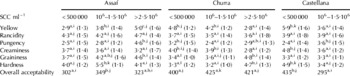
The results obtained in the quantitative descriptive analysis carried out by the panel of trained experts are shown in Table 3. The qualitative milk fat composition can be regarded as the most important descriptor of cheese body colour (Rohm & Jaros, Reference Rohm and Jaros1997) and the increase of fat lipolysis may explain the increase of yellow index as SCC rose for the Assaf breed. However, the opposite was observed for local breeds.
Mean and standard deviation (SD) for sensory characteristic evaluated by the trained panel (1–7 scale) and sum of the scores for the overall acceptability evaluated by consumers of 12-month-old cheeses made from low (<500 000 SCC ml−1), medium (106–1·5·106 SCC ml−1) and high (>2·5·106 SCC ml−1) SCC milks of the three studied breeds

a,b,c Different letter in the same row means statistically significant differences at α=0·05 between different SCC levels for each breed
i,j,k Different letter in the same row means statistically significant differences at α=0·05 between breeds for each SCC
Regarding the parameters of flavour, the panellists did not find significant differences in rancidity due to the increase in SCC values. Regarding pungency, however, the scores increased significantly with the SCC for the Assaf and Castellana breeds. This result indicates that the observed increase in lipolysis produced an increase of pungency because short chain fatty acids are first released (Gobetti et al. Reference Gobetti, Lanciotti, De Angelis, Corbo, Massini and Fox1999).
The textural parameter most clearly affected by the increase in SCC was creamy sensation, a decrease in this parameter being observed for the cheeses from all breeds. Regarding the graininess, a significant increase with SCC was observed for the Assaf and Churra breed. Previous research has pointed out that high-SCC cheeses showed an increase in proteolysis and higher amounts of I-αs1-CN which is associated with problems in cheese texture (Irigoyen et al. Reference Irigoyen, Izco, Ibáñez and Torre2000; Sousa et al. Reference Sousa, Ardo and McSweeney2001) increasing the crumbliness which has been related to the accelerated breakdown of αs1-CN (Revilla et al. Reference Revilla, Rodríguez-Nogales and Vivar-Quintana2007), which is believed to be one of the principal determinants of texture in cheese (Creamer & Olson, Reference Creamer and Olson1982). Finally, sensory hardness, did not show any clear trend with respect to the SCC may be because it depended more on the dry extract (Table 4).
Correlation coefficientsFootnote a between physico-chemical and sensory parameters
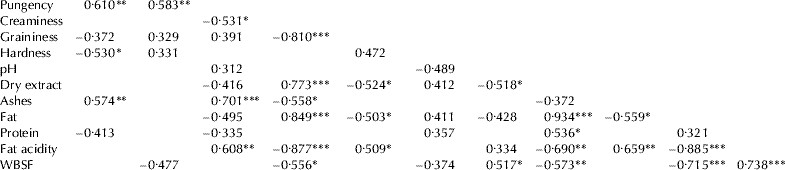
a Values lower than 0,25 are not shown in order to simplify the results exposition
* Significant correlation at α=0·1 level. ** Significant correlation at α=0·05 level. *** Significant correlation at α=0·01 level
Breed had a significant effect on the sensory parameters. The cheeses made with Assaf breed milk had higher values for rancidity, probably due to the high proportion of short chain fatty acids of Assaf milk (Vivar-Quintana et al. Reference Vivar-Quintana, Revilla, Pérez-Rodrigo and Rodriguez-Nogales2008), together with higher yellow colour and pungency values for high SCC-milk cheeses. Finally, cheeses from the Churra breed has statistically lower values in this parameter.
The means of the results obtained for consumer preferences are shown in Table 3. Cheeses elaborated with Churra breed milk obtained the highest scores, regardless of the SCC levels, together with the low-SCC Castellana breed cheeses. Unlike previous studies (Revilla et al. Reference Revilla, Rodríguez-Nogales and Vivar-Quintana2007), there was no decrease in acceptability when SCC levels rose, with the exception of Castellana breed cheeses. This suggests that breed, rather than SCC levels, influences acceptability to a greater extent and, furthermore, that consumers prefer cheeses from the local breeds.
Correlation between physico-chemical and sensory parameters
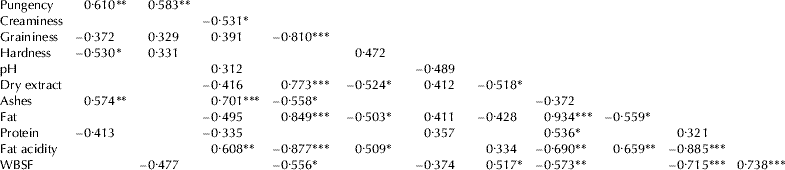
Study of the correlations (Table 4) among the physico-chemical parameters analysed reveals, as observed previously, a strong negative correlation between the fat content and fat acidity and both were correlated with the shear force (WBSF). Then, the cheeses with less fat and greater fat acidity were those with the least hardness. Kebary et al. (Reference Kebary, Khador, Zedan and Mahmoud1996) established that FFA levels and soluble nitrogen have the same behaviour during cheese maturation pointing that proteolysis and lipolysis are affected by the same factors.
Other correlations of interest are those seen between the dry extract and fat, of positive sign, and hence of negative sign with regard to fat acidity. The higher moisture contents may contribute to a greater degree of triglyceride lipolysis liberating more total FFA (Jaeggi et al. Reference Jaeggi, Govindasamy-Lucey, Berger, Johnson, McKusick, Thomas and Wendorff2003).
The correlations between the dry extract, protein content and pH show that the cheeses with less dry extract had lower protein levels and high pH values due to the greater proteolysis (Sousa et al. Reference Sousa, Ardo and McSweeney2001). In turn, ash is negatively correlated with the fat content and positively with fat acidity, indicating that the cheeses with a high degree of lipolysis are characterised by a greater mineralization of the samples. Previous results have shown an increase in total calcium (Bianchi et al. Reference Bianchi, Bolla, Budelli, Caroli, Casoli, Pauselli and Duranti2004), sodium (Pirisi et al. Reference Pirisi, Piredda, Corona, Pes, Pintus and Ledda2000) and chlorides (Morgan & Gaspard, Reference Morgan and Gaspard1999) as milk SCC increase.
Concerning the correlations observed among sensory descriptors and the physico-chemical variables the results point to a strong positive correlation between pungency and ash and fat acidity because these parameters depend on the lipolysis process.
The correlations found for creamy sensation and graininess with physico-chemical variables such as ash, fat acidity, fat content, dry extract and the shear force (WBSF) showed that an increase in proteolytic activity, as revealed by the higher ash content and moisture, produced textural defects decreasing creaminess. On the other hand, reduction or removal of fat from cheese causes textural, functional and sensory defects (Mistry, Reference Mistry2001) as is revealed by the correlations founded between texture parameters and the parameters related to lipolysis. Hardness is not significantly correlated with any of the physico-chemical parameters studied, although the correlation coefficients with the dry extract, protein and fat are positive in agreement with those of Vinas et al. (Reference Vinas, Poveda and Cabezas2001).
Regarding the descriptors used for the sensory analysis, it may be seen that the yellow colour is significantly correlated with pungency, which in turn is positively correlated with rancidity. Ginzinger et al. (Reference Ginzinger, Jaros, Lavanchy and Rohm1999) reported that yellowness index increased as cheese aged pointing out that lipolytic activity also affected cheese colour.
With respect to the textural parameters, hardness is not significantly correlated with the remaining textural parameters, but is negatively correlated with the yellow colour. Cheese colour is affected by the structure, the closer the surface cheese the lighter the colour (Pavia et al. Reference Pavia, Guamis, Trujillo, Capellas and Ferragut1999). Finally, the creamy sensation is negatively correlated with both pungency and graininess because lipolysis and proteolysis are affected by the same factors (Kebary et al. Reference Kebary, Khador, Zedan and Mahmoud1996).
Authors are grateful to Spanish Junta de Castilla y León (SA066/04) and Fundación Caja Rural for financial support. M.A. Lurueña-Martínez acknowledges a pre-doctoral fellowship from Consejería de Educación de la Junta de Castilla y León.