In recent years government policies across the UK have begun to recognise how important childcare is to parents, children, the economy, and wider society (Hansen and Hawkes, Reference Hansen and Hawkes2009; Lewis, Reference Lewis2011; Lewis and West, Reference Lewis and West2017). It benefits children by improving their access to high quality early education, especially for those on lower incomes (Sylva and Pugh, Reference Sylva and Pugh2005), enables parents to access the workforce, particularly women and lone parents (Lewis, Reference Lewis2003; Skinner and Finch, Reference Skinner and Finch2006; Sanders et al., Reference Sanders, Annesley and Gains2019; Cagliesi and Hawkes, Reference Cagliesi and Hawkes2021), and it contributes to overall economic activity (Bonoli, Reference Bonoli2013; De Henau, Reference De Henau2022). The expansion of childcare and early education has been actively promoted in England, Scotland, and Wales, where funded (often referred to as ‘free’) provision has been introduced for children aged between two and four years old and more recently for children aged from nine months, meaning all eligible children aged under five years old will get thirty hours free childcare from September 2025. This is compared to Northern Ireland where over the last decade political debates have discussed introducing measures and legislation to expand childcare provision for three- to four-year-olds, but limited progress has been achieved.
Childcare largely operates in the private market across the UK and is tightly regulated. This has led to a sector that heavily relies on a market-based approach to childcare, which leaves public bodies with less control over fees and where services are provided subsequently creating inequalities of access and financial instability (Penn, Reference Penn2007). To make childcare more affordable and accessible, various government subsidies and support schemes have been introduced across the UK yet childcare costs continue to place financial pressures on families.
The purpose of this article is to provide an analysis of childcare policy in Northern Ireland, looking to policy approaches introduced in England, Scotland, and Wales, where childcare systems operate differently. It will examine financial support schemes across the UK that have been introduced to help parents with childcare costs and explore the different types of subsidy schemes available. Drawing together this evidence and availability of funded childcare provision, the article discusses the lessons that the Northern Ireland Executive can learn and draw conclusions on a potential future policy direction. This is timely, as the Northern Ireland Executive has been restored after a twenty-four month hiatus (between May 2022 and February 2024), with all political parties expressing a will to push for a solution to the long-term lack of support with rising childcare costs. Work to develop a Childcare Strategy is currently underway, with a commitment to provide financial support to parents and providers in the intervening period.
The term ‘childcare’ used in this article refers to formal, registered, and regulated childcare up to the age of twelve which is aligned to the Northern Ireland Department of Health’s minimum standards requirements for childminding and day care (Department of Health, 2018). However, the article will focus on childcare provision for those up to age five, before enrolment in primary school, as this is the period when children require most time-intensive care and thus where the majority of policy intervention has focused.
Childcare policy in Northern Ireland
Childcare in Northern Ireland has a fragmented history and primary responsibility for its delivery is split between two Departments. Since 2007, the Department of Education has had responsibility for early education including pre-school provision and Sure Start – a programme that supports parents with children aged under four years old, living in disadvantaged areas. Under the Children (Northern Ireland) Order 1995, the role of regulations, inspections, and standards sit with the Department of Health. However, overall policy responsibility rests with the Northern Ireland power-sharing Executive, which means if a childcare strategy is developed, it must gain cross-party approval before it can be implemented. The Executive created under the 1998 Belfast Agreement takes decisions on ‘significant and controversial issues’, which cut across the responsibility of two or more Ministers (Northern Ireland Executive Office, 2022). Horgan and Gray (Reference Horgan and Gray2012) highlight that the inability for one government department to take the lead on childcare reflects a silo mentality to policy-making within the Executive and impedes policy progress. The Executive develops a Programme for Government every three years that outlines strategic vision for the future which aims to improve wellbeing for all. The 2008 Programme for Government committed to ‘ensuring access to affordable quality childcare’ (Office of the First Minister and Deputy First Minister, (OFMDFM) 2008: 12). Three years later a similar pledge was also outlined in the 2011 Programme for Government, which stated that it would ‘publish and implement a Childcare Strategy with key actions to provide integrated and affordable childcare’ (OFMDFM, 2011: 10). However, neither commitments to childcare were achieved and the following Draft Programme for Government published in 2016 failed to mention childcare at all.
The previous Strategy ‘Children First, The Northern Ireland Childcare Strategy – A Policy Statement’ (Department of Health and Social Service, 1999: 7) received sixty-one million pounds for a duration of three years and aimed to ‘ensure high quality, affordable childcare for children aged up to fourteen in every local community in Northern Ireland’. Following a prolonged period of no new policy developments, a Draft Childcare Strategy was published in 2015 (Department of Education, 2015), but it failed to get beyond the consultation stage and ultimately was never implemented (McMillan and McConnell, Reference McMillan and McConnell2015).
Progress to develop a Childcare Strategy in Northern Ireland has been impacted by political instability (Heenan and Birrell, Reference Heenan and Birrell2021). It has been calculated that the Executive has been in a state of collapse for more than 41.5 per cent of its existence since the second of December 1999, when Northern Ireland ministers first took office (Factcheck NI, 2023). Policy decisions considered to be significant and require a statutory basis, such as financial support for childcare, cannot be made by civil servants (Sheeran, Reference Sheeran2022). As a result of multiple prolonged hiatuses, work to develop a Childcare Strategy has been consistently stalled. A further problem is the long-established funding model for Northern Ireland’s public services. Northern Ireland does not have the same tax and revenue raising powers as its devolved counterparts in the Scottish Parliament and Welsh Assembly. The Barnett Formula, which was only intended to be a short-term arrangement, is used to calculate the annual block grant for Northern Ireland. The formula is not based on ‘need’ per head of the population, which frustrates efforts to implement long-term strategies that require significant and sustained funding, such as childcare (NI Fiscal Council, 2023).
Considering the funding arrangements for Northern Ireland and the ongoing financial strain on public spending, it is unsurprising that ‘The New Decade, New Approach,’ agreement, which brought about the restoration of the Northern Ireland Assembly in January 2020, explicitly committed to focusing a new strategy ‘to deliver extended, affordable, and high quality provision of early education and care initiatives’ on families with children age three and four (Northern Ireland Executive Office, 2022: 9). Furthermore, at the time, focusing on this age group aligned with the policy direction of other jurisdictions. The Conservative government has since announced significant investment to extend its childcare provision to younger children, which is discussed below.
The Childcare Act 2006, which placed a new statutory duty on local authorities to secure sufficient childcare for parents in England and Wales, has no equivalent in Northern Ireland (Horgan and Gray, Reference Horgan and Gray2012). This duty was underpinned by a New Labour Government policy aim to eradicate child poverty and provide flexible childcare to enable parents to work (Linsey and McAuliffe, Reference Linsey and McAuliffe2006; Penn, Reference Penn2014). This was a significant development for the early years and childcare sector and was the first piece of legislation to direct legal responsibility for the provision of childcare, while acknowledging the importance of parental choice by an expansion of the private market (Harris, Reference Harris2022). Penn and Randall (Reference Penn and Randall2005: 85) describe how childcare policy under Labour at this time was ‘defined predominately in terms of the educational needs of children, especially disadvantaged children’. While a range of providers contribute to the delivery of childcare, New Labour deepened marketisation of childcare provision by subsequently favouring the expansion and development of the private sector (Penn, Reference Penn2007; Lloyd, Reference Lloyd2008; Daly, Reference Daly2010; Hall and Stephens, Reference Hall and Stephens2020). This applies across all parts of the UK, particularly for the under-five-year olds and the debate over public versus private provision continues.
Spiralling childcare costs in Northern Ireland
Failure to prioritise childcare policy in Northern Ireland for more than two decades has contributed to a fragmented and costly system of childcare for both families and childcare providers. Figures from Employers For Childcare, a charity based in Northern Ireland, which has tracked the cost of childcare in Northern Ireland since 2010, found that the average cost of a full-time childcare place was £193 per week (Employers For Childcare, 2023). For 41 per cent of families this was the largest monthly bill, ahead of their mortgage or rent payment. According to the Northern Ireland Statistics and Research Agency (NISRA), the median gross weekly household income in Northern Ireland was £641 per week (NISRA, 2023), thus the average cost of a full-time childcare place equates to just over 30 per cent of the median gross household income. This is amongst the highest in the Organisation for Economic Co-operation and Development (OECD) countries, and the latest figures show that the UK has the third most expensive childcare system in the world with a full-time place costing an average £12,376 per year (OECD, 2021). The Annual Survey of Hours and Earnings data also shows that the medium income in Northern Ireland is forty pounds below the UK average; therefore, in the absence of any funded provision, parents spend a larger proportion of their income paying for childcare compared to other parts in the UK (NIRSA, 2023). Household expenditure in Northern Ireland has been significantly eroded by the cost-of-living crisis. The Consumer Council reported that in quarter three of 2023, the lowest earning households (£253.56 after income tax) had twenty-six pounds and eighty-one pence in discretionary income (Consumer Council, 2023). The consequences of this have a particular impact for women, who remain the main care providers but receive little support for childcare, creating additional structural barriers to paid work. This is acutely the case in Northern Ireland where the inactivity rate for Northern Ireland is 28.3 per cent compared to a UK rate of 21.4 per cent (NISRA, 2022), and the female rate has been consistently higher than the male rate.
To maximise the proportion of working age adults in employment, the government has significantly expanded work activation policies, specifically within the main income replacement benefit Universal Credit. New measures, such as in-work, conditionality aims to improve incentives to undertake more or better paid work through mandatory work-related requirements with increased support for childcare costs (Department for Work and Pensions, 2018). Women with dependent children and particularly lone parents are affected by intensification of work activation, as the policies are premised on the parent’s ability to access affordable and flexible childcare arrangements (Andersen, Reference Andersen2020; Fitzpatrick and Chapman, Reference Fitzpatrick and Chapman2021; Harris, Reference Harris2022; Clery et al., Reference Clery, Dewar and Edney2023). Women’s access to social citizenship rights are curtailed due to the persistent lack of access to childcare as it subjects mothers to conflicting responsibilities of work requirements and unpaid childcare (Lister, Reference Lister2003). This disregard of the value of unpaid care suggests that childcare commitments represent a personal ‘barrier’ to work, rather than structural problems with childcare provision. Bacchi’s (Reference Bacchi2016) theoretical lens of policies as gendering practices highlights the role of policy in the multifaceted ongoing social construction and negotiation of gender. Chanfreau (Reference Chanfreau2022) applied this approach to Universal Credit through ‘the worker’ and ‘the parent’ and found the policy of in-work conditionality is persistence of gender inequality in paid work and unpaid family care by actively hindering equal responsibility for both earning and parenting. It is also argued by Chanfreau (Reference Chanfreau2022) that this reinforces a commitment to the patriarchal family model, where the gendered division of labour is upheld.
Help with childcare costs in the four nations
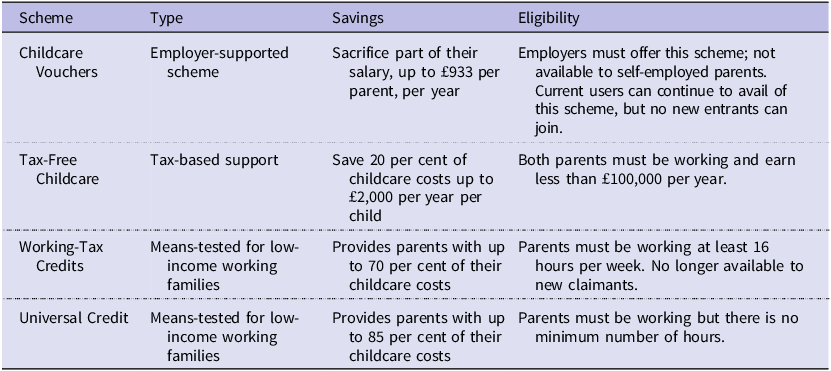
To make childcare more affordable and accessible for families, the government subsidises childcare costs directly throughout the tax and benefits system across the UK. There is a range of financial support schemes available to parents, they depend on factors such as household income, child’s age, cost of childcare, and working status, reflecting a complicated and patchy system (Lewis and West, Reference Lewis and West2017; Butler and Rutter, Reference Butler and Rutter2016; Wood, Reference Wood2021). This is compounded by differences across the devolved administrations, creating a convoluted system, which is difficult for parents to navigate. As a result, some families may not be receiving the best form of financial support available to them. Additionally, both the Childcare Voucher scheme and Working-Tax Credits are being gradually phased out. The various subsides are shown in Table 1, and in all cases at least one parent must be employed.
Financial support schemes available to help with the cost of childcare

Table 1 Long description
A table comparing financial support schemes for childcare costs. The table has four rows and four columns. The columns are labeled Scheme, Type, Savings, and Eligibility. Row 1: Scheme, Childcare Vouchers; Type, Employer-supported scheme; Savings, Sacrifice part of their salary, up to £933 per parent, per year; Eligibility, Employers must offer this scheme; not available to self-employed parents. Current users can continue to avail of this scheme, but no new entrants can join. Row 2: Scheme, Tax-Free Childcare; Type, Tax-based support; Savings, Save 20 percent of childcare costs up to £2,000 per year per child; Eligibility, Both parents must be working and earn less than £100,000 per year. Row 3: Scheme, Working-Tax Credits; Type, Means-tested for low-income working families; Savings, Provides parents with up to 70 percent of their childcare costs; Eligibility, Parents must be working at least 16 hours per week. No longer available to new claimants. Row 4: Scheme, Universal Credit; Type, Means-tested for low-income working families; Savings, Provides parents with up to 85 percent of their childcare costs; Eligibility, Parents must be working but there is no minimum number of hours.
While eligibility and entitlements vary amongst schemes, they all share one common feature by favouring working parents. This has led to a childcare system that is not set up in the interest of parents who are seeking to get into work, are in education, training, or starting a business, yet access to childcare is essential before they can undertake these activities.
Reshaping early education and care: lessons for Northern Ireland?
Across the UK there is a wealth of literature and research linking investment in education and childcare to improvements in children’s wellbeing and outcomes (Heckman, Reference Heckman2006; Esping-Andersen et al., Reference Esping-Andersen, Garfinkel, Han, Magnuson, Wagner and Waldfogel2012; Purdy et al., Reference Purdy, Logue, Montgomery, O’Hare and Redpath2021). High-quality early education and care is widely recognised to benefit child development, combat child poverty, and reduce expenditure at later stages (Dahlberg et al., Reference Dahlberg, Moss and Pence2013; Melhuish et al., Reference Melhuish, Ereky-Stevens, Petrogiannis, Ariescu, Penderi, Rentzou, Tawell, Leseman and Broekhuisen2015; Black et al., Reference Black, Barnes, Baxter, Benynon, Clowes, Dallat, Davies, Furber, Goyder, Jeffery, Kritsotakis and Strong2020; Davies et al., Reference Davies, Hendry, Gibson, Gliga, McGillion and Gonzalez-Gomez2021). Government-funded schemes for early education and childcare have received considerable policy attention, and state-funded provision has been available since the 1990s (Roberts et al., Reference Roberts, Mathers, Joshi, Sylva, Jones, Hansen, Joshi and Dex2010; Lewis and West, Reference Lewis and West2017). By 2010 in England, all three- and four-year-olds were entitled to fifteen hours per week for thirty-eight weeks a year (Sanders et al., Reference Sanders, Annesley and Gains2019; Chen and Bradbury, Reference Chen and Bradbury2020). This was extended in 2017 when the Conservative government introduced thirty ‘free hours’ of childcare per week for thirty-eight weeks per year for children of working parents. While the universal entitlement of fifteen hours per week is focused on supporting child development, the extended offer aims to provide additional free childcare to ‘help families by reducing the cost of childcare and will support parents into work or to work more hours, should they wish to do so’ (Department for Education, 2015: 4). The entitlement may be ‘stretched’ with a few weekly hours over more weeks, and places can be delivered by a range of registered providers (such as childminders, nursery schools, day nurseries and out of school settings) yet there is no obligation on them to offer this entitlement. The government is expanding this support by providing thirty hours a week for children aged nine months to three years. The new schemes will be rolled out in phases from April 2024 to cover all children under the age of five by September 2025 (HM Treasury, 2023).
In general, the overall concept and policy as an investment in early years and childcare has been welcomed; however, it has also received considerable criticism in terms of its eligibility criteria, operation, and overall delivery. The decision to target the thirty hour offer, including its extension to children from zero – nine-month-olds and two-year-olds to only working parents, rather than prioritising access for the most disadvantaged families who may not qualify, including those in insecure employment, zero hours contracts, or who wish to pursue education has been widely criticised (Weale, Reference Weale2017; Bradbury et al., Reference Bradbury, Hoskins and Fogarty2021). Access to high-quality childcare can help address the effects of poverty, and improve longer-term development and educational outcomes (Butler and Rutter, Reference Butler and Rutter2016). However, take-up rates of free hours are much lower in areas with high deprivation rates (Campbell et al., Reference Campbell, Gambaro and Stewart2018; National Audit Office, 2020) and there are questions if this is an effective use of government funding as it overlooks families and children on lower-incomes who would greatly benefit from the entitlement. This is particularly so given that evidence suggests that universal access to early education and care can help reduce inequalities and promote social mobility (West et al., Reference West, Roberts and Noden2010). A recent report from Employers for Childcare and the Joseph Rowntree Foundation (JRF) (2024) emphasises that currently lower-income families are least likely to benefit from access to quality childcare due to having little choice but to reduce their hours of work or stop work altogether. Thus, disadvantaged children are missing the benefits of quality provision. There is a wealth of research to show that the first 1001 days (two years) of a child’s life are crucial to their development and well-being (Barnes et al., Reference Barnes, Baxter, Beynon, Black, Clowes, Dallat, Davies, Furber, Goyder, Jeffrey and Kritsotakis2018; Black et al., Reference Black, Barnes, Baxter, Benynon, Clowes, Dallat, Davies, Furber, Goyder, Jeffery, Kritsotakis and Strong2020). The Conservative Government established Family Support Hubs following a review of ‘Early Years Healthy Development’ led by Member of Parliament, Andrea Leadsom, in 2020. Family Support Hubs are a multi-agency network that are designed to co-ordinate early intervention services and to match families to existing support (HM Government, 2022). Crucially, this service does not provide early years education or childcare provision. The implementation of austerity policies by the Coalition and Conservative governments witnessed the closure of 1,416 Sure Start Centres in England, an initiative that was rolled out from 2002 by the previous New Labour government, despite evidence that the service delivered a transformative impact (Department for Education, 2016; Bate and Foster, Reference Bate and Foster2017; Chakelian, Reference Chakelian2023). Sure Start Centres in Northern Ireland have been shielded from the ferocity of the cuts in England, with thirty eight Centres covering the top 25 per cent of deprived areas across the province and are consistently demonstrating positive policy outcomes and parental feedback (Department of Education, 2023).
There’s also significant concern that the government level of funding is inadequate (Lewis and West, Reference Lewis and West2017; Jarrett, Reference Jarrett2018; Bradbury et al., Reference Bradbury, Hoskins and Fogarty2021; De Henau, Reference De Henau2022). The level of support is determined using the Early Years National Funding formula and is provided to local authorities who then establish the hourly rate paid to early years providers (Department for Education, 2022). Recent discussions across the childcare sector have focused on the discrepancy between the cost per hour to deliver the entitlement and the funding per hour that they receive. As a result, many providers report covering their costs by charging more for the non-funded hours (HC 9 March 2020). In this regard, the overall aim and operation of the policy is problematic as parents are unable to fully access affordable childcare despite their entitlement to ‘free hours’. The 2023 Spring Budget announced a further £204 million pound investment in 2023 – 2024, increasing to £288 million in 2024 – 25 (HM Treasury, 2023); however, there is still broad concern that it will be insufficient to meet the rising cost of provision (Education Committee, 2023). Analysis by Institute for Fiscal Studies (2023) shows that the investment is in line with the anticipated rise in provider costs over the next two years but fails to address the 13 per cent real terms cut the sector absorbed since 2017–2018.
While most schemes target three-to four-year-olds, the main divergence is linked to the eligibility criteria which differs across the UK. For example, the Childcare Offer (thirty hours per week) in Wales was amended to include parents in education and training from September 2022 (Welsh Government, 2022). Extending the eligibility criteria is recognised as a positive change and can help ensure more children can access early education and care, but the Children’s Commissioner for Wales noted that further steps are needed to ensure inclusivity of children from non-working families (Children’s Commissioner for Wales, 2022).
There is evidence of policy divergence in Scotland – where provision for Early Learning and ChildcareFootnote 1 recently doubled from fifteen hours a week (600 hours per year) for all three- and four-year-olds (Scottish Government, 2018). Provision is designed so that ‘Funding Follows the Child’ which provides parents with greater choice in how to access their child’s funded hours and the type of setting available to them (i.e. public, private, or childminders) (Scottish Government, 2018: 6). Distinct from the English and Welsh model, Mooney and Scott (Reference Mooney and Scott2016: 245) note that the Scottish government approach is underpinned by a more ‘child-centred’ agenda that draws on a Nordic model of children’s and parents’ rights, arguably building on the Scottish National Party’s aim to make Scotland the ‘best place in the world to grow up’ (Scottish National Party, 2018). This reflects a trend in Scottish policy-making since devolution for policies to promotes values of fairness, social justice, and equality (Birrell, Reference Birrell2009; Mooney and Scott, Reference Mooney and Scott2011).
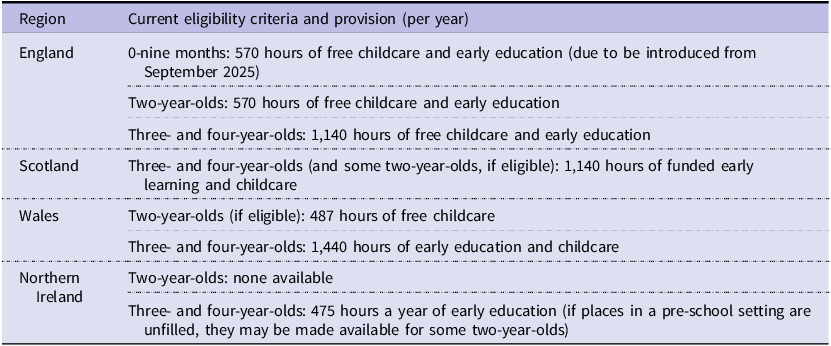
While early education and childcare entitlements differ slightly across England, Scotland, and Wales (as shown in Table 2), both areas of funded provision remain intrinsically linked and have received considerable policy attention (Lewis, Reference Lewis2011; Campbell et al., Reference Campbell, Gambaro and Stewart2018). This is compared to Northern Ireland, where early education and childcare are largely seen as two separate policy areas and less focus has been placed on childcare before pre-school. State funded early education provision is provided by The Department of Education’s Pre-School Education Programme under The Education (NI) Order 1997, which offers twelve and a half hours per week provision for thirty-eight weeks for every child in their immediate pre-school year. This normally consists of five sessions per week, each lasting two and a half hours per day. The Programme is specifically focused on play-based learning activities to help children learn and prepare for primary school. Notably, the Department of Education guidance stipulates that this is not to be regarded as free or funded childcare (Department of Education, 2024). While this is an important programme for children, its current design is rigid and the limited hours provided, mean that it does not give the same flexibility to parents seeking to work full-time compared to similar schemes available in other parts of the UK (McQuaid et al., Reference McQuaid, Graham and Shapira2013). Interestingly, the previous Draft Childcare Strategy (Department of Education, 2015: 35) suggested that childcare services and education should be ‘complementary’, but despite the lip service paid in the document, a co-existence of two competing services remains with divergent entitlement, funding, ratio, inspection, and staffing arrangements. Horgan (Reference Horgan2005: 55) rightly pointed out that Northern Ireland ‘has never had the benefit of even the relatively small amount of state-funded childcare enjoyed by children in Britain’. Almost two decades later this continues to be the case.
Eligibility criteria and provision for funded early education and childcare in the UK

Table 2 Long description
A table comparing funded early education and childcare provisions across UK regions. The table has four rows and four columns. Column headers are Region, Current eligibility criteria and provision (per year). Row labels are England, Scotland, Wales, and Northern Ireland. Row 1: England: 0-nine months: 570 hours of free childcare and early education (due to be introduced from September 2025), Two-year-olds: 570 hours of free childcare and early education, Three- and four-year-olds: 1,140 hours of free childcare and early education. Row 2: Scotland: Three- and four-year-olds (and some two-year-olds, if eligible): 1,140 hours of funded early learning and childcare. Row 3: Wales: Two-year-olds (if eligible): 487 hours of free childcare, Three- and four-year-olds: 1,440 hours of early education and childcare. Row 4: Northern Ireland: Two-year-olds: none available, Three- and four-year-olds: 475 hours a year of early education (if places in a pre-school setting are unfilled, they may be made available for some two-year-olds).
Since 2020, discussions have focused on extending the pre-school education length, as it currently stands approximately 40 per cent of children in Northern Ireland can access twenty-two and a half hours of pre-school education with the majority (60 per cent) receiving a minimum of twelve and a half hours (Northern Ireland Assembly Debate, 2024). However, the ‘A Fair Start’ report (Purdy et al., Reference Purdy, Logue, Montgomery, O’Hare and Redpath2021) recommends that provision should be standardised to at least four and a half hours per day (twenty-two and half hours per week). The report also said it was in support of the efforts to bring forward an Executive Childcare Strategy but that it assumes funding for the Strategy will be ‘bid for separately’ (Purdy et al., Reference Purdy, Logue, Montgomery, O’Hare and Redpath2021: 3). This all points to a blurred understanding of what constitutes ‘education’ and ‘care’ (Randall, Reference Randall2000). While childcare is defined as comprising education and care in the Childcare Act 2006, there is no equivalent definition in Northern Ireland and as a result early education and childcare continue to remain separate. This lack of joined up working with regard to early education and childcare has resulted to a fragmented approach to policy and practice (Birrell and Gray, Reference Birrell and Gray2017), whereby the provision of childcare is largely neglected.
The current cost of living crisis adds additional pressures to families and the childcare sector. Reports in England indicate rising costs are having a significant impact on the sector, and it was revealed that 4,000 childcare providers closed between March 2021 and March 2022 which is the largest decline since 2015–2016 (Ofsted, 2022). In response, the government launched a consultation to propose lowering the statutory minimum staff-to-child ratios for two-year-olds from 1:4 to 1:5. The minimum ratio requirements set by the Early Years Foundation Stage statutory framework (Department for Education, 2021) vary according to the age of the child and qualification level of staff. The government announced plans to lower the ratios and said the change will come into force from September 2023 but will be optional for both providers and parents. It is argued that the change will help reduce the cost for parents by following the Scottish model of one adult caring for five two-year-olds in group-based settings. However, as demonstrated throughout this article, each childcare system differs across the devolved jurisdictions and it is difficult to compare the systems mainly due to funding differences in terms of the allocated funding per child rate from local authorities and because a larger proportion of childcare settings in Scotland are run by local councils, where costs differ. Those working within the sector question if the change can truly reduce costs for families and some have argued that the only meaningful difference can come from the government paying the full rate for funded childcare provision (Early Years Alliance, 2022).
Opportunity for childcare in Northern Ireland?
In May 2024, the Minister for Education in Northern Ireland announced that the Department of Education would move towards a standardised position where all three- and four-year-olds would be able to access twenty-two and a half hours of pre-school education per week (thirty-eight weeks per year), which would help mitigate childcare costs for some families (Department of Education, 2024). Employers for Childcare and JRF (2024: 24) argue that this development begins to recognise early education as a ‘public good’, which prioritises tackling child poverty and disadvantage by providing parents with the space to increase their income through work. Expanding pre-school education for three- to four-year-olds is not surprising particularly as the infrastructure is largely in place. However, it is unclear how the expansion will address current issues around flexibility, eligibility, and affordability. It is more likely that these issues can be addressed by developing a more generous scheme that draws on lessons from certain aspects of provision in England, Scotland, and Wales.
Providing twenty-two and a half hours of pre-school education would surpass the level of universal childcare provision currently offered for three- and four-year olds in England (fifteen hours), but would fall short of provision in Scotland, where pre-school children benefit from thirty hours of provision. It is unclear when access to twenty-two and a half hours of pre-school education will be rolled out. Employers for Childcare and JRF (2024) detail current problems with capacity, which will need to be addressed in the context of significant budgetary pressures for both the newly formed Executive and for parents who are seeking immediate support.
In addition to the standardisation of pre-school provision, the Minister for Education also announced a new ‘Northern Ireland Childcare Subsidy Scheme’ that is designed to reduce childcare costs for working parents by 15 per cent. The scheme is linked to Tax-Free Childcare (TFC), which means only families using this form of financial support are eligible. While it is positive to finally see a commitment to invest in our early years and childcare sector, the authors are concerned about the eligibility of the scheme, particularly linking it to TFC. Firstly, the eligibility criteria is restrictive as it targets only working parents. This overlooks the needs of parents who are seeking to get into work, are in education, training, or starting a business, yet access to childcare is essential before they can undertake these activities. The decision to include working parents arguably disregards the value of unpaid care, which is disproportionately provided by women and suggests that childcare commitments represent a personal barrier to work, rather than structural problems with childcare provision. Secondly, eligibility under TFC also excludes parents who have No Recourse to Public Funds (NRPF). Research shows that children in families with NRPF face a greater risk of destitution and many are surviving on very little income (Fitzpatrick et al., Reference Fitzpatrick, Bramley, Treanor, Blenkinsopp, McIntyre, Johnsen and McMordie2023). The exclusion of families who have NRPF adds an additional barrier for those who are trying to access work and/or education.
The Northern Ireland Executive has diverged from other parts of the UK by allocating a subsidy to parents compared to England, Scotland, and Wales, where an allocated number of hours for childcare provision is available. The authors are concerned that the current approach by the Northern Ireland Executive is not sufficiently inclusive and does not support all families. We would strongly advocate for a new model totalling thirty-two and a half hours per week combining both pre-school education and childcare would represent a significant step forward. Based on the current infrastructure we would envisage a universal model that would provide all three- and four-year-old children twenty-two and a half hours of pre-school education, complemented by a further ten hours of childcare provision delivered by any registered provider (thirty-two and half hours in total). Akin to what is available in Wales, the childcare offer would be accessible for forty-eight weeks of the year; however, the entire thirty-two and a half hours will be for childcare only during the remaining nine weeks outside of term time.
In Scotland, some two-year-olds (whose families are entitled to certain mean-tested benefits) can access thirty free hours of childcare. It is proposed to go further than the current Scottish model, by extending the thirty-two and a half hours offer of childcare provision delivered by registered providers to all two-year-olds in Northern Ireland for forty-eight weeks per year. Drawing lessons from different parts of the UK, it is proposed that Northern Ireland should introduce a universal early education and childcare model for all children aged two to four years old.
Ring-fenced budget for early education and childcare provision from the UK treasury
It is acknowledged that delivering an early education and childcare model which provides thirty-two and half hours for forty-eight weeks per year for children aged two to four years old will come at a considerable cost. The public funding model will require a significant level of flexibility to guarantee capacity across both state-funded early education and for those who require private childcare provision. Private providers who provide childcare and wraparound support (after school and during school holidays) require adequate funding, which is broadly reflective of the average cost of nurturing a child and which is governed by high-quality standards and the development of the early year’s profession (Employers for Childcare and JRF, 2024). The hourly rate should be adjusted annually to take account of inflation. Increased funding to the thirty-eight Sure Start Centres in Northern Ireland could increase their capacity to deliver early intervention to children in disadvantaged areas. The Northern Ireland Executive has made a commitment to continue to negotiate a new funding formula, based on ‘need’ to put the region’s finances on a stable footing (Campbell, Reference Campbell2024). Alongside this political ambition, it is suggested that the Executive push for an annually adjusted ring-fenced budget that is reserved for the administration and management of childcare provision. There is precedent for this kind of arrangement. The Northern Ireland Department for Communities has responsibility for almost all social security spending. From the formation of Northern Ireland (1921) the generosity of this system is governed by the ‘parity principle’ whereby the funding provided is kept in line with the rest of the UK. The cost is treated by Treasury as Annually Managed Expenditure (AME) and is met directly by the UK government outside the parameters of the block grant. If the Northern Ireland Executive decides to be more generous (for e.g. through supplementary social security payments) then this additional cost must be met from the block grant, rates, fees, and other charges (Northern Ireland Fiscal Council, 2024). It is acknowledged that an enhanced system which seeks to circumvent the issues that have been identified by the Westminster scheme would require additional resource from the block grant. There is a strong case to be made for the Northern Ireland scheme representing a key pillar in achieving greater economic prosperity for all communities (Hutcheson, Reference Hutcheson2023).
A complex picture of some key issues and debates emerges, and while some are specific to England, they provide invaluable learning for Northern Ireland, particularly at a time when the Department of Education continues to develop a Childcare Strategy.
Conclusion
The legislative nature and strength of early years and childcare policy varies across England, Scotland, and Wales, and certain challenges around affordability and availability remain (De Henau, Reference De Henau2022; Harris, Reference Harris2022), yet the willingness to invest and reform the sector demonstrates a commitment to childcare, which is less apparent in Northern Ireland. Investment to expand provision in terms of hours, eligibility, and entitlement in other parts of the UK leaves the childcare sector in Northern Ireland even further behind. A dispiriting picture emerges and the lack of progress, frequently interrupted by political stalemate brings into question the political will to invest in the childcare sector. The long-standing separation of early education and childcare is particularly problematic, and this fragmentation hinders policy progress (Birrell and Gray, Reference Birrell and Gray2017). Failing to address the cost of childcare for so many years is a significant policy shortcoming that affects many different parts of our society, most intensely the wellbeing of women and children. It’s time that childcare was valued as a critical part of our social and economic infrastructure and taken seriously as investment in our future prosperity.