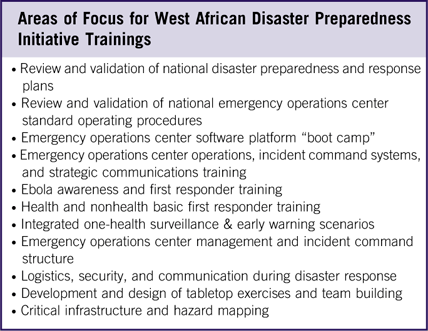
In 2015, a consortium of partnering organizations, including the United States Africa Command, the Economic Community of West African States (ECOWAS), the Kofi Annan International Peacekeeping Training Centre, the National Disaster Management Organization of Ghana, and the US military’s Center for Disaster and Humanitarian Assistance MedicineFootnote a conducted the West Africa Disaster Preparedness Initiative (WADPI). WADPI leveraged 6 years of whole-of-government, all-hazard disaster management assistance on the African continent by the Center for Disaster and Humanitarian Assistance Medicine’s Disaster Preparedness Program. WADPI aimed to strengthen national capacities among 12 West African partner nations to better implement a whole-of-government, all-hazards approach to disaster preparedness and response management by building upon lessons learned from the international Ebola virus disease crisis. This goal was realized through a series of 3-week-long awareness training sessions in Accra, Ghana ( Table 1 ), involving government, civilian, and military representatives from each country with a key focus on individuals closely involved with disaster or disease outbreak preparedness and response operations.Reference Morton Hamer, Reed and Greulich 1
Areas of Focus for West African Disaster Preparedness Initiative Trainings

After partner nations had completed their trainings, WADPI proceeded to provide similar training to delegates from ECOWAS given the crucial role the organization plays in coordinating disaster management at the regional level as well as the assistance it can offer to member states as they develop strategies and institutions for enhanced disaster management capabilities. As part of this training, which occurred from November 16 to November 20, 2015, WADPI held a tabletop exercise in conjunction with ECOWAS leadership and representatives from many ECOWAS member states on November 19, 2015. As disaster drills are often an invaluable component of preparedness,Reference Waeckerle 2 the purpose of this tabletop exercise was to test recent learning and to identify strengths and weaknesses of response.
METHODS
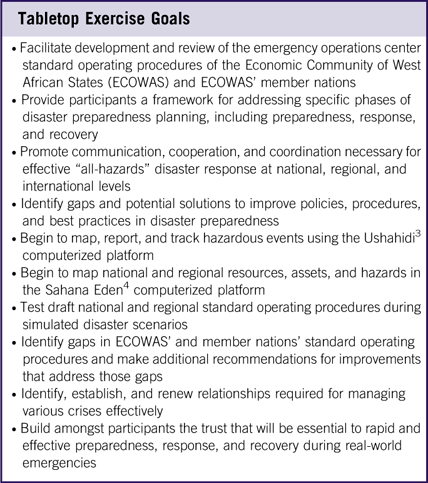
This tabletop exercise (TTX) was designed to give participants from ECOWAS and 10 ECOWAS member states an opportunity to work collaboratively in simulated disaster preparedness scenarios, as well as to reassess and develop ideas for further optimizing both ECOWAS’ and its member nations’ disaster plans ( Table 2 ). Participants were to be faced with 3 periods of intensifying disasters during the simulated period of time in the TTX. The country representatives and the ECOWAS Commission were expected to take in the facts presented to them and use 3 internet-based disaster data management tools (Ushahidi, 3 Sahana Eden, 4 and QGIS 5 ) to research, make sense of, and communicate about the potential impacts that might reach their country from other neighboring countries.
Tabletop Exercise Goals

Observers were assigned to make note of the interactions within and between the 10 West African EOCs—as well as between these national EOCs and ECOWAS—as they engaged to address national and regional “all hazards” challenges in TTX sessions that mimicked emerging real-world challenges.
After each of the TTX’s 3 phases (preparedness, response, and recovery), facilitators distributed a 5-question anonymous open-ended participant survey to prompt participants to consider how—with the help of the TTX—they believe ECOWAS should best prepare for future crises. The survey questions covered topics including interagency coordination and communication, management and governance, “lessons learned,” plans and SOPs, and multilateral coordination. Descriptive statistics were used to analyze participants’ demographic characteristics. Survey responses were handwritten, and surveys were provided in English and French. Survey responses were not subjected to official qualitative analysis, but were rather reviewed by the authors for common themes of concern among participants. This study was determined to be “quality improvement/not research” by the Johns Hopkins Institutional Review Board.
RESULTS
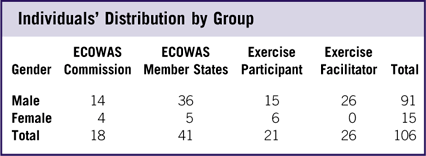
A total of 106 individuals (91 male, 15 female) participated in the ECOWAS exercise in many different roles. These individuals were divided into 4 groups: (1) TTX participants, (2) TTX facilitators, (3) ECOWAS Commission personnel, and (4) ECOWAS member states. Table 3 provides an overview of the distribution of these individuals by group.
Individuals’ Distribution by Group

The ECOWAS Commission included representatives from 7 countries (Cote d’Ivoire, Ghana, Guinea-Bissau, Guinea Conakry, Nigeria, Sierra Leone, and Togo). The ECOWAS member state participants included representatives from 10 countries (Benin, Burkina Faso, Cote d’Ivoire, The Gambia, Guinea-Bissau, Liberia, Mali, Nigeria, Senegal, and Togo). The TTX participants were from ten countries (Benin, Cote d’Ivoire, Togo, The Gambia, Burkina Faso, Cape Verde, Ghana, Niger, Nigeria, and Senegal). The TTX facilitators represented seven countries (Benin, Cote d’Ivoire, Ghana, Nigeria, Senegal, Togo, and the United States of America).
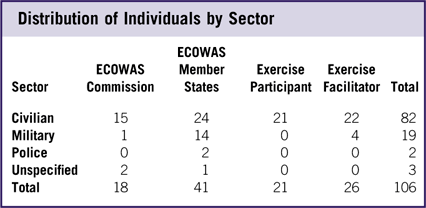
Individuals who participated in this TTX worked in three sectors: civilian, military, and police. Seventy-seven percent of those who attended this TTX were from the civilian sector, 18% were from the military sector, 2% were from the police sector, and 3% did not specify their affiliations. Table 4 provides an overview of the distribution of these individuals by sector.
Distribution of Individuals by Sector

Abbreviation: ECOWAS, Economic Community of West African States
Key Issues for Action
The 5-question survey given to participants had a 100% response rate. Qualitative comments from open-ended survey questions illuminated 5 key actions that TTX participants suggest undertaking in the near term to improve regional disaster communication and coordination.
Language and Cultural Issues as Barriers
Differences in language and culture created some of the most consistent barriers in the ECOWAS TTX. Even with interpretation and support, the French- and Portuguese- speaking participants faced greater challenges in making optimal use of the resources made available to them. ECOWAS should extend greater effort toward bridging communication and resource gaps between ECOWAS member states in the trainings, TTXs, and ongoing collaborations it creates or facilitates.
Management and Governance
West African states that were previously French, English, or Portuguese colonies have generated diverse mechanisms of governance. In addition, those states’ evolution since independence has led to a high variance in their ability to prepare for, respond to, and recover from disasters because of how their authority structures, access to funding, and systems are organized. The countries that structure their emergency management agencies directly under the head of state, vice president, or prime minister are typically equipped to assemble and deploy necessary emergency resources far more quickly and adeptly than the nations whose emergency authorities are linked to other government officials. These variations in nations’ current chains of command, management, and governance were reflected in the types of actions ECOWAS member states took during the TTX and how effectively those actions produced the desired outcomes.
Examples of autonomous disaster management agencies within nations are the National Disaster Management Organisation in Ghana and the National Emergency Management Agency in Nigeria. Senegal, Benin, and Togo, on the other hand, have directorates of civil protection embedded within their respective ministries of interior, which handle disaster preparedness and response efforts.
Situational Awareness and Interstate Communication
Effective sharing of data and real-time communication is essential for establishing situational awareness and multisector coordination within each nation state and between neighboring states. The nation states participating in the ECOWAS TTX demonstrated great variability in their ability to use data systems. ECOWAS has a critical role to play in engaging region-wide data-strengthening initiatives.
Bridging WADPI Efforts to Ongoing SOP and EOC Advancement
ECOWAS and its partners should work further with ECOWAS member states and interested donors to identify and engage appropriate resources to continue WADPI or other disaster preparedness and response initiatives. Through the extension of WADPI or similar long-term engagement strategies, ECOWAS and its member states will be able to employ SOPs that render their (planned) EOCs effective at communicating, collaborating, and coordinating within and between states during multisector disaster operations.
Multilateral Action on Preparedness, Response, and Recovery
ECOWAS should continue to build upon the successes and goodwill generated by the Disaster Preparedness Program and WADPI to render West Africa more resilient—prepared not only for today’s challenges but also for future challenges throughout the region. Ensuring the successful completion of region-wide trainings, TTXs, and adoption of SOPs and EOCs that can interoperate is both an achievable goal and one that facilitates the full execution and sustainment of the tenets of the Global Health Security Agenda and Sustainable Development Goals in West Africa.
Extending Effective Emergency Operations to the County and Community Levels
Liberia is the sole ECOWAS nation to have received the support necessary to permit WADPI’s program (of planning, training, and TTX) to be extended to officials working at the county level. In November 2015, 467 participants from 15 counties in Liberia received training and developed or critiqued plans for SOPs and EOCs that linked the counties to one another, to the nation, and to the region. ECOWAS Commission participants articulated a deep interest in having WADPI trainings and TTXs extended down to the county and community levels in their states as well. Just as Liberia received county-level training, and just as emergency response teams were assembled for the ECOWAS regional training and TTX, county and community response team capacity should be developed to serve all ECOWAS member states, thus bridging the regional, national, and local levels.
DISCUSSION
Regional organizations are demonstrating an increasing role in disaster preparedness. In the latter quarter of the 20th century, more than 30 regional organizations or programs involved with disaster risk management emerged around the world.Reference Hollis 6 The involvement of regional organizations in disaster management can be particularly helpful in the scenario where national capacities are overwhelmed and aid from international organizations is inadequate or slow to arrive. Regional organizations’ involvement can bridge this gap and provide aid more quickly and efficiently and potentially in a way that is more culturally appropriate and sensitive to the needs of disaster victims. As an example, the Association of Southeast Asian Nations has provided its member nations with a guide to help disaster managers in national governments to gain basic knowledge of how to utilize international tools and services. 7 Development of such a guide or even a policy agreement among ECOWAS member states on disaster response could be a crucial follow-up activity to these efforts to enhance preparedness.
Initially, the participating national EOC teams worked primarily with their own team members and with support from their respective information technology support teams. However, during the latter part of the preparedness phase, the TTX evaluation team noticed 2 changes. First, it noted that the teams, initially struggling to find their bearings within the simulation’s deepening chaos, began to follow internal checklists and establish more patterned discussions and behaviors. At the same time, progressing toward the response and recovery phases of the TTX, the ECOWAS Commission representatives were introducing innovations into the TTX environment that were significantly improving the bilateral interactions of the national EOC teams as well as the interactions between ECOWAS and the national teams.
Along with the expected process of validating the national EOC SOPs, during the response and recovery phases nascent forms of multilateral communication and organization emerged as innovations within the TTX. With these new forms-based communication processes being introduced across the ECOWAS enterprise within the TTX, the level of chaos within the simulated exercise environment lessened. The most prepared national teams—those that were utilizing well-developed SOPs—were now reaching out to help less-prepared national teams. With the flow of information improving, more collaborative responses began to elevate the collective regional effectiveness within the simulated response and recovery phases. As data management during disasters is also a key component of effectiveness,Reference Morton and Levy 8 , Reference Mansourian, Rajabifard and Zoej 9 exposure to the Ushahidi, Sahana Eden, and QGIS systems was also a helpful experience for TTX participants, and emphasis on use of these open-source systems throughout ECOWAS may serve to further enhance disaster preparedness and response capabilities by sustainable means.
By prompting ECOWAS personnel and participants from member states to address common, challenging problems while housed in the same room, the TTX achieved several key objectives. First, it enriched ECOWAS personnel’s understanding of what the organization and member states will need and how they will operate and proceed during real disasters. This knowledge will prove invaluable once ECOWAS has built its own regionally focused EOC. Second, it facilitated ECOWAS’ and member states’ sharing of best practices amongst one another, so that ECOWAS’ and individual nations’ SOPs could be optimized. It also facilitated ECOWAS member nations’ development and utilization of interoperable plans and information technology systems. This interoperability is crucial to enabling ECOWAS and its member nations to communicate, collaborate, and coordinate effectively during the preparedness, response, and recovery phases of regional and national disasters.
Limitations
This was a tabletop exercise only and not a full simulation exercise. There was not a formal qualitative analysis of the participants’ responses, but rather a review by the authors to determine common themes in concerns among respondents to the questionnaire. The authors feel that the insights gained in such an unusual regional collaborative forum may be instructive for others in similar settings, although they may not be directly generalizable.
CONCLUSION
In this era of emerging infectious diseases, rapid climate change, and other global threats, West Africa will experience both more frequent and more devastating disasters. The Ebola crisis helped make this very evident, as it threatened and set back the development of Liberia, Sierra Leone, and Guinea.Reference Sy and Copley 10 , Reference Ness 11 This TTX initiated the process of validating and refining ECOWAS’ regional and national SOPs that teams will employ in ECOWAS’ and national EOCs to prepare for, respond to, and recover from future disasters. In addition, those who had received training through WADPI were able to engage their new skills in the context of the simulated crises within the TTX.
Further emphasis on the consistent use of uniform or interoperable data systems throughout ECOWAS, administratively establishing disaster management agencies directly in the executive branch of government, improving multilingual communication abilities among ECOWAS members, and extending disaster training to county and local level officials are all important concepts learned from this TTX. Development of an ECOWAS regional disaster guide or policy for member nations may also be helpful. WADPI, through this exercise and other initiatives, has rendered both the nations of West Africa and ECOWAS more and better equipped to face the future in both the good and challenging times ahead.
Funding
Overseas Humanitarian, Disaster, and Civic Aid Funding