In her 1988 collection of essays entitled The End of Imagination, the writer Arundhati Roy chastised the Indian government's continued nuclear weapons program. She wrote:
It is such supreme folly to believe that nuclear weapons are deadly only if they're used. The fact that they exist at all, their very presence in our lives, will wreak more havoc than we can begin to fathom. Nuclear weapons pervade our thinking. Control our behavior. Administer our societies. Inform our dreams. They bury themselves like meat hooks deep in the base of our brains. They are purveyors of madness. They are the ultimate colonizer. Whiter than any white man that ever lived. The very heart of whiteness.Footnote 1
Here Roy is rather explicit in positing nuclear arms as a psychological form of control closely tied to the history of European imperialism. Indeed, for Roy, the ability of nuclear weapons to instantly and catastrophically destroy creates a system of power in which those nations (often formerly imperial) that maintain nuclear arms hold all of the cards. This power structure is justified and normalized through fears of nuclear destruction, an apocalyptic scenario over which the majority of humanity seems to have little control. Thus, for Roy, nuclear weapons have both implicit and explicit connections to the global history of imperialism and the racial construction of “whiteness” that often accompanied this history.Footnote 2 For Roy, nuclear weapons are “white weapons” not necessarily because they were originally conceived and created by “white people,” but because they were imagined as a tool to perpetuate a racialized global power structure.
Roy's provocation leads us to further consider the uniqueness of nuclear weapons in the longer history of imperial control. Certainly, numerous weapons in the nineteenth and twentieth centuries were originally devised for use in the European imperial context. One can think of such obvious examples as the machine gun, the gunboat, and barbed wire; but even such seemingly unrelated creations like the German Shepherd dog were rooted in the European desire to maintain violent control over imperial lands.Footnote 3 Nevertheless, none of these weapons offers the level of destruction that nuclear arms can produce. As Roy notes, the perception of nuclear weapons as apocalyptic is central to their success as a means of control. Of course, a weapon's actual destructive capabilities are important for demonstrating its power, but imperial order can be equally maintained if people simply believe in their ability to destroy. Indeed, it is important to point out that the mere perception of nuclear weapons as the absolute arbiter of the international order and human existence writ large has historical precedent. Since its first military use in World War I, poison gas has provoked similar fears of total annihilation around the world. In fact, until the American deployment of the atomic bomb on Hiroshima and Nagasaki, cultural visions of global apocalypse were invariably soaked in chemicals such as chlorine, phosgene, and mustard gas.Footnote 4 Moreover, like those associated with the later atomic bomb, these visions of chemical death were often overlaid with racialized interpretations that attempted to parse the ultimate masters from the intended victims in this newly dangerous chemical world.
This article intends to fully reveal the construction of racialized understandings of chemical weapons in the German context between their first use in 1915 and their reapplication in the Final Solution. Indeed, it was the Germans who found far more applications for chemical weapons and were far more concerned with their potentially genocidal powers than the other Western nations who joined in this race for chemical dominance. As such, this paper argues that, during the interwar period, the development and use of chemical weapons was intricately intertwined with certain developing understandings of German nationality, ethnicity, and race. Through constructed categories of “white” and “non-white,” “German” and “non-German,” “European” and “Other,” poison gas helped to define a particular post–World War I interpretation of German identity that was tied to what the influential philosopher Oswald Spengler described as “Faustian Man,” or the Western man most apt to technological application.
Although poison gas had failed to demonstrate German military dominance in World War I, interwar debates over the German ability to again harness the destructive power of chemical weapons raised questions over the fundamental controllability of such weapons. By asserting that technological control was an inherent, almost spiritual, quality that was most prevalent among the German people, a combination of nationalists, militarists, and proponents of gas warfare incorporated the mastery of poison gas into the amalgam of ethnic, racial, and national identity that the Nazis relied upon in their subsequent attempt to create of an exclusionary and authoritarian national community. Thus, this paper posits the earlier German imperial conceptualization of the intersection of race and chemical weapons as what historian Birthe Kundrus has called a “sounding board for National Socialism.”Footnote 5
Since the 1951 publication of Hannah Arendt's The Origins of Totalitarianism, scholars have debated whether the genocidal use of weapons like poison gas or the atomic bomb were products of the kind of imperial violence that Arundhati Roy evokes. Arendt herself posited a direct line of causation, arguing that Europeans learned and internalized this particularly brutal form of violence through their more vicious encounters with peoples subjected to colonialism in the nineteenth century. Within the narrower context of German history, the supporters of this line of thinking have suggested that the Germans’ short-lived imperial project had direct implications for the experience of World War I. For instance, historian Isabel Hull has claimed that the German military's decision to employ gas attacks in World War I was part of a larger commitment to the “ruthless methods and outright terror against civilians” that was born in the colonies.Footnote 6 The historian Sebastian Conrad has supported this claim, writing: “It is necessary to register, for example, the “reimportation” of the strategies of colonial warfare—the use of machine guns, gas attacks, air raids, the deployment of colonial army units—to Europe. It … suggests taking more seriously the way in which the policies that Germany pursued in the territories it occupied during the war, such as in Ober Ost … were informed by experiences and analogies of occupation and foreign rule gained in colonial settings.”Footnote 7
Taking Arendt's argument even further, some scholars have argued that Germany's imperial experience plus its ultimate loss of colonies following the First World War was central to the Nazi desire to resituate colonial violence in eastern Europe.Footnote 8
Although this article fits within a growing body of historical literature that remains cautious concerning any direct causation between imperial violence and the Holocaust, it does expound upon the ways in which poison gas moved back and forth between the European and colonial context, thereby importing and tossing aside various racialized interpretations in different political and social circumstances.Footnote 9 For, as Lara Day and Oliver Haag have pointed out, the processes of cultural “racialization” were (and are) fluid, continually worked out through political and cultural contestations and in historically specific contexts.Footnote 10
Although poison gas was deemed an inappropriate weapon for so-called civilized Western nations throughout the nineteenth century, it was first used on the European battlefields of World War I against French colonial troops. For many of the Europeans who reflected on this first chemical assault, its supposed success against non-Europeans immediately suggested that perhaps gas was an inherently Western and “white” weapon. Although such narratives presented gas as a technological wonder weapon, it was impossible to ignore the fact that gas was not easily controlled and numerous German soldiers were accidentally injured during this initial attack. Problems of control continued throughout the war and questions over the mastery of poison gas lingered over the following two decades, thus inspiring various Germans to speculate about the masters of this dangerous weapon of annihilation in ethno-racial terms. It was not until the late 1920s that German poison gas scientists and strident techno-nationalists argued (or implied) that it was in fact the Germans who were destined for mastery over the atmospheric conditions for life.
This line of thinking was adopted by the Nazis during their rise to power, assisting in the creation of the Reichsluftschutzbund (RLB, or Reich Air Defense League) and the expansion of state-sponsored chemical weapons development. Indeed, both the RLB's subsequent psychological readying of Germany for future aero-chemical warfare and the SS's use of carbon monoxide and Zyklon-B within the gas chambers of the Holocaust represent a strong reassertion of the racialized interpretations of poison gas that were first developed in World War I. According to this reinterpreted logic, the Germans were the definitively ruthless masters of a chemically saturated world, surviving gas through limited exposure with the assistance of technologies like gas masks while simultaneously asphyxiating those they viewed as racially inferior.Footnote 11
Chemical Weapons and Race in the First World War
Interestingly, it was the French who first disregarded the long-standing cultural and political fears of chemical weapons in order to scientifically explore gas's potential military applications. In 1912, the French scientists André Kling and Daniel Florentin prepared a form of tear gas at the Paris municipal laboratory.Footnote 12 The laboratory employees poured this new lachrymatory agent into hand grenades that could be used for crowd control. In the end, the Paris police brigade did not use the new chemical invention, but these grenades did make their way into the hands of the French army's engineering corps. The engineers carefully considered various military applications of tear gas, eventually realizing its value in creating confusion among hostile crowds. At the same time, they feared its penchant for wafting back onto French soldiers and remained unsure whether large amounts of the gas could prove lethal. For this reason, tear gas appeared particularly suited for scenarios in which the enemy had little protection and could be caught unsuspecting. In the colonial context where indigenous people rarely had technological defenses against modern European weapons, tear gas appeared especially useful for maintaining French imperial control.Footnote 13
Although imperial applications for gas would soon be found, the first use of these chemically synthesized French gases occurred on the battlefields of World War I. Hoping that the supposed nonlethality of tear gas would skirt the preemptive weapons ban of the 1899 and 1904 Hague Conferences, which had prohibited the use of “asphyxiating or deleterious gases,” the French engineer corps fired their so-called cartouches suffocantes at German soldiers in the first months of the conflict.Footnote 14 The French use of tear gas, coupled with the failure of the Schlieffen Plan to quickly rout the French army, encouraged the Germans to strike back with their own chemical weapons. In the fall of 1914, the German artillery began to experiment with shells filled with nasal irritants and xylyl bromide tear gas.Footnote 15 These early “T-Shells” were first fired at Russian troops at Bolimow, where they created so little effect that Russian soldiers were reportedly unaware that chemical weapons had been deployed.Footnote 16 Consequently, the German artillery under General Erich von Falkenhayn and Colonel Max Bauer shifted its attention to the proposals of a well-known chemist named Fritz Haber.
Haber, then the director of the Kaiser Wilhelm Institute for Physical and Electrochemistry, was a converted Jew and a former organic chemist at the Technical University of Karlsruhe who had risen to prominence among German military circles through his ability to synthesize nitrogen for the German war effort. Among his peers, Haber was known as a particularly patriotic man, originally wishing to join the Prussian military before being passed over for an officer's commission during his mandatory year of military service. For the rest of his life, Haber suspected that his early military career was stymied because of his family's religion because no Jew had ever been selected as a Prussian reserve officer in a combat service. Nevertheless, Haber knew that contributions in the scientific realm could be made for the national cause. After serving as an advisor to the T-Shell project, he suggested that the German army replace tear gas with aerosolized chlorine. Chlorine, released from large canisters, presented several advantages over previous methods. First, it did not require artillery shells, which the German military was sorely lacking. Second, by avoiding the use of shells, the Germans hoped to avoid the stipulations of the Hague Conventions, which explicitly banned poisonous projectiles. Lastly and most importantly, chlorine was known to be lethal when encountered in sufficient density. After the failure of the T-Shell project and the bogging down of operations on the western front, Falkenhayn had specifically requested a weapon that could incapacitate the enemy “permanently.”Footnote 17
Most German commanders were initially skeptical of the plan to use chlorine gas. Since the Franco-Prussian War, infantry and cavalry officers in the German army harbored a strong distrust of technological changes in warfare.Footnote 18 Reflecting on the ways in which technologies like the machine gun and repeating rifles slowly eroded close quarters combat and individual chivalry, these representatives of the old guard attempted to bar new weapons from accepted military practice.Footnote 19 To defend their position, they made both strategic and cultural claims about the ineffectiveness of these new technologies.
Since antiquity, poison had often been associated with dishonor and deception precisely because it could discount or invert the relative strength of combatants. For this very reason, nineteenth-century European military men frequently described poison as inherently feminine or shameful, thus ensuring that poison gas was never employed on the European battlefield throughout the nineteenth century.Footnote 20 After the first chlorine gas test at an artillery range near Cologne in 1914, a close advisor to Falkenhayn, General Gerhard Tappen, sustained this long-standing position, describing chlorine gas as “initially repugnant” and of an “unchivalrous nature.”Footnote 21 Major General Berthold von Deimling, who would later superintend the gas attack at Ypres wrote, “I must admit that the task of poisoning the enemy as if they were rats went against the grain with me as it would with any decent sentient soldier.”Footnote 22
After the German defeat at the First Battle of the Marne and the appointment of Falkenhayn to chief of the general staff, however, the German army begrudgingly ignored these claims to tradition and decided to proceed with Haber's plan. Poor weather conditions led to several false starts, but on April 22, 1915, the Germans finally unleashed approximately six thousand cylinders of chlorine gas along a seven-thousand-meter front at Ypres. A 150-ton white cloud of chlorine slowly wafted toward the French lines, predominantly manned by Franco-Algerian troops. It is unknown whether the decision to first use gas on colonial troops was intentional or just a product of the strategic desire to take Ypres.Footnote 23 Either way, at least some German soldiers who followed the chlorine cloud certainly found the foreign appearance of their enemy noteworthy. Subsequent depictions of the attack featured dark-skinned men in their bright red and blue French uniforms falling to their knees and grasping at their throats. According to the German witnesses, those who escaped the gas ran from their positions in panic, leaving behind their guns and the fezzes that marked them as colonial troops. Reportedly, the Germans shot many of the French soldiers while they writhed in agony from the gas. One infantryman, Fischer, wrote of the attack, “Woe be unto the enemy when they encounter our perfume. It's pure mass murder and with almost devilish joy we put an end to them quickly. It is easy to explain why we didn't take many prisoners, we beat to death everyone left alive in the trenches.”Footnote 24
Two days later, the Germans again released chlorine gas at the Ypres Salient. This time they faced the 2nd Canadian Brigade, which held its ground for a short period of time before retreating to the town of Ypres. The German troops failed to advance further than their modest initial objective and were unable to achieve a breakthrough against the Canadians. This led to four subsequent German gas attacks, which the Canadian troops, now outfitted with cotton mouth pads, increasingly learned to resist. Much was subsequently made of Canadian bravery and composure in the face of these gas attacks. Military historian Tim Cook has pointed out that the Canadians were particularly adept in gas warfare and gas discipline due to their unique chain of command.Footnote 25 Although this may very well be the case, it is also important to consider the German perception of Canadian soldiers in contrast to Algerian colonial troops.
The dark skin and the “African-ness” of the French Berber soldiers appears particularly important to some of the Germans who encountered them. Even prior to the start of the German colonization of Africa, many Germans maintained distinct conceptions of the so-called “dark continent.” As historian Robert Kestling has pointed out, anti-Black racism had been cultivated in Germany at least as far back as the eighteenth century.Footnote 26 Indeed, Hegel and other German Romantic and Historicist thinkers contributed greatly to the conception of Africa as a place without real culture.Footnote 27 But it was the German participation in the imperial scramble for Africa that significantly intensified these sentiments of disdain. Through the proliferation of imperialist textbooks, advertisements, photography, and adventure novels (among other cultural artifacts), late-nineteenth-century Germans increasingly viewed Africans as lesser beings.Footnote 28 According to historian Klaus Bachmann, “Black people in the colonies were viewed by the German public as childish [and] immature … they allegedly lacked self-control and strategic thinking and needed to be guided and educated by superior whites.”Footnote 29 Of course, the Franco-Algerian troops at Ypres did not necessarily have the dark skin that many Germans associated with sub-Saharan backwardness, but nevertheless, German depictions often imagined all of these men as dark-skinned Berbers. Indeed, as historian Heather Jones has noted, German soldiers regularly lumped all Allied colonial troops into a singular category of barbaric savages.Footnote 30 By mentally darkening the collective skin tone of Algerian and Moroccan troops, Germans were able to fit them into their preconceived notion of the Schwarze, or “Black man,” a racialized trope that had already come to define French Berber troops in the Franco-Prussian War.Footnote 31
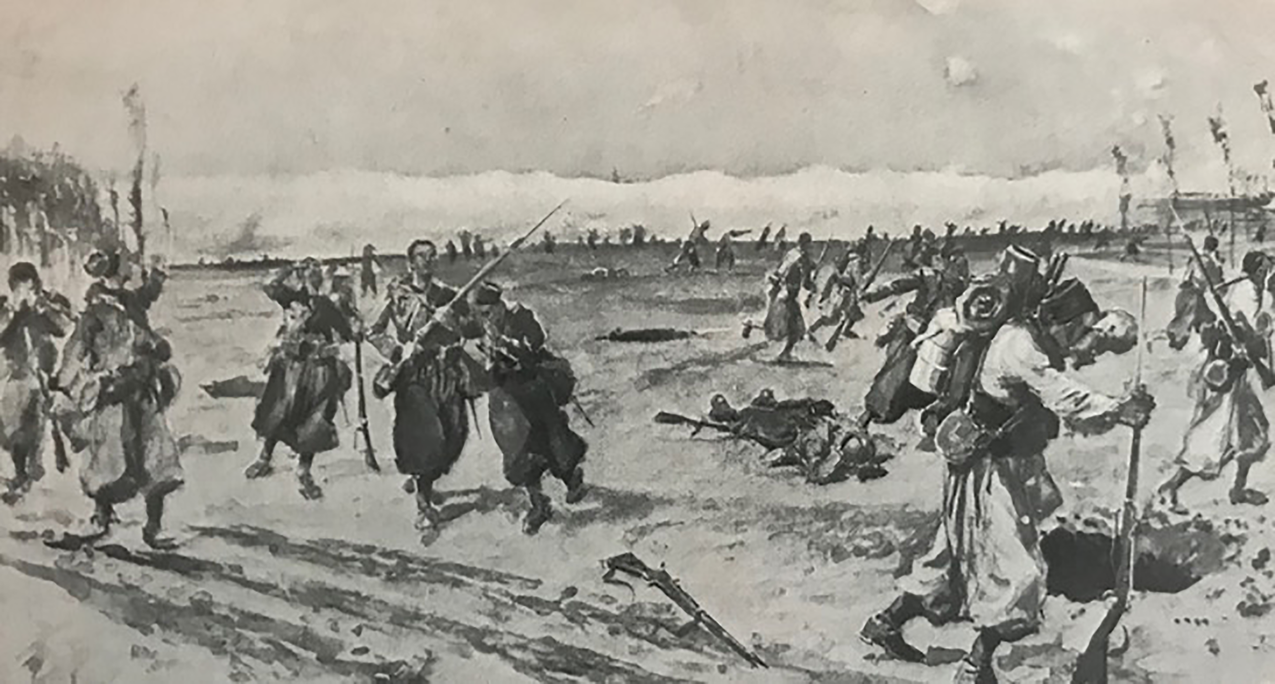
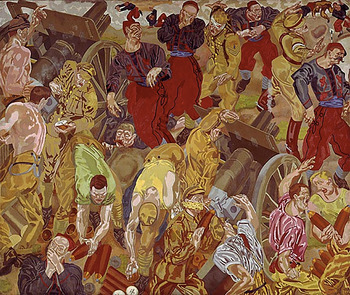
Although racial stereotypes were certainly not unique to the Germans, it is useful to compare German and Anglo commemorations of the imperial French troops in this historical instance. When placing illustrations like the only one produced for Rudolph Hanslian's 1927 Der chemische Krieg in contrast with William Roberts's 1918 painting The First German Gas Attack at Ypres, we can see the way in which the image chosen for German commemoration darkened the Algerian soldiers’ skin tone and isolated them from their Canadian allies. In contrast, the English painter places the Algerian troops among the Canadians and makes little distinction between skin tones. The visual reality of the Franco-Algerian retreat is not at stake here, and Hanslian's image may hold some level of facticity. But the distinction between European and non-European troops appears to linger in the German mind, and by 1927, dark-skinned Berbers have been permanently separated from their Arab and Canadian counterparts and made the focus of the gas attacks at Ypres (see figures 1 and 2).
A depiction of the French colonial troops retreating from German gas at Ypres. Dark-skinned men run in chaos as they drop their guns and fezzes. This image was originally printed by the Illustrated London News, but was subsequently reprinted in the German gas scientist Rudolf Hanslian's authoritative and influential book on poison gas from 1927. Hanslian's caption reads: “The advancing chlorine cloud forces the Algerian troops to flee their trenches.” Rudolf Hanslian, Der chemische Krieg (Berlin: E. S. Mittler & Sohn, 1927), table 2.

William Roberts's painting The First German Gas Attack at Ypres is a useful contrast for Hanslian's image. Roberts presents both Canadian and Algerian troops suffering and fleeing together. The Algerians are depicted with skin equally as light as their Canadian allies. Roberts was an English artilleryman who served at Ypres one year after the first gas attacks. William Roberts, The First German Gas Attack at Ypres, 1918. Oil on canvas, 304.8 x 365.8 cm. 8729. National Gallery of Canada.

Due to the supposed success of their gas attack against colonial troops, the German military initially posited poison gas as a distinctly European weapon. In a historical moment in which many Europeans first came face to face, on their own soil, with both colonial populations and the extreme levels of violence that had formerly been exclusively associated with colonial lands, continued assertions of European superiority through technological aptitude proliferated. Nevertheless, German soldiers and commanders were still unsure if they truly maintained total control over their newfound technology. In their attacks at Ypres, the German gas led to at least five thousand casualties, including about one thousand deaths.Footnote 32 About two thousand of these men were German soldiers who had inhaled chlorine either while installing the gas batteries or venturing too close to the gas cloud during the attack. German infantrymen were reportedly deeply distrustful of the new weapon and resented having to live next to the large canisters of gas, which occasionally leaked into the trenches.Footnote 33 Furthermore, once the gas was released, it relied on the wind to carry it in the correct direction. Unexpected changes in wind direction frequently brought the gas back onto German troops, making the weapon a rather unreliable ally over the next two years of fighting.Footnote 34 In fact, the fear of poison gas was apparently one of the major reasons that the Germans failed to gain significant ground in the wake of the Ypres attack. Soldiers refused to closely follow the gas and looked for any excuse to stop their advance. Most German commanders shared the sentiments of their men and further worried that gas attacks would both bring international censure and inspire retaliatory Allied chemical attacks.Footnote 35
Fears over Allied retribution were warranted, and the British subsequently used the German attack as a justification for releasing their own chlorine gas five months later. This began the chemical arms race among the British, French, and Germans in which thousands of men from every side perished. Over the course of this struggle, the Germans repeatedly tried to convince themselves that poison gas was their own distinct advantage. Advocates for the use of gas, such as Fritz Haber, pointed to Germany's massive chemical industry, which could produce more poison gas than any other nation in the early years of the war. They further posited chemical warfare as a uniquely technical skill, which the German mind and spirit could best exploit. At the same time, they remained insistent that gas was, in fact, a more humane and more civilized form of warfare because it did not disfigure or maim its victims.Footnote 36 Poison gas, they claimed, was a distinct point of German national pride in a war that was increasingly cast as a struggle for cultural superiority.Footnote 37
On the Eastern front, German soldiers did often realize this claim to national chemical superiority. Immediately after the attacks at Ypres, the German gas regiments moved to the Eastern front to employ their weapon against the Russians. Russian troops were caught completely unprepared for the new weapon, and many succumbed to gas poisoning or fled the battlefield.Footnote 38 Even after these initial military disasters, the Russian army continually failed to distribute effective gas masks, thus exposing its soldiers as the least chemically protected men in Europe.Footnote 39 One of Fritz Haber's gas technicians, the future Nobel Prize-winning physicist Otto Hahn, described the devastating effects of gas in the East, writing: “We encountered a significant number of gas-poisoned Russians who could no longer escape from the cloud. They had been surprised by the gas without a protective mask and were now lying or squatting in a lamentable state.”Footnote 40
The German ability to rout the Russians with new military technologies fit within long-standing German prejudices concerning the Slavic East. Well before the turn of the twentieth century, Slavic lands had appeared to many German proto-imperialists as a potential colonial space. Like Africa, these were supposedly uncivilized areas inhabited by barbarous peoples. Indeed, nineteenth-century German historians and geographers described the East, especially Poland and Russia, as a “Slavic sea” that threatened to engulf the small, ethnically German enclaves that existed outside of the German empire.Footnote 41 As a people, the Slavs were said to be unmanly, undisciplined, and prone to outbursts of emotion that stemmed from their “Asiatic” origins.Footnote 42 Given the dominant German colonial view of the Slavic East, it is not surprising that German soldiers frequently described Slavs as Black men masquerading in white skin.Footnote 43 Some members of the German military speculated that it was for this very reason that the Russians were as unable to resist poison gas as African colonial troops.Footnote 44 Thus, for subscribers to such essentializing and homogenizing claims, German chemical mastery in the East was a product of ethno-national determinants similar to those proclaimed at Ypres.
Chemical warfare on the western front, on the other hand, continued to plague the German military. Although the Germans enjoyed early dominance in the research and development of poison gas, the Allies soon caught up. By 1917, the British had introduced the first gas shells, and the entrance of the Americans into the war added yet another growing chemical arsenal to the fray. In the final year of World War I, German soldiers on the western front lived in trenches that dripped and sweated deadly chemicals. Forced to endlessly wear their cumbersome gas masks, these men struggled to survive the constant barrages of Allied chlorine, phosgene, and mustard gas shells. In losing their dominant grasp over the chemical war, some German commanders further wondered whether the Germans were truly destined to control chemical weapons. Admittedly, they were being bested by other “European” nations, but the situation still encouraged German commanders to return to their initial skepticism of Fritz Haber's plans. Reflecting on Haber's key role in the first use of chlorine gas, some began to wonder if the means of total warfare (like chemical weapons) represented not a German futurity, but a Jewish one. For instance, in his later reflections on the war, General Erich Ludendorff wrote: “The total war (which is not just a matter for the armed forces but also directly affects the life and soul of every single member of the warring peoples) was born [through] changed policy in which the Jews’ desire for power … became ever clearer as they attempted to weaken the German people and suck them of their lifeblood.”Footnote 45
By 1918, the German national consciousness had long associated Jews with the Slavic East. Indeed, the westward migration of eighty thousand Russian Jews in the late nineteenth century inspired distinct German fears of a barbarous and uncivilized “flood from the East.”Footnote 46 Much like with the Slavs, the experiences of imperialism and World War I served to blend attributions of foreignness within the German imagination. Thus, the Jews were at times described as “a racial mixture of the Near Eastern, Oriental, Hamatic, and Negroid races.”Footnote 47 Although the Jews were often said to be as deceitful and dangerous as African or Slavic peoples, they had also apparently managed to integrate more seamlessly into German society. For some more virulently antisemitic German military men, it was perhaps these concealed Jews who had destroyed Germany's battlefield honor and forced its army into a chemical war that it could not possibly win.Footnote 48 This Dolchstoß theory was reinforced by the fact that advances in chemical weaponry allowed the German army to conduct its retreat from the western front at the end of the war. By firing mustard gas at strategic terrain, the German artillery created certain pockets through which small platoons of troops could pull back.Footnote 49 This retreat conceptually tied Fritz Haber's chemical laboratories and the weapons produced there to the distinct moment of German defeat.
Interwar Visions of Gas and Colonial Chemical Conflict
If empire was the laboratory in which modern German ethno-racial categories were first conceived, then World War I was the arena in which these categories were tested, applied, and refashioned based on the changing circumstances of German identity. Weaponized poison gas, an apparent hallmark of the evolving nature of modern warfare, developed concurrently and interrelatedly with these emerging German conceptions of race, ethnicity, and nationalism. Erich Ludendorff made this clear when he claimed that the weapons of total war such as poison gas affected “every single member of a warring peoples.” Indeed, World War I proved to many Germans that all future wars would be waged along ethno-national lines that could now easily be described in racialized terms.Footnote 50 For instance, in 1919, the German linguist Wilhelm Doegen wrote that “Germany did not fight against a world of armies … but rather against a world of races.” It was precisely the global nature of the war that justified the vague idea that each belligerent nation had both a unique political and biological “racial” identity and that these racial differences determined the aptitudes of each people during wartime.Footnote 51
In the vein of this postwar racial logic, many Germans remained unsure whether they were the ultimate masters of chemical warfare. Nevertheless, many chemical weapons experts were convinced that gas was at least a European, or “white,” weapon. In his well-received 1927 account of First World War chemical warfare, the former German gas officer Rudolf Hanslian wrote:
The gas weapon placed the highest requirement on the morale and intelligence of the soldier … it separated the wheat from the chaff when it came to gas discipline. In combat, it distinguished between those who could perform their combat task and the inferior masses who collapsed mentally and retreated. Thus, the gas tightened the circle of peoples who could survive in a modern war … It has been shown that indigenous peoples such as Russians, Italians, and colored troops succumb more readily to the psychological pressures of gas warfare than the culturally higher Americans, Germans, English, and French.Footnote 52
For many German political theorists, it became increasingly important to align German national identity with other “Western” and “white” nations after the signing of the Treaty of Versailles.Footnote 53 The treaty's intentional weakening of the German state through reparations payments, territory reductions (including the loss of its colonies), and military restrictions put the nation in a precarious political position. German attempts to align themselves with other Western nations served as a rhetorical method to protest the Allied treatment of Germany as both a “colonized” and “emasculated” nation. Indeed, one of the central motivators of stringent German interwar nationalism was the attempt to resist the supposed Allied colonial thrust into the German heartland.
The humiliation of the German state was amplified by the postwar Allied occupation of the Rhineland. The French were particularly active in this occupation, sending about two hundred thousand soldiers to ensure French military control in the border territory. Between twenty-five and forty thousand of these troops were colonial Africans.Footnote 54 For many German nationalists (including long-standing supporters of German colonialism), the use of French colonial troops to patrol German soil was the ultimate colonial inversion. In their minds, the Germans were now no longer viewed as Europeans and no longer afforded the rights of a superior “white” people.Footnote 55 As early as 1919, nationalist German propaganda campaigns sprung up to decry German weakness in all of its specific historical forms. Such campaigns termed the French use of colonial troops from Algeria, Morocco, and other African colonies as a “Black Shame,” a “Black Disgrace,” and a “Black Horror.”Footnote 56 They drew on imperial discourses to again describe the colonial soldiers as “savage” and “uncivilized,” creating public fears of the African troops that led to real discrimination. Relying heavily on sexualized imagery, these campaigns symbolically linked the supposed rape of white German women by African soldiers with the subjugation of the German nation by the “Black race.”Footnote 57 Thus, nationalists called on all Germans to support both a racially unified “white” national community (or Volksgemeinschaft) and a rearmed German state that could reassert its masculinity.Footnote 58
This distinct form of vociferous German nationalism, which now drew explicitly on concepts of whiteness, was unique in that it resembled the growing nationalism of other European minority groups while representing a majority sentiment in a still powerful country.Footnote 59 Employing slippery ethno-national terms allowed Germans to simultaneously posit themselves as both “Western” and “white” as well as the ultimate victims in the new Anglo-American world order. According to such claims, only through a future national struggle could the Germans justifiably upset this international system of oppression.
Since the 1921 publication of the Italian General Guilio Douhet's highly influential military treatise entitled The Command of the Air, Europeans across the continent assumed that this future national struggle would feature the use of air power and poison gas. Pointing out that airplanes could now cut to the center of any nation and drop gas bombs on unsuspecting civilians, Douhet argued that the nation with the strongest air force and the most devastating chemical weapons would dominate the future world order.Footnote 60 Often reading Douhet's claims as gospel, many German nationalists and militarists now saw a second world war as an opportunity for German redemption. However, success in this endeavor clearly required the protection of a weakened Germany from aero-chemical attack. A 1928 article from the Lübecker General-Anzeiger pointed to the many problems now facing proponents of chemical rearmament: “Only one nation stands defenseless in these preparations for the gas war. A weakened Germany does not have the right to participate in rearmament. It will play a completely passive role in the gas war, which is expected to spare no one.”Footnote 61
Not surprisingly, this newly reimagined chemical struggle tapped into preexisting ethno-racial distinctions. For German nationalists who had imbibed Social Darwinian thought, the future aero-chemical war would be a “struggle of life” and a struggle for “living space” that would determine the ethno-racial groups that were fit for survival in a chemically precarious world.Footnote 62 This set of ideas was fortified by various strands of “young conservative” nationalist thought that proliferated throughout the Weimar era. Engaging firsthand experience and theoretical reflections on World War I, both Ernst Jünger and Oswald Spengler foretold a coming race war in which the Germans might well prove victorious. In philosophical tracts like Der Arbeiter (1932), Jünger claimed that the nation that could best harness the powers of technology would dominate the modern world. By accepting technology as their cultural Gestalt and wading through the coming violence of the technologically enhanced world, the technically adept Germans appeared to Jünger as if they were poised for such success.Footnote 63 Oswald Spengler's widely read book The Decline of the West (1918/1922) similarly posited the coming of a world-historical struggle between racially essentialized civilizations. Moreover, in his lesser-known subsequent work Man and Technics (1931), Spengler broached the role of technological thinking as a cultural force in this envisioned struggle. He wrote: “For these ‘colored’ peoples (including, in this context, the Russians) the Faustian technics are in no way an inward necessity. It is only Faustian man that thinks, feels, and lives in this form. To him it is a spiritual need, not on account of its economic consequences, but on account of its victories.”Footnote 64
It is worth noting that Spengler predominantly referred to “Faustian Man” as a broadly northern European ideal-type who could harness the power of technology to an extent greater than individuals from any other broadly defined civilizations. Nevertheless, some German nationalists imported this idea as constituent of a more narrowly defined German ethno-racial identity. In attempts to redress the German failures in World War I and the ignominies of the interwar experience, these men blended earlier constructions of race, nation, and ethnicity in order to proclaim the Faustian employment of technology as a quasi-spiritual German quality that would allow the German people to reshape any presumed Anglo-American world order.
Not surprisingly, for many German chemists and gas scientists, the harnessing of poison gas was the epitome of such Faustian technics. In fact, in his 1932 history of poison gas, the gas scientist Ulrich Müller-Kiel wrote:
It is probably not too much to say that from the world-historical point of view the prohibition of chemical weapons, which the “victorious states” have declared for the German people, represents a short-sightedness … It is possible to imagine that in the not too distant future the self-destruction of the white race comes to completion under the pressure of the increasingly empowered colored people. In such a decisive struggle, which perhaps our children and certainly our grandchildren will have to carry out, success will only result from the possession of the highest technical means, and among these is the use of chemical weapons.Footnote 65
In contravention of Allied surveillance, German chemists and chemical engineers had continued their search for such “highest technical means” during the interwar period. Since the end of World War I, German chemical companies and research laboratories had redirected their chemical weapon production toward applications in pesticides and medicine. The creation of gases like Zyklon-B, which proved extremely effective in exterminating vermin, demonstrated the ways in which poison gas research could seemingly benefit humanity. Fritz Haber and other gas scientists who remained affiliated with the Kaiser Wilhelm Institute continually reiterated this message, relying on the commonly held belief that all scientific research must lead to human progress.Footnote 66 At the same time, the German military and various German chemical companies wanted to continue poison gas research in order to reclaim their leading position in the armaments industry. Under the arms restrictions of the Treaty of Versailles, much of this interwar toxicological work was covertly conducted in small university and private laboratories throughout Germany. One of the major players in the continuation of chemical weapons development was a former employee of Fritz Haber named Hugo Stoltzenberg. Between 1920 and 1925, Stoltzenberg was contracted by the German government to “clean up” the large stockpiles of chemical weapons produced during the war. As part of this supposed clean-up process, Stoltzenberg quietly moved leftover chlorine, mustard gas, and ethylene shells to his chemical factory in Hamburg.
With offices around the world, Stoltzenberg became a chemical weapons consultant for various national militaries. In 1921, he received his first contract to serve as the chief engineer at Spain's new La Marañosa mustard gas plant, which he initially stocked with gas from his Hamburg warehouses. Regardless of numerous postwar international agreements that attempted to ban the use of chemical weapons in war, the Spanish military used Stoltzenberg's mustard gas between 1922 and 1927 to subdue Abd el Krim's rebellion in Morocco.Footnote 67 Spanish planes flew over Berber settlements, dropping gas on civilians and rebel soldiers alike. The Italians later mimicked this form of warfare in their attacks on Libyan peoples in 1923 and 1927, and then again in their war against Ethiopia from 1935 to 1941.Footnote 68 Italian military commanders argued that chemical weapons were ideal for creating terror among native populations who had no ability to protect themselves or reciprocate in kind.Footnote 69 Clearly, it was also the case that the Spanish and Italians were testing their chemical arsenal on the fringes of European control, where the violence and destruction of their actions would avoid significant international scrutiny.Footnote 70 Nevertheless, the German press paid close attention to these attacks with one report stating that “The effect was terrible, blindness, swelling of the head, white leprosy-like patches on the surface of the body, death with signs of severe burning after about twenty minutes. The Italians gassed the Abyssinian position until all life was extinguished.”Footnote 71
Spanish and Italian gas attacks further entrenched the prewar European assumption that although chemical weapons could not be used against other Europeans, they were completely acceptable when directed against non-European, nonwhite populations. Because gas was an incredibly formidable but also frequently uncontrollable weapon, European militaries thought it most wise to only employ chemical weapons against people they viewed as powerless and unsuspecting. Not all Germans, however, were convinced of the European mastery over this chemically precarious world order. In fact, German pacifists in the 1920s frequently pointed to the volatile and unruly nature of gas to trouble the belief that Germany, or Europe, could possibly remain the master of chemical weapons. Such arguments fed into larger German interwar peace movements, which advocated for international legislation banning the future use of poison gas.Footnote 72 Interestingly, these pacifists also used explicitly racist arguments to argue their point. For instance, Gertrud Woker, a leading organic chemist and a central figure in the Women's International League for Peace and Freedom, wrote that “The agents that will play the most central role in the self-destruction of the white race are poison gas and modern aviation technology.”Footnote 73 Playing on German fears of Social Darwinian racial competition, Woker claimed that it was poison gas that would lead to the political rise of the “Black race.” She made this explicit in a subsequent article from 1925, writing:
From his first-hand knowledge of colonial troops [in World War I], [John] Haldane stated that Negroes are relatively immune [to mustard gas]. It may be comforting for the colored population to know that once the European and American cities are transformed into Negro villages, the citizens no longer need to worry too much about mustard gas. It is only a matter of time before the Negro and other colored people realize the import of their immunity while the white race destroys itself. Poor white folks! It is not the height of your culture that determines your fate, but the mustard immunity of your black slaves. You have introduced the blacks to your murderous tools; when will these murderous tools be directed against you?Footnote 74
Although the German public, heavily influenced by the “Black Shame” campaign, certainly feared the possible political rise of the “Black race,” few probably believed in the ability of Africans to employ such technology in this imagined racial struggle. The greater threats in the late 1920s appeared to be the United States and Soviet Russia, which both continued to stockpile large quantities of chemical weapons throughout the decade. The American threat, however, remained distant in the German imagination compared to Soviet Russia's looming chemical menace in the not-too-distant East.Footnote 75 In an attempt to redress czarist failures in World War I, the Soviets were quick to erect chemical weapons factories near Samara. Ironically, much of this work was done in cooperation with Hugo Stoltzenberg and the German military, which hoped to use the Russian interior to continue its own covert development of a chemical arsenal. Regardless of this ostensive cooperation, tensions remained high between the two countries as the German public increasingly learned to fear Russian chemical attacks.
Reports of Soviet chemical weapons preparation filtered back to the German press throughout the late 1920s and early 1930s.Footnote 76 Falling back on the cultural trope of the uncivilized and barbarous Slav, many Germans feared that the Russians would never adhere to recently signed international agreements like the Geneva Protocol, which reiterated and rephrased the ban on the use of chemical weapons. In fact, now that the Russians were led by the supposedly dangerous and internationally isolated Bolsheviks, German public opinion-makers asserted that they were even more likely to torture and murder helpless civilians.Footnote 77 Indeed, an article from a 1932 edition of the air protection journal Luftschutz Rundschau claimed that “The Russian workers and peasants also seem to have little faith in international solidarity; they immediately reintroduced compulsory military service after the Bolshevik seizure of power and prepared themselves for chemical air raids by creating a large military air force and a comprehensive civil air-defense organization.”Footnote 78
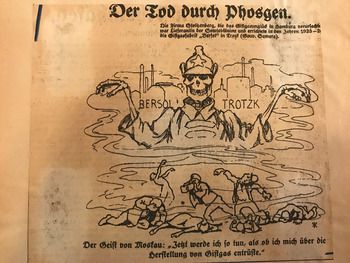
Concerns over Russian chemical weapons reached a climax in 1928 when Hugo Stoltzenberg's Hamburg chemical factory experienced a major phosgene leak. Two hundred Hamburgers were poisoned and eleven died, and the area west of the city center lost much of its low-lying vegetation and animal life.Footnote 79 Outrage over this accident led to the German press's eventual discovery of Stoltzenberg's connections to secret chemical weapons production in Russia.Footnote 80 Subsequent investigative journalism claimed that not only were the Russians indeed producing chemical weapons, but that their poison gas had already insidiously made its way into Germany. The publicly circulated assumption, that Stoltzenberg had been shuttling chemical weapons between his German warehouses and Russian production plants, made subsequent Soviet chemical attacks seem increasingly imminent (see figure 3).
“Death by Phosgene.” Published immediately after the Hamburg gas accident, this political cartoon conveys the German fear of Soviet gas. The “Ghost from Moscow” appears in front of several Russian chemical factories, claiming: “I will only pretend to be upset about the production of poison gas.” Image from Staatsarchiv Hamburg (SH) Giftgas Unglück auf der Veddel, 1928, 135-1, I–IV, 4069.

The Hamburg gas accident, in coordination with Stoltzenberg's connection to Russian chemical weapons production, gave credence to the already popular idea that Germany's enemies were both inside and outside of the nation's borders. Since the German loss of World War I, those who propagated the Dolchstoßlegende (or stab-in-the-back myth) had insisted that certain uncooperative or even treacherous segments of Germany's civilian population continuously weakened the nation. Among those most commonly blamed, German Jews received particularly virulent condemnation from predominantly right-wing nationalist circles. German antisemites had already propagated associations between Jews and Russian Bolshevism throughout the 1920s, but the growth of the Soviet chemical weapons program and the rise of the Nazis reignited claims about the Jews’ role in the proliferation of poison gas. By the mid-1930s, the German gas protection journal Gasschutz und Luftschutz was claiming that the Russian chemical arsenal was developed under the direction of the expressly Jewish revolutionary Leon Trotsky.Footnote 81 A second article from 1937 made the connections among Bolshevism, Jews, and chemical weapons even more explicit, stating: “What Jewish Bolshevism really means: The obliteration of culture—the desire for the complete destruction of the noble and the good and a concurrent propagation of the low and the bad! To meet this growing threat, we see more and more [German] people ready to take defensive measures and make sacrifices, and this is especially true for those who feel particularly threatened by the Bolshevik danger at the eastern border of Europe. In this case, the question of gas and air protection has become increasingly urgent.”Footnote 82
When considering such interwar visions of the future, which merged new concepts of race and technological warfare, it became quite natural for regular German civilians to wonder if, in fact, they were prepared for such a struggle. The loss of World War I and the nation's subsequent disarmament led many to assume the worst; namely, that they would be the first victims of this chemically precarious world.Footnote 83
The Nazi Inversion of the Chemical World Order
The political rise of the Nazis only brought increased attention to issues of German national security in the early 1930s. By exploiting civilian fears over future aero-chemical war and ethno-racial struggle, the Nazis were able to justify their large-scale rearmament program while simultaneously subsuming class differences (with varying levels of success) into the ethno-national state. Their agenda included the creation of a national aero-chemical defense system that merged both military defenses with a trained air raid community composed of every German civilian. To that end, the Nazis set up the Reichsluftschutzbund (RLB) in April 1933 and placed it under the auspices of Hermann Göring. Within one year, the RLB was a millions-strong voluntary air protection organization that began to create its own envisioned national community from the ground up.Footnote 84 Not only would this protective community put German minds to ease over future aero-chemical warfare, but it would also create yet another site for the spread of Nazi Weltanschauung (or ideological worldview).Footnote 85
In creating a national community of air and gas protection, the RLB insisted that every German citizen could contribute to aero-chemical defense. As part of this call for German participation, the leaders of the RLB wished to ensure Germans that they could, in fact, exert some control over chemical weapons. Inverting the long-standing fear that poison gas had slipped from German control, the RLB again vowed that gas was an inherently German creation. These claims relied on the increasingly developed conception of the German people as an essentialized ethno-national race with a particular talent for the Faustian technical skills required in chemical warfare.Footnote 86 Revealing such an ideological construction, a set of 1938 guidelines for gas protection officers read “Chemical weapons are a typical German weapon since they correspond to the special scientific-technical talent of the Germans.”Footnote 87 The press department at the chemical conglomerate IG Farben agreed with this sentiment, further adding that “Chemical weapons are the weapons of superior intelligence and superior technical-scientific thinking. As such they are able to play a decisive role for Germany.”Footnote 88
If poison gases were again posited by the RLB as inherently German, then other ethno-national groups could not possibly be the masters of an international order determined by chemical warfare. Again, gas scientists and proponents of rearmament insisted that the proliferation of chemical weapons was not part of a Jewish plan to bring Germany to its knees. In fact, according to this view, the Jews were not creating chemical weapons but rather seeking German chemical disarmament through a Bolshevistic program of political defeatism.Footnote 89 In one of the few Nazi speeches to explicitly employ the language of poison gas, Hermann Göring spoke in 1933 of the “bitter struggle with the eternally destructive poisons of Marxism” and the “stinking mists” of communist calls to dismantle the German military.Footnote 90 Such accusatory claims were apparently taken seriously by the leaders of the RLB, who excluded Jews from their national air raid community. Indeed, Jews were not allowed to participate in aero-chemical protection exercises and were not served by state emergency services. This exclusion was yet another step in the Jews’ loss of their German citizenship, which was now defined by the Nazis’ ethno-racially constructed Volksgemeinschaft (or German people's community).Footnote 91
It is, however, important to point out that this German Volksgemeinschaft, defined in part by technical skill in aero-chemical resistance, was indeed an imagined phenomenon. While a coterie of RLB officials, gas scientists, and gas mask companies pushed this narrative through widely circulated air protection guidelines and propaganda, as well as less widely circulated technical journals such as Die Gasmaske and Gasschutz und Luftschutz, ego documents from German civilians rarely make personal claims to an ethno-racial technical superiority. Nevertheless, it seems clear that the RLB hoped to instill such ideas through constant gas and air-raid drills as well as a commitment to avoiding full-scale civilian evacuations in the case of aero-chemical attack. In fact, as the French and British began evacuating vulnerable civilians when aero-chemical attack felt all but certain during the 1938 Munich crisis, the Nazis refused to make similar preparations. The president of the RLB, Hugo Grimme, claimed that the Germans, armed with their technical training, would be able to withstand such an attack.Footnote 92 Not shockingly, such claims did not entirely inspire civilian confidence, and although local German air protection services received high marks throughout most of World War II, the collective community of chemically resistant Germans never materialized.
The particularly interesting aspect of the RLB's imagined Volksgemeinschaft, however, is Grimme's willingness to subject German civilians to poison gas. Pulling on claims from former World War I soldiers such as Ernst Jünger, the RLB treated aero-chemical attack as a bonding ritual that the German people must complete. This chemically saturated right-of-passage intriguingly fit within a seemingly unrelated body of Nazi ideology that was most fully developed in the gas chambers of the Holocaust. Although it can create a false sense of the gas chamber's inevitability, it is important to point out that poison gas was already rhetorically used as an arbiter of ethno-racial dominance in the interwar period. Besides writings from antigas activists, apocalyptic prophets, and strident ultra-nationalists like Ludendorff, it is impossible to ignore the passages in Hitler's Mein Kampf in which he wonders what a fully controllable gas could do for his imagined racially pure German state. Hitler wrote: “If at the beginning of the war and during the war twelve or fifteen thousand of these Hebrew corrupters of the people had been held under poison gas, as happened to hundreds of thousands of our very best German soldiers in the field, the sacrifice of millions at the front would not have been in vain.”Footnote 93 Hitler further wrote that the German people needed to learn “to combat poison gas with poison gas. It is our duty to inform all weaklings that this is a question of to be or not to be.”Footnote 94
Decades of strong historical scholarship has made it clear that such interwar vitriol was not the early stage planning of the SS's gas chambers. It is, however, clear that these quotes reveal that Hitler was continuing to develop a logic of Social Darwinian struggle on an ethno-national scale. It was the memories of World War I, the interwar fears of aero-chemical attack, and applied chemistry's proximity to biological language that made poison gas the ideal weapon in this imagined struggle. Indeed, the linguistics scholar Andreas Musolff has pointed to the importance of bodily metaphors in the writing of Mein Kampf.Footnote 95 Hitler relied heavily on a metaphorical construction in which the Jews, as an ethno-racial group, served as a form of blood poisoning or a parasite on the German national body. During the Third Reich, this metaphor was then mapped onto the German social world, allowing for the later conceptualization and normalization of genocide. Subsequent metaphors of poor health, degeneration, infestation, or cancer were extended to other racialized groups that the Nazis viewed as inferior, including people of African descent and Slavs. Nazi writings and films like Der ewige Jude used verbs such as swarming, polluting, and spreading to describe the ways in which such “vermin” weakened the German race.Footnote 96 Just like the populations of formerly colonial lands, Jews and other unwanted peoples within the German state were seen as not quite human and, as such, not to be afforded the internationally respected rights of “white Europeans.” On a rhetorical level, this process of dehumanization allowed for, if not encouraged, the use of restricted weapons like poison gas for the “disinfection” or “delousing” of the German nation.
Conversely, Mein Kampf positioned the Germans as the Aryan masters in this racialized struggle. In order to attain the desired mastery of a chemically precious world, however, the collective German body would have to wade through a world of poison gas, concurrently learning the technical skills of Faustian man and the communal bonds of the RLB's vision of Volksgemeinschaft. Simultaneously, such a self-immersion in gas would shed the so-called parasites that could not endure a chemically precarious world. As historian Paul Weindling put it: “Immersion in a lethal gas was a baptism of destruction and cleansing—a macabre rite of purification in the name of the extinction of parasites and the conservation of resources.”Footnote 97 The Nazis’ willingness to expose Germans to poison gas is perhaps best seen in the T4 euthanasia program, in which the Nazis began to use six carbon monoxide gassing installations in 1939 to kill those Germans deemed mentally or physically unfit. The program was put to a halt in 1941 due to mass protests conducted by a wide range of German civilians who, again, did not buy into this chemically inflected view of world struggle.
Although many Germans balked at the idea of gassing other German citizens, they of course had no control over aero-chemical attacks from other nations or peoples. It was only the RLB's vision of a national community of aero-chemical protection that could provide Germans with some level of security. As historian Claudia Koonz has argued, it was quite possibly a pervasively self-congratulatory conception of the collective German nation as indomitable and protected that allowed many Germans to turn a blind eye to exclusionary violence against others.Footnote 98 Indeed, racially determined inequalities were regularly and implicitly accepted in the Nazis’ world of zero-sum geopolitics. If the Aryan race was to thrive in a chemically precarious world, this logic argued, the weak, sick, and parasitic would have to be removed if not permanently destroyed.
Although Imperial German racism was certainly important for the realization of Nazi genocide, it is also important to remember that these racialized concepts were flexible, unstable, and open-ended.Footnote 99 Since the development of the means of industrialized genocide, that is, poison gas, most Germans remained unsure whether they were, in fact, the masters of this new chemical power. It was only through an intentional campaign for national aero-chemical protection that the RLB and the Nazis were able to assure themselves that their Faustian ethno-racial superiority applied to chemical warfare. Poison gas, which had terrorized German soldiers and civilians for more than two decades, was now imbued with new symbolic meaning. As an inherently German weapon, gas could not possibly be immoral or malevolent. Rather, following the wartime logic of scientists like Fritz Haber, gas was posited as more civilized and controllable than the traditional means of warfare.Footnote 100 In fact, the SS devised their mobile gassing vans after Heinrich Himmler had become sick while witnessing the mass execution of Jews and Roma in 1941.
The use of poison gas, Himmler claimed, would relieve German soldiers of the “psychological burden” of murder, which could possibly turn them into “savages.” Indeed, gas was posited as a “humane” weapon that differentiated the Germans from other “uncivilized” peoples.Footnote 101 For Himmler and other Nazis, it was precisely this employment of techno-scientific thinking for industrialized mass murder that defined the Faustian German race. This technological pursuit of murderous efficiency was epitomized by the SS men who pulled gas masks over their faces, thus protecting themselves from the unpredictable dangers of chemical weapons before pouring Zyklon-B pellets down onto their helpless victims in the gas chambers at Auschwitz.Footnote 102 According to historian Gideon Graf, the delegations of Nazi officials who arrived at Auschwitz to watch this grisly scene were providing themselves with a form of entertainment “similar to gladiator bouts in Rome.”Footnote 103 Although some Nazis may have found chemically induced murder amusing, it is more likely that such viewings were a form of reassurance or tangible proof of their presupposed chemical world order. Indeed, in his lectures from the mid-1970s, the French philosopher Michel Foucault made this quite clear, writing:
Risking one's life, being exposed to total destruction, was one of the principles inscribed in the basic duties of the obedient Nazi, and it was one of the essential objectives of Nazism's policies. It had to reach the point at which the entire population was exposed to death. … [This] was the only way it could truly constitute itself as a superior race and bring about its definitive regeneration once other races had been either exterminated or enslaved forever.Footnote 104
It was this lopsided form of technological violence that punctuated the historical admixture of chemical weapons and racialized identity in Germany. The Nazis had clearly conceived of both the “master” and the “victim” of this newly imagined chemical world through ethno-racial categories that had developed concurrently and at times codependently with the mythos surrounding chemical weapons. Thus, while various interpretations of the nature of chemical threat historically shifted, the obvious power imbalances inscribed into chemical weapons in the imperial context were reasserted by the Nazi regime. To this day, such starkly delineated groupings of human lives, which in their essence stand counter to the uncontrollability of poison gas, remain central to the decision to actually employ chemical weapons. Certainly, this was the dynamic at play when the United States chose to use napalm in Vietnam, when the Soviets released nerve gas on the Afghan people, and when the Syrian army continues to deploy chlorine and mustard gas against its own civilians.Footnote 105 Thus, in returning to Arundhati Roy's opening gambit, it is fair to say that the atomic bomb was not the first and only modern industrial weapon that has maintained a psychological form of imperial control. “The very heart of whiteness,” as Roy describes it, had already been colored by the pale and corrosive touch of poison gas.Footnote 106