Implications
In equids, the use of the first postpartum heat (foal heat) for insemination, in order to reduce the interval between two consecutive parturitions, is controversial due to a reported lower fertility. Results reported in our study suggest that the foal heat in the female donkey (jenny) could be successfully used for artificial insemination (AI) when the onset of foal heat occurs after day 8 postpartum. This criterion could be easily used in practice in the reproductive management of equids.
Introduction
Donkey reproduction has received an increasing amount of attention over the last few years, due to the fact that several breeds are considered endangered by the Food and Agriculture Organization. In 2014, the Martina Franca breed consists of 68 male donkeys (jackasses) and 292 jennies approved for breeding (Food and Agriculture Organization Domestic Animal Diversity Information System, 2014) and thus should be considered endangered. Furthermore, some peculiarities regarding donkey production have increased interest in this species. Donkey milk has been found to be more similar to human milk than other dairy species, making it suitable as a cow’s milk substitute for babies and adults suffering from cow’s milk protein allergies (Bordonaro et al., Reference Bordonaro, Dimauro, Criscione, Marletta and Macciotta2013).
An important key element in preserving mammal species is the study of reproduction. The estrus cycle of donkeys is generally considered to be similar to that of horses, but some differences are described by several authors (Godelieve et al., Reference Godelieve, Vandeplassche, Wesson and Ginther1981; Ginther et al., Reference Ginther, Scraba and Bergfelt1987; Henry et al., Reference Henry, Figueiredo, Palhares and Coryn1987; Meira et al., Reference Meira, Ferriera, Papa, Tornero and Bicudo1995; Blanchard et al., Reference Blanchard, Love, Thompson, Ramsey and O’Meara1999; Carluccio et al., Reference Carluccio, Panzani, Contri, Tosi, De Amicis and Veronesi2008; Contri et al., Reference Contri, Robbe, Gloria, De Amicis, Veronesi and Carluccio2014). The donkey is a monotocous species, and the pregnancy length (PL) in Martina Francan donkeys was reported to last 352 to 376 days (Veronesi et al., Reference Veronesi, Villani, Wilsher, Contri and Carluccio2010). For these reasons, the use of the first heat after parturition to achieve pregnancy could optimize reproduction of this endangered breed. The horse mare recovers its reproductive cycle soon after delivery (Jischa et al., Reference Jischa, Walter, Nowotny, Palm, Budik, Kolodziejek and Aurich2008), showing foal heat, 5 to 12 days after parturition (Ginther, Reference Ginther1992). The resumption of ovarian activity with ovulation after parturition occurs in a physiologically short time frame (Heidler et al., Reference Heidler, Parvizi, Sauerwein, Bruckmaier, Heintges, Aurich and Aurich2003). The uterine involution and endometrial remodeling seem to follow the endocrine recovery of the reproductive system (Jischa et al., Reference Jischa, Walter, Nowotny, Palm, Budik, Kolodziejek and Aurich2008). The resorption of microcaruncles (Gygax et al., Reference Gygax, Ganjam and Kenney1979), the disappearance of neutrophils and the proliferation of endometrial cells (Jischa et al., Reference Jischa, Walter, Nowotny, Palm, Budik, Kolodziejek and Aurich2008) are demonstrated within a few days after parturition. All these factors result in an intrauterine environment that could support a new pregnancy.
In a previous study on mares, Loy (Reference Loy1980) reports a high pregnancy rate on the foal heat if ovulation occurs after day 10. Previous findings have shown that the fertilized embryo enters into the uterus 144 to 168 h after ovulation (Battut et al., Reference Battut, Colchen, Fieni, Tainturier and Bruyas1997). Thus, in a study by Loy (Reference Loy1980), the embryos likely enter the uterus at 16 to 17 days after parturition, when the histological involution of the uterus is complete (Gygax et al., Reference Gygax, Ganjam and Kenney1979). Postpartum uterine involution was carefully studied in the mares (Ginther, Reference Ginther1992; Sharma et al., Reference Sharma, Davies Morel, Dhaliwal and Dadarwal2010; Blanchard et al., Reference Blanchard, Thompson, Love, Brinsko, Ramsey, O’Meara and Varner2012), but little information is available for jennies (Dadarwal et al., Reference Dadarwal, Tandon, Purohit and Pareek2004). The use of AI is also a relevant issue in terms of maximizing reproductive efficiency in farm animals, and it is particularly effective in ensuring heterozygosis and long-term population survival in endangered breeds (Schook et al., Reference Schook, Wildt, Weiss, Wolfe, Archibald and Pukazhenthi2013).
As there is limited data regarding fertility at foal heat in jennies (Tosi et al., Reference Tosi, Bernabò, Verni, Valbonetti, Muttini, Mattioli and Barboni2013), the aim of the present study is to describe the reproductive characteristics and to verify if the reproductive performances attained after AI during foal heat are comparable with those found in the natural onset estrus in Martina Francan jennies.
Material and methods
Management of the animals
The study was conducted between 2007 and 2013 on a total of 73 different jennies in Martina Franca, aged from 4 to 17 years and weighing 310 to 390 kg, and three jackasses aged between 6 and 10 years and weighing 380 to 415 kg. The donkeys were housed in the Veterinary Teaching Farm of the University of Teramo (Italy); the jennies were grouped in small herds and were kept in outdoor paddocks, whereas the jackasses were kept in individual 5×5 m2 boxes with access to an outdoor paddock. All the animals were kept in natural photoperiod at a latitude of 42°43′34.351″N and a longitude of 13°46′21.539″E, at around 270 m above sea level. Jennies were fed standard hay ad libitum and supplemented individually with 2 kg of commercial equine fodder; jackasses received 10 kg of standard hay supplemented with 3 kg of commercial balanced stallion fodder twice daily.
Before 30 days of the expected parturition, jennies were transferred into delivery boxes (5×5 m2) and monitored via a closed circuit television system. All jennies recruited for this study delivered normally, without obstetric assistance. Criteria for normal parturition were as follows: delivery in recumbency, allantochorion rupture and fetal delivery unassisted, dorsal anterior presentation of fetus, second stage of foaling no longer than 20 min, natural rupture of the umbilical cord and placental expulsion time no longer than 120 min. All jennies were monitored for estrus signs from the 2nd day after parturition by teasing for 3 to 4 min followed by a gynecological and ultrasound examination.
Gynecological and ultrasound examination
After foaling, the jennies underwent a gynecological examination and transrectal ultrasound evaluation of the reproductive tract. In total, 42 jennies were randomly assigned to the foal heat group (F), in which the foal heat was monitored for insemination. The other 31 jennies were randomly assigned to the control group (C), in which the third natural estrus after parturition was monitored and used for insemination.
The ovarian status was monitored transrectally by a Concept 2000 (Dynamic Imaging Limited, Livingston, Scotland, UK) ultrasound machine equipped with a 7.5-MHz linear probe, every 12 h from estrus signs until a 35 mm follicle was detected, then every 6 h until ovulation. For each heat the following parameters were recorded: day 1 of heat signs (E1), the time between foaling and E1 (tFE), the diameter of the largest follicle at E1 (dE1), the day at which the dominant follicle disappeared on the ovary (OV), the diameter of the dominant follicle at the last examination before ovulation (dOV). Furthermore, the time between E1 and OV (tEOV) and the time between foaling and OV (tFOV) were recorded. When multiple follicles were present on the ovary, the calculations were based on the first follicle to ovulate, but the diameter of the other follicles until ovulation was measured and recorded. Multiple ovulations were also recorded. The parameters tFE and tFOV were not evaluated in group C.
Uterine involution was ultrasonographically evaluated at days 3, 6, 9, 15, 21, 28 and 34 after parturition, by measuring the diameter of the pregnant uterine horn (dUH) on its base (corporo–cornual junction) (Dadarwal et al., Reference Dadarwal, Tandon, Purohit and Pareek2004). The complete involution was defined as the time of the last examination after which no further significant decrease of the dUH was found.
Semen preparation and artificial insemination
At visualization of a follicle ⩾35 mm diameter, jennies were artificially inseminated every 48 h until OV with fresh extended semen from three jackasses with normal fertility. The jackass used for each insemination was chosen randomly. In all cases, semen was collected using a Missouri artificial vagina (IMV Technologies, L'Aigle, France). Semen concentration was determined using a Burker counting chamber (Merck, Leuven, Belgium). Kinetic evaluation was performed using a computer-assisted sperm analyzer system IVOS 12.3 (Hamilton Thorne Biosciences, Beverly, MA, USA) for objective evaluation of motility. For this, semen sample was diluted to 30×106 sperm/ml with INRA 96 (IMV Technologies), incubated for 10 min at 37°C, loaded on a Makler chamber (Sefi Medical Instruments, Haifa, Israel) and analyzed. Setup of the system was as previously described (Gloria et al., Reference Gloria, Contri, De Amicis, Robbe and Carluccio2011). After the analysis, the insemination doses (15 ml) were prepared by diluting raw semen with INRA 96 to achieve about 800×106 progressively motile sperm/dose.
Reproductive performance
The pregnancy was diagnosed by ultrasound at 14 days after the last insemination and the pregnancy rate (PR14 – pregnant jennies at day 14/inseminated jennies×100) was calculated. In case of detection of twin conceptuses, one of the embryos was crushed transrectally to reduce the pregnancy to a singleton pregnancy, as described in the horse in the study by Pascoe et al. (Reference Pascoe, Pascoe, Hughes, Stabenfeldt and Kindahl1987). A pregnancy confirmation was performed at 45 days (PR45 – pregnant jennies at day 45/inseminated jennies×100) to record possible early pregnancy loss. The PL (time between the OV and the day of parturition) and the foaling rate (FR – foaled jennies/pregnant jennies×100) were recorded.
Statistical analysis
Data were reported as means±SD. Each continuous parameter (E1, tFE, dE1, OV, dOV, tEOV, tFOV and dUH) in both the foal heat and the control groups was compared using a univariate GLM using ANOVA, in which the group and the age of the jenny were considered as fixed variables. In order to verify the effect of the day of foal heat onset on the probability of the jenny becoming pregnant, the pregnancy rate was compared before and after each specific tFE. Thus, the pregnancy rate recorded in the jennies in which the onset of foaling heat occurred in under a specific number of days (i.e. tFE⩽3 days) was compared with those in the jennies in which the onset of foaling heat occurred after that specific day using the Fisher’s exact test. The same procedure was also performed for the tFOV.
The double ovulation rate in groups F and C was compared using a χ 2 test.
The differences were considered significant at P<0.05. All data were analyzed using the software PASW (SPSS) version 18 for Windows (IBM, SPSS Inc., Chicago, IL, USA).
Results
In group F the onset of foal heat occurred 7.4±2.1 days after foaling, with a significant effect on the jenny (P<0.01). The estrus behavior in group F, evaluated by teasing with the jackass was similar to that observed in group C. In this study, dE1 and dOV were similar in group F and group C (Table 1). The tEOV in group F (7.1±0.9 days, range: 5 to 9 days) was similar to that recorded in group C jennies (6.8±0.7 days, range: 6 to 8 days). Both follicle diameter and mean time required for follicle development were similar between the groups (Table 1). The time between parturition and ovulation in group F was 12.9±2.3 days, whereas in group C it was 57.3±6.2 days. Both the increase of the follicle between E1 and OV and the mean daily growth of the follicle were similar in groups F and C (Table 1). The double ovulation rate observed in group F was (21.4%, 9/42 jennies) similar to that detected in group C (16.1%, 5/31 jennies).
Mean±SD (range) of the ultrasonographic sizes of dominant preovulatory follicles in Martina Franca jennies at foal heat (group F) and at the third heat after parturition (group C)

dE1=diameter of the largest follicle at beginning of estrus (E1); dOV=diameter of the dominant follicle at the last examination before ovulation (OV).
The dUH decreased constantly, with a significant decrease between day 3 and day 9, day 15 and day 21 (P<0.01). Differences between day 21 and day 28 or day 34 were not significant. No differences were found in the diameter recorded at the corporo–cornual junction between groups F and C at day 21 (58.6±2.4 and 60.2±1.6 mm, respectively) or later.
The ejaculates were comparable between jackasses, with a mean concentration of 298±66×106 sperm/ml, a total motility of 92±6%. The insemination doses showed similar characteristics, in which the mean progressive motility was 87±3%, with no difference between doses used in group F (86±4%) compared with group C jennies (88±3%).
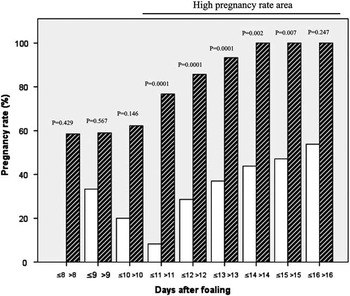
The foal heat pregnancy rate at day 14 was 57.1%. This value was lower than PR14 obtained in group C (80.6%). However, the tFE seemed to affect significantly the probability of the jenny becoming pregnant. The Fisher’s exact test showed that the PR14 was significantly increased in the jennies in which the tFE was >5 days, reaching values similar to those obtained in group C in jennies with tFE>7 days (Figure 1). Similarly, the pregnancy rate at day 14 seemed to be significantly higher in the jennies in which ovulation occurred 12 days or more after foaling (Figure 2).
Bar graph of the pregnancy rate at day 14 after ovulation in 42 Martina Franca jennies inseminated at foal heat on the basis of the time between foaling and foaling heat onset (expressed in days). P value was calculated on the basis of the Fisher’s exact test.

Bar graph of the pregnancy rate at day 14 after ovulation in 42 Martina Franca jennies inseminated at foal heat on the basis of the time between foaling and ovulation (expressed in days). P value was calculated on the basis of the Fisher’s exact test.

The occurrence of twin pregnancies was 14.3% (6/42), all in group F jennies, and the treatment was effective in all cases, as no twin pregnancy was confirmed at day 45. In one case in group F, a jenny with single pregnancy was not confirmed at day 45 (2.38%), and in this case the tFE and tFOV were 6 and 11 days, respectively.
The FR in group C was similar (100%) to that of group F (95.8%), as well as the PL (365.1±7.3 days in group C and 362.9±10.8 days in group F, respectively).
Discussion
Data from this study confirmed that in the jenny as well as in the mare, the foal heat occurred early and showed, for most aspects, the same features of normal cyclic jennies heat. The estrus length, the daily growth of the follicle and the preovulatory diameter of the follicle were comparable with those recorded in normal cycling jennies, managed in a similar manner, and were in agreement with those previously reported (42.9 mm) in the literature (Carluccio et al., Reference Carluccio, Gloria, Veronesi, De Amicis, Noto and Contri2007).
The data reported in this study showed an overall lower pregnancy rate when jennies were inseminated at the time of foal heat compared with jennies inseminated during non-postpartum heat (57.1% and 82.3%, respectively). This finding was in agreement with previous studies of the mare, in which the pregnancy rate at foal heat was reduced by about 20% (Loy, Reference Loy1980; Blanchard et al., Reference Blanchard, Thompson, Brinsko, Stich, Wendt, Varner and Rigby2006). Conversely, a study reported similar pregnancy rates in mares inseminated at the foal heat and during non-postpartum heat (Blanchard et al., Reference Blanchard, Taylor and Love2004). In our study, the pregnancy rate resulting from AI during foal heat seemed to be significantly affected by the duration of time between parturition and both the foal heat onset (tFE) and ovulation (tFOV). In donkeys, a higher likelihood of occurrence of pregnancy was possible when the foal heat occurred 8 or more days after parturition. Similarly, a significantly higher probability of pregnancy was found when ovulation occurred 12 days or more after foaling. These findings were in agreement with those reported for the mare (Loy, Reference Loy1980), in which the pregnancy rate increased if ovulation occurred later than day 10 after foaling. In the horse, after fertilization, the embryo remains for 5 to 6 days within the oviduct (Hinrichs and Riera, Reference Hinrichs and Riera1990), and enters into the uterus 144 to 168 h after ovulation (Battut et al., Reference Battut, Colchen, Fieni, Tainturier and Bruyas1997). At this point (15 to 16 days after foaling), the uterus seems to have an adequate degree of involution (Gygax et al., Reference Gygax, Ganjam and Kenney1979; Jischa et al., Reference Jischa, Walter, Nowotny, Palm, Budik, Kolodziejek and Aurich2008). Although no data on the timing of the histological involution of postpartum jennies have been reported in literature, it may be likely that a comparable mechanism is also present in postpartum donkey. This hypothesis was corroborated by the reduction of the uterine size recorded in this study. In most jennies, the recovery of the normal diameter of the uterus was detectable within 21 days, and was in agreement with data previously reported in the donkey, in which the mean time for complete involution was 22.5±1.7 days. Furthermore, a significant increase in the time required for a complete involution in jennies in which foal heat occurred earlier than day 9 postpartum (25±1 and 20±1 days, respectively) was reported (Dadarwal et al., Reference Dadarwal, Tandon, Purohit and Pareek2004).
The single pregnancy loss observed in the jennies inseminated at foal heat was very low when compared with data reported in the mare (2.4% v. 12.4% pregnancy lost between day 15 and 35) (Morris and Allen, Reference Morris and Allen2002). In the foal heat jennies a higher incidence of double ovulations (21.4%) was observed, about twofold as compared with that reported in the Thoroughbred mare (12%) during foal heat (Morris and Allen, Reference Morris and Allen2002). Thus, a higher number of jennies with twins (14.3%) as compared with foal heat Thoroughbred mares (Morris and Allen, Reference Morris and Allen2002) was observed. Manual crushing of the small twin embryo vesicle was reported as a safe procedure to correct the twin pregnancy in the mare, with a survival rate for the remaining twin exceeding 90% (Pascoe et al., Reference Pascoe, Pascoe, Hughes, Stabenfeldt and Kindahl1987; Morris and Allen, Reference Morris and Allen2002). The results of this study confirmed these data in the jenny.
The PL recorded in jennies that became pregnant at foal heat was similar to that reported in non-pregnant jennies managed in the same experimental conditions, and were comparable with those reported for this donkey breed (Carluccio et al., Reference Carluccio, Panzani, Tosi, Faustini, De Amicis and Veronesi2015).
In conclusion, the foal heat of the jenny could be used successfully for reproductive management in order to reduce the interdelivery interval, and to increase both milk production and foaling per year rate. On the other hand, the data reported here show that the pregnancy rate increased significantly when the onset of foal heat occurred 8 days or more after foaling, or when ovulation occurred 12 days or more after foaling. Thus, these parameters should be considered as criteria for the successful use of foal heat in this species, and when the foal estrus occur within 8 days after the foaling, the recommendation is to avoid insemination or mating during foal heat and to shorten pharmacologically the following diestrus.
Acknowledgments
This research was part of the research project 150 19/11/09 nr. 3483, funded by the Assessorato alle Politiche Agricole, Regione Puglia (Italy). The authors are grateful to Senator Dario Stefano, Dr Filippo Nico and Dr Silvio Schito (Assessorato alle Politiche Agricole, Regione Puglia, Italy), and to Dr Pasquale Solazzo (head of the Istituto Incremento Ippico di Foggia, Italy) for their support. In this study, the authors would like to honor the memory of Dr Rosario Mancuso, who supported this paper through his practical skills.