It is commonplace to expect that increasing inflows of immigrants can pose new challenges for both the supply of welfare services and citizens’ support of welfare policies. In an influential study, Alesina and Glaeser (Reference Alesina and La Ferrara2004) compare redistribution patterns in Europe and the United States and focus on racial heterogeneity as a key explanatory factor for significant differences in the redistributive role of the state on both sides of the Atlantic. They specifically argue that “if Europe becomes more heterogeneous due to immigration, ethnic divisions will be used to challenge the generous welfare state” (Alesina and Glaeser Reference Alesina and La Ferrara2004, 11).Footnote 1
Which mechanisms explain the negative effect of immigration on native support for welfare states, and can certain institutional characteristics of social policies mitigate or exacerbate this effect? While there seems to be a general consensus that immigration and support for redistribution tend to be negatively correlated (Alesina, Glaeser and Sacerdote Reference Alesina, Glaeser and Sacerdote2001; Luttmer Reference Luttmer2001; Lind Reference Lind2007; Dahlberg, Edmark and Lundqvist Reference Dahlberg, Edmark and Lundqvist2012), the specific causal mechanism behind this relationship is far from being settled. Moreover, an emerging body of literature points to a number of demographic, economic, and political factors moderating the relationship between immigration and support for social policy (Soroka et al. Reference Soroka, Johnston and Banting2004; Crepaz Reference Crepaz2006; van Oorschot 2006; Crepaz Reference Crepaz2008; Finseraas Reference Finseraas2008; Larsen Reference Larsen2008; Crepaz and Damron Reference Crepaz and Damron2009; Mau and Burkhardt Reference Mau and Burkhardt2009; Eger Reference Eger2010). This literature, however, has obtained conflicting results claiming both high and low effects of institutions. Moreover, the validity of previous studies mainly based on observational data has been challenged by a potentially endogenous relationship between attitudes and institutional settings.
In this paper, we argue for a policy heterogeneity approach and expect means-tested social policies to exacerbate the negative impact of immigration on support for social policy. On the basis of the distinction between self-regarding and other-regarding preferences for redistribution (Cavaillé and Trump Reference Cavaillé and Trump2015), we hypothesize that the importance of the latter can increase in policy settings targeting resources to recipients that are less representative of the population. While in universal programs all social groups benefit equally from transfers, the identity of the recipient becomes a more relevant trait when deciding to support means-tested policies that benefit some social groups and not others.
Our analytical strategy consists of manipulating the universal versus means-tested design of specific social policies in a survey experimental setting. We focus on the United Kingdom and on child benefit policies. The United Kingdom provides a research setting in which Welfare State retrenching has been thoroughly discussed for many years, and the debate is increasingly connected to the issue of immigration. Therefore, our experimental design is realistic in the British context, and our treatments are able to trigger meaningful reactions. Our experimental design presents respondents with four randomly assigned treatment conditions, in which immigration is either primed or not, and the child benefit policy is either universal or means-tested.
Our contribution is threefold. First, from a theoretical perspective, our policy heterogeneity approach sheds some light on one of the most important puzzles in the comparative political economy literature, namely why individuals do not always support redistribution according to their economic interests (Meltzer and Richard Reference Meltzer and Richard1981; Pontusson and Rueda Reference Pontusson and Rueda2010; Cavaillé and Trump Reference Cavaillé and Trump2015; Rueda and Stegmueller Reference Rueda and Stegmueller2016). Our findings confirm that the presence of immigration may overshadow economic considerations, but reveal that the magnitude of this effect is highly conditional on the exogenous design of policies as universal or means-tested. More importantly, means-tested programs are significantly more popular than universal programs when immigrants are not primed as beneficiaries, but are equally popular when immigrants are primed. This implies that, contrary to common wisdom, means-testing does not make social benefits more vulnerable to cut-backs in a context of welfare state retrenchment. Our results are also at odds with the interpretation that high levels of education and progressive cultural values insulate individuals from anti-immigrant reactions in any case (Hainmueller and Hiscox Reference Hainmueller and Hiscox2007; Sniderman and Hagendoorn Reference Sniderman and Hagendoorn2007). Our results rather suggest that the ethnic identity of welfare recipients and deservingness beliefs partially drive support for redistribution, and that this effect is observable across the whole socio-economic spectrum.
Second, our experimental evidence has policy-relevant conclusions regarding the support for social policies in increasingly diverse European societies. While the tendency in austerity times is to re-frame social policy programs as means-tested in order to cut down social expenditure, this kind of policies are more prone to exacerbate ethnic divisions. This finding is consistent with previous research highlighting the risk of affirmative action or highly targeted policies that unintentionally increase the stigma of ethnic welfare recipients (Manza and Brooks Reference Manza and Brooks1999, 161; Larsen Reference Larsen2008; Crepaz and Damron Reference Crepaz and Damron2009).
Third, at the methodological level, our experimental design is relatively new in this literature and tries to overcome possible heterogeneity and endogeneity biases when trying to identify the relationship between institutions and attitudes.
THE STATE OF THE ART
Robust empirical evidence links immigration with a lower provision of public goods (Alesina, Baqir and Easterly Reference Alesina and Glaeser1999; Alesina and La Ferrara Reference Alesina, Baqir and Easterly2005). This relationship has been described as one of “the most powerful hypotheses in political economy” (Banerjee, Iyer and Somanathan Reference Banerjee, Iyer and Somanathan2005, 639). In the United States, it has been found that living in racially homogeneous neighborhoods increases support for social spending (Luttmer Reference Luttmer2001). Similar findings have been obtained in cross-national comparative studies (Banting and Kymlicka Reference Banting2006; Crepaz Reference Crepaz2006; Senik, Stichnoth and Van der Straeten Reference Senik, Stichnoth and Van der Straeten2008), Germany (Stichnoth Reference Stichnoth2012), Sweden (Dahlberg, Edmark and Lundqvist Reference Dahlberg, Edmark and Lundqvist2012), Spain (Jofre-Monseny, Sorribas-Navarro and Vázquez-Grenno Reference Jofre-Monseny, Sorribas-Navarro and Vázquez-Grenno2016), and the United Kingdom (Ford Reference Ford2006). Most of the literature is based on aggregate-level comparisons, and uses social expenditures as a share of gross domestic product (or analogous indicators) as the dependent variable and some “objective” measure of immigration as the independent variable (Ribar and Wilhelm Reference Ribar and Wilhelm1999; Fearon Reference Fearon2003; Alesina and Glaeser Reference Alesina and La Ferrara2004). This aggregate-level line of research coexists with an individual-level one, which uses anti-immigrant attitudes as a predictor of attitudes toward redistribution or the role of the government in reducing income inequality (Gilens Reference Gilens1995; Gilens Reference Gilens1996; Gilens Reference Gilens1999; Alesina, Glaeser and Sacerdote Reference Alesina, Glaeser and Sacerdote2001; Lind Reference Lind2007; Schmidt and Spies Reference Schmidt and Spies2014).
The apparent robustness of the relationship between immigration and support for redistribution, however, has been recently challenged by comparative and case study research failing to replicate the link (Soroka et al. Reference Soroka, Johnston and Banting2004; Banting Reference Banting and Kymlicka2005; Evans Reference Evans2006; Baldwin and Huber Reference Baldwin and Huber2010; Gerdes Reference Gerdes2011). An emerging strand of literature tries to reconcile these inconsistencies by pointing out to nuanced heterogeneous effects, or to powerful omitted alternative explanations. There is evidence that the link between anti-immigrant sentiment and support for redistribution varies across levels of foreign-born population, multicultural policies, economic attitudes and conditions, political strategy, public policy preferences, and demographic changes among other factors (Fellowes and Rowe Reference Fellowes and Rowe2004; Soroka et al. Reference Soroka, Johnston and Banting2004; Crepaz Reference Crepaz2006; Finseraas Reference Finseraas2008; Senik, Stichnoth and Van der Straeten Reference Senik, Stichnoth and Van der Straeten2008; Hopkins Reference Hopkins2009; Mau and Burkhardt Reference Mau and Burkhardt2009; Eger Reference Eger2010; Rugh and Trounstine Reference Rugh and Trounstine2011; Lieberman and McClendon Reference Lieberman and McClendon2013).
Among the different possible factors moderating the relationship between ethnic considerations and support for redistribution, the type of welfare regime and institutional setting are two of the newest, most promising, yet contested factors proposed in the literature. Beyond the scientific value of this line of research, understanding the specific policy framing that exacerbates public rejection for redistribution on ethnic grounds has obvious practical implications for policy making. Some authors have hypothesized that liberal welfare regimes tend to stigmatize people in need of social aid, as well as direct hostility to receivers (Larsen Reference Larsen2008; Crepaz and Damron Reference Crepaz and Damron2009). However, as Schmidt and Spies point out, “empirical support for a welfare regime effect is rather mixed” (Reference Schmidt and Spies2014, 7). For instance, when comparing social-democratic and liberal regimes, Larsen (Reference Larsen2011) finds that Danes and Swedes are as likely as British and US citizens to characterize out-group members as lazy. Conversely, Eger (Reference Eger2010) finds a general negative correlation between immigration and social expenditure at the subnational level, even in paradigmatic social-democratic cases such as Sweden. This finding is consistent with van Oorschot (Reference Tavits and Potter2006), who argues that patterns of inter-ethnic solidarity are generalizable to all European countries. Finseraas (Reference Finseraas2008) has even proposed that social-democratic regimes are precisely those that promote stronger feelings of welfare chauvinism.
The disparity of results regarding the conditioning impact of welfare regimes and institutions described in this section is puzzling. In this study, we extend the current state of the topic by addressing two important caveats: the heterogeneity of welfare regime classifications and the endogeneity between attitudes and institutional settings. As for the problem of heterogeneity, the different categories in welfare regime classifications usually include few and heterogeneous countries. It is likely that such a broad level of aggregation produces unstable findings, especially when considering that different welfare regimes can prime different specific types of social policy (e.g., health, unemployment, and retirement) and that each social policy can be framed within a more-or-less universalistic logic within a single country. Hence, we depart from a welfare regime-level of analysis to instead focus on a policy framing approach. Under the assumption that a single type of welfare regime can prime different aspects of social policy, we are interested in the impact of the universal versus means-tested character of the policy, while keeping all the other possible individual and policy-related confounders constant.
As for the problem of endogeneity, it is reasonable to think that institutional settings and preferences in public opinion reinforce each other, or that unobserved factors can at once drive both institutions and preferences. This concern is particularly plausible given that ethnic identities and considerations have proved to be fluid and endogenous to political processes (Chandra Reference Chandra2001; Posner Reference Posner2005) and that institutional arrangements interact with ethnic preferences when explaining certain political outcomes (Cho Reference Cho2010).
THEORETICAL MECHANISMS
Other-Regarding Considerations and Means-Tested Policies
Economic self-interest is at the core of a canonical model of redistribution initially proposed by Romer (Reference Romer1975) and further developed by Meltzer and Richard (Reference Meltzer and Richard1981). This model essentially predicts that preferences for redistribution are a function of increasing economic inequality. When the median falls significantly below the mean in the income distribution of a given country, aggregate level of redistribution demand should increase. The micro-level expectation is that lower-income individuals will generally support redistribution because they tend to benefit more from it (Lindert Reference Lindert1996; Moene and Wallerstein Reference Moene and Wallerstein2001).
Despite the intuitive logic of models based on self-interest, pure economic calculations have received mixed support in previous research on attitudes toward redistribution (Lindert Reference Lindert1996) and inter-ethnic relations (Sniderman and Hagendoorn Reference Sniderman and Hagendoorn2007). In order to resolve this contradiction, Cavaillé and Trump (Reference Cavaillé and Trump2015) offer a compelling twofold conceptualization of demands for redistribution that is central to our argument. Instead of assuming a unidimensional continuum from more to less redistribution, Cavaillé and Trump consistently identify two constructs that have been conflated in previous research: self-regarding preferences that are a consequence of material self-interested considerations of the kind outlined above, and other-regarding preferences focusing on the identity or deservingness of welfare beneficiaries. While the former type of preference is conceived as taking resources from a given group (generally the rich), the latter is focused on giving resources to another group (generally the poor).
Building upon the distinction between self-regarding and other-regarding preferences, we expect that support for redistribution will decrease when immigrants are perceived to be welfare beneficiaries and independently of self-interested considerations among the majority group. This expectation is rooted in social identity theory (Tajfel Reference Tajfel1981). The social identity argument is based upon the assumption that citizens with strong attachments to the in-group tend to articulate more negative attitudes toward out-groups, and to follow some sort of ethnic favoritism when redistributing resources. Identity arguments have also been linked to mechanisms based on trust and reciprocity (Putnam Reference Putnam2007; Habyarimana, Humphreys and Posner Reference Habyarimana, Humphreys and Posner2009). The identity mechanism is also interpreted as a mechanism of cultural or social similarity, and has proved to be an important explanation to why self-interest is not consistently related to redistribution preferences (Shayo Reference Shayo2009; Lupu and Pontusson Reference Lupu and Pontusson2011). Our first hypothesis summarizes the expected effect of immigration and its link to cultural and identity considerations:Footnote 2
Hypothesis 1 (Other-regarding hypothesis): Priming immigrants as the main beneficiaries of redistribution decreases support for social policy (a), and the effect is driven by other-regarding considerations, such as cultural prejudice against immigration and deservingness beliefs (b).
Our main contribution is that self-regarding or other-regarding considerations are exogenously affected by different policy settings. This implies that both types of considerations are available for a single person, and that top-down influences originating in policy making or elite cueing are able to prime one over another in ways that are not always consistent with individual self-interest. More specifically, we expect the effect summarized in Hypothesis 1 to be stronger in means-tested than in universal policy settings. In universal policies everyone benefits from a given social policy. Since the pool of beneficiaries is representative of the population, other-regarding considerations should be less consequential. By contrast, means-tested policies target resources to some groups and not others. Therefore, the identity and deservingness of beneficiary groups should become a more relevant trait when deciding to support or not a given social policy. Consistently with previous research, when minority ethnic groups are perceived to be disproportionally poor, majority support for redistribution should decrease (Alesina and Glaeser Reference Alesina and La Ferrara2004). This leads to our second hypothesis:
Hypothesis 2 (Policy Setting hypothesis): Means-tested (as opposed to universal) policy settings exacerbate the negative effect of immigration on support for social policy (a), and this is due to a stronger effect of other-regarding considerations (b).
Policy Effects Across Levels of Education and Socio-Economic Status
Our first two hypotheses summarize the expected average effects of immigration and policy framings on support for redistribution. However, there are reasons to expect some heterogeneity across levels of education and social status, which could unpack some of the mechanisms behind the policy effects described above. There are two main competing expectations that are described below.
First, a recent strand of the literature has argued that other-regarding considerations have an income-dependent effect, and that they matter more for the rich (Dimick, Rueda and Stegmueller 2016). In this view, altruism is a luxury good that only the rich can afford. This is based upon the idea that tax and transfer considerations and material self-interest are expected to affect more the poor, whereas the rich should be more sensitive to other-regarding considerations.
On the basis of previous contributions and their own theory, Rueda and Stegmueller (Reference Rueda and Stegmueller2016, 474) argue that the relative importance of receiving benefits is greater for the poor than the relative importance of paying taxes for the rich. Similarly, in Dimick et al.’s (2016, 2) model, the decreasing marginal utility of consumption makes inequity aversion more consequential for the rich, who are more willing to give up an extra dollar of private consumption for altruistic reasons.
How does this interact with the immigration priming? In the Rueda and Stegmueller framework, we should expect higher status individuals to be more sensitive to the presence of immigrants among welfare recipients (see also Rueda Reference Rueda2014 for an explicit argument along these lines, and Dahlberg, Edmark and Lundqvist Reference Dahlberg, Edmark and Lundqvist2012 for evidence from Swedish municipalities). From this perspective, higher status individuals should be particularly more inclined to transfer resources to the members of the in-group who are more in need, and less inclined to do so if the needy are members of the out-group. Identity and group cueing mechanisms are compatible with more rational versions of altruism. From this perspective, mutual regard and expectations of reciprocity are crucial to agree with some sort of redistribution (Collier Reference Collier2013, 62). The hypothesis of rational or empathic altruistic behavior toward culturally close members has received some empirical validation in laboratory experiments (Fehr and Gächter Reference Fehr and Gachter2000; Charness and Rabin Reference Charness and Rabin2002).
Second, however, the idea of altruism as a luxury good is not fully compatible with a more conventional view treating cultural factors as diverting the poor from their “true” redistributive preferences (Alesina and Glaeser Reference Alesina and La Ferrara2004; Finseraas Reference Finseraas2009; Tavits and Potter Reference Tavits and Potter2015). According to this view, immigration priming should make other-regarding considerations more salient also for low-income individuals, given that it reduces the self-interested reasons to support the policy. This line of reasoning is equally consistent with the expectation of means-tested policies activating other-regarding considerations outlined above, but it expects the effect to be observed also among lower status individuals. From this perspective, citizens with fewer resources should rely on self-interest when immigration is not considered, but should react much more to the presence of out-group welfare recipients when immigration is primed, and especially in policy settings that activate other-regarding considerations.
The two previous theoretical rationales lead to two alternative expectations, namely that our policy effects should be mainly driven by the rich or by the poor. We are agnostic at this point about which of the two following hypotheses should prevail, or whether they are actually complementary.
Hypothesis 3a Immigration priming is more consequential for high-status individuals’ support for social policy, given that they rely more on other-regarding considerations, and this should be especially so in means-tested schemes that underline the identity of recipients.
Hypothesis 3b Immigration priming is more consequential for low-status individuals’ support for social policy, given that it makes other-regarding considerations salient for them as well, and this should be especially so in means-tested schemes that underline the identity of recipients.
EXPERIMENTAL DESIGN
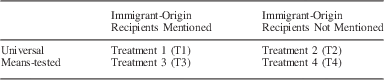
To test our hypotheses, we use an experimental research design that presents a hypothetical yet realistic case of social policy to a sample of respondents. Respondents were randomly divided into four groups, across which we vary two relevant characteristics: on the one hand, the explicit mention of the presence of immigrants among the recipients or not, and on the other, the universal versus means-tested design. As such, our design is based on 2×2 experimental conditions, as shown in Table 1.
Experimental Conditions

This design allows us to overcome the aforementioned problems of cross-country and cross-program comparisons. The random assignment and precision in the experimental manipulations allow us to control potential confounding factors. Additionally, the experimental design is useful in avoiding problems of social desirability that arise in survey research on immigration-related issues (Mutz Reference Mutz2011).
In short, the primary treatment consists of mentioning the growing presence of immigrants among recipients. By alerting respondents to this specific dimension of the policy, however, we do not aim to modify the evaluation of the dimension but its salience in the formation of the respondent’s attitude. As a result, our treatment conveys neither positive nor negative information regarding the immigrant group or their relation to the policy but aims to make respondents more aware of an immigrant presence among recipients. By just manipulating salience, we can reasonably approach the actual effect of the presence and visibility of immigration among recipients.
To test our hypotheses, we selected a specific policy—namely, child benefits—for which both universal and means-tested framings of the policy were realistic and easily conceivable. Child benefits policy is particularly credible in the context analyzed in this study, given its place in public debate. In the United Kingdom, child benefits were granted to every family with a child less than 16 years old, with higher payments (£20.30 per week) for the oldest child and £13.40 per week for each subsequent child.Footnote 3 While this policy had been universal since its establishment under the Family Allowances Act in 1945, in January 2013 the Liberal–Conservative coalition government passed an amendment that introduced an upper income limit (£50,000 individual earnings) to eligibility criteria that was implemented through a high income tax charge. This decision, which came with some controversy, highlights the relevance of analyzing the implications of changing welfare policies from universal to means-tested, since doing so might weaken the support they gather and threaten their long-term viability. Our experiment was fielded shortly after this policy change. Both the timing of the experiment and the wording of the vignettes were compatible with a scenario where the policy was about to change, but also with a scenario where the policy had just changed. Moreover, our aim is to assess the magnitude of the gap in social policy support caused by the immigration condition within each policy setting. The randomization of our treatments ensures that any possible informational bias related to the design of the policy is the same across our immigration and non-immigration conditions. In order to frame the vignettes within a realistic setting, and elicit answers that take into account budget restrictions, the wording incorporated a reference to the context of economic crisis and public spending cuts. Therefore, our results shall be informative about policy effects in a context of retrenchment, increasing immigration inflows, and politicization of welfare state and immigration issues.
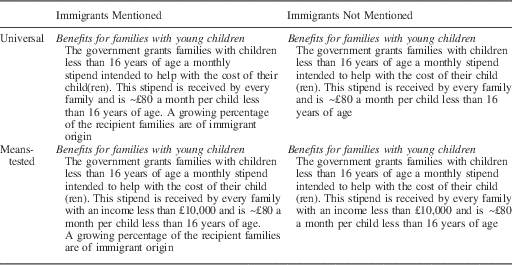
Our experiment was administered via an online survey to a sample of 3600 British respondents and collected by YouGov among panel members that ensure proportionality regarding some key demographics.Footnote 4 Respondents were randomly assigned to each treatment condition and presented with the four vignettes (Table 2).Footnote 5
Vignette Design

After being exposed to the vignette, respondents were asked to answer the following question:
In the current context of crisis, the government is sharply reducing its spending in several areas. Regarding these benefits for families with children less than 16 years of age, you personally consider that:
1. These benefits should be removed, and the resources should be devoted to other issues.
2. These benefits should be reduced, and part of the resources should be devoted to other issues.
3. These benefits should be maintained.
4. These benefits should be expanded with resources currently devoted to other issues.
The wording of the question sought to overcome the social desirability effect attached to a popular policy, such as family support, by making explicit reference to both the current context of generalized spending cuts and the implicit trade-off of each option regarding other areas of spending. This design also allowed us to overcome some endemic problems of measurement that hamper the validity of results in the literature. The majority of previous studies use variation in actual heterogeneity as the independent variable, though they are more divided on using either actual social spending or support for the welfare state as their dependent variables. As Ford (Reference Ford2006) argues, the use of actual spending as the outcome variable, although relevant, might lead to misleading conclusions on the effect of immigration and heterogeneity on individual attitudes, since a lag or incongruence between public opinion and policy shifts might exist.
In order to test our hypotheses, we rely on measures of deservingness beliefs and cultural prejudice. While we do not claim to be capturing the full range of possible other-regarding considerations with these two indicators, both are well-known measures of identity considerations concerning welfare recipients. The former is captured by a 0–10 scale of agreement with the following statement: “Benefits claimants do not work hard enough.” To measure prejudice we asked respondents “Generally speaking what impact, if any, has immigration had on the UK’s culture?,” and offered them a 0–10 scale with three labeled options: Very harmful to UK culture (0), No effect (5), and Very beneficial to UK culture (10). Responses have been recoded to range from less to more prejudice.
Finally, we also make use of the measures of socio-economic status provided by Yougov: the education variable that identifies those respondents with no formal qualifications, those with GCSE, A-Level and with a university degree. Class is measured by the National Readership Survey classification in the United Kingdom: AB (upper-middle and middle class), C1 (lower-middle class), C2 (skilled working class), and D (working class).
ANALYSIS
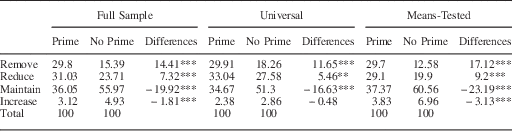
Table 3 shows the main results of the experiment, which concern the main effect of immigration and policy setup. The first finding is that explicit mention to immigrants clearly reduced the respondent’s probability of supporting the policy (Hypothesis 1a), and strengthened the willingness to suppress or reduce the policy in both cases. Differences are, in all cases, strong and statistically significant at conventional levels (p<0.01).
Results of the Experiment (Column Percentages)

Note: *p<0.10, **p<0.05, ***p<0.01.
Results show substantial differences in response patterns when immigrants were mentioned in the treatment vignettes. When primed about immigration, nearly twice as many respondents preferred that child benefits were removed. Significant differences also appeared in the other categories; less respondents wanted to maintain (−20 percent) or increase (−2 percent) child benefits under the immigration priming condition.
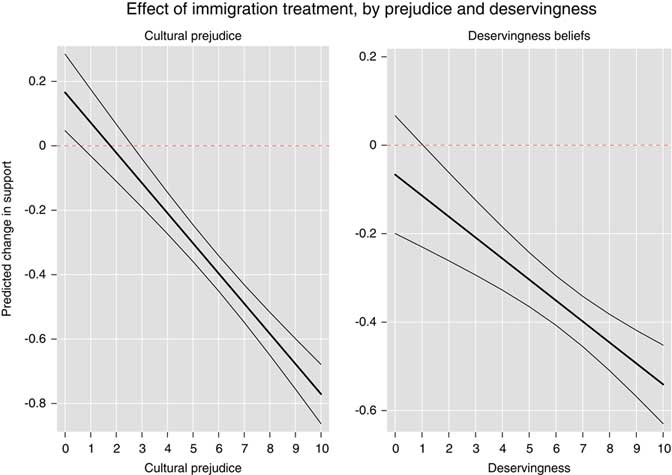
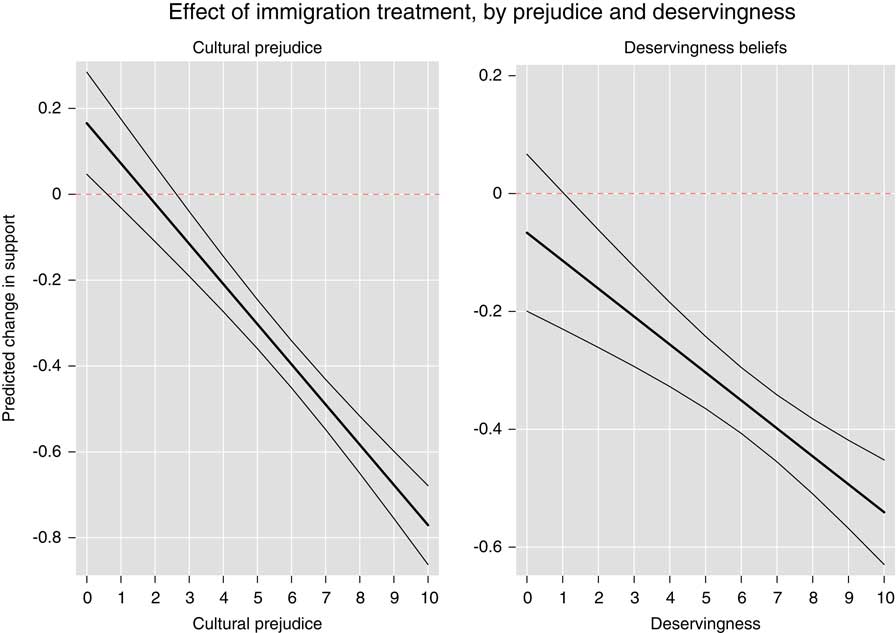
Hypothesis 1b argued that the negative immigration effect would be driven mostly by cultural prejudice and deservingness beliefs. Figure 1 displays the effects of immigration priming across levels of cultural prejudice and deservingness beliefs. The effects are calculated through an ordinary least squares (OLS) regression with the support scale as a dependent variable and immigration priming, cultural prejudice and their interaction as predictors (full tables in the Online Appendix). The conditional effect is strong and clear. Among those with lower levels of cultural prejudice the immigration priming has no effect or, even, increases support for social policy. However, among respondents with moderate to high levels of cultural prejudice, the effect of immigration on support for social policy is negative and increasing, reaching a maximum of −0.8 (in a four-point scale). A very similar story emerges when we use deservingness beliefs as a moderator. For those respondents that believe that welfare recipients work hard enough, the immigration treatment does not have a statistically significant effect, but it clearly reduced support for child policies among those that think otherwise.
Effect of immigration treatment, by prejudice and deservingness
Having clearly documented the negative immigration effect on support for social policy, and the moderating effect of cultural prejudice and deservingness beliefs, we now turn to our second hypothesis. Our main argument (summarized in Hypothesis 2a) anticipated that the “immigration effect” would not be constant across types of policy. In Table 3 we show the full results of the experiment that disaggregate the four treatment conditions. As evident from the distribution of percentages, differences were not constant across both types of policy. These results reveal that, while priming respondents about immigrant recipients depressed support for the policy in every case, the differences were sharper in means-tested conditions. If we add the absolute differences between the immigration priming and non-priming conditions across the four responses, those in the means-tested conditions are 1.5 times higher than the universal ones: they add up to 52.64, while in the universal condition the sum of the absolute differences is 34.22.
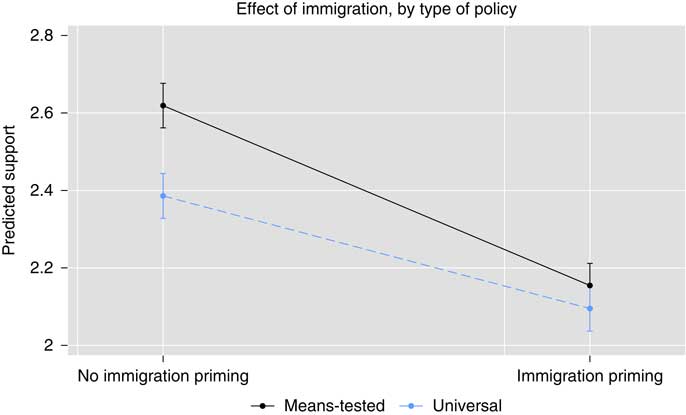
For a clearer portrait of the differential effects, we can represent the average support across conditions in a response scale ranging from 1 to 4. Figure 2 points quite clearly to the fact that support for child benefits, when immigration is not primed, is significantly higher for means-tested than universal programs. At the same time, results also show how that there are no differences in support across policy setups when immigration is primed.
Effect of immigration, by type of policy
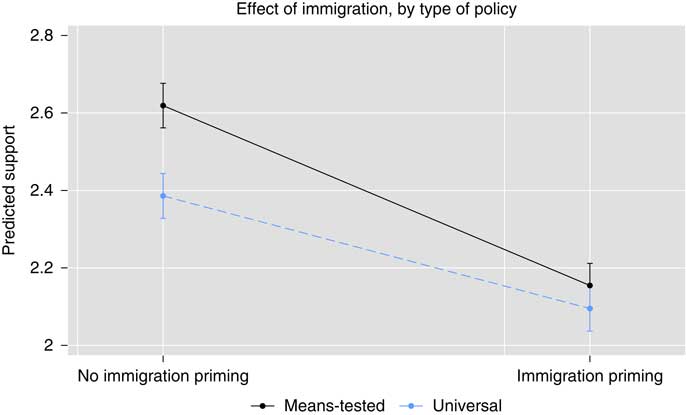
For a more direct test, we implemented an OLS model with the type of policy program, the presence of immigration, and the interaction between both as predictors (see Table A1 in the Online Appendix). The coefficient of the interaction ran in the expected direction and was statistically significant (p<0.01). We also directly assessed whether these differences reached conventional levels of statistical significance by comparing the marginal effects of the presence of immigration across the two policy conditions. Mentioning the presence of immigrants among recipients had a stronger marginal effect on the probability of supporting the program when means-tested (−0.46) than when universal (−0.46+0.17=−0.29).
Our results reveal a sort of “race to the bottom” in popular support for child benefits when immigration is mentioned. In the absence of immigrant priming, means-tested policies gather more support. However, when immigrants were mentioned in the treatment, both types of policy converged to approximately the same levels of support. Therefore, the immigration effect was stronger in the case of means-tested policies.
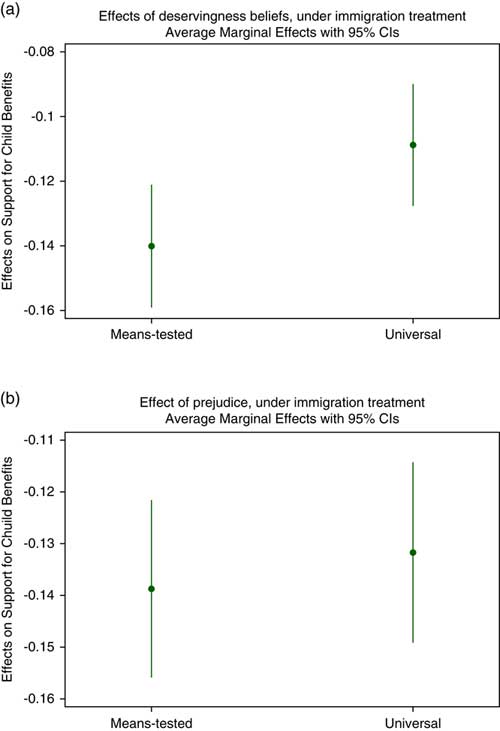
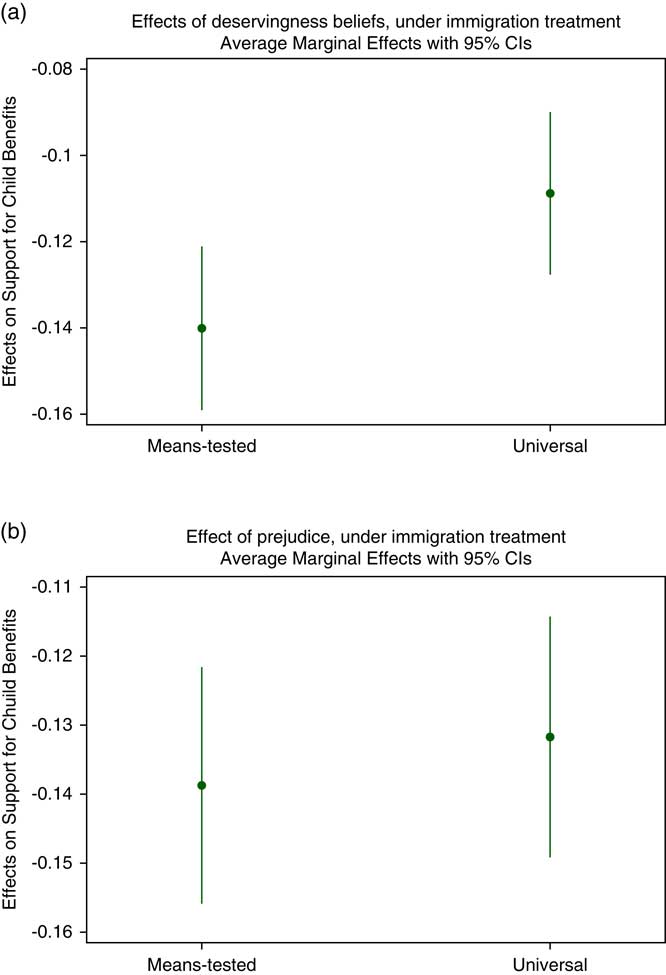
Hypothesis 2b relied on the idea that when immigration was primed, other-regarding considerations would be more consequential in the means-tested than in the universal condition. The empirical validity of this claim seems to be sensitive to the specific indicator used, as indicated by Figures 3(a) and 3(b). Those figures represent the marginal effect of deservingness beliefs and cultural prejudice on support for the child benefits, under the immigration treatment. While the effect of cultural prejudice is indistinguishable across policy types, we do find a significantly stronger effect of deservingness beliefs in the means-tested condition than in the universal one, among those respondents that received the immigration treatment.Footnote 6 This finding allows us to claim that some forms of other-regarding considerations can partially drive the policy effect that we find. However, it is also true that the differential reliance on other-regarding considerations across policy settings is smaller than anticipated, and might not be the only source of policy heterogeneity. It could also be that our indicators are not fully capturing the whole range of other-regarding considerations. More specifically, cultural prejudice may be a very encompassing predictor, not exclusively capturing other-regarding considerations. Overall, there is some support for the proposition that deservingness beliefs are partially driving the stronger effect of immigration in means-tested policies, but the results do not allow us to reject other types of considerations.
(a) Effects of deservingness beliefs, under immigration treatment (b) Effect of prejudice, under immigration treatment Note: CI=confidence interval
We now turn to Hypothesis 3. On the basis of the components outlined in that hypothesis, the analysis of possible heterogeneous effects across levels of socio-economic status follows different steps.
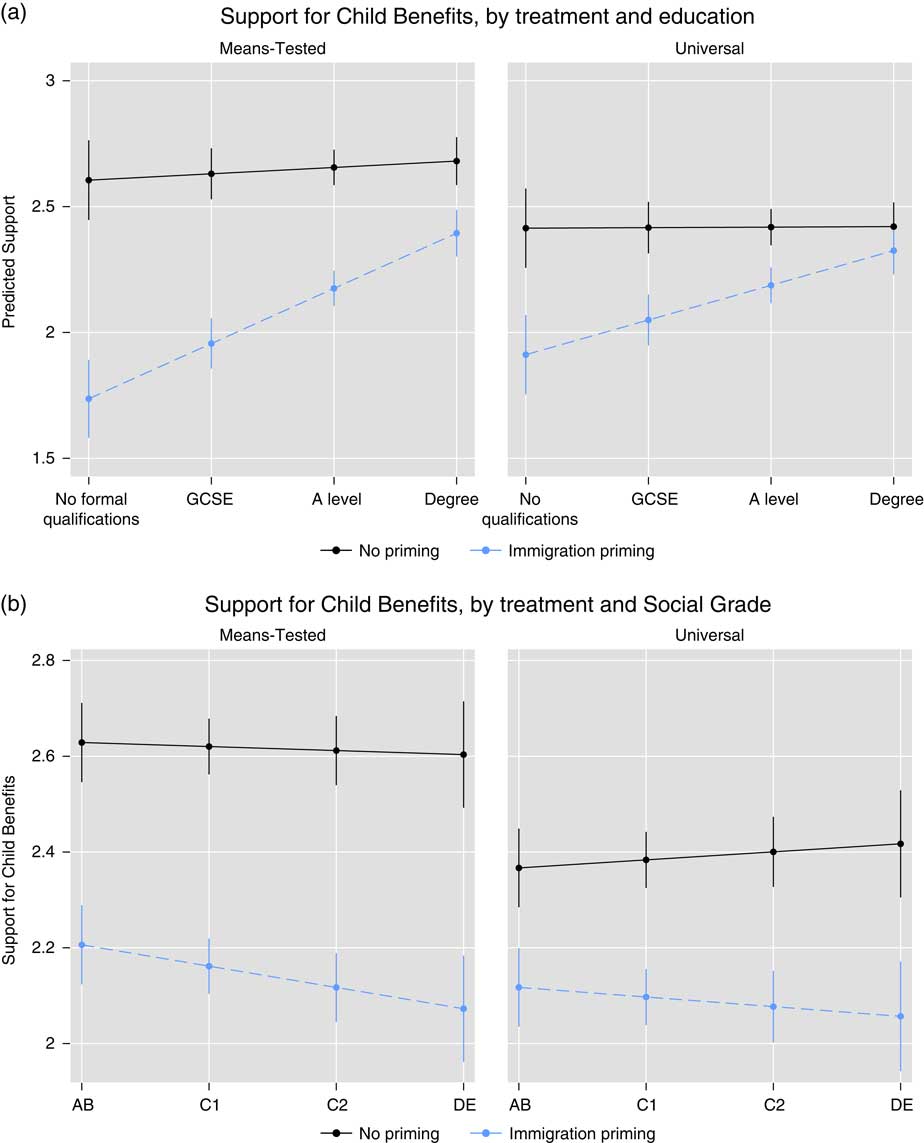
First, Figures 4(a) and 4(b) show that priming immigration matters for everyone but, if anything, is slightly more consequential in magnitude for low-status citizens. This pattern is clear when we look at educational groups (Figure 4(a)), and less so for social grade (Figure 4(b)), where there are no statistically significant differences of the immigration effect across groups. We therefore do not find evidence for the altruistic luxury good hypothesis (Hypothesis 3a) expecting only the rich to be more sensitive to immigrant recipients (Rueda Reference Rueda2014).
(a) Support for child benefits, by treatment and education (b) Support for child benefits, by treatment and social grade
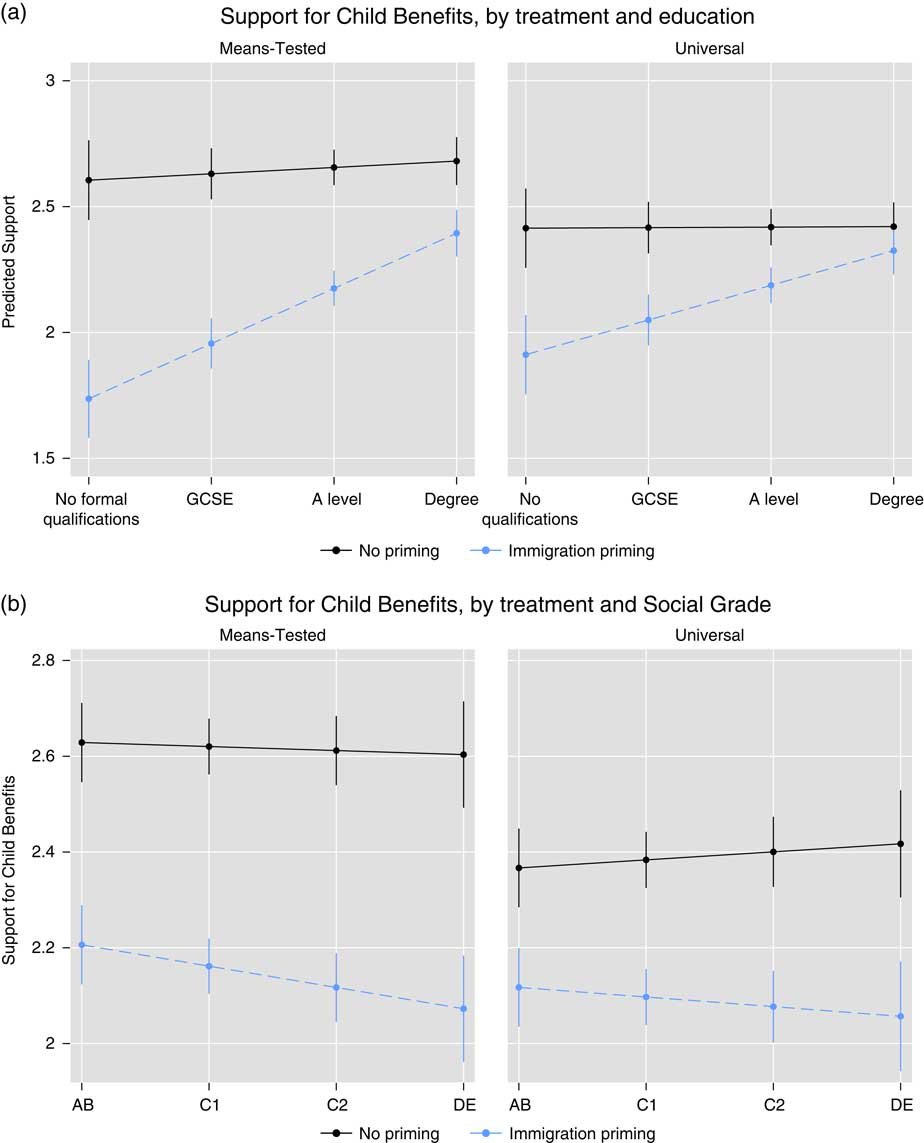
Moreover, in Figures 4(a) and 4(b) it can be seen that the immigration effect is larger in the means-tested condition, but that the interaction with education and social grade works in a very similar way across the two types of policy frames. Means-tested policies exacerbate the immigration effect across the board: their differential effect is constant across social groups.
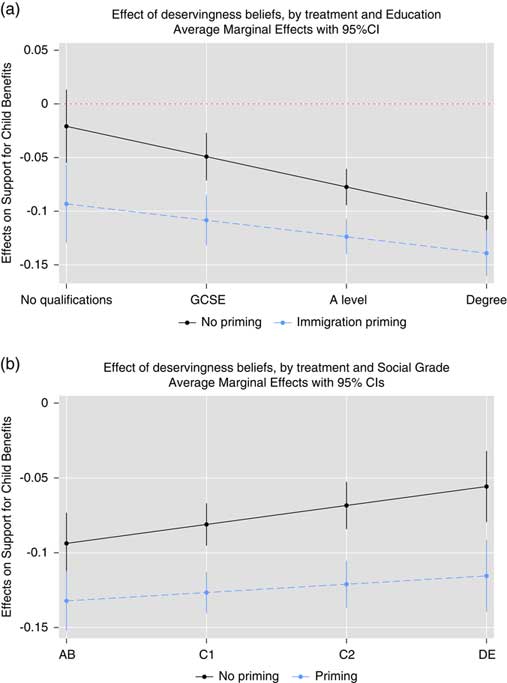
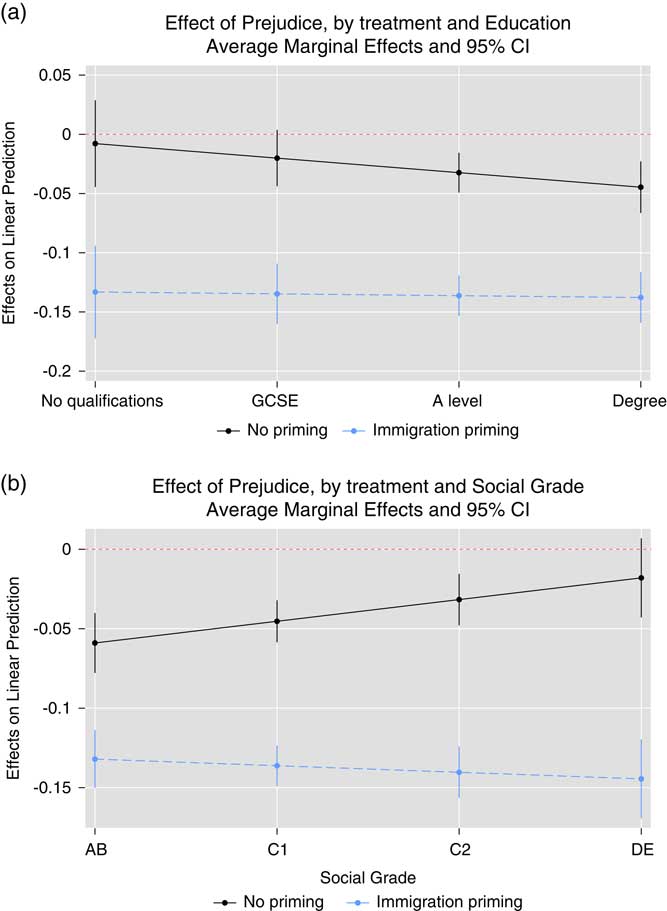
The rationale behind Hypotheses 3a and 3b is that immigration priming increases the effect of other-regarding considerations, and that this should operate distinctly across social groups. In Figures 5(a) and 5(b) we directly test this proposed mechanism, by comparing the marginal effect of deservingness beliefs under the immigration and non-immigration primings across social groups. The evidence is not conclusive: priming immigration makes deservingness beliefs more consequential for all groups. If any, the effect is smaller, and not statistically significant, for the highly educated and high-status respondents.
(a) Effect of deservingness beliefs, by treatment and education (b) Effect of deservingness beliefs, by treatment and social grade Note: CI=confidence interval
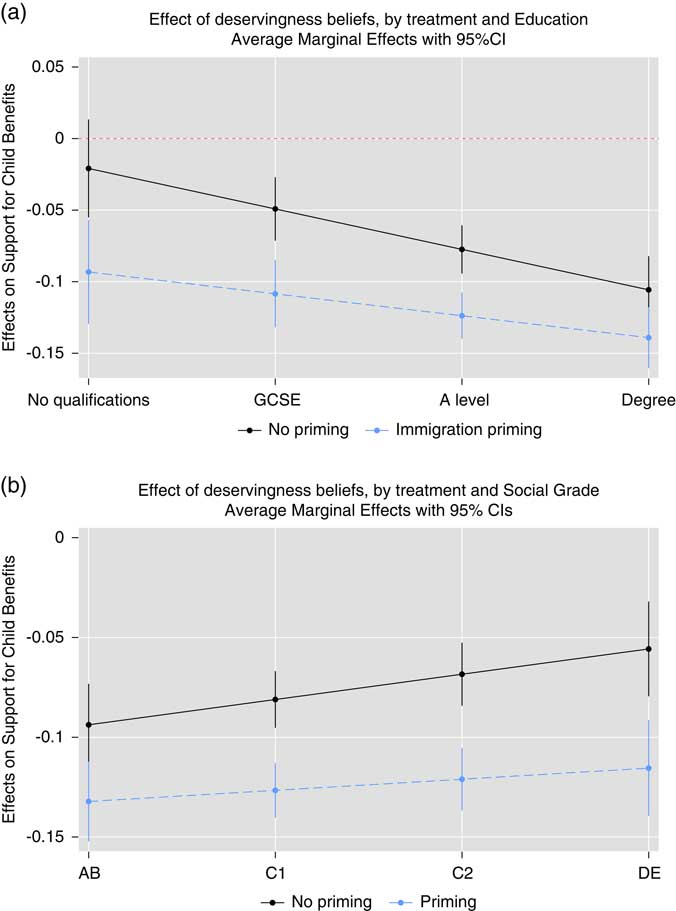
If instead of deservingness beliefs we use cultural prejudice (Figures 6(a) and 6(b)), we observe a similar pattern. Prejudice naturally matters more for welfare-related attitudes when immigration is primed, and the effect is strong and clear for all groups. It is only slightly stronger at lower levels of status, but the differences are not significant. Therefore, the expectation of a stronger reliance of other-regarding considerations when immigration is primed among low-status citizens is confirmed on the basis of deservingness beliefs, but not cultural prejudice.
(a) Effect of prejudice, by treatment and education (b) Effect of prejudice, by treatment and social grade Note: CI=confidence interval
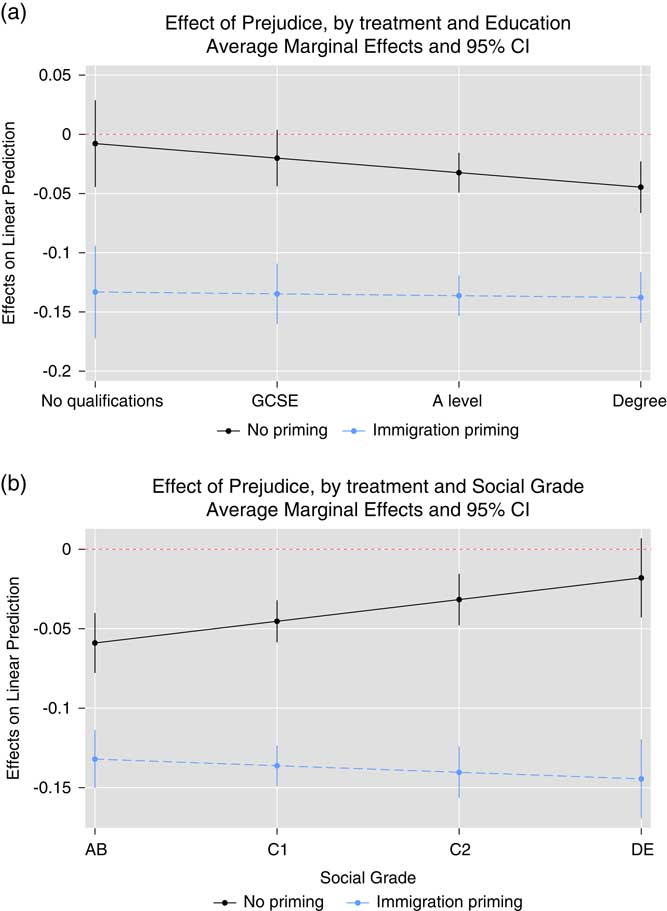
Overall, the detailed analysis of heterogeneous treatment effects cannot fully discern between Hypotheses 3a and 3b. We fail to identify a clear mechanism that makes immigration priming more consequential in means-tested policy frames for some educational and social groups and not others. The differences across social groups in how they react to the immigration priming are uniform across the two policy conditions. Therefore, our data do not allow us to establish that using means-tested as opposed to universal schemes makes any specific social group distinctively reactive to immigration.
CONCLUSIONS
The negative correlation between immigration and support for the welfare state has been considered by some as one of the strongest findings in contemporary political economy studies (Banerjee, Iyer and Somanathan Reference Banerjee, Iyer and Somanathan2005, 639), especially in the United States (Alesina and Glaeser Reference Alesina and La Ferrara2004). The extent to which this relationship holds up in European societies and is consistent across different types of individuals and institutional settings has recently been a matter of controversy and contradictory findings in the comparative literature (Luttmer Reference Luttmer2001; Soroka et al. Reference Soroka, Johnston and Banting2004; Banting Reference Banting and Kymlicka2005; Lind Reference Lind2007; Senik, Senik Stichnoth and Van der Straeten Reference Senik, Stichnoth and Van der Straeten2008; Baldwin and Huber Reference Baldwin and Huber2010). Our contribution relies, on the one hand, upon the experimental manipulation of the presence of immigrant-origin welfare recipients and, on the other, upon the means-tested versus universal character of social policies. This strategy allows us to make a step forward in dealing with possible heterogeneity and endogeneity biases that might have challenged the validity and comparability of previous studies.
Our survey experiments show important exogenous effects of policy designs. In the absence of immigration, means-tested programs garner significantly more public support than universal programs. When immigrants are primed as beneficiaries of welfare transfers, however, support for social policy is more strongly reduced in means-tested settings, and reaches similarly low levels to universal settings. Immigration, therefore, appears to be more consequential for means-tested policy programs.
These findings are relevant to the distinction between self-regarding and other-regarding preferences for redistribution (Cavaillé and Trump Reference Cavaillé and Trump2015). When immigration is primed, means-tested programs enhance the saliency of some other-regarding considerations, specifically those related with beliefs of recipients’ deservingness. However, the same is not true for cultural prejudice, which matters similarly in universal and means-tested conditions. This may mean that cultural prejudice is not exclusively capturing other-regarding considerations, or that our deservingness and prejudice indicators are not capturing the whole possible range of other-regarding considerations. Overall, it is fair to conclude that some other-regarding considerations like deservingness are partially behind our policy effects, but that this does not mean that other-regarding considerations are the only reason behind our findings.
We obtained mixed results also in the analysis of how different social groups react to the immigration priming in means-tested and universal policy settings. While we found a tendency of the lower educated to be more sensitive to the immigration priming, and to increase more their reliance on deservingness beliefs, it is not robust to the use of other measures of status, and does not work for cultural prejudice.
More importantly, we did not find the moderating effect of policy setting on the impact of immigration priming to vary across social groups. While this strengthens the validity of our average treatment effect across the whole socio-economic continuum, it also limits our capacity to discern between competing theoretical frameworks explaining the policy effects that we find. While the effect cannot be due to pure economic calculations (high-status individuals never benefit from means-tested policies, so they should not react to immigration primes in that specific policy setting), we also fail to validate recent theoretical frameworks based on non-economic externalities of income inequality and altruistic considerations toward culturally similar individuals (Rueda Reference Rueda2014; Rueda and Stegmueller Reference Rueda and Stegmueller2016). The disproportionately higher willingness to help people of a similar ethnic background in socio-economically deprived situations is not only driven by the rich. This might simply mean that poor children are considered deserving by all (Van Oorschot Reference Tavits and Potter2006), and that the austerity agenda had been mostly accepted as unavoidable at the time of the experiment and therefore most citizens agreed to transfer resources only to those needing them the most.
Our findings have important implications for the literature on attitudes toward redistribution. Models of social policy preferences based on pure economic considerations have received mixed evidence in previous work (Meltzer and Richard Reference Meltzer and Richard1981; Pontusson and Rueda Reference Pontusson and Rueda2010). Our findings show that this is partially due to important variation across institutional settings. Our experimental design shows how institutional settings can make the transfer of resources toward the needy more-or-less salient (Habyarimana, Humphreys and Posner Reference Habyarimana, Humphreys and Posner2009; Shayo Reference Shayo2009). Our results are, however, at odds with the idea that high levels of education insulates native individuals from anti-immigrant reactions in any case (Hainmueller and Hiscox Reference Hainmueller and Hiscox2007; Sniderman and Hagendoorn Reference Sniderman and Hagendoorn2007), since highly educated individuals are also prone to react to immigration primes in means-tested settings.
Our results have policy implications, since they are consistent with previous research highlighting the risk of affirmative action or highly targeted policies that unintentionally increase the stigma of ethnic welfare recipients (Manza and Brooks Reference Manza and Brooks1999, 161; Larsen Reference Larsen2008; Crepaz and Damron Reference Crepaz and Damron2009). Current austerity policies and tendencies to favor means-tested policies are natural strategies to cut down social expenditure and deal with high budget deficits. However, this policy seems to come with a cost, since it actually exacerbates ethnic divisions and can thus generate negative externalities in the governance of increasingly diverse societies. Interestingly, even if the popularity of means-tested policies is more sensitive to the presence of immigration, the average levels of support for means-tested programs in the absence of immigrant recipients are higher than for universal programs. This goes against common wisdom and reveals that public support for targeted forms of welfare spending can be robust even in contexts of welfare state retrenchment.
Finally, our research also opens up many possibilities for improvement. First, the causal mechanisms behind the responses of low- and high-educated individuals should be further scrutinized in future research. The robust average treatment effects that we found suggest that both low- and highly skilled individuals can be affected by identity considerations. However, it is still plausible to think that the reduction in support for means-tested policies among the less affluent could respond to increased inter-ethnic competition for material resources in a policy setting that was originally designed to benefit them the most. The levels of fiscal burden and size of revenue across policy settings that could possibly be behind self-interested preferences of the poor were beyond the scope of our study. Second, despite trying to find a good balance between internal and external validity through survey experiments, more efforts must be made to test the generalizability of our results across more countries and types of welfare regime. Our experiment was conducted in a context of economic crisis and welfare retrenchment, so it might be interesting to test whether the same mechanisms work in a context in which social spending is subject to less political and budgetary pressure. The same applies to different substantive attributes of social policy. It remains to be seen whether anti-poverty, retirement, and health care, among others, elicit similar responses.
Acknowledgement
The authors are grateful for the economic support of the Spanish Ministry of Science and Innovation, grant number CSO2010-18534.