Introduction
Pigeonpea is emerging as the most common tropical and subtropical legume in cereal farming systems in subtropical Australia, because it is hardy and adaptable to drought and heat. Recently, due to the high demand in the international market, pulse growers and processors have shown increased interest in promoting pigeonpea production in Australia. Weeds are one of the major factors that could affect the productivity of pigeonpea (Bidlack et al. Reference Bidlack, Middick, Shantz, MacKown, Williams and Rao2006; Goyal et al. Reference Goyal, Tikka, Patel and Ahlawat1991; Mahajan et al. Reference Mahajan, Rachaputi and Chauhan2019). Yield loss in pigeonpea may vary from 32% to 90% if weeds are not controlled (Saxena and Yadav Reference Saxena and Yadav1975; Talnikar et al. Reference Talnikar, Kadam, Karande and Jogdand2008; Vaishya and Khan Reference Vaishya and Khan1989). Pigeonpea competes poorly with weeds because of its slow initial growth and limited early canopy development. Planting pigeonpea in wide row spacing (>90 cm) provides another opportunity for weeds to establish and outgrow the slow-growing pigeonpea seedlings.
Horse purslane is a problem weed in many pigeonpea fields in Asia (Vaishya and Khan Reference Vaishya and Khan1989) and Australian summer crops (GRDC 2014). Although many PRE herbicides can control horse purslane, their effectiveness depends on environmental factors (e.g., rainfall, temperature and soil type) and the persistence level of a particular herbicide. In general, the efficacy of PRE herbicides depends on the soil moisture content (Mahajan et al. Reference Mahajan, Chauhan and Gill2013). Under dryland conditions (i.e., rainfed), PRE herbicides do not perform well, resulting in poor weed control (Jursik et al. Reference Jursik, Soukup, Holec, Andr and Hamouzová2015). Occasionally, PRE herbicides may not provide season-long weed control, because of the herbicides’ short persistence in soil (Mahajan et al. Reference Mahajan, Chauhan and Gill2013). A recent study revealed that the half-life of pendimethalin ranged from 24 to 34 d (Kočárek et al. Reference Kočárek, Artikov, Voříšek and Borůvka2016). Reddy et al. (Reference Reddy, Rao, Babu and Rao2016) reported that the critical period of weed competition in pigeonpea varied from 4 to 6 wk and canopy closure occurred after 6 wk. Under this circumstance, late cohorts of weeds could significantly interfere with crop growth and produce seeds for reinfestation in the field. Furthermore, the short life cycle of horse purslane and the plant’s ability to produce numerous seeds (52,000 plant−1) make it a highly problematic weed in pigeonpea crop (Umarani and Selvaraj Reference Umarani and Selvaraj1995).
Pigeonpea is a medium (120 to 130 d) or long (150 to 160 d) duration crop, and any weed-control program based on PRE herbicides may not provide season-long weed control in pigeonpea. Inadequate weed control due to inactivation or short persistence of PRE herbicides and the emergence of multiple cohorts of weeds may result in a high infestation of this weed. Thus, options with POST herbicides are needed for effective and season-long weed control. It is likely that if farmers are unable to apply PRE herbicides at the appropriate time, a POST herbicide could provide another opportunity for weed control in pigeonpea. Earlier studies suggested satisfactory control of horse purslane in pigeonpea could be obtained with PRE herbicides (namely, alachlor, fluchloralin, and pendimethalin) (Goyal et al. Reference Goyal, Tikka, Patel and Ahlawat1991; Malik and Yadav Reference Malik and Yadav2014; Triapathi and Vivek Reference Tripathi and Vivek1995; Varshney Reference Varshney1993), although these studies revealed that yield could be increased with hand weeding at 30 to 40 d after sowing (DAS). Hand weeding is not possible in countries like Australia where the cost of labor is prohibitively high. Hence, the application of POST herbicides could increase pigeonpea yield by providing season-long effective weed control.
Imazapic, bentazon, and acifluorfen have been widely used as POST herbicides in pulses. Imazapic is an imidazolinone herbicide registered for use in pulses for the past 24 years (Wilcut et al. Reference Wilcut, York, Grichar, Wehtje, Pattee and Stalker1995). Imazapic has both PRE and POST activity and kills weed plants by inhibiting branched-chain amino acids, which is required for protein synthesis and cell growth (Beran et al. Reference Beran, Masters and Gaussoin1999; Tu et al. Reference Tu, Hurd and Randall2001). Bentazon is a POST herbicide for control of broadleaf weeds. It inhibits photosynthesis by inhibiting photosystem II of the electron transport system, similar to the mechanism of triazine and urea herbicides (Böger et al. Reference Böger, Beese and Miller1977; Mine and Matsunaka Reference Mine and Matsunaka1975). Acifluorfen is a diphenyl ether herbicide that inhibits protoporphyrinogen oxidase and is registered in many legume crops (Umeda and MacNeil Reference Umeda and MacNeil1999). The use of the rotation of different herbicides could delay the problem of herbicide resistance and provide sustainable weed control by preventing a major shift to dominant weed (Wrubel and Gressel Reference Wrubel and Gressel1994). Therefore, it is imperative to develop a weed control program in pigeonpea by evaluating herbicides with a different mode of action to find solutions that will minimize the drive to resistance.
Pigeonpea was recently introduced in Australia and options for controlling broadleaf weeds in pigeonpea with POST herbicides are limited. There is a need to find herbicide options to address season-long weed control. Herbicides such as imazapic, bentazon, and acifluorfen have been tested for weed control in pulses, including pigeonpea (Bidlack et al. Reference Bidlack, Middick, Shantz, MacKown, Williams and Rao2006; Grichar Reference Grichar2008; Singh and Sekhon Reference Singh and Sekhon2013; Vaishya and Khan Reference Vaishya and Khan1989); however, they have not been tested for pigeonpea in Australian environment. To provide season-long weed control and enhanced yield in pigeonpea, there is a need to evaluate PRE and POST herbicides in this relatively new crop. The effectiveness of imazapic, bentazon, and acifluorfen applied POST or in a sequence after pendimethalin applied PRE has not been studied for horse purslane control in pigeonpea in Australia, to our knowledge. Thus, this research was aimed to (1) evaluate different herbicides (PRE and POST) for horse purslane control and crop safety, and (2) evaluate POST herbicides applied in sequence after pendimethalin for horse purslane control and its subsequent impact on pigeonpea injury and yield.
Materials and Methods
A field study was conducted in 2017 and 2018 at the Research Farm of the University of Queensland, Gatton (27.5514°S; 152.3428°E), Australia. The climate of the region is subtropical with an average annual rainfall of 851 mm. The soil type at the experimental site was a medium clay with 1.3% organic matter and a pH of 6.9. The experimental site was the same in each year and the field was prepared with two passes of a disc harrow followed by a rotovator. The crop was grown during February to August in each year and the field remained fallow from September to January. Deep tillage (25 to 30 cm) was done at the experimental site with a disc plow after the termination of the first experiment. No fertilizer was applied to the crop at any stage.
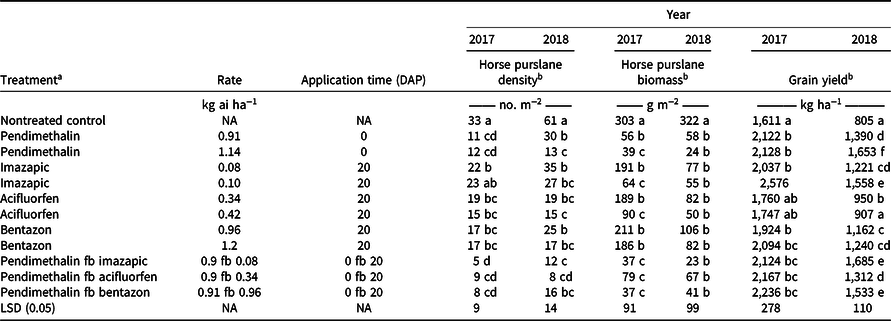
The experiment was arranged in a randomized complete block design with 12 treatments (Table 1) replicated thrice. Herbicides included in the study were pendimethalin (StompXtra®; BASF Australia Ltd., Southbank, Victoria, Australia), acifluorfen (Blazer®; United Phosphorus Ltd., Australia), bentazon (Basagran®; BASF Australia Ltd.), and imazapic (Flame®; BASF Australia Ltd.). Each year, an advanced breeding line of pigeonpea (Pcv 1: indeterminate type) was seeded in the first week of February and harvested in August. Seeds were sown with a cone planter at a seeding rate of 30 kg ha−1 at 50-cm row spacing. The size of the plots was 3 m by 4 m. The field was surface irrigated (5-cm depth) immediately after sowing, using an overhead sprinkler system for irrigation. Pendimethalin (0.91 and 1.14 kg ai ha−1) was applied as PRE immediately after sowing (before the irrigation), and POST herbicides (imazapic at 0.08 and 0.10 kg ai ha−1; acifluorfen at 0.34 and 0.42 kg ai ha−1; and bentazon at 0.96 and 1.2 kg ai ha−1) were applied 20 DAS with a CO2-pressurized backpack sprayer equipped with four flat-fan nozzles (AIRMIX 110015 Quick TeeJet nozzles, Model 25611; Spraying Systems Co., Wheaton, IL) spaced at 50 cm and delivering a water volume of 160 L ha−1 at 196 kPa. A foliar spray of chlorantraniliprole (Altacore; FMC, Philadelphia, PA) 20% suspension concentrate insecticide was made (150 mL ha−1) at flowering time to control insect pests.
Effect of herbicide treatments on horse purslane and biomass, and grain yield of pigeonpea in field experiments in Gatton, Australia, 2017 and 2018.

a Abbreviations: DAP, days after planting; fb, followed by; NA, not applicable.
b Any two numbers in the same column fb the same letter are not significantly different (P = 0.05).
Horse purslane density and biomass were determined at 45 DAS by using a 50-cm by 50-cm quadrat placed at two locations in each plot. Weeds were counted and samples were collected by cutting horse purslane at the ground level and drying in an oven at 70 C for 72 h. Crop phytotoxicity was rated visually based on a scale of 0% to 100% at 45 DAS (with 0 indicating no response and 100 indicating crop death). The crop was combine-harvested and grain yield was recorded from a harvested area of 9.0 m2 (3 m by 3 m) plot. For ease of harvesting, the pigeonpea crop was desiccated in the last week of July each year (physiological maturity stage of the crop; 167 DAS in 2017 and 174 DAS in 2018), using a foliar spray of glyphosate (0.94 kg ae ha−1) plus saflufenacil (0.024 ai ha−1). Grain yield was converted to kg ha−1 at 12% moisture content.
Statistical Analyses
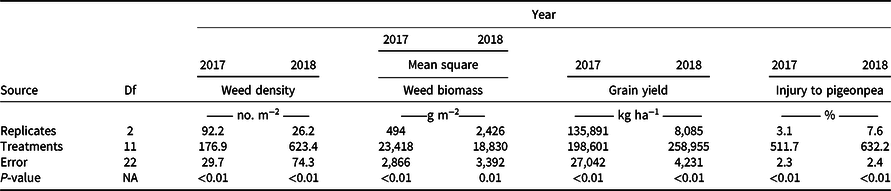
Weed density, biomass, and crop yield differed between years, but there was no year by treatment interaction; therefore, data are presented separately for each year. ANOVA was performed using Elementary Designs Application software (version 1.0 beta; Free Software Foundation, www.agristudy.com) (Table 2). Before ANOVA, data were also validated for meeting the assumptions of normality and equal variance using Levene and Shapiro-Wilk tests, respectively. Unless indicated otherwise, after ANOVA, means were separated using LSD at P = 0.05. The relationship between grain yield and weed biomass was assessed using linear correlation considering the mean of all treatments.
ANOVA for different parameters of pigeonpea in field experiments conducted in Gatton, Australia, 2017 and 2018.

a Abbreviations: Df, degrees of freedom; NA, not applicable.
Results and Discussion
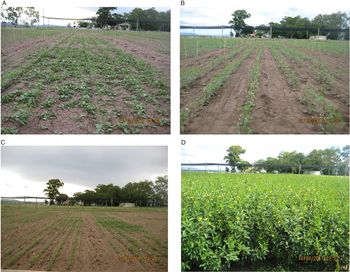
In 2017, the experimental site was heavily infested with horse purslane (natural infestation) (Figure 1A). However, in 2018, the weed population in the nontreated plots comprised buffelgrass [Pennisetum ciliare (L.) Link], stinkgrass [Eragrostis cilianensis (All.) Vign. ex Janchen], and feather fingergrass (Chloris virgata Sw.). It is pertinent to mention here that in this article, only horse purslane data are reported.
(A) Horse purslane infestation in pigeonpea; (B) phytotoxicity of acifluorfen to pigeonpea; (C) weed free plot with pendimethalin application; and (D) lush green crop of pigeonpea.

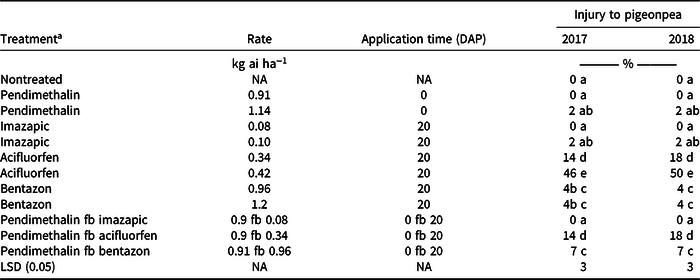
All herbicide-treated plots had a lower horse purslane density compared with the nontreated control (Table 1; Figure1D). In both years, weed density was lower in plots treated with the sequential application of pendimethalin 0.91 kg ai ha−1 applied PRE followed by (fb) imazapic 0.08 kg ai ha−1 applied POST, compared with imazapic applied POST at 0.08 or 0.10 kg ai ha−1. In both years, weed density was similar in all sequential spray treatments (pendimethalin applied PRE fb imazapic or acifluorfen or bentazon applied POST). Pendimethalin applied PRE at 1.14 kg ha−1 also resulted in a similar weed density when compared with all sequential spray treatments. Horse purslane density was higher in the imazapic 0.08 kg ai ha−1 POST-treated plots than in the plots treated with pendimethalin applied PRE at 1.14 kg ai ha−1. Tripathi and Vivek (Reference Tripathi and Vivek1995) found that pendimethalin 1.5 kg ai ha−1 applied PRE reduced weed density, including of horse purslane, in pigeonpea by 73% when compared with the nontreated control. However, Singh and Sekhon (Reference Singh and Sekhon2013) observed that pendimethalin 0.45 or 0.75 kg ai ha−1 applied PRE provided little control of weeds (including horse purslane) in pigeonpea; hence, a higher dose of pendimethalin or additional hand weeding was required. Acifluorfen 0.42 kg ai ha−1, bentazon 1.2 kg ai ha−1, and imazapic 0.10 kg ai ha−1 applied POST controlled horse purslane density by 54%, 48%, and 30%, respectively, in 2017; and 75%, 72%, and 55%, respectively, in 2018. Crop phytotoxicity was observed with acifluorfen applied POST, particularly when applied at 0.42 kg ai ha−1, compared with 0.34 kg ai ha−1 (Table 3; Figure 1B). Charles (Reference Charles2006) also observed pigeonpea injury with acifluorfen in Australia, totaling 3 on a scale of 5 in a phytotoxicity-evaluation rating system. Bidlack et al. (Reference Bidlack, Middick, Shantz, MacKown, Williams and Rao2006) found that imazapic at 0.25 kg ai ha−1 applied POST provided effective grass and broadleaf weed control in pigeonpea, although temporary chlorosis and stunting was observed in the crop. We did not observe any injury to pigeonpea crop after the POST application of imazapic 0.10 kg ai ha−1 (Table 3). Grichar (Reference Grichar2007) observed that bentazon applied POST at a lower rate (0.42 kg ai ha−1) controlled horse purslane only up to 30% in peanut.
Effect of herbicide treatments on crop phytotoxicity score (45 d after sowing) in field experiments conducted in Gatton, Australia, 2017 and 2018.

a Abbreviations: DAP, days after planting; fb, followed by; NA, not applicable.
Pendimethalin applied PRE at 1.14 kg ai ha−1 reduced horse purslane biomass by 87% and 92% in 2017 and 2018, respectively, compared with the nontreated control. Pendimethalin applied PRE, even at a lower rate (0.91 kg ha−1), reduced horse purslane biomass by approximately 81% in both years, compared with the nontreated control. Imazapic applied POST at 0.10 kg ha−1 reduced horse purslane biomass by 79% and 82% in 2017 and 2018, respectively, compared with the nontreated control. In both years, horse purslane biomass was lowest with the sequential application of pendimethalin 0.91 kg ha−1 PRE fb imazapic 0.08 kg ha−1 POST. Horse purslane biomass was similar in all sequential spray treatments (pendimethalin applied PRE fb imazapic or acifluorfen or bentazon applied POST). Grichar (Reference Grichar2008) reported that pendimethalin at 1.12 kg ai ha−1 PRE reduced horse purslane biomass by 73% in peanut (Arachis hypogaea L.).
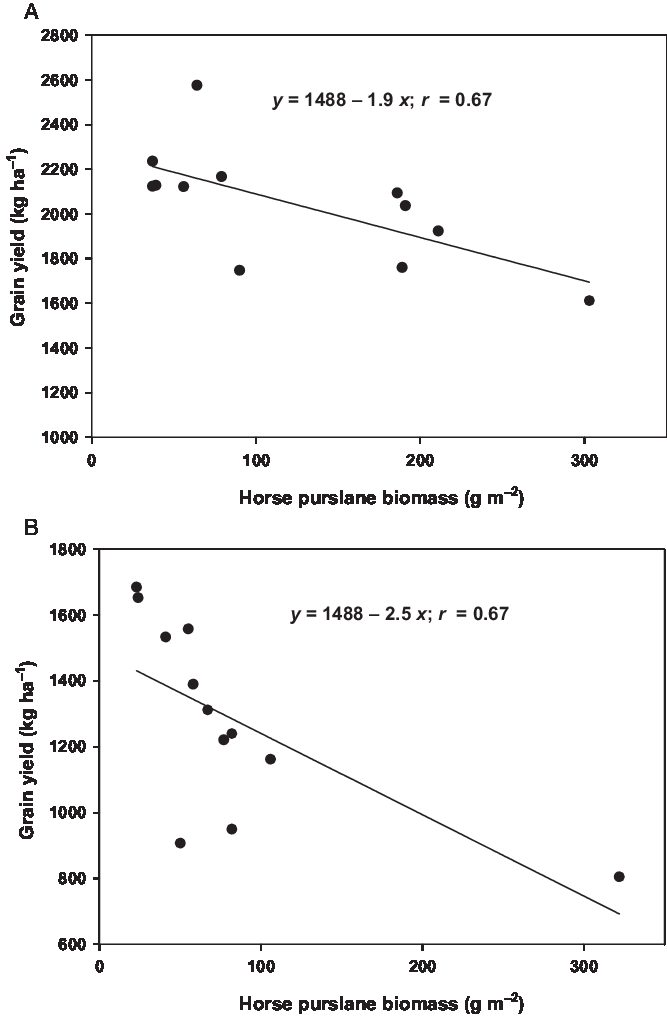
Grain yield varied from 1,611 kg ha−1 to 2,576 kg ha−1 in 2017 and from 805 kg ha−1 to 1,685 kg ha−1 in 2018, depending on herbicide treatment (Table 1). Pendimethalin applied PRE at 0.91 kg ha−1 resulted in 31% and 72% higher yield in 2017 and 2018, respectively, compared with the nontreated control. Pendimethalin applied PRE at the higher rate (1.14 kg ha−1) had a better yield than the lower application rate only in 2018. Regardless of application rate, the application of acifluorfen POST provided a lower yield than the application of imazapic POST in both years. Grain yield with sequential application of pendimethalin (0.91 kg ha−1) PRE fb imazapic (0.08 kg ha−1) POST increased by 32% and 109% in 2017 and 2018, respectively, compared with the nontreated control. In 2017, all sequential spray treatments (pendimethalin applied PRE fb imazapic or acifluorfen or bentazon applied POST) had similar grain yield. However, in 2018, the yield was lower when acifluorfen (0.34 kg ai ha−1) was treated in sequence after pendimethalin (0.91 kg ai ha−1) application as compared with imazapic (0.08 kg ai ha−1) or bentazon (0.96 kg ai ha−1).
The highest grain yield (1,685 kg ha−1) of pigeonpea in 2018 was obtained with the sequential application of pendimethalin PRE and imazapic POST, due to a broad spectrum of weed control (Table 1). In 2017, the highest yield (2,576 kg ha−1) was obtained with the application of imazapic applied POST at a higher rate (0.10 kg ha−1). The higher rate of imazapic (0.10 kg ha−1) applied POST provided better control of multiple cohorts of horse purslane in 2017, because the field was infested with horse purslane only. In 2017, grain yield was lower with sequential application of pendimethalin (0.91 kg ha−1) applied PRE fb imazapic (0.08 kg ha−1) applied POST than in plots treated with the application of imazapic applied POST at a higher rate (0.10 kg ha−1). However, in 2018, such an increase was not found, because the weed flora was diverse. The lower pigeonpea yield with the application of acifluorfen applied POST was due to the phytotoxic effect on the crop and the crop suffered from weed competition. The lower rate of acifluorfen also resulted in crop phytotoxicity, but the crop recovered quickly after the spray. This could be the reason for higher grain yield with the sequential application of pendimethalin and acifluorfen compared with the application of acifluorfen at 0.42 kg ai ha−1 applied POST.
A negative correlation (r = −0.67 both in 2017 and 2018) was observed between horse purslane biomass and grain yield of pigeonpea (Figure 2). This suggests that horse purslane caused a substantial reduction in grain yield as a result of resource competition. Higher yield with herbicide treatments was due to better weed control and resulted in reduced crop-weed competition. Pigeonpea used the available resources more effectively as a result of low weed pressure and thereby produced a higher yield. Grichar (Reference Grichar2007) observed 54%, 92%, and 124% increase in peanut yield due to improved weed control with acifluorfen, bentazon, and imazapic, respectively, compared with a nontreated control. In another study, sequential applications of pendimethalin applied PRE fb imazapic applied POST, pendimethalin applied PRE fb acifluorfen applied POST, and pendimethalin applied PRE fb bentazon applied POST increased peanut yield by 83%, 4%, and 7%, respectively, compared with a nontreated control (Grichar Reference Grichar2008). A recent study by Mahajan et al. (Reference Mahajan, Rachaputi and Chauhan2019) also revealed that pendimethalin PRE provided effective control of horse purslane in pigeonpea planted at 25- and 50-cm row spacing; however, in paired rows or in a mixed weed flora situation (i.e., mixture of grass and broadleaf weeds), effective weed control was obtained only with the sequential application of pendimethalin and imazapic.
Correlation of horse purslane biomass with grain yield in (A) 2017 and (B) 2018 in field experiments conducted at Research Farm of the University of Queensland, Gatton, Australia.

In conclusion, pendimethalin applied PRE at 0.91 kg ai ha−1 PRE and imazapic applied POST at 0.10 kg ai ha−1 effectively controlled horse purslane in pigeonpea and resulted in improved yield compared with acifluorfen application. Bentazon applied POST at 1.2 kg ai ha−1 provided moderate weed control; however, it also resulted in improved yield when compared with the application of acifluorfen POST. The study findings also suggested that if a PRE herbicide (e.g., pendimethalin) is unable to provide season-long weed control, application of imazapic or bentazon POST in sequence could provide effective weed control. Acifluorfen caused phytotoxicity to the crop; therefore, the yield increment than with other herbicides.
Here, we report a herbicide program for effective weed management in pigeonpea that could be used in rotations. Herbicides such as imazapic and acifluorfen may also create selection pressure on weeds if used frequently, because they have higher soil persistence than bentazon. This warrants the use of herbicide rotation in pigeonpea for sustainable weed control and to mitigate the possibilities of the evolution of herbicide resistance in weeds. Therefore, more POST herbicides should be evaluated for better weed control options in pigeonpea. Additional research is required to study the effect of pendimethalin and other PRE herbicides on nodulation of different pigeonpea cultivars and under different soil conditions. Information is also needed for the residual effect of herbicides on succeeding crops, especially when imazapic is to be used in pigeonpea-based cropping systems.
Acknowledgments
There was no specific funding for this research and the authors declare no conflicts of interest.