Fourteen years have passed since a 9.0-magnitude earthquake (the Great East Japan Earthquake) struck the east coast of Japan near Iwate, Miyagi, and Fukushima Prefectures on March 11, 2011, which resulted in an accident at Tokyo Electric Power Company’s Fukushima Daiichi Nuclear Power Station (FDNPS). Fifty minutes after the earthquake, a tsunami with a height of over 15 m hit the FDNPS, causing extensive damage to its cooling system and a loss of all power at the plant.1, 2 Consequently, a radioactive plume containing radioiodine and radiocesium was dispersed into the atmosphere from units 1-4 of the FDNPS.
The International Commission on Radiological Protection recommends that when planning for emergency situations, reference levels should be applied in the process of optimization. The reference levels for the highest planned residual doses in emergency situations typically range from 20-100 mSv.3 Based on this recommendation, the Japanese government decided on the highest planned residual dose of 20 mSv after a disaster and accordingly issued evacuation orders and food regulation policies.Reference Murakami, Ono and Tsubokura4
On March 11, 2011, the Japanese government issued evacuation orders to residents living within 3 km of the FDNPS, with the evacuation area being extended to a 20-km radius the following day. As a result of this countermeasure, almost 110 000 residents were forced to evacuate, and this minimized their external radiation exposure. Thereafter, within the framework of the Fukushima Health Management Survey, an evaluation of the external radiation exposure doses among residents in Fukushima Prefecture was conducted based on their behavior during the 4 months after the accident. The findings revealed that the average radiation exposure dose was 0.8 mSv in 475 855 study participants and <3 mSv in 97.4% of the participants, and that the maximum dose was 25 mSv,Reference Yamashita5, Reference Ishikawa, Yasumura and Akahane6 indicating that the prompt evacuation after the disaster was effective. However, at this time, despite tremendous efforts being made toward the recovery of the affected areas, more than 25 000 of the evacuated residents of Fukushima Prefecture have still not been able to return to their homes.7, Reference Morita, Nomura and Tsubokura8
In Fukushima Prefecture, 1831 residents died or went missing as a result of the earthquake and tsunami (direct deaths), whereas 2348 died by indirect causes such as declining health and suicide as a result of long-term evacuation.9 In particular, many hospitalized older patients died during or after evacuation.Reference Nomura, Blangiardo and Tsubokura10-Reference Yamamura, Sawano and Ozaki16 Although evacuation during the nuclear accident was essential to minimize radiation exposure, these patients might not have died if they had not been required to evacuate immediately after the disaster.
Before the accident, monitoring posts were installed to monitor ambient dose equivalent rates (H*(10)) around the FDNPS (Figure 1), and data, including weather conditions (hereinafter referred to as “measurement data”), were recorded and collected by Fukushima Prefecture. Unfortunately, many of these monitoring posts failed to work in the initial phase of the accident because of blackouts caused by the earthquake and tsunami. However, 1 monitoring post installed in the Yamada district (Figure 2), which is located about 4 km from the FDNPS and near 3 hospitals (Ohno, Futaba, and Futaba Kosei), where many patients died during or after evacuation, was able to record ambient dosimetry data continuously.
Monitoring post locations (red pins) and enlarged map of the Hamadori area (black box).

Location of the 3 hospitals and monitoring post in the Yamada district.

Given this background, in the present study, we obtained H*(10) data from after the disaster in the Yamada district and calculated the exposure doses of hospitalized patients and medical personnel in several scenarios with the aim of exploring the concept of “tailor-made” evacuations considering individual situations to minimize disaster-related incidents after complex disasters, including nuclear accidents.
Methods
Data Formatting
We used comma-separated values (CSV) files from monitoring posts by measurement point from the “H*(10) Measurement Results in March 2011” and “H*(10) Results from April to June 2011” published by Fukushima Prefecture.17, 18 The measured data in the CSV files were formatted chronologically using Python and point data for display in ArcGIS® software (Esri, Redlands, CA, USA) (Figure 2).
First step: conversion of standard time (SDT) fields from numeric to date/time
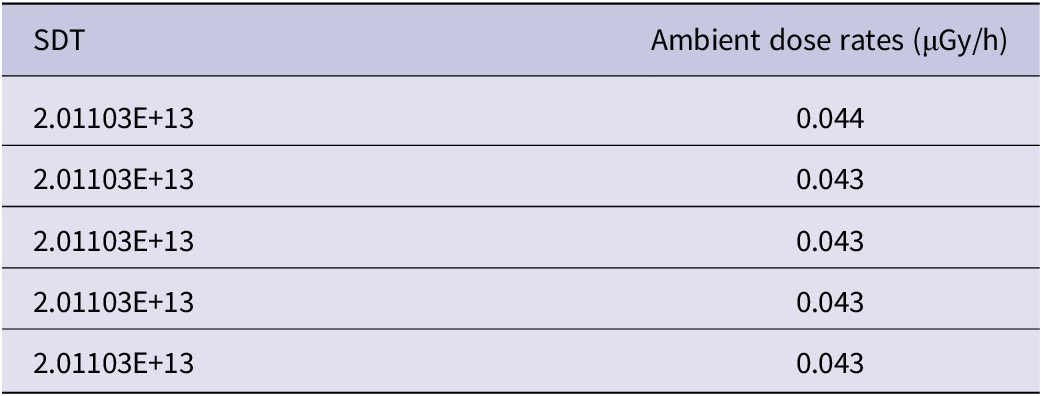
The SDT field in the downloaded raw data contains the date and time of the measurement as a numerical value (Table 1). Because the Python language “DateTime” function calculates date fields in ArcGIS field operations, the date field was converted and used as shown in the following example: “20110301010000” → “2011/3/1 1:00”.
Downloaded H*(10) data and measurement results from the Yamada district

These are the head H*(10) data. The SDT values cover March 11, 2011 01:00 to March 11, 2011 05:00. The ambient dose rates are the hourly average.
Second step: add latitude and longitude information
A “Monitoring Post Observation Sites.csv” file was created based on the monitoring post information provided by the Fukushima Prefecture Radiation Monitoring Office (Table 2). This file contains the numbers of all 25 monitoring posts, along with the name, location, and both latitude and longitude of the post. Because the file name of the measurement data uses the month, number, and name of the observation point, the final information about the observation point was added using numerical information, as shown in the following example: “201103_trend01_shigeoka_new.csv” (the underlined part is the number information).
Data from the monitoring post observation points

Monitoring post No.14 was not available because of damage from the tsunami.
In this study, we used data from the Yamada district, which is located about 4 km from the FDNPS. As described earlier, this district is located near 3 hospitals (Ohno, Futaba, and Futaba Kosei), where many patients died during or after evacuation.
Simulation Modeling
In the case of a hypothetical nuclear disaster, not only patients, who are primarily associated with disaster-related deaths, but also medical workers, who are evacuating indoors to a hospital will experience exposure. Among all medical workers, the present study focused on doctors and nurses, along with hospitalized patients for simulation modeling considering differences in residential areas and working hours.Reference Callen and McKenna11 When individuals are indoors, the radiation exposure dose differs depending on the shielding ratio of the building material. Therefore, we investigated the types of buildings comprising the target hospitals based on the essential items of the Geospatial Information Authority of Japan’s digital map information. As a result, because most buildings in each hospital were almost the same type, the reduction factor was calculated as 0.1 for concrete buildings.Reference Yoshida-Ohuchi, Matsuda and Saito19 In addition, simulation models were created by dividing the residential areas of the nurses and doctors into wooden buildings (reduction factor: 0.4)Reference Yoshida-Ohuchi, Matsuda and Saito19 and concrete buildings, considering the distance from their workplaces. The time spent commuting to and from work was assumed to be on foot, and no reduction factor was used. In addition, a model was created for comparison when the individual was outdoors. Based on these conditions, we created the following simulation models (Table 3).
Conditions for each model

Model 0: Being outside 24 h/day.
Model 1_a: Being in a hospital 9 h/day, commuting and being outside 2 h/day, and being in a wooden residential home 13 h/day.
Model 1_b: Being in a hospital 9 h/day and in a wooden residential home 15 h/day.
Model 1_c: Being in a hospital 9 h/day, commuting and being outside 2 h/day, and being in a concrete residential building 13 h/day.
Model 1_d: Being in a hospital 9 h/day and in a concrete residential building 15 h/day.
Model 2_a: Being in a hospital 11 h/day, commuting and being outside 2 h/day, and being in a wooden residential home 11 h/day.
Model 2_b: Being in a hospital 11 h/day and in a wooden residential home 13 h/day.
Model 2_c: Being in a hospital 11 h/day, commuting and being outside 2 h/day, and being in a concrete residential building 11 h/day.
Model 2_d: Being in a hospital 11 h/day and in a concrete residential building 13 h/day.
Model 3: Being in a hospital 24 h/day.
Model 0 is the control value, Models 1 and 2 suppose medical personnel such as doctors and clinical nurses working at the hospital, and Model 3 supposes hospitalized patients. Next, we calculated the accumulated exposure doses from March 11-April 20, 2011 (the first 40 days after the accident) in each model.
Results
On March 15, 2011 (4 days after the earthquake and tsunami), the H*(10) rapidly increased to more than 250 μSv/hour (Figure 3), mainly as a result of the venting at Unit 2. Then, because of the relatively short decay half-life (about 8 days) of iodine-131 (131I), steadily decreased and reached less than 50 μSv/hour 1 month thereafter. In Model 0, the accumulated exposure doses exceeded 20 mSv on March 21 (10 days after the earthquake and tsunami and 5 days after the initial increase in ambient doses) and 50 mSv during the first 40 days after the disaster.
Accumulated exposure doses in each model from the Yamada district.

In Models 1_a, 1_b, 2_a, and 2_b (living in a wooden residential home), the accumulated exposure doses ranged between 10-20 mSv, compared with almost 10 mSv during this period in Models 1_c, 1_d, 2_c, and 2_d (living in a concrete residential building). Furthermore, in Model 3 (hospitalized patients), the accumulated exposure doses were much less than 10 mSv. The accumulated exposure doses did not reach 20 mSv in any of the Models 1-3.
Discussion
To our knowledge, this is the first study to estimate the accumulated exposure doses among medical personnel and hospitalized patients using raw H*(10) data from the FDNPS disaster. The findings indicated that the accumulated exposure doses were far below 20 mSv (the highest planned residual dose after a disaster according to the Japanese government), even among patients and medical personnel who stayed in a hospital near the FDNPS or their home for 1 month. These results suggest that the timing of an evacuation after a nuclear disaster should be carefully considered based on a balance of predicted exposure doses and individual characteristics, such as age, physical condition, and vulnerability.
In Fukushima Prefecture, many residents died by indirect causes, such as declining health and suicide as a result of long-term evacuation.Reference Yamamura, Sawano and Ozaki16 Especially, many hospitalized patients died during or after evacuation. In Futaba hospital, which is located about 4.5 km from the FDNPS and close to the Yamada district (Figure 2), 39 (11.5%) of 338 patients (predominantly critically ill patients who were bedridden or disabled) died before the evacuation was complete.Reference Sawano, Nishikawa and Ozaki14 Also, at Futaba Kohsei Hospital, which is located about 4.0 km from the FDNPS, 4 (2.9%) of 136 hospitalized patients died up until the time evacuation was complete (March 13, 2011).Reference Sawano, Senoo and Yoshida15 On the other hand, no patient died at Ohno Hospital. In these hospitals, many patients with psychiatric disorders, as well as older adults with chronic disorders, were hospitalized. It is possible that these patients might have survived had they not been evacuated from the hospital immediately after the accident.
In this study, we reconstructed H*(10) data from the FDNPS accident in 2011 using discontinuously recorded data from the Yamada district. Based on this accident, it is estimated that 160 petabecquerels (PBq) of 131I (half-life decay: 8.0 days), 18 PBq of cesium-137 (134Cs; half-life decay: 2.1 years), and 15 PBq of 137Cs (half-life decay: 30.2 years) were released into the atmosphere.20 In addition, based on the Chernobyl accident in 1986, 1760 PBq of 131I, 47 PBq of 134Cs, and 85 PBq of 137Cs were released (20). Although the total amount of released radionuclides was relatively limited after the FDNPS disaster compared with Chernobyl, the types of released radionuclides were similar in both accidents. Because radioiodine, especially 131I, was the main component of the initial radiation exposure among residents in both of these nuclear accidents, it may be possible to develop a system that can predict individual exposure doses and shielding status using initial H*(10) after such accidents in the future. The potential usefulness of such a system suggests the importance of the concept of “tailor-made” evacuations considering individual situations to minimize disaster-related incidents after complex disasters, including nuclear accidents.
Limitations
This study has several limitations. First, we reconstructed H*(10) from only the Yamada district, which is relatively close to the hospitals that experienced numerous deaths of hospitalized patients due to indirect causes. Areas close to other medical facilities that experienced indirect deaths among vulnerable residents in Fukushima Prefecture should also be investigated. Second, this study focused on only medical personnel and hospitalized patients. If older patients and medical personnel decide not to evacuate immediately after an accident, the predicted exposure doses for other workers, such as those in the transit industry who supply “clean (not contaminated)” foods, drugs, and other daily necessities to maintain the functions of medical facilities, also need to be estimated. Thus, further studies are needed to help reduce the risks of future disasters, including nuclear accidents.
Conclusions
In conclusion, we estimated H*(10) data from Fukushima Prefecture after the FDNPS accident and calculated the exposure doses of hospitalized patients and medical personnel under several different scenarios. Because radioiodine almost completely disappeared within a few months after the accident, it is estimated that the patient dose in the first year, even among those staying at the hospital, would not exceed 20 mSv. To minimize disaster-related incidents after such complex disasters, the present findings highlight the importance of establishing the concept of “tailor-made” evacuations considering individual situations.
Author contribution
Maho Takeshita: Data formatting and conversion of Standard Time (SDT) fields from numeric to date/time.
Hitomi Matsunaga: Collection of data.
Noboru Takamura: Writing of manuscript.
Byungdug Jun: Simulation modeling and writing of manuscript.
Competing interests
This research was supported by the Fukushima Institute for Research, Education and Innovation (F-REI) and JST SPRING, Japan (grant number JPMJSP2172). The authors declare no conflicts of interest.