Implications
Equine crib-biting is a well-known behavioural stereotypy and resembles oral stereotypies present in other species, including production animals. Genetic susceptibility has been suggested, and we therefore established case–control cohorts of horses in two breeds to test the possible association of eight candidate genes (Leptin, Ghrelin, Ghrelin receptor, Dopamine receptor, Serotonin receptor, μ-opioid receptor, N-cadherin and Semaphorin). Our results did not reveal evidence for an association at any of the tested loci, suggesting that the studied genes are not major genetic risk factors in our target breeds. Expansion of the study population is warranted, together with new genome-wide approaches to identify the possible risk loci.
Introduction
Crib-biting in horses (Equus caballus) is a stereotypic oral behaviour. A crib-biting horse grasps a fixed object with its incisor teeth and contracts the lower neck muscles to retract the larynx caudally (McGreevy et al., Reference McGreevy, Richardson, Nicol and Lane1995). This movement coincides with an in-rush of air through the crico-pharynx into the oesophagus, producing the characteristic cribbing sound (McGreevy et al., Reference McGreevy, Richardson, Nicol and Lane1995). Hemmings et al. (Reference Hemmings, McBride and Hale2007) preferred to place this oral equine stereotypy in the same aetiological category as stereotypies in other species. Crib-biting occurs especially after consuming concentrate feed (McGreevy and Nicol, Reference McGreevy and Nicol1998; Hemmann et al., Reference Hemmann, Koho, Vainio and Raekallio2013). Post-feeding peaks of oral stereotypic behaviour have also been observed in pigs (Robert et al., Reference Robert, Matte, Farmer, Girard and Martineau1993), cattle and sheep (Sambraus, Reference Sambraus1985). An association between crib-biting and gastric ulceration (Nicol et al., Reference Nicol, Davidson, Harris, Waters and Wilson2002) and entrapment of the small intestine in the epiploic foramen (Archer et al., Reference Archer, Freeman, Doyle and Proudman2004) has been suggested. Crib-biting may occupy several hours of the horse’s day with a high cribbing rate (up to 2000 repetitions), and can interfere with a horse’s daily routines by reducing the time available for eating and resting (McGreevy and Nicol, Reference McGreevy and Nicol1998). Crib-biting involves aspects of addictive (Dodman et al., Reference Dodman, Shuster, Court and Dixon1987) and motivated behaviour (Houpt, Reference Houpt2012).
The molecular genetic background of crib-biting remains completely unknown, although breed predisposition suggests that genes may play a role. The prevalence of crib-biting is estimated to be between 3% and 15% in many breeds (Pell and McGreevy, Reference Pell and McGreevy1999; Albright et al., Reference Albright, Mohammed, Heleski, Wickens and Houpt2009) and up to 30% in Thoroughbreds (Luesher et al., Reference Luesher, McKeown and Dean1998). Pedigree studies also suggest the involvement of genetic factors, although the mode of inheritance has not been determined (Vecchiotti and Galanti, Reference Vecchiotti and Galanti1986). Genetic evidence in other animal stereotypies has been established, including examples such as bank voles (Schoenecker and Heller, Reference Schoenecker and Heller2000) and compulsive dogs (Dodman et al., Reference Dodman, Karlsson, Moon-Fanelli, Galdzicka, Perloski, Shuster, Lindblad-Toh and Ginns2010). Stress, gastric discomfort and frustration caused by stall restrictions and early weaning (Nicol et al., Reference Nicol, Davidson, Harris, Waters and Wilson2002; Latham and Mason, Reference Latham and Mason2008; Hothersall and Nicol, Reference Hothersall and Nicol2009) have been suggested as additional risk factors for equine crib-biting.
Recent annotation of the equine genome has facilitated genetic studies on evolution, breed structure, diseases, morphology and behaviour (Petersen et al., Reference Petersen, Mickelson, Cothran, Andersson, Axelsson, Bailey, Bannasch, Binns, Borges, Brama, da Câmara Machado, Distl, Felicetti, Fox-Clipsham, Graves, Guérin, Haase, Hasegawa, Hemmann, Hill, Leeb, Lindgren, Lohi, Lopes, McGivney, Mikko, Orr, Penedo, Piercy, Raekallio, Rieder, Røed, Silvestrelli, Swinburne, Tozaki, Vaudin and Wade2013). Equine linkage disequilibrium is intermediate in length between the dog and human, and there is a long-range haplotype sharing among breeds (Wade et al., Reference Wade, Giulotto, Sigurdsson, Zoli and Gnerre2009). With the availability of new genomic resources, we have established a case–control cohort of horses in two breeds to test the possible association of known or expected stereotypy genes in crib-biting horses using a candidate gene approach. We selected eight candidate genes, including Leptin (Lep), Ghrelin (GHRL), Ghrelin receptor (GHS-RIA), Dopamine receptor (DRD1), μ-opioid receptor (OPRM1), N-cadherin (CDH2), Serotonin receptor (Htr1B) and Semaphorin (SEMA6). Leptin (Buff et al., Reference Buff, Morrison, Ganjam and Keisler2005) and ghrelin (Kojima et al., Reference Kojima, Hosoda, Date, Nakazato and Kangawa1999) are endogenous hormones that influence hypothalamic mechanisms regulating appetite and modulate the reward mechanism (Jerlhag et al., Reference Jerlhag, Egecioglu, Landgren, Salomé, Heilig, Moechars, Datta, Perissoud, Dickson and Engel2009). Polymorphism in ghrelin and the GHS-R1A gene has been associated with addictive behaviour in humans (Monteleone et al., Reference Monteleone, Tortorella, Castaldo, Filippo and Kaj2007) and rats (Landgren et al., Reference Landgren, Engel, Hyytiä, Zetterberg, Blennow and Jerlhag2011). Dopamine receptors are associated with persistence and reward dependence in humans (Kulikova et al., Reference Kulikova, Malyuchenko, Timofeeva, Shleptsova, Shchegol, Vedyakov and Tonevitskii2007) and in horses (Momozawa et al., Reference Momozawa, Takeuchi, Kusunose, Kiusui and Mori2005). Altered dopamine physiology was found to be associated with stereotypy development in horses (McBride and Hemmings, Reference McBride and Hemmings2005). Opioid receptor supersensitivity has been demonstrated to be associated with stereotypy in rats (Broderick et al., Reference Broderick, Blaha and Lane1983) and endogenous opioids are involved in the stereotyped behaviour of tethered sows (Cronin et al., Reference Cronin, Wiepkema and van Ree1985). Association with the CDH2 region was found in a canine compulsive disorder (Dodman et al., Reference Dodman, Karlsson, Moon-Fanelli, Galdzicka, Perloski, Shuster, Lindblad-Toh and Ginns2010). Semaphorin genes have been implicated in psychiatric disorders in humans (Mann et al., Reference Mann, Chauvet and Rougon2007) and Sema6A-deficient mice revealed a hyperactive phenotype (Rünker et al., Reference Rünker, O’Tuathaigh, Dunleavy, Morris, Little, Corvin, Gill, Henshall, Waddington and Mitchell2010). Differences in the level of stereotypic performance appear to be related to increased general activity in laboratory mice (Würbel and Stauffacher, Reference Würbel and Stauffacher1996), bank voles (Cooper et al., Reference Cooper, Ödberg and Nicol1996) and horses (Vecchiotti and Galanti, Reference Vecchiotti and Galanti1986). Substance-abuse disorder was found to be associated with polymorphism of the human 5-HT 1B receptor gene G861C (Huang et al., Reference Huang, Oquendo, Harkavy Friedman, Greenhull, Brodsky, Malone, Khait and Mann2003). In the current study, a single nucleotide polymorphism (SNP) within or near each candidate gene was investigated for association with crib-biting in case–control cohorts of horses of two breeds.
Material and methods
Animals and phenotyping
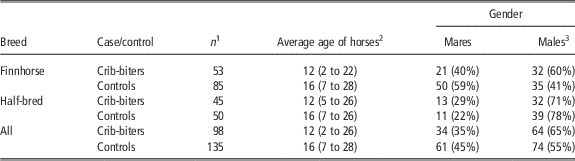
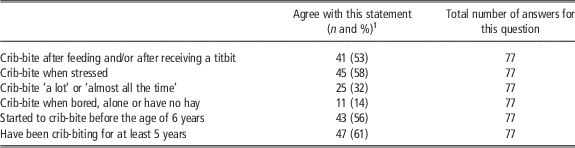
A cohort of privately owned horses, including 98 crib-biting and 135 non-crib-biting control horses, was established (Table 1). We received blood samples from two breeds, including Finnhorses (53 cases, 85 controls) and half-breds (45 cases, 50 controls). The Finnhorse is a native Finnish cold-blooded breed mainly used in equestrian sports (jumping, dressage, eventing, driving and trotting). All half-breds in this study were warmblood crosses, including breeds such as the Hanoverian, Swedish half-bred, Thoroughbred, Wielkopolski, Holsteiner and Finnish Warmblood. The half-breds were used as riding horses and in breeding. Horses in Finland are typically housed in loose boxes or open sheds, fed two to four times per day with hay and concentrate, and put out in a paddock for 2 to 8 h daily. The age, pedigree, breed and gender of the horses were verified according to their registration number in the register of the Finnish trotting and breeding association, Suomen Hippos, which serves as the registry for horses in Finland and maintains breeding records and a pedigree database. Blood samples were recruited through advertisements on the University of Helsinki website, at equine clinics and in domestic horse magazines. Phenotypic information on the horses was obtained through a detailed owner-completed questionnaire (Supplementary Material S1). The following phenotypic criteria were used: control horses were more than 10 years old without a history of crib-biting. Two 7-year-old half-breds were used as non-crib-biting controls in our recent study and were videotaped for 48 h to verify behaviour status. Where possible, the control horses were sampled from the same stables as the affected horses. The affected horses had shown excessive crib-biting for at least 1 year, and many of them for several years from a young age. Crib-biters are easily recognized by owners in the stables, as the horses make a typical grunting sound. More detailed owner-reported information on crib-biting behaviour was available for 77 of the 98 affected horses (Table 2).
Breed, age, and gender of the crib-biting and control horses

1 Number of horses.
2 Average age of horses during data collection mean (minimum to maximum).
3 Stallions and geldings.
Summary of crib-biting behaviour in all cases

1 The number of owners who considered that this alternative best describes the crib-biting behaviour of their horse. In parentheses is the percentage of owners selecting this alternative from the total number of detailed answers for this question.
DNA isolation
A jugular EDTA blood sample (10 ml) was drawn by a veterinarian. Genomic DNA was isolated from whole blood leucocytes using a semi-automated Chemagen robot (PerkinElmer, Waltham, Massachusetts, USA), according to the manufacturer’s protocol.
SNP selection, genotyping and association analysis
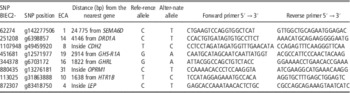
Eight functional candidate genes were selected for the study: GHRL, GHS-RIA, Lep, DRD1, OPRM1, CDH2, Htr1B and SEMA6. Genomic locations and sequences of the genes were retrieved from the NCBI and Ensembl equine databases (http://www.broadinstitute.org/mammals/horse). Candidate SNPs around the genes were selected from the equine dbSNP database (http://www.ncbi.nlm.nih.gov/projects/SNP), and tagging SNPs were selected within kilobases from the candidate genes (Table 3). Before genotyping the entire study cohorts, we verified the informativeness (MAF) of the selected SNPs in a cohort of 29 horses in one breed. Validated SNPs were genotyped either by TaqMan assays or Sanger sequencing in the study cohort, including 138 Finnhorses (53 cases and 85 controls) and 95 half-breds (45 cases and 50 controls).
SNPs, candidate genes, alleles, primers of the SNPs

SNP=single nucleotide polymorphism; ECA=Equine chromosome.
SNPs of candidate genes were amplified using primer pairs designed based on the GenBank sequences presented in Table 2. The genomic DNA was amplified using the PCR on a thermocycler with denaturation for 30 s at 94°C, annealing for 30 s at 58°C to 60°C, and ending with a 1-min extension at 72°C for 34 cycles. PCR was ended with a 10-min extension at 72°C. Each PCR reaction (20 µl) contained 20 ng of template DNA, 0.4 µl of 10 µM DNTPs, 2 µl of each primer (5 µM), 0.10 µl of Biotools polymerase (5 U), 1.5 µl of 10× Biotools buffer and 0.8 µl of 50 mM MgCl2 (Biotools B&M Labs, S.A., Madrid, Spain). The volume was adjusted to 20 µl with autoclaved nanopure water. The PCR products were purified using the Exo SAP PCR Clean-up system (Affymetrix, Santa Clara, CA, USA) following the manufacturer’s protocol. The size of PCR products was verified by electrophoresis using a 1% agarose gel. PCR products were sequenced using capillary sequencing at the FIMM Technology Center. For the TaqMan SNP genotyping assay (Life Technologies, Van Allen Way, Carlsbad, CA, USA), 20 ng DNA was dried onto the bottom of each well of a 384-well plate and 4 µl of PCR mix was added. After PCR, the absolute quantification data were saved and allelic discrimination was performed. Owing to the neighbouring SNP being too close, TaqMan genotyping was not successful for all SNPs. In these situations, traditional PCR and the sequencing method described above were used.
Sanger sequences were analysed using Sequencher software (version 5.1, Gene Codes Corporation, Ann Arbor, MI, USA). To compare the allele frequencies, a case–control association test was conducted using PLINK 1.07 software (http://pngu.mgh.harvard.edu/~purcell/plink/). Fisher’s exact test was used to examine the significance of the association of the SNP between cases and controls. A significance level of <0.05 was applied. Chi-squared values and odds ratios were determined using PLINK software. The odds ratios were calculated with 95% confidence intervals.
Ethics statement
The study protocol was ethically accepted by the Faculty of Veterinary Medicine, University of Helsinki (13.6.2007, Dnro 1076/58/2007), and blood sample collection was carried out with the consent of the horse owners.
Results
Towards our aim to test the possible association of the known stereotypic genes in equine crib-biting, we established a study cohort including 233 horses from two breeds. According to responses in the detailed owner-completed questionnaire (Supplementary Material S1), crib-biting often started after feeding and was associated with stress. Strenuous training sessions, preparation for training, adaptation to a new environment and isolation from other horses were reported as potential sources of stress. A lack of activity (boredom) and lack of food were also listed (Table 2). Boredom was described by owners as an extended period of time without company, food or activity.
A more detailed history of crib-biting was available for 77 horses. According to owners, over half of these had crib-bitten for at least 5 years (Table 2). However, one-third of the owners did not know the age of onset, although an early age was suspected because the horse had often already performed the behaviour when purchased. About a quarter of crib-biting horses were reported to crib-bite ‘a lot’ or ‘almost all the time’. Crib-biting typically starts at an early age, and we therefore selected control horses that were over 10 years of age without any history of crib-biting.
We were only able to establish a modest sample size for two breeds, Finnhorses (53 cases and 85 controls) and half-breds (45 cases and 50 controls) (Table 1). The mean age (range) of the horses at the time of sampling was 16 (7 to 26) years in controls and 12 (range: 2 to 26) in cases. On the basis of the available pedigrees, all cases and controls in half-breds were unrelated at the grandparental level. In Finnhorses, the pedigree-based inbreeding coefficient, 4.154 (Hippos database), was similar to the whole Finnhorse population.
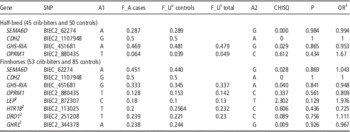
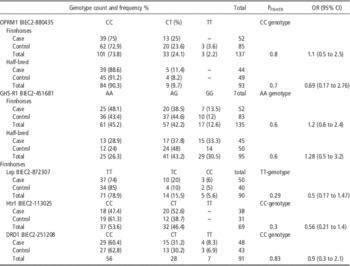
To test whether any of the candidate genes were associated with crib-biting, we selected a nearby SNP for each candidate gene and genotyped the SNPs in the study cohort of Finnhorses and half-breds. Comparison of the allele and genotype frequencies between the cases and controls for each breed separately did not indicate an association with any of the studied genes in either of the breeds (Tables 4 and 5). The cut-off for statistical significance was a P-value of 0.05, but neither the allele or genotype frequencies of the studied SNPs reached the significance level. The P-values of the allele frequencies varied between 0.1 and 1.0 and the genotype frequencies between 0.29 and 0.83. The odds ratios were >1 for OPRM1 in half-bred horses and for SEMA6D, LEP and DRD1 in Finnhorses; however, as the P-values did not reach the significance level of 0.05, the odds ratios were non-significant.
Allele frequencies of minor alleles

A1=minor allele, A2 major allele, F_A cases=frequency of minor allele in cases, F_Uu controls=frequency of minor allele in controls; F_Ut total=frequency of minor alleles in controls+cases.
1 Estimated odds ratio, 95% confidence interval.
2 Finnhorses, 47crib-biters and 47 controls.
Genotype distributions in crib-biting horses and their non-crib-biting controls

OR=estimated odds ratio; 95% CI=95% confidence interval.
Discussion
Previous studies have suggested genetic susceptibility to crib-biting (Vecchiotti and Galanti, Reference Vecchiotti and Galanti1986), and we selected eight functional candidate genes for this study on the basis of their known roles in animal and human stereotypy or addiction. Our results suggest that the studied genes are not major genetic risk factors in crib-biting in our sample cohort. Expansion of the study cohorts and the use of genome-wide approaches in future is warranted.
Leptin (Buff et al., Reference Buff, Morrison, Ganjam and Keisler2005) has been associated with appetite (Hommel et al., Reference Hommel, Trinko, Sears, Georgescu, Liu, Gao, Thurmon, Marinelli and DiLeone2006) and modulation of the reward mechanisms in rats (Landgren et al., Reference Landgren, Engel, Hyytiä, Zetterberg, Blennow and Jerlhag2011). Reward behaviour has been connected as a causal factor with crib-biting (Nicol et al., Reference Nicol, Davidson, Harris, Waters and Wilson2002; Hemmings et al., Reference Hemmings, McBride and Hale2007). The plasma leptin concentration was lower in crib-biting horses compared with controls and correlated negatively with crib-biting intensity during feeding (Hemmann et al., Reference Hemmann, Koho, Vainio and Raekallio2013). The minor allele frequency of the SNP near leptin between crib-biting horses and controls (difference, P=0.129) is worth further study for its trend for an association. In rats, the knockout of leptin receptors in the ventral tegmental area led to sensitivity to highly palatable food (Hommel et al., Reference Hommel, Trinko, Sears, Georgescu, Liu, Gao, Thurmon, Marinelli and DiLeone2006). Similarly, the consumption of highly palatable foods increased oral stereotypy in pigs (Rushen et al., Reference Rushen, Schouten and De Passille1990). Crib-biting is typically a postprandial behaviour affected by environmental factors (McGreevy et al., Reference McGreevy, Richardson, Nicol and Lane1995; Hothersall and Nicol, Reference Hothersall and Nicol2009). This was supported by our survey data, in which most horses were reported to crib-bite most intensively after feeding on concentrate or tidbits.
Ghrelin influences the physiological mechanisms related to feeding and has been associated with the modulation of reward mechanisms (Jerlhag et al., Reference Jerlhag, Egecioglu, Landgren, Salomé, Heilig, Moechars, Datta, Perissoud, Dickson and Engel2009) and gastric protection (Kojima et al., Reference Kojima, Hosoda, Date, Nakazato and Kangawa1999). Gastric irritation has also been associated as a causal factor with crib-biting (Hothersall and Nicol, Reference Hothersall and Nicol2009). The plasma concentration of ghrelin is elevated in human patients with addictive behaviours (Kraus et al., Reference Kraus, Schanze, Gröschl, Bayerlein, Hillemacher, Reulbach, Kornhuber and Bleich2005), and it was also higher in crib-biting horses than their controls (Hemmann et al., Reference Hemmann, Raekallio, Kanerva, Hänninen, Pastell, Palviainen and Vainio2012). Leu72Met polymorphism of the ghrelin gene has been found to be associated with binge eating disorder in rats, and an association of ghrelin with motivated behaviours and possibly with rewards in general has been suggested (Landgren et al., Reference Landgren, Engel, Hyytiä, Zetterberg, Blennow and Jerlhag2011). A SNP in the ghrelin receptor GHS-R1A gene has been associated with high alcohol consumption in humans (Landgren et al., Reference Landgren, Engel, Hyytiä, Zetterberg, Blennow and Jerlhag2011). Despite previous functional evidence in several species, leptin and ghrelin loci did not associate with crib-biting in our two equine breeds.
Dopamine-receptor gene polymorphisms are highly associated with curiosity, reward dependence, and persistence in humans (Kulikova et al., Reference Kulikova, Malyuchenko, Timofeeva, Shleptsova, Shchegol, Vedyakov and Tonevitskii2007) and horses (Momozawa et al., Reference Momozawa, Takeuchi, Kusunose, Kiusui and Mori2005). In horses, crib-biting can be temporarily prevented by opioid antagonists such as naloxone (Dodman et al., Reference Dodman, Shuster, Court and Dixon1987), suggesting that it might be a reward behaviour (McBride and Hemmings, Reference McBride and Hemmings2005). The µ-opioid receptor (MOR) impacts on reward and stress responses (Bond et al., Reference Bond, LaForge, Tian, Melia, Zhang, Borg, Gong, Schluger, Strong, Leal, Tischfield, Kreek and Yu1998). Differences have been detected in the endogenous opioids of crib-biters, but the results have been contradictory (McGreevy and Nicol, Reference McGreevy and Nicol1998). Pell and McGreevy (Reference Pell and McGreevy1999) found no differences in plasma β-endorphin concentrations between cases and controls, and suggested that stereotypic horses may have inherited opioid receptors with a greater sensitivity than those of control horses. In humans, a SNP in the MOR gene encodes a variant that binds the endogenous opioid peptide, β-endorphin, with three-fold greater affinity than prototype receptors (Bond et al., Reference Bond, LaForge, Tian, Melia, Zhang, Borg, Gong, Schluger, Strong, Leal, Tischfield, Kreek and Yu1998). We found no association with an SNP near the µ-opioid receptor. However, it has been suggested that opioid receptors may play a more active role during the development of crib-biting rather than during the maintenance of the established behaviour (Nestler, Reference Nestler2001).
A study on dogs displaying compulsive sucking behaviour demonstrated an association with the CDH2 locus (Dodman et al., Reference Dodman, Karlsson, Moon-Fanelli, Galdzicka, Perloski, Shuster, Lindblad-Toh and Ginns2010). Luesher et al. (Reference Luesher, McKeown and Dean1998) suggested that crib-biting could represent an equine compulsion. However, we did not find any evidence of an association with the CDH2 locus, which suggests that canine flank sucking and equine crib-biting do not share a similar aetiology. The semaphorin gene (SEMA6) was studied here because it has been implicated in behavioural disturbances in humans (Mann et al., Reference Mann, Chauvet and Rougon2007). Sema6A-deficient mice revealed a hyperactive phenotype, and although it was not accompanied by an increase in stereotypic behaviours, it was reflected in both increased locomotion and increased exploration (Rünker et al., Reference Rünker, O’Tuathaigh, Dunleavy, Morris, Little, Corvin, Gill, Henshall, Waddington and Mitchell2010). In laboratory mice (Würbel and Stauffacher, Reference Würbel and Stauffacher1996) and bank voles (Cooper et al., Reference Cooper, Ödberg and Nicol1996), differences in the level of stereotypic performance appear to be related to increased general activity. Dodman et al. (Reference Dodman, Shuster, Court and Dixon1987) considered hyperkinetic behaviour patterns to be typical for crib-biting horses, and Vecchiotti and Galanti (Reference Vecchiotti and Galanti1986) suggested that in some circumstances the genes involved simply make the horse unusually nervous. We did not find any association for SEMA6, although many crib-biting horses in this study were described by the owner to be nervous or very active. With the current modest sample sizes, we did not find evidence for an association with any of the genes.
Conclusions
According to the survey, crib-biting often manifested after feeding and was associated with stress, such as strenuous training sessions and isolation from other horses. We found no evidence for an association of the studied genes with equine crib-biting. We managed to assemble only a limited sample size in this study, which would have allowed us to find only major risk loci that may not be obvious in this trait. Crib-biting is a genetically complex disorder affected by several environmental factors. A much larger sample size is needed together with new genome-wide approaches, including high-density SNP arrays to identify risk loci.
Acknowledgements
Funding for this study was provided by grants from the Finnish Veterinary Foundation and the Academy of Finland. The authors thank the horse owners and veterinarians, especially DVM Hannu Kirstinä for collecting and sending blood samples and Sini Karjalainen for excellent technical assistance.