Optimal development depends on both infant and the relational context. A proper maturation of the infant's physiological systems is required for cognitive and social–emotional growth; parental sensitivity provides a holding environment for self-regulation and relatedness, and a harmonious family atmosphere affords a sense of belonging and the acquisition of a moral code (Belsky, 1984; Sameroff, 1997). Risk conditions stemming from parent or child compromise infant development, and the pathway is thought to relate to the effects of each on the formation of early relationships. Because relationships function as unitary systems and are built on the ongoing transactions between the interacting partners, risk conditions, regardless of their source, are likely to result in less optimal relational systems (Fogel, 1993; Sameroff, 1995). Consequently, most studies applying the transactional and systemic approaches to the study of developmental risk test the cumulative and interactive effects of maternal and child's risk in a single sample. Recently, there has been a call to expand the application of transactional models to include new experimental designs, theoretically driven structural models, and family-level constructs (Cowan & Cowan, 2002; Davies & Cicchetti, 2004; Sameroff & Mackenzie, 2003). The present study utilizes a cohort-comparison design to tease apart the effects of mother-related risk from those of child-related risk on the development of parent–child and family relationships at the transition to parenthood. Five groups of high-risk families were recruited and compared to a control cohort. In three of the groups, the initial risk to family functioning was mother related; in the other two, the initial risk was child related, and the impact of maternal versus child risk was tested. In addition, structural modeling was used to assess pathways from individual, dyadic, and triadic determinants to the development of the family process.
Family Process and Developmental Risk
The notion that families function as unitary systems that are integrated from the behaviors of each family member has predominated the field of family theory and research for four decades (Bell, 1961; Epstein, Bishop, & Levine, 1978; Minuchin, 1974, 1985). This systemic perspective implies that the involvement of each individual and the reciprocal relationships between each dyad are central for the emergence of a cohesive and harmonious family style that supports optimal development (Belsky, 1981; Cowan & Cowan, 2002; Fincham, 1998; McHale & Cowan, 1996). As such, risk conditions stemming from parent or child are likely to impact on the family system, and different maladaptive patterns may emerge when risk conditions are parent related or child related (McHale & Fivaz-Depeursinge, 1999). Yet, to date, very few studies assessed the multiple levels of influence on the family process in the context of developmental risk during the first stages of family formation (Davies & Cicchetti, 2004).
Models on family functioning theorize that the family process is shaped by a series of hierarchical and embedded levels of influence (Belsky, 1981; Parke & Tinsley, 1987). These include the individual-to-individual (e.g., mother on child), individual-to-dyadic (e.g., child on marriage), dyadic-to-dyadic, dyadic-to-triadic, and individual-to-triadic influences, all of which are bidirectional in nature. Although appealing theoretically and supported on some components, the model as a whole has not been put to systematic validation, nor has its utility in the study of clinical populations been demonstrated. Of particular theoretical and clinical interest is whether risk conditions shape the family process primarily through their impact on various one-on-one relationships or whether maternal and child risk conditions exert a direct impact on the family process as a whole.
Family-level constructs that describe the family process are often inherently systemic and focus on the organizational, adaptive, and relational features of the family unit (Fivaz-Despeursinge & Corboz-Warnery, 1999; Howes, Cicchetti, Toth, & Rogosch, 2000; Johnson, 2001; Westerman & Massoff, 2001). Factors assessing the family style are typically formulated along opposite poles of systemic functioning, such as cohesion and conflict (Katz & Woodin, 2002), democracy and negativity (Kitzmann, 2000), or enmeshment and autonomy (Rothbaum, Rosen, Ujiie, & Uchida, 2002). A factor analysis conducted on a series of polarized family scales has pointed to two central constellations underlying the higher order family process; cohesion and rigidity (Feldman, Masalha, & Nadam, 2001). Family cohesion describes the cooperative family, where family members are involved, parents focus on the child's signals, affect is warm and accepting, and family members respect each other's autonomy. The rigid family style is typical of the “enmeshed” family (Minuchin, 1974), where personal autonomy is discouraged, the atmosphere is tight and didactic, creativity gives way to patterned repetitions, individuals compete for attention and control, and the interactive focus is turned to the adult rather than the child. Together, family cohesion and rigidity provide a four-pole matrix that evaluates the degree of reciprocity–harmony versus intrusiveness–competition in the family unit.
Different relational patterns in the parent–child and marital subsystems are related to the cohesive and rigid family styles. Family cohesion is associated with higher marital satisfaction and more reciprocity and synchrony during mother–child and father–child interactions (Feldman et al., 2001; Keren, Feldman, Namdari-Weinbaum, Spitzer, & Tyano, 2005; Kitzmann, 2000). In contrast, family rigidity has been correlated with greater distance and intrusion and less touch and contact in the marital, mothering, and fathering subsystems (Feldman, Weller, Eidelman, & Sirota, 2003; Fivaz-Despeursinge & Corboz-Warnery, 1999). These findings suggest that specific dyadic patterns may lead to distinct family processes; higher parental reciprocity may increase family cohesion and harmony, whereas parental intrusiveness may lead to family rigidity and interruption.
The Transition to Parenthood and Family Relational Patterns
The transition to parenthood marks an important period in the life cycle of individuals, which requires substantial reorganization of the family system (Cowan & Cowan, 1992; Feldman, 2000). Consistent with the dynamic systems' formulations, periods of reorganization are highly susceptible to perturbations and risk conditions (Thelen & Smith, 1994). Numerous studies demonstrate that more favorable maternal, paternal, and infant conditions are related to better paternal adaptation, lower martial distress, and increased sensitivity at that stage (Belsky & Pensky, 1988; Parke & Beitel, 1988). Longitudinal studies have shown that the parents' prebirth personality, representations, and expectations color later parenting experiences and shape the parents' ability to coparent their first child (McHale et al., 2004; Van Egeren, 2004). In particular, maternal depression and anxiety, lower father involvement in household and childcare responsibilities, and a difficult infant temperament interfere with maternal functioning at the transition to parenthood (Cox, Owen, Lewis, & Henderson, 1989; Feldman, Sussman, & Zigler, 2004; Ruble, Hackel, Fleming, & Stangor, 1988).
Assessing family patterns in the context of developmental risk at the first stages of family formation is important, as family patterns stabilize quickly and are not easily amenable to positive change (Minuchin, 1985). Furthermore, over time, maternal and child risk shape each other in a bidirectional fashion; maternal psychopathology increases infant dysregulation and infant negative emotionality exacerbates maternal distress (Cutrona & Troutman, 1986; Feldman, Greenbaum, Mayes, & Erlich, 1997; Miller, Barr, & Eaton, 1993). The transition to parenthood may afford a unique window to assess the effects of maternal and child risk on the parent–child and family relationships before bidirectional influences have been consolidated.
Maternal Emotional Distress and Family Relational Patterns
Maternal emotional distress, in terms of anxiety and depressive symptoms, compromises infant adaptation and the mother–infant relationship (Weinberg & Tronick, 1998) and negatively affects children's cognitive, social–emotional, and self-regulatory skills (Goodman & Gottlieb, 1999). Specifically, maternal depression decreases the level of reciprocity, synchrony, and coordination between mother and child (Bettes, 1988; Feldman, 2003; Field, Healy, Goldstein, & Guthertz, 1990; Jameson, Gelfand, Kulscar, & Teti, 1997). Depression slows the mother's capacity to read and respond to the infant's communicative signals, and interferes with the dyadic capacity to mutually regulate affective states, a developmental task of the 3- to 6-month stage (Gianino & Tronick, 1988). Similar links have been described between maternal anxiety and the level of reciprocity between mother and child (Farber, Vaughn, & Egeland, 1981; Feldman et al., 1997; Woodruff-Borden, Morrow, Bourland, & Cambron, 2002), and the effects of maternal anxiety and depression on dyadic relatedness are especially strong at the transition to parenthood (Farber et al., 1981; Matthey, Barnett, Ungerer, & Waters, 2000; Miller et al., 1993). In addition, maternal depression interferes with family functioning (Seifer, Dickstein, Sameroff, Magee, & Hayden, 2001), increases negative emotional expression in the various family subsystems (Rogosch, Cicchetti, & Toth, 2004), and moderates the effects of father alcoholism on child attachment security (Eiden, Edwards, & Leonard, 2002). First-time depressed mothers also demonstrated a lower “triadic capacity”—the mental ability to incorporate the infant into the family unit (Perren et al., 2003). When mothers show symptoms of depression and anxiety in the immediate postpartum period that do not remit by the time the infant is 3–4 months old, the risk to infant development may be increased (Murray & Cooper, 1997). It is also likely that in such cases the development of the family process is especially compromised.
Recently, researchers have moved from assessing main effects of maternal depression to understanding its underlying mechanisms and interaction effects, particularly the combination of depression with unsupportive contexts, marital discord, and comorbidity with other psychiatric disorders (Carter, Garrity-Rokous, Chazan-Cohen, Little, & Briggs-Gowan, 2001; Kurstjen & Wolke, 2001). Among the central buffers against maternal distress is the father's involvement in household and childcare responsibilities, especially at the transition to parenthood (Feldman, 2000; Simpson, Rholes, Campbell, Tran, & Wilson, 2003). Thus, from a systems' perspective, father involvement may have an influence on the individual level, by reducing maternal distress, in addition to its potential impact on the dyadic and triadic levels. Maternal emotional distress may operate on the dyadic level, by decreasing reciprocity in the mother–child subsystem, as well as on the triadic level, by reducing cohesion and harmony within the family context.
Infant Biological Risk and Family Relational Patterns
Research on the effects of infant biological risk on parenting is often informed by studies of premature infants. Premature infants display high levels of negative emotionality, their capacity to engage in social interactions is limited, and their emotional expressions are often unclear (Eckerman, Hsu, Molitor, Leung, & Goldstein, 1999; Landry, 1986; Malatesta, Grigoryev, Lamb, Albin, & Culver, 1986). To compensate for the infant's lower involvement, mothers often resort to intrusive tactics and increase the level of talking, toy presentation, or physical manipulation (Brachfeld, Goldberg, & Sloman, 1980; Greene, Fox, & Lewis, 1983; Minde, 2000). Research documenting interactions between fathers and premature infants similarly describe infant negative engagement and increased father intrusiveness (Feldman et al., 2003; Holditch-Davis & Miles, 1997). Premature birth also interferes with family development, and the impact of prematurity is especially strong at the transition to parenthood (Corter & Minde, 1987). Similarly, Fiese and Sameroff (1989) pointed to the special importance of the family context to the well-being of pediatric children. These data suggest that infant biological risk may impact on the intrusive element of the mothering and fathering subsystems, potentially leading to a family process marked by higher intrusiveness, rigidity, and a didactic approach.
Intrauterine growth retardation (IUGR), defined as a birth weight below the 10th percentile for the infant's gestational age, is an additional biological risk associated with high infant reactivity and negative emotionality and less optimal mothering. Infants with IUGR, especially those born prematurely, display high negative affect during mother–infant interactions, frequent state change, and higher levels of passivity, even in comparison to appropriate for gestational age premature infants. In parallel, mothers of IUGR infants tend to show high levels of intrusive behavior during interactions with their infants (Gorman, Lourie, & Choudhury, 2001; Mullen, Garcia-Coll, Vohr, Muriel, & Oh, 1988; van Beek, Hoprinks, Hoeksma, & Samson, 1994; Watt, 1986), and this high maternal intrusiveness compromises infant development (Feldman & Eidelman, 2006). Although little data are available on the father–child relationship or the family process among infants with IUGR, the high level of infant dysregulation is likely to have a similar effect on fathering and the family process. Thus, the influence of infant biological risk on the family system may operate through the individual level, by increasing infant negative affect, which may increase intrusiveness and rigidity during dyadic and triadic interactions.
The Present Study
In light of the above, the present study examined the emergence of parent–infant and family interactions in the context of developmental risk. As suggested by Rutter, Pickles, Murray, and Eaves (2001), to advance our understanding of risk and development there is a need to “pull apart” variables that typically go together and examine their differential impact on children in context. Thus, an attempt was made to separate the effects of mother-related risk from those of child-related risk on family patterns. Six groups of parents and their 4-month-old first-born child were included; a control group and five high-risk groups. The three mother-risk groups included mothers with symptoms of depression, anxiety, or comorbidity of anxiety and depression, and these symptoms were reported at both the postpartum and when infants were 4 months old. The other two groups included families parenting premature infants and infants who were born prematurely with IUGR.
Two central hypotheses were examined. The first hypothesis considered mean-level differences in dyadic and triadic relational patterns. In light of the aforementioned studies, two systemic constructs were examined at the dyadic level; reciprocity and intrusiveness, constructs that index the goodness of fit between parent and child. Family cohesion and rigidity were the systemic constructs assessed at the family level. It was expected that risk stemming from mother or child would compromise early relationships, and less optimal relational patterns were thus expected in high-risk families compared to controls. However, because fathers in all groups were screened for anxiety and depression, the father–child relationship was expected to provide some buffer against maternal emotional distress, and dyadic and triadic patterns in the mother-risk groups would thus be more optimal as compared to the infant-risk groups.
The second study goal was to test the theoretical model on the multiple levels of influence on the family system. Structural modeling was used to evaluate individual, dyadic, and triadic influences on the harmonious–coherent and the rigid–intrusive family styles. Three variables were assessed at the individual level; father involvement, maternal emotional distress, and infant negative emotionality, factors that impact on family adaptation at the transition to parenthood. A central study question was whether risk and protective factors on the individual level affect the family process directly or whether their impact is moderated by the dyadic level. Current notions on the family process as a unique phenomenon, related to but not fully reducible to its specific constituents, suggest the existence of both direct and mediated effects. Pattern-specific influences were hypothesized between the individual and the dyadic levels. Maternal distress was expected to reduce the reciprocity component of early dyadic relationships, whereas infant negative emotionality to affect the intrusive element. Pattern-specific dyadic to triadic influences were also hypothesized. Higher reciprocity was expected to promote family cohesion, whereas parental intrusiveness was expected to result in a family process marked by higher rigidity, competition, and interruption.
Method
Participants
Participants were 145 families including mother, father, and their 4-month-old first-born child divided into six groups: a control group and five high-risk groups. Families in the control and mother-risk groups were recruited from a large birth survey conducted in three tertiary-care hospitals in Israel. Hospitals were of comparable size and level of patient care. On the second postbirth day, mothers in the survey completed a battery of self-report measures, including demographic and health questionnaires and measures of depression, anxiety, and affect regulation. Mothers in the infant-risk groups were recruited in a neonatal intensive care unit for a developmental follow-up of premature infants and their families. These mothers completed similar demographic, health, and mood questionnaires when the infant reached term age (37 weeks gestational age) prior to discharge from the hospital.
Of the 1,487 women who delivered at term and completed the survey, women whose infants were 4 months old at the time of the study were randomly selected to participate in the control and mother-risk groups if they were (a) physically healthy and delivered a healthy singleton baby at full term (>36 weeks gestation, birth weight > 2,500 g), (b) older than 20 years of age, (c) living with the infant's father and parenting a first-born child to both mother and father, and (d) both mothers and father completed at least 12 years of schooling and the family was considered middle class by Israeli standards (Harlap, Davis, Grower, & Prywes, 1977).
Mothers were approached to participate in the control group if their postpartum Beck Depression Inventory (BDI; Beck, 1978) scores were lower than 9 and their State-Trait Anxiety Inventory (STAI) trait (Spielberger, Gorsuch, & Lushene, 1970) scores were lower than 43 (see below). Mothers were approached to participate in the depressed group if their BDI scores were higher than 9 and their STAI scores lower than 43; in the anxious group if scoring high on the STAI but not on the BDI, and in the comorbid group when scoring high on measures of both anxiety and depression. Because this study focused on risk stemming from mother or child, inclusion criteria for the study was that the father scored below the cutoff on both anxiety and depression. Of the 1,487 women participating in the survey, high depressive symptoms were reported by 139 women (9.37%), high anxiety symptoms by 128 women (8.60%), and of those, 69 women (4.64%) reported comorbidity of anxiety and depression.
Of the 45 first-time mothers approached to participate in the study as controls on the basis of low postbirth depression and anxiety scores, 4 declined participation, citing father refusal and work schedule as reasons, 1 was not included because of high depression scores at 4 months, and 2 were not included because of high paternal anxiety (N = 1) and depressive symptoms (N = 1), leaving 38 families in the control group.
Of the 30 first-time mothers whose postbirth depression scores were high, whose postbirth anxiety scores were low, and who were approached to participate in the depressed group, 3 declined participation because of family and work reasons, 5 scored lower than 9 on the BDI at 4 months, and 2 were excluded because of paternal anxiety symptoms, leaving 20 families in the mother depressed group.
Twenty-five first-time mothers with high postbirth anxiety symptoms were approached to participate in the anxious group. Of these, 3 declined participation because of reasons related to father and work, 4 scored lower on the STAI at 4 months, and 1 was excluded because of father depressive symptoms. The final maternal anxiety group consisted of 17 families.
Twenty-four first-time mothers with high postpartum anxiety and depression were approached to participate in the comorbid group. Of these, 2 women declined because of personal reasons, 6 women no longer had both high anxiety and high depression, and 1 was excluded because of high father depressive symptoms, leaving 15 families in the comorbid group.
The infant-risk groups included families with infants born prematurely at very low birth weight (VLBW; birth weight < 1,650 g, gestational age < 33 weeks; VLBW; N = 34) and families parenting IUGR infants, defined as birth weight of below the 10th percentile for the infant's gestational age (IUGR; N = 21). All families were of middle-class background, mothers were over 20 years old, both parents completed at least 12 years of schooling, and the infant was the first child to both mother and father. None of the mothers or fathers in these groups reported high anxiety or depression at discharge from the hospital or when the infant was 4 months old. Ten families parenting a first-born singleton child born at biological risk were excluded because of maternal and paternal depression or anxiety (N = 4), maternal depression (N = 4), and paternal depression (N = 2). Infants born prematurely were between 25 and 33 weeks gestational age at birth (M = 31.2 weeks, SD = 1.72) and born at a mean birth weight of 1,285.32 g (SD = 327.13). IUGR infants in this study were all born prematurely between 27 and 35 weeks gestational age (M = 33.6 weeks, SD = 1.97) at a mean birth weight of 1,306.22 g (SD = 354.13). Premature and IUGR infants differed on gestational age but not on actual birth weight, and were observed at 4 months corrected age (i.e., time to full gestation + 4 months). Families excluded from the study did not differ from the participating families on demographic or infant medical factors.
Maternal anxiety and depressive symptoms showed individual stability from the postpartum to 4 months (anxiety, r = .52, p < .001, depression, r = .63, p < .001), and the two scores were averaged into a single maternal anxiety and maternal depression scores.
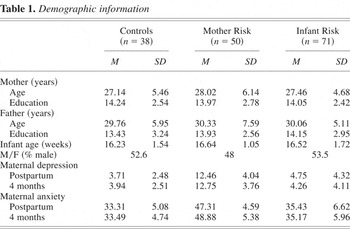
Demographic information for the three groups (controls, mother risk, infant risk) is reported in Table 1 and show no differences in demographic factors across groups. As expected, differences emerged in maternal anxiety and depression scores at the two observations.
Demographic information

Procedure
Families were visited at home during the evening when both parents were home and the infant was expected to be fed and rested. In cases when the infant was asleep or very fussy, visits were rescheduled. Interactions included 5 min of each mother–infant and father–infant interaction (counterbalanced). Following the two interactions, a triadic family session was videotaped. Instructions were “play with your infant as you normally do.” No toys were provided, and some families used their own toys. Following play, parents completed a battery of self-report measures.
Measures
BDI
The BDI (Beck, 1978) is a widely used 21-item instrument that measures the level of depressive symptoms on a 3-point scale. Internal consistency for this sample was .86. A score of 9 or above on the BDI indicates a dysphoric mood and marks an elevated risk for major depression (Kendall, Hollon, Beck, Hammen, & Ingram, 1987), and was used as a cutoff for the depressed group. Mothers in the depressed and comorbid group scored 9 or above (range = 9–33) on the BDI, and mothers in the other groups received a score below 9.
STAI
This well-validated 40-item instrument (Spielberger et al., 1970) uses separate scales to measure stable individual differences in anxiety proneness (trait) and current states of anxiety. A score of above 43 on the trait anxiety subscale was selected as the cutoff, based on a community study of 1,076 women in the postpartum period. It was found that mothers scoring above 1 SD of the mean (M = 35.03, SD = 7.22) were at greater risk to develop anxiety-related disorders, as measured by a full psychiatric evaluation (Gilboa, Granat, Feldman, Kvint, & Merlov, 2004). Internal consistency for the current sample was .87. Mothers in the anxious and comorbid groups scored above 43 on the trait anxiety subscale of the STAI (range = 43–57), and mothers in the other groups received a score lower than 43.
Father involvement
Fathers and mothers rated the level of the father's involvement in childcare and household responsibilities. The childcare composite was averaged from six items, each rated on a scale of 1 (low) to 5 (high), addressing the frequency in which father plays, babysits, feeds, bathes and diapers, takes walks, and brings infant to medical checkups (α = .82). The household composite was based on five items, including the level of father's shopping, cleaning, washing dishes, doing laundry, and cooking (α = .79). The two scores were correlated (r = .73, p < .001) and averaged into a single score. The final Father Involvement composite for each family was the average of the mother's and father's scores (α = .77).
Parent perception of infant temperament
The Infant Characteristics Questionnaire (Bates, Freeland, & Lounsbury, 1979) consists of 24 items measured on a 9-point scale. The Fussy–Difficult factor was used in this study. Internal consistency was .78. Mothers' and fathers' scores were correlated (r = .55, p < .001) and averaged into a single score (α = .84).
Coding
Parent–infant interactions
Coding of parent–infant and family interactions were conducted using the Coding Interactive Behavior Manual (CIB; Feldman, 1998). The CIB is a global rating system with 42 codes each rated on a 5-point scale that are aggregated into several composites. The CIB has been validated in studies of healthy and at-risk dyads, and has shown sensitivity to infant age, biological and social–emotional risk, maternal psychopathology, and the effects of intervention (Feldman et al., 1997, 2001, 2003; Feldman, Eidelman, & Rotenberg, 2004; Feldman, Keren, Gross-Rozval, & Tyano, 2004). Composites, codes included in each composite, and internal consistency for the current sample were as follows:
- Parent sensitivity and responsiveness (mother α = .88, father α = .86). Parent acknowledgement of infant's signals, maintenance of visual contact, warm and positive affect, appropriate vocal quality, resourcefulness in handling infant distress or expanding the interaction, consistency of style, adaptation to infant changing states.
- Parent intrusiveness (mother α = .80, father α = .83). Parent's physical manipulation of infant's body, interruption of infant's activities, breaking gaze while infant is looking, disregard of infant's signals, parent leading the interaction.
- Infant involvement (mother α = .82, father α = .78). Infant initiates interactive bids, infant vocalizes, infant shows positive affect, infant looks at parent, interaction are judged to be infant led.
- Infant negative emotionality (mother α = .85, father α = .82). Infant shows fatigue and tiredness, infant emits fuss-cry vocalization, and infant withdraws.
- Dyadic reciprocity (mother α = .91, father α = .87). Dyad engage in give-and-take play, interaction is synchronous, dyadic style is rhythmic and fluent.
Coding was conducted by two coders, blind to group membership, who were trained to 90% agreement on all categories. Interrater reliability, measured on 25 families, averaged 93% (intraclass r = .92, range = .87–.98).
Triadic family interactions
Triadic interactions were coded with the CIB family codes in line with previous studies (Feldman et al., 2001, 2003). Codes address the family as a single unit and include 15 scales. Twelve scales described pairs of opposite family styles, and each opposite was coded separately on a scale from 1 to 5. These included avoidance–involvement, autonomy–intrusiveness, activity–passivity, cooperation–competition, creative play–didactic play, and parent-oriented interaction–infant-oriented interaction. Three additional codes addressed the family atmosphere: level of affect, mutual gaze, and use of toys.
Two constructs were identified on the basis of factor analysis (Feldman et al., 2001): cohesion and rigidity:
- Family cohesion (α = .84) included the following codes: family cooperation, autonomy, avoidance (negative), creativity, positive affect, and mutual gaze. The cohesive style describes a warm, involved, fluid, and affectively expressive family atmosphere, which is conducive for infant growth.
- Family rigidity (α = .78) included the following codes: family intrusiveness, competition, parent-directed interaction, and didactic play. The rigid style describes an atmosphere of little freedom, parental continuous “teaching” or “on-task” persistence, attention is often paid to one parent or to the relationship between parents, and there is typically a sense of competition, interruption, and little harmony between family members.
Coding was conducted by three graduate students in psychology following extensive training in the CIB coding system. Reliability was conduced for 21 mother–child interactions, 21 father–child interactions, and 21 family interactions (seven of each controls, mother-risk, and infant-risk sessions). Interrater reliability averaged 92% (intraclass r = .91, range = .84–.95) with no score lower than 90% agreement. The mother–child, father–child, and family interactions were transferred to different tapes and each set of interactions was coded by a different coder to avoid a carryover effect. Coders were blind to the family's group membership.
Results
The results are reported in four sections. In the first, group differences in dyadic and triadic relational patterns are examined. Group differences were testes with multivariate analyses of variance (MANOVAs) with group (controls, mother-risk groups, infant-risk groups) and infant gender as the between-subject factors, followed by univariate analyses with post hoc Scheffé tests. In the second section, bivariate correlations between dyadic ant triadic relational patterns and the background variables were assessed. In the third, separate regression models were used to predict family patterns from individual and dyadic determinants for each group. In the final section, structural modeling was used to examine individual, dyadic, and triadic paths to the cohesive and rigid family styles.
Group differences in parent–child and family relational patterns
Mother–infant interactions
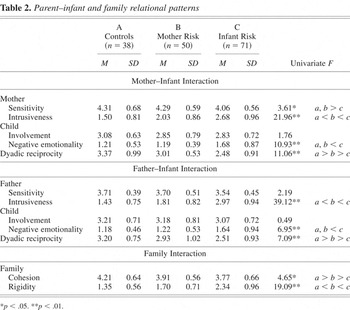
A MANOVA computed for the five mother–child interactive variables with group and infant gender as the between-subject factors revealed an overall main effect for group; Wilks' F (df = 10, 270) = 6.98, p < .001. Univariate tests with post hoc comparisons appear in Table 2.
Parent–infant and family relational patterns

As seen in Table 2, differences between the controls, mother-risk groups, and infant-risk groups were found for maternal intrusiveness and dyadic reciprocity, and the findings point to a linear decline pattern. Control mothers were more reciprocal and less intrusive than mothers in the mother-risk groups, who showed lower intrusiveness and higher reciprocity than those in the infant-risk groups. Infant negative emotionality and maternal sensitivity were less optimal in the infant-risk groups but no differences emerged between the controls and the mother-risk groups.
Father–infant interactions
A MANOVA computed for the five father–infant interaction variables revealed a similar overall main effect for group, Wilks' F (df = 10, 270) = 5.72, p < .001. Univariate tests appear in Table 2. Similar to the findings for mothers, group differences emerged for father intrusiveness and dyadic reciprocity in a linear decline pattern. Control fathers showed lower intrusiveness and higher reciprocity than fathers in the mother-risk groups, who were less intrusive and more reciprocal than fathers in the infant-risk groups. Infant negative emotionality was higher in the infant-risk groups and no differences emerged between controls and mother-risk groups.
Family interactions
A MANOVA computed for the two family factors, cohesion and rigidity, revealed an overall main effect for group, Wilks' F (df = 4, 276) = 3.47, p < .01. Univariate tests, presented in Table 2, indicate that family cohesion and rigidity both showed a linear decline pattern. Family cohesion was highest and rigidity was lowest in the control group, lower cohesion and higher rigidity was observed in the mother-risk groups, and the infant-risk families displayed the lowest cohesion and highest rigidity. No infant gender effects were found for the dyadic and triadic relational patterns.
Summary of group differences in parent–child and family patterns
In sum, mean level differences were found in parental intrusiveness and dyadic reciprocity in a linear decline pattern. Intrusiveness was lowest and reciprocity highest in control families, less optimal in the mother-risk groups, and the poorest in the infant-risk groups. Similar patterns were found for family cohesion and rigidity, which were the most optimal in the control families, less in the mother-risk groups, and least in the infant-risk groups. Other interactive variables showed differences only between the infant-risk groups and the other groups. Maternal sensitivity was lower in the infant-risk group, and child negative emotionality with both mother and father was highest in the infant-risk group.
Analyses of the differences within the risk groups revealed the following patterns. Within the mother-risk groups, depressed mothers scored lower than comorbid and anxious mothers on intrusiveness and were the least reciprocal. These findings point to the risk for intrusive parenting among anxious mothers and for extremely low reciprocity among depressed mothers. Within the infant-risk groups, mothers of IUGR infants scored the highest (of all six groups) on intrusiveness, the infants showed the highest negative emotionality, and the family atmosphere was most rigid. No differences were found in father–infant interaction within the mother-risk or infant-risk groups.
Bivariate correlations and regressions
To assess the associations between interactive patterns in the two parenting subsystems, correlations between the five interactive behaviors during mother–infant and father–infant interactions were computed. A medium level of stability was detected and correlations were as follows: sensitivity, r = .30, p < .001; intrusiveness, r = .51, p < .001; infant involvement, r = .42, p < .001; infant negative emotionality, r = .68, p < .001; and dyadic reciprocity, r = .38, p < .001. These findings support the transactional perspective that postulates mutual influences between the mothering and fathering subsystems on early social behavior. Infant social involvement during parent–infant interaction was associated with maternal sensitivity (r = .28, p < .001) and paternal sensitivity (r = .31, p < .001), pointing to the child's contribution to the dyadic system.
In light of the high correlations between infant negative emotionality in mother–infant and father–infant interactions, the five infants who were highly negative (a score of 4.5 or more in one or more sessions) were excluded from the following analyses. However, when controlling for infant negative emotionality, the correlations between interactive patterns during mother–child and father–child interactions remained essentially unchanged, suggesting that the stability in relational patterns is unrelated to infant negative emotionality.
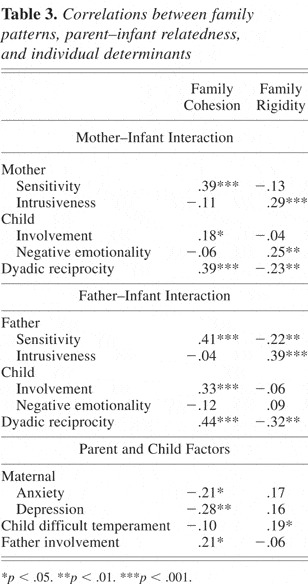
Bivariate correlations between the two family constructs (cohesion and rigidity) with maternal and paternal interactive behavior and individual determinants appear in Table 3.
Correlations between family patterns, parent–infant relatedness, and individual determinants

As seen, family cohesion correlated with higher maternal and paternal sensitivity, with higher infant involvement with mother and father, and with higher mother–child and father–child reciprocity. Higher family cohesion was also related to lower maternal anxiety and depression and to higher father involvement. The rigid family style was associated with higher maternal and paternal intrusiveness, with higher infant negative emotionality during mother–infant and father–infant interactions, and with lower dyadic reciprocity with mother and father. Family rigidity was also associated with higher maternal anxiety and with a more difficult infant temperament. These data support the family systems' notions on the associations between the various dyadic subsystems in the family and the higher order process.
Predicting family cohesion and rigidity in the three groups
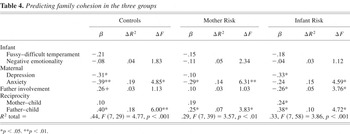
The next set of analyses evaluated whether a similar pattern of associations is found between the individual, dyadic, and triadic systemic levels in cases of mother-risk, child-risk, and control families. Hierarchical multiple regressions were used to predict family cohesion from individual and dyadic patterns, and regressions and were computed separately for each group. In each model, the first block included the infant measures: parent reported fussy–difficult temperament and observed negative emotionality; the second block included maternal anxiety and depression averaged from the postbirth and 4-month scores, the third block included father involvement, and the final block included mother–child and father–child reciprocity, the dyadic measure hypothesized to have the greatest contribution to family cohesion. Results of the three models are presented in Table 4.
Predicting family cohesion in the three groups

Results of the three models demonstrate that, in the main, similar factors predicted family cohesion in the three groups, indicating that the contributors to family-level cohesion are similar across groups. In each group, the maternal anxiety and depression block was negatively related and the parent reciprocity block was positively related to family cohesion. In the infant-risk group, father involvement had an additional contribution to the prediction of family cohesion. To test the hypothesis that there was no difference in the magnitudes of the beta coefficients between groups, Cohen and Cohen's (1983) method was used. The largest difference in the beta coefficients between groups was in the prediction from maternal depression to family cohesion between the infant risk and mother-risk groups. Examination of the differences between the magnitudes of these coefficients yielded a Fisher Z value of 0.916, which is smaller than the 1.96 value required for significance at the p < .05 level.
The next set of regressions examined the predictors of family rigidity for the three groups. Similar predictors were used except for the last step, which included maternal and paternal intrusiveness as predictors of family rigidity. Again, similar predictors emerged in the three groups. The infant negative emotionality block, the maternal emotional distress block, and the parent intrusiveness block each explained unique variance in family rigidity. These findings suggest that similar factors operating at the individual and dyadic levels contribute to the formation of the family style in families of low risk, mother-related risk, and child-related risk. Examination of the beta coefficients showed no significant differences between the coefficients in the three groups.
Structural modeling: Individual, dyadic, and triadic influences on the family process
The findings reported in the third section, indicating similarities in the predictors of family-level constructs across groups, suggest that the data can be collapsed across groups to examine pathways to the family relational patterns in the entire sample. Structural modeling was used to test the theoretical model on the individual, dyadic, and triadic influences on the family process. Analyses were computed with the AMOS 4 program (Arbuckle & Worthke, 1999), using the maximum likelihood estimation method. Five indices were used to assess the model fit; the chi-square statistic and the goodness-of-fit index (GFI) examine the general fit of the model. The adjusted GFI (AGFI) considers the model's adaptiveness taking into account the degrees of freedom, and the normed FI (NFI) provides an index for the relations between the proposed model and an independence model that assumes no associations between the variables in the model. Finally, the root mean square error of approximation (RMSEA) provides an index of model parsimony. A nonsignificant chi square; a GFI, AGFI, and NFI of .90 or above; and a RMSEA of .05 or below indicate a close fit of the model to the data (Byrne, 2001).
Structural Model 1
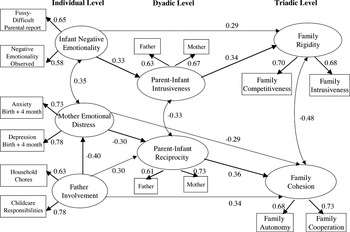
As a first step, a model was constructed (Model 1) which tested the fit to the data under the assumption that individual determinants impact on the family process through their effect on the dyadic level. In this model, therefore, no direct links between the individual and triadic levels were charted. Links were charted on the individual level from father involvement (a latent construct including father involvement in household and childcare) to maternal emotional distress (a latent construct including maternal depression and anxiety) and bidirectional links were charted between maternal emotional distress and infant negative emotionality (the latent construct including parent reported infant difficulty and the observed infant negative emotionality construct). Individual to dyadic links were charted between father involvement and maternal emotional distress to the latent construct of parent reciprocity, which included maternal and paternal reciprocity. Similarly, individual to dyadic influences were charted between infant negative emotionality and the latent construct of parent intrusiveness, including maternal and paternal intrusiveness. Dyadic to triadic paths were charted between dyadic reciprocity and the latent factor of family cohesion, which included the variables with the highest loading on family cohesion (family autonomy and family cooperation), and between parent intrusiveness and the latent construct of family rigidity (including family competition and family intrusiveness). Results of the structural model indicate that the model provided an acceptable, but not a good fit to the data: χ2 (df = 45) = 57.23, p = .08, GFI = .90, AGFI = .87, NFI = .85, RMSEA = .081, with the chi-square statistic marginally significant and the RMSEA above .05 (Byrne, 2001).
Structural Model 2
To improve the fit of Model 1, Model 2 included three additional individual to triadic paths, which tested the hypothesis that individual determinants have a direct influence on the family process, in addition to influence mediated through the dyadic level. The three additional paths included a path between infant negative emotionality and family rigidity, a path between maternal emotional distress and family cohesion, and a path between father involvement and family cohesion. Results of the structural model indicate that Model 2 provided an excellent fit to the data: χ2 (df = 42) = 32.57, p = .51, GFI = .95, AGFI = .93, NFI = .92, RMSEA = .036. This model was a significant improvement over Model 1; Δχ2 (df = 3) = 22.33, p < .001. All paths with β values above .25 are significant at p < .05, and the model is presented in Figure 1.

Model 2 standardized coefficients indicating paths between the individual, dyadic, and triadic levels on family cohesion and rigidity. Paths are charted on the individual level from father involvement to maternal emotional distress and bidirectionally between maternal emotional distress and infant negative emotionality. Individual-to-dyadic influences are charted from maternal emotional distress and father involvement to dyadic reciprocity and from infant negative emotionality to parental intrusiveness. Dyadic-to-dyadic links are charted between dyadic reciprocity and parental intrusiveness. Dyadic-to-triadic links were charted from dyadic reciprocity to family cohesion and from parental intrusiveness and family rigidity. Triadic-to-triadic links are charted between family cohesion and rigidity. Finally, individual-to-triadic links are charted between father involvement and maternal emotional distress with family cohesion and between infant negative emotionality and family rigidity. Beta coefficients above .25 are significant at p < .05; χ2 (45) = 32.57, p = .51, GFI = .95, AGFI = .93, NFI = .92, RMSEA = .036.
Results of the structural model indicate that father involvement had an influence on decreasing the mother's emotional distress. Father involvement and maternal emotional distress each showed an individual to dyadic influence, by impacting on dyadic reciprocity, as well as an individual to triadic effect, by enhancing family cohesion. A similar pattern emerged for the relation of infant negative emotionality and dyadic and triadic intrusiveness. Infant negative emotionality impacted on parental intrusiveness and had an additional direct impact on the level of family rigidity. Within-level bidirectional influences were found on the dyadic level, between reciprocity and intrusiveness, and on the triadic level, between family cohesion and rigidity.
Discussion
This study examined the emergence of mother–infant, father–infant, and family relational patterns in five groups of high-risk families. Developmental risk in these families was observed immediately after birth; in the mother-risk groups, mothers showed symptoms of anxiety or depression already at the second postbirth day, and in the infant-risk groups, infants were born prematurely with or without additional intrauterine growth retardation. Furthermore, all families were at the sensitive stage of the transition to parenthood; hence, the family process developed in the context of risk from the start. The methodology used in this study was also unique in its choice to separate groups of mother-related risk from those of child-related risk and assess their differential impact on the parent–child and family relationships. By applying the same experimental design to separate matched cohorts, the results can thus illuminate specific disruptions to the parenting and family systems under different risk conditions and specify the focus for intervention. It is important to note, however, that families were observed at one time point and parent–infant and family interactions were relatively brief, adapted to the attentional capacities of 4-month-old infants. The findings, therefore, need replication and longitudinal evaluation to assess whether the reported disruptions to early relationships are transitional or long lasting.
Mean-level analyses revealed a consistent linear decline pattern, with control families scoring most optimally, mother-risk groups scoring lower, and infant-risk group showing the poorest relational quality on the dyadic and triadic measures. This pattern was especially notable for dyadic reciprocity and parental intrusiveness. Reciprocity and intrusiveness are systemic constructs that assess the degree of coordination within the social system and the parent's adaptiveness to the child's pace and rhythms. Possibly, maternal and child risk conditions disrupt these systemic processes to a greater extent as reciprocity and intrusiveness index the more complex, interpersonal, and dynamic features of the relational unit. On other constructs, such as sensitivity and infant negative emotionality, differences were observed only between the infant-risk groups and the other groups, indicating that the interactions between infants at biological risk and their parents is compromised on most domains of early social relatedness.
One reason for the more optimal relationships in the mother-risk groups may relate to the buffering effect of the father. The associations between the infant's social involvement with mother and father with the parent's interactive sensitivity as well as the stability in the infant's social involvement between the two sessions may suggest that one mechanism by which fathers provide a buffer is by increasing the infant's social responsiveness. Fathers in this study were screened for anxiety and depression, and families were intact and of low-risk background, and this choice was made to tease apart the effects of maternal emotional distress from the confounding effects of single parenthood, poor social support, and low socioeconomic status (SES). Such sample composition may explain the differences between the present findings and those of Field (1992), who found low social involvement among infants of depressed mothers. In Field's studies, however, mothers were mainly young, single, and of low SES, and the findings for depression are confounded by the findings for contextual risk. Similarly, van IJzendoorn, Goldberg, Kroonenberg, and Frenkel (1992), in a meta-analysis of attachment classifications in samples of mother-related risk and child-related risk, showed more deviant attachment classifications in the mother-risk groups. Again, the mother-risk samples often consisted of mentally ill women of high contextual risk, whereas the child-risk groups typically included middle-class pediatric samples. It is thus possible that in cases of intact families, where fathers are relatively undistressed, the father–child relationship may provide an opportunity for a healthy parenting system that attenuates the effects of maternal emotional distress to some extent. The present findings are consistent with those reported for low-risk samples (e.g., Murray & Cooper, 1997; Weinberg & Tronick, 1998), which showed that maternal depression decreases the reciprocity component of early social relationships. Future research is thus required to separate the effects of maternal anxiety and depression from those of contextual risk on the infant's ultimate social–emotional growth.
When infants show dispositional dysregulation and display high levels of negative affect, as was the case among infants at biological risk, both the mothering and fathering systems are compromised. In trying to engage infants with low self-regulation, inconsistent attention, limited social engagement, and unclear communicative signals, parents often resort to intrusive tactics (Minde, 2000), and the present data point to a similar pattern. The direct influence of infant negative emotionality on family rigidity, above and beyond its impact on dyadic intrusiveness, underscores the persistent effects of infant dysregulation on any relational context. Interventions directed to families of children born at biological risk should thus focus on both the parent–child and family relationships and address the intrusive component of early social systems.
Results of the regression models predicting family cohesion and rigidity in the three groups suggest that similar factors contribute to the formation of the family process in families of high and low risk and when the risk is mother related or child related. Thus, it appears that maternal and child risk shape the family system primarily through their impact on increasing or decreasing specific systemic components at the various levels rather than by altering the pattern of associations between the determinants of the family process. Such findings may extend current theoretical models on the family system at its initial stages of development. Consistent with the formulations of the family system's theory (Minuchin, 1974) and its application to clinical use (e.g., McHale & Fivaz-Depeursinge, 1999), the data may suggest that even minor differences in the system's individual or dyadic components may lead to substantial differences in the level of family functioning. These findings, however, require much further study and replication in families of different stages, cultures, and developmental risks. It is possible that among highly maladaptive families, such as abusive families or families at high contextual risk, the pattern of associations between factors is substantially altered, in addition to differences in the system's individual and dyadic components.
The structural model showed significant influences between each level of the family system and the next as well as within each level. It appears that already at the first months of parenting the family system functions as a microecology that is dynamically assembled from components at each ecological level: child, parent, dyad, and triad (Sameroff, 1997). Of interest, influences between each level and the next were pattern specific, emphasizing the links between specific risk conditions and specific behavioral patterns. These pattern-specific influences then impacted on other relational patterns by means of same-level influences. For instance, maternal emotional distress had an impact on parental intrusiveness through its effect on decreasing dyadic reciprocity, which in turn, led to higher intrusiveness. Similarly, infant negative emotionality had an influence on dyadic reciprocity by means of increasing the parent's tendency to stimulate the child, regardless of his or her readiness or cooperation. Consistent with research on maternal depression and mother–infant synchrony (Feldman, 2003; Field et al., 1990), the effects of maternal emotional distress on dyadic and triadic interactions were specific to the reciprocal component of early relationships. Such findings are in line with theoretical positions suggesting that the central risk of growing with a depressed mother is the restriction of the infant's later capacity for intimacy (Stern, 1995). These findings may direct interventions for children of depressed mothers to enhancing the capacity for interpersonal reciprocity, both within intimate relationship and in larger social networks.
As seen from the structural model, risk and protective factors originating in the mother, father, or child influenced the family in two ways: by shaping dyadic relationships, which in turn, impacted on the family system, and by exerting a direct impact on the family process. The findings, therefore, support the aforementioned theoretical models on family development as consisting of a network of mutual, hierarchically organized influences (Belsky, 1981; Cowan & Cowan, 2002; Parke & Tinsley, 1987). According to these models, the family process is formed by the individual characteristics of each member as well as by the various one-on-one relationships between dyads. Similarly, the findings are consistent with theoretical positions suggesting that one pathway by which maternal and child risk affect early development is through their impact on the child's rearing environment and its relational networks, both within intimate relationships and in larger social contexts (Miklowitz, 2004; Zenah, Boris, & Larrieu, 1997). In a similar vein, family resilience is thought to develop on the basis of protective factors within the individual as well as buffering relationships in the family, including older siblings or nondistressed adults (Hawley & DeHaan, 1996).
Father involvement had an impact on the individual level, by reducing maternal emotional distress, as well as on the triadic level, by increasing family cohesion. Father involvement is among the central buffers against maternal depression, anxiety, stress, and marital decline, and the effects of father involvement on maternal distress is especially high at the transition to parenthood (Belsky & Pensky, 1988; Feldman et al., 1997; Heinicke, 1984; Levy-Shiff, 1994; Ruble et al., 1988). In addition to sheer amount, the number of different childcare activities the father shares (e.g., feeding, playing, babysitting) is predictive of the infant's social competence (Feldman, 2000), suggesting that the range of the father's caregiving activities, in addition to the amount of time father spends with the child, is an important component of father involvement. Current models on father involvement emphasize the unique role of the father for optimal development (Tamis-LeMonda & Cabrera, 2002). The present findings extend these models to high risk families and underscore the multiple pathways by which father involvement contributes to family life during the first months of family formation.
Limitations of the study primarily relate to the fact that families were not seen longitudinally, to assess the long-term effects of maternal and child risk on the family process, and sessions with each parents and the triad were relatively short. However, most observational studies of infants' interactions with their caregivers at that age sample only a few moments of play, and such interactions were found to predict infant development in the cognitive and social–emotional domains (Feldman, Eidelman, et al., 2004; Jaffee, Beebe, Feldstein, Crown, & Jasnow, 2002). Future research is required to address the determinants of the family process at different stages of the life cycle and among families of different risk conditions, cultural contexts, and socioeconomic background. The evolution of the family into a coherent system from its discrete individual and dyadic components, particularly in the context of developmental risk, is an underresearched area that requires much further study. Better understanding of the family and its unique features may shed new light on the effects of the rearing context on the developing child.