





Background
Epidemiological, clinical, and experimental work supports the notion that the periconceptional environment, including biological, social, and structural factors that influence both maternal and paternal lineages, shapes long-term health trajectories. Reference Velazquez, Fleming and Watkins1–Reference Barker and Thornburg8 The evidence from these multiple bodies of work are gathered under an umbrella hypothesis called the Developmental Origins of Health and Disease (DOHaD). DOHaD aligns closely with the Social Determinants of Health (SDoH) framework in that both frameworks suggest key roles for the sociocultural and politico-economic environments in shaping human health, but where DOHaD suggests that the early life environment is likely more important than environmental exposures in other stages of the life course. Despite decades of observational and mechanistic studies that align with the main predictions of the DOHaD hypothesis, familiarity with and understanding of DOHaD concepts remain largely confined to academic institutions and researchers. Reference Tohi, Tu’akoi and Vickers9–Reference Jacob and Hanson13 There is an urgent need, however, for policymakers, practitioners, and the general public to become familiar with DOHaD and its implications for health. Reference McKerracher, Moffat, Barker, Williams and Sloboda11,Reference Hildreth, Vickers, Buklijas and Bay14 Current global socio-economic, geopolitical, and environmental conditions (e.g. rising food insecurity, increasing inequities in relation to class and racialisation, new climate change-related challenges) are contributing to more uncertain, more stressful developmental environments for the next generations, and multi-level policy, practice, and behavioural interventions are needed to meet the moment. Reference Hildreth, Vickers, Buklijas and Bay14
Knowledge translation (KT) is used to reduce the knowledge–practice gap and optimise the impact of research, resulting in the development of evidence-based programmes, policies, and practices, Reference McKerracher, Moffat, Barker, Williams and Sloboda11 and the communication of clear, accessible, and evidence-based health information. 15 Knowledge is critical in supporting individual level behaviour change. Reference Faries16 We have shown that pregnant individuals with greater DOHaD knowledge exhibit higher diet quality Reference McKerracher, Moffat and Barker17 and adolescents who participate in DOHaD education initiatives show increased engagement in health-promoting behaviours. Reference Bay, Mora, Sloboda, Morton, Vickers and Gluckman18 Despite the evidence, existing DOHaD KT efforts have had limited success.
Studies, including our own, consistently show that the public, health professionals, and policymakers have limited DOHaD awareness. Reference Tohi, Tu’akoi and Vickers9–Reference Jacob and Hanson13 This may be due to the oversimplification of the interplay between individual behaviours and broader social and structural determinants of health, Reference Penkler19 which unintentionally place burden on pregnant individuals for the health of the next generation. Reference McKerracher, Moffat, Barker, Williams and Sloboda11,Reference Richardson, Daniels and Gillman20 Past DOHaD KT efforts have failed to build the motivation and confidence required to support sustained behaviour change. Reference Hildreth, Vickers, Buklijas and Bay14,Reference Bay, Mora, Sloboda, Morton, Vickers and Gluckman18,Reference Woods-Townsend, Leat and Bay21,Reference Molinaro, Evans, Regnault and de22 Without intentional, equity-focused dissemination strategies, DOHaD knowledge remains inaccessible to those most affected by social and structural inequities. Researchers have thus called for novel, multipronged KT strategies which reflect the complexity of DOHaD and meaningfully engage diverse audiences. Reference McKerracher, Moffat, Barker, Williams and Sloboda11,Reference Hildreth, Vickers, Buklijas and Bay14
One promising KT approach to communicate DOHaD concepts is arts-based knowledge translation (ABKT). Reference Chin, Dickinson, McKerracher, Barker, Dombrowski and Sloboda23 ABKT has the same goals as traditional KT methods but disseminates information through the creation or presentation of visual and/or performing artworks. Reference Kukkonen and Cooper24 This approach can communicate complex health messages in accessible and emotionally resonant ways, transcending cultural and literacy barriers, and fostering critical reflection and community dialogue. Reference Fancourt and Finn25–Reference Eaves29 Previous research has identified these characteristics as factors that may enhance DOHaD KT’s ability to promote the value of community-based health promotion. Reference McKerracher, Moffat, Barker, Williams and Sloboda11,Reference Hildreth, Vickers, Buklijas and Bay14 Thus, in the current study we set out to conduct both process and outcomes evaluations of the implementation of a public-facing ABKT initiative to translate DOHaD concepts. We aimed to examine the feasibility, acceptability, and impact of a travelling art exhibition designed to engage the public with DOHaD-related concepts.
Methods
The Art of Creation Study
The Art of Creation Exhibition (referred to herein as the Exhibition) is part of an ongoing multicomponent ABKT programme, The Art of Creation Study. The Art of Creation (AoC) is a collaborative research and KT programme between a university laboratory conducting DOHaD research (Sloboda Lab, McMaster University) and a community art gallery (The Art Gallery of Hamilton). The AoC aims to increase awareness of DOHaD amongst the public, policymakers, and social and healthcare workers and support the development of healthy environments before and during pregnancy by fostering emotional and cognitive engagement through art activities (www.artofcreationstudy.com).
Logic model and programme theory
The logic model articulating the AoC’s theoretical foundation informed the Exhibition’s design and guided the selection of outcomes for evaluation (Fig. 1). Grounded in principles of ABKT and health promotion, the model reflects a synthesis of public health evidence and community-identified needs. Our model identified three core problems: (1) lack of public unawareness of DOHaD, (2) inadequate preconception community support, and (3) limited preconception preparation among childbearing parents. The model features several programme inputs including interdisciplinary collaborations between DOHaD scientists, artists/arts educators, local cultural and social institutions, and local families. These inputs enable: (1) the co-development of artworks representing DOHaD science, (2) participatory artmaking with pregnant individuals and community members, and (3) public exhibitions and outreach in cultural and community institutions. These activities were designed to partly address the core problems by increasing public awareness and emotional engagement with DOHaD concepts, supporting preconception preparation, and fostering community dialogue. Long-term goals in our model included improved preconception health, greater societal support for early life health, and increased use of cultural institutions for health education.
Logic model for the Art of Creation (AoC) Study programme. This logic model outlines the theory of change underpinning the AoC Study programme, which uses arts-based strategies to increase public understanding of the Developmental Origins of Health and Disease (DOHaD), promote individual preconception preparation, and strengthen community support. It maps the relationships between identified public health needs, programme resources and activities, and anticipated short-, medium-, and long-term outcomes. Elements specifically relevant to the formation of the AoC Exhibition evaluated in this study are indicated in blue boxes.

Figure 1. Long description
A logic model for the Art of Creation Study programme. The model is structured into several columns: Problem, Needs, Evidence Base, Resources, Activity, and Outcomes, which are further divided into Short-term, Medium-term, and Long-term outcomes. The Problems column lists issues such as public unawareness of Early Origins science, lack of preparation for pregnancy, and insufficient community support. The Needs column outlines the requirements to address these problems, such as effective communication of science and community support. The Evidence Base column highlights the use of art and cultural institutions to communicate science and support health improvements. The Resources column lists the involved parties, including scientists, artists, educators, healthcare providers, and women. The Activity column details actions like developing art materials and creating exhibitions. The Outcomes column shows the expected results, divided into short-term, medium-term, and long-term outcomes, such as community use of art galleries, increased awareness, and improved preconception health. Elements relevant to the AoC Exhibition are highlighted in blue boxes.
The Art of Creation Exhibition
Our travelling Exhibition consists of a selection of artworks obtained from the AoC’s Artist Residency Program, participatory artmaking with pregnant individuals, and scientific histological images (Supplemental 1). All artworks were curated to form the basis of the Exhibition which aimed to increase public understanding of DOHaD and provide opportunities to reflect on the determinants of health.
Artist residency programme artwork
Seven professional artists participated in the AoC’s Artist Residency Program (Supplemental 2). The Residency Program comprised four one-hour visits to a university laboratory conducting DOHaD-based research, where artists observed the research process, asked questions, and discussed findings with scientists. Afterwards, artists were asked to create a piece of art based on their observations and interactions that reflected a message that they felt was particularly meaningful. Importantly, these messages were derived from the artists’ interpretation of the science observed in the laboratory, rather than directed by the research team. The artworks included spoken word, visual and installation art, dance, and sculpture (Supplemental 1).
Artwork created by pregnant participants
The AoC Study programme engaged in arts-based focus groups with pregnant individuals where a study facilitator prompted conversations about pregnancy health while an experienced arts educator led participants through art making to prompt creative reflection on their pregnancy experiences. During these sessions, participants could be photographed by a professional photographer. Three artworks were created in response to this process: 1) a collage of photographs of the participants in different stages of their pregnancies, 2) a collage of participants’ quotations and artworks, and 3) an artwork created by the arts educator/artist who facilitated the focus groups that shared her facilitation experience (Supplemental 1).
Scientific artwork
The two scientific ‘artworks’ exhibited were histological sections of a mouse embryo and a mouse testis created by the university laboratory (Sloboda Lab, McMaster University, Supplemental 1).
Exhibition setting and sites
The Exhibition was shown throughout the City of Hamilton, Ontario, Canada, a mid-sized city with a population of 569,353. 30 It is a statistically average Canadian city in terms of age structure, educational attainment, commutability, immigration, visible minority representation, and housing tenure; Reference Shkolnik31 however, pronounced neighbourhood-level differences in income and education levels contribute to geographical differences in health outcomes, including life expectancy. 32,Reference DeLuca, Buist and Johnston33 We intentionally brought the Exhibition to different Hamilton neighbourhoods and venues to reach these diverse communities. At each location, the Exhibition was curated in consultation with location representatives to best suit community needs.
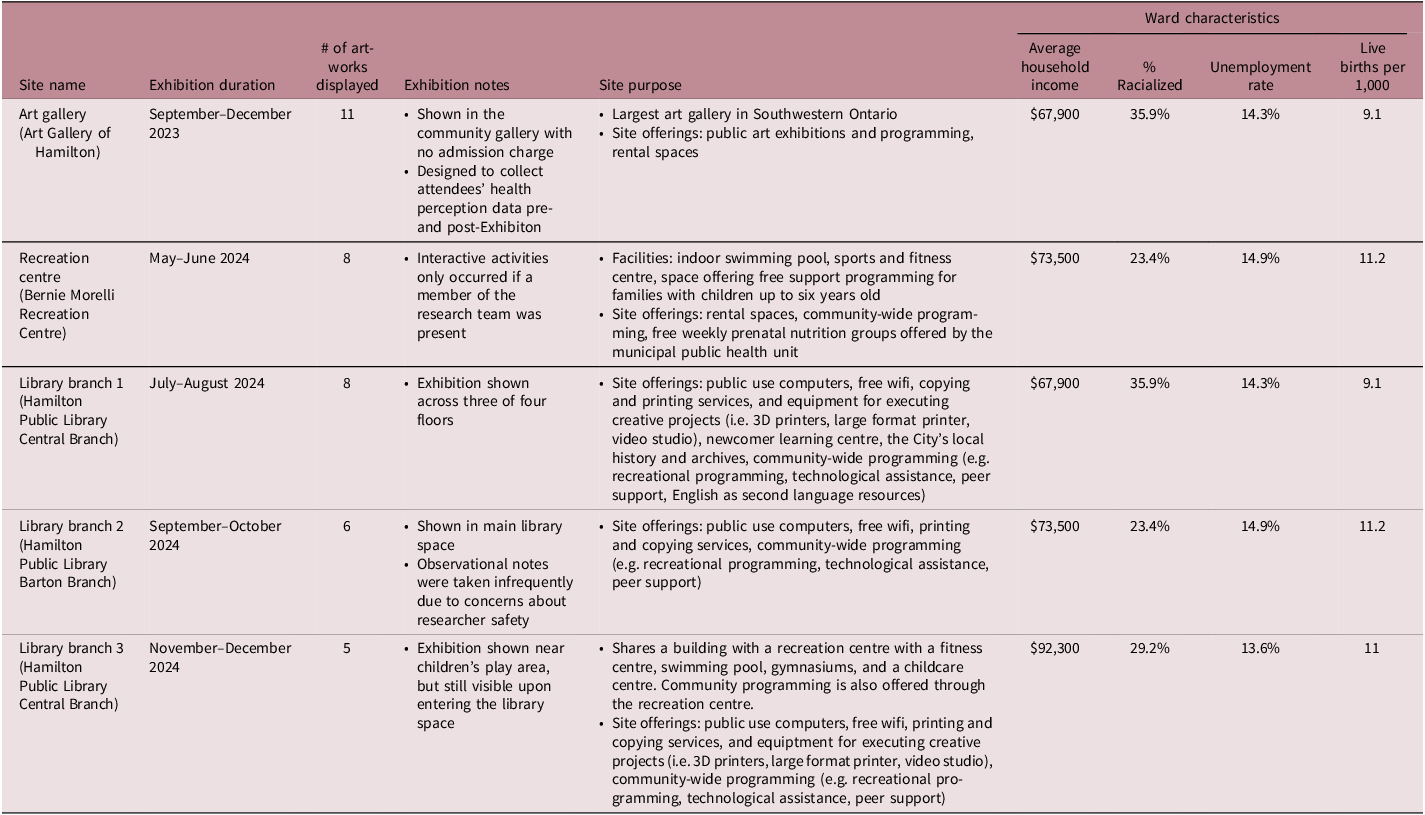
The Exhibition was shown at an art gallery, a recreation centre, and three libraries from September 2023 to December 2024. The five sites varied by usage and population demographics according to data obtained from Open Hamilton, the City of Hamilton’s open data portal which provides publicly available municipal datasets for research and public use (Table 1). 34 Exhibition sites were broadly categorised into a gallery site, where visitors intentionally entered the space to view artwork, and community sites, where visitors entered the space for other programming and were not primed to interact with artwork. The Art Gallery and Library Branch 1 are located in a lower-income, ethnically diverse urban core. 34 However, because the Art Gallery is the largest in Southwestern Ontario and Library Branch 1 offers a broad range of programmes and services, these sites attract visitors from beyond the immediate ward. Library Branch 3 serves a higher-middle income suburban ward. 34 The Recreation Centre and Library Branch 2 serve a lower-middle income urban ward with the highest unemployment rate across sites (Table 1). 34 However, this ward’s income statistics misrepresents the visible signs of poverty surrounding Library Branch 2. Reference MacPhail35
Descriptions of Exhibition sites and their demographic characteristics

Table 1. Long description
Table with five rows and eight columns. Columns are Site name, Exhibition duration, Number of artworks displayed, Exhibition notes, Site purpose, Average household income, Percentage racialized, Unemployment rate, and Live births per 1000. Row 1: Art gallery (Art Gallery of Hamilton), Hamilton, 11, Shown in the gallery with no admission fee, Designed to collect attendee perception data pre and post exhibition, 67900, 35.9 percent, 14.3 percent, 9.1. Row 2: Largest art gallery in Southwestern Ontario, Southwestern Ontario, 67900, 35.9 percent, 14.3 percent, 9.1. Row 3: Recreation centre (Bernie Morelli), May-June 2024, 8, Interactive activities only occurred if a member of the research team was present, 573500, 23.4 percent, 14.9 percent, 11.2. Row 4: Facilities: indoor, swimming pool, sports and fitness centre, childminding services, free support programming for families with children up to 6 years old, Site offerings: rental spaces, community-driven programming, free weekly prenatal nutrition groups offered by the public-health unit, 573500, 23.4 percent, 14.9 percent, 11.2. Row 5: Library branch 1 (Hamilton Public Library Central Branch), July-August 2024, 8, Exhibition shown across three of four floors, Site offerings: public use computers, free wifi, copying and printing services, and equipment for executing creative projects (i.e. 3D printers, large format printer, video studio), newcomer learning centre, the City’s digital literacy and archive, community-wide programming (e.g. recreational programming, author readings, language exchange, peer support, English as second language resources), 67900, 35.9 percent, 14.3 percent, 9.1. Row 6: Library branch 2 (Hamilton Public Library Barton Branch), September-October 2024, 6, Shown in main library space, Site offerings: public use computers, free wifi, copying and printing services, and equipment for executing creative projects (i.e. 3D printers, large format printer, video studio), newcomer learning centre, the City’s digital literacy and archive, community-wide programming (e.g. recreational programming, author readings, language exchange, peer support, technological assistance, peer support), 73500, 23.4 percent, 14.9 percent, 11.2. Row 7: Library branch 3 (Hamilton Public Library Central Branch), November-December 2024, 5, Exhibition shown near children’s play area, but still visible upon entering the library space, Site offerings: public use computers, free wifi, copying and printing services, and equipment for executing creative projects (i.e. 3D printers, large format printer, video studio), newcomer learning centre, the City’s digital literacy and archive, community-wide programming (e.g. recreational programming, author readings, language exchange, peer support, technological assistance, peer support), 92300, 29.2 percent, 13.0 percent, 11.
Data collection
Data were collected using survey-type interactive activities, observational notes, QR code analytics, and team member reflections. The study protocol and all instruments were approved by the Hamilton Integrated Research Ethics Board, protocol #16467.
Interactive data collection activities
Interactive activities were integrated into the Exhibition at each site to facilitate participant reflection on health determinants and to obtain structured feedback. We chose to use interactive activities for evaluation because previous ABKT studies that used traditional evaluation methods (e.g. surveys) have shown low response rates. Reference Watfern, Triandafilidis and Vaughan36–Reference Boardman, Clark, Buck and Hundt38 We were also concerned that such methods may disproportionately capture the views of highly opinionated individuals rather than the broader public who we aimed to assess. The activities were co-developed over several months through collaboration between the research team and artists/arts educators. Prompts for each data collection activity were developed based on terminology and constructs used in our prior studies assessing public DOHaD understanding Reference McKerracher, Moffat and Barker17,Reference Woods-Townsend, Leat and Bay21 because no validated instruments existed at the time for assessing DOHaD-related knowledge (Supplemental 3). Since the Exhibition was adapted, in consultation with site staff, to the characteristics of each site, such as space availability and patron interests and characteristics, the design and inclusion of interactive activities followed an iterative process. Consequently, some of the content and format of interactive activities varied across sites (see below).
Interactive activities included:
-
• Written feedback to a prompt asking attendees how the Exhibition made them feel and any additional comments or questions. This activity was incorporated at all locations.
-
• A budgeting task where attendees were given five tokens to allocate across three health-influencing domains (individual behaviours, environmental and opportunity-based factors, and parental periconception health) in response to the prompt: ‘What determines your health?’ This activity was incorporated at all locations.
-
• A categorical section activity where individuals were presented with three coloured balls representing factors that influence their health: blue (representing individual behaviours), orange (representing environmental and opportunity-based factors), and pink (representing parental periconception health). Participants were instructed to select up to one ball of each colour (maximum of three balls total) to indicate which factor(s) they believed influenced their health. This activity was present only at the Art Gallery location.
-
• A categorical response task where attendees used a sticker to indicate their agreement (agree, disagree, or unsure) to a prompt asking whether their health is influenced by their parental periconception health. This activity was incorporated only at the library locations.
Observational notes
Observational notes were taken during two-hour intervals on each day that the Exhibition was open to the public at four out of the five sites. One library location was excluded due to safety concerns. Verbal and physical threats were made by library patrons to members of the research team and other library patrons; these patrons were also frequently observed using illicit substances within the library, escalating threatening behaviour. Observation periods were randomly scheduled to ensure coverage of each two-hour time block across all days of the week. These observations were collected on a standardised data collection form and captured the number of individuals who entered the space, their characteristics, patterns of Exhibition engagement, and contextual factors influencing attendance:
-
1. Visitor characteristics: For each individual who entered the Exhibition space, perceived demographic characteristics were recorded including age category (child (age 2–18 years), adult (19–64 years) or senior (65 years or older)), gender (man or woman), and race (racialized or Caucasian). Attendees under two years of age were excluded because only individuals aged two and older can engage with representations of concepts and ask questions about their environment. Reference Wilks, Gerber and Erdie-Lalena39 Perceived race was used in this study to emphasise how race is a socially constructed concept which impacts individuals’ living and lived experiences, including their health. Reference Smedley40 Attendance was also categorised as solitary, in pairs, small groups (three to four), or large groups (five or more).
-
2. Engagement with the Exhibition: For groups of three or fewer, each attendee’s behaviour in the space was recorded. For groups of four or larger, the behaviour of one randomly selected attendee within the group was recorded including: time spent viewing Exhibition components, number of artworks viewed, movement patterns, engagement with interactive activities, conversations/comments, photography of Exhibition components, and whether attendees read descriptions of the artwork and content of the Exhibition. Time spent viewing each Exhibition component was categorised using museum visitor tracking behaviour guidelines: Reference Serrell41 (a) passed within two metres of the component without looking, (b) glanced at the component for less than 2 s without stopping, (c) paused for 2–10 s with their feet planted and gaze directed at the component, or (d) stopped for more than 10 s with their feet planted and gaze directed at the component.
-
3. Contextual factors affecting engagement: These included concurrent events or programmes (e.g. public transportation strikes, artist talks), the date and time of observation, and the level of crowding.
Three training sessions were conducted to minimise observer and confirmation bias between the two research assistants collecting data. Research assistants independently recorded the same attendees’ demographics and behaviours, then resolved discrepancies by consensus. Attendee follow-up was not performed to confirm perceived demographics and inter- or intra-rater reliability was not calculated since our primary goal was to capture contextual observations.
QR code analytics
All artworks, with the exception of the collages of participants’ photos and quotations and artworks, and scientific artwork, were accompanied by a short description of the artist’s intentions and a QR code linked to a full artist statement (Supplemental 1). The Exhibition also contained QR codes that directed attendees to a website and video with more information about DOHaD. The number of times QR codes were scanned was recorded.
Reflexive documentation
Following each Exhibition, team members (JMC, SD, and DMS) retrospectively reflected on the decision-making dynamics and implementation challenges and facilitators. Email correspondence between team members and relevant community partners were reviewed to further contextualise implementation processes.
Data analyses
A parallel convergent mixed methods approach, where quantitative and qualitative data are simultaneously and independently collected and analysed before integrating the results, Reference Fetters, Curry and Creswell42 was used to analyse data on the acceptability, feasibility, and impact of the Exhibition. We defined feasibility as the practicality and adaptability of installing and sustaining the Exhibition in different public settings; Reference Moore, Audrey and Barker43 acceptability as public reception of the Exhibition including engagement with content and value placed on its format and goals; Reference Moore, Audrey and Barker43 and impact as the uptake of DOHaD concepts, intentions to apply the knowledge gained, and emotional responses to the Exhibition.
Quantitative data analyses
Descriptive statistics summarise the number of observed attendees, their perceived characteristics, and their behaviours and responses to interactive activities. To determine whether attendee understanding of health changed after viewing the Exhibition, observational data was used to identify attendees who completed the budgeting activity before viewing artworks and the categorial selection activity after viewing artworks. These attendees were then stratified into a low exposure group (those who viewed less than half of the artworks before completing the categorial selection activity) and a high exposure group (those who viewed half of the artworks or more before completing the categorial selection activity).
Three Firth-penalised multivariate logistic regression models were created examining the relationships between: artwork exposure and attendees’ agreement that lifelong health is impacted by (1) parental periconception health, (2) individual behaviours, and (3) environmental and opportunity-based factors. All models were adjusted for perceived participant characteristics. To assess whether participant characteristics differed between high and low artwork exposure groups, chi-square or Fisher’s exact tests were conducted. If the proportion of characteristics differed significantly between the groups, a sensitivity analysis was conducted. All quantitative analyses were conducted using R (version 4.2.1).
Qualitative data analysis
Conventional content analysis Reference Hsieh and Shannon44 was used to analyse attendees’ written feedback, transcripts of comments/conversations, reflections, and email correspondences. Google Translate was used to translate written feedback from other languages into English; all written feedback was included in analysis. Verbal feedback in languages other than English was not translated and was excluded from analysis. All qualitative data was first deductively categorised into themes of acceptability, feasibility, and impact. This was followed by inductive, iterative coding to identify emergent sub-themes. Reference Bingham45 To enhance rigour, a second researcher (GD) independently reviewed 10% of the dataset. Coding discrepancies were discussed and resolved through consensus to ensure consistency. Credibility was further supported through triangulation across data sources. All data were processed using NVivo 14.
Integration of findings
Following all analyses, data were integrated through narrative weaving, the integration of qualitative and quantitative data throughout the results rather than reporting each data type in isolation. Reference Fetters, Curry and Creswell42 Representative quotations were included to illustrate key themes, not just to support quantitative data. Particular attention was paid to areas of confirmation, discordance, and expansion. Reference Fetters, Curry and Creswell42
Results
Results are presented according to our predefined aims of assessing the Exhibition’s acceptability, feasibility, and impact. Sub-themes are presented within corresponding sections. While our logic model (Fig. 1) guided our project design and the selection of outcomes for evaluation, we acknowledge that external factors influencing outcomes related to the artistic and creative practices themselves is possible, but beyond the scope of this study. The presented results focus on evaluating the Art of Creation Exhibition as a KT tool for disseminating DOHaD-based science to the public.
Attendees’ characteristics and interactive data collection activity response counts
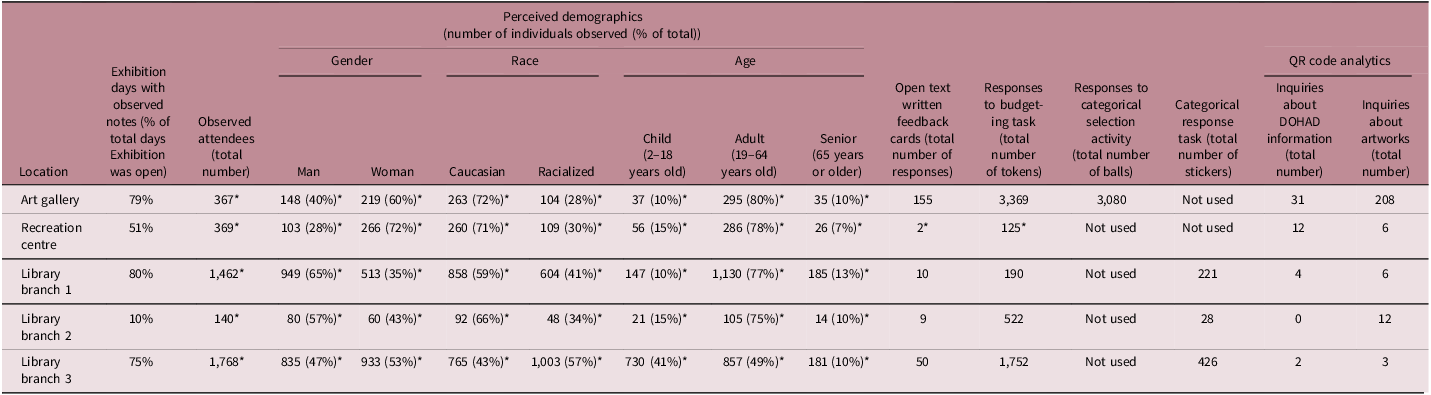
Depending on the site, observational data were collected on 10%–80% of the days the Exhibition was open (Table 2; 10% at Library Branch 2 and 80% Library Branch 1). Perceived participant demographics varied by site (Table 2). A larger proportion of racialized individuals were observed in community sites (29.5%–56.7%) compared to the Gallery site (28.3%). Age distributions were generally similar across sites, except for Library Branch 3 where more children were observed. Gender also varied across sites; more men and boys were observed at Library Branches 1 and 2 (65% and 57% of observed individuals, respectively), while more women and girls were observed at the Recreation Centre site (72% of observed individuals) (Table 2).
Attendees’ characteristics and interactive data collection activity response counts at each Exhibition site

Table 2. Long description
The table presents data on attendee demographics and interactive data collection activity response counts at various Exhibition sites. It includes columns for gender, race, age, open text feedback, responses to budgeting tasks, responses to categorical selection activity, categorical response tasks, inquiries about DOHAD information, and inquiries about artworks. The table has 5 rows and 11 columns. Row 1: Man, 148 (40 percent); Woman, 219 (60 percent); Caucasian, 263 (72 percent); Racialized, 104 (28 percent); Child (2-18 years old), 37 (10 percent); Adult (19-64 years old), 295 (80 percent); Senior (65 years or older), 35 (10 percent); Open text written feedback cards (total number of responses), 155; Responses to budgeting task (total number of tokens), 3,369; Responses to categorical selection activity (total number of stickers), 3,080; Categorical response task (total number of stickers), Not used; Inquiries about DOHAD information (total number), 31; Inquiries about artworks (total number), 208. Row 2: Man, 103 (28 percent); Woman, 266 (72 percent); Caucasian, 260 (71 percent); Racialized, 109 (30 percent); Child (2-18 years old), 56 (15 percent); Adult (19-64 years old), 286 (78 percent); Senior (65 years or older), 26 (7 percent); Open text written feedback cards (total number of responses), 2 asterisks; Responses to budgeting task (total number of tokens), 125 asterisks; Responses to categorical selection activity (total number of stickers), Not used; Categorical response task (total number of stickers), Not used; Inquiries about DOHAD information (total number), 12; Inquiries about artworks (total number), 6. Row 3: Man, 949 (65 percent); Woman, 513 (35 percent); Caucasian, 858 (59 percent); Racialized, 604 (41 percent); Child (2-18 years old), 147 (10 percent); Adult (19-64 years old), 1,130 (77 percent); Senior (65 years or older), 185 (13 percent); Open text written feedback cards (total number of responses), 190; Responses to budgeting task (total number of tokens), Not used; Responses to categorical selection activity (total number of stickers), Not used; Categorical response task (total number of stickers), 221; Inquiries about DOHAD information (total number), 4; Inquiries about artworks (total number), 6. Row 4: Man, 80 (57 percent); Woman, 60 (43 percent); Caucasian, 92 (66 percent); Racialized, 48 (34 percent); Child (2-18 years old), 21 (15 percent); Adult (19-64 years old), 105 (75 percent); Senior (65 years or older), 14 (10 percent); Open text written feedback cards (total number of responses), 9; Responses to budgeting task (total number of tokens), 522; Responses to categorical selection activity (total number of stickers), Not used; Categorical response task (total number of stickers), 28; Inquiries about DOHAD information (total number), 0; Inquiries about artworks (total number), 12. Row 5: Man, 835 (47 percent); Woman, 933 (53 percent); Caucasian, 765 (43 percent); Racialized, 1,003 (57 percent); Child (2-18 years old), 730 (41 percent); Adult (19-64 years old), 857 (49 percent); Senior (65 years or older), 181 (10 percent); Open text written feedback cards (total number of responses), 50; Responses to budgeting task (total number of tokens), 1,752; Responses to categorical selection activity (total number of stickers), Not used; Categorical response task (total number of stickers), 426; Inquiries about DOHAD information (total number), 2; Inquiries about artworks (total number), 3.
* Data only collected when study team member was present.
At all sites, data were collected through the budgeting task, written feedback stations, and QR code analytics although levels of participation varied according to site (Table 2). The categorical response task was only used at library sites (Table 2); participation varied according to library location.
Feasibility
We evaluated both the feasibility of installing and sustaining the Exhibition in different public settings and the feasibility of collecting data during the Exhibition.
Feasibility of installing a public ABKT initiative to disseminate DOHaD concepts
Between September 2023 and December 2024, the Art of Creation Exhibition was successfully installed in five sites across Hamilton, Canada: an art gallery, a recreation centre, and three public library branches.
Enablers to Installation: Supportive community partnerships, established through pre-existing relationships and targeted outreach, were essential to successful implementation and engagement across diverse settings. Shared values between the research team and community partners around communicating DOHaD concepts through art fostered meaningful, cross-sector collaborations. Collaborations helped researchers tailor the Exhibition to each site by providing insights into site-specific needs and local networks.
Challenges to Installation: The Exhibition’s installation was challenged by a lack of shared language and understanding between researchers and community partners. Researchers underestimated practical constraints like space use and security, while community partners were unfamiliar with research processes like ethics requirements. The Exhibition was also temporarily closed at some sites due to scheduling conflicts. Despite these challenges, collaboration was enabled through trust, patience, and relationship building, though this required substantial time commitments. Community sites required more adaptation than the Gallery, as artwork safety was difficult to maintain with limited security and public unfamiliarity with gallery norms (e.g. not touching artwork). To address this, AoC artists were consulted about exhibiting printed reproductions of their artworks. While most agreed, some declined over concerns about misrepresentation, ultimately reducing the number of artworks exhibited in the community settings (Table 1). To support cohesion and flow, Exhibition layouts were adapted collaboratively with community partners to suit each space, but in some sites space limitations constrained the number of artworks displayed and the overall flow of the Exhibition.
Feasibility of collecting research data during the ABKT initiative
We were able to collect data successfully at all sites, but some challenges limited the amount and quality of data collected. Community partners’ concerns regarding the security of interactive activities led to safeguards such as locked display boxes and restricting data collection to times when a research assistant was present. In some sites, space use and layout reduced the feasibility of collecting data. In sites where the Exhibition did not have a clear start and end point, it was difficult to gather data from participants before and after their Exhibition experience. Sites located near children’s play areas had low attendee adherence to data collection instructions, making data collection unachievable. Consequently, some interactive activity data were excluded from analysis.
In contrast, data collection using observational notetaking was highly feasible. Similarly, there were no feasibility concerns related to QR code analytics or written feedback.
Fidelity to data collection procedures
Since fidelity is critical for maintaining data validity, reliability, and reproducibility across sites, we evaluated adherence to specified data collection procedures. The greatest fidelity was observed for written feedback data collection, although the degree varied by site. 92% of written feedback at the Gallery site and 74% at community sites was related to attendees’ perceptions of the Exhibition. The majority (89%) of written feedback that was unrelated to the Exhibition was collected at Library Branch 3, likely due to the Exhibition being near a children’s play area. This unrelated feedback included nonsensical text and drawings of unrelated content. Our observational notetaking protocol had high fidelity; the documentation of behaviours determined a priori was consistent across dates and sites. In louder, busier environments (e.g. Library Branches 1 and 3), it was difficult to note attendees’ conversations and comments, limiting data quality and completeness. Interactive data collection activity protocols had low fidelity in both community and gallery sites; many attendees did not follow budgeting task, categorical selection activity, or categorical response task instructions. At the Gallery site, many attendees were observed completing post-Exhibition tasks before viewing artworks and contributing more responses than instructed at the categorical selection activity. Similar trends were observed at the library branches’ budgeting tasks and categorical response activities.
Acceptability
We investigated the public’s reception of the Exhibition, including engagement with Exhibition content and perceived value of its format and goals. Initially, to analyse attendee engagement data, we developed an engagement score but then disregarded the score as it was not consistent with observational data. Since there is no existing validated method for quantifying engagement in artistic disciplines, we have included details on the score and our interpretation of the results in Supplemental 4 to further discourse on this topic.
Acceptability of using ABKT in an art gallery
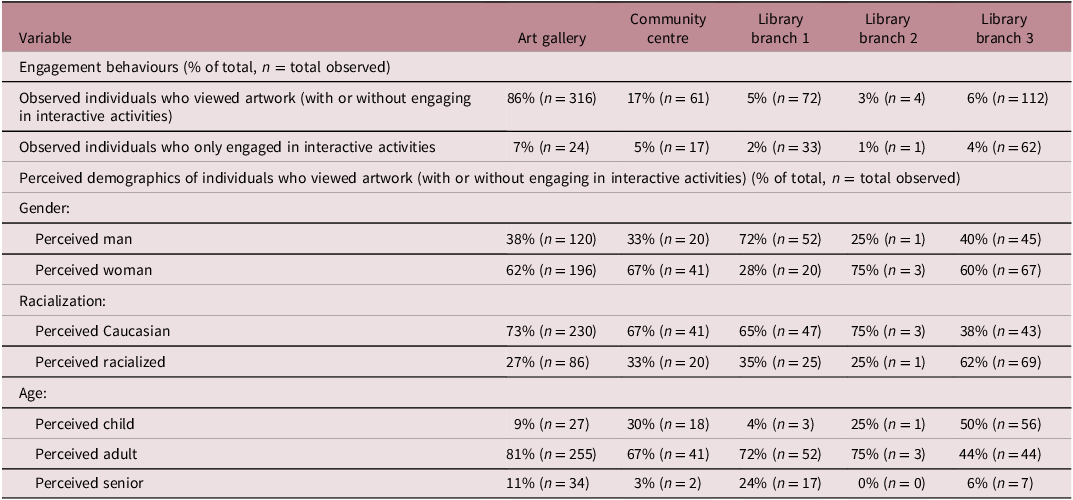
At the Gallery site, 93% of observed individuals viewed the Exhibition (Table 3). Attendees’ engagement varied; some briefly skimmed artworks and exited within a minute while others spent considerable time engaging with both the artworks and interactive activities. Among adults attending with children, some allowed children to explore freely and play with interactive activities while others used the opportunity to discuss DOHaD concepts. For example, one attendee reflected in the written feedback: ‘we discussed the concepts… [the children] know we all do not have the same starting line”’. 7% of observed individuals entered the Exhibition space without engaging with the Exhibition; most of these 7% were participating in other gallery programming or walking through the space.
Observed attendees’ engagement and perceived demographics by site

Table 3. Long description
A table comparing observed individuals’ engagement and perceived demographics by site. The table has 10 rows and 5 columns. The columns are labeled as follows: Observed individuals who only engaged in interactive activities, Perceived demographics of individuals who viewed artwork (with or without engaging in interactive activities) (% of total, n = total observed), Gender, Racialisation, and Age. The rows provide data for different sites. Row 1: Observed individuals who only engaged in interactive activities, 7% (n = 24), 5% (n = 17), 2% (n = 33), 1% (n = 1), 4% (n = 62). Row 2: Perceived man, 38% (n = 120), 33% (n = 20), 72% (n = 52), 25% (n = 1), 40% (n = 45). Row 3: Perceived woman, 62% (n = 196), 67% (n = 41), 28% (n = 20), 75% (n = 3), 60% (n = 67). Row 4: Perceived Caucasian, 73% (n = 230), 67% (n = 41), 65% (n = 47), 75% (n = 3), 38% (n = 43). Row 5: Perceived racialized, 27% (n = 86), 33% (n = 20), 35% (n = 25), 25% (n = 1), 62% (n = 69). Row 6: Perceived child, 9% (n = 27), 30% (n = 18), 4% (n = 3), 25% (n = 1), 50% (n = 56). Row 7: Perceived adult, 81% (n = 255), 67% (n = 41), 72% (n = 52), 75% (n = 3), 44% (n = 44). Row 8: Perceived senior, 11% (n = 34), 3% (n = 2), 24% (n = 17), 0% (n = 0), 6% (n = 7).
Attendees’ written feedback and verbal comments often expressed an appreciation of the artwork, describing artworks as ‘beautiful’, ‘powerful’, and ‘impactful’. Written and verbal feedback was received in multiple languages including Spanish, Mandarin, Korean, and Italian, reflecting the Exhibition’s cross-cultural resonance. The Gallery’s ample space and strategic artwork curation supported meaningful attendee engagement with the Exhibition’s narrative; some attendees wrote reflections applauding ‘how the pieces came together thematically and… how each new piece added context to the previous ones’. Attendees frequently described the Exhibition as thought-provoking, with written feedback including: ‘Thank you for making me think’. Many attendees found the integration of art and science an effective way to spark curiosity, writing that it made them ‘want to learn more about [early origins] science!’ Furthermore, attendees demonstrated interest in more scientists using art to share their research, with some writing that they want ‘more of this’ and others writing that it was an ‘extremely cool way to learn more about the science’. Despite widespread positive feedback, a few attendees wrote that the artworks were ‘unpleasant‘ or verbally commented that audio elements were ‘annoying’. Two individuals with a history of miscarriage wrote about how they found the content ‘triggering’. Although a minority (n = 2) wrote that they left feeling ‘confused’ or ‘disinterested’, no attendees expressed disagreement with the Exhibition’s core message or questioned the value of disseminating this information.
Interactive activities were a major engagement point at the Gallery site. The categorical selection task was especially effective in drawing attendee attention, redirecting attendees’ focus away from the artwork in some instances. Many verbal comments reiterated that the activity was ‘fun’. Engagement was particularly evident in children, who often remained engaged after adults indicated it was time to leave. These activities enhanced attendee reflection. For example, one visitor wrote ‘I love that questions are asked without a concrete answer as a way to make you think, feel and reflect’.
Acceptability of using ABKT in community sites
Attendees engaged considerably less with the Exhibition in community settings; 3%–17% of observed individuals viewed artwork (Table 3). Most attendees briefly skimmed artworks or only stopped at one or two. Many appeared to overlook the Exhibition, preoccupied with attending scheduled programming or passing through the space without the intent to engage. Several visitors remarked on the Exhibition’s limited visibility, writing in the feedback cards that they ’stumbled upon it while trying to find a quiet spot’. A small proportion of observed attendees (1%–5%) engaged with the interactive activities without viewing the artworks.
Despite limited observed interaction, for the attendees that did engage, the Exhibition evoked positive emotional responses. Some attendees wrote about their appreciation for the artwork and its message, describing it as ‘beautiful and touching’. Several attendees praised the Exhibition’s representation of reproductive health, highlighting its rarity and importance. For example, one attendee wrote: ‘It is so rare – and as a result refreshing – to see women’s health represented in such a fulsome way. [Women] are so often (still!!) reduced to stereotypes’. Several attendees expressed a desire for broader public access, with four individuals writing that ‘this project should be shared with the masses’. While most feedback was positive, one individual misinterpreted the Exhibition’s message, criticising the Exhibition for shaming non-birthing parents. Children’s reactions were diverse; some wrote that it was ‘boring’ while others paused their play to view artworks or use the interactive activities to discuss health determinants with their peers. Some attendees wrote that the Exhibition prompted them to reflect on ‘what can you change, what do you have to accept and move on from’. Others reflected on pregnancy and the beauty of life. Some expressed curiosity about how the artworks were created.
Impact
Next, we investigated the impact of our Exhibition, evaluating attendee uptake of DOHaD concepts, intentions to apply the knowledge gained, and emotional responses to the Exhibition.
Across all sites, observational data showed that the Exhibition prompted dialogue and reflection amongst attendees. Attendees frequently discussed the determinants of health in response to interactive activities. In Library Branch 3, children were observed having discussions with accompanying adults and/or peers at interactive activities about the determinants of health, and at the Gallery site, most discussions about the determinants of health occurred while or after engaging with interactive activities. In response to artworks, discussions extended to pregnancy-related topics such as surrogacy, ultrasound, and parental health. For example, one attendee wrote that they left the Exhibition ‘thinking about how much our lives are impacted by our environment, our genetics, and the choices we make’, while another reflected on ‘motherhood - how lonely it can be, how difficult and wonderful it can be, how challenging, the uncertainty of not knowing if I’m doing right, wrong, enough or too little’.
Impact in an art gallery
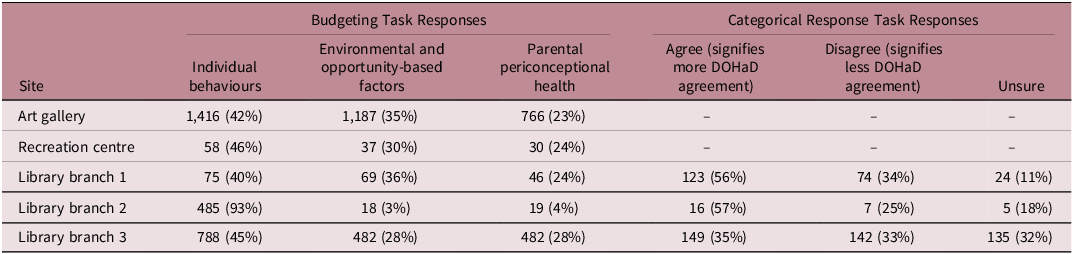
A budgeting task was placed at the beginning of the Exhibition to assess attendees’ baseline perceptions of factors influencing health. Data were excluded if attendees did not follow task instructions. Data show that attendees prioritised the impact of individual behaviours (42% of tokens, n = 1,416) over environment and opportunity-based factors (35% of tokens, n = 1,187) and parental periconception environments (23% of tokens, n = 766). This emphasis on individual responsibility was also reflected in conversations where one attendee said, ‘you’re an adult now, so [your health] should be your responsibility’.
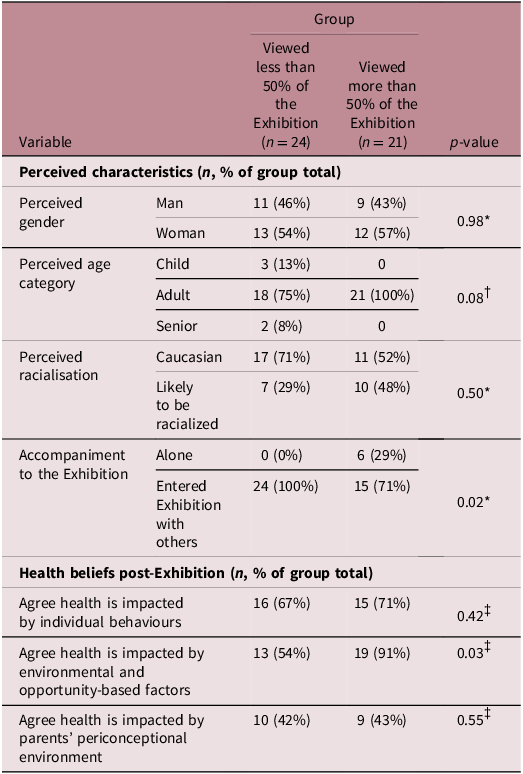
At the Gallery site, observational data indicated low adherence to the completion of interactive activities in the intended sequence. Only 59 attendees (16% of observed individuals) completed the budgeting task before viewing the Exhibition and the categorical task after viewing the Exhibition. 15 attendees were excluded from data analysis due to missing data. The remaining 44 attendees were stratified by whether they viewed 50% of artworks or more (high exposure) or less than 50% of artworks (low exposure). Group characteristics and post-Exhibition health beliefs are shown in Table 4. High and low exposure groups differed significantly in terms of accompaniment (χ 2 = 5.38, p = 0.02); 100% of high exposure individuals entered the Exhibition with others while 71% of low exposure individuals entered the Exhibition with others. Sensitivity analyses confirmed that exposure effects were not confounded by this difference.
Characteristics of observed attendees who engaged in pre- and post- Exhibition activities in the intended sequence

Table 4. Long description
The table compares characteristics and health beliefs of attendees who viewed more or less than 50 percent of an exhibition. It has 11 rows and 5 columns. The columns are labeled Variable, Viewed less than 50 percent of the Exhibition (n = 24), Viewed more than 50 percent of the Exhibition (n = 21), and p-value. The rows are grouped into Perceived characteristics and Health beliefs post-Exhibition. Perceived characteristics include Perceived gender, Perceived age category, Perceived racialisation, and Accompaniment to the Exhibition. Health beliefs post-Exhibition include Agree health is impacted by individual behaviours, Agree health is impacted by environmental and opportunity-based factors, and Agree health is impacted by parents’ periconceptional environment. Each row provides the count and percentage of attendees in each group for the respective variable. Notable trends include significant differences in accompaniment to the Exhibition and agreement that health is impacted by environmental and opportunity-based factors.
* p-value obtained from Chi square test.
† p-value obtained from Fisher’s exact test.
‡ p-value obrained from Firth-penalised multivariate logistic regression model controlling for perceived gender, age, and racialisation and accompaniment to the Exhibition.
Compared to attendees with low exposure, those with high exposure showed higher odds of believing that their health is influenced by environmental and opportunity-based factors. This association remained significant after accounting for perceived gender, age, and racialisation, and whether individuals attended the Exhibition alone or with others (OR = 6.62, 95% CI [1.22, 68.34], p = 0.03; AIC = 21.88; AUC = 0.80). This outcome was supported by written feedback which suggests that the Exhibition ‘shines a light on how significant our social conditions are’. In contrast, no significant differences were observed between exposure groups regarding beliefs about the impacts of individual behaviours (p = 0.42) or parental periconception health (p = 0.55). Despite this, attendees’ written reflections indicated an understanding of how parental periconception health impacts their own health; eight attendees shared that viewing the Exhibition increased their ‘DOHaD’ knowledge. One attendee wrote that after viewing the Exhibition, they understood that ‘health is more than how you treat your body, but also what happens in development/growth’. Indeed, 25% of written reflections (n = 39) discussed DOHaD concepts but, based on the data, we could not ascertain whether the writer’s knowledge had increased. Attendee reflections included how ‘the health and wellness of the community begins with the most vulnerable’ and how ‘parents’ health and environment impact the child’s health, which impacts what healthy choices they can make’.
The degree to which attendees understood the Exhibition’s message varied. Some written reflections suggested that attendees believed that parental influence on offspring health begins after birth; for example, one attendee wrote that ’parents shape our personality, but as we grow up, we can change ourselves and eliminate bad habits’. Others believed that the Exhibition implied that fostering health-promoting communities could prevent outcomes such as miscarriage. A few individuals found the messaging stigmatising because the Exhibition shamed pregnant individuals whose circumstances limited their ability to engage in health-promoting behaviours. A small portion of attendees (n = 9) also wrote that they left the Exhibition reflecting on topics that were unintentionally communicated by the Exhibition, such as ‘how unique and fragile life is’. Misinterpretation was also seen in observational data where some attendees believed that artworks showcased ‘the hardworking man making money for the fat CEOs’ or that depictions of placentas ‘look like a mushroom’.
The Exhibition had mixed effects on attendees’ intentions to seek more information and engage in health-promoting behaviours. Some attendees wanted to learn more; QR codes linked to websites with more information about Exhibition artwork were scanned 208 times and QR codes linked to more information about DOHaD were scanned 31 times. However, others wrote that they felt ‘small and powerless… [because] it’s nothing more than a lottery which determines your future’.
Impact in community sites
Space constraints at community sites meant that pre- and post-Exhibition data could not be collected. Budgeting task data (Table 5) showed individual behaviours were most frequently prioritised (39.5%–92.9% of tokens budgeted), while parental periconception health was least prioritised (3.6%–27.4% of tokens budgeted). When participating in the activity and asked if her parental periconception health affected her health, one child immediately replied ‘no, not my parents’. In most locations, the percentage of tokens allocated to environmental and opportunity-based factors and parental periconception environment were similar. However, at Library Branch 1, more emphasis was placed on environmental and opportunity-based factors (36.3% vs. 24.2%). In the categorical response task, most library attendees (35%–57.1% of respondents) agreed that parental periconception health influences future health, although at Library Branch 3, responses were evenly distributed across ‘agree’, ‘disagree’, and ‘unsure’ (Table 5).
Attendee responses to budgeting and categorical response tasks by site

Table 5. Long description
The table compares attendee responses to budgeting and categorical response tasks by site. It has two main sections: Budgeting task responses and Categorical response task responses. The Budgeting task responses section includes columns for Individual behaviours, Environmental and opportunity-based factors, and Parental periconceptional health. The Categorical response task responses section includes columns for Agree, Disagree, and Unsure. The table has six rows with varying data points. For example, the first row shows 1,416 (42 percent) for Individual behaviours, 1,187 (35 percent) for Environmental and opportunity-based factors, and 766 (23 percent) for Parental periconceptional health. The second row shows 58 (46 percent), 37 (30 percent), and 30 (24 percent) respectively. The third row includes data for Agree, Disagree, and Unsure, with 123 (56 percent), 74 (34 percent), and 24 (11 percent) respectively. The table provides a detailed breakdown of how attendees prioritized different factors and their responses to categorical questions.
Across all community sites, only three of 71 written reflections discussed impact. One attendee’s written reflection demonstrated that they misinterpreted the Exhibition’s message, suggesting that it shamed non-birthing parents for being ‘inherently unhealthy’. Another attendee wrote that they wanted more information about DOHaD; this was supported by 18 scans of QR codes with more DOHaD information. 12 of these 18 scans occurred in the Recreation Centre.
Discussion
We have shown that a public art exhibition can feasibly, acceptably, and effectively communicate DOHaD concepts to the public. Successfully installed in five diverse sites, attendees described the Exhibition as aesthetically pleasing and thought-provoking, sparking discussions and reflections on the determinants of health. Attendees expressed no concerns about DOHaD concepts being communicated in this manner, and importantly, individuals who viewed more artwork showed a greater understanding of the SDoH. Therefore, our data show that ABKT can be an effective tool for the dissemination of DOHaD-based concepts to the public.
Feasibility
Installation feasibility: Despite some challenges, the Exhibition was highly feasible and successfully installed in five diverse locations. Consistent with other studies, Reference Kukkonen and Cooper24,Reference Théberge, Smithman and Turgeon-Pelchat46 building relationships with community partners required considerable time, financial, and people-related resources, but was critical to installation success. Limited space and security reduced Exhibition visibility and the number of artworks displayed, despite the study team’s careful selection of community locations that were least likely to compromise the intended messaging. As such, future studies should explore how factors, such as available space, layout, visibility, and security infrastructure, affect the fidelity of delivering ABKT initiatives.
Data collection feasibility and fidelity: QR code analytics, reflexive documentation, observational notetaking, and written feedback were feasible in all sites; however, feasibility was influenced by physical layout and space use. Consistent with other studies, Reference Boardman, Clark, Buck and Hundt38 the amount of written feedback varied by site, likely reflecting differences in attendee motivation, time, and/or environmental cues. While open-ended questions in public spaces can yield irrelevant data, Reference Chamberlain and Yoxall47 we found only a small proportion of written responses (8% in the Gallery site and 26% in community sites) were unrelated to the Exhibition. The quality of observational data also varied by site as noise levels and crowding limited the ability to hear attendees’ comments/conversations.
In contrast, data collection using interactive activities was less feasible. Space and security constraints limited data collection to opening hours and prevented pre- and post-Exhibition data collection. When implemented, attendees did not adhere to data collection activity instructions, resulting in low fidelity to the instructions. This is in contrast to previous studies where interactive activities provided useful insights into attendees’ beliefs. Reference Chamberlain and Yoxall47 This may be due to the nature of the activities we designed; they lacked structured, step-wise instructions that typically support higher fidelity (i.e. digital surveys or scenario-based decision trees). Placement of these activities is also crucial; future studies should thoughtfully place interactive activities in areas where attendees have no choice but to follow activity instructions. Despite these limitations, observational data and written feedback indicated that these activities played a significant role in prompting reflection and discussion about the determinants of health, demonstrating the value of incorporating playful elements and structured data collection activities into ABKT initiatives.
Acceptability
Observational and written data at all sites demonstrated that attendees found the Exhibition acceptable; many attendees described the Exhibition as visually impactful and thought-provoking and expressed appreciation for an arts-based approach to sharing motherhood and pregnancy-related topics. The Exhibition was unacceptable only to a small number of attendees due to aesthetic preferences, personal experiences with miscarriage, or misinterpretation of the Exhibition’s messaging. Such responses are common when exhibitions are presented to diverse audiences. Reference Boardman, Clark, Buck and Hundt38 While ABKT initiatives should be guided by an artistic aesthetic (a set of design principles), Reference Kukkonen and Cooper24,Reference Lafrenière, Hurlimann, Menuz and Godard37 appreciation of the aesthetic is not required for impact. Notably, no attendees questioned the value of sharing DOHaD information with the public, suggesting support for the Exhibition’s core message.
Exhibition engagement varied by site. At the Gallery site, 93% of observed individuals viewed the Exhibition and spent longer periods doing so than in other sites. In community sites, 3%–17% of observed individuals viewed the Exhibition and those who did only interacted with a small proportion of the displayed artworks. Differences in observed engagement may be due to variation in the proportion of days observational notes were collected while the Exhibition was open (ranging from 10% to 80%), which could affect the representativeness of site-specific data. It may also be explained by contextual factors, including differences in foot traffic across locations, which may have influenced both crowding and the space available to view the artworks, or variation in promotional strategies. All sites were promoted through the study’s social media channels, as well as site-specific social media, newsletters, and/or on-site advertisements; however, the Gallery location received additional exposure through local television and newspaper coverage.
Despite this differential engagement, we contend that the reach of ABKT initiatives must exist beyond art gallery settings. Art galleries are visited for the express purpose of viewing art; more engagement with the art would therefore be expected in these settings. Galleries are also more frequently visited by affluent individuals Reference Bennett and Frow48,49 and often fail to represent the experiences of marginalised communities, despite attempts to improve inclusivity. Reference Dymond50 Therefore, limiting ABKT to art gallery settings risks reinforcing existing inequities in public access to health information. Artist ‘meet-and-greet’ sessions, question-and-answer panels, curator-led tours, Reference Watfern, Triandafilidis and Vaughan36 and concurrent educational programming Reference Doubeni, Nelson and Cohn51 could be effective ways to increase audience engagement in community-based sites where visitors may be attending for purposes other than to see artwork.
Impact
Consistent with other initiatives that presented artwork without explicit messaging, Reference Watfern, Triandafilidis and Vaughan36,Reference Boardman, Clark, Buck and Hundt38,Reference Newman, Duong, Kahlon and Li52–Reference Hutmacher and Aufschnaiter55 our Exhibition elicited written and verbal reflections on the determinants of health and pregnancy-related topics and DOHaD information seeking behaviour. Some attendees across all sites showed interest in learning more about DOHaD by scanning QR codes embedded in the Exhibition (although this was a small proportion of the total number of visitors observed) or writing reflections. In some instances, we could not ascertain whether the attendee’s knowledge had increased. Since our previous work suggests that the public is generally unaware of DOHaD, Reference McKerracher, Moffat, Barker, Williams and Sloboda11–Reference Jacob and Hanson13 the presence of reflections and discussions about DOHaD suggests that ABKT is a useful, thought-provoking method to introduce these complex scientific topics to the public.
Few attendees reported leaving the Exhibition feeling powerless, confused, or misinterpreting the Exhibition’s message. For those that did, it is likely that the ambiguous nature of our Exhibition fuelled these responses. When little explicit messaging is provided, individuals project their own meanings onto artwork and respond emotionally, Reference Parsons26 which can lead to misinterpretations of the intended message. Reference Boardman, Clark, Buck and Hundt38,Reference Clark53 The Exhibition was intentionally designed to encourage this type of personal engagement while recognising that interpretations are shaped by each attendees’ lived and living experiences. Reference Rieger and Schultz56–Reference Lafrenière and Cox58 In future studies, researchers should carefully consider their intentions and consider ways that may mitigate misinterpretation, such as following artwork viewing with discussions or workshops.
The uptake of DOHaD concepts was limited by the extent of engagement. At the Gallery site, attendees who viewed more than 50% of the artworks had significantly higher odds of agreeing that environmental and opportunity-based factors influence health compared to attendees with lower exposure. Since the wide confidence interval limits precision and we could only control for perceived race, gender, and age and accompaniment to the Exhibition, this association may be influenced by residual confounding. This may include factors such as prior DOHaD knowledge or familiarity. However, this result aligns with previous findings where exposure to an ABKT exhibition enhanced attendees’ understanding of health-related topics. Reference Watfern, Triandafilidis and Vaughan36,Reference Boardman, Clark, Buck and Hundt38,Reference Newman, Duong, Kahlon and Li52,Reference Hutmacher and Aufschnaiter55
We saw no relationship between the amount of artwork attendees were exposed to and their beliefs about how their individual behaviours or parental periconception health impacted their health. This suggests that our Exhibition did not fully convey the DOHaD message in a single viewing. Follow-up evaluations are required to assess the long-term impact of this or similar ABKT initiatives and whether multiple exposures are necessary to reinforce DOHaD understanding and engagement.
At community sites, most attendees agreed that parental periconception health impacts a baby’s lifelong health, as evidenced by categorical response data collected across the three library sites. Since interactive data collection activities varied across locations due to the iterative, site-responsive design of data collection, there may be limited direct comparability between the libraries and Recreation Centre; however, written and verbal feedback at all community sites suggested that attendees agreed that parental periconception health impacts a baby’s lifelong health. However, when asked to prioritise health determinants in the budgeting task, attendees allocated the fewest tokens to parental periconception health. Instead, they focused on factors such as individual behaviours. As the budgeting task was implemented consistently across sites, a more direct comparison of responses and stronger confidence in this observed pattern can be made. This gap between recognising the importance of parental periconception health and prioritising it suggests that, although the public may conceptually understand the relevance of DOHaD-related concepts, these ideas may not resonate as actionable or as high priorities in decision-making. This gap between awareness and salience highlights the need for future DOHaD KT methods to not only inform but embed the importance of early life health determinants into public values and priorities.
Accessibility
Although not a primary outcome, accessibility of DOHaD concepts was an underlying motivation for this work and can be partially inferred from patterns of engagement across sites. Attendees were observed discussing the Exhibition in multiple languages, and written feedback was received in several languages, suggesting cross-cultural reach. A range of perceived genders, ages, and races were also observed engaging with the Exhibition, with proportions varying by site. While these findings may suggest increased DOHaD accessibility, they should be interpreted with caution. Variation in the proportion of observation days across sites may limit how well these patterns reflect overall visitor trends. Additionally, differences in layout, as well as the number and types of artworks and interactive activities presented, may have influenced engagement. Sites with more diverse interactive elements may have attracted a broader range of visitors due to increased opportunities for interaction, rather than greater accessibility of DOHaD concepts. As such, future studies should explore how factors such as layout and Exhibition artworks and activities affect the accessibility of sharing DOHaD concepts through arts-based methods.
Interdisciplinary approaches
Together, our findings and outcome evaluation suggest that using an interdisciplinary KT approach for complex scientific concepts such as DOHaD appear publicly acceptable and may foster reflection and discussion. These findings support a view valuing the co-production of knowledge and shifting towards participatory approaches in science communication. Involving diverse relevant and interested parties will diversify how scientific education is conducted and who receives and benefits from such education. A more inclusive, accessible, and engaged approach will broaden the public’s ability to advocate for policies and programmes that represent their interests and shapes collective understanding of health-promoting attitudes and behaviours. However, interdisciplinary and multi-stakeholder implementation remains structurally challenging. Funding mechanisms, institutional priorities, and academic reward systems largely continue to favour discipline-specific research outputs, which can limit opportunities for sustained truly interdisciplinary collaboration. Addressing these structural constraints will be important for supporting the continued development and scalability of integrative approaches such as ABKT in public health research and practice.
Strengths and limitations
Our study was conducted exclusively in a mid-sized urban centre in Canada, and although the city is statistically similar to the average Canadian city, Reference Shkolnik31 our findings may not be relevant to other social and demographic contexts. Our study’s reliance on observational data is both a strength and limitation. Our large sample size provided a detailed account of how diverse individuals interacted with the Exhibition across five distinct settings; however, attendee demographics were based on perception rather than self-identification, which may have led to misclassification, oversimplified identities (e.g. not capturing the full spectrum of gender, race, and age and how these shape interactions), and limited our ability to identify behavioural trends. Since no follow-up was conducted to confirm perceived demographics, observer and confirmation bias likely influenced our interpretations, although measures were put in place to ensure consistency in perceived demographics. Additionally, the lack of information about attendees and their prior knowledge and views, such as previous understanding of or familiarity with DOHaD, limits our ability to assess the Exhibition’s impact. A particular strength of observational data collection is that it limits non-response and sampling bias seen in surveys and interviews. Reference Watfern, Triandafilidis and Vaughan36 Furthermore, when the observer is unknown to those being observed, data are less prone to the Hawthorne effect or social desirability bias. Reference Parsons26,Reference Denzin59 As most attendees did not follow the interactive data collection activity instructions, we had a small sample size to interpret attendees’ changes in knowledge and belief following exposure to the Exhibition. Although our findings were statistically significant and triangulation of data sources improved reliability, a larger sample size is needed to determine, with confidence, whether the Exhibition changed public DOHaD knowledge. Although we used established questions to assess DOHaD knowledge and attitudes, Reference McKerracher, Moffat and Barker17,Reference Woods-Townsend, Leat and Bay21 these questions were not validated and, at the time of the study, no validated DOHaD knowledge survey existed. Thus, the lack of standardised and psychometrically tested instruments limits comparability across studies. The recently developed DOHaD knowledge survey Reference Hildreth, Oyamada and Bay60 should be implemented in future studies. Our study also did not collect data on the Exhibition’s long-term impact on DOHaD knowledge, limiting our ability to assess the stickiness or persistence of the Exhibition’s impact. Future studies should consider collecting participant contact information to enable longitudinal follow-up or surveying sites to assess if exhibitions prompt subsequent programming or discussions.
Conclusion
This is the first study to employ and evaluate ABKT methods to communicate DOHaD concepts to the public. Our findings suggest that ABKT can address the limited public awareness of DOHaD in a feasible, acceptable, and impactful manner. Our Exhibition was successfully installed in five distinct locations across a mid-sized urban centre and received positive feedback for its visual appeal, thought-provoking content, and integration of arts and sciences. Although engagement varied across settings, the Exhibition increased awareness of DOHaD-related concepts and prompted reflection, information seeking, and intentions to adopt health-promoting behaviours. We suggest that future studies should incorporate interactive activities as opportunities for discussion and reflection, explore strategies to enhance engagement in community settings, and examine the long-term impacts of ABKT. To truly shift public understanding and action around early life health, we must move beyond conventional dissemination and engagement practices and incorporate innovative approaches that foster dialogue and reflection across diverse communities. The approach we present in this paper makes complex science accessible and resonant, enabling research to drive meaningful change in public health.
Supplementary material
The supplementary material for this article can be found at https://doi.org/10.1017/S2040174426100658.
Acknowledgements
We would like to thank the members of the Sloboda Lab, specifically Erica Yeo, for fostering a supportive environment where scientists and artists can learn from one another, and the members of the Art of Creation team, specifically Stephan Dombrowski, Sophie Hogan, Tina Moffat, Beth Murray-Davis, Kym Rae, and Chloe Rexdiemer, for their creativity, dedication, and commitment to bringing this vision to life. We would also like to thank the Art of Creation Advisory Committee (Jocelynn Cook, Vanessa Crosbie Ramsay, Dara Roth Edney, Lilianna Figueredo, Emily Gillard, Saera Jean, Nicole Knibb, Laura Schmidt, Jennifer Vickers-Manzin, Guy Vizine, and Lindsay Zalot) for generously sharing their invaluable insights, which shaped this project in thoughtful and transformative ways. We would also like to extend our gratitude to our Artists in Residency (Lester Coloma, Vanessa Crosbie Ramsay, Julia Garlisi, Kathryn Killackey, Jill Letten, Cornelia Peckart, Ravinder Ruprai, and LT the Monk) and to the participants in our arts-based support groups. Your creativity and willingness to explore the intersection of arts and sciences fuelled this project. The artworks you created offered powerful new ways for audiences to engage with the Developmental Origins of Health and Disease and pregnancy experiences. We would like to extend our sincere gratitude to the University of Southampton Institute for Life Sciences and the Southampton Institute for Arts and Humanities for their role in supporting the development of this paper. The insights and reflections shared by scholars at these institutions enriched our thinking and helped shape the direction and content of this work.
Financial support
This study was supported by the New Frontiers in Research Fund (DMS), McMaster University (DMS), Canadian Institute of Health Research (JMC, GD), Ontario Graduate Scholarship (JMC, GD), Mitacs (DMS), and the Canadian Research Chair Program (DMS).
Competing interests
None.
Ethical standard
The authors assert that all procedures contributing to this work comply with the ethical standards of the relevant national guidelines on human experimentation (Tri-Council Policy Statement) and with the Helsinki Declaration of 1975, as revised in 2008, and have been approved by the institutional committees (Hamilton Integrated Research Ethics Board, protocol #16467).



 Open access

