Introduction
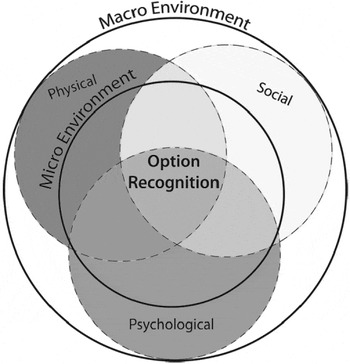
As people get older, the significance of place and the importance of situating the self appropriately have implications for self-esteem, health and wellbeing. The interaction between environmental context and personal identity is reflected in a wide range of social, psychological and physical issues. The social dimensions often centre on the micro- and macro-environments of the community and entail personal, family and housing histories. Psychological factors may be seen in displays of attachment, loss and emotions concerning security and safety, which can impact on morale. The physical or material setting itself may continue to be supportive or become challenging. At the micro level of the individual's dwelling, this can lead to re-investment, adaptation or re-configuration. At the macro level of the community, it may lead an individual to maintain, increase or reduce levels of engagement. The interface between these factors generates the complexity of person–environment interactions that may lead to an environmental tipping point that demands action and which we have called ‘option recognition’.
Researchers have sought to identify – often through survey methods – the impact on wellbeing in old age of transitions to, and re-location within, more supportive/age-segregated environments, identifying the importance of self-definition in dependence and independence (Mertens and Wimmers Reference Mertens and Wimmers1987). The research presented here extends these findings by illustrating the complexity of person–environment fit in both mainstream and supportive environments. The argument is developed from extended analyses of the rich qualitative data collected for the ‘Environment and Identity in Later Life’ study and from the findings of other historical and contemporary biographical and generational studies (Hanson, Kellaher and Rowlands Reference Hanson, Kellaher and Rowlands2001; Holland Reference Holland2001). Building on the notion of ‘option recognition’ (Peace, Holland and Kellaher Reference Peace, Holland and Kellaher2006), in this discussion we extend the concept to include the layered environments of physical, psychological and social experience that encompass both place and time at micro and macro levels of interaction. We draw upon and extend the conceptualisation of person–environment fit or congruence in the North American and Western European gerontology literature.
Theoretical and methodological underpinnings: person–environment research
Environmental gerontology is a multi-disciplinary field that has generated inter-disciplinary research (for recent overviews seeOswald and Rowles Reference Oswald, Rowles, Wahl, Tesch-Romer and Hoff2006; Peace et al. Reference Peace, Werner-Wahl, Mollenkoph, Oswald, Bond, Peace, Dittmann-Kohli and Westerhof2007). This work was grounded in that of earlier human ecologists, sociologists and psychologists (Kleemeier Reference Kleemeier and Birren1959; Lewin Reference Lewin1936; Murray Reference Murray1938; Park, Burgess and McKenzie Reference Park, Burgess and McKenzie1925), and furthered by the emergence of environmental psychology and the creation of environments specifically for the long-term care of older people. Throughout, an understanding of both the objective and subjective dimensions of person–environment interfaces has gradually been elaborated and refined.
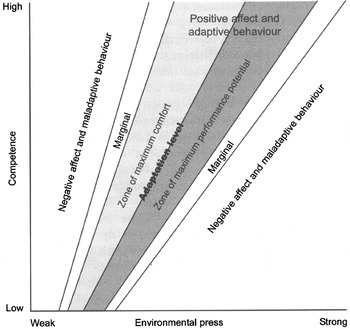
Since the late 20th century, a number of ecological perspectives have emerged. For example, the interface between person and environment was central to the work of psychologist M. Powell Lawton and his colleagues. Lawton's early work focused on how individuals coped with particular situations at specific points in time. In the 1960s, Lawton and Simon developed the ‘environmental docility hypothesis’ which outlined the basic premise that the less competent the individual the greater the impact that environmental factors are likely to have (Lawton and Simon Reference Lawton and Simon1968). Further extended by Lawton and Nahemow (Reference Lawton, Nahemow, Eisdorfer and Lawton1973), the notion elaborated into the ‘press-competence model’, which considered individual competence as a function of the immediate and wider environments in which a person lived. The model enabled a judgement on the degree of comfort and the ‘performance potential’ that could be experienced in a particular environment (Figure 1). This work was based on research undertaken with vulnerable older people for whom ‘competence’ was defined as ‘the theoretical upper limit of capacity of the individual to function in the areas of biological health, sensation and perception, motor behaviour and cognition’ (Lawton Reference Lawton1983: 350), and assessed through measurable tasks (Rubinstein and de Medeiros Reference Rubinstein, de Medeiros, Wahl, Scheidt and Windley2004).
Lawton and Nahemow's ecological model. Source: Lawton and Nahemow (Reference Lawton, Nahemow, Eisdorfer and Lawton1973: 661). Reproduced with permission of the American Psychological Association.

Central to the model was an ‘adaptation level’ at which people are able to ‘tune out the environment’ by achieving a state of balance between the comfort zone and the challenge zone (Lawton Reference Lawton1980: 13, 2000: 190–1). This focuses on the coping ability of the individual and raises concerns about the possibility of environmental determinism. Both Lawton (Reference Lawton1985, Reference Lawton, Bengtson and Shaie1989, Reference Lawton, Friedman and Wachs1999) and Nahemow (Reference Nahemow, Rubinstein, Moss and Kleban2000) addressed this criticism by introducing the concepts of ‘environmental pro-activity’ and ‘environmental richness’ that enabled ‘press’ to be seen as stimuli. They noted that the way in which an older person coped with change could relate to personal competence and the adaptation of either behaviour or the environment or both. Other researchers have developed various approaches to person–environment congruence in later life and recognised the importance of personal motivation and personal needs on decision-making (Carp and Carp Reference Carp, Carp, Altman, Lawton and Wohwill1984; Kahana and Kahana Reference Kahana, Kahana, Lawton, Windley and Byerts1982).
The subjective experience of ‘ageing in place’ and facets of place attachment have also been considered (Altman and Low Reference Altman and Low1992). The work of North American gerontologists and from social geography and anthropology (Rowles Reference Rowles1978, Reference Rowles1983, Reference Rowles2000; Rubinstein Reference Rubenstein1989; Rubinstein and Parmelee Reference Rubenstein, Parmelee, Altman and Low1992), and of the West European psychologists Oswald and Wahl (Reference Oswald, Wahl, Rowles and Chaudhury2005), has situated the person through her or his experience of affective, cognitive and behavioural ties to place. In addition, Cvitkovich and Wister (Reference Cvitkovich and Wister2003) incorporated a temporal dimension to reveal environmental influences across the lifecourse, and Golant (Reference Golant2003) introduced three temporal factors to the Lawton–Nahemow model: the salience of past experiences and future expectation; how older individuals interpret change and use it in self-identity; and the trajectory of change in personal attributes. This paper contributes a British perspective on the issues associated with such environmental complexity.
Unsurprisingly, much gerontology research on person–environment congruence or fit has centred on the impact of the micro-environments of ‘special’ accommodation and care settings. Until the 1990s, less attention was paid to the situations of the majority of older people living in the community in ‘mainstream’, ‘non-specialised’ or ‘ordinary’ housing, and there continues to be less research that situates the micro within the macro-environments of neighbourhoods, towns or the wider place context of where and how older people live (Kendig Reference Kendig2003). Recently the focus has changed, however, with the growing appreciation of global population ageing leading to a widening concern about person–environment fit in later life, as seen in the World Health Organisation's (2007) ‘age-friendly cities’ initiative, and more attention to urban–rural differences (Keating Reference Keating2007; Scharf, Phillipson and Smith Reference Scharf, Phillipson and Smith2005). The research reported here encompassed not only the lives of older people living in both ‘ordinary’ housing and ‘special’ (or supported) accommodation, but has also considered both everyday experiences of the micro-environment and the macro-environment of community. It offers an analysis of the layers of environment that older people experience through everyday living, and deploys an approach to person–environment fit that extends Lawton and Nahemow's (Reference Lawton, Nahemow, Eisdorfer and Lawton1973) ecological model to encompass this complexity.
Environment and identity in later life research: study methodologies
The primary data used in this discussion derives from the ‘Environment and Identity in Later Life’ study which formed part of the United Kingdom Economic and Social Research Council funded ‘Growing Older’ programme that ran from 1999 to 2003 (Peace, Holland and Kellaher Reference Peace, Holland and Kellaher2006). Ethnographic methods were used with groups and particular individuals, but nevertheless the collected data are extensive for a largely qualitative study.Footnote 1 Three types of environment and locations in southern England were chosen: metropolitan/urban (London Borough of Haringey); small town/urban/suburban (the town of Bedford), and small town/village/semi-rural (the county of Northamptonshire). The aim was to reflect the diversity of people and places in the three areas. The research sought the views of older people living in each locality, so the first stage of the investigation in 1999–2000 was group discussions with older members of each community to identify the themes and categories that they thought significant about their homes and communities. Nine focus groups of three to eight older people were conducted, seven with ‘naturally occurring’ groups including two social/luncheon clubs, a mothers' union (Christian) group, a sewing circle, a black oral-history group (in Haringey), a men's billiards group, and a Sikh community group (for which a translator was used) (in Bedford). The other two groups were of residents of sheltered housing schemes – groups of conventional if small apartments with a resident or non-resident manager who provides supervision, surveillance and emergency contact services but not personal support or care. Of the nine groups, in four the participants were all-white British and Irish, in three they were of mixed race, in one they were all Black-Caribbean, and in one all of Indian origin. Two of the groups were all male; four were all female; and three had both genders. The sessions were led by one or more of the researchers, depending on the size of the group, and they were audio-taped for later content analysis.
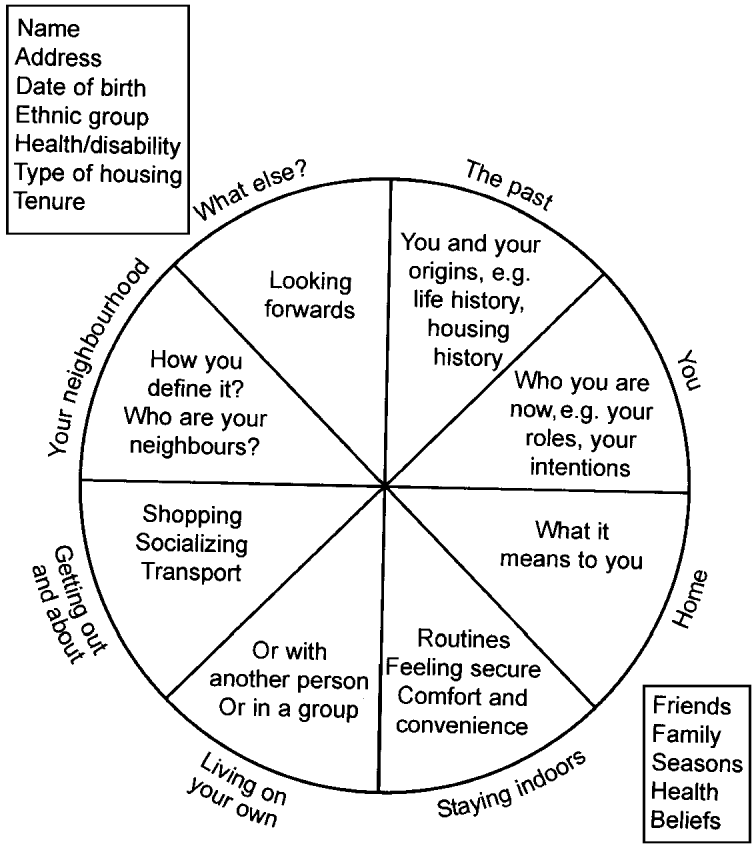
The group work was invaluable for identifying the topics for further exploration at the next stage using purposive sub-samples in each location. This detailed research was accomplished through in-depth face-to-face interviews during 2000–01 using the ‘Facets of Life Wheel’, an innovative research tool shown in Figure 2. It is a circle that rotates on a wide board, with eight segments each focusing on one topic and its prompts. Both the topics and the prompts were informed by the focus group discussions. Pilot interviews enabled the participants and researchers to refine the scope of the eight domains and procedures for choosing the areas to be discussed. Also piloted at this stage was the full Housing Options for Older People tool (Heywood et al. Reference Heywood, Pate, Means and Galvin1999), which proved too lengthy to add to the detailed conversation. The researchers left a copy of this instrument with participants to complete and return if they wished. Eventually 54 interviews were undertaken, 18 in each locality.
The ‘Facets of Life Wheel’. Source: Peace, Holland and Kellaher (Reference Peace, Holland and Kellaher2006: 26). Reproduced with the permission of the Open University Press.
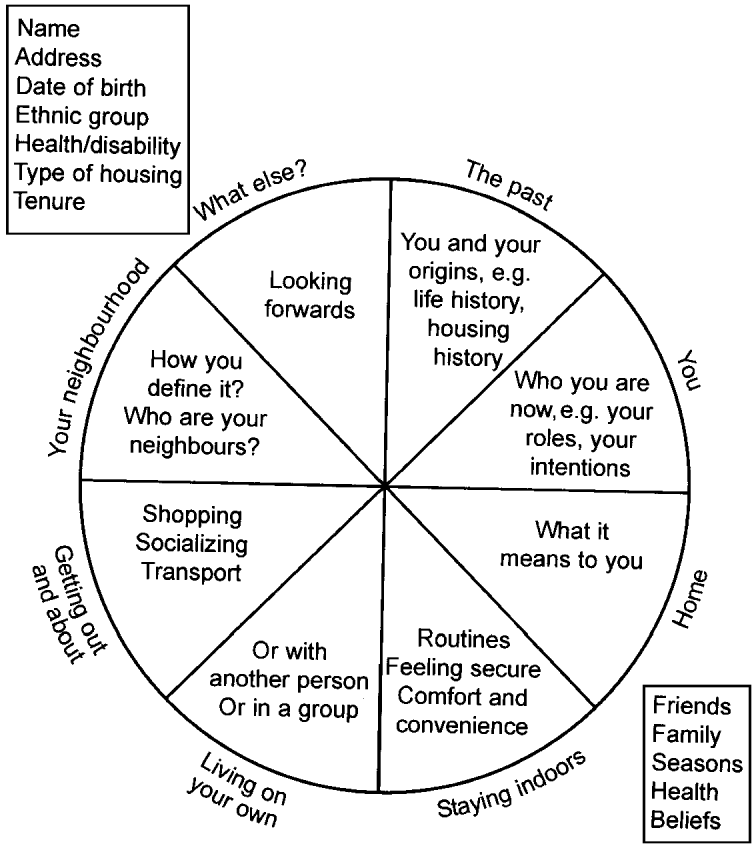
While the wheel was the main focus of all the conversations, the information generated by the tool was supplemented with basic and supportive data gathered through structured questions concerning: age, marital status, gender, ethnicity, religion, house type and size, tenure, occupancy, subjective health assessment, financial status, housing satisfaction, housing history, mobility range, the layout of the accommodation, and quality of life (Heywood et al. Reference Heywood, Pate, Means and Galvin1999); characteristics that might influence interactions with the environment. Some of these were listed to remind the researcher to address these issues. They are seen in Figure 2 as two rectangles outside the wheel. Through these various methods, a detailed dossier was compiled for each respondent. This made it possible to organise the data by socio-demographic attributes, to develop chronological housing histories, and to undertake thematic content analysis on detailed interview narratives guided by the grounded theory approach (Glaser and Strauss Reference Glaser and Strauss1967; Strauss Reference Strauss1987; Strauss and Corbin Reference Strauss and Corbin1990).
The initial analysis of the data was carried out by the three authors, each taking one location and coding transcripts against the domains of investigation in the wheel. These initial codes were then discussed by the three researchers, case-by-case for each location, at the same time checking the proposed coding with other data from the dossiers, such as health and tenure information. Coding from the three locations was subsequently compared and integrated by agreement between the researchers enabling inter-rater reliability. Any initial differences of opinion about coding, or the meaning of a participant's words, were reconciled by further investigation of the data and discussion of its context until agreement was reached. The participants were given the option of seeing their transcript and a copy of the recording, but few took up this offer and none of those who did requested any changes. One participant subsequently chose to withdraw from the research for personal reasons and in that case the transcript and other data were destroyed. The emergent concepts from this process, agreed between the researchers (aspects of which are developed in Peace, Holland and Kellaher Reference Peace, Holland and Kellaher2006) included:
• Temporal perspectives on self in environment.
• Spatial perspectives on self and environment.
• Layers of environment and boundaries between them.
• Normative expectations of ‘home’ and ‘neighbourhood’.
• Complexity and agency in environmental adaptation.
Using this initial groundwork, here we further develop our arguments through additional analysis.
Characteristics of the sample
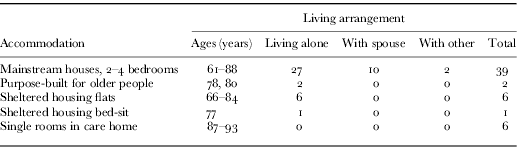
The 54 respondents were aged from 61 to 93 years (mean 80), and two-thirds were women. At the time of interview, ten were still married; 39 were widow(er)s or divorced/separated, and five described themselves as having been single all their lives or for a very long time. Of those who took part, the Haringey respondents were the most multi-cultural: four had been born in the West Indies and came to England during the 1950s, one had moved from India and two from Ireland, while another although born in Britain was from an Italian family. In terms of housing tenure, the Northamptonshire participants were most likely to be owner-occupiers and the Haringey participants most likely to be tenants. The types of housing were very diverse and included residential care homes and a various ‘ordinary’ mainstream houses (detached, semi-detached, terraced) (Table 1). Nearly one-third of the respondents lived in flats (apartments), which were more common in the Bedford and Haringey samples. In contrast, living in bungalows was most often found in Northamptonshire's villages.
Accommodation and living arrangements of the sample
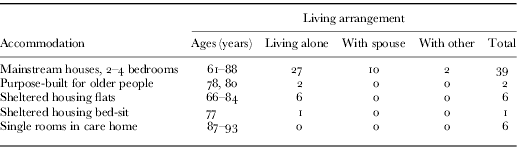
Source: Tabulated from Peace, Holland and Kellaher (Reference Peace, Holland and Kellaher2006: 93).
Understanding everyday experiences
As outlined above, our interpretation of the diverse data has been guided by the environmental contexts raised by the respondents (Peace, Holland and Kellaher Reference Peace, Holland, Kellaher, Andrews and Phillips2005a, Reference Peace, Holland, Kellaher, Rowles and Chaudry2005b, Reference Peace, Holland and Kellaher2006). Here we examine examples of common experiences to emerge from the data, describing moving and staying put, and developing a sense of self in place through the organisation of space and routines in different forms of environment, both micro and macro, before defining the concept of ‘option recognition’.
Environmental change: ‘moving’ and ‘staying put’
While each of the 54 respondents in the ‘Environment and Identity’ study had a unique housing history, they shared attitudes that reflected similar experiences of gender, generation and location. Experiences across time may influence how people deal with personal change in later life. The respondents were invited to talk about all the places where they had lived. Some had lived in just one or two homes in a single area; others had migrated across continents or moved home many times during their lives. Some told stories about continuity in living together and family support across and between generations, where decisions about staying put and moving to other accommodation were affected by the attitudes and behaviour of ‘significant others’.
The socio-historical context of these stories no doubt has an impact on certain attitudes and behaviours. As noted, the members of the purposive sample were born between 1907 and 1940, most during the 1920s, so before the immense housing improvements that began in the 1950s. Most of the respondents' first homes were in private-rented accommodation, often shared with extended family and in poor condition by today's standards. Like many others of the same age, several respondents did not leave the parental home until they married or took a job with accommodation (e.g. domestic service). By the relatively prosperous later 1950s and 1960s, it became easier and more viable for young adults to establish their own homes. It was striking that associations between ‘independent adulthood’ and ‘a place of one's own’ persisted into later life, as some respondents, when anticipating a time when they could no longer live independently, expressed a strong preference for a care home, the so-called ‘last resort’, rather than having to live with and ‘impose’ upon their children. Some saw a care home as a different form of independent living since it would be determined through their own decision-making.
Indeed, despite close involvement with ‘significant others’, 44 respondents lived alone at the time of the interview. The experience of living alone across the lifecourse had varied, as had the degree to which living alone in old age was a preference or a necessity. Mertens and Wimmers (Reference Mertens and Wimmers1987) observed that independence includes elements of privacy, self-determination, competence and status, and consistent with their findings, in our study independence emerged as a highly significant rationale. The respondents talked about the benefits of being able to do what they liked when they liked, and of not having to answer to anyone else or to fit into other people's routines. Yet those living alone also admitted to loneliness at times. This central tension highlights the interplay of the material, social and physical aspects of people's living situations. Our finding, that the possibility of loneliness, or of living in a more restricted way, is less uncomfortable than the possibility of ‘being a burden’ on the family, is consistent with previous observations (e.g. Clark, Dyer and Horwood Reference Clark, Dyer and Horwood1998; Heywood et al. Reference Heywood, Pate, Means and Galvin1999; Toffaleti Reference Toffaleti1997), although we acknowledge that there are cultural variations in the meanings that attach to living alone.
These views also reflect the dialectic between autonomy and security across the lifecourse (Parmlee and Lawton, Reference Parmlee, Lawton, Birren and Schaie1990), as people negotiate location, tenure and accommodation type. Research has shown that where people are able to take control of a move, they are more likely to achieve a solution that they find satisfactory (Altman and Low Reference Altman and Low1992). This recognition of ‘options’ across the lifecourse depends on social capital. Our respondents were asked whether they had thought about moving from their present home; what kinds of moves they had considered, how they positioned themselves, and to which areas they might move. Across the three locations, differences in housing provision and availability appeared to influence their strategies. In Haringey, a densely-populated inner London Borough, sheltered housing was widespread and a well-understood social housing option for older people. Here many of the respondents considered it a legitimate and familiar form of mainstream housing: local information and observations led many to contemplate this option. By contrast, in the other two locations, several respondents were unclear as to what sheltered housing was or entailed and how it was accessed, and they had little information about or interest in forward planning for this option.
For most people in later life, however, the prospect of moving becomes especially difficult when they live alone or are in poor health, because the disruption, organisation and associated costs are serious concerns. Only a few of the respondents had moved recently or had considered moving. In the main, more people had thought about moving but decided against it, at least for the present. They were inclined to put off the decision until their health and strength failed them, and a few did not want to talk about the topic at all. For most, moving or not moving was bound up with uncertainty about their future selves and required facing up to the end of life.
The sense of self-in-place
What is it that impels people in later life to use the expression ‘for as long as possible’ about staying in their own home, and diverts or distracts people from thinking about moving? As Table 1 shows, among the 54 respondents, 39 (72%) lived in ‘ordinary’ housing, and 15 (28%) had moved either to sheltered accommodation (nine) or into a care home (six) – highly contrasting environments with respect to individualised or collective living, a theme central to the following discussion. One aspect of the person–environment interaction is the way in which people engage with others, ‘editing’ which aspects of self to reveal to or conceal from others. In interactions with others, we all construct and reconstruct representations of our selves to present a face to the world. It is clear that for these respondents their environments were equally part of their ‘face to the world’ in that they used their homes and surroundings to reveal and explain who and what they are and what they do, as well as what they had been and had done. We use this analysis of space, time and the positioning of the ageing self to take account of routines and the organisation of space. First we consider the micro-environment of different forms of (collective and non-collective) accommodation, and then the discussion is widened to the relationship between the macro- and micro-environment, to arrive at a definition of the concept that we put forward here, ‘option recognition’.
The organisation of space and routines in mainstream housing
Everyday behaviour is composed and reinforced through the culturally-recognisable configuration of spaces in the home and in the ‘public’ and ‘private’ spaces defined through access, permission and control (Hillier and Hanson Reference Hillier and Hanson1984). While homes are generally ‘private’, in the sense that they are not freely open to the public, different levels of access apply to different categories of visitors (casual callers, officials, friends and family) and to different spaces; for example, hallways and lounges are more ‘public’ than bedrooms. Likewise, when people share a home, shared space is generally differentiated from personal space. The domestic home is also redolent of gender and hetero-normative sexuality (Darke Reference Darke, Gilroy and Woods1997; Johnston and Valentine Reference Johnston, Valentine, Bell and Valentine1995; Madigan and Munro Reference Madigan, Munro, Chapman and Hockey1999) and often indicative of status and socio-economic class (Oswald and Wahl Reference Oswald, Wahl, Rowles and Chaudhury2005). There is an understanding of what is appropriate, and what activities are appropriate for particular times and places (e.g. when and where to eat dinner, or when to mow the lawn). The respondents revealed the importance they attached to living in spaces that are configured in ways that they and their peers regard as acceptable and that enable the culturally comforting routines which underpin a shared understanding of this appropriateness (and which can be problematic in age-segregated and collective settings).
As Table 1 depicts, 39 of the respondents lived in ‘ordinary’ housing – houses and flats – with between two and four bedrooms and the usual rooms for eating, washing and relaxing. Most lived alone, some with a partner, and most said that the available space was neither too little nor too much for their daily routines. Much accommodation for older people has been designed on the premise that older people prefer less living space to make daily living more manageable, but the respondents who lived in technically ‘under-occupied’ housing rarely described it as unmanageable (Peace, Holland and Kellaher Reference Peace, Holland and Kellaher2006: 100–1). This finding confirms others on the value of space in later life (seeKellaher Reference Kellaher and Sumner2002), even when it is little used or used mainly for storage. Having an extra room created options for different ways of living. Henry (pseudonyms are used), a married man in ‘fair’ health, put it like this:
[We have] three nice bedrooms; well, two are quite large, one's got a shower in it and a sink. The other one … [is] the main. … I sleep in one, my wife sleeps in the other because once I had this trouble with this thing: I used to have to get up three or four times a night and disturbed her. So I've got used to sleeping in me own double-bed, she sleeps in her own double-bed and, that's it, we're quite happy you know. We have a cup of coffee in bed together in the morning, and that's it, no problem.
Henry indicated how managing space in different ways enables people to remain in control. Such environmental mastery also relates to design and layout or architectural variations in the respondents' ‘ordinary’ housing (cf. Hanson, Kellaher and Rowlands Reference Hanson, Kellaher and Rowlands2001; Hillier and Hanson Reference Hillier and Hanson1984).
The privacy of the ‘ordinary’ home also allows people to support and conceal aspects of the self, and for older people this may include increasing frailty. Their home environment can be progressively adapted to provide different levels of support. Bertie, a retired architect aged 84 years in ‘good but fluctuating’ health, said that after his wife had suffered a number of strokes, making changes in their suburban semi-detached house to enable her to stay in their own home became part of his life's work. He recognised that he had to cope in this situation, and using his architectural knowledge and experience was able to take action:
You see yourself, if you're with a person, and perhaps that's where I had the advantage over the OT [occupational therapist]. I was with her all the while, so I could see whether a handle was needed. One of the vital ones is the top of the stairs on the newel post, as you get off the stair lift, at the top of the stairs you have a handle to grasp. … Upstairs we've got a toilet and the very same situation arose, I put handles both sides, but then you've got a two foot, six inches [762 mm] door swing in, and you sterilise two foot, six inches of the floor space, and so I put bi-fold doors up there, and I did the same in the bathroom because there we wanted additional room. You see it wasn't only the patient, we wanted a carer alongside her. … I would say that the authorities have been very helpful, but I do believe that [for] a lot of things … if you have the inclination to be a do-it-yourself [person], you can do it yourself and I have done a lot.
In ‘mainstream’ domestic dwellings, the respondents planned and achieved high levels of privacy and personalisation, which we argue is part of having a life of quality. Space was also temporalised by their adaptation to routines, for the maintenance of everyday patterns was important to the respondents. This can be equated with the ‘adaptation level’ of Lawton and Nahemow's ‘press-competence model’, whereby the environment may be ‘tuned out’ and seen as a background for temporal markers. The respondents revealed that many partnerships had developed seamless or complementary daily or seasonal routines. Where such partnerships had ended by death or separation, some well-established routines continued to be an important component of the remaining partner's lifestyle, although some rebalancing of the person–environment interaction was usual. This was explained well by Nerys, a widowed respondent aged 73 years in ‘very good’ health, who lived in a detached house in a semi-rural village:
Oh yes, I used to go to bed about 9.30 pm and have a bath, and he would get up for 10 pm and we would watch the 10 o'clock news; he would be reading the paper and I would do a crossword, and we'd settle down about 11 to 11.30. That is how it always was. He went to quite a few meetings, but he was always back and we would have a cup of tea and biscuit, and then I would say ‘I am off’, and he would switch off and come up later. It's so funny, but I cannot sit here at that time but think to myself, it is silly, because I am contented. … I don't know why, I get through my days. I don't quite know how to explain … it is not the same and it never will be the same, but you have got to get through the days and the nights.
Routines could also illustrate connection with the wider social environment. Bertie, quoted earlier, described a deft use of ‘domestic fittings’ to interact with a neighbour for their mutual convenience and reassurance:
Yes, I mean I can get up [from bed in the mornings] whatever time I like. One of my worries is that if my curtains aren't drawn, certain neighbours of mine wonder what is happening (laughs), and they will come and diplomatically tap the front window or door. I am grateful for that … in fact, I have an arrangement whereby as a result of difficulties caused to my neighbour this way, I draw the side curtain so that they would know I was on the move (laughs). So if I decide I don't want to get up at the moment that means it is sometimes 10 am before I start moving.
Here the respondents have described how, through the routines of daily living, the home becomes a locus of personal meaning. Older people act on the material qualities of the places where they live to maintain a sense of self-in-place.
The organisation of space and routines in specialised and institutional accommodation
Not all dwellings allow the same levels of self-containment, privacy and control, and among the study participants there was a continuum of arrangements, from a large farmhouse with extensive grounds to a small bedroom in a care home. Fifteen of the respondents lived in environments dedicated to providing various levels of support and care: six in single rooms in residential care homes, and nine were in different forms of sheltered housing, from purpose-built flats with two bedrooms, to a bed-sitting room that had a kitchenette and en suite bathroom. While not all had kitchens, all had the basic facilities of sleeping, living and bathing/toileting spaces. Among those not living in supportive housing, there was a general reluctance to consider age-segregated communities, because they were seen as one step away from ‘normal’ life in the general community, although not as great a step as moving to a care home. Neil, a married man living in mainstream housing, vigorously explained how he could contemplate moving to sheltered housing with its more secure lifestyle, but that the surrender of control implied in living in a care home was unacceptable:
Well, the thing is, to me it comes in stages. First, I would move to a smaller place, possibly [with] a smaller garden and possibly sheltered housing but that is about as far as I would go … that's my limit. … If I get taken into a home I'll have to … as long as I have a brain in my head, and I am able to do things, that's about as far as I go, sheltered housing, but I'm not going any further.
Neil was willing to consider a future in which his relationship with his environment might be sufficiently uncomfortable to require action, but he was not planning an anticipatory move to pre-empt future problems of the kind that takes a minority of older people into assistive housing. Of those who had moved to sheltered housing, the key deciding influences were diverse ‘push and ‘pull’ factors, including the quality and suitability of the accommodation, security and companionship. Nevertheless, many living in mainstream housing were unclear about the available support and wider implications of living in sheltered housing. The uncertainty was shared by some who were already sheltered housing residents, as Hermione, who was concerned about her fluctuating health, implied:
I have been here exactly three-and-a-half months. So when [the warden] told me about this, she said ‘you can have an independent life, I haven't got the time to look after 36 people, so you have all got to be … it is not a care home, and we don't bother you’. When I moved in I said, ‘can I do this and do that?’, and she said ‘you can do what you want as long as I don't annoy anyone’.
This comment emphasises the concerns that people have about the possible loss of autonomy in specialised accommodation, and a sense that routines and habits would have to be renegotiated in the context of living in sheltered housing, entailing as it does some level of protective surveillance and/or support, and the limited space in each unit of accommodation, though with the addition of some shared amenities. British sheltered-housing schemes are very diverse in their years of construction, designs and locations, but a common criticism has been the limitations of space – including inadequate storage and insufficient provision for overnight visitors or live-in carers; and the consequences of selecting residents based on age, as the age profile of the residents rises (Tinker, Wright and Zelig Reference Tinker, Wright and Zelig1995). Percival (Reference Percival2000) has also documented the sometimes inward-looking social life of such schemes. These issues were not raised, however, as important matters by the participants who had moved to sheltered housing, some of whom had been pleased to exchange space for security. It should be noted here that the choice of ‘extra-care housing’ was not found to be a considered option for participants in this research which took place prior to an expansion of this form of assisted living in the United Kingdom, and it may be true that transitions to this type of accommodation may display greater personal mastery over decision-making (cf. Personal Social Services Research Unit 2006).
Turning to the few respondents who were care home residents, they seemed to cope better than the other respondents imagined that they themselves would in the setting. Those who had entered care homes did so primarily because of health-care needs and the desire to relieve family members of the responsibility for their care. In many cases, family members and health professionals had advised that residential care was in their best interests. These respondents described how, on moving in, they had given up their accustomed routines and adapted to the institutional routines. The result was a heightened concern with micro-aspects of the self that could be accommodated or expressed in the privacy of their own rooms (e.g. when to listen to the radio). The respondents still living in their own homes were keenly aware of the diminished control of routines and the contraction of personal space involved in moving to a care home. They held views that in a care home there is nothing to do all day long, and that residents are forced to associate with people they have no wish to mix with. The consequence would appear to be impoverished person–environment interactions and the predominance of micro-level concerns. This view was encapsulated by Naomi, whose health fluctuated:
Yes, I … I always … it would worry me to go to an old people's home. I hope I never do, I hope I die before I go into an old people's home, because I couldn't bear to … I couldn't sit there, you know, arguing about whether the windows should be open or closed. I couldn't stand it.
Finally, to make the case for ‘option recognition’ there is a need to move beyond experiences of the dwelling to recognise the impact of the wider environment and how the press of micro- and macro-environments may combine, leading to a ‘tipping point’.
The organisation of space and routines beyond the home environment
Data from the ‘Environment and Identity’ study also considered the wider environment of immediate surroundings, neighbourhood and community. The respondents were asked to describe the bounds of their personal neighbourhood in terms of their routines and their sense of comfort and familiarity. They talked about the personal meanings of places that had biographical significance for them. With reference to the external or community environment, the pertinence of the environmental press model was clear in the respondents' accounts of aspects of the physical environment in relation to their capacity to walk or drive. Nancy, who had limited mobility, explained this well:
I can walk for about a quarter-of-an-hour I should think, and then I have to have a little sit but, you know, coming back is the worst, up the hill, you know … but I don't carry a lot of shopping because either my neighbour fetches things for me if I need anything heavy, or my relatives take me shopping, you know, so I manage. So we have a local taxi down and he picks us up about an hour later.
Nancy recognised that in order to stay in her own home she needed to mobilise her resources: pacing herself, accepting help with gardening, adjusting her shopping habits and drawing on the support of friends and relatives. She had accepted a small loss of independence because it allowed her to remain in control of where and how she lived. Declining health had a particularly strong impact on how the respondents felt about their capacity to engage with their neighbourhood and the wider environment. Indian-born Hajit, aged 68 years and with multiple health problems, was keenly aware of environmental constraints, particularly in connection with travel:
I have to think twice. For example, I can't go back to India now for the fear that if I am not feeling well, I may not come back alive [and] because you have to be very confident about medical attention wherever you go. The other thing is staying somewhere … a day trip is alright, but more than that, you have got to think about toilets and things.
A respondent in north London, Harry who was aged 85 years, described his constant unease when outside the house following two incidents of being attacked on the street, and how for him the potential danger of the external environment had affected his health, wellbeing and ability to stay in his mainstream housing. Indeed at the time of the interview, Harry was temporarily living in a residential care home for ‘re-ablement’ following a hospital stay. Following the first attack, he refused the offer of sheltered accommodation but now regretted the decision in the light of his increasing frailty and a keen sense of what amounted to ‘environmental press’ from both the micro- and macro-environments of his home and the wider neighbourhood. As he explained:
When they took me home from the hospital, I said ‘never in my life could I get out of doors on my own’. I have got a step out the front, two steps at the porch. I would never do it, would they believe me? They took me down; of course, there were two of them helping me. I wouldn't [did not normally] have any help at all on my own. …Well (laughs), ever since the first time I was mugged, you hear footsteps behind you … and look around like that and see if you can see them. One day there was a coloured chap … and he was walking behind me, and I swung my stick around and ‘bump’, I gave him a bump. Whether he was going to or whether he wasn't, he got the ‘bump’. … See they look around and see if there are people about. Oh yes, terrible! Never, never used to, you could leave your front door open all night. The only person that would come [people only came round to ask] ‘oh, have you got some sugar?’, that is all. Now you have got to bolt your bloody door up, have a spy hole and look through it. [If someone knocks] I look through it and say, ‘on my gate is Beware of the Dog’, and they say, ‘you haven't got a dog’. I say, ‘ah, there you go’.
Later in his account, Harry acknowledged that he could no longer cope with living in his own home, and began to articulate a strategic assessment that reflected his reduced personal competence in relation to environmental press at both the macro level of ‘community’ change and the micro level of accommodation and support. Some respondents who were resident in care homes had acted upon such assessments once they had had the time and help to weigh up the pros and cons of moving to a care home. They revealed an ability to temper their feelings of loss of their home and its routines with a sense that they had chosen the best or only realistic option that would bring security and remove their own and their families' worries. By contrast, however, two respondents who had relocated to care homes in unfamiliar areas, while comfortable and settled in the home, talked about their sense of dislocation from the surroundings of the care home because they had no previous acquaintance with the locality.
Conclusions: understanding the concept of ‘option recognition’
The ethnographic approach of this study with a small number of respondents seen intensively over extended periods has confirmed and exemplified the complexity of person–environment interaction. While in the participants' expressions quality of life issues were more often implicit than explicit, we argue that the findings have justified the methodology. This analysis of data from the ‘Environment and Identity’ study has focused on the ways in which decision-making in later life is influenced by the complexity of person–environment fit and congruence, including older people living in both mainstream and supportive housing. The interviews guided by the ‘Facets of Life Wheel’ enabled analysis of the integration of social and physical/material aspects of the environment on personal identity (psychological environment). The methodology built on the work of Rowles, Rubenstein, Oswald and Wahl in developing mixed-method approaches with a strong focus on subjective experience. Two important issues underpinning the dynamic between person and place in later life have been recognised as fairly robust across a range of socio-economic circumstances. Firstly, as people age, many experience a change in their relationship with place and space, which become more personally defined and situated. Many people experience long-term or temporary frailties that influence everyday decisions about activities, but physical frailty and personal competence, though related, should not be seen as synonymous. In spite of poor health, most of the respondents maintained routines and found ways of supporting themselves in mainstream housing. Secondly, older people bring their experiences over time to this dynamic and therefore confront issues of continuity and change in time and space.
These two factors need to be taken into account when seeking to understand how decisions are made about whether to ‘age in place’ or to move (Oswald and Rowles Reference Oswald, Rowles, Wahl, Tesch-Romer and Hoff2006). They are central to the examples outlined above and have enabled us to define the concept of ‘option recognition’ by which to describe the consequences for older individuals at points in time when, in spite of the importance of personal autonomy in establishing a ‘place of one's own’, change occurs that requires a new strategy to maintain self-identity. Here we acknowledge that our findings support those of Golant (Reference Golant2003), particularly on the relationship between past experiences and future expectations. This does not mean that change is an inevitable outcome, but that for each individual, in assessing for her/himself the current situation and her/his likely competence in the face of current and future environmental challenges, the possible options are evaluated in terms of the maintenance of self-identity rather than in terms of ‘objective’ criteria.
Most of the respondents succeeded in living in their own home and community using various strategies to maintain their lifestyle. The views of those who had not had personal experience of care-home life and sheltered housing appeared to be based on a combination of popular attitudes and assumptions and their own observations, whether encouraging or not, of the circumstances of family, friends and associates living in care settings. As new forms of alternative housing-with-care develop and become better understood, attitudes may change but in the main, concerns about control over routines, autonomy and association were central to their decision-making because they continued to underpin everyday living and the ability to remain more or less engaged with wider society and to feel part of it.
Their habitual use of the phrase ‘as long as possible’ suggests that the respondents were aware of alternative specialised housing for older people with needs for different levels of support, security and association, and the consequences of changing health. Against this understanding of alternative ways of living, these older individuals – usually in direct or indirect consultation with others (family, friends, officials) – repeatedly interpreted and reinterpreted themselves in relation to their current environment and their living arrangements to calibrate whether and when an environmental adjustment needed to be made. For older people with differing degrees of cognitive health issues, such reassessments are likely to be made with or by others. It is this ongoing process of assessment, calibration and adjustment, evident in these ethnographic accounts that we call ‘option recognition’. Figure 3 outlines the complexity of person–environment interaction that influences this concept.
‘Option recognition’ in later life: person–environment complexity.

As indicated here and through the respondents' expressions, individuals bring different forms of social capital – housing tenure, financial security, social networks – to this person–environment interaction. Housing tenure (Saunders Reference Saunders1990), and in particular the capital held in housing, can have a particular influence on decisions about ‘ageing in place’. In England, for example, where entitlement to help with the cost of residential care is presently means-tested, people may find themselves using their own resources (above a defined threshold) to fund their accommodation and care, and for many this means selling their house or offsetting the costs against property. In contrast, the more recent development of extra-care housing allows residents to buy (or rent) their accommodation, thus preserving ownership rights and capital investment, while also offering companionship and security. Moving to extra-care housing still entails the disruption of a move and for some the loss of a cherished long-term home, but this form of assisted living has proved to be attractive to those who can afford it and have access to it. For some of our respondents, had this option been available it might have offered a solution to the dilemma of being personally responsible for the physical condition of their home at a time when their own capacities and energy, as well as their financial resources, were diminishing, but without having to take the big step of accepting care home life.
Individuals arrive at old age along different paths with very different experiences of health, activity and social involvement. ‘Option recognition’ takes place within the person's own repertoire of available support, continuing responsibilities and social position. Here aspects such as gender and culture can have an effect not only on attitudes to various options that may be available, but also on the material qualities of the environment. Several of the older couples in this study made pre-emptive environmental decisions around retirement, with the support of each other and time to plan, leading to downsizing, maintenance and adaptation. Given that on average women live longer than men, however, and that most husbands are older than the wife, this means that many very old women face difficult decisions alone and when they are much more vulnerable. Several respondents found themselves in this position, when children and other family members were generally seen as supportive. In contrast, one never-married older woman found much support from people she had befriended in a long life of service so that her options included getting support from those within her faith community, an example that reflects Wenger's observations about those experiencing childlessness at the end of life (Wenger Reference Wenger2009). Consequently, our data highlights the importance of social capital in providing the necessary emotional and practical support to women respondents living alone. While a few participants were from minority ethnic or cultural groups, the numbers were insufficient to support meaningful analysis of the role of cultural variations on ‘option recognition’. Issues of sexuality were not explicitly explored in the study, and none of the participants talked personally about non-heterosexual relationships or issues. Individual insights suggest that this is a fruitful area for further research.
To conclude, the concept of ‘option recognition’ sets out to capture the extent of environmental impact that can affect decision-making in later life, and points up the importance of continuity and change in both macro- and micro-environments. It recognises that individual experience of place is layered and that knowledge of personal biography and experience in time and space leads to greater clarification of the complexity of person–environment interaction. In reconsidering theoretical developments to date in environmental gerontology, the authors have demonstrated the importance of ethnographic research across settings and locations that enables comparability within and between place for older people living in both ordinary and supportive environments. Through extending research in this way, understandings of place attachment and detachment in later life and their consequences for wellbeing can be further developed.
Acknowledgements
The research was supported by grant L480254011 from the UK Economic and Social Research Council. The authors thank all the people who participated in the study for their generous contributions.