


INTRODUCTION
One of the most robust empirical facts in the political science literature is that children resemble their parents along a number of political behaviors and attitudes. Since Hyman (Reference Hyman1959) launched political socialization as a field, a large body of evidence has emerged documenting substantial parent-offspring correlations in political orientations and party identification (Jennings and Niemi Reference Jennings and Niemi1968; Reference Jennings and Niemi1974; Jennings, Stoker, and Bowers Reference Jennings, Stoker and Bowers2009; Ventura Reference Ventura2001). Several studies have also reported significant intergenerational transmission in political participation and voter turnout (Beck and Jennings Reference Beck and Jennings1982; Jennings and Niemi Reference Jennings and Niemi1981; Jennings and Stoker Reference Jennings and Stoker2009; Plutzer Reference Plutzer2002).
There is much scholarly interest in trying to better understand the role of the family in generating these intergenerational relationships (Hess and Torney Reference Hess and Torney1967; Niemi Reference Niemi1974; Renshon Reference Renshon1977; Sapiro Reference Sapiro2004; Verba, Burns, and Shlozman Reference Verba, Burns and Schlozman2003). Such research is part of a greater endeavor to understand how political culture is transmitted. Insights into this transmission process are, in turn, of critical importance in achieving goals such as promoting political participation, developing citizenship, and reducing participatory inequality (Sapiro Reference Sapiro2004). Researchers studying transmission sometimes distinguish between two pathways that could produce parent-child resemblance. The first is the perceptual pathway (Westholm Reference Westholm1999) which operates whenever parents directly transfer values to their children through processes such as imitation and education. The second is the social-milieu pathway (Dalton Reference Dalton1982) and produces parent-child resemblance indirectly, as parents transmit social characteristics such as social class or religious identities to their offspring. These characteristics subsequently have downstream effects on political attitudes and behaviors.
One possibility this work rarely considers explicitly is the existence of causal pathways from pre-birth factors, such as genes and the prenatal environment, to political behaviors, and that exploring these pathways may further illuminate the developmental processes. When the possibility is raised, it is often dismissed (Almond and Coleman Reference Almond and Coleman1960; Easton and Dennis, Reference Easton and Dennis1969). For example, Easton and Dennis (Reference Easton and Dennis1969) advocate an analytical framework in which children are assumed to enter the world as blank slates onto which political marks are gradually entered and refurbished (Easton and Dennis Reference Easton and Dennis1969). A rare exception is Peterson's (Reference Peterson1983) early call for the study of biological factors in political socialization.
Recent years have witnessed the launch of a new field of inquiry on the genetic basis of political attitudes and behaviors. Studies of twins conclude that genetic factors account for up to half the variance in political variables, with the remaining variance explained by nongenetic factors (Alford, Funk, and Hibbing Reference Alford, Funk and Hibbing2005; Fowler, Baker, and Dawes Reference Fowler, Baker and Dawes2008; Hatemi et al. Reference Hatemi2007; Reference Hatemi2009; Reference Hatemi2010; forthcoming; Martin et al. Reference Martin1986). The fraction of variance accounted for by “family environment,” is rarely statistically distinguishable from zero and is often estimated to be exactly zero. These findings have led to calls (i) to investigate the possible role of genes and other pre-birth factors in generating parent-child resemblance and (ii) for empirical researchers to think carefully about genetic heterogeneity as a source of bias in empirical research (Alford, Funk, and Hibbing Reference Alford, Funk and Hibbing2005; Fowler, Baker, and Dawes Reference Fowler, Baker and Dawes2008).
This article explores both calls using a unique data set of Swedish adoptees. The “natural experiment” of adoption effectively breaks the genetic link between parent and child and allows us to use the data for two conceptually distinct purposes. A first, simple way to use adoption data to test for pre-birth factors as a source of intergenerational transmission is to compare the transmission from adoptive parents to their adoptive children with the transmission in families in which parents raise their biological children. Adoption data can also be used to obtain estimates of the causal impact on child outcomes from being assigned to different family types (Sacerdote Reference Sacerdote, Benhabib, Jackson and Bisin2011). If adopted children are conditionally randomly assigned to families, estimates from regressions of adoptee outcomes on family characteristics should not be biased by “pre-birth confounding,” which occurs if the parental input is correlated with unobserved pre-birth factors (such as genes or the prenatal environment). Even when random assignment does not stricly hold, adoption gives rise to substantial independent variation in a child's rearing conditions that can be used to obtain more credible estimates of the effects of various family characteristics.
Most research to date on adoptees has been conducted by psychologists and sociologists working in the behavior genetic tradition (see Bouchard and McGue Reference Bouchard and McGue2003 for a review), and—more recently—economists (see Sacerdote Reference Sacerdote, Benhabib, Jackson and Bisin2011 for a review). A striking conclusion emerging out of this body of research is that the relationships between measures of the family environment and child outcomes are always weaker in the absence of a genetic relationship between parent and child. One oft-cited adoption study on cognitive ability fails to find any strong evidence that favorable rearing environments have permanent effects (Scarr and Weinberg Reference Scarr and Weinberg1978), though there are positive transitory effects. Studies of economic outcomes, by contrast, have found evidence of permanent effects of family environment on outcomes such as earnings and schooling. For example, Sacerdote (Reference Sacerdote2007) shows, using a sample of Korean-born American adoptees, that assignment to a small family with college-educated parents is associated with a 16 percentage point increase in the probability of college completion relative to assignment to a large family in which both parents lack a college education.
A number of serious obstacles to conducting adoption research help explain why data on adoptees have not previously been used in political science. One is the difficulty of obtaining appropriately large samples; most existing work in psychology uses samples in the hundreds. A second challenge is that obtaining data on the adoptees’ biological parents is rarely possible, making the evaluation of the important identifying assumption that adoptees are (conditionally) randomly assigned to their families difficult. Finally, the success of survey-based adoption research often hinges critically on the willingness of multiple family members to participate. Nonresponse may introduce selection problems, which could affect the estimates in unpredictable ways.
This article overcomes these obstacles by using the population-based Swedish Multi-Generation Registry to identify Swedish-born adoptees born between 1965 and 1975. For all adoptees in the final sample that is analyzed, information is available on their biological mother, adoptive mother, adoptive father, and siblings who are close in age. In more than half of the cases, the biological father of the adoptees can also be identified. We obtained permission to match these individuals to the local electoral rolls from the general elections held in Sweden in 2010 and to population-based administrative records containing information on income, educational attainment, and numerous other background variables. This use of registry data ensures that problems due to nonresponse do not arise, and facilitates obtaining a sample of adoptees that is an order of magnitude greater than those in many other studies. The final sample comprises approximately 2,000 adoptees and an additional 8,000 parents and siblings. Because the sample contains detailed information on the adoptees’ biological and adoptive parents, we can directly test the assumption of nonrandom assignment and evaluate how sensitive our main findings are to failures of the assumption.
To organize and interpret our findings, we use a regression framework originally developed by Björklund, Lindahl, and Plug (Reference Björklund, Lindahl and Plug2006) in a study on the intergenerational transmission of education and earnings.Footnote 1 Under a transparent set of assumptions, the framework can be used to decompose the parent-child transmission coefficient into a component due to pre-birth factors and a component due to post-birth factors. Following Björklund, Lindahl, and Plug (Reference Björklund, Lindahl and Plug2006), we interpret the relationship between an adoptive child and his/her biological parents’ voting behavior as broadly capturing pre-birth factors. Associations with the adoptive parents’ turnout behavior are interpreted as capturing post-birth factors. The results suggest that both pre- and post-birth factors account for a substantial and approximately equal share of the parent-child resemblance in turnout. We also find evidence of a negative interaction between pre- and post-birth factors in our maternal models.
In addition to conducting analyses in the spirit of Björklund, Lindahl, and Plug (Reference Björklund, Lindahl and Plug2006), we investigate the relationship between the turnout of individuals adopted at birth and some measurable features of their family environments. In the voting literature, one of the most robust findings is that parental education predicts voter turnout later in life (Sandell and Plutzer Reference Sandell and Plutzer2005; Verba, Burns, and Schlozman Reference Verba, Burns and Schlozman2003; Verba, Schlozman, and Burns Reference Verba, Schlozman, Burns and Zuckerman2005), but it is possible that this relationship is driven by a relationship between parental education and unobserved pre-birth factors that influence child turnout through other channels. Analyses of the sample of adoptees show that the association with parental education and other rearing-family characteristics persist even in a setting where such a bias is unlikely to operate. However, the influence of these factors is mildly attenuated, and the effect of parental education appears to be primarily driven by the mother's education. Because the voting behavior of the typical adoptee in this study is observed around the age of 40, the results suggest that the rearing-family environment can have sizeable and lasting effects on political participation.
Our approach differs in a number of important ways from earlier behavior genetic work in political science, where the focus has been on decomposing outcome variance. The standardized variance components estimated in conventional behavior genetic models are fractions of variation accounted for by a set of hypothetical, latent variables. The variance components are necessarily dependent on each other; for example, increasing the amount of environmental variation necessarily depresses the proportion of variance accounted for by genetic factors. Because the estimands in our framework are regression coefficients associated with observed variables such as parental education or voting, relating the estimates to those in existing political science research is easier. The article therefore contributes to building a methodological bridge between behavior genetic research and mainstream scholarship in political science. This helps make transparent the relationship between behavior genetic research and socialization research and helps clarify why—despite frequent claims to the contrary in the literature—the findings from twin studies do not imply that parents and family socialization play no central role in the development of political behavior. A second advantage of the regression framework is its flexibility. For example, it is easily extended to allow for interactions between pre- and post-birth factors. Third, use of regression counters a common problem specific to adoption studies focusing on variance decomposition: due to stringent adoption screening, the pool of adoptive parents tends to be more similar than the pool of birth parents; the greater variation among the latter group can inflate correlations between birth parents and their children relative to correlations between adoptive parents and their children.Footnote 2
The article is organized as follows. We begin by presenting the Björklund, Lindahl, and Plug (Reference Björklund, Lindahl and Plug2006) framework and discussing issues of identification. The next section provides a brief historical narrative of the adoption process during the period of study. We then describe the construction of the adoption data set and provide some sample summary statistics. The following section reports the results from the basic models and numerous robustness checks. We conclude with a discussion of the main findings.
FRAMEWORK
The standard model of intergenerational transmission is
 \begin{equation}
Y_{i}^{\,bc}=\beta _{0}+\beta _{1}Y_{i}^{\,bp}+\epsilon _{i}^{bc}
\end{equation}
Data on adoptees and their biological and adoptive parents can, under certain conditions, be used to decompose β1 into one component measuring pre-birth factors and one measuring post-birth factors. We begin by writing the voting behavior of adopted child i as
 \begin{equation}
Y_{i}^{\,ac}=\alpha _{0}+\alpha _{1}Y_{i}^{\,bp}+\alpha _{2}Y_{i}^{\,rp}+\epsilon _{i}^{\,ac},
\end{equation}
In adoption studies, data on biological parents are usually not available, so the standard approach is to infer α1 by comparing the estimated transmission coefficient from a sample of own-birth children to the transmission coefficient obtained from the regression of Y i ac on Y l rp in a sample of adoptees (Plug Reference Plug2004; Plug and Vijverberg Reference Plug and Vijverberg2003; Sacerdote Reference Sacerdote2007). Because registry data on voter turnout for the biological parents are available, our data allow us to estimate α1 and α2 directly and test the restriction that α1 + α2 = β1.
We also estimate fully saturated models in which the pre- and post-birth environments are allowed to interact. Specifically, we estimate the following equation for our sample of adoptees:
 \begin{equation}
Y_{i}^{\,ac}=\alpha _{0}+\alpha _{1}Y_{i}^{\,bp}+\alpha _{2}Y_{i}^{\,rp}+\alpha _{3}Y_{i}^{\,bp}\cdot Y_{i}^{\,rp}+\epsilon _{i}^{\,ac}.
\end{equation}
The framework outlined above is based on a number of assumptions. Because several of the assumptions are unlikely to hold exactly, examining the results’ sensitivity to departures from the conditions of the ideal experiment of random assignment is important. We explore the sensitivity of our results both qualitatively, in the next section, which discusses institutional features of the Swedish adoption system, and quantitatively, by using the rich administrative data to conduct a number of robustness checks in the Results section.
The interpretation of the α1 and α2 parameters as measures of pre- and post-birth factors is only strictly valid under two assumptions. The first—and most important—is that adoptees are conditionally randomly assigned to families. This assumption may fail if authorities use information about the adoptee's biological parents to try to find a set of adoptive parents with similar characteristics. If the assignment of adoptees is random conditional on variables that are observable, such as education, age, or income, then it suffices to condition appropriately on these variables. If some of the variables authorities use are unobserved, however, the transmission coefficients are likely to be biased upward. Second, because adoptees are never assigned to a family immediately after birth, we must also assume that variation in neonatal environments is not a source of bias.
Even if the true model is additive, the sum of the population parameters α1 and α2 may not be equal to β1. One reason for this inequality is that the own-birth and adopted children in our sample may have systematically different pre-birth characteristics. They may also face systematically different post-birth environments. In particular, restrictions placed on who is allowed to adopt a child may introduce left truncation of the environmental variation adoptees face. Left truncation will not necessarily bias regression coefficients. However, if there are diminishing marginal returns to environmental quality and adoptees are only assigned to a range of environments where the returns to environmental improvements are low, extrapolations from adoption samples to samples of own-birth children may be misleading. Another distinct way in which the distributions of environments may differ is if adoptees are exposed to different environments, including parenting behaviors, just because they were adopted. The very process of adoption may also be developmentally disruptive in ways that impact the transmission from parent to child.
Finally, as a result of their adoption status, adopted children may not be as close to their parents as own-birth children, on average, especially in those cases where there are striking differences in the physical appearance (Grotevant et al. Reference Grotevant, Dunbar, Kohler and Lash2000). Although especially salient in the case of international or transracial adoptions, such mechanisms may also change the strength of the transmission process within ethnically homogenous samples such as ours.
THE SWEDISH ADOPTION SYSTEM 1965 TO 1975
This section briefly discusses the Swedish adoption system, focusing on four features of the system that are directly relevant for evaluating the plausibility of the identification strategy: (i) the age at which the adoptees moved to their adoptive parents’ homes; (ii) the formal rules and informal norms that determined how children were matched to families; (iii) how the adoptees compare to nonadopted children; and (iv) how the adoptive parents compare to the adoptee's biological parents. A comprehensive discussion of these questions is also given in Björklund, Lindahl, and Plug (Reference Björklund, Lindahl and Plug2006), Hjalmarsson and Lindquist (Reference Hjalmarsson and Lindquist2013), Lindquist, Sol, and Van Praag (Reference Lindquist, Sol and Praag2012), and the references cited therein.
During the time period we study, the majority of adoption cases involved an unmarried pregnant woman who did not have the means to provide for the child. The first contacts with the social authorities were often made during pregnancy. The social workers’ instructions prescribed that the child should be separated from the biological mother as soon as possible (Allmänna Barnhuset 1955; 1969).
Before arriving at the home of the prospective adoptive parents, the newborn child would first be placed in a special nursery. During this period, the biological mother was given some time to think over her decision, and the child also underwent a comprehensive mental and physical health assessment. The rules mandated that the child should not remain in the special nursery for more than three months and should be placed in an adoptive family on a trial basis before the age of six months. After the trial period of three to six months, the prospective parents could formally apply for adoption. Between 1960 and 1973, 83% of the babies arrived at their adoptive homes before the age of 1 (Bohman Reference Bohman1970; Nordlöf Reference Nordlöf2001).
The official guidelines from 1955 explicitly instructed social workers to try to match children to parents with similar cognitive and physical characteristics (Allmänna Barnhuset 1955). Though no such explicit recommendation was made in an updated version of the manual (Allmänna Barnhuset 1969), it is clear that the matching procedures that were used continued to produce some positive correlations between the characteristics of adoptive and biological parents (Björklund, Lindahl, and Plug Reference Björklund, Lindahl and Plug2006).
Only a few formal rules existed concerning who was allowed to adopt a child (Allmänna Barnhuset 1969). Prospective parents were required to be at least 25 years old, and the adoptive mother's age rarely exceeded 40. The adoptive father was expected to have a stable source of income and adequate housing. More informally, the guidelines recommended that the social worker strive to find parents who were reasonably intelligent, tolerant, and empathetic.
Some important differences between the biological and adoptive parents do exist (Björklund, Lindahl, and Plug Reference Björklund, Lindahl and Plug2006; Bohman Reference Bohman1970; Nordlöf Reference Nordlöf2001). Compared to a representative sample of parents, the biological parents were younger and more likely to come from disadvantaged socioeconomic backgrounds, whereas the adoptive parents were somewhat older and more likely to come from upper socioeconomic strata. In all cases, however, substantial overlap is present in the distributions of characteristics of adoptive and biological parents.
Children given up for adoption had lower birth weight and were at slightly greater risk of congenital defects. Children perceived to have severe health problems or whose parents suffered from mental illness were often not placed in adoptive homes but instead placed in foster or institutional care. Bohman (Reference Bohman1970) shows that the average health status of a sample of adoptees aged 10–11 was indistinguishable from a sample of nonadopted children. The lack of differences between the two groups probably masks two opposite forces of selection that approximately cancel out each other.
One can draw three important conclusions from this description. First, in a large majority of cases, the children were placed in the adoptive home soon after birth, most often before six months of age. Second, it is likely that some selective placement on cognitive and physical characteristics took place. Finally, we find differences between both (i) the adoptive and the own-birth children and (ii) the adoptive and the biological parents. These three conclusions directly relate to the plausibility of the identification assumptions discussed in the previous section and are used to inform the set of sensitivity checks we conduct later.
DATA
Our data set is constructed by merging data from several administrative sources, most importantly the Swedish Multi-Generation Registry (Statistics Sweden 2010) and the quinquennial censuses. The Multi-Generation Registry includes all individuals born after 1931 who were also residents in Sweden at some point since 1961. These individuals are referred to as index persons. The register contains generally high-quality information about the biological parents of index persons born in the 1960s. In the case of adoptees, however, the identity of their biological parents, especially fathers, is more likely to be missing. If a child is adopted, the identity of the adoptive parents is also recorded. The structure of the registry thus makes identification of the entire population of adoptees, their adoptive parents, biological mothers, and many other first- and second-degree biological relationships straightforward.
To construct our sample, we began with a sample comprising all adoptees born in Sweden between 1965 and 1975 whose biological mothers and adoptive mothers could be identified and were alive as of December 31, 2009.Footnote 3 We identified 2,207 such individuals, who along with their adoptive and biological mothers constitute the core sample. We used the census records to verify that the adoptive mother was the same person recorded as the mother in the household in all censuses.
Discarding the cases in which a child did not grow up with a unique pair of household parents leaves a core sample of 2,060 adopted children. By construction, the adoptive parents and biological mothers of all of these children are known, and the biological fathers can be identified in 1,340 cases. Because the sample is constructed to maximize the number of observations with complete data on both mothers, our preferred specification is the one in which the transmission is from mother to child.
The sample was also augmented with data on additional nonadopted siblings. To achieve a reasonable sample size, we included all siblings born between 1960 and 1980, a window 10 years wider than that used to select the adoptees. We eliminated children who were not raised by both of their biological parents according to the censuses, leaving 475 biological children born to mothers who adopted at least one child and 103 children born to mothers who gave up at least one child for adoption. The sample of own-birth children plays an important role in the analyses because we use it to estimate the population transmission coefficient from Equation (1).
We matched all these individuals to the electoral rolls from the general elections in Sweden in 2010. Since measures of voter turnout are not recorded in any population-based registers, data on turnout had to be collected manually at each of the 21 County Administrative Boards where the electoral rolls are kept after the election. We observe whether an individual voted in the parliamentary election and the two regional elections that were held simultaneously. We also matched the sample to administrative registers with information about educational attainment, income, and some additional demographic and socioeconomic characteristics.
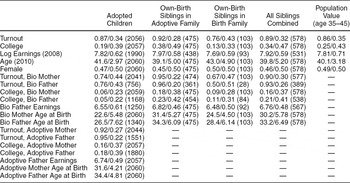
Table 1 reports descriptive statistics for the main variables. Columns 1–3 show summary statistics for the three types of children in the sample—children who were adopted, own-birth children of mothers who adopted at least one child, and own-birth children of mothers who gave up at least one child for adoption. Column 4 shows the sum of all own-birth children in the sample. Turnout rates in these four groups are, respectively, 87%, 92%, 76%, and 89%. The final column shows that turnout in a representative sample of Swedes aged 35–45 was 86%. The adopted children are therefore quite representative, whereas the remaining two groups appear to be positively and negatively selected, respectively, on traits conducive to political participation. Turnout in the combined sample of own-birth children (89%) is similar to turnout among the adoptees and in the population as a whole. Similar patterns of selection appear to hold for educational attainment and yearly earnings.
Summary Statistics

Notes: Means, standard deviations, and number of observations for some key variables. Column 1 shows summary statistics for the adopted children in the sample. Column 2 provides summary statistics for own-birth children reared by parents who adopted children. Column 3 provides summary statistics for own-birth children of parents who gave up at least one child for adoption. Column 4 is the sum of columns 2 and 3. Column 5 provides population summary statistics for the relevant age group (35–45). Turnout is equal to one if the individual voted in the September 2010 Swedish parliamentary election. College is a binary variable equal to one if the individual has at least three years post-secondary schooling. Log earnings is the log of earnings in 2008. Father earnings is the mean of the father's log earnings between 1970 and 1990.
We also report descriptive statistics for the parents of the three types of children. Given that most characteristics are distributed differently in the rearing and biological parents, summary statistics are reported separately for these two groups. It is evident that there are some substantial differences between the samples. For example, the turnout rate among adopted children's biological mothers is 74%, whereas turnout in the sample of adoptive mothers is 92%. The patterns observed for fathers are similar. The adoptive parents are, on average, better educated, have higher incomes, and are relatively older compared to the adopted children's birth parents. Despite these differences in means, which are in most cases statistically significant, there is also substantial overlap in the distributions of characteristics.
RESULTS
Baseline Results
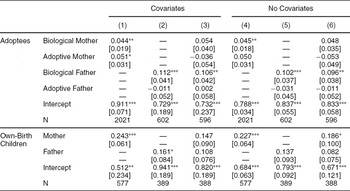
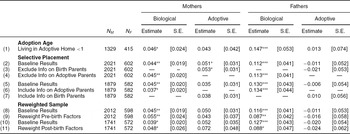
Table 2 reports the intergenerational transmission coefficients for the sample of adoptive (panel 1) and own-birth children (panel 2), using linear models. Linear probability models are estimated mostly to facilitate comparisons with earlier work. However, as Online Appendix C shows, the findings are substantively identical if we use a probit model instead. Throughout, we report estimates from models with and without a set of baseline covariates. These covariates are child's gender, a set of dummies for child's birth year, 25 dummies for parents’ region of residency according to the 1970 census, and eight dummies for parents’ age cohort. For expositional clarity, the tables do not report coefficients for these baseline covariates. Columns 1–3 of Table 2 report the estimates from the model with covariates and columns 4–6 report transmission coefficients from the specification without covariates. The differences are always minor, so our discussion focuses on the transmission coefficients from the models with covariates. In all analyses, standard errors are clustered at the household level. In maternal models, the clustering is done by household mother, and in the paternal models, the clustering is done by household father. Because we constructed the sample to maximize the number of observations in the maternal model, we emphasize these results more.
Baseline Results

Notes: OLS regressions of child's turnout on parent's turnout; * significant at 10%; ** significant at 5%; *** significant at 1%. Standard errors are clustered by household parent. Columns 1–3 show transmission coefficients from linear models with covariates included. Columns 4–6 show the estimates without baseline covariates. These covariates are child's gender, child birth-year dummies, 25 dummies for parents’ region of residency, and 8 dummies for parents’ age.
Columns 1 and 4 of Table 2 report the results from our preferred maternal model. The results show that the turnout of both biological mothers and rearing mothers is a significant predictor of the adoptee's voting. Holding rearing mother's voting status constant, the probability that the adopted child voted is 4.4 percentage points greater if the biological mother voted (p value = 0.02). Holding constant the turnout of the biological mother, a child whose adoptive mother voted is 5.1 percentage points more likely to vote (p value = 0.09). Even though the pre-birth effect is larger, it is estimated less precisely because there is less variation in the turnout of adoptive mothers. Columns 2 and 5 show the analogous estimates for fathers. The sample size is obviously smaller. Nonetheless, the pre-birth effect is estimated with sufficient precision to statistically rule out a zero effect at conventional levels of significance. Adoptees in this sample whose biological fathers vote are 11.2 percentage points more likely to vote (p value < 0.01). The point estimate is large, but also imprecise, with a standard error of 0.04.Footnote 4 For this reason, we cannot reject the null hypothesis that the paternal and maternal pre-birth effects are statistically identical (p value = 0.10). The estimated post-birth effect in the paternal model is negative and not distinguishable from zero (p value = 0.84). Columns 3 and 6 report estimates from a model that includes both fathers’ and mothers’ turnout simultaneously. Because many biological fathers are missing, the sample size declines significantly. The biological father's voting nevertheless remains a significant predictor of the child's turnout. The coefficient of the adoptive father is close to zero, whereas the remaining coefficients are estimated very imprecisely.
The second panel reports results from the sample of own-birth children. As in previous work on own-birth children (Jennings and Niemi Reference Jennings and Niemi1981; Jennings and Stoker Reference Jennings and Stoker2009; Plutzer Reference Plutzer2002), there is strong evidence of parent-child resemblance in turnout. Column 4 shows that, conditioning only on the baseline covariates, having an own-birth mother who voted is associated with an increased probability of turnout of 24.3 percentage points. The corresponding estimate for fathers is 16.1 percentage points. Previous estimates for educational attainment and income (Björklund, Lindahl, and Plug Reference Björklund, Lindahl and Plug2006), crime (Hjalmarsson and Lindquist Reference Hjalmarsson and Lindquist2013), and self-employment (Lindquist, Sol, and Van Praag Reference Lindquist, Sol and Praag2012), using representative comparison samples of own-birth children, have shown that the additive functional form appears to fit the data surprisingly well. We find, however, some evidence suggesting that the sum of the pre- and post-birth coefficients is lower than the estimated transmission coefficient in the sample of own-birth children. A formal test of the hypothesis that α1 and α2—estimated from the sample of adoptees—is equal to β1—estimated from our sample of own-birth children—rejects the hypothesis at the 5% level (p value = 0.02). The difference may be due to chance, but it could also reflect differences between the sample of adoptees and the own-birth children that make the own-birth children an invalid control group. We explore the latter possibility as part of our sensitivity analyses. A final possibility is that the differences are due to interactions between the pre- and post-birth factors, an issue to which we now turn.
The Interaction of Pre-Birth and Post-Birth Factors
In the political science literature, there is much interest in identifying interactions between genes and environments (Alford, Funk, and Hibbing Reference Alford, Funk and Hibbing2005; Mondak et al. Reference Mondak2010). Researchers studying gene-by-environment (G*E) interactions must wrestle with a number of conceptual and definitional questions (Benjamin et al. Reference Benjamin2012b) and empirical challenges (Conley Reference Conley2009). In molecular genetic work, a major challenge is that most genetic effects on complex outcomes, including political variables, are likely to be of tiny magnitude (Benjamin et al. Reference Benjamin2012a; Reference Benjamin2012b). Duncan and Keller (Reference Duncan and Keller2011) provide evidence that most—perhaps all—G*E studies in psychiatric genetics conducted to date have been false positives; they attribute the plethora of false positives to existing studies having been underpowered. Benjamin et al. (Reference Benjamin2012a) have raised similar concerns about published associations with economic and political variables. A second challenge, which applies to all G*E research, is that genes and environments are unlikely to vary independently in observational data. The inability to inexpensively manipulate genes and environments exogenously thus makes the identification of G*E interactions challenging (Conley Reference Conley2009).
Adoption data are valuable both for addressing the challenge of small effects and the potential endogeneity of the environment. Studying the aggregate effects of pre-birth factors and their interactions with broad measures of the environment allows us to bypass the problem that individual genetic variants are likely to have small effects. Adoption also creates a lot of variation in the child's rearing environment that is plausibly exogenous, mitigating endogeneity concerns.
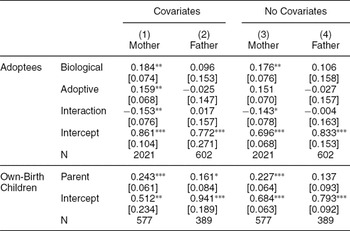
Table 3 reports results from the augmented transmission model, which includes an interaction term between the pre- and post-birth factors. These models allow us to explore whether the effect of one factor on turnout probability depends on the presence or absence of the other factor. In the maternal models, the interaction effect is negative: the transmission of the adoptive mother's voting is strongest in adoptees whose biological mothers were nonvoters. Adoptees whose biological mothers were voters are 0.6 percentage points more likely to vote if they are assigned to a family where the adoptive mother votes. By contrast, adoptees whose biological mothers were nonvoters are almost 16 percentage points more likely to vote if they are assigned to a family in which the adoptive mother is a voter.Footnote 5
The Interaction of Pre-Birth and Post-Birth Factors
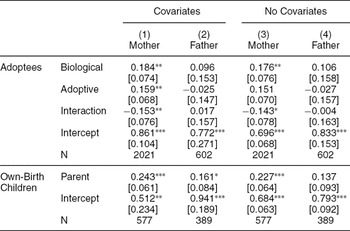
Notes: OLS regressions of child turnout on biological parent's turnout, adoptive parents’ turnout, and their interaction. * significant at 10%; ** significant at 5%; *** significant at 1%. Standard errors are clustered by household parent. Baseline covariates are child's gender, dummies for child's year of birth, 25 dummies for parents’ region of residency, and 8 dummies for parents’ age cohort.
Taken literally, these point estimates suggest that the marginal effect that a pre- or post-birth factor has on the turnout probability is entirely determined by the absence or presence of the other factor. A more cautious and appropriate interpretation is that some degree of substitutability may exist between pre- and post-birth factors. In light of these results, it is not surprising that a test of the restriction α1 + α2 + α3 = β1 is not rejected (p value = 0.47).
Sensitivity Analyses
The estimates reported in Tables 2 and 3 suggest that both pre- and post-birth factors help account for the intergenerational transmission in turnout. However, as noted above, this interpretation rests on important assumptions about (i) the timing of adoption, (ii) random placement of adoptees to their adoptive families, (iii) the distributions from which adoptees are drawn, and (iv) the distributions from which the parents are drawn. Here, we investigate these assumptions and conduct some sensitivity analyses to examine the robustness of the basic results to departures from the assumptions.
We begin with age at adoption. Because 9 out of 10 adoptees spent some time in institutional care before placement, it is important to know if we have reason to believe that the time spent in institutionalized care impacted subsequent development in ways that make generalizing from samples of adoptees to nonadoptees difficult. Bohman (Reference Bohman1970), in an evaluation of the adoption system, writes that “material conditions and staff were of high standard” (p. 25) but also points out that there is some evidence that the institutional stay delayed development (Klackenberg Reference Klackenberg1956).
To test the hypothesis that delayed adoptions may be a source of bias, we reran the basic specifications, restricting the sample to adoptees known to have lived with their adoptive parents by the age of 1 at the latest (see Online Appendix B for details on the construction of this variable). Table 4 presents the results. The estimated transmission coefficients are not sensitive to this restriction. In their study on education and income, Björklund, Lindahl, and Plug (Reference Björklund, Lindahl and Plug2006) reported similar findings in a larger sample of Swedish adoptees.
Sensitivity Analyses

Notes: Summary of robustness tests reported in the main text. * significant at 10%; ** significant at 5%; *** significant at 1%. Standard errors are clustered by household parent. NM is number of observations in maternal model and NF is number of observations in the paternal model. All specifications control for the child's gender, a set of dummies for child's year of birth, 25 dummies for parents’ residency and 8 dummies for parents’ age cohort.
The second assumption is that adoptees are randomly assigned to families, at least conditional on observables. Under random assignment, characteristics of the biological parents should be unrelated to the characteristics of adoptive parents. In the sample, the polychoric biological mother-adoptive mother correlation in turnout is 0.06 (p value = 0.30), the biological father-adoptive father correlation is –0.13 (p value = 0.26), the biological father-adoptive mother correlation is –0.03 (p value = 0.73), and the biological mother-adoptive father correlation is –0.08 (p value = 0.26). These low correlations are reassuring and suggest that selective placement of adoptees with respect to traits conducive to political participation appears to have been minimal. But one should not infer from the low correlations that there was no selective placement of adoptees (Björklund, Lindahl, and Plug Reference Björklund, Lindahl and Plug2006; Hjalmarsson and Lindquist Reference Hjalmarsson and Lindquist2013). Consistent with some selective placement, Björklund et al. (Reference Björklund, Lindahl and Plug2006) report that the adoptive mother biological mother correlation for years of schooling is equal to 0.140 and the adoptive father biological father correlation is 0.144. In our sample, these numbers are 0.170 and 0.105 (p values < 0.001).
We explore the sensitivity of the results to departures from this assumption in two distinct ways. Following Björklund, Lindahl, and Plug (Reference Björklund, Lindahl and Plug2006), one can think of nonrandom assignment as an omitted-variables problem. An association between the adoptive parents’ voting behavior and omitted pre-birth factors could bias the estimates of the post-birth effects. It is easy to see how such biases could arise under nonrandom placement. If children assigned to parents who are educated also, on average, have more favorable pre-birth endowments, the regression of the adoptee's turnout on the adoptive parent's turnout is likely to deliver an upward-biased estimate of the causal effect.
We first examine, separately in the maternal and paternal models, how the estimated effect of the adoptive parents’ turnout changes if one omits the biological parents’ turnout. We similarly examine how the estimated effect of the biological parents’ turnout changes if one omits the adoptive parents’ turnout. In both cases, an increase in the estimated coefficients would indicate omitted-variable bias. Rows 3 and 4 in Table 4 show the results. Given that biological parents’ turnout is virtually uncorrelated with adoptive parents’ turnout, it is not surprising that the estimates hardly move.
A second robustness test is to include as much relevant information as possible about the biological and adoptive parents’ characteristics. We use a rich set of controls comprising parental age, education, occupation according to the 1980 census, the average of the logarithm of income 1970–1990, family size in the 1970 census, and a set of dummy variables for region of residence according to the 1970 census.Footnote 6 If a correlation between the pre-birth factor and features of the adoptive environment drives the estimated pre-birth effects, then one should expect the coefficient to fall if controls measuring the post-birth environment are included. Similarly, if the effect of the post-birth factor is driven by correlations with the pre-birth environment, the estimated coefficients of the adoptive parents should fall when we control for the biological parents’ characteristics.
We begin by restricting the sample to the subsample of adoptees for whom all of the characteristics are nonmissing for both the adoptive and biological parent, so that transmission coefficients are being estimated from the same set of individuals in the specifications with and without covariates. This restriction diminishes the sample size only marginally, from 2,021 to 1,879 in the maternal models. Row 5 contains the baseline results. Row 6 shows the sensitivity of the estimated pre-birth effects to inclusion of the adoptive parent's characteristics, and Row 7 reports the sensitivity of the estimated post-birth effects to the inclusion of the biological parent's characteristics. Overall, the estimates change only marginally. The largest decline observed in the maternal model is that the estimated pre-birth effect goes from 0.045 to 0.037 (the same robustness check in fathers gives rise to a slight increase of the coefficient). All in all, the relatively minor and nonsystematic changes to the transmission estimates indicate that the baseline results are robust to the omitted variables.
We next turn to the assumption that the distribution of characteristics of own-birth children and their parents are the same as the distribution of characteristics in adopted children and their adoptive parents. If substantial differences exist, β1 may not be equal to the sum of α1 and α2 even if the linear specification is correct. We conduct two robustness checks, both of which involve reweighting the samples to make them more comparable. The first is designed to make adoptive parents similar to the parents of own-birth children regarding socioeconomic status, education, and age. The second is designed to make the biological parents of the adoptees more similar to the parents of own-birth children.
To construct the first set of weights, we use data on both parents’ birth quartile, socioeconomic status according to the 1980 census, and an indicator variable for college completion. Socioeconomic status is dichotomized to take on the value 1 if the parent is classified in the census as an intermediate or higher-level nonmanual employee, professional, or upper-level executive, and 0 otherwise (see Online Appendix B for a description of the 1980 census socioeconomic status variable). For each unique combination of categories j, we compute the number of own-birth children (N obc,j ) and the number of adoptees (N a,j ). In our weighted regressions, we define an adoptee's weight as N obc,j /N a,j if Naj > 0 and 0 otherwise. We then re-estimate the baseline models using weighted least squares. The procedure for constructing the weights based on the pre-birth characteristics is analogous, except we conduct the matching separately on biological mother's age, occupational status, and college attainment in the maternal models and the corresponding characteristics of the biological father in the paternal models. A desire to keep the number of unsuccessful matches low motivates the choices of relatively coarse bins.
This procedure will not perfectly equate the pre- or post-birth environments. The goal is, more modestly, to investigate whether making the distributions more similar appears to appreciably impact the estimated transmission coefficients. We report the results from the weighted-least squares regressions in rows 8–11 in Table 4. The estimates are similar to those from the unweighted regressions.
Overall, the sensitivity tests reported in Table 4 suggest that the estimates are reasonably robust; the estimates of the maternal pre-birth effect fall between 3.7 and 5.5 percentage points, and the estimates of the post-birth effect are in the range 3.5 and 7.2 percentage points.
Though the estimates appear to be robust across subsamples and to reweighting, an important question concerns whether the findings from adoptees generalize to nonadoptees and to other countries. The number of adoptions of Swedish-born children declined appreciably between 1965 and 1975 as a result of increasing availability of contraceptives and a gradual relaxation of abortion laws. It is therefore possible that the studied adoptees are becoming progressively less and less representative of the population. Holmlund, Lindahl, and Plug (Reference Holmlund, Lindahl and Plug2011, 643) find, however, that the patterns of intergenerational transmission in a sample of Swedish adoptees born around 1976 are similar to those reported by Björklund, Lindahl, and Plug's (Reference Björklund, Lindahl and Plug2006) study of adoptees born between 1962 and 1966.
Previous studies on income and education (Björklund, Lindahl, and Plug Reference Björklund, Lindahl and Plug2006), crime (Hjalmarsson and Lindquist Reference Hjalmarsson and Lindquist2013), and self-employment (Lindquist, Sol, and Van Praag Reference Lindquist, Sol and Praag2012) all used data from population-wide registries to obtain a precise estimate of the population value of β1. These studies find the sum of pre- and post-birth coefficients in their adoptee samples (
 $\hat{\alpha }_{1}+\hat{\alpha }_{2}$
) are remarkably close to the estimate of β1 obtained from a very large representative sample of own-birth children. Unfortunately, no large representative sample with turnout data exists from which we can estimate this coefficient. Instead, our strategy is motivated by the data in Table 1, which suggests that the combined sample of own-birth children is reasonably representative of the population.
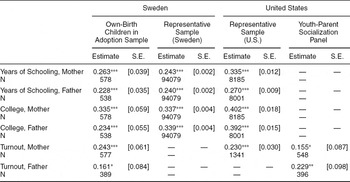
One way to gauge whether the transmission coefficients estimated from the sample of own-birth children in this sample is comparable to the population transmission coefficients is to compare the transmission coefficients for education obtained from our sample to the population figures reported by Björklund, Lindahl, and Plug (Reference Björklund, Lindahl and Plug2006). Table 5 presents transmission coefficients for years of schooling and a binary variable for college completion. Column 2 reproduces the figures from Björklund, Lindahl, and Plug (Reference Björklund, Lindahl and Plug2006). Björklund, Lindahl, and Plug (Reference Björklund, Lindahl and Plug2006) work with a 20% random sample of all nonadopted children born in Sweden between 1962 and 1966. But as Table 5 shows, the standard errors are so small that the distinction between their estimates and the population parameters is of no practical significance. Column 1 of Table 5 reports the estimated transmission coefficients in the entire sample of own-birth children (born between 1960 and 1980). Overall, the estimates of intergenerational mobility in years of schooling and college completion from our sample of own-birth children are similar to the population figures. We find no strong indications that the transmission coefficients from our sample of own-birth children are systematically higher or lower than the values reported by Björklund, Lindahl, and Plug (Reference Björklund, Lindahl and Plug2006).
Transmission Compared to Representative Samples

Notes: Own-birth transmission coefficients in Swedish and US samples. * significant at 10%; ** significant at 5%; *** significant at 1%. Coefficients are estimated using only samples of own-birth children. Controls for child's gender, parental age, child's age, and region of residency are included in all specifications. Racial self-classification is also controlled for in U.S. samples. Swedish estimates for college and years of schooling are from Björklund, Lindahl, and Plug (Reference Björklund, Lindahl and Plug2006). U.S. representative sample estimates are obtained from the NLSY.
The last two rows in the first column reproduce the transmission coefficient for turnout from our sample of own-birth children. The coefficient for transmission from mother to child, 0.24, is similar to the results obtained when estimating transmission coefficients in the two groups of own-birth children. Transmission in the own-birth children raised by parents who adopted children is 0.26 (s.e. 0.10, n = 474), and transmission in the group of own-birth children raised by parents who gave up at least one child for adoption is 0.25 (s.e. 0.18, n = 103). The latter group of children should be similar to adoptees with respect to pre-birth characteristics, whereas the former should be similar in terms of post-birth characteristics. We conclude that the transmission coefficients in own-birth children do not appear to be particularly sensitive to the subsample in which they are estimated.
Sweden's political system and its electorate stand out along certain dimensions in international comparisons. A particularly striking difference is the high Swedish turnout rates (Birch Reference Birch2010). All political behavior takes place within an institutional environment and the parameter estimates obtained from one set of environments does not necessarily translate to others. As an empirical matter, we are not aware of any evidence that estimates of behavior genetic parameters obtained from Swedish data vary systematically from those obtained from other countries. For example, a recent comparative study of the heritability of political variables in Australia, Denmark, Sweden, and the United States found small differences across countries (Hatemi et al., forthcoming).
However, a specific concern is that the high turnout rates in Sweden may depress estimates of the pre-birth and post-birth influences relative to other countries, thus compromising the external validity of our estimates. To explore this question, we use information from two U.S. longitudinal data sets with intergenerational data on voting behavior: (i) the National Longitudinal Study of Youth (NLSY) and (ii) the Youth-Parent Socialization Panel Study (Elliot Reference Elliot2006). We sought to minimize differences between the sample-selection criteria used to define the U.S. samples and the criteria used to construct the Swedish samples and we control for a very similar set of baseline covariates in these analyses. For details, see Online Appendix D.
The right panel of Table 5 reports the transmission coefficients from these two American samples. The NLSY maternal coefficient is 0.23 (s.e. 0.03), which is close both to the paternal (0.16) and maternal (0.24) estimates in the Swedish data. Because the NLSY sample is very large, the estimate is precise. The final two columns show the estimated transmission coefficients from the YPSPS sample. These estimates are somewhat less precise, but are similar in magnitude to the Swedish transmission coefficients, with a paternal estimate of 0.23 (s.e. 0.10, n = 396) and a maternal estimate of 0.16 (s.e. 0.09, n = 548). We conclude that no major differences appear to exist in the magnitude of the parent-child transmission coefficient in Sweden and the United States.
PARENTAL EDUCATION AND VOTER TURNOUT
So far we have used the adoption design to decompose the parent-child resemblance into a pre- and a post-birth factor. Adoption data can also be used to illuminate which features of the family environment are relevant for the development of political behaviors and preferences, a question to which we now turn.
The standard approach in the transmission literature is to study the relationship between parental characteristics and children's political behaviors in samples of own-birth children. A robust result emerging from this literature is that parental education is positively related to adult political engagement and voting participation (Sandell and Plutzer Reference Sandell and Plutzer2005) and the relationship is often interpreted as causal (Verba, Burns, and Schlozman Reference Verba, Burns and Schlozman2003). Existing estimates may overstate the causal effect of education if parental education is associated with pre-birth factors that are not properly controlled for. Evidence from adoption research in psychology (Scarr and Weinberg Reference Scarr and Weinberg1978) and economics (Sacerdote Reference Sacerdote, Benhabib, Jackson and Bisin2011) suggests that parental characteristics are much more weakly related to children's cognitive test scores in adoptive families than in families with own-birth children. Fowler, Baker, and Dawes (Reference Fowler, Baker and Dawes2008) note the possibility of bias due to the omission of genes in research on the intergenerational transmission of political participation, but no suitable data exist for directly testing the hypothesis.
We test the hypothesis of confounding by examining how the associations between parental characteristics and children's political participation vary as a function of the genetic relatedness between parent and child. If the relationships are weaker in parent-child pairs in which the parent is genetically unrelated to the child, a plausible interpretation is that omitted pre-birth factors are biasing the estimated coefficients. Following Sacerdote (Reference Sacerdote2007), one can think of adoption as an experiment that randomly assigns children to different types of families. Regressions of child outcomes on family characteristics can then be interpreted as treatment effects. Formally, we estimate
 \begin{equation}
Y_{i}^{\,ac}=\alpha _{0}+T_{i}^{\,af}\beta _{1}+\sum _{k=1}^{m}\gamma _{k}C_{ki}^{\,bm}+\epsilon _{i}^{\,ac},
\end{equation}
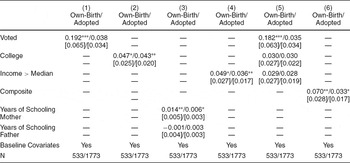
Table 6 reports results from specifications with the family-type variable defined in four different ways. To provide a benchmark for comparison, we report estimates from the sample of own-birth children next to the estimates obtained from the sample of adoptees. The first column shows the results from a model in which the treatment variable takes the value 1 if the rearing mother voted. The results suggest transmission is about five times stronger in the presence of a genetic link between parent and child. The second column reports results from a model in which the treatment variable takes the value 1 if at least one parent has a college degree. Reassuringly, we replicate the finding from previous work on samples of own-birth children, that parental education is associated with turnout later in life. In our sample of own-birth children, growing up in a family in which at least one parent has a college degree is associated with an increase in turnout of 4.7 percentage points. Adoptees assigned to families in which at least one parent has a college degree are 4.3 percentage points more likely to vote. Column 3 shows the results from an analogous specification but with years of education measured continuously and included separately for mothers and fathers. These estimates suggest that maternal education (or variables correlated with maternal education) drives the effect. Each additional year of maternal schooling is associated with an increase in the probability of voting of 1.4 percentage points in the sample of own-birth children, whereas the corresponding coefficient is 0.6 percentage points in the sample of adoptees. The results thus show that a relationship between parental education and participation persists even after accounting for unobserved heterogeneity in pre-birth factors.
Family Characteristics and Turnout in Own-Birth Children and Adoptees

Notes: OLS regressions of child turnout on family characteristics in own-birth and adopted children. * significant at 10%; ** significant at 5%; *** significant at 1%. All specifications include controls for the child's gender, a set of dummies for child's year of birth, 25 dummies for parents’ region of residency, and 8 dummies for parents’ age cohort. Specification with adoptees also include controls for biological mother's college, years of education, family size in 1970, average of logarithm of income 1970–1990, and occupational status according to the 1980 census.
Column 4 shows that children reared in a household in which the father's average earnings between 1970 and 1990 are above the median are more likely to vote. As would be expected under the hypothesis of pre-birth confounding, the relationship is weaker in adoptees: the coefficent is approximately one-fourth lower. Columns 5 and 6 show estimates from models that make richer use of the variables jointly. Column 5 includes all three variables simultaneously, and column 6 shows the estimates from a model in which the treatment indicator variable takes the value 1 if at least two of three variables Voted, College, or Income > Median are equal to 1.
DISCUSSION
One of the most firmly established empirical findings in the political science literature is the substantial parent-child resemblance in political behavior and attitudes (Jennings and Niemi Reference Jennings and Niemi1968; Reference Jennings and Niemi1981; Jennings, Stoker and Bowers Reference Jennings and Stoker2009; Sapiro Reference Sapiro2004). This article investigates the sources of this resemblance using a uniquely assembled Swedish data set with information about the voter turnout of a large number of adopted individuals and their adoptive and biological parents. We also use the adoption data to try to obtain estimates of the relationship between parental characteristics and child turnout that are not confounded by unobserved pre-birth factors. The richness of the data allows for a number of sensitivity checks that are not always feasible in adoption research. Our work is closely related to twin studies of political attitudes and behavior (Alford, Funk, and Hibbing Reference Alford, Funk and Hibbing2005; Fowler, Baker, and Dawes Reference Fowler, Baker and Dawes2008; Hatemi et al. Reference Hatemi2007; Reference Hatemi2009; Reference Hatemi2010; Martin et al. Reference Martin1986), though an important difference is that the regression-based framework we employ produces estimates that are easier to relate to existing research in political science.
Conventional twin studies find that the proportion of variation explained by family environment is low, sometimes zero. Such findings are typical in behavior genetics, where the conventional wisdom is that family effects “largely wash out by late adolescence” (Loehlin, Horn, and Ernst Reference Loehlin, Horn and Ernst2007, 643).Footnote 7 Social scientists often react to the behavior genetic findings with incredulity. After all, assigning a newborn child to a family is one of the largest social interventions one can imagine. The results this article presents suggest that perhaps some of the skepticism is warranted. We find quite strong evidence that post-birth effects on voting behavior do not “largely wash out.”Footnote 8 Though some degree of selective placement may be biasing the estimates in the direction of finding post-birth effects, the robustness checks suggests that such biases are likely to be quite small. In the preferred specification with adoptive and biological mothers included, the post-birth effects are imprecisely estimated but are of the same magnitude as the pre-birth effects.
Other evidence of post-birth influences comes from the analysis that shows that the relationships between child's turnout and a number of parental characteristics persist, though they are consistently weaker, in parent-child pairs in which the child is adopted. Given earlier findings on own-birth children (Verba, Schlozman, and Burns Reference Verba, Schlozman, Burns and Zuckerman2005), the results on education are of particular interest. Adoptees assigned to families in which at least one parent is college educated are 4.3 percentage points more likely than other adoptees to vote, suggesting that the relationship is not driven entirely by genetic confounds. A closer look suggests that maternal education drives this effect. This result is consistent with Jennings and Niemi's (Reference Niemi1974) finding that in families in which fathers and mothers are discordant on political attitudes, adolescents are on average more similar to their mothers.
Though the evidence of post-birth effects is robust, the analyses also show that pre-birth factors account for a substantial share of the intergenerational resemblance in voter turnout. Despite the fact that all formal ties between biological parents and adoptees were cut at adoption, and that a large majority of the children in the sample have no information about their biological parents (Nordlöf Reference Nordlöf2001), the voting behavior of adoptees around the age of 40 can still be predicted by the voting behavior of their biological parents. In both the maternal and paternal models, the pre-birth effects are positive and significant: adoptees with a biological mother who voted are approximately 4 percentage points more likely to have voted, and adoptees with a biological father who voted are approximately 11 percentage points more likely to have voted. This result provides partly independent corroboration of the pervasive finding from twin studies that genes in the aggregate explain a modest to large fraction of the variation in political participation (Fowler, Baker, and Dawes Reference Fowler, Baker and Dawes2008) and attitudes (Alford, Funk, and Hibbing Reference Alford, Funk and Hibbing2005; Hatemi et al. Reference Hatemi2007; Reference Hatemi2009; Reference Hatemi2010). Evidence from adoption studies is a valuable complement to this body of work because adoption research relies on a different set of critical assumptions than those that tend to incite the most controversy in twin studies (Charney Reference Charney2012).
It is important to be clear about what can and what cannot be learned from studies such as ours. In particular, it is frequently asserted in the political science literature that findings from behavior genetic studies (i) imply that changing political attitudes and behaviors is more difficult than is usually believed and (ii) pose a challenge to socialization research and the conventional wisdom that parents play a critical role in a child's political development.
The first assertion is wrong for two distinct reasons. First, even if pre-birth factors whose effects are difficult to modify explain a high fraction of trait variation, we cannot infer that the trait is difficult to change, because powerful environmental interventions may still exist that do not contribute to outcome variance in the current population (Goldberger Reference Goldberger1979). A compulsory voting law with severe penalties inflicted on nonvoters would probably massively increase turnout, irrespective of the fraction of outcome variance in turnout accounted for by genes in the current population.
Second, pre-birth factors may impact outcomes through environmental pathways that themselves are modifiable (Jencks Reference Jencks1980). Relatively direct physical pathways from pre-birth factors to political participation may exist in principle, but the possibility that many (perhaps all?) of the relevant pre-birth factors impact turnout only indirectly seems exceedingly likely. An extreme example in the spirit of Jencks (Reference Jencks1980) may help illustrate the argument. Imagine an adoption study conducted in a society with strong norms, perhaps even laws, against female political participation. In such a society, an individual's sex chromosomes will be strongly associated with turnout. In a technical sense, a biological characteristic determined before birth, the adoptee's sex, is a powerful determinant of turnout. But the mechanism is environmental: neither norms nor laws are immutable. The example of female political participation is extreme, but one can easily imagine how genetic factors could operate in similar ways with respect to voting. For example, physical factors such as attractiveness and height may influence how well liked a child is, with downstream effects on extraversion, confidence, and ultimately a whole array of political behaviors.
Similar arguments also clarify why evidence of pre-birth factors does not necessarily falsify socialization theories in which the family plays a critical role in development. The reason is that pre-birth factors may influence turnout through channels in which parental behaviors are important mediating variables. As an illustration, suppose some children find reading books more enjoyable because of an inherited predisposition and further, that parents respond to these differences by creating more cognitively stimulating environments for children who express an early interest in reading. Small initial differences could then give rise to substantial heterogeneity in reading skills and the ability to process political information. Such heterogeneity, in turn, could translate into vast differences in political knowledge (Verba, Schlozman, and Brady Reference Verba1995) and political interest (Prior Reference Prior2010), with downstream effects on an array of political behaviors.Footnote 9 Both skeptics and advocates of the use of behavior genetic methods in political science often take as a given that the existence of pre-birth effects would imply the existence of a causal and direct physical pathway from genes (or some other pre-birth factor) to outcomes. But such an assumption may rest, in the language of Jencks (Reference Jencks1980), on a “narrowly physiological model” (p. 723) of how genes impact complex behaviors.
Rather than reject theories of socialization, findings such as ours can help inform research on the transmission of political attitudes and behaviors by placing restrictions on the set of theories of the intergenerational transmission of voting behavior that can be considered plausible. The existence of causal pathways from pre-birth factors to turnout is inconsistent with any model that posits that the only source of parent-child resemblance in political behavior is a set of exogenously varying parental characteristics transmitted automatically to children through, for instance, imitation. Although some socialization research operates under a presumption that transmission occurs through a one-way causal chain from parental behaviors and attitudes to children, research that views parental behaviors as responsive to children's behaviors and treats children as active participants in the development process challenges such presumptions (Kuczynski Reference Kuczynski and Kuczynski2003; Niemi and Hepburn Reference Niemi and Hepburn1995). Our results show how studying the role of pre-birth factors in the development process may lead to new insights. For example, being reared in a post-birth environment conducive to political participation is more valuable for a child whose biological mother is a nonvoter. If the return to environmental quality varies by pre-birth factors, such information is valuable for determining where policies or interventions designed to increase political participation might have the most significant impact.
Supplementary materials
To view supplementary material for this article, please visit http://dx.doi.org/10.1017/S0003055413000592




Comments
No Comments have been published for this article.