A relation between hospital construction and hospital-acquired infection is well established. Prior studies have documented an increase in fungal infections, particularly Aspergillus spp., associated with hospital renovations.Reference Kanamori, Rutala, Sickbert-Bennett and Weber 1 Also, bacteria may be aerosolized during construction,Reference Boix-Palop, Nicholas and Xercavins 2 although the clinical significance of this occurrence is less clear.
In contrast to infections occurring during construction, little attention has been directed to the potential beneficial effect of renovation on infection risk after the completion of the renovation. Potential bacterial pathogens, such as vancomycin-resistant Enterococcus (VRE), often contaminate the surfaces in patient rooms, and such environmental contamination is associated with an increased risk of patient VRE colonization and infection.Reference Drees, Snydman and Schmid 3 , Reference Martinez, Ruthazer, Hansjosten, Barefoot and Snydman 4 Thus, remodeling that includes replacement of surfaces could conceivably reduce the rate of infection, at least until environmental recontamination occurs.
Despite regular surveillance and contact precautions, VRE gastrointestinal colonization is a common occurrence on our unit, which is dedicated to the care of patients with hematologic malignancies and hematopoietic stem-cell transplantation (HSCT) recipients. In 2009–2010, our unit underwent extensive remodeling with replacement of all surfaces. This renovation presented a unique opportunity to assess the effect of our construction on and to estimate the contribution of environmental contamination to the incidence of VRE gastrointestinal colonization.
METHODS
Unit Remodeling
Between January 2009 and April 2010, our inpatient unit underwent a complete renovation, including replacement of all surfaces both within patient rooms and outside the rooms in hallways and staff working areas. Following construction, all rooms had been converted to either high-efficiency particulate air (HEPA)–filtered positive-laminar-airflow rooms (n=30) or negative-flow rooms (n=4). In construction phase 1, one-half of the unit was remodeled. During this time, patients were housed in the other half of the unit, with the overflow mixed with general medical patients on a separate medical unit. In phase 2, the remaining half of the unit was similarly renovated. The portion of the unit under construction was always physically isolated.
Unit and Equipment Disinfection Procedures
Before, during, and after construction, room and unit cleaning protocols and guidelines for disinfecting equipment shared among patients did not change. However, during construction, increased monitoring of and training for cleaning personnel was instituted. In this monitoring, initially random applications of ultraviolet-tagged gel (GlitterBug; Brevis, Salt Lake City, UT) were utilized; later, adenosine triphosphate detection using the 3M Clean Trace Monitoring System (3M, St Paul, MN) was used. Formal logs were also introduced to document double cleaning. Cleaning protocols included the daily cleaning of all rooms with a phenolic disinfectant and terminal double cleaning, including walls and ceilings. Outside the patient rooms, cleaning procedures included once-daily dusting and disinfection of all fixtures, including phones and computer keyboards. Nursing and clinical staff did not routinely disinfect these areas after use.
Patients
We studied 536 consecutive admissions (500 patients) with a diagnosis of newly discovered acute leukemia, a first autologous HSCT, or a first allogeneic HSCT in which the patient had a negative admitting VRE stool culture. In total, 36 patients were admitted both for leukemic induction and HSCT. Patients were housed in individual rooms, routinely had central venous catheters inserted, and received prophylactic proton pump inhibitors. Stools were cultured weekly for VRE during the inpatient stay. Hand washing was required before any room entrance, and VRE colonized patients were placed into contact isolation (gloves and gowns). During the study period, hand washing on our unit was monitored monthly by an infection preventionist nurse. Just prior to construction, a hospitalwide focus and educational campaign for hand hygiene was implemented. This intervention resulted in an increase in observed compliance from 81% before construction to a consistent 95% after. Monitoring data on gowning and gloving were not available. Antibiotic regimens remained consistent over the duration of the study. Afebrile neutropenic patients received antimicrobial prophylaxis (ie, levofloxacin, penicillin, and either an echinocandin, or antimold triazole). The usual empiric antibiotic regimen for febrile neutropenia was a carbapenem with or without extended gram-positive coverage, usually vancomycin. The Intermountain Healthcare Institutional Review Board approved the study.
Multilocus Sequence Typing
Previously cryopreserved isolates were inoculated on blood agar. DNA was isolated using the UltraClean Microbial DNA isolation kit (MoBio Laboratories, Carlsbad, CA). Polymerase chain reaction (PCR) was performed using primers for 7 E. faecium multilocus sequence typing (MLST) housekeeping genes: atpA, ddl, gdh, purK, gyd, pstS, and adk (Invitrogen, Carlsbad, CA).Reference Homan, Tribe and Poznanski 5 Reactions were performed in 25 μL volumes using Qiagen Multiplex PCR Master Mix (Qiagen, Hilden, Germany). PCR products were sent for cleanup and sequencing with both PCR forward and reverse primers (TACGen, Richmond, CA). Sequences were queried against the Enterococcus faecium locus and sequence definitions database. The sequence type was determined via comparison with the MLST database at the University of Oxford (http://pubmlst.org) and with MLST profiles obtained from previously sequenced VRE samples from the same period (see NCBI BioProject database no. PRJNA329509).
Environmental Sampling
In late 2016, we prospectively cultured 10 areas outside the patient rooms that are commonly touched by healthcare personnel: computer keyboard, mouse, patient cart, scale, door handle to patient room, wall push button, refrigerator handle, sink handles, staff phone, and door handle to nursing work area. Environmental cultures were obtained by passing sterile, saline-moistened cotton-swabs over a defined area, which were then used to inoculate bile esculin azide broth (Hardy Diagnostics, Midvale, UT). Culture-positive broths were plated on VRE ChromID agar plates for identification (bioMerieux, St. Louis, MO). All environmental cultures were completed by a study investigator (J.C.).
Statistical Analysis
Probabilities of colonization were estimated using the Kaplan-Meier method. Hazard ratios (95% confidence limits) and statistical associations were accomplished using log-rank tests. Group medians were compared with permutation tests using R statistical software (R Foundation for Statistical Computing, Vienna, Austria). Permutation testing was selected because it works on the exact comparison of interest, as opposed to statistics constructed from simplified computation, and because the more complex calculation procedures required are now readily feasible with modern computing. After correction for multiple comparisons,Reference Benjamini and Hochberg 6 P<.05 was considered significant.
RESULTS
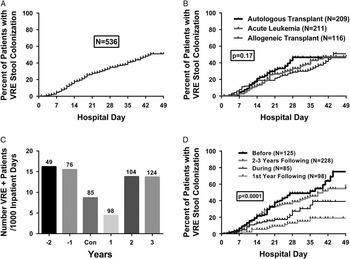
The cumulative risk of VRE colonization for all admissions is shown in Figure 1A. In total, 184 admissions (34%) developed hospital-acquired VRE colonization (11.6 cases per 1,000 inpatient days). The median time to colonization was 15 days. Colonization risk was linearly related to length of stay (LOS). The cumulative rates of VRE colonization were similar for the 3 patient groups (Figure 1B). Therefore, these were combined for subsequent analyses.
(A) Hospital-acquired VRE colonization rate for the entire population of 536 patients. (B) Comparison of hospital-acquired VRE colonization rates for patients with newly diagnosed acute leukemia, those receiving an autologous HSCT, and those receiving an allogeneic HSCT. (C) Comparison of VRE incidence rates for the periods under study. Con, construction. Numbers on the x-axis are years before and after construction. The numbers above the bars indicate the number of patients analyzed during the interval. (D) Comparison of hospital-acquired VRE colonization rates for patients hospitalized during the following time periods: the 2 years before construction, during construction, the year after the renovation, and 2–3 years later.

Unit Renovation and VRE Colonization Risk
The incidences of hospital-acquired VRE colonization before, during, and after our unit renovation are shown in Figure 1C. For the 2 years prior to renovation, colonization rates were stable at 15.8 cases per 1,000 inpatient days. During construction, the incidence was 8.7 cases per 1,000 inpatient days. After the renovation, the VRE incidence during the first year was 4.4 cases per 1,000 inpatient days and then returned to stable levels at 13.7 cases per 1,000 inpatient days. Colonization rates during the first and second phases of our construction were 9.3 and 7.2 cases per 1,000 inpatient days, respectively. The cumulative rates of VRE acquisition are shown in Figure 1D. Compared to the rates for the 2 years prior to construction, the VRE rates for the second and third years after the renovation showed no significant difference (hazard ratio [HR], 1.2; 95% confidence interval [CI], 0.86–1.7; P=.30). Conversely, VRE acquisition rates were significantly reduced during construction (HR, 0.47; 95% CI, 0.31–0.77; P=.002) and the first year after the renovation (HR, 0.23; 95% CI, 0.18–0.44; P<.0001).
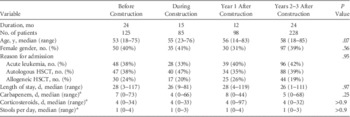
To determine whether risk factors for VRE colonization remained similar over the study period, we compared the records of patients admitted during the 4 time periods (Table 1). No differences were detected among groups in gender, reason for admission, or risk factors we have previously identified for VRE colonizationReference Ford, Lopansri and Haydoura 7 : LOS, days of carbapenem exposure, days of high-dose corticosteroids, and number of stools per day. A trend toward older age for patients treated later in the study was observed.
Characteristics of Patients by Admission Date in relation to Unit Renovation.

NOTE. HSCT, hematopoietic stem-cell transplantation.
a Before detection of VRE colonization or discharge.
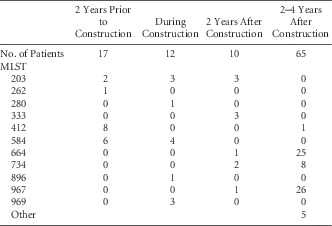
Distribution of MLSTs in Relation to Construction

NOTE. MLST, multilocus sequence typing.
Unit Renovation and Changes in VRE MLST
The results of MLST typing on a convenient subset of banked stool samples (1 stool per patient) are shown in Table 2. Typing results on patients prior to and more than 2 years after construction will be reported as part of a larger VRE surveillance study (M. A. Gazdik Stofer, unpublished data) but are included for comparison. These data suggest unit domination by ST412 and ST584 prior to construction. During construction, these types seemed to diminish, and they virtually disappeared after construction. Ultimately, they were replaced by ST664 and ST967.
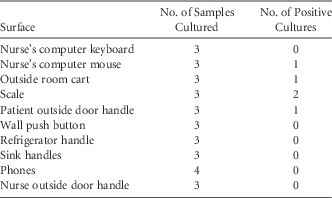
Results of Cultures on Surfaces Outside Patient Rooms

Unit Environmental Cultures
We previously reported culture results, obtained in 2015, of the surfaces of rooms occupied by patients colonized with VRE.Reference Ford, Lopansri and Gazdik 8 These studies showed that VRE can be recovered from 10% of rooms after aggressive terminal cleaning. Because we lacked culture results from surfaces outside of the patient rooms, we prospectively cultured 10 areas commonly touched by healthcare workers in the interroom environment; VRE was readily recovered from several of these sites (Table 3). Because of the interval between the study period and the performance of these cultures and the small number of positive cultures, MLST of these isolates was not performed.
DISCUSSION
In this study, we explored the effect of extensive unit renovation on the rates of acquisition of VRE colonization. During the study period, the makeup of the patient population, supportive care guidelines, unit personnel, cleaning protocols, VRE surveillance and isolation procedures, and our previously identified risk factors for VRE colonization remained stable. We observed a trend toward a higher median age later in the study period. However, age was not a predictive factor in our prior studies of these populations.Reference Ford, Lopansri and Haydoura 7 , Reference Ford, Gazdik and Lopansri 9 Therefore, patient and treatment variables do not seem to account for the differences in VRE colonization among the periods studied.
Our data show a substantial transient decrease in VRE colonization after the renovation. We hypothesize that this is due to the replacement of contaminated surfaces, resulting in reduced colonization rates among patients that in turn minimized the recontamination of the environment. Teltsch et alReference Teltsch, Hanley, Loo, Goldberg, Gursahaney and Buckeridge 10 also noted a decrease in several “exogenous” organisms, including VRE, after the conversion of an intensive care unit to private rooms. Interestingly, these authors attributed the decrease to the increase in single-patient rooms.
Our construction not only replaced contaminated surfaces but also increased the number of HEPA-filtered positive-flow rooms on our unit. In addition, improvements in the monitoring of cleaning personnel may have increased the efficiency of room cleaning after construction, and a new emphasis improved compliance with hand washing. These changes may have further decreased room and patient contamination.Reference Boswell 11 – Reference Hayden, Bonten, Blom, Lyle, van de Vijver and Weinstein 13 Although these intervention results did not change after the renovation, the decrease in VRE colonization was temporary. This temporary reduction and the dominant VRE strain type changes suggest that progressive environmental contamination from patients may have been more important factors. Notably, the steady-state incidence of VRE colonization after the renovation (ie, 2–3 years afterward) was 13% lower than before construction, which is not statistically significant. This reduction may represent a longer-term effect of room filtration, improved cleaning compliance, and/or better hand hygiene.
Bacterial contamination of the environment may occur during construction,Reference Boix-Palop, Nicholas and Xercavins 2 potentially increasing the risk of colonization and infection. However, as opposed to fungus,Reference Kanamori, Rutala, Sickbert-Bennett and Weber 1 renovation-associated bacterial outbreaks are not well documented. Likewise, we observed no increase in VRE colonization rates during our renovation. Conversely, our patients experienced a 50% reduction in VRE colonization. This decrease was observed in both halves of the construction phase and may have been due to the housing of some patients off the unit or in the newly constructed areas where patient VRE colonization pressure and environmental contamination levels were lower.
Identifying the sites of VRE environmental contamination that may contribute to patient acquisition has been an important area of investigation. Virtually all previous work has focused on the surfaces in the patient room. These studies have shown a strong correlation between positive environmental cultures and the risk for VRE colonization in ICU patients.Reference Drees, Snydman and Schmid 3 , Reference Martinez, Ruthazer, Hansjosten, Barefoot and Snydman 4 In contrast, little attention has been directed toward surfaces outside of patient rooms. We found that several high-touch staff areas in the interroom environment were also contaminated. Given that some VRE strains can persist on dry surfaces for weeks to months,Reference Kramer, Schwebke and Kampf 14 that the areas outside patient rooms are not aggressively decontaminated, and that some of these high-touch areas, such as the outside door latch to a patient room, could contaminate the hands of healthcare workers after hand washing, contaminated areas outside the rooms could also pose significant risks to patients.
An additional factor, which may warrant further investigation, is the effect of our positive-flow rooms. While these may prevent contaminated hallway air from entering rooms, contaminated air from a colonized patient’s room may be pushed into the interroom environment, contributing to contamination of staff areas.
Our results suggest an apparent change in the predominant colonizing strains of VRE on our unit after the renovation. A similar change in strain types was observed by McManus et alReference McManus, McManus, Mason, Aitcheson and Pruitt 15 after the renovation of a burn unit. ST664 and ST967 were not identified prior to or during our renovation, and our data are consistent with the hypothesis that these types were introduced to our unit by patients admitted after the renovation. While ST412 and ST584 have been prevalent, especially in the Western Hemisphere, ST967 is novel and ST664 is rarely reported.Reference Michael, No and Roberts 16 Outbreaks of these strains on our unit suggest compliance problems with isolation and sterilization procedures, which we have documented elsewhere.Reference Ford, Lopansri and Gazdik 8 They also suggest the possibility that other outbreaks before or after the study period may have gone undetected.
Notably, some MLST types predominated over others during our study period. We have previously shown that our patients harbor many VRE strains, some with high frequencies and some with low frequencies.Reference Ford, Lopansri and Gazdik 8 Thus, some VRE strains had higher fitness for survival and propagation on our unit. Further study is needed to determine whether this increased robustness is due to prolonged survival on surfaces, higher efficiency of patient colonization, or both.
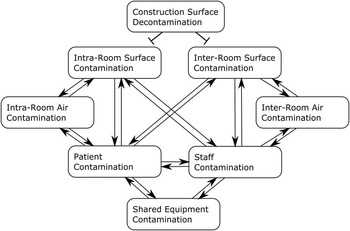
Our data suggest complex, dynamic, and reciprocal relations between VRE organisms, patients, staff, and the environment as illustrated in Figure 2. With adequate time and relatively stable numbers of inpatients, an equilibrium seems to occur, which on our unit is approximately 14–16 VRE colonizations per 1,000 inpatient days. This rate may theoretically be improved by decreasing the contamination rate of any of the areas outlined in the boxes. Thus, lower patient colonization pressure,Reference Bonten, Slaughter and Ambergen 17 use of contact isolation by staff,Reference Harris, Pineles and Belton 18 , Reference Slaughter, Hayden and Nathan 19 more intense room-cleaning procedures,Reference Hayden, Bonten, Blom, Lyle, van de Vijver and Weinstein 13 and air filtrationReference Muzslay, Moore, Turton and Wilson 12 have all been shown to lower colonization with antibiotic-resistant bacteria. Our data suggest that more attention to disinfecting the environment outside of rooms may also be helpful. Our construction seems to have temporarily interrupted this equilibrium by eliminating both the contamination inside and outside the patient rooms. Shortly after reopening the unit, different VRE strains appear to have been introduced, and endemic transmission with 2 new dominant strains was established within 1 year.
Hypothetical representation of the reservoirs of vancomycin-resistant Enterococcus (VRE) (boxes) and transfers between reservoirs (arrows) on our unit. Inhibitory effect of construction is noted at the top.

Our study has several limitations: We used a retrospective design; thus, the possibility of undetected confounding factors affecting colonization rates cannot be excluded. This study was conducted in a single institution with distinctive practice patterns. Cryopreserved stool specimens were available for only a portion of our patient population, and our environmental cultures were relatively few. In addition, information on pertinent variables such as VRE colonization pressure, VRE colonization on admission rates, compliance with contact precautions, and environmental cultures during the study period were not available.
In summary, the extensive renovation of our unit was associated with a dramatic but temporary reduction in VRE colonization rates. More intensive environmental disinfection procedures, including in areas outside patient rooms that are frequented by staff, may be helpful in decreasing VRE colonization rates.
ACKNOWLEDGMENTS
The authors thank the physicians, nurses, and other hospital staff who cared for the patients, and Greg Snow, PhD, for help with the statistical analysis.
Financial support: This study was supported by the Intermountain Healthcare Medical and Research Foundation.
Potential conflicts of interest: B.K.L. has received research support from Cubist/Merck in support of a project unrelated to this study. All other authors report no conflicts of interest relevant to this article.