Introduction
In ocean science, the analysis of carbon isotopes, particularly of radiocarbon (14C), is crucial for understanding processes such as ocean water circulation and atmosphere–ocean CO2 exchange (Matsumoto Reference Matsumoto2007; McNichol et al. Reference McNichol, Key and Guilderson2022). Achieving a global understanding of ocean water dynamics requires carbon isotope data for many oceanic regions, and therefore depends critically on the consistency and reliability of the methods used to obtain the data (Anderson Reference Anderson2020; Key et al. Reference Key, Quay, Schlosser, McNichol, von Reden, Schneider, Elder, Stuiver and Ostlund2002; Olsen et al. Reference Olsen, Lange, Key, Tanhua, Bittig, Kozyr, Alvarez, Azetsu-Scott, Becker and Brown2020). Consequently, standard operating procedures have been established for seawater analysis; for CO2-related analyses, these standards require poisoning of the water samples during collection with mercury chloride (HgCl2) solution to prevent changes in carbon contents (dissolved inorganic carbon: DIC and dissolved organic carbon: DOC) owing to biological activity (Abrams Reference Abrams2013; Dickson et al. Reference Dickson, Sabine and Christian2007). However, owing to the ecological toxicity of Hg, its release into the environment is strictly regulated such as the Minamata Convention on Mercury. Further, HgCl2 pretreatment has been reported to introduce analytical error into concentration and carbon isotopes of DIC and concentration of DOC (Argentino et al. Reference Argentino, Kalenitchenko, Lindgren and Panieri2023; Mos et al. Reference Mos, Holloway, Kelaher, Santos and Dworjanyn2021). Consequently, there is an imperative for the development of more environmentally friendly alternatives to HgCl2 that can effectively inhibit biological activities in water.
Benzalkonium chloride (BAC) has shown great promise as a disinfectant in the analysis of carbon-related parameters in water samples alternative to HgCl2. The BAC addition to water samples has been reported an effective treatment for measuring freshwater DIC δ13C and 14C (Takahashi et al. Reference Takahashi, Handa, Sugiyama, Matsushita, Kondo, Kimura and Tusujimura2019; Takahashi and Minami Reference Takahashi and Minami2022) and swamp-water dissolved CH4 (Osaka et al. Reference Osaka, Nagata, Inoue, Itoh, Hosoi-Tanabe and Iwata2024). The change in the DIC isotope ratio due to the addition of BAC is solely the result of carbon blanks from the BAC solution. (Takahashi et al. Reference Takahashi, Handa, Sugiyama, Matsushita, Kondo, Kimura and Tusujimura2019). However, the BAC addition did not entirely prevent the change in carbon isotopic signature in seawater (Takahashi and Minami Reference Takahashi and Minami2022; Reference Takahashi and Minami2025). Such changes may be related to the presence in seawater of bacterial spores (Gloël et al. Reference Gloël, Robinson, Tilstone, Tarran and Kaiser2015), which are resistant to many disinfectants (Wessels and Ingmer Reference Wessels and Ingmer2013). However, as spores are ubiquitous in both seawater and freshwater (Brown Reference Brown2000), their presence alone cannot explain the different effects of BAC in freshwater and seawater. To elucidate this, we therefore examined the effects of the different salinity of seawater on BAC, and of different concentrations of BAC.
Samples and methods
The seawater samples (SW) were collected from the sea surface at Nagoya Port (Nagoya City, Japan), which is located in a tidal flat of the Pacific Ocean near the estuaries of several major rivers. In this zone the seawater is mixed with river water, resulting in a slightly lower chemical concentration than offshore seawater (Table 1). While SW can be considered as a brackish water sample, it is treated as a coastal seawater sample in this study. Because coastal seawater is more microbially abundant than open ocean seawater, we are considering using it to test its bactericidal properties. Tidal-flat discharge water is likely to contain more organic matter, nutrient salts, and microbes than offshore seawater (Hu et al. Reference Hu, Wang, Fu, Yan, Wu, Tsang, Le and Sun2016; Sakamaki et al. Reference Sakamaki, Nishimura and Sudo2006). The samples were not filtered or treated with disinfectant at the time of sampling.
The list of samples in this study. *: 1 mol·L −1 solution

Table 1 Long description
A table comparing different samples of seawater and their components. The table has 4 columns and 3 rows. The columns are labeled Sample, Seawater (g), Ultrapure water (g), *NaHCO3 (g), Diluted SW (L), Artificial seawater powder (g), Salinity, and BAC concentration (percent). The rows are labeled Low-salt, High-salt, and SW. Row 1: Low-salt, 487, 1809, 1.46, 1.15, 0, 4.4, 0, 0.01. Row 2: High-salt, 1107, 0, 2.4, —, 20.7, 26.5, 0, 0.01. Row 3: SW, 1107, 0, 2.4, —, 0, 20.8, 0, 0.01, 1. The table provides detailed information on the composition and properties of different seawater samples, including the amounts of seawater, ultrapure water, NaHCO3, diluted seawater, artificial seawater powder, salinity, and BAC concentration.
We first compared the effects of low and high salinity on the disinfectant activity of BAC, then compared the effects of different concentrations of BAC at constant salinity (Table 1). To prepare the low salinity water, seawater samples were diluted to approximately 20% with ultrapure water. Then to make high salinity water, artificial seawater powder (Marine Art SF-1, Osakayakken Co., Ltd., Japan) was then added to part of the diluted seawater to achieve a salinity roughly equivalent to that of seawater. Two steps of dilution and salts addition yielded solutions with different salinities but equal levels of microorganisms. This study describes the sample diluted to 20% as Low-salt, that mixed with artificial seawater powder as High-salt, and seawater in the second experiment as SW, respectively. BAC (10% concentration) was added to half of each sample, achieving a final BAC concentration of 0.01%. This resulted in four treatments: Low- and High-salt without BAC, and those with BAC. Second, different amounts of BAC solution were added to the undiluted SW, achieving final BAC concentrations of 0, 0.01, 0.1, and 1% at constant salinity.
In both experiments, to stimulate microbial activity, beet sugar powder was dissolved into the sample water at 2 g·L−1. We predicted that the DIC derived from beet sugar would exhibit the same 14C concentration and δ13C value as the beet sugar itself, that is, 103.3 ± 0.7 pMC and −26.2‰, respectively (Takahashi and Minami Reference Takahashi and Minami2022). As the beet sugar was decomposed by microbial activity, the 14C concentration and the δ13C value of the resulting DIC are nearly identical to those of beet sugar. Therefore, the greater the biological activity, the higher the 14C concentration and the lower the δ13C value. To facilitate the detection of changes in the carbon isotopes due to the addition of DIC derived from beet sugar, we added a 1 mol·L−1 NaHCO3 solution (FUJIFILM Wako Pure Chemical Co., Japan, Table 1) which has a low 14C concentration of ca. 0.7 pMC and a high δ13C value of −3.8‰ (Takahashi et al. Reference Takahashi, Handa and Minami2021). The 14C concentration and the δ13C value of the artificial seawater powder dissolved in ultrapure water were measured in this study to be 2.8±0.1 pMC and −3.8‰, respectively. These values are nearly identical to those of the NaHCO3 solution, and adding it does not hinder the detection of isotope changes.
The water samples were preserved in sterilized glass vials (125 mL), sealed with sterilized butyl rubber septa coated with Teflon and aluminum caps. They were stored at room temperature (ca. 20°C) and without light shielding. The vials were pre-evacuated and sealed, and the water was injected into them using a needle attached to a syringe. For the first experiment, the preservation periods were 0, 13, 24, and 234 d for the Low- and High-salt with BAC, 0 and 13 d for the Low-salt without BAC, and 0, 13, and 24 d for the High-salt without BAC. For the second experiment, the preservation periods were 0, 8 and 28 d for the SW with 0% and 0.1% BAC, and 0, 12, 25, and 30 d for those with 0.01% and 1% BAC. Multiple vials of seawater were preserved and randomly selected to extract CO2 at each preservation period. CO2 was extracted using the ReCEIT procedure (Takahashi et al. Reference Takahashi, Handa and Minami2021).
The 14C concentration and the δ13C value of the extracted CO2 were measured using a 3 MV AMS (model 4130-AMS, HVEE, Netherlands) at the Institute for Space–Earth Environmental Research, Nagoya University (Nakamura et al. Reference Nakamura, Niu, Oda, Ikeda, Minami, Takahashi, Adachi, Pals, Gottdang and Suya2000), and isotope ratio mass spectrometry with a dual inlet system (Delta-V advantage, Thermo Fisher Scientific, Inc., USA) at the Geological Survey of Japan, respectively. Isotopic fractionation for 14C measurement was corrected using the 13C/12C ratio measured using the AMS system.
Results and discussion
Effects of salinity on BAC activity
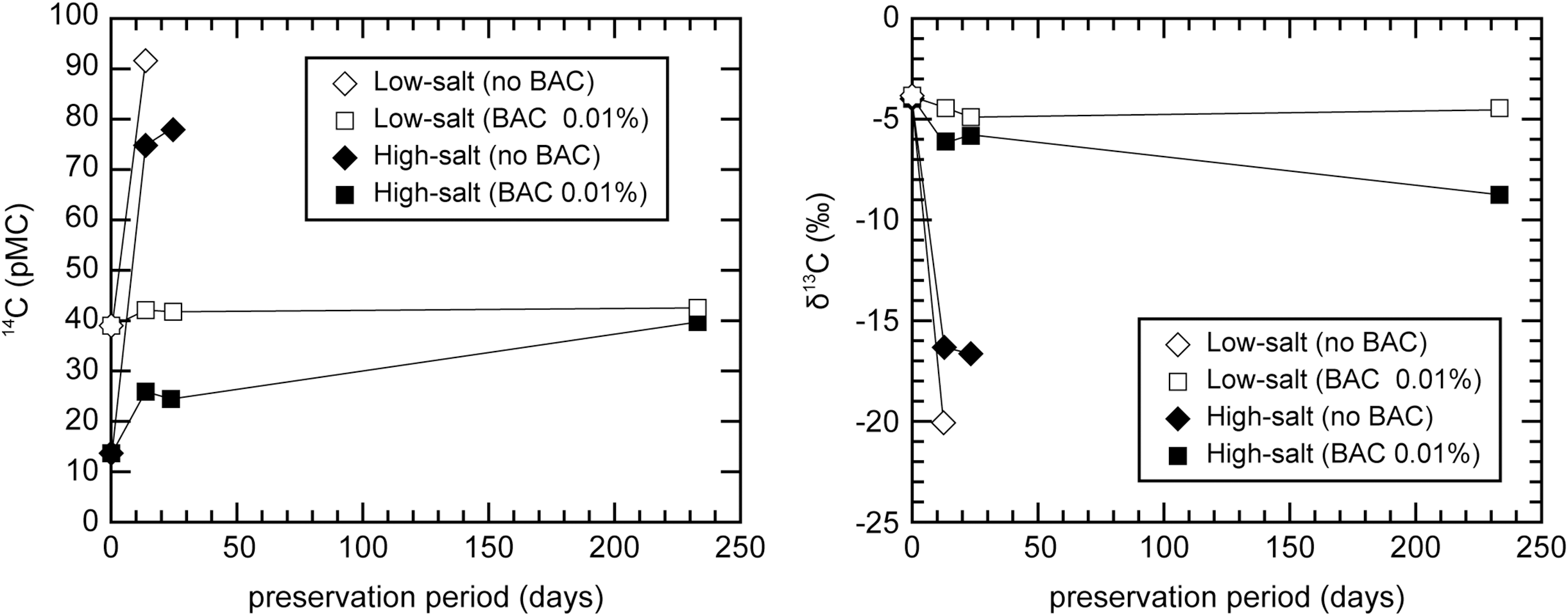
In the absence of BAC, the Low- and High-salt exhibited large changes in DIC 14C (64.6 pMC and 53.3 pMC) and δ13C (−12.3‰ and −16.1‰) over time (Figure 1), suggesting that the added DIC was derived from the beet sugar. This represented a smooth consumption process of the readily degradable sugars, which in turn suggests that microbial activity is being artificially promoted. Therefore, since the present study detected alterations that were several times greater than those observed in natural samples, we posit that the results possess a certain degree of reliability. The similar trends of isotopic changes during the first two weeks indicate that the samples contained similarly abundant microbial populations and suggest that their microbial activity was nearly identical. In contrast, when BAC was added, the changes in isotope values were notably suppressed at both Low- and High-salt, although not sufficiently: 3.4 pMC and 12.3 pMC for 14C and −1.0‰ and −4.9‰ for δ13C, respectively, with larger changes observed at High-salt (salinity: 26.5) than at Low-salt (salinity: 4.4). These results suggested that the salt in seawater alters the efficacy of BAC over time, indicating that it affects microbial activity during preservation. A salt is known as an antimicrobial reagent to preserve foodstuffs, and to be able to impede microbial activity in water samples (Takahashi et al. Reference Takahashi, Handa, Sugiyama, Matsushita, Kondo, Kimura and Tusujimura2019). However, as samples used in this study presumably contained their original seawater-adapted microbial communities at the time of analysis and salinity of samples in this study was as same level as seawater or lower, it is unlikely that their microbial activity would be significantly inhibited by salinity. Therefore, the difference in isotope ratios is presumably due to a decrease in BAC effectiveness rather than to the salt concentration itself.
The 14C concentration and δ13C values of SW during the preservation for the Experiment (1). Notice: the initial 14C concentration differs due to the varying quantities of artificial seawater powder added to the Low- and High-salt.

BAC, a cationic surfactant, comprises a positively charged N atom covalently bonded to four hydrocarbon residues; it thus adsorbs easily to anionic surfaces, such as those of biomass (Gilbert and Moore Reference Gilbert and Moore2005; Ismail et al. Reference Ismail, Tezel and Pavlostathis2010; Ren et al. Reference Ren, Li, Zhang, Liu and Sun2011). The inhibitory effect of BAC on microbial activity depends on its hydrophobicity and the length of its N-alkyl chains (García et al. Reference García, Ribosa, Guindulain, Sánchez-Leal and Vives-Rego2001; Gilbert and Moore Reference Gilbert and Moore2005). If the reaction between BAC and salt may break the N-alkyl chain or inhibit the function of the N cation, it would result in a reduction of the bactericidal effects of BAC. Considering that previous studies have observed DIC changes after preservation periods longer than approximately two weeks (Takahashi et al. Reference Takahashi, Handa, Sugiyama, Matsushita, Kondo, Kimura and Tusujimura2019; Takahashi and Minami Reference Takahashi and Minami2022), it is expected that it will take several days for the effectiveness of BAC to decrease due to the interaction of BAC and salt. Paradoxically, this suggests that the effectiveness of BAC in seawater is sustained during the initial few days. It was reported that BAC reduces the germination rate of spores, that is a high-resistance form of microorganism, but cannot inactivate them (Basaran Reference Basaran2011). Consequently, a plausible hypothesis is that BAC killed most microorganisms during the initial few days, however, the weakening of BAC that may occur after a few days allows surviving spores to begin reactivating, thereby changing DIC in seawater.
Effects of BAC concentration
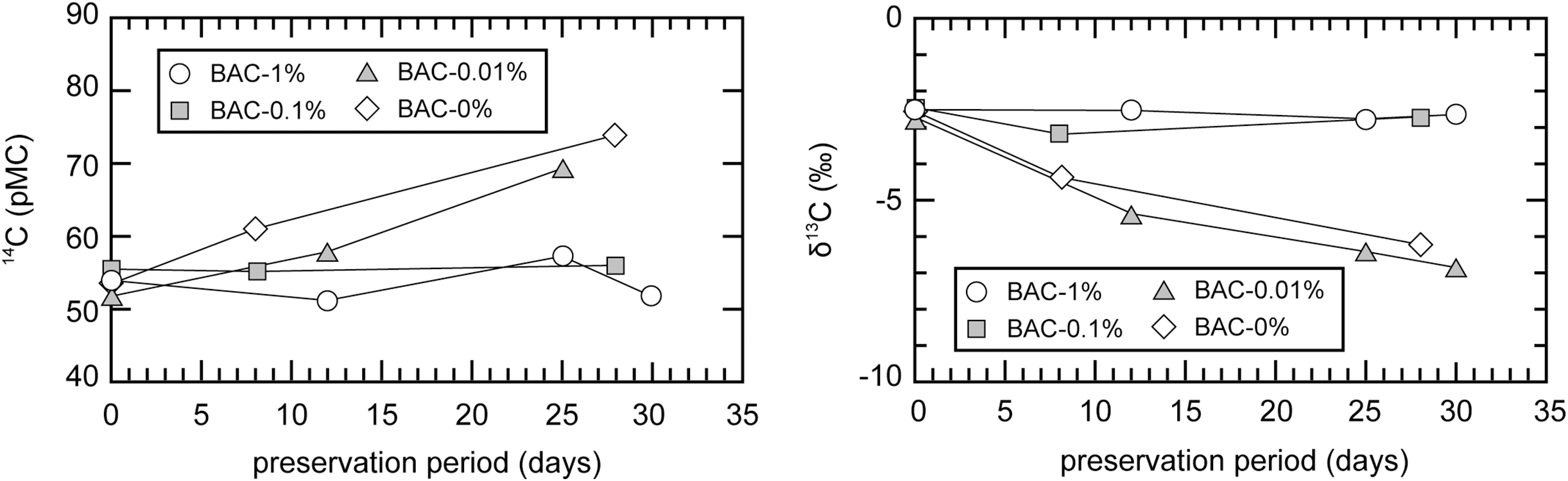
DIC isotope values of SW changed negligibly over time at 0.1% and 1% BAC (Figure 2). The fluctuation ranges in 14C and δ13C in these samples are 0.4 pMC and 2.6 pMC, and 0.28‰ and 0.73‰, respectively, which exceed the error ranges, however, the trends of isotopic change are not shifting in a positive or negative direction; rather, they are remaining constant. They were shifted significantly at 0.01% BAC to be 14.1 pMC and −4.14‰, which were similar with those at 0% BAC to be 16.3 pMC and −3.70‰. Consistent with prior findings (Gloël et al. Reference Gloël, Robinson, Tilstone, Tarran and Kaiser2015; Takahashi et al. Reference Takahashi, Handa, Sugiyama, Matsushita, Kondo, Kimura and Tusujimura2019; Takahashi and Minami Reference Takahashi and Minami2022), our findings indicate that BAC exhibited diminished bactericidal efficacy over time in SW. As the effects of BAC concentration were tested at the original salinity of SW (20.8), the change in DIC isotope values at 0.01% BAC suggests that this BAC concentration was insufficient to inhibit microbial activity, rather than that we used suboptimal salinity conditions for the microbial community. The isotopic changes of 0.01% BAC were quite similar with those observed in the absence of BAC, suggesting that at a concentration of 0.01%, BAC exerts minimal effect. However, given that a 0.01% of BAC concentrations is effective for freshwater samples, as reported in previous studies (García et al. Reference García, Ribosa, Guindulain, Sánchez-Leal and Vives-Rego2001; Kuo Reference Kuo1998; Takahashi et al. Reference Takahashi, Handa, Sugiyama, Matsushita, Kondo, Kimura and Tusujimura2019; Takahashi et al. Reference Takahashi, Handa and Minami2021; Takahashi and Minami Reference Takahashi and Minami2022), and considering the results of our first experiment, the salt may have had an influence on the efficacy of BAC in SW. The fact that the DIC isotope values of SW did not change over time at 0.1% and 1% BAC suggests that these BAC concentrations were sufficient to compensate for its functional inhibition by salt.
The 14C concentration and δ13C values of SW during the preservation for the Experiment (2). Since the initial values of BAC-0% could not be measured, the average value of the other three BAC concentrations was used instead.

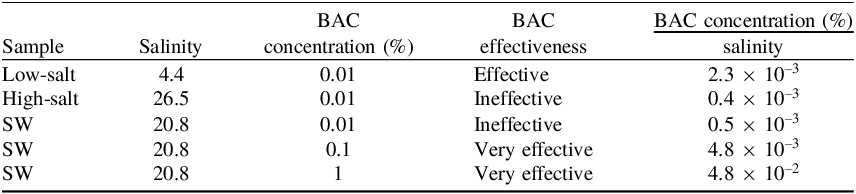
Table 2 summarizes the BAC effectiveness and the ratio of BAC concentration (%) to salinity. The findings of the present study demonstrate that the ratio must be 5×10⁻³ % per unit of salinity or greater to prevent DIC alterations during the preservation, and therefore the BAC concentration to be added to seawater with a salinity of 35 can be estimated at least 0.18%, although there is room for debate as to whether the threshold concentration can be proportionally calculated based on salinity. It must be noted that this value was obtained from the limited data with experiments in which BAC concentrations varied by several orders of magnitude. Therefore, while we can conclude that 0.018% is insufficient, it is still possible that the threshold concentration falls within the range of 0.018% to 0.18%, rather than precisely at 0.18%. Takahashi and Minami (Reference Takahashi and Minami2025) obtained good results using a method that combines BAC addition and filtration. This method was tested at a BAC concentration of 0.01%, using brackish seawater, as in this study. The threshold concentration may change if seawater samples with normal salinity are used. Furthermore, if the sample preservation period exceeds the 30 days investigated in this study, the amount of BAC administered would likely need to increase.
Comparison of salinity, BAC concentration and BAC effectiveness

Table 2 Long description
A table with four rows and three columns comparing salinity, BAC concentration, and BAC effectiveness. The columns are labeled 'Sample', 'Salinity', 'BAC concentration (%)', 'BAC effectiveness', and 'BAC concentration (%) salinity'. The rows are labeled 'Low-salt', 'High-salt', 'SW', and 'SW'. Row 1: Low-salt, 4.4, 0.01, Effective, 2.3 x 10^-3. Row 2: High-salt, 26.5, 0.01, Ineffective, 0.4 x 10^-3. Row 3: SW, 20.8, 0.01, Ineffective, 0.5 x 10^-3. Row 4: SW, 20.8, 0.1, Very effective, 4.8 x 10^-3. Row 5: SW, 20.8, 1, Very effective, 4.8 x 10^-2.
Conclusions
This study revealed that salt reduces the bactericidal effect of BAC as a disinfectant in DIC analysis of water samples, although its mechanism remains to be elucidated. Assessment with BAC addition indicated that the DIC isotope values changed more at high-salinity of 26.5 than low-salinity of 4.4. At constant salinity (20.8), DIC isotope values changed at low BAC concentration of 0.01% but not at higher BAC concentrations of 0.1% and 1%. A comparison of salinity and BAC concentration revealed that 0.018% was insufficient as an effective BAC concentration for seawater with a normal salinity. It was estimated that there was a threshold concentration between 0.018 and 0.18%. If the preservation period is longer than 30 days, it is expected that additional BAC will be required, though the necessary amount is unclear.
The reduction in BAC bactericidal activity due to salt can be avoided by increasing the BAC concentration in the preservation water, which in normal salinity seawater within 30 days of preservation is 0.18% by estimation with a highest level. BAC solutions are usually available at a 10% concentration. If sample is 100 mL, it is needed to add 1.8 mL of 10% BAC solution. Since increasing the BAC concentration may increase the risk of carbon contamination from the BAC solution, it should be found ways to reduce the amount added, such as by using combination with filtration.
Future work should verify the threshold concentration at which BAC can be effective at the salinity of normal seawater. It will also be important to devise ways to reduce the BAC concentration in combination with filtration. Additionally, samples with added BAC cannot be used for analysis of dissolved gases with low concentrations that require bubbling, such as methane and non-methane hydrocarbons. We plan to determine if adding an antifoaming agent before gas extraction after sample preservation resolves this issue. Mercury-based sterilization methods have not yet been prohibited, but we expect it to only be a matter of time before they are. This research is a step toward establishing a new method of measuring radiocarbon concentrations that does not rely on mercury. Although BAC is a substance with significantly lower risk than mercury, it still has a bactericidal effect, therefore it goes without saying that efforts must be made to prevent its release into the environment.
Acknowledgments
The authors thank Professor Dr. Hiroyuki Kitagawa, Nagoya University and Ms. Hiroko Handa, Geological Survey of Japan, AIST (affiliation at the time of the experiment) for their help with the AMS measurements and experimental supports, respectively. The authors also sincerely thank the anonymous reviewers and editors for their time and thoughtful feedback on our manuscript. This study was supported by JSPS KAKENHI Grant Number 23K03500, and partly carried out by the joint research program of the Institute for Space–Earth Environmental Research, Nagoya University.