Hemophilia is an inherited X-chromosome-linked deficiency in clotting factors that leads to bleeding disorders. Individuals with severe hemophilia can spontaneously bleed into joints, muscles, body cavities, and soft tissue. These problems may not only lead to severe and sustained disability but also to intense pain, affecting the patient's overall quality of life (Reference Lippert, Berger and Berntorp8).
There are two main therapeutic strategies for these problems: on-demand and prophylactic treatment. On-demand treatment includes factor concentrate replacement during an acute bleeding episode or when doing surgery and has been common practice since the 1960s (Reference Aledort, Haschmeyer and Pettersson1;Reference Miners, Sabin and Tolley12). This strategy seems to be the standard practice in most countries (Reference Lippert, Berger and Berntorp8), especially developing countries (Reference Martines-Murillo, Quintana and Ambriz10). The alternative to this treatment is to infuse clotting factor on a prophylactic basis to prevent bleeding episodes and their associated following problems from occurring in the first instance. Indeed, evidence suggests that treatment that begins at an early age, before the onset of serial bleeding (primary prophylaxis), can prevent the onset of hemophilic arthropathy (Reference Miners, Sabin and Tolley12). Usually, quantities of factor are presented two or three times per week (Reference Miners, Sabin and Tolley11). Prophylaxis is currently the preferred method of patient management (16) and recommended by European guidelines for children with severe hemophilia (Reference Berntorp, Astermark and Bjorkman2;3).
Clinical studies have shown significant improvements in clinical and economic outcomes with the use of prophylactic treatment. Results include avoidance of joint and other bleeding, reduced disability, lower rates of hospitalizations, and lower productivity losses through time off from school or work. However, this was achieved at considerable cost (Reference Liesner, Khair and Hann7–Reference Manco-Johnson, Abshire and Shapiro9;Reference Smith, Teutsch and Shaffer14;Reference Szucs, Offner and Schramm15;Reference Van Den Berg, Fischer and Van Der Bom17).
There are approximately 7,000 patients with bleeding disorders in Iran (Reference Karimi, Rahmani and Ardeshiri6), of which 6,235 suffer from hemophilia (5). In Iran, similar to most developing countries, the predominant strategy to treat hemophilia patients is on-demand. Moreover, a prophylaxis regimen has been used by a few patients (15 patients) since May 2007, and there is an increasing interest for applying this treatment to patients. The government annually spends approximately €40 million on hemophilia patients (5), but there is a lack of economic evaluation studies to measure cost-effectiveness of this spending.
The objective of the study was to assess the cost-effectiveness of prophylactic treatment compared with on-demand treatment in patients with severe hemophilia A without inhibitors over a 6-month period from the Ministry of Health (third-party payers) perspective.
METHODS
A multicenter retrospective chart review was conducted for a 6-month period in 2007. The study was carried out at three hemophilia treatment centers: two that provide on-demand treatment and one that provide prophylaxis treatment.
For the purpose of this study, prophylaxis is defined as the uninterrupted, scheduled administration of factor VIII at least three times weekly for a minimum of 6 consecutive months.
Patients eligible for recruitment included those with severe hemophilia A (factor level <1 percent) who had not developed an inhibitor against the coagulating factor, who had a maximum age of 9 years, and who received medical care at the hemophilia treatment centers between 20 September 2007 and 20 March 2008 (this is same year in terms of the Iranian calendar). Based on these criteria, we found fourteen and eleven patients who had been treated on-demand and with secondary prophylaxis, respectively.
Data were obtained from documents in the hemophilia treatment centers during a period of approximately 6 months. Because the data were gathered retrospectively, the only resource to be included in the analysis was the amount of the clotting factor used (indeed, there are no other cost data in patient's medical records). In addition, other studies indicated that this was the main cost driver in hemophilia treatment (Reference Globe, Curtis and Koerper4;Reference Lippert, Berger and Berntorp8;Reference Smith, Teutsch and Shaffer14). Health effects were presented in terms of a clinical outcome: avoided bleeds.
Incremental Cost-effectiveness Analysis
We examined the incremental cost-effectiveness ratio (ICER) of on-demand treatment compared with prophylactic treatment in patients with severe hemophilia A without inhibitors. The time horizon of the analysis was 6 months. The incremental cost-effectiveness ratio was defined as the difference in costs of prophylaxis treatment versus on-demand (in Rials) divided by the difference in effectiveness (avoided bleeds). The foreign exchange rate used in the analysis was 1.00 Rial = €0.00015 (2008).
Sensitivity Analysis
The robustness of the results of this cost-effectiveness analysis was explored using one-way sensitivity analysis. To reflect uncertainty of cost, the price of the clotting factor, in consult with a medicine expert in the Health Ministry of Iran, was varied by 10 percent.
RESULTS
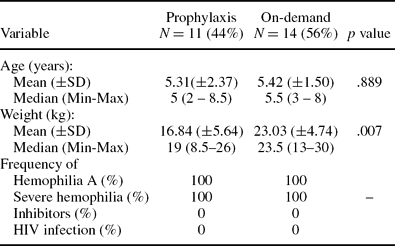
A total of twenty-five children were included in study: eleven of them had received VIII factor as prophylaxis and fourteen belonged to on-demand group. The main demographic and clinical characteristics of both groups are shown in Table 1. The mean age was 5.31 ± 2.37 years (range, 2–8.5 years) and 5.42 ± 1.50 years (range, 3–8 years) in prophylaxis and on-demand groups, respectively. It can be seen from the table that there is no significant difference in age between the two groups. The mean weight in the on-demand group was significantly higher than the prophylaxis group (see Table 1). All patients had severe hemophilia A, without any inhibitors or HIV infection.
Demographic and Clinical Characteristics of Patients

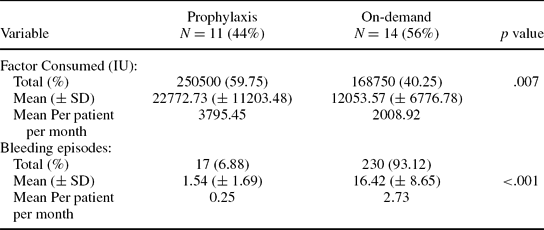
Table 2 shows the factor consumption and the outcome data. As can be seen from Table 2, the mean of factor consumption in the prophylaxis group is approximately 1.9 times more than the on-demand group (p = .007). When we adjust the results based on weight of patients, this difference increases to 2.6. In other words, while patients in the on-demand group consumed 87.20 units/kg per month, prophylaxis patients used 225.31 units/kg per month.
Resource Consumption and Outcome Data

This amount of factor consumption equals 101,212,020 Rials (€6,747.45) and 53,571,375 Rials (€3,571.42) per patient during 6 months in the prophylaxis and on-demand groups, respectively.
Overall, 247 bleeding episodes were reported over the 6-month study period; 93.12 percent of them happened in the on-demand group. Patients treated prophylactically had 0.25 and on-demand had 2.73 bleeds per month.
With prophylactic treatment, the incremental cost per avoided bleed was approximately 3,201,656 Rials (€213.45) over 6 months in Iran. Moreover, the results were insensitive to changes in price of clotting factor.
DISCUSSION
The aim of this study was to perform a cost-effectiveness analysis of prophylaxis treatment versus on-demand treatment for individuals with severe hemophilia. To our knowledge, this study is the first full economic evaluation in hemophiliac patients in Iran.
This study indicated that prophylaxis achieved fewer bleeding episodes per month than on-demand therapy. This finding is consistent with results of other studies that demonstrated significant improvements in outcomes with the use of prophylactic treatment (Reference Aledort, Haschmeyer and Pettersson1;Reference Liesner, Khair and Hann7–Reference Miners, Sabin and Tolley11;Reference Nilsson, Berntorp and Lofqvist13;Reference Van Den Berg, Fischer and Van Der Bom17).
The study showed that prophylaxis treatment costs were approximately 2 times higher than on-demand costs. This is in line with other studies showing that prophylaxis was a more expensive treatment in comparison with the on-demand method (Reference Aledort, Haschmeyer and Pettersson1;Reference Globe, Curtis and Koerper4;Reference Liesner, Khair and Hann7–Reference Miners, Sabin and Tolley11;Reference Nilsson, Berntorp and Lofqvist13;Reference Van Den Berg, Fischer and Van Der Bom17).
Moreover, the results showed that avoiding one additional bleeding episode would cost an additional 3,201,656 Rials (€213.45). These incremental cost-effectiveness ratios were much lower than those reported by Miners et al. (Reference Miners, Sabin and Tolley11) (€858/avoided bleed), Szucs et al. (Reference Szucs, Offner and Schramm15) (€1295 per avoided bleed), and Smith et al. (Reference Smith, Teutsch and Shaffer14) (€1124–1410 per avoided bleed). One possible explanation for this difference could be that we included only factor consumption costs as the only direct cost in our analysis, and we did not consider other direct costs. This was because of lack of data on other direct costs, although factor VIII consumption estimated to account for more than 90 percent of hemophilia care costs (Reference Globe, Curtis and Koerper4;Reference Manco-Johnson, Abshire and Shapiro9;Reference Smith, Teutsch and Shaffer14). Another possible reason could be related to the consumption of factor VIII in prophylaxis among patients in this study. The actual dosage used in prophylaxis in this study for many patients was substantially less than what other investigators recommended (Reference Miners, Sabin and Tolley11).
The results of this study should be interpreted in light of several limitations. First, this study was a retrospective analysis, and the number of patients was too small to draw conclusions, so the results should be interpreted with caution. Moreover, most published guidelines for pharmacoeconomic evaluations recommend the adoption of a societal perspective. The societal perspective, in addition to direct medical costs, includes direct nonmedical costs and potential indirect costs (Reference Lippert, Berger and Berntorp8). In the current study, Ministry of Health perspective as third party payer was used that included direct medical costs.
In general, considering incremental costs of prevented bleeding episodes, the application of prophylactic treatment in Iran was more cost-effective than on-demand therapy. We suggest that there is a need for prospective studies with societal perspective to have a real estimate of the treatment costs and also to investigate the effects of treatment on the patient's quality of life.
CONCLUSION
This study demonstrated that the number of bleeding episodes in the on-demand group were higher than the prophylaxis group. However, factor consumption was significantly higher in the prophylaxis group. Finally, the study concluded that prophylaxis is a more effective treatment, but with a considerable cost.
POLICY IMPLICATION
Economic evaluation studies are increasingly used as a tool in policy decisions about how to allocate scarce resources when faced with competing options in health care. Although, hemophilia treatments incur considerable cost to the healthcare system of Iran, there is no evidence about the cost-effectiveness of different therapies. It seems that the results of this study can be used by decision makers to determine how money is spent on hemophilia and can act as a start point for including an economic evaluation approach in policy making in Iran.
CONTACT INFORMATION
Aliasghar Ahmad Kia Daliri, MSc (alik2003@gmail.com), Lecturer, Health Care Management, Shiraz University of Medical Sciences, Consultant, Department of Health Insurance, Ministry of Welfare and Social Security, No1286, Vali-e-asr St, Tehran, Iran
Hassan Haghparast, MSc, PhD. Student (hassan.haghparast@ki.se), Public Health Sciences, Karolinska Institute, Nobels vag 9, SE-171 77, Stockholm, Sweden
Jahanara Mamikhani, MD, PhD (mamikhani_jam@yahoo.com), Manager, Behinpuyan Research Institute, 25 Kashani Street, Tehran, Iran