INTRODUCTION
Amnestic mild cognitive impairment (aMCI), which is often considered a transitional period between healthy cognitive aging and Alzheimer’s disease (AD), is characterized by an isolated memory decline in the absence of other cognitive or functional impairments. Much research involving aMCI has focused on describing the nature of the retrospective memory (i.e., explicitly prompted recall of past events) deficit that defines this condition. Reduced encoding, rapid forgetting rates, and increased sensitivity to interference during retrieval have all been documented in aMCI (Chetelat et al., Reference Chetelat, Desgranges, de la Sayette, Viader, Berkouk, Landeau, Lalevee, Le Doze, Dupuy, Hannequin, Baron and Eustache2003; Perri et al., Reference Perri, Carlesimo, Serra and Caltagirone2005). These deficits are consistent with the neuropathology of this condition, which primarily affects the hippocampus and related mesial temporal lobe structures (Pennanen et al., Reference Pennanen, Kivipelto, Tuomainen, Hartikainen, Hanninen, Laakso and Soininen2004).
Two important and increasingly common findings are that mild executive dysfunction is also an early manifestation of aMCI (Kramer et al., Reference Kramer, Nelson, Johnson, Yaffe, Glenn, Rosen and Miller2006) and that the combination of reduced scores on measures of verbal delayed recall and executive function has a discriminating ability in predicting conversion to AD in this population (Tabert et al., Reference Tabert, Manly, Xinhua, Pelton, Rosenblum, Jacobs, Zamora, Goodkind, Bell, Stern and Devanand2006). Subtle reductions in executive function abilities may account for weaknesses in more strategic aspects of cognition, such as those required to successfully carry out intended actions in the future. Prospective memory (PM) is an aspect of episodic memory that involves the formation, maintenance, and execution of future intentions and is often the source of subjective memory complaints among individuals with aMCI. Despite the frequency with which such complaints are made, as well as its clear implications for everyday functioning (Graf et al., Reference Graf, Uttl, Dixon, Graf and Ohta2002), there have been very few studies of PM in aMCI.
PM is a complex process involving at least four stages: (a) intention formation—the period during which the future activity is planned (i.e., what to do and when to do it), (b) intention retention—the period during which the intention is held in memory while other activities are occurring (i.e., ongoing task), (c) intention initiation—the point at which the appropriate cue (e.g., an event) triggers an effortful and controlled search of memory for the intention, and (d) intention execution—when the retrieval context actually occurs and the action of the intended action is executed (Ellis, Reference Ellis, Brandimonte, Einstein and McDaniel1996; Kliegel et al., Reference Kliegel, Martin, McDaniel and Einstein2001). Given the multifaceted nature of PM, failure on a PM task could be due to a number of reasons, only some of which would be considered a pure PM failure.
One potential complication in understanding PM failures involves retrospective memory. In a typical PM task, retention of the action or retrieval context may fail. This is the common experience of knowing that you have to do something but not remembering what it is. Alternatively, retrieval of the delayed intention may occur at inappropriate time (e.g., remembering to pay a bill after the due date has passed). According to Einstein and McDaniel (Reference Einstein, McDaniel, Brandimonte, Einstein and McDaniel1996), these examples refer to the retrospective and prospective components of a PM task, respectively. Although both components involve conscious episodic recollection, only the retrospective component (remembering that and what to do) is characteristically an episodic memory function mediated by temporal–limbic systems (Nyberg & Tulving, Reference Nyberg and Tulving1996). The prospective component (noticing when to do something and initiating the appropriate action) depends more on attention and executive functions mediated primarily by frontal–striatal systems (Burgess et al., Reference Burgess, Quayle and Frith2001). In light of neuropathology affecting both mesial temporal and, to a lesser extent, frontal systems in aMCI, these individuals may fail to remember to carry out intended actions in the future because of poor episodic memory and/or relative weaknesses in executive function.
Currently, there is only some suggestion that individuals with aMCI have impaired PM relative to healthy age-matched peers (Kazui et al., Reference Kazui, Matsuda, Hirono, Mori, Miyoshi, Ogino, Tokunaga, Ikejiri and Takeda2005; Troyer & Murphy, Reference Troyer and Murphy2007), and preliminary evidence indicates differential effects of aMCI on time- and event-based PM tasks. For example, Troyer and Murphy (Reference Troyer and Murphy2007) found that participants with aMCI obtained lower scores on time- relative to event-based laboratory measures of PM. AD patients performed significantly poorer than both the healthy controls and the aMCI participants on all PM tasks, but there were no performance differences between the time- and the event-based PM tasks within the AD or the control group. The authors suggested that time-based PM tasks may be sensitive to the earliest cognitive changes associated with aMCI, possibly reflecting decreased self-initiation, attention switching, and/or inhibition on memory tasks due to early involvement of the frontal system. Once criteria for a diagnosis of AD are met, time- and event-based PM are likely equally affected. In the study by Kazui et al. (Reference Kazui, Matsuda, Hirono, Mori, Miyoshi, Ogino, Tokunaga, Ikejiri and Takeda2005), individuals with aMCI showed impaired performance on two single-trial, event-based tasks; time-based PM was not assessed.
The current study sought to further explore time- and event-based PM in aMCI using the Memory for Intentions Screening Test (MIST; Raskin, Reference Raskin2004), which is a standardized and more comprehensive measure of PM than has been used previously in this population. To date, the MIST has been shown to discriminate between healthy adults and individuals with either HIV infection (Carey et al., 2006) or schizophrenia (Woods et al., 2007). Unlike the PM measures that have been studied so far in individuals with aMCI, the MIST requires participants to perform eight different PM tasks over a 30-min period while concurrently adhering to a distractor task. PM trials are balanced with respect to delay interval (2 vs. 15 min), cue type (event-based vs. time-based), and response type (action vs. verbal). Additionally, incorrect responses are coded via a detailed scoring system, which allows for a more comprehensive analysis of component processes underlying PM failures than in previous studies of PM in aMCI. The MIST also includes a 24-hr delay period (an ecologically valid measure of PM) and a forced-choice recognition test of the delayed intentions. Available psychometric data on the MIST support its construct validity (Carey et al., 2006), convergent validity (Carey et al., 2006; Woods et al., 2007), and incremental ecological validity (Woods et al., Reference Woods, Iudicello, Moran, Carey, Dawson and Grant2009).
We hypothesized that healthy elderly controls would outperform individuals with aMCI on all MIST variables, given the neuropathology affecting mesial temporal and frontal systems in aMCI. Individuals with aMCI were also expected to show disproportionate difficulty with time- relative to event-based PM tasks compared to healthy controls as found by Troyer and Murphy (Reference Troyer and Murphy2007). We also predicted that PM performance would be significantly associated with measures of attention and executive functioning.
METHOD
Participants
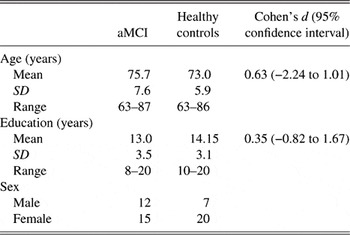
Participants included 27 individuals with single-domain aMCI and 27 age- and education-matched healthy controls. Demographic characteristics of both groups are presented in Table 1. As shown in the table, the two groups did not differ in age, education level, or sex distribution. Written informed consent was obtained from all participants, and a stipend of $10/hr was provided. The current study was approved by the Research Ethics Board at Baycrest Center in Toronto and by the Department of Psychology at York University.
Demographic characteristics

Note
n = 27 per group.
The aMCI participants were recruited from the research participant pool at Baycrest (n = 3), talks given at local community centers (n = 8), referrals from other neuropsychologists (n = 9), a neurologist at a local memory clinic (n = 6), and our previous research (n = 1). Twenty-seven healthy elderly individuals were recruited from the research participant pool at Baycrest (n = 10), talks given at local community centers (n = 8), referrals from other neuropsychologists at Baycrest (n = 5), and flyers posted at local community centers (n = 1) and doctors’ offices (n = 3). Exclusionary conditions for participants included a history of head injury with loss of consciousness for more than 30 min, past or present learning disability, current systemic medical disease, major neurological or psychiatric disorders, nonnative English speaker, or a score of 8 or above on either subscale of the Hospital Anxiety and Depression Scale (Zigmond & Snaith, Reference Zigmond and Snaith1983).
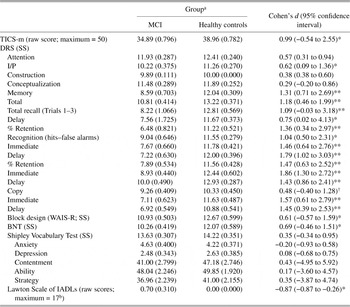
The consensual judgment of two neuropsychologists at Baycrest was required for classification of aMCI. Classification of this condition was made on the basis of Petersen’s (Reference Petersen2004) criteria. Specifically, the participants had to demonstrate a subjective memory complaint, normal activities of daily living, normal general cognitive function, and objective memory impairment. The presence of a subjective memory complaint was determined by an initial telephone interview. Normal activities of daily living were confirmed using the Lawton Scale of Instrumental Activities of Daily Living (Lawton & Brody, Reference Lawton and Brody1969). Performance on diagnostic measures for both groups is presented in Table 2.
Mean (SEM) diagnostic age-corrected cognitive test scores as a function of group

Note
SS, Standard Score; I/P, Initiation/Perseveration; IADLs, Instrumental Activities of Daily Living.
a n = 27 per group.
b Low scores indicate less impairment.
† p < .10.
* p < .05.
** p < .001.
The aMCI participants, on average, evidenced a greater degree of functional difficulties relative to controls, but this was due to physical limitations and not cognitive decline. Importantly, scores were within the normal unimpaired range on this measure (Table 2). Normal general cognitive functioning was confirmed using (a) the nonmemory subscales (i.e., Attention, Initiation/Perseveration, Construction, and Conceptualization) of the Dementia Rating Scale (DRS; Mattis, Reference Mattis1988), (b) the Rey–Osterrieth Figure (Lezak, Reference Lezak1995; copy administration), (c) the Block Design subtest of the Wechsler Adult Intelligence Scale-Revised (WAIS-R; Wechsler, Reference Wechsler1987), (d) the Boston Naming Test (BNT)—30-item version (Kaplan et al., Reference Kaplan, Goodglass and Weintraub1983), and (e) the Shipley Institute of Living Scale (Zachary, Reference Zachary1986). Performance on all nonmemory measures was within normal limits.
Evidence of objective memory impairment for one’s age, education, and intellectual function was determined using the following measures: (a) the Memory subtest of the DRS; (b) the Immediate and Delayed Logical Memory and Paired-Associates subtests of the Wechsler Memory Scale-Revised (WMS-R; Wechsler, Reference Wechsler1987); (c) the Hopkins Verbal Learning Test-Revised, Form 3 (Brandt & Benedict, Reference Brandt and Benedict2001); and (d) the Rey–Osterrieth Complex Figure Test (Lezak, Reference Lezak1995; immediate and delayed recall administrations). Twenty-six participants were impaired on at least two memory measures, and the remaining one participant was impaired on two scales of a single memory test. Abnormal memory performance in this study was defined by a performance of at least 1.5 SDs below age-corrected published norms unless education and performance on other nonmemory measures were well above average in which case a memory score of 1 SD below the mean would be considered a relative deficit for that person.
Performance on all memory measures was significantly lower among the aMCI participants than among the controls (Table 2). Fulfillment of these criteria coupled with the degree of functional independence of participants was used to confirm the absence of dementia. Controls performed within the normal range for their age on all measures in the diagnostic test battery. For both patients and controls, scores on the DRS, WAIS-R subtests, WMS-R subtests, and BNT were compared to the Mayo Older Adult Normative Sample (Ivnik et al., Reference Ivnik, Malec, Smith and Tangalos1992; Lucas et al., Reference Lucas, Ivnik, Smith, Bohac, Tangalos, Kokmen, Graff-Radford and Petersen1998). Performance on the Rey–Osterrieth Figure for both groups was compared to the normative sample found in Lezak (Reference Lezak1995). The Shipley Institute of Living Scale was scored according to the standard guidelines provided by the authors (Zachary, Reference Zachary1986).
Design and Procedure
Participants were first given a telephone screening interview, followed immediately by the Telephone Interview for Cognitive Status-Modified (TICS-m; Welsh et al., 1993). The telephone screening interview included questions regarding personal and demographic information, current health status, and medical history. It also queried subjective feelings of memory abilities (on a 5-point Likert Scale from 1, very poor, to 5, very good). Prior to administration of the TICS-m, participants were told to reduce distractions (e.g., television, radios) and to keep pens and pencils out of reach. Participants who did not meet the screening eligibility criteria (TICS-m score >30 and no exclusionary condition) were thanked for their interest in the study but were not invited to participate further. Those who met diagnostic criteria completed the experimental and additional neuropsychological tests in a separate 90-min session approximately 1 week later. After providing informed written consent, each participant completed the MIST first, followed by two experimental measures of source memory and one experimental measure of item memory (reported in a separate paper) and then five standard clinical tests of executive function.
The MIST (Raskin, Reference Raskin2004) is a standardized paper-and-pencil test that was used to assess PM performance. As described earlier, the MIST requires participants to complete eight different PM tasks, counterbalanced for delay interval (2 vs. 15 min), cue type (event-based vs. time-based), and response type (action vs. verbal). Participants carry out the various PM tasks while concurrently adhering to a distractor task, which consists of several word search puzzles (downloaded from www.funbrain.com). Participants attempt to complete the word searches as quickly as possible throughout the test. The word search is interrupted only to carry out prospective commands. Time-based PM tasks consist of performing a specific task either 2 or 15 min after instruction without an external prompt. For example, a participant might be asked to remind the experimenter to take a break after 15 min. Two digital clocks are placed in clear view to the left and right of the participant for the duration of the test. Event-based PM tasks require a response from the participant after a specific event (e.g., the participant is instructed to remind the experimenter to rewind a tape upon presentation of a tape recorder). These tasks also occur after either 2 or 15 min, though the time is not mentioned to the participant. The MIST requires a postcard, tape recorder, red pen, Request for Records Form, several word search puzzles, and two digital clocks.
The MIST was administered according to the standard guidelines provided by the author (Raskin, Reference Raskin2004). MIST items are scored on a 3-point scale, ranging from 0 (i.e., no response or an incorrect response to an event-based trial) to 2 (i.e., completely correct response) points. Each item contributes to three of six subscales (range = 0–8 points), determined by its delay (2 or 15 min), cue (event-based or time-based), and response characteristics (action or verbal). The six subscales are summed to create a summary score ranging from 0 to 48. The MIST also includes retrospective recall probes, which are administered for trials in which the participant fails to provide any response. The probe consisted of a multiple-choice test with three possible options for each trial. If any response was given during the PM test, a score of 1 was automatically given on the retrospective probe. If no response had been given during the test, then a correct response to the multiple-choice question yielded a score of 1 and an incorrect answer yielded a score of 0.
Finally, participants were instructed to telephone the examiner at a specific time the following day and to indicate how many hours the participant had slept following the test. The call served as a 24-hr probe of PM. Participants received 2 points for a correct or an incorrect response at the correct time (±1 hr), 1 point if the phone call was at the incorrect time, and a score of 0 if they failed to call.
There are several different types of potential errors that participants could make on the MIST. A no response error refers to a lack of response for a given trial. A task substitution error occurs when the participant substitutes an action for a verbal task (or vice versa), performs a prior task from any part of the test, or makes a novel response. A loss of content error is when the participant indicates an awareness of having to perform a task (verbal or action) but forgets the content of the task (e.g., “I know I’m supposed to do something, but I don’t remember what.”). A place losing omission error occurs when the participant initiates but does not complete a task. A place losing repetition error is when the participant repeats the immediately preceding task instead of completing the appropriate task. A loss of time error is when the participant performs a task at an incorrect time. Last, a random error refers to a random response made at a random time (e.g., reciting the national anthem).
Upon completion of the MIST, five measures were used to examine executive function. These measures included (a) the number of categories achieved on the modified version (Nelson, Reference Nelson1976) of the Wisconsin Card Sorting Test (WCST; Hart et al., Reference Hart, Kwentus, Wade and Taylor1988), in which ambiguous cards are removed and three decks are used; (b) the total number of words generated in a word fluency test using the letters F, A, and S (Spreen & Benton, Reference Spreen and Benton1977); (c) the total raw score from the Mental Arithmetic subtest from the WAIS-R (Wechsler, Reference Wechsler1981); (d) the total raw score from the Mental Control subtest from the WMS-R (Wechsler, Reference Wechsler1987); and (e) the total raw score from the Backward Digit Span subtest from the WMS-R (Wechsler, Reference Wechsler1987). These measures were selected according to the results of exploratory and confirmatory factor analyses using several neuropsychological tests associated with frontal lobe function (Glisky et al., Reference Glisky, Polster and Routhieaux1995). The Arithmetic subtest from the WAIS-R was administered first, followed by the Mental Control subtest from the WMS-R and Digit Span from the WAIS-R, FAS, and the modified WCST.
RESULTS
Statistical Analyses
A series of Shapiro–Wilk’s W Tests revealed that the MIST variables were all nonnormally distributed (all ps < .05). A series of Wilcoxon Rank Sum Tests and unbiased Cohen’s d effect sizes were therefore used to perform between- and within-group analyses of the MIST. The study sample sizes provided adequate statistical power to detect medium effect sizes (1 − b > 80, critical a = .05) for all between- and within-group analyses.
For each participant, a z score for each of the five executive function measures was calculated based on the mean and SD from the control group. A composite measure of executive function was then calculated for each participant as the mean z score for these five tests. Nonparametric Spearman’s rho correlation coefficients were run to compare overall performance on the MIST to the composite measure of executive functions for each group. Performance on episodic memory measures was not compared to overall performance on the MIST as these measures were used to classify participant groups.
MIST Results
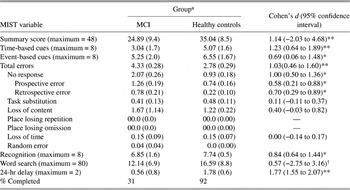
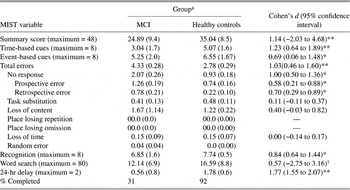
PM performance on the MIST is displayed in Table 3 as a function of group. As shown in the table, large effect sizes were seen across the majority of measures on the MIST, including on the MIST total summary score (Cohen’s d = 1.14), the 24-hr delay (Cohen’s d = 1.77), and the multiple-choice recognition trial (Cohen’s d = 0.84), in favor of the controls. The effect size was also large on the time-based (Cohen’s d = 1.23) PM trial, whereas a moderate effect size emerged between the two groups on the event-based (Cohen’ s d = 0.69) PM trial in favor of the controls. A medium effect size was noted between the two groups on the word search task in favor of the control group (Cohen’s d = 0.57).
Mean (SD) performance on the MIST as a function of group
a n = 27 for each group.
† p < .10.
* p < .05.
** p < .001.
Error types are also shown in Table 3 as a function of group. As shown in the table, the aMCI participants made more errors overall than did the controls (Cohen’s d = 1.03). The profile of errors was marked by more no response errors (i.e., omission errors) among the aMCI participants relative to the controls. When each error type was examined as a proportion of the total number of errors made on the MIST, there were no significant group differences across all error types (all ps > .05). Thus, for both groups, no response errors were the most prevalent, followed by loss of content, task substitution, and loss of time errors. Only one aMCI participant made a random error. Place losing omission or repetition errors did not occur in either group.
Items for which participants failed to respond on the initial trial (i.e., no response or omission errors) were recoded as prospective or retrospective errors corresponding to correct or incorrect performance, respectively, on subsequent recognition memory testing. When these error types were examined between groups as a proportion of the total number of no response errors, there was a trend toward significance for prospective errors (aMCI: M = 61.52, SEM = 7.4; Health Controls: M = 83.33, SEM = 8.8; p = .053), whereas the groups were equivalent for proportional retrospective errors (aMCI: M = 34.13, SEM = 7.2; HC: M = 19.79, SEM = 8.6; p = .189). As noted, omission errors due to both prospective and retrospective failures occurred more often in the aMCI than in the healthy control group. However, controls recognized a greater proportion of these items subsequently, which underscores the patients’ difficulty with both the prospective and the retrospective components of prospective tasks.
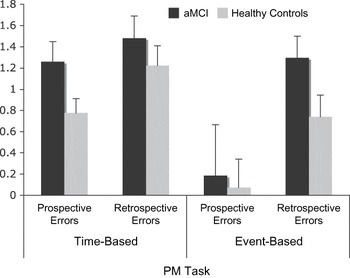
Additional error analyses were carried out to determine whether cue type (time-based vs. event-based) interacted with memory failure type (prospective vs. retrospective) and group. As shown in Figure 1, both groups were more likely to make retrospective than prospective errors, but the difference between these two error types appeared to be more pronounced on the event-based (retrospective memory errors: M = 1.02, SEM = 0.15; PM errors: M = 0.13, SEM = 0.05; p = .017) than on the time-based (retrospective memory errors: M = 1.35, SEM = 0.14; PM errors: M = 1.02, SEM = 0.12; p < .001) tasks. Thus, for both groups, errors on the MIST were more likely due to retrospective memory failures (i.e., forgetting what) than to PM failures (i.e., forgetting to carry out the intended action at the appropriate time), especially for items involving specific retrieval cues.
Mean prospective and retrospective errors as a function of group and PM task. Both groups were more likely to make retrospective than prospective errors, but the difference between these two error types appeared to be more pronounced on the event-based than on the time-based tasks.

Executive Function Results
Although executive function performance was in the normal range in the aMCI group, their overall composite score (M = −0.51, SEM = 0.13) was lower than that of the control group (M = −0.01, SEM = 0.13; p = .01). However, for both groups, performance on the executive function composite score was unrelated to overall performance on the MIST (controls: r[27] = .296, p = .134; aMCI: r[27] = .207, p = .301).
DISCUSSION
Consistent with predictions, the aMCI showed a trend for greater difficulty on the time- relative to the event-based PM tasks, although the magnitude of the difference was not as large as predicted. Troyer and Murphy (Reference Troyer and Murphy2007) found that the aMCI participants had a disproportionate difficulty on the time- relative to the event-based tasks compared to the controls, but they used a different methodology. In their study, participants were required to make the same response on each trial, which places little demand on retrospective memory. In contrast, the MIST requires the formation of multiple cue–action associations (e.g., a red pen to cue signing one’s name, a tape recorder to cue rewinding a tape), which forces participants to encode and remember different responses to different cues. This likely increased the level of difficulty in the event-based tasks such that it approached the difficulty of time-based tasks. Therefore, our paradigm differed from that of Troyer and Murphy (Reference Troyer and Murphy2007) in terms of the extent of the strategic monitoring and cue detection processes required. Moreover, the sensitivity of PM might have more to do with the particular nature of the cue and retrieval processing demands (such as whether multiple cue–action associations need to be retrieved as in the MIST) than whether or not an external cue is provided.
On a more conceptual level, the marginal difference between the aMCI and the control participants on the distractor test coupled with the significantly weaker performance among the aMCI participants on the forced-choice recognition test of the intentions suggests that inefficient learning and/or disturbed consolidation may be responsible for the PM impairment in aMCI. The use of a distractor task as part of the MIST to prevent rehearsal of the cues and intentions may have interfered with learning and/or memory consolidation of the cue–intention pairings among the aMCI participants. Recent findings demonstrate a particular difficulty with inhibitory control (Johns et al., 2008), diminished attentional resources early in the course of aMCI (Levinoff et al., Reference Levinoff, Saumier and Chertkow2005), as well as changes to the functional network subserving divided attention among individuals with aMCI (Dannhauser et al., Reference Dannhauser, Walker, Stevens, Lee, Seal and Shergill2005). In light of these findings, the aMCI participants in this study may have had less executive control and overall attentional capacity to devote to both the ongoing task and the cue monitoring, regardless of whether such monitoring took the form of automatic or strategic detection processes.
Overall, the profile of PM impairment observed among the aMCI participants is in line with the neural system model of PM offered by Burgess et al. (Reference Burgess, Quayle and Frith2001). These authors posit that the anterior and posterior portions of the cingulate cortex together with the hippocampus mediate PM. Involvement of the anterior cingulate in PM is not surprising, given reliable findings in the literature of anterior cingulate cortex activity on tasks that require divided attention, associating an appropriate response within a given context, monitoring the outcome of an action, and switching behaviors with unexpected outcomes (Elliot & Dolan, 1998). The anterior cingulate has strong afferent–efferent connections to the prefrontal cortex, especially dorsolateral and orbitofrontal regions (Botvinick et al., Reference Botvinick, Braver, Barch, Carter and Cohen2001). It is also involved in memory functioning, particularly when retrieval demands are high, such as remembering the multiple cue–action associations in this study. The posterior cingulate cortex has strong reciprocal connections with entorhinal and parahippocampal cortices (e.g., Sutherland et al., Reference Sutherland, Wishaw and Kolb1988) and thus also plays an important role in successful memory performance. Metabolic reductions in these areas have been reliably identified among persons with aMCI (e.g., Johnson et al., Reference Johnson, Jones, Holman, Becker, Spiers, Satlin and Albert1998; Killiany et al., Reference Killiany, Gomez-Isla, Moss, Kikinis, Sandor, Jolesz, Tanzi, Jones, Hyman and Albert2000) and have been shown to characterize the clinical progression from mild cognitive impairment (MCI) to AD (Johnson et al., Reference Johnson, Jones, Holman, Becker, Spiers, Satlin and Albert1998; Kogure et al., Reference Kogure, Matsuda, Ohnishi, Asada, Uno, Kunihiro, Nakano and Takasaki2000). Therefore, early involvement of the anterior and posterior cingulate cortex together with primary pathology affecting the mesial temporal lobes may account for the PM impairment in aMCI.
Consistent with the relatively rapid rate at which individuals with aMCI lose information from memory (Chetelat et al., Reference Chetelat, Desgranges, de la Sayette, Viader, Berkouk, Landeau, Lalevee, Le Doze, Dupuy, Hannequin, Baron and Eustache2003), our findings from the 24-hr task suggest that after 1 day, individuals with aMCI do indeed experience a marked deficit in PM not observed among controls. Specifically, significantly fewer individuals with MCI than controls correctly executed the intended action (i.e., telephoning the examiner the day after the testing session to report the number of hours they slept that night). Although participants were not encouraged to use mnemonic cues or strategies (i.e., writing things down), it was not prohibited. The 24-hr task is a strength of the MIST as it provides a unique way of extending a laboratory measure to a more naturalistic setting; to the best of our knowledge, this is the first study to examine PM in aMCI beyond the scope of the experimental session. In the future, it would be informative to also track whether participants use strategies to carry out this trial. Impaired performance on the 24-hr task provides additional and ecologically relevant evidence of the pervasiveness of the PM impairment in aMCI and also raises an important question regarding the maximum length of time that individuals with aMCI are able to successfully retain a delayed intention.
Contrary to expectations, the composite executive function z score was unrelated to PM in either of the two groups. It may be that the particular executive functions tapped by our battery of tests differ from those tapped by the MIST. With alternative measures of executive function, particularly on tasks requiring inhibitory control, planning, and switching between tasks, a significant relation between PM and MIST performance could potentially emerge. Thus, the multifaceted nature of both the executive function measures and the MIST summary score itself likely contributes to the lack of the expected correlation between these measures. The use of a more “pure” measure of PM may therefore correlate more strongly with specific measures of executive functions.
The PM impairment among individuals with aMCI potentially carries significant implications for this group, particularly with respect to their independent living. For example, Woods et al. (Reference Woods, Moran, Carey, Dawson, Iudicello, Gibson, Grant and Atkinson2008) found that PM was more critical to medication adherence than other cognitive ability areas, including measures of episodic memory. aMCI may place individuals at a greater risk for medication noncompliance, given neuropathology affecting mesial temporal and prefrontal networks than among those whose conditions are limited to dysfunction of frontal systems. That is, from our analyses of the omission errors on the MIST, it appears that not only are individuals with aMCI at risk of forgetting both the name of their medications (i.e., retrospective failure) and the intention to take the medication at the appropriate times (i.e., prospective failure). An electronic memory aid that notifies a patient when it is time to take medication and also provides the name, dosage, and exact instructions (e.g., take with food) could be most useful to individuals with aMCI. Individuals with aMCI who are busily engaging in an activity are less likely to attend to the necessary environmental or time cues to initiate the correct action at the appropriate time and to the correct cue.
Importantly, there are no demographically adjusted published normative standards for the MIST. Normative data, as well as more information regarding the psychometric properties of the MIST, are needed to improve the clinical applicability of this PM measure. The present findings may be generalizable only to individuals with aMCI in the early stages of the disorder and not to those with less insight into their memory impairments or to other subtypes of MCI (e.g., multiple domains slightly impaired). Taken together, the high frequency of PM complaints among individuals with aMCI coupled with more objective evidence of PM impairment observed in this study suggests that formal assessment of performance-based PM should be included in neuropsychological evaluations of persons with aMCI. Although not diagnostic of aMCI, evaluation of PM performance would further characterize the types of memory difficulties associated with this condition.
ACKNOWLEDGMENTS
This research was supported in part by a faculty grant from York University (to J.B.R.). No financial or other relationships currently exist that could be interpreted as a conflict of interest affecting this manuscript. This research is based on the doctoral dissertation of S.K., submitted to York University. Portions of these data were presented at the annual meetings of the International Neuropsychological Society, February 2007, in Portland, OR, and February 2008, in Kona, HI. We thank Tobi Lubinsky for assistance with data collection. Nicole Anderson and Howard Chertkow assisted in patient classification. Susan Murtha provided helpful discussions of the study results.