Introduction
The peer context is particularly challenging to navigate during adolescence. On the one hand, forming close peer relationships is a central developmental task associated with psychological and physical adjustment (Allen & Loeb, Reference Allen and Loeb2015; Yeager, Dahl, & Dweck, Reference Yeager, Dahl and Dweck2018). On the other, affiliations with peers during adolescence can increase risk for substance use (Brechwald & Prinstein, Reference Brechwald and Prinstein2011). It is not surprising that adolescent substance use is considered a social behavior because it predominantly occurs in the presence of peers (Brechwald & Prinstein, Reference Brechwald and Prinstein2011; Johnston, O'Malley, Bachman, & Schulenberg, Reference Johnston, O'Malley, Bachman and Schulenberg2006). To date, theoretical models of adolescent substance use have focused on the mechanisms through which peers increase risk for substance use (e.g., Dishion, Spracklen, Andrews, & Patterson, Reference Dishion, Spracklen, Andrews and Patterson1996; Iacono, Malone, & McGue, Reference Iacono, Malone and McGue2008). Understanding what individual and contextual factors facilitate adolescents forming adaptive or nonadaptive peer relationships that may contribute to risk toward or protection from substance use that often occurs in peer contexts is a vitally important question with implications for both theory and prevention. However, few studies have attempted to examine this critical question.
Allen and Loeb (Reference Allen and Loeb2015) assert that an interpersonal style characterized by a strong value to establish and maintain close friendships (high communal social goals) and to resist peer influences to engage in behavior contrary to self-interest (high agentic social goals) may foster positive social adaptation and avoidance of risk behavior. Furthermore, the benefits of this interpersonal style may be augmented in the context of authoritative parenting – a parenting style characterized by high parental responsiveness and demandingness. Baumrind (Reference Baumrind1991) similarly argued that the joint effects of interpersonal strivings and authoritative parenting support the development of adolescent social competence. Moreover, interpersonal strivings (such as valuing close friendships and agency in decision making with family and friends) and parenting all shift during adolescence (Keijsers & Poulin, Reference Keijsers and Poulin2013; Trucco, Wright, & Colder, Reference Trucco, Wright and Colder2014). Accordingly, youth interpersonal styles and parenting should systematically change during adolescence to meet the changing developmental needs of adolescents, and these changes are thought to have important implications for risk behaviors (Coley, Votruba-Drzal, & Schindler, Reference Coley, Votruba-Drzal and Schindler2008; Trucco et al., Reference Trucco, Wright and Colder2014). No research, to our knowledge, has tested the joint effects of adolescent interpersonal style and parenting and their development on substance use – a common adolescent risk behavior. This was the goal of the present study.
Adolescent interpersonal style
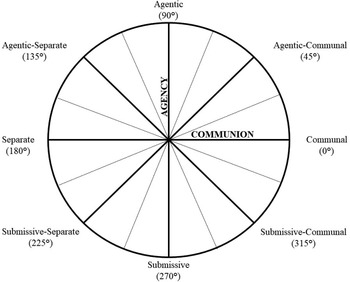
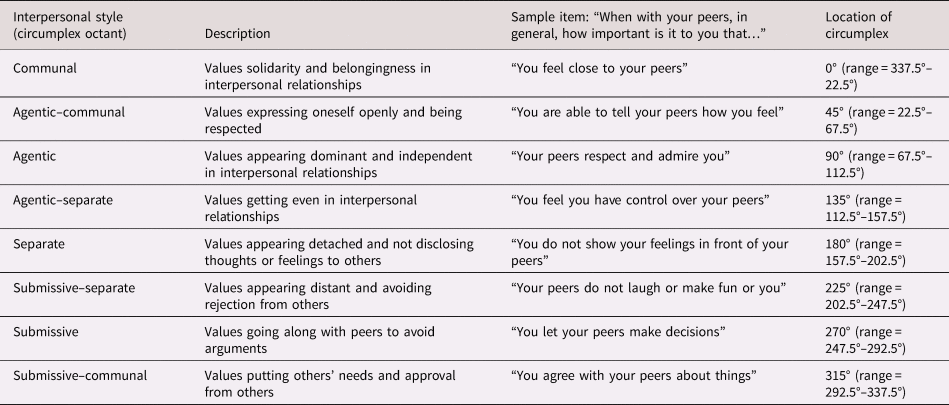
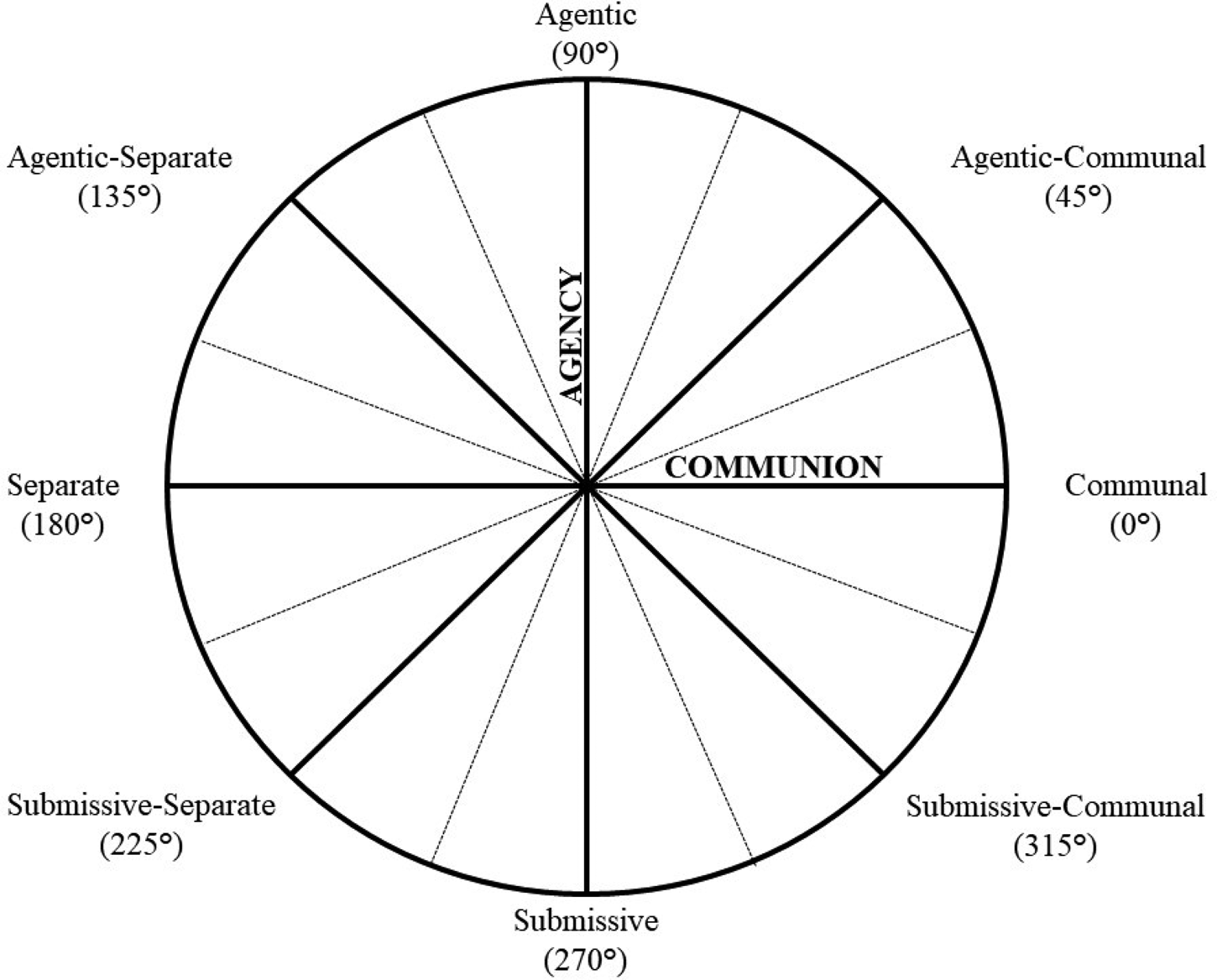
Interpersonal theory posits that agency and communion – two higher order personality constructs – can be used to describe different interpersonal styles (Dawood, Dowgwillo, Wu, & Pincus, Reference Dawood, Dowgwillo, Wu, Pincus, Zeigler-Hill and Shackelford2017). Communal social goals (communion) refers to valuing being part of and gaining acceptance from social relationships; they are manifested in strivings for intimacy and connectedness with dyadic and peer group relationships (Trucco, Wright, & Colder, Reference Trucco, Wright and Colder2013). Agentic social goals (agency) refer to valuing individuality; they are manifested in articulating one's own opinions even when they stray from group consensus, and striving for power and mastery (Dawood et al., Reference Dawood, Dowgwillo, Wu, Pincus, Zeigler-Hill and Shackelford2017; Trucco et al., Reference Trucco, Wright and Colder2013). As shown in Figure 1, agentic and communal social goals are orthogonal dimensions that form a Cartesian plane (Locke, Reference Locke2003). This circular structure of agency and communion, known as the interpersonal circumplex, facilitates the examination of interpersonal style by allowing researchers to examine an individual's location on the circumplex using circular statistics (Sadler & Woody, Reference Sadler and Woody2003; Wright, Pincus, Conroy, & Hilsenroth, Reference Wright, Pincus, Conroy and Hilsenroth2009; Zimmermann & Wright, Reference Zimmermann and Wright2017) (see Table 1).
Circumplex structure of the Interpersonal Goals Inventory for Children Revised (IGI-CR). The interpersonal circumplex is a comprehensive structural model used to conceptualize and assess social goals. Each octant (e.g., submissive–separate, communal) is measured with four distinct items and reflects a characteristic style of social goals. Four scales capture the poles of communion versus separate and agency versus submissive, with the remaining four scales capturing blends of these poles. Degrees reflect the circumplex structure of the measure. Octants closest together have the highest correlations with each other whereas octants furthest apart (e.g., agentic and submissive) have the lowest correlations. Trucco et al. (Reference Trucco, Wright and Colder2013) provide extensive details regarding the circumplex structure of social goals.
Octant information for the Interpersonal Goals Inventory for Children Revised (IGI-CR)

Within this framework, an interpersonal style characterized by valuing both close friendships (high communion) and independence with the ability to resist peer influence (high agency) is thought to promote social competence and protect youth from engaging in risk behavior (Allen & Loeb, Reference Allen and Loeb2015; Baumrind, Reference Baumrind1991). This agentic–communal interpersonal style corresponds to an angular location of 45° on the circumplex (see Figure 1). A critical aspect of interpersonal theory is that it is important to consider the combination of agency and communion together to understand interpersonal and risk behavior. That is, elevation on both communion and agency is crucial for positive adjustment, whereas valuing just communion or just agency is potentially problematic (Allen & Loeb, Reference Allen and Loeb2015; Allen, Chango, & Szwedo, Reference Allen, Chango and Szwedo2014). Thus, combinations of high agency and low communion (agentic–separate interpersonal style, angular location of 135°) or low agency and high communion (submissive–communal interpersonal style, angular location of 315°) align with risk interpersonal styles (Trucco et al., Reference Trucco, Wright and Colder2013). Some evidence supports these predictions.
Adolescents who strongly value independence and resistance to peer influence (high agency) are less susceptible to peer influence (Allen et al., Reference Allen, Chango and Szwedo2014; Allen, Porter, & McFarland, Reference Allen, Porter and McFarland2006); however, they tend to have low-quality peer relationships and engage in high levels of externalizing behaviors (Allen et al., Reference Allen, Chango and Szwedo2014; Meisel & Colder, Reference Meisel and Colder2015, Reference Meisel and Colder2017; Ojanen & Nostrand, Reference Ojanen and Nostrand2014). Strongly valuing close relationships (high communion) is associated with high-quality peer relationships and peer acceptance (Le, Impett, Lemay, Muise, & Tskhay, Reference Le, Impett, Lemay, Muise and Tskhay2018; Ojanen, Grönroos, & Salmivalli, Reference Ojanen, Grönroos and Salmivalli2005; Trucco et al., Reference Trucco, Wright and Colder2013), but also with adolescent substance use (Allen et al., Reference Allen, Chango and Szwedo2014; Meisel & Colder, Reference Meisel and Colder2015). These studies highlight the relevance of agency and communion for social adjustment and risk behavior, and that elevation of one or the other cardinal dimensions of interpersonal goals has pros and cons. Of note, these studies did not examine how standing on both agency and communion might be associated with adjustment, substance use, and other risk behaviors. Accordingly, how different combinations of agency and communion together would be associated adjustment and risk behavior remains untested.
Parenting styles
Parenting can support a positive interpersonal style to promote positive peer relationships and avoid risk behavior (Allen & Loeb, Reference Allen and Loeb2015). An effective parenting style is one where parents provide guidance and protection to their children as well as the freedom to experiment and learn on their own to become competent and socially well-adjusted (Allen & Loeb, Reference Allen and Loeb2015; Darling & Steinberg, Reference Darling and Steinberg1993). This parenting style is often referred to as authoritative parenting, and is characterized by high levels of parental responsiveness and high levels of parental demandingness (Baumrind, Reference Baumrind1991). The style of interaction between parent and adolescent serves as a context to model and practice adaptive interpersonal behaviors that are thought to flow into other domains, such as interactions with peers and engagement in risk behaviors (Baumrind, Reference Baumrind2005; Darling & Steinberg, Reference Darling and Steinberg1993). Numerous studies have shown the benefits of authoritative parenting on a variety of outcomes, including parent–child relationship quality (Karavasilis, Doyle, & Markiewicz, Reference Karavasilis, Doyle and Markiewicz2003), friendship satisfaction (Bae, Reference Bae2015), resistance to peer influence, and reduced likelihood of substance use (Baumrind, Reference Baumrind1991; Calafat, García, Juan, Becoña, & Fernández-Hermida, Reference Calafat, García, Juan, Becoña and Fernández-Hermida2014; Latendresse et al., Reference Latendresse, Rose, Viken, Pulkkinen, Kaprio and Dick2008; Piko & Balázs, Reference Piko and Balázs2012; Pires & Jenkins, Reference Pires and Jenkins2007). Conversely, adolescents with nonauthoritative parents have been found to experience greater conflict in interpersonal relationships with parents and peers (Oudekerk, Allen, Hessel, & Molloy, Reference Oudekerk, Allen, Hessel and Molloy2015), lower levels of resistance to peer influence (Baumrind, Reference Baumrind1991), and higher rates of substance use relative to adolescents with authoritative parents (Piko & Balázs, Reference Piko and Balázs2012). Taken together, these studies suggest that authoritative parenting may provide a parent–child relationship context that supports an agentic–communal interpersonal style.
Despite the theoretical importance of the joint effects of an adolescent's interpersonal style and parenting style on healthy adolescent development and protection from substance use (Allen & Loeb, Reference Allen and Loeb2015; Baumrind, Reference Baumrind1991), no research has examined such joint effects to our knowledge. This is a significant gap in the literature as both adolescent interpersonal styles and parenting styles shape how adolescents transact with their social environments (Allen et al., Reference Allen, Chango and Szwedo2014; Calafat et al., Reference Calafat, García, Juan, Becoña and Fernández-Hermida2014), and the joint effects of these influences may render adolescents more or less adept at avoiding peer influences that encourage and support substance use.
Developmental shifts in social goals and parenting
An adolescent's interpersonal style and parenting style are both suggested to systematically shift during adolescence to meet adolescents’ developmental needs (Allen & Loeb, Reference Allen and Loeb2015; Baumrind, Reference Baumrind1991). Specifically, communal and agentic goals are expected to increase over the course of adolescence to facilitate achieving the developmental tasks of intimacy and independence, and promote health behaviors (Le et al., Reference Le, Impett, Lemay, Muise and Tskhay2018; Oudekerk et al., Reference Oudekerk, Allen, Hessel and Molloy2015; Yeager et al., Reference Yeager, Dahl and Dweck2018). In contrast, non-normative growth such as increases in communion without being balanced by increases in agency or vice versa are thought be impede achieving intimacy and independence, and promote risk behavior (Allen et al., Reference Allen, Chango and Szwedo2014). Furthermore, increases in agency and communion are facilitated by parenting contexts characterized by an authoritative parenting style throughout adolescence, but with slight declines in parental demandingness (Allen & Loeb, Reference Allen and Loeb2015; Baumrind, Reference Baumrind1991). Failure to decrease parental demandingness is thought to undermine the development of agency and communion and thus place adolescents at greater risk for engagement in risk behaviors (Cook, Chaplin, & Stroud, Reference Cook, Chaplin and Stroud2015; Oudekerk et al., Reference Oudekerk, Allen, Hafen, Hessel, Szwedo and Spilker2014; Reference Oudekerk, Allen, Hessel and Molloy2015). Parents who decrease their warmth and responsiveness during early and middle adolescence are conceptualized to goad more interpersonally cold adolescents who are at increased risk for substance use and adverse outcomes (Baumrind, Reference Baumrind1991; Oudekerk et al., Reference Oudekerk, Allen, Hessel and Molloy2015).
To date, some work has examined developmental changes in social goals and parental responsiveness and demandingness. Consistent with the supposition that social goals should increase during adolescence, Trucco et al. (Reference Trucco, Wright and Colder2014) found growth in agentic and communal goals from early to middle adolescence. Parental responsiveness and demandingness also change during adolescence (Coley et al., Reference Coley, Votruba-Drzal and Schindler2008; De Goede, Branje, & Meeus, Reference De Goede, Branje and Meeus2009; Keijsers & Poulin, Reference Keijsers and Poulin2013), with parental responsiveness decreasing during early adolescence and increasing during middle and late adolescence (Keijsers & Poulin, Reference Keijsers and Poulin2013). Increases in parental responsiveness are associated with low levels of adolescent substance use (Coley et al., Reference Coley, Votruba-Drzal and Schindler2008). Parental control, including parental demandingness, declines during adolescence (Keijsers & Poulin, Reference Keijsers and Poulin2013). Failure to decrease demandingness undermines adolescent agency and communion, and is associated with poor social adjustment and higher engagement in deviant behavior, including substance use (Allen et al., Reference Allen, Chango and Szwedo2014; McElhaney, Porter, Thompson, & Allen, Reference McElhaney, Porter, Thompson and Allen2008; Oudekerk et al., Reference Oudekerk, Allen, Hessel and Molloy2015). Although developmental changes in social goals and parenting have been found in prior work, no studies, to our knowledge, have simultaneously assessed changes in interpersonal style and parenting styles in adolescence using a longitudinal design. This is a notable gap in the literature given the proposed joint effects of interpersonal style and parenting on adolescent risk behavior.
The current study
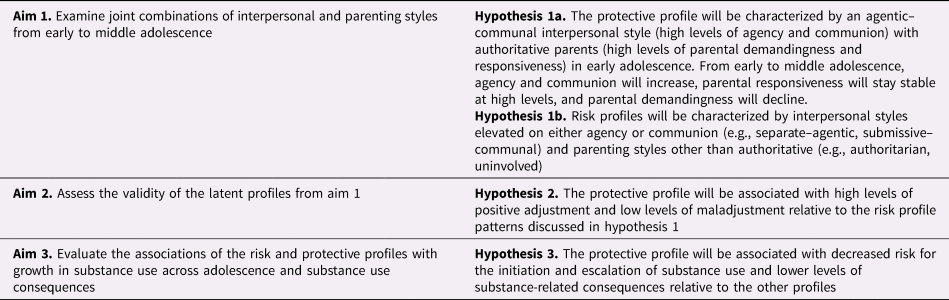
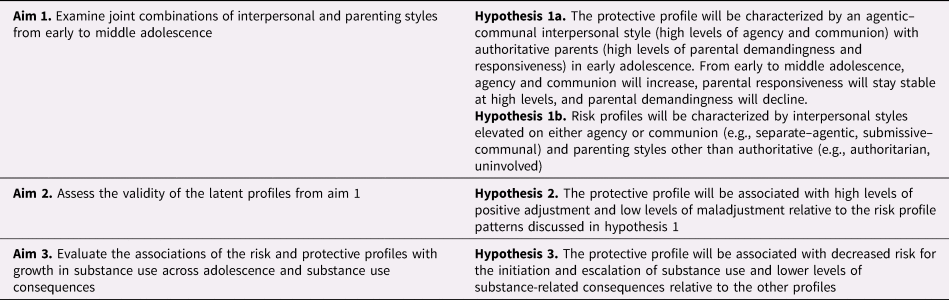
The first aim of the present study was to identify profiles or subgroups of adolescents based on their interpersonal style and parents’ parenting style across adolescence and then to assess their relationships with indicators of social adjustment. We hypothesized that a protective profile will emerge in early adolescence, characterized by an agentic–communal interpersonal style (high levels of agency and communion) with authoritative parents (high levels of parental demandingness and responsiveness). With respect to change, this protective profile is expected to show increases in agency and communion, stable high parental responsiveness, and declines in parental demandingness. Risk profiles were characterized by interpersonal styles elevated on either agency or communion (e.g., separate–agentic, submissive–communal) and parenting styles other than authoritative (e.g., authoritarian, uninvolved).
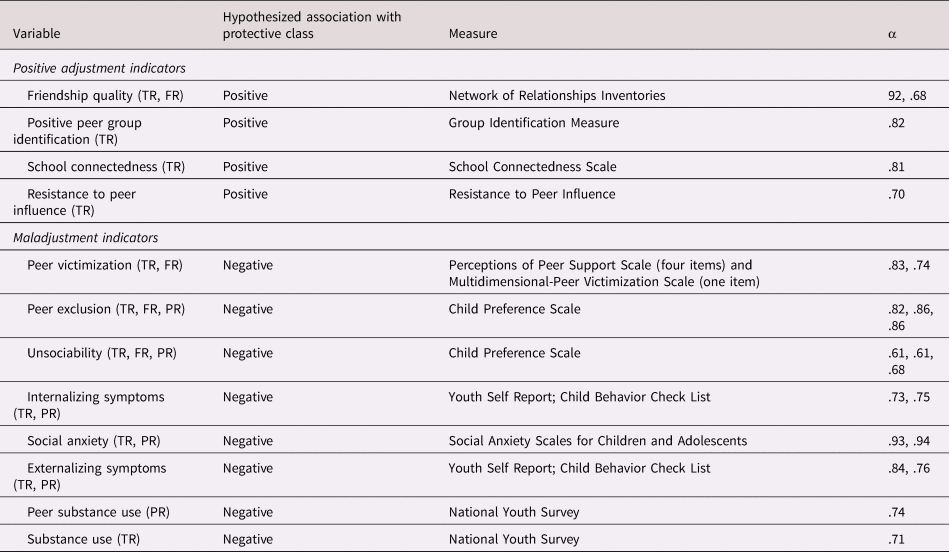
The second aim was to examine profile associations with indicators of positive adjustment and maladjustment. We hypothesized that the protective profile should be associated with high levels of positive adjustment and low levels of maladjustment relative to the risk profile patterns discussed in the first hypothesis (see Table 2 for full list of hypothesized associations).
Hypothesized associations of the protective profile with indicators of positive adjustment and maladjustment
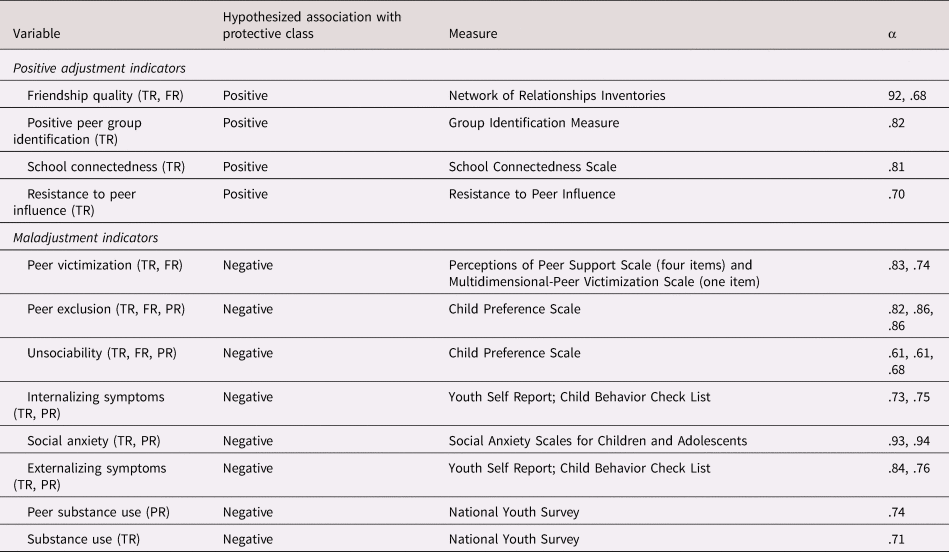
Note: TR = target report, FR = friend report, PR = parent report. Indicators of positive and negative adjustment were all assessed at Wave 3.
The third aim was to evaluate whether the proposed protective profile (agentic–communal interpersonal style with increases in agency and communion coupled with authoritative parenting with stable high responsive and declines in demandingness) is associated with trajectories of substance use across adolescence as well as substance-related consequences during late adolescence. We hypothesized that the protective profile will be associated with decreased risk for the initiation and escalation of substance use and lower levels of substance-related consequences (Allen & Loeb, Reference Allen and Loeb2015; Baumrind, Reference Baumrind1991).
Method
Participants
Participants were drawn from a longitudinal study examining risk and protective factors associated with the initiation and escalation of early adolescent substance use. Random-digit dialing procedures were used to recruit 387 families (one child, one caregiver) in the period 2007 to 2009. Listed and unlisted telephone numbers were used in Erie County, NY, and 98.5% of households had a landline at the time of recruitment. The sample was evenly split on gender (N = 213 females, 55%) and included non-Hispanic Caucasian (83.1%), African American (9.1%), Hispanic (2.1%), and Asian (1.0%) youths, as well as youths of mixed ethnicity (4.7%). The median family income was US$70,000 (in the range US$1,500 to US$500,000); 6.2% of the families received public income assistance.
At Waves 1, 2, and 3, target adolescents provided the names of four close friends and one was recruited into the study (peer) to provide a collateral report of the target adolescent's peer environment. Peers were required to be within 2 years of age of the target adolescent and could not be a sibling. Targets were allowed to nominate different peers at each wave to allow for the fluid nature of adolescent peer relationships (Knecht, Snijders, Baerveldt, Steglich, & Raub, Reference Knecht, Snijders, Baerveldt, Steglich and Raub2010). The demographic characteristics of the community sample were similar to those of Erie County from whence the sample came (for more complete details, see Trucco, Colder, Wieczorek, Lengua, & Hawk, Reference Trucco, Colder, Wieczorek, Lengua and Hawk2014).
The current study used data from Wave 1 (W1) through Wave 9 (W9) of the longitudinal project. The average ages (in years) of the target participants was 12.1, 13.1, 14.1, 15.1, 16.1, 17.1, 17.9, 18.9, and 19.9 at W1 to W9, respectively. Overall retention across the nine waves was excellent (W2 = 96%, W3 = 96%, W4 = 96%, W5 = 94%, W6 = 91%, W7 = 91% W8 = 91%, W9 = 90%). Chi-square and analysis of variance tests comparing those with and without missing data on W1 variables suggested no significant differences (p > .05) for age, gender, ethnicity, parental income, parental marital status, agency, communion, parental demandingness, parental responsiveness, alcohol use, cannabis use, and cigarette use. The low attrition rate and lack of differences suggest that missing data did not have a substantial impact on the findings of the study.
Procedures
At W1–W3 and W7–W9, adolescents and their caregivers were interviewed annually in university research offices. After informed consent and assent procedures, caregivers and adolescents were escorted to separate rooms for the assessments, which consisted of both laboratory tasks as well as questionnaires assessing a wide range of family, peer, and individual level risk and protective factors for adolescent drug use. Considering the age of the participants at W7 (M = 17.9 years), W8 (M = 18.9 years), and W9 (M = 19.9 years) a number of them had relocated out of the area. To retain these individuals, participants were provided with an opportunity to complete the questionnaires remotely at these waves: N = 18 or 5% of the W7 sample, N = 33 or 9% of the W8 sample, and N = 83, 24% of the W9 sample completed the questionnaires remotely. The assessments took approximately 2.5–3.0 hours. For W1, W2, and W3, families were compensated $75, $85, and $125, respectively, and adolescents received a small prize ranging from $5 to $15. At W7, W8, and W9, adolescents were compensated $125, $135, and $145 while caregivers were compensated $40, $45, and $50, respectively.
W4, W5, and W6 consisted of a brief telephone-based audio-computer-assisted self-interview (CASI) survey of substance use that took 10–15 min to complete. Parents provided consent over the phone and were given a phone number and PIN for their adolescent to use. Assent from the adolescent was obtained at initiation of the audio-CASI survey. Adolescents were compensated, $15, $15, and $20 at W4, W5, and W6, respectively. All procedures were approved by the University's Institutional Review Board (Study title: Internalizing problems, motivation, peers, & development of adolescent drug use; MODCR00000706).
Measures
Substance use (W1–W9)
Substance use was assessed across W1 to W9 with separate questions assessing the past-year frequency of alcohol use, cigarette use, and cannabis use (Elliot & Huizinga, Reference Elliot and Huizinga1983). At W1–W6, items were fill-in-the-blank. At W7, W8, and W9, participants reported past-year alcohol, cigarette, and cannabis frequency using an 8-point response scale (1 = not at all to 8 = everyday) that was converted to represent the number of use days in the past year for each substance. This was done to be consistent with W1–W6. A past-year substance use frequency variable was created by summing the number of days adolescents used alcohol, cigarette, or cannabisFootnote 1. To reduce the influence of outliers, extreme values were recoded to three standard deviations above the mean at each wave (Tabachnick & Fidell, Reference Tabachnick and Fidell2007). This resulted in 3.6% of all substance use observations being recoded (range = 0%–6.25% across W1–W9).
Substance use-related consequences (W7–W9)
Alcohol- and cannabis-related consequences were assessed at W7–W9 using the Young Adult Alcohol Consequences Questionnaire (YAACQ; Kahler, Strong, & Read, Reference Kahler, Strong and Read2005; Read, Kahler, Strong, & Colder, Reference Read, Kahler, Strong and Colder2006) and the Marijuana Consequences Questionnaire (MACQ; Simons, Dvorak, Merrill, & Read, Reference Simons, Dvorak, Merrill and Read2012), respectively. The YAACQ (48 items) and MACQ (50 items) assess a range of consequences experienced in the past year with dichotomous responses (0 = no, 1 = yes). Items from each measure were averaged to form a scale score. Individuals who did not consume alcohol or use cannabis in the past year were assigned scores of 0. The internal consistency for both the YAACQ (α = .93 to .94) and the MACQ (α = .91 to .95) was strong. Nicotine dependence was assessed using the Fagerström Test for Nicotine Dependence (FTND; Heatherton, Kozlowski, Frecker, & Fagerström, Reference Heatherton, Kozlowski, Frecker and Fagerström1991). This measure consists of theoretically relevant questions to nicotine dependence, such as time to the first cigarette of the day, the cigarette you would hate to give up with most, do you smoke when you are very ill, and do you smoke more during the first few hours after waking than the rest of the day (α = .68 to .84).
Social goals (W1–W3)
Social goals were assessed with the Interpersonal Goals Inventory for Children Revised (IGI-CR; Trucco et al., Reference Trucco, Wright and Colder2013). The IGI-CR comprises 32 items all containing the prompt “When with your peers, in general how important is it to you that…?” Response options include a 5-point scale ranging from 0 (= not at all important to me) to 4 (= extremely important to me). The IGI-CR captures what adolescents value when interacting with their peers. The IGI-CR is composed of eight octants containing four items each (see Table 1). Each of the eight octants of the interpersonal circumplex are used to compute vector scores that capture the multidimensionality of agency and communion. Vector scores were computed at each wave to represent agentic and communal goals using formulas commonly used by social goals researchers (Locke, Reference Locke2003; Ojanen et al., Reference Ojanen, Grönroos and Salmivalli2005). High scores on the agentic vector correspond to valuing and appearing dominant and independent. High scores on the communal vector correspond to valuing solidarity and belongingness. The IGI-CR fits a circumplex structure (Trucco et al., Reference Trucco, Wright and Colder2013) and has demonstrated strong convergent and divergent validity with indicators of social adjustment such as peer group identification, friendship quality, aggression, peer victimization, shyness, and peer exclusion (Trucco et al., Reference Trucco, Wright and Colder2013; Trucco, Bowker, & Colder, Reference Trucco, Bowker and Colder2008). The internal consistencies were high for agentic (α = .82 to .84 across waves) and communal (α = .89 to .92 across waves) goals scores.
Parental demandingness and responsiveness (W1–W3)
Adolescents’ perceptions of the extent to which their parents were demanding and responsive were assessed using the Parenting Styles Inventory II (PSI-II; Darling & Toyokawa, Reference Darling and Toyokawa1997). The PSI-II consists of two 5-item subscales assessing parental demandingness (e.g., “My parent really expects me to follow family rules,” “If I don't behave myself, my parents will punish me,” and “My parent points out ways I could do better”) and parental responsiveness (e.g., “I can count on my parents to help me out if I have a problem,” “My parents spend time just talking to me,” and “My parent and I do things that are fun together”). The responsiveness (α = .62 to .77) and demandingness (α = .61 to .65) subscales demonstrated adequate reliability across the three waves they were assessed.
Data analytic strategy
Aim 1
A core tenet of developmental psychopathology and the social developmental perspective assessed in the current study is the idea that individuals are fundamentally multidimensional, both with respect to their characteristics (e.g., interpersonal style) and social environments (e.g., parenting). The challenge for the current study and developmental psychopathology research more broadly is to employ analytic techniques that capture this complexity adequately (Lanza & Cooper, Reference Lanza and Cooper2016). Longitudinal latent profile analysis (LLPA) is well suited to examining distinct patterns of adolescent interpersonal styles (combinations of agentic and communal social goals) and parenting styles (combinations of demandingness and responsiveness) across early to middle adolescence (Collins & Lanza, Reference Collins and Lanza2013). For hypotheses 1a and 1b, agency, communion, parental demandingness, and parental responsiveness at W1–W3 served as indicators of longitudinal latent profiles (LLPs). The LLPA provided descriptive information regarding an adolescent's interpersonal style and parents’ parenting style at a single time point, as well descriptive information on how an adolescent's interpersonal style and parents’ parenting style developed from early to middle adolescence (W1 to W3).
LLPA was first conducted with indicator variances constrained to be equal across classes. Then, increasingly complex LLPA models were evaluated by individually freeing indicator variances across classes (Masyn, Reference Masyn and Little2013). The Akaike information criterion, Bayesian information criterion, entropy, sample size of classes, the Lo–Mendell–Rubin test, and bootstrapped likelihood ratio test were all used to determine the number of profiles to extract (Nylund, Asparouhov, & Muthén, Reference Nylund, Asparouhov and Muthén2007; Tein, Coxe, & Cham, Reference Tein, Coxe and Cham2013). In addition to these fit indices, the theoretical underpinnings of the current study as well efforts to favor more parsimonious models (e.g., inspection of profiles to determine whether they provide unique information) guided the selection of the final profile solution (Collins & Lanza, Reference Collins and Lanza2013; Wright & Hallquist, Reference Wright and Hallquist2014).
After selection of the final LLPA solution, latent profiles were labeled based on the following criteria.
(a) The structural summary method (SSM) and circular statistics, which help describe circumplex data, such as interpersonal style (Wright et al., Reference Wright, Pincus, Conroy and Hilsenroth2009). Three parameters provided by the SSM were particularly of interest to describe the latent profiles – the angular displacement, R 2, and amplitude. Angular displacement provides information regarding the interpersonal style of a profile. For example, an angular displacement of 360° would reflect a communal interpersonal style whereas an angular displacement of 225° would indicate a submissive–separate interpersonal style (see Figure 1). In circular statistics, R 2 reflects interpersonal prototypicality, which indicates the degree to which a profile is characterized by a single interpersonal style (Wright et al., Reference Wright, Pincus, Conroy and Hilsenroth2009). Lastly, amplitude reflects the distinctiveness of the interpersonal style, with a greater amplitude indicating greater interpersonal style distinctiveness relative to alternative interpersonal styles (Gurtman, Reference Gurtman, Horowitz and Strack2011; Wright et al., Reference Wright, Pincus, Conroy and Hilsenroth2009). Following guidelines in the literature, R 2 values of .70 or higher reflect adequate prototypicality and values above .80 reflect good prototypicality; amplitude absolute values of .15 or higher were used to indicate marked distinctiveness (Wright et al., Reference Wright, Hallquist, Morse, Scott, Stepp, Nolf and Pilkonis2013; Zimmermann & Wright, Reference Zimmermann and Wright2017). The ability to precisely characterize the interpersonal style of subgroups using these SSM statistics is a notable strength of LLPA (Wright et al., Reference Wright, Hallquist, Morse, Scott, Stepp, Nolf and Pilkonis2013).
(b) The parenting style of each profile was defined by the mean levels of parental responsiveness and parental demandingness in each profile relative to the sample means at W1, W2, and W3 (Carlo, White, Streit, Knight, & Zeiders, Reference Carlo, White, Streit, Knight and Zeiders2018). For example, higher demandingness and responsiveness relative to the sample mean would reflect authoritative parenting whereas higher responsiveness and lower demandingness would reflect permissive parenting. The use of model fit criteria to determine the number of profiles and LLPA providing mean values for responsiveness and demandingness of each profile allows for more precise classifications of parenting styles relative to median splits of responsiveness and demandingness, which are often conducted to create parenting styles (Zhang, Wei, Ji, Chen, & Deater-Deckard, Reference Zhang, Wei, Ji, Chen and Deater-Deckard2017).
(c) Growth in agency, communion, parental responsiveness, and parental demandingness from early to middle adolescence. Growth was assessed using Cohen's d to determine the amount of change from W1 to W3 for each construct within each profile: d < 0.20 indicated no growth; d > 0.20 indicated small growth; d > 0.50 indicated medium growth; d > 0.80 indicated large growth.
Aim 2
Considering concerns raised in the literature regarding the number of profiles to extract as well as the interpretability of the latent profiles obtained in LLPA (Bauer & Curran, Reference Bauer and Curran2003; Wright & Hallquist, Reference Wright and Hallquist2014), validity analyses were conducted to determine whether the identified profiles differed on theoretically meaningful measures (see Table 2 for variables and Supplementary Materials 1 for a complete list of measures). To reduce concerns regarding shared method variance when validating our profiles, adolescent, peer, and parent reports of indicators of social adjustment and psychopathology were used. All variables included in the validity analyses were assessed at W3 (the last wave included in our LLPA). Multinomial logistic regressions were used to compare all profiles with each other on the adjustment variables (Wright et al., Reference Wright, Hallquist, Morse, Scott, Stepp, Nolf and Pilkonis2013). Considering the high number of comparisons (210), an odds ratio (OR) of 2 was used to indicate meaningful profile differences (Ferguson, Reference Ferguson2009).
Aim 3
Two-part growth models with random effects allow for the simultaneous modeling of growth in probability of whether an adolescent used a substance in the past year as well as growth in the levels of substance use across adolescence (Olsen & Schafer, Reference Olsen and Schafer2001). Moreover, the separation of growth in the probability of use from levels of use addresses issues related to zero-inflation commonly found in adolescent substance use data (Olsen & Schafer, Reference Olsen and Schafer2001). Currently, there is no method for combining LLPA with two-part growth models with random effects; a two-stage approach was thus used to assess how the longitudinal latent profiles were associated with the probability of and growth in substance use. First, adolescents were assigned to their most likely latent profile using profile probabilities. Second, profile membership was used to create contrast variables that were included as predictors of growth in the probability of substance use as well as levels of substance abuse from early to late adolescence using two-part growth models (Olsen & Schafer, Reference Olsen and Schafer2001). This two-step approach was also used to predict substance-related consequences. Substance-related consequences were modeled with the YAACQ, MACQ, and FTND at W7–W9, such that these variables served as indicators of latent alcohol-related consequences, cannabis-related consequences, and nicotine dependence, respectively. Latent alcohol, cannabis, and nicotine consequences loaded onto a higher-order substance-related consequences latent variable. All models controlled for age, gender, and minority status.
Results
Descriptive statistics
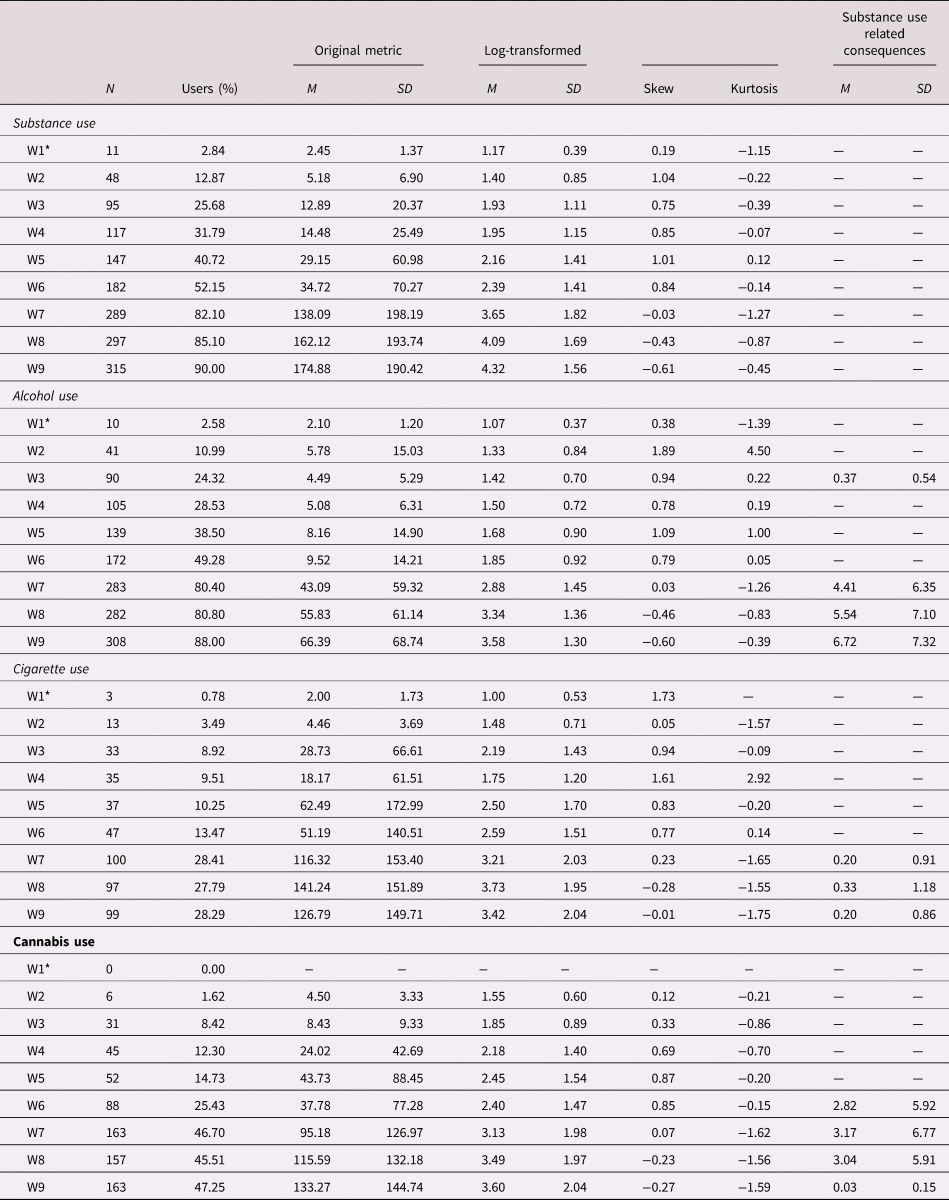
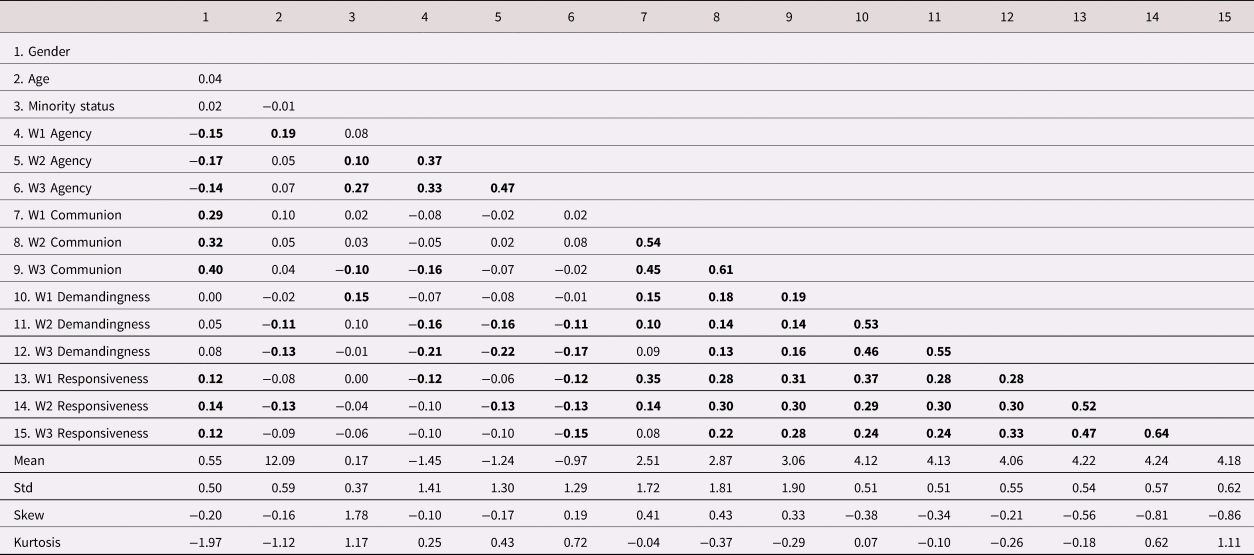
Not surprisingly given the age of our sample, rates of substance use were low at the earlier waves and increased over the course of the study (see Table 3). Table 4 provides zero-order correlations between social goals and parental responsiveness and demandingness. Consistent with the orthogonal conceptualization of agentic and communal goals, agentic and communal goals were unrelated within-time. At W2 and W3, agentic goals were negatively associated with both parental responsiveness (r = −.15 to −.13) and parental demandingness (r = −.17 to −.16). Communal goals were positively associated with both parental demandingness (r = .14 to .16) and parental responsiveness (r = .28 to .35) within-time. Parental responsiveness and demandingness were also positively correlated with each other within-time (r = .30 to .37).
Descriptive statistics for substance use (nonusers excluded from continuous variables)
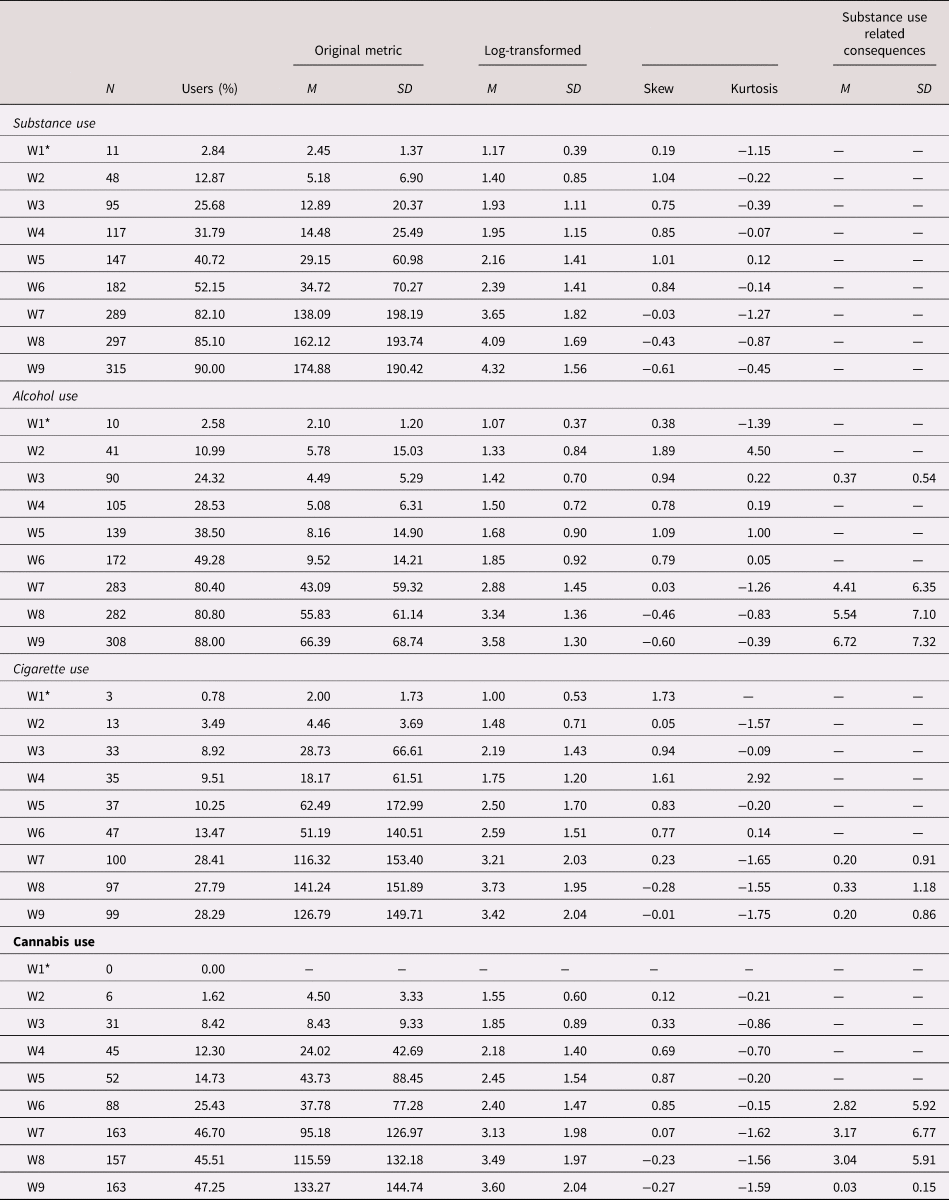
Note: *Not included in two-part growth models due to low endorsement of use. Means for alcohol and cannabis represent the average number of consequences endorsed on the Young Adult Alcohol Consequences Questionnaire (YAACQ) and Marijuana Consequences Questionnaire (MACQ), respectively.
Zero-order correlations for social goals and parenting
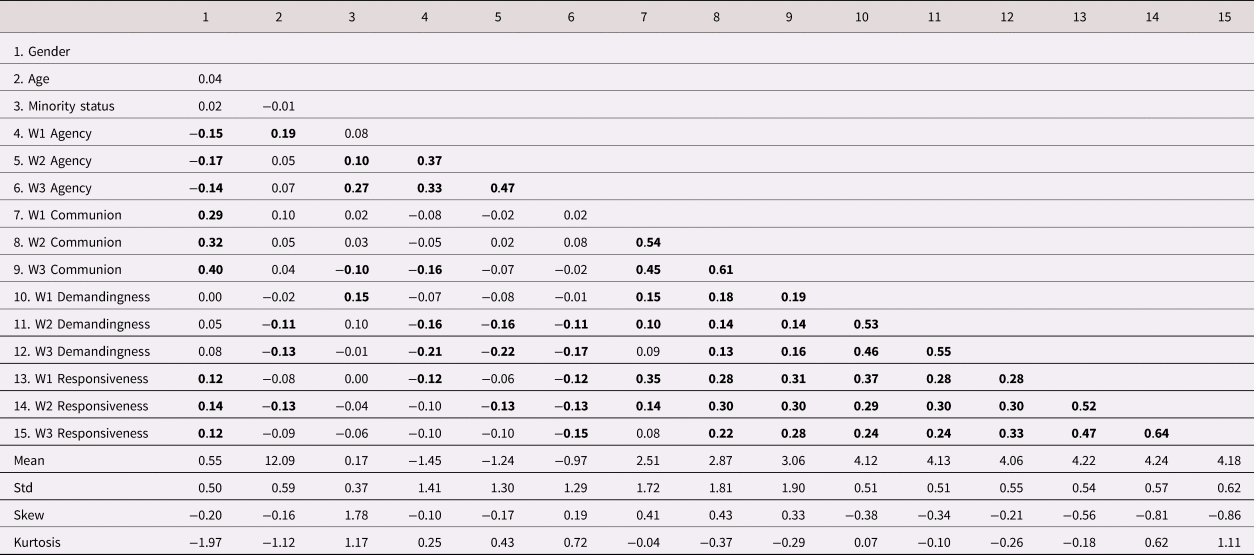
Note: W = Wave. Significant correlations at p < .05 are in bold.
Longitudinal latent profile analyses
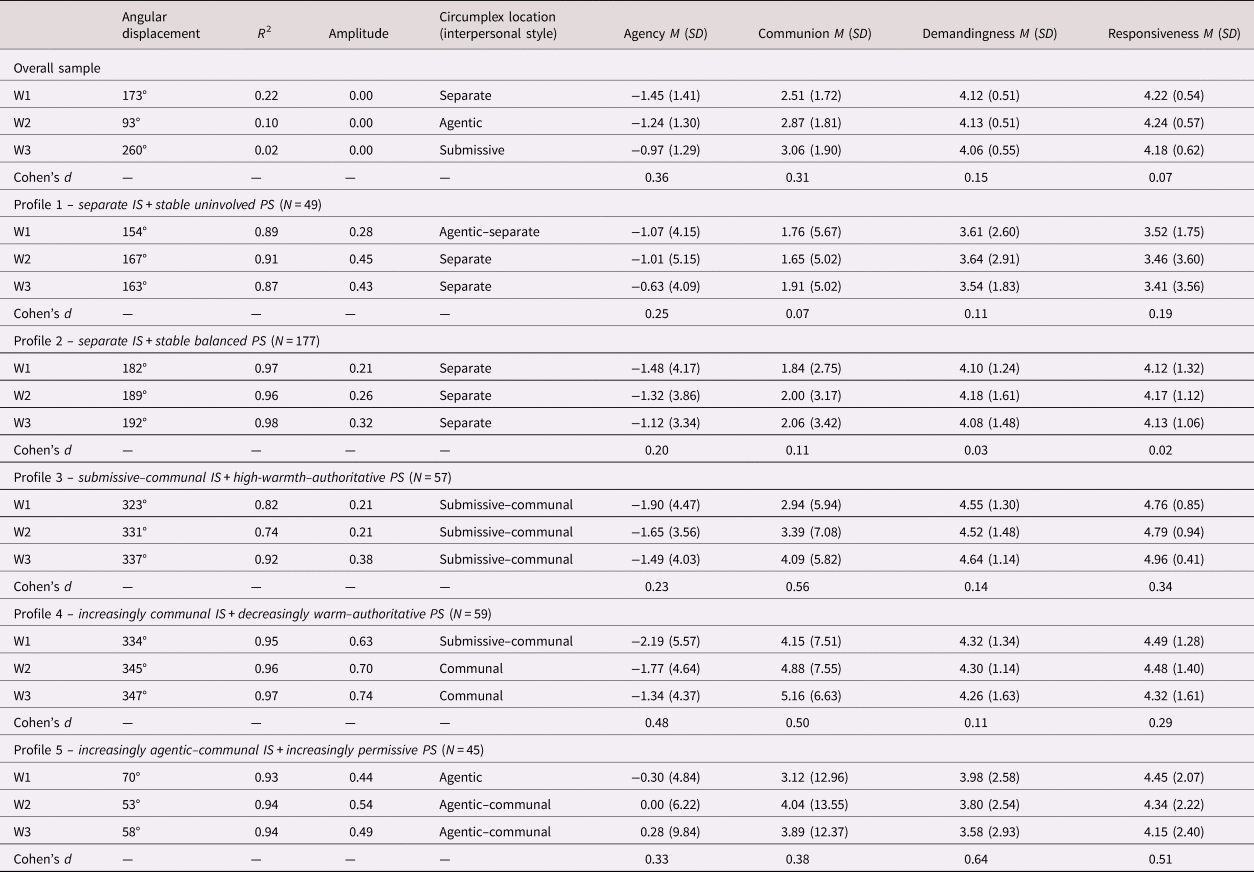
A five-profile solution was selected as the final LLPA solution (see Table 5 for hypothesized profiles and Supplementary Materials 2 for detailed information regarding final profile selection). Table 6 provides descriptive information (e.g., SSM results, profile means, magnitude of growth) that was used to assign names to each profile. Each of the five profiles were characterized by highly prototypical (R 2 M = .92, range = .74 to .98) and distinct (amplitude M = .42, range = .21 to .74) interpersonal styles.
Summary of study aims and hypotheses
Descriptive information for the final LLPA solution
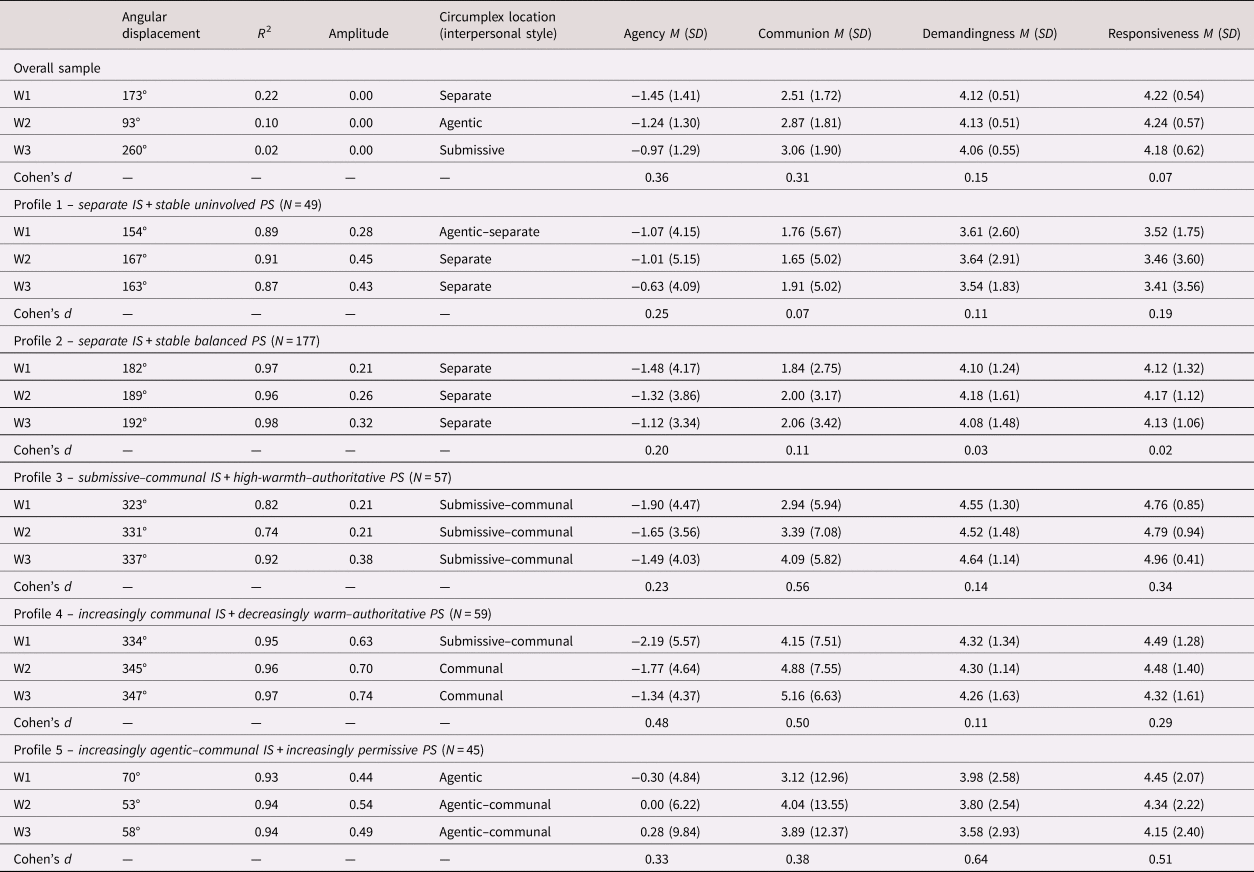
Note: Cohen's d indicates the magnitude of growth for each variable from Wave 1 to Wave 3 in each LLPA. IS =interpersonal style; PS = parenting style.
The first profile (N = 49) – the combination of a separate interpersonal style (IS) and a stable uninvolved parenting style (PS) (separate IS + stable uninvolved PS)) – had a separate interpersonal style with modest growth in agency and communion across W1–W3, as well as an uninvolved parenting style characterized by stable below-average levels of parental responsiveness and demandingness at W1–W3.
The second profile (N = 177), separate IS + stable balanced PS, also had a separate interpersonal style but with a balanced parenting style characterized by stable average levels of parental responsiveness and demandingness.
The third profile (N = 57), submissive–communal IS + high-warmth–authoritative PS, had a submissive–communal interpersonal style with small increases in agency and medium increases in communion, as well as a high-warmth authoritative parenting style characterized by above-average stable levels of demandingness and above-average increasing levels of responsiveness.
The fourth profile (N = 59), increasingly communal IS + decreasingly warm–authoritative PS, had a communal interpersonal style with small increases in agency and moderate increases in communion, as well as a warm-authoritative parenting style characterized by above-average stable levels of parental demandingness and modest declines in parental responsiveness that went from 0.5 SD above average to average levels from W1 to W3.
The fifth profile (N = 45), increasingly agentic–communal IS + increasingly permissive PS, had a agentic–communal interpersonal style with small increases in agency and communion, as well as a permissive parenting style characterized by moderate declines in parental demandingness where levels went from average to nearly 1 SD below the mean from W1 to W3 and moderate decreasing parental responsiveness that was consistently in the average rangeFootnote 2.
Validity analyses
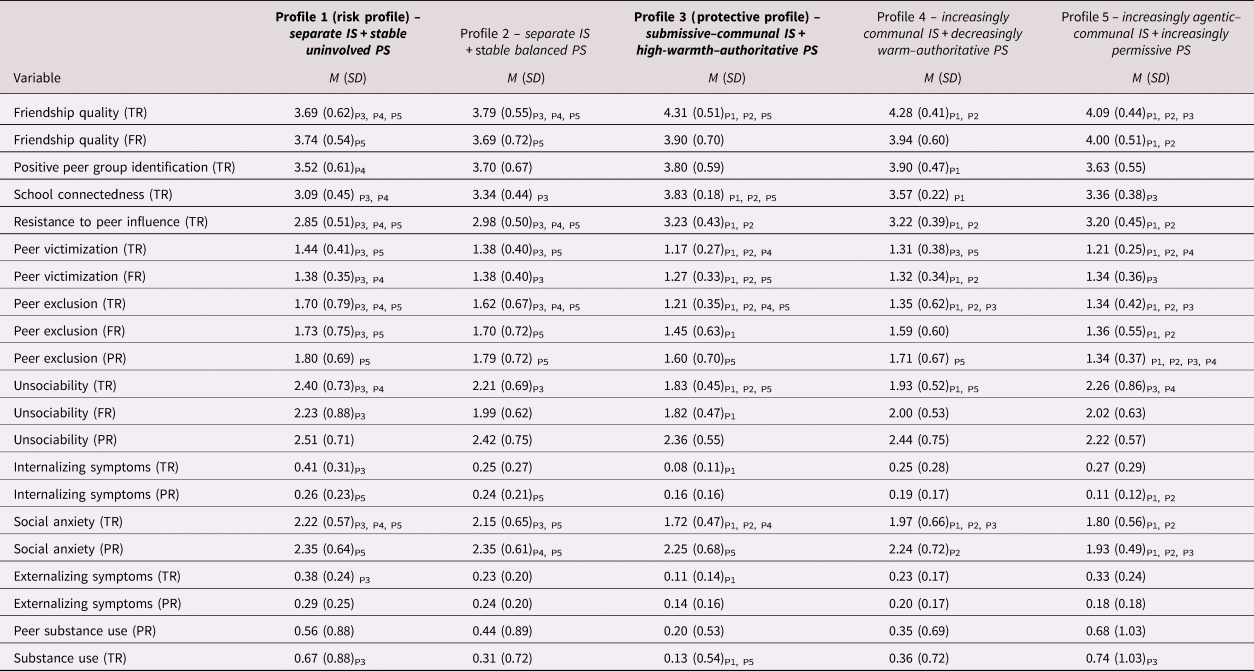
To assess the validity of the latent profiles, adolescents were assigned to their most likely profile membership and compared on theoretically meaningful indicators of adjustment (see Table 7). The entropy of 0.82 for the five-profile solution indicated that individuals were assigned to latent profiles with a high degree of certainty (Tein et al., Reference Tein, Coxe and Cham2013). Initial examination of profile differences on demographic characteristics indicated that the profiles significantly differed on gender, minority status, and parental marital status. No differences were found with respect to participant age or parental education. Consistent with prior work demonstrating higher rates of communal goals for females (Trucco et al., Reference Trucco, Wright and Colder2013), the increasingly communal IS + decreasingly warm–authoritative PS profile, which had the highest levels of communal goals, had a greater percentage of females relative to all classes (OR] = 4.86–7.38) besides the submissive–communal IS + high-warmth–authoritative PS profile. The submissive–communal IS + high-warmth–authoritative PS profile had a greater percentage of females relative to the separate IS + stable balanced PS profile (OR = 3.41) and the separate IS + stable uninvolved PS (OR = 3.15). The submissive–communal IS + high-warmth–authoritative PS profile had the highest level of parents who were married compared with all other classes (OR = 4.71–14.84) and the lowest representation of ethnic minorities status compared with all profiles (OR = 3.0–6.55) besides the increasingly communal IS + decreasingly warm–authoritative PS profile. All subsequent multinomial logistic regressions controlled for gender, minority status, and parental marital status.
Validity analyses for the latent profiles
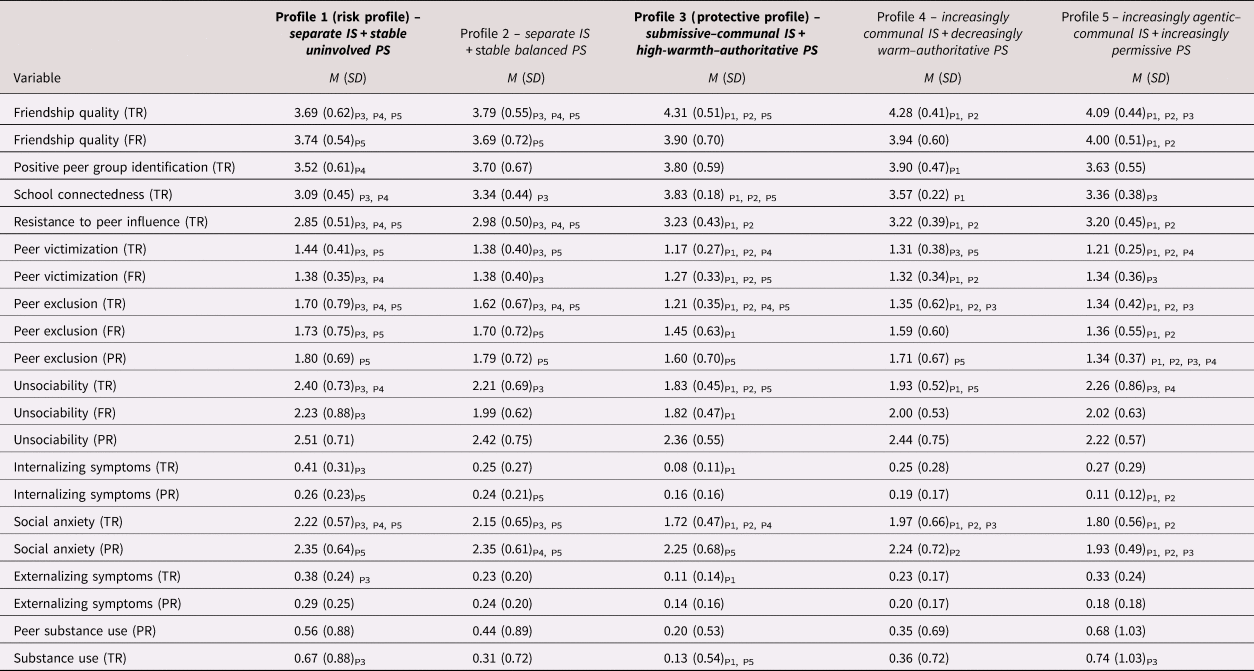
Note: Differences between profiles of an effect size magnitude greater than OR = 2 are indicated by a subscript P (profile) and the corresponding class. IS = interpersonal style, PS = parenting style, P1 = profile 1, P2 = profile 2, P3 = profile 3, P4 = profile 4, P5 = profile 5. The risk and protective profiles are bolded to aid with figure interpretation. TR = target report, FR = friend report, PR = parent report
Considering the large number of differences reaching our effect size cutoff, only key profile differences are summarized here. Validity analyses indicated that the submissive–communal IS + high-warmth–authoritative PS profile was the most protective. This profile had higher levels of friendship quality (OR = 7.08–10.09), school connectedness (OR = 4.17–5.25), and resistance to peer influence (OR = 3.91–6.31), as well as lower levels of peer victimization (OR = 4.40–8.43), peer exclusion (OR = 4.89–5.13), unsociability (OR = 2.85–3.95), and social anxiety (OR = 4.80–5.24) relative to the separate IS + stable uninvolved PS profile and separate IS + stable balanced PS profile. The submissive–communal IS + high-warmth–authoritative PS profile also had lower levels of internalizing symptoms relative to the separate IS + stable uninvolved PS profile (OR = 3.11), and had higher school connectedness (OR = 2.73) and lower levels of peer victimization (OR = 2.04), unsociability (OR = 3.05), and substance use (OR = 3.03) relative to the increasingly agentic–communal IS + increasingly permissive PS profile. Lastly, adolescents in the submissive–communal IS + high-warmth–authoritative PS profile reported experiencing less peer victimization (OR = 4.40), peer exclusion (OR = 2.37), and social anxiety symptoms (OR = 2.21) than adolescents in the increasingly communal IS + decreasingly warm–authoritative PS profile.
The validity analyses indicated that the separate IS + stable uninvolved PS profile and separate IS + stable balanced PS profile – both characterized by a separate interpersonal style – were highest on the indicators of maladjustment. Specifically, these profiles were characterized by lower levels of friendship quality (OR = 3.07–10.09) and resistance to peer influence (OR = 2.63–6.31) and higher levels of exclusion (OR = 2.06–5.13) relative to all other classes. Although differences between the separate IS + stable uninvolved PS profile and the separate IS + stable balanced PS profile did not meet our conservative effect size, the separate IS + stable uninvolved PS profile had lower values than the separate IS + stable balanced PS profile on positive peer group identification and resistance to peer influence, and higher values on unsociability and target substance use. These effects all had OR > 1.50, which is typically used to characterize a small effect (Cohen, Reference Cohen1988).
Overall, the results of the validity analyses suggested that adolescents in the submissive–communal IS + high-warmth–authoritative PS profile were the most socially well-adjusted and adolescents in the separate IS + stable uninvolved PS profile were the most socially maladjusted and distressed. Considering these consistent differences, the submissive–communal IS + high-warmth–authoritative PS profile was treated as the protective profile in our prediction models and the separate IS + stable uninvolved PS profile was treated as the risk profile in our prediction modelsFootnote 3.
Two-part growth model
Due to the low levels of substance use at W1 (see Table 3), this wave was not included in the two-part growth models with random effects. The intercepts for both dichotomous and continuous growth were set at W3. Details of the two-part growth model (e.g., model fit, nested tests, slope factor loadings, variance–covariance estimates) can be found in Supplementary Materials 3. A piecewise growth model, with the first piece of growth from W2 to W6 and the second piece from W6 to W9, provided the best fit for both the dichotomous and continuous portions of the model. The probability of substance use significantly increased from W2 to W6 (M = 0.96, p < .001) and W6 to W9 (M = 3.04, p < .001). Similarly, continuous levels of substance use increased from W2 to W6 (M = 0.41, p < .001) and from W6 to W9 (M = 2.73, p < .001). There was significant variability in all intercepts and slopes of the probability, as well as levels of substance use. Although log-likelihood nested model tests guided model selection, the likelihood ratio chi-square test for growth in dichotomous substance use, which was χ 2 = 301.68 (243), p = .006, is the only fit statistic available for two-part growth models with random effects.
Substance use growth prediction models
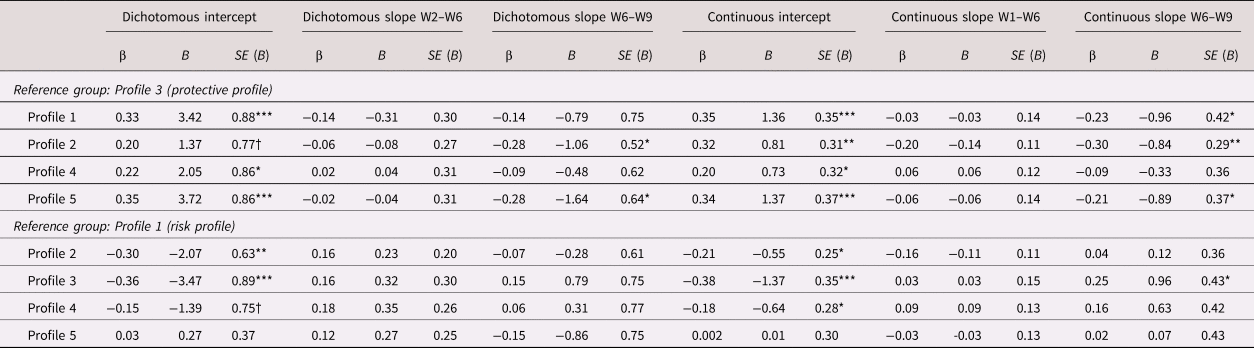
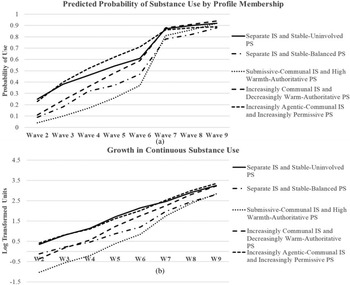
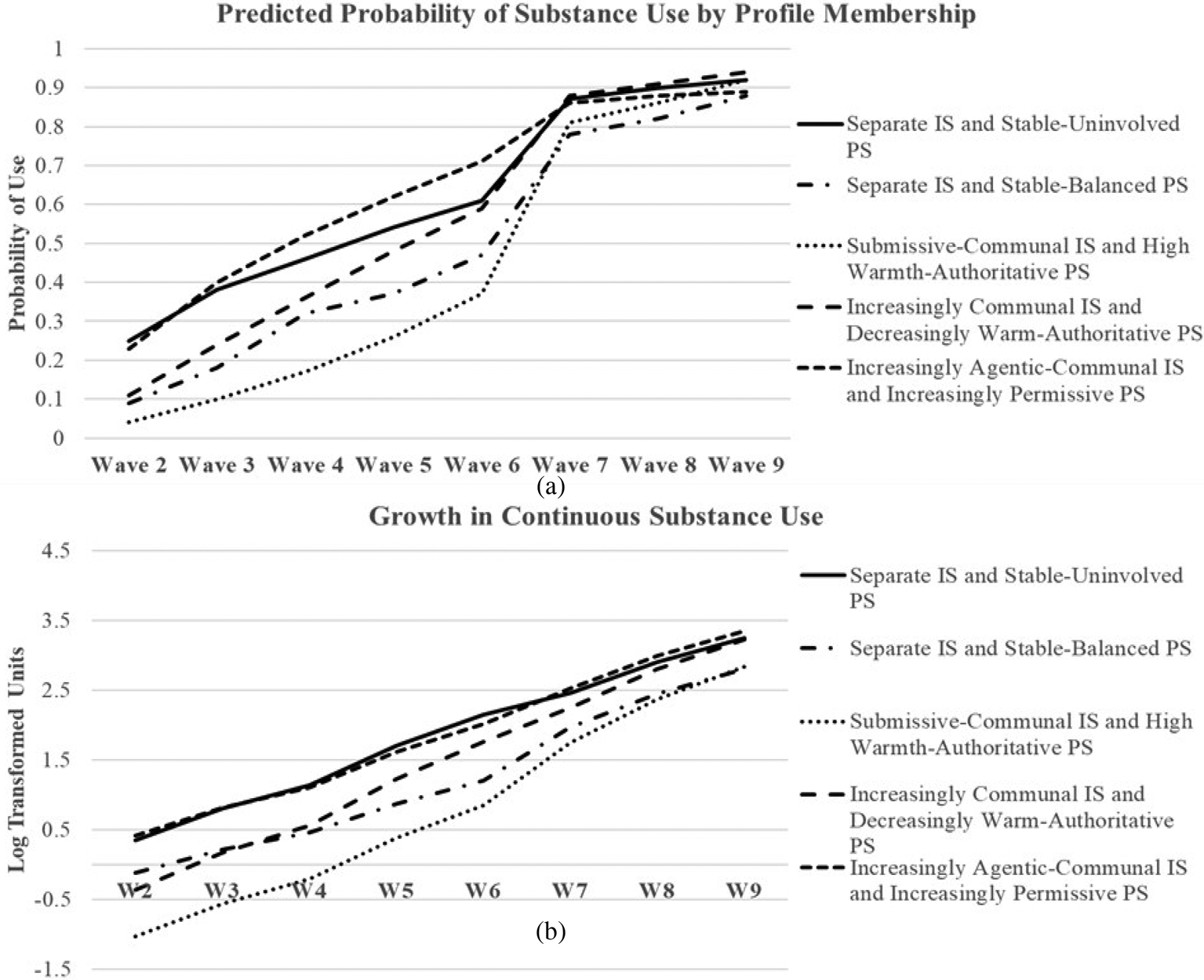
Dummy coded variables were created to model the associations between profile membership and substance use growth. Dummy coded variables were created with two separate reference groups: (a) the submissive–communal IS + high-warmth–authoritative PS profile, which was identified as a protective profile based on validity analyses, and (b) the separate IS + stable uninvolved PS profile, which was identified as a risk profile based on the validity analyses. Gender, minority status, and age were included as statistical control variables. The two-part model included covariances between the intercepts at W3 and growth in substance use from W2 to W9, and thus, associations between the latent profiles and growth in substance use represent prospective associations accounting for intercept covariation at W3. Statistical comparisons of growth in the probability of substance use and growth in levels substance use can be found in Table 8 and Figure 2 provides the model-implied growth trajectories for each profile.
Latent profiles predicting two-part substance use growth model with random effects
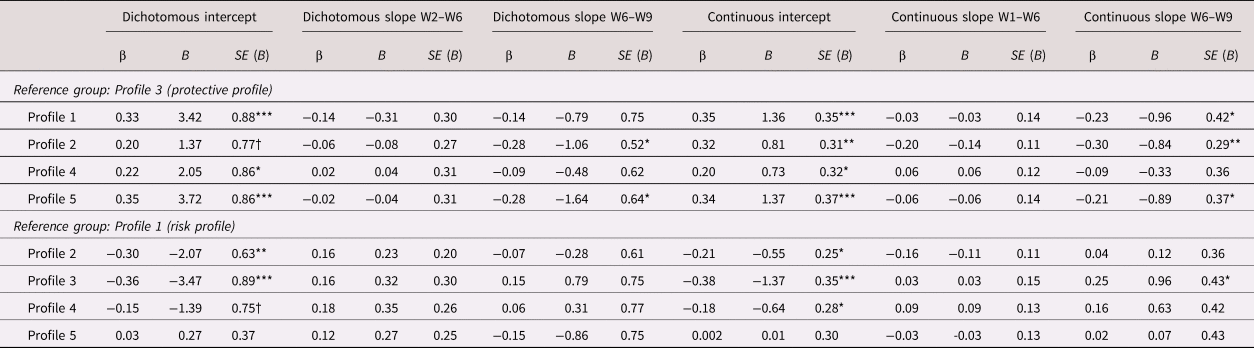
Note: †p < .10, *p < .05, **p < .01, ***p < .001.
Profile 1 = separate IS + stable uninvolved PS.
Profile 2 = separate IS + stable balanced PS.
Profile 3 = submissive–communal IS + high-warmth-authoritative PS.
Profile 4 = increasingly communal IS + decreasingly warm–authoritative PS.
Profile 5 = increasingly agentic–communal IS + increasingly permissive PS.
(a) Predicted probabilities of substance use. (b) Continuous levels of substance use. IS = interpersonal style, PS = parenting style.
The submissive–communal IS + high-warmth–authoritative PS profile (protective profile) reference group
As depicted in Figure 2, relative to the other profiles, the submissive–communal IS + high-warmth–authoritative PS consistently displayed the lowest probabilities of substance use from early through middle adolescence (W1–W6). Whereas adolescents in the protective profile had lower probabilities of substance use in early and middle adolescence, their overall probabilities of use caught up with the other profiles in late adolescence. These “catch-up effects” are indicated in the significant negative beta coefficients comparing the protective profile with the other profiles (e.g., increasingly agentic–communal IS + increasingly permissive PS) in Table 8 on the slopes of substance use from W6 to W9.
Similar to the results for the probability of substance use, continuous levels of substance use for the protective profile were consistently lower than all other profiles from W1 to W6. The protective profile displayed catch-up effects in late adolescence. These catch-up effects are indicated by significant negative beta coefficients on comparing the protective profile with other profiles (e.g., separate IS + stable balanced PS) in Table 8 on the slopes of substance use from W6 to W9.
The separate IS + stable uninvolved PS profile (risk profile) reference group
The separate IS + stable uninvolved PS profile was associated with a higher probability of substance use at W3 relative to most other profiles (see Figure 2). The risk profile maintained the second highest probabilities of substance use from early through middle adolescence (W2 to W6), the increasingly agentic–communal IS + increasingly permissive PS profile had the highest probabilities from W2 to W6. The separate IS + stable uninvolved PS profile had higher levels of substance use compared with all other profiles from W2 to W9 besides the increasingly agentic–communal IS + increasingly permissive PS profile.
Overall, these results indicated that adolescents in the submissive–communal IS + high-warmth–authoritative PS profile had lower probabilities and levels of substance use in early and middle adolescence relative to the other profiles. Conversely, adolescents in the risk profile had higher probabilities and levels of substance use in early and middle adolescence compared with nearly every other profile.
Substance use consequences prediction models
As with the two-part prediction models, the submissive–communal IS + high-warmth–authoritative PS profile and the separate IS + stable uninvolved PS profile each served as the reference group in models predicting substance-related consequences. The measurement model for substance-related consequences (χ2 = 28.44 (24), p = .24, comparative fit index (CFI) = .99, root mean square error of approximation (RMSEA) = .02) provided a good fit to the data and as did the model including profile membership, gender, minority status, and age (χ2 = 154.50 (88), p < .001, CFI = .93, RMSEA = .04). Since cannabis and cigarette consequences were not assessed at W3, substance use at W3 was included in the model as a control variable. The effect from substance use at W3 predicting latent substance-related consequences (β = .33, p = .03) in late adolescence was statistically significant.
The submissive–communal IS + high-warmth–authoritative PS profile (protective profile) reference group
Membership of the submissive–communal IS + high-warmth–authoritative PS profile was associated with significantly lower levels of substance-related consequences relative to the separate IS + stable uninvolved PS profile (β = .22, p = .006) and the increasingly communal IS + decreasingly warm–authoritative PS profile (β = .14, p = .007). Adolescents in the submissive–communal IS + high-warmth–authoritative PS profile had marginally significant lower levels of substance-related consequences relative to the increasingly agentic–communal IS + increasingly permissive PS profile (β = .11, p = .08) in late adolescence.
The separate IS + stable uninvolved PS profile (risk profile) reference group
The separate IS + stable uninvolved PS was associated with greater substance-related consequences relative to the separate IS + stable uninvolved PS profile (β = −.27, p = .01) and the submissive–communal IS + high-warmth–authoritative PS profile (β = −.24, p = .006).
Discussion
Social developmental research has long sought to understand how adolescents can form close peer relationships while circumventing risk behaviors that predominantly occur in the peer context, such as substance use. From the framework forwarded by Allen and Loeb (Reference Allen and Loeb2015), adolescents are thought to accomplish this through an adaptive combination of interpersonal and parenting styles. Specifically, adolescents with an agentic–communal interpersonal style (high agentic and communal social goals) and authoritative parents (high parental responsiveness and demandingness) are believed to be best equipped to form close peer relationships while avoiding risk behavior and substance use (Allen et al., Reference Allen, Chango and Szwedo2014; Allen & Loeb, Reference Allen and Loeb2015). Moreover, interpersonal and parenting styles should change from early to middle adolescence to facilitate the accomplishment of important developmental tasks such as establishing close peer relationships and establishing independence from parents (Baumrind, Reference Baumrind1991; Oudekerk et al., Reference Oudekerk, Allen, Hessel and Molloy2015). The present study sought to examine the joint development of interpersonal style and parenting style from early to middle adolescence and their relationship with social adjustment and substance use.
LLPA identified distinct joint combinations of interpersonal and parenting styles and their development from early to middle adolescence. LLPA is a particularly useful technique because it allows for the identification of distinct classes of interpersonal and parenting styles while providing rich developmental information regarding patterns of change in interpersonal and parenting styles (Lanza & Cooper, Reference Lanza and Cooper2016). The LLPA supported a five-profile solution: (a) the separate IS + stable uninvolved PS profile, (b) the separate IS + stable balanced PS profile, (c) the submissive–communal IS + high-warmth–authoritative PS profile, (d) the increasingly communal IS + decreasingly warm–authoritative PS profile, and (e) the increasingly agentic–communal IS + increasingly permissive PS profile. The use of a circumplex measure of social goals allowed for calculation of structural summary statistics that provided information to classify the interpersonal style of each profile precisely (Wright et al., Reference Wright, Pincus, Conroy and Hilsenroth2009, Reference Wright, Hallquist, Morse, Scott, Stepp, Nolf and Pilkonis2013). Of note was that each of these LLPs were highly prototypical, indicating that each profile could be classified by a single interpersonal style (Wright et al., Reference Wright, Hallquist, Morse, Scott, Stepp, Nolf and Pilkonis2013). Moreover, the parenting styles identified in our LLPA largely overlapped with those identified by Baumrind (Reference Baumrind1991). The stable uninvolved, stable balanced, high-warmth–authoritative, decreasingly warm–authoritative, and increasingly permissive parenting styles identified in the LLPA corresponded to Baumrind's (Reference Baumrind1991) uninvolved, good-enough, authoritative, authoritative, and permissive parenting styles, respectively.
One challenge of LLPA is the difficulty of ascertaining whether the observed profiles as a whole (joint effects of interpersonal goals and parenting) or specific aspects of the profiles (e.g., interpersonal style) contribute to associations with outcome variables. The importance of the combination of interpersonal and parenting styles and their development from early through middle adolescence was evident in the differential associations for each profile with risk behaviors than would be anticipated if parenting and interpersonal styles were considered independently. The separate IS + stable uninvolved PS and separate IS + stable balanced PS profiles provided strong support that the latent profiles reflected the joint impact of interpersonal and parenting styles. Both of these profiles were characterized by a separate interpersonal style, which has been repeatedly implicated in negative outcomes such as poor social adjustment and increased substance use (Meisel & Colder, Reference Meisel and Colder2015; Ojanen et al., Reference Ojanen, Grönroos and Salmivalli2005). In addition, both profiles characterized by a separate interpersonal style evidenced poor social adjustment (e.g., low friendship quality, resistance to peer influence, high peer victimization). Nevertheless, the separate IS + stable balanced PS profile had a significantly lower probability of substance use in early adolescence relative to the separate IS + stable uninvolved PS profile. These findings suggest that the negative impact of a separate interpersonal style may be buffered by a stable balanced parenting style or exacerbated by a stable uninvolved parenting style. Furthermore, these findings reflect multifinality, such that the same risk factor – a separate interpersonal style – was differentially related to substance use depending on the parenting context (Cicchetti & Rogosch, Reference Cicchetti and Rogosch1996).
Profile effects on substance use
The results from the present study support the idea that the joint effects of interpersonal and parenting styles impact interpersonal functioning and substance use behaviors. Hypothesis 1 stated that a protective profile would emerge, characterized by an agentic–communal interpersonal style with increasing levels of agency and communion from early to middle adolescence coupled with an authoritative parenting style with stable levels of responsiveness and small decreases in demandingness from early to middle adolescence (see Table 5). Interestingly, none of the profiles in the LLPA were consistent with this hypothesized profile. Nevertheless, the submissive–communal IS + high-warmth–authoritative PS profile did emerge as a protective profile based on validity and substance use prediction model results. Validity analyses for this profile largely aligned with our hypothesis for aim 2, such that the associations between the protective profile and indicators of adjustment (e.g., high levels of married vs. single parents, high levels of school connectedness, resistance to peer influence) and maladjustment (e.g., lower levels of self- and peer-reported peer victimization, social anxiety) indicated that adolescents in this profile were socially well-adjusted.
An unexpected finding was that adolescents with warm authoritative parents were not characterized by agentic–communal social goals as we expected (Allen & Loeb, Reference Allen and Loeb2015). Instead, this parenting style was linked to submissive–communal social goals, as reflected by the submissive–communal IS + high-warmth–authoritative PS profile. Interestingly, adolescents in this profile had the highest mean levels of resistance to peer influence (a measure of behavioral agency), despite their submissive–communal social goals style. Interpersonal theory may provide an explanation for this apparent discrepancy. This theory argues that being able to triage agency based on the demands of a particular social situation is socially advantageous and indicative of positive adjustment (Gurtman, Reference Gurtman, Horowitz and Strack2011). For example, adolescents would likely benefit personally and socially from demonstrating high agency when being pressured to engage in an activity counter to one's self-interest and lower agency when casually socializing with peers, rather than acting with the same levels of agency across these distinct social contexts. In line with this idea, adolescents in the submissive–communal IS + high-warmth–authoritative PS profile were found to have greater interpersonal flexibility (lower distinctiveness) than all other profiles (Cohen's d = 4.20–7.13) besides the separate IS + stable balanced PS profile (Cohen's d = 0.15). These findings suggest that discrepancies between agentic social goals and resistance from peer influence in the protective profile may be a result of adolescents in this profile being able to adjust their agency to the demands of their social context.
With respect to growth in substance use from early through late adolescence, the submissive–communal IS + high-warmth–authoritative PS profile demonstrated consistent protective effects by delaying the probability of use and moderating levels of substance use during early adolescence. Delayed initiation of substance use has been consistently associated with low risk for crime, early pregnancy, and substance use disorders in adulthood (Odgers et al., Reference Odgers, Caspi, Nagin, Piquero, Slutske, Milne and Mofitt2008), and is a central target of many prevention and intervention efforts (Spoth, Trudeau, Guyll, Shin, & Redmond, Reference Spoth, Trudeau, Guyll, Shin and Redmond2009). In line with prior work demonstrating that delayed initiation is associated with lower rates of substance-related consequences, the submissive–communal IS + high-warmth–authoritative PS profile had lower levels of substance-related consequences relative to the separate IS + stable uninvolved PS and the increasingly communal IS + decreasingly warm–authoritative PS profiles. Taken together, these findings indicate that adolescents with highly responsive authoritative parents and a submissive–communal interpersonal style are largely protected from risk for substance-related consequences through their delayed onset of substance use.
In contrast to the submissive–communal IS + high-warmth–authoritative PS profile, the separate IS + stable uninvolved PS profile was identified as a risky profile. Relative to the other profiles, this joint combination of parenting and interpersonal styles indicated lower levels of friendship quality, school connectedness, and resistance to peer influence, along with higher levels of unsociability, social anxiety, and internalizing symptoms. These findings are in line with studies that have found separate social goals to be associated with low friendship quality and peer group identification (Ojanen et al., Reference Ojanen, Grönroos and Salmivalli2005; Trucco et al., Reference Trucco, Wright and Colder2013), and uninvolved parenting to be associated with relational aggression (Kawabata, Alink, Tseng, Van Ijzendoorn, & Crick, Reference Kawabata, Alink, Tseng, Van Ijzendoorn and Crick2011) and poor school performance (Baumrind, Reference Baumrind1991). Further support for the maladaptive nature of this combination of interpersonal and parenting styles stemmed from substance use prediction models that found membership in this profile to be associated with a greater probability and greater levels of substance use compared with most other classes. Furthermore, membership in this profile was associated with increased risk for substance-related consequences relative to the separate IS + stable uninvolved PS and the submissive–communal IS + high-warmth–authoritative PS profiles. Overall, the pattern of findings for the separate IS + stable uninvolved PS profile are in line with social developmental perspectives that argue that low levels of either communion or agency and low levels of parental responsiveness and demandingness place adolescents at increased risk for poor social relationships and substance use (Allen & Loeb, Reference Allen and Loeb2015).
Interestingly, in addition to demonstrating the protective effects of the submissive–communal IS + high-warmth–authoritative PS profile and the risk effects of the separate IS + stable uninvolved PS profile, the two-part growth model results also demonstrated equifinality for the profiles of interpersonal and parenting styles (Cicchetti & Rogosch, Reference Cicchetti and Rogosch1996). Youth with divergent likelihoods and levels of substance use in early adolescence converged to have similar levels of use in late. One such example was observed for the submissive–communal IS + high-warmth–authoritative PS profile and the separate IS + stable uninvolved PS profile – these profiles had identical probabilities of substance use in late adolescence (92%) but distinct developmental trajectories leading to their probabilities of use (see Figure 2). Whereas the submissive–communal IS + high-warmth–authoritative PS profile started with a low probability of substance use in early adolescence (4% probability of use), the separate IS + stable uninvolved PS had the highest probability of use in early adolescence (25% probability of use). These findings suggest that, in comparison to youth in the separate IS + stable uninvolved PS profile, who were at high risk for substance use throughout adolescence, the combination of parenting and interpersonal styles in the submissive–communal IS + high-warmth–authoritative PS may only place youth at risk for substance use in late adolescence. One explanation for adolescents in this profile displaying similar probabilities of use in late adolescence is their unique combination of interpersonal and parenting styles. These adolescents strongly value close relationships, as indicated by their high friendship quality, and have parents who are very warm and authoritative. The highly responsive and engaged parenting of adolescents in this class may help prevent youth from being in peer contexts that involve substance use until late in adolescence (Coley et al., Reference Coley, Votruba-Drzal and Schindler2008). This and other examples of equifinality in the present study demonstrate the value in assessing joint combinations of interpersonal and parenting styles to better understand developmental pathways of substance use.
Clinical implications and limitations
Improving parenting practices and promoting an agentic–communal interpersonal style are important components of prevention and intervention efforts targeting adolescent substance use (Winters et al., Reference Winters, Botzet, Stinchfield, Gonzales-Castaneda, Finch, Piehler, Leukefeld and Gullotta2018; Yeager et al., Reference Yeager, Dahl and Dweck2018); for example, interventions that target parental responsiveness and demandingness through increasing behaviors such as parent–child communication and parental monitoring (Austin, Macgowan, & Wagner, Reference Austin, Macgowan and Wagner2005). Agency and communion are targeted through increasing assertiveness and resistance to peer influence, and building relationships with peers not using substances (Bryan et al., Reference Bryan, Yeager, Hinojosa, Chabot, Bergen, Kawamura and Steubing2016; Kuntsche & Kuntsche, Reference Kuntsche and Kuntsche2016). The findings from the current study highlight a new wrinkle to the importance of parenting and interpersonal style in substance use prevention and intervention efforts. Jointly targeting the promotion of adolescent agency and communion as well as facilitating authoritative consistent parenting behaviors – as opposed to targeting either interpersonal or parenting styles – may be important to protect adolescents from engaging in substance use and experiencing substance-related consequences.
Although some work has found that adolescent interpersonal style can moderate substance use treatment outcomes (Boswell, Cain, Oswald, McAleavey, & Adelman, Reference Boswell, Cain, Oswald, McAleavey and Adelman2017), our findings suggest that the joint combination of an adolescent's interpersonal style and parenting context may be more crucial for promoting positive outcomes than interpersonal style alone. For example, adolescents characterized by high agency and communion in the increasingly agentic–communal IS + increasingly permissive PS profile were found to be at increased risk for substance use during early adolescence, despite what would appear to be a more beneficial interpersonal style. This indicates that facilitating high levels of agency and communion may be insufficient to protect adolescents from substance use behaviors. The parenting context needs to be considered. Conversely, adolescents in the increasingly communal + decreasingly warm–authoritative PS profile had the highest probability of substance use by late adolescence relative to the other profiles, despite their parents having above-average levels of both responsiveness and demandingness. The high probabilities of substance use for adolescents in this profile suggest that adaptive parenting alone may also be insufficient to protect adolescents from substance use if adolescents are not both highly agentic and communal. Taken together, the results from the present study suggest that prevention and intervention efforts could be strengthened by jointly assessing and promoting adaptive parenting styles in conjunction with adaptive adolescent interpersonal styles.
The current study should be understood within the context of certain limitations. Our assessments of social goals and parenting styles were both based on adolescent reports and hence associations may be inflated due to common method variance. Observer reports of social goals have been shown to provide incremental predictive power and may provide helpful information regarding whether others perceive adolescents to be acting in accordance with their self-reported values (Clifton, Turkheimer, & Oltmanns, Reference Clifton, Turkheimer and Oltmanns2005). Similarly, observational assessments of parenting behavior have also shown incremental predictive power (Allen, Grande, Tan, & Loeb, Reference Allen, Grande, Tan and Loeb2018). Our sample consisted of predominantly non-Hispanic Caucasian and middle-class families. To improve the generalizability of our results and replicate profile differences such as the protective profile having the highest levels of married parents, future work examining parenting and interpersonal styles would benefit from more diverse samples.
Parenting and interpersonal styles were not assessed in middle adolescence. Understanding the developmental trajectories of interpersonal and parenting styles from early adolescence to the end of middle adolescence will likely provide important additional information regarding their joint development and impact on behavior. Relatedly, parenting and child personality reciprocally predict one another – changes in adolescent interpersonal styles likely alter parenting styles and vice versa (Stepp et al., Reference Stepp, Whalen, Scott, Zalewski, Loeber and Hipwell2014). The LLPA did not capture these bidirectional effects and future work examining bidirectional associations may advance our understanding of the underlying mechanism for the joint combinations of adolescent interpersonal styles and parenting styles (Harris, Reference Harris1995). In addition to bidirectional effects between parents and their children, peers are also thought to shape the interpersonal styles of adolescents (Harris, Reference Harris1995). Future work should consider examining peer characteristics (e.g., personality) and how they may impact joint combinations of interpersonal and parenting styles.
One concern of LLPA, and mixture modeling in general, is poor replicability and questionable validity (Hallquist & Wright, Reference Hallquist and Wright2014). Efforts were made to attenuate these concerns by conducting replicability and validity analyses; however, future studies should aim to replicate our identified LLPs to further bolster confidence in the findings of this study. With that said, the latent profiles identified through the LLPA should be viewed as heuristics, rather than true subgroups, for describing population heterogeneity in combinations of interpersonal and parenting styles (Lanza & Cooper, Reference Lanza and Cooper2016). A second limitation of LLPA is that latent profiles are categorical subgroups, whereas many behaviors, such as personality and parenting, likely differ continuously by degrees rather than by types (Bauer, Reference Bauer2007). Lastly, we did not assess indicators of social adjustment in late adolescence, thus prohibiting examination of how our profiles were associated with interpersonal functioning in later developmental periods.
Conclusion
The current study is the first to assess social developmental perspectives that argue that the joint development of interpersonal and parenting styles impacts adolescent social adjustment and substance use behaviors. Supporting these perspectives, the results indicated that the style in which an adolescent interacts with their peers in combination with the style in which their parents interact with them is associated with indicators of positive and negative adjustment, including substance use and substance-related consequences. For example, adolescents who value approval from their friends and putting their friends’ needs first and whose parents set clear limits but also tend to their emotional needs were found to be socially well adjusted and largely protected from substance use, predominantly through their delayed substance use initiation. The findings from the present study support the importance of examining the joint effects of social goals and parenting on adolescent adjustment and substance use.
Supplementary Material
The supplementary material for this article can be found at https://doi.org/10.1017/S0954579420001637
Financial Statement
This research was supported by a grant from the National Institute on Drug Abuse (R01DA019631) awarded to Craig R. Colder and a grant from the National Institute of Alcohol Abuse and Alcoholism (F31AA025521) awarded to Samuel N. Meisel.
Conflicts of Interest
None