INTRODUCTION
Maize is one of the most versatile emerging crops with wider adaptability under varied agro-ecological conditions in India. Following intensive rotations over the past four decades exhaustive depletion of soil micronutrients has occurred in India (Singh, Reference Singh and Alloway2008). Approximately one third of the cultivated soils in India are deficient in boron (B) (Gupta et al., Reference Gupta, Singh and Dixit2008), with highly leached calcareous sandy soils (>15% CaCO3) with pH more than 7.0 being more prone to B deficiency (Alloway, Reference Alloway2008a). In fact, low B availability is widely spread in calcareous soils, hill and sub-mountainous soils of north-eastern Indian states and in red/lateritic soils. In the Indian agriculture, B application is then essential in a wide range of soils. B deficiency leads to low productivity and nutrient use efficiency, which ultimately accord less profit to farmers. To date no scientific information is available on graded levels of boron-coated urea (BCU) for maize.
Application of diammonium phosphate (DAP) has reduced sulphur (S) application to soil. However, S deficiency has been reported in USA (Dick et al., Reference Dick, Kost, Chen and Jezed2008), Europe (Messick, Reference Messick, Sarkar, Biswas, Das, Kalwe and Maity2003), Australia (Hocking et al., Reference Hocking, Pinkerton and Good1996), Central America (Raun and Baretto, Reference Raun and Baretto1992), China (Messick, Reference Messick, Sarkar, Biswas, Das, Kalwe and Maity2003), India (Biswas et al., Reference Biswas, Sarkar, Tanwar, Das and Kalwe2004) and Pakistan (Rashid et al., Reference Rashid, Bajwa, Hussain, Naeemuddin and Rahman1992). Agricultural grade commercial sulphur, gypsum, pyrites and phospho-gypsum are common sources of sulphur in India (Oo et al., Reference Oo, Shivay and Kumar2007), as well as bentonite sulphur (Shivay et al., Reference Shivay, Kumar, Prasad and Pal2014). India has limited sulphur deposits in the form of calcium sulphate (gypsum) and elemental sulphur has to be imported by the fertilizer industry. The Sulphur Institute at Washington, DC has played a major role in focusing on sulphur deficiency in soils. Initially, sulphur-coated urea (SCU) was developed by Tennessee Valley Authority (TVA) researchers for controlled release of nitrogen besides its popularity as turf fertilizer in USA (Prasad et al., Reference Prasad, Rajale and Lakhdive1971). Currently, different companies in Canada, USA, China and Japan are manufacturing controlled release urea materials (Trenkel, Reference Trenkel1997) with sulphur content ranging from 4 to 15%. As results, SCU increased grain yield by about 15% over prilled urea (PU) in a rice–wheat system at Delhi (Prasad, Reference Prasad2013), less SCU is needed for rice production as compared to PU in the Philippines (Flinn et al., Reference Flinn, Marmaril, Valseo and Kaiser1984); and SCU improved productivity and protein yields of wheat significantly in multi-location trials in Iran over PU fertilization (Malkouti et al., Reference Malkouti, Bazbordi, Lotfalahi, Shahabii, Slavoshi, Vakil, Ghadari, Keshavarz, Ghazemzadeh, Ghanberpouri, Dashadi, Babakari and Zaynalifard2008). However, SCU with graded doses has so far not been tried in maize and our efforts were, therefore, directed towards evaluating the effect of SCU on grain yield, nutrient use efficiency and input economics in the maize crop.
Cereal grains such as rice, wheat, maize are inherently low in Zn content and bioavailability when grown in Zn-deficient soils (Cakmak et al., Reference Cakmak, Pfeiffer and McClafferty2010; Prasad, et al., Reference Prasad, Shivay and Kumar2014). Gibson (Reference Gibson2006) estimated that ~60–70% of the human population in Asia and sub-Saharan Africa could be at risk due to low Zn intake (IRRI, 2006). Zn deficiency is also responsible for ~4% of the burden of morbidity and mortality in below 5 year age children and for the loss of ~16 million global disability adjusted life years (Black et al., Reference Black, Allen, Bhutta, Caulfield, de Onis, Ezzati, Mathers and Riviera2008; Walker et al., Reference Walker, Ezzati and Black2009). The major issues for improving dietary composition with Zn in developing countries are money and poor purchasing power. Considering these facts, agronomic-biofortification of cereals through Zn fertilization (e.g., agronomic biofortification/ferti-fortification) is an economically feasible option, which aims at keeping sufficient amount of available Zn in the soil solution for maintaining adequate Zn transport to the sink during reproductive growth stages.
The major aim of this study was to evaluate the relative performance of different coated urea materials (BCU, SCU and ZnCU) for increasing maize productivity in an acceptable economically manner. The field experiments were set up with the objectives to assess the response of maize to varying Zn, B and S-coated urea levels, estimate use efficiencies of applied coated urea/fertilizers by maize, and computation of the comparative economics of different coated fertilizer materials in maize.
MATERIALS AND METHODS
Experimental site
Field experimentation was conducted during rainy (July–October) seasons of 2013 and 2014 at the Experimental Farm of Indian Agricultural Research Institute (IARI), New Delhi, India (28°38’N, 77°10’E, 228.6 m above mean sea level). The sandy loam (Typic Haplustepts) soil had 0.43% organic carbon (Walkley and Black, Reference Walkley and Black1934), 142.5 kg ha−1 of oxidizable N (Subbiah and Asija, Reference Subbiah and Asija1956), 12.5 kg ha−1 available P (Olsen et al., Reference Olsen, Cole, Watanabe and Dean1954), 275.1 kg ha−1 exchangeable K (Hanway and Heidel, Reference Hanway and Heidel1952) and pH 7.9 (1:2.5 soil and water ratio; Prasad et al., Reference Prasad, Shivay, Kumar and Sharma2006). The DTPA extractable Zn (Lindsay and Norvell, Reference Lindsay and Norvell1978), the soluble sulphate estimated turbidimetrically (Chesnin and Yien, Reference Chesnin and Yien1950) and available boron (Berger and Troug, Reference Berger and Troug1939) in the experimental field were 0.36, 8.0 and 0.36 mg kg−1 soil, respectively. The critical level of DTPA extractable Zn for rice grown in alluvial soils in rice–wheat belt in north India varies from 0.38 to 0.90 mg kg−1 while the critical limits of hot water extractable B and CaCl2 extractable S in soil is 0.58 and 8–10 mg kg−1 (Katyal and Rattan, Reference Katyal and Rattan2003; Rego et al., Reference Rego, Sahrawat, Wani and Pardhasaradhi2007).
Experimental details
Three different coated urea materials, Zn-coated urea (ZnCU), SCU and BCU, were tested in three different experiments. The experiments were laid out in a randomized block design with three replications for two years. The experiment I consisted of seven fertilizer treatments: absolute control (no N and no B), PU, 0.1, 0.2, 0.3, 0.4 and 0.5% BCU (the amount of boron applied was 0.28, 0.56, 0.84, 1.12 and 1.40 kg ha−1, respectively). The experiment II also had seven fertilizer treatments: absolute control, PU, 1, 2, 3, 4 and 5% SCU and the amount of S applied was 3.1, 6.3, 9.42, 12.6 and 15.7 kg ha−1, respectively. The experiment III consisted of 10 combinations of two coating materials, zinc sulphate hepta hydrate (ZnSHH) and zinc oxide (ZnO), with five levels of Zn coating (0.5, 1.0, 1.5, 2.0 and 2.5% w/w of PU) and an absolute control (no Zn and no N). The amount of Zn applied was 1.4, 2.8, 4.2, 5.6 and 7.1 kg ha−1 with 0.5, 1.0, 1.5, 2.0 and 2.5% ZnCU, respectively. The experimental field was ploughed twice with a tractor drawn disc plough following planking and ridge making on 67.5 cm spacings. Phosphorus at 26 kg P ha−1 as single super phosphate and potassium at 41.6 kg K ha−1 as muriate of potash were broadcasted at final ploughing. However, N at 130 kg ha−1 as PU or coated fertilizer materials was applied in two equal splits; half at sowing and the other half at the knee height stage. Maize (Zea mays L.) variety ‘HQPM 1’ (HKI 193–1 × HKI 163) was sown in the second week of July with recommended practices and harvested in the last week of October in both 2013 and 2014. The plot size was 5.4 × 3.0 m for each treatment. Herbicide atrazine (Atrataf 50 WP) was applied at 1.0 kg a.i. ha−1 as a pre-emergence spray one day after sowing. In addition, earthing up was done at 45 days of growth. The gap filling was accomplished immediately after germination in order to maintain uniform plant population. Irrigation was scheduled based on the crop water requirement and gap in rainfall. The irrigations were applied through open channels at critical crop growth stages, i.e., young seedling, knee high stage, flowering, cob development to dough stage. The plots were irrigated separately with 60–70 mm depth of water.
Coating prilled urea with boron, sulphur and zinc
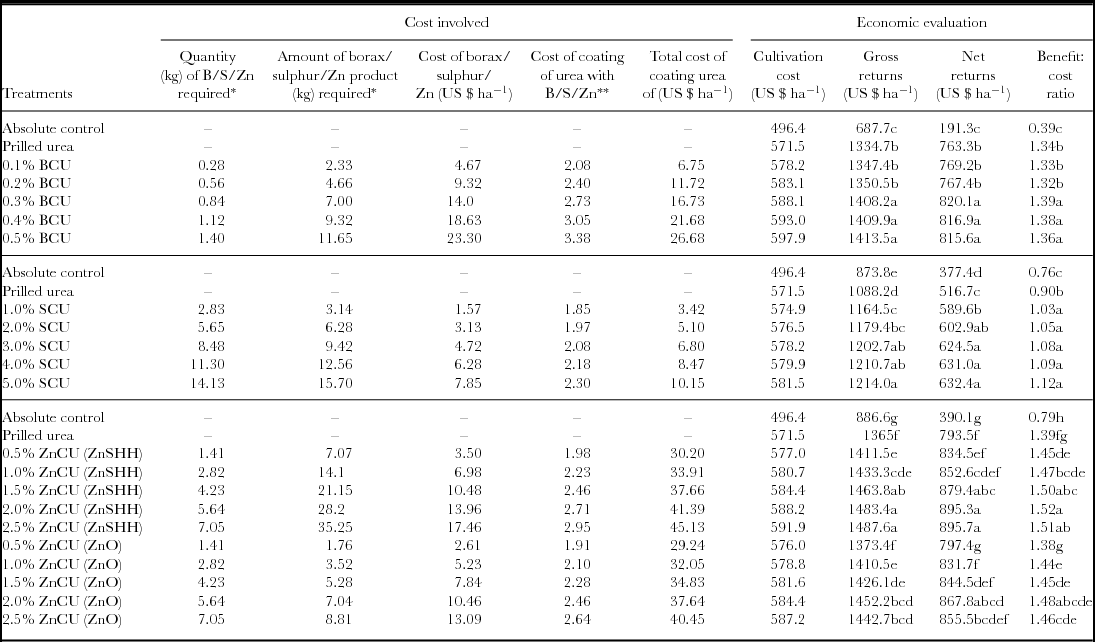
BCU with 0.1, 0.2, 0.3, 0.4 and 0.5% B coating onto PU was prepared in laboratory using borax (12% B) and 1:1 aqueous solution (water:gum) of gum–acacia as a sticker. Gum is natural plant origin adhesive material of Acacia tree. Boron coating of PU was done in lots of 5 kg PU in a manual rotating seed treatment drum. Five kg of PU was added to the drum then the required quantity of gum–acacia solution was added and the drum was rotated for 15 minutes to provide a fine coating of gum–acacia on urea prills. The required amount of borax was then added to the drum and the contents were thoroughly mixed by rotating the drum for 15 minutes. BCU was then transferred to plastic trays, which were dried overnight at room temperature (25 ± 5 °C) using air blowing fans. The amount of borax and gum–acacia required for 0.1, 0.2, 0.3, 0.4 and 0.5% coating onto 5 kg PU was 41.2, 82.4, 123.8, 164.9 and 206.1 g and 30, 40, 50, 60 and 70 g, respectively. SCU was prepared like BCU. The amount of sulphur (bentonite sulphur dust) required for 1, 2, 3, 4 and 5% coating onto 5 kg PU was 55.6, 111.1, 166.7, 222.2 and 277.8 g, respectively. Coating more than 5% S onto PU using the present technique was not possible. ZnCU was also prepared following the same procedure as for BCU. The amount of ZnSHH and ZnO required for 0.5, 1.0, 1.5, 2.0 and 2.5% Zn coating onto 5 kg PU was 125, 249, 374, 499 and 624 g and 31, 62, 93,125 and 156 g, respectively (Table 1). The quantity of gum–acacia needed was same as used in preparation of BCU. Coated urea was made about 3–4 days before application in the field. Total cost involved in coating of urea (cost of B/S/Zn + coating) based on prevailing prices (US $ ha−1) in the Indian market during the cropping season is given in Table 1.
Cost involved in the coating of boron, sulphur and zinc onto prilled urea and economic evaluation for one hectare maize crop. Means in a column with at least one letter common are not statistically significant using Fisher's least significant difference.

* For coating of 282.6 kg urea (kg ha−1); **At the rate of 7% of fertilizer prices (US $ ha−1)
Prevailing prices of fertilizer materials during 2013&14: (i) Borax (12% boron) at the rate of US $ 2.0 kg−1, (ii) Sulphur dust (90% S) at the rate of US $ 0.50 kg−1, (iii) ZnSO4.7H2O (20% Zn) at the rate of US $ 0.50 kg−1; (iv) ZnO (80% Zn) at the rate of US $1.49 kg−1, (v) Prilled urea at the rate of US $ 0.087 kg−1, (vi) Price of one US $ = 60.6 INR [Note: Prilled urea at the rate of US $ 883 tonne−1; US $ 24.97 for an application of 130 kg ha−1]
Yield attributes and yields
The crop was harvested when cob sheaths turned brownish and grains became hard. Five cobs were randomly selected from each plot during harvest and their length from base to tip of the cob was measured and the mean value was recorded. The cobs were harvested manually and grains were separated from cob by hand operated shelling machine. The total number of grains from the five cobs were counted and averaged out to get number of grains cob−1. The grains obtained from five cobs were weighed and averaged to compute grain weight cob−1. The border rows around the experimental plots were harvested first and the net area was harvested for yields. After separating from stalk and shelling of husk and silk, all the cobs from each plot were dried naturally and threshed by a mechanical thresher. The grain yield was adjusted to 15% moisture content and the stover yield was determined after air drying. Stover yield was obtained by subtracting grain yield from respective total biomass yield (grain + dry stover). Grain and stover yields were expressed in Mg ha−1. The cultivation cost and economics (US $ ha−1) of maize is shown in Table 1.
Chemical analysis of plant samples
Above ground maize samples (three plants per plot) were collected 10 days before harvesting and washed with tap water followed by dilute hydrochloric acid (0.05 N), deionized water and finally with double distilled water. The samples were dried in an oven at 60 ± 5 °C, separated into grain and stover, ground and sieved to pass 40 mesh sieve in a Macro–Wiley Mill. Three samples per plot were analysed for total N using a Kjeldahl digestion unit as described by Prasad et al. (Reference Prasad, Shivay, Kumar and Sharma2006). From each plot, 0.5 g dry matter samples of grain and stover were taken for Zn analysis. The Zn content in grain and stover was determined by wet digestion (di-acid digestion) procedure on an atomic absorption spectrophotometer (Prasad et al., Reference Prasad, Shivay, Kumar and Sharma2006). Finally, the uptake of N or Zn was determined by multiplying maize biomass (grain and stover) and N or Zn concentration in the respective parts. Total N or Zn uptake was calculated by summing up the two values, i.e., grain + stover uptake of N or Zn. N uptake (grain, stover and total) was calculated by using the following expression: N uptake (kg ha−1) in grain/stover = [% N in grain/stover × grain/stover biomass (kg ha−1)]; Total N uptake (kg ha−1) = N uptake in grain + N uptake in stover. The Zn uptake was also calculated following the same procedure as in N uptake.
Nitrogen use efficiencies
In general, four terms are used in relation to nitrogen use efficiency: Agronomic Efficiency (AEN), Recovery Efficiency (REN), Partial Factor Productivity of nitrogen (PFPN) and N Harvest Index (HIN). The following expressions were used to determine these efficiencies as suggested by Pooniya and Shivay (Reference Pooniya and Shivay2013):
 $$\begin{equation}
{\rm{A}}{{\rm{E}}_{\rm{N}}}({\rm{kg}}\;{\rm{grain}}\;{\rm{increased}}\,{\rm{per}}\,{\rm{kg}}\,{\rm{N}}\,{\rm{applied}}) = ({\rm{Yf}} - {\rm{Yc}})/{\rm{Na}}
\end{equation}$$
 $$\begin{equation}
{\rm{R}}{{\rm{E}}_{\rm{N}}}(\%\, {\rm{of}}\;{\rm{N}}\;{\rm{taken}}\,{\rm{up}}\,{\rm{by}}\,{\rm{a}}\,{\rm{crop}}) = [({\rm{NUf}} - {\rm{NUc}})/{\rm{Na]\,^{*}100}}
\end{equation}$$
 $$\begin{equation}
{\rm{PF}}{{\rm{P}}_{\rm{N}}}({\rm{kg}}\;{\rm{grain}}\;{\rm{per}}\,{\rm{kg}}\,{\rm{N}}\,{\rm{applied}}) = {\rm{Yf}}/{\rm{Na}}
\end{equation}$$
 $$\begin{equation}
{\rm{H}}{{\rm{I}}_{\rm{N}}}({\rm{Nitrogen}}\;{\rm{harvest}}\;{\rm{index}}\,{\rm{as}}\,\%) = ({\rm{NUg}}/{\rm{NUg}} + {\rm{s}})\,^{*}100
\end{equation}$$
Where, Yf and Yc are the yields (kg ha−1) in fertilized and control (no fertilizer) plots, respectively. NUf and NUc are the amounts of N taken up by a maize crop in fertilized and control plots, respectively and Na refers to the amount of N applied (kg ha−1). NUg and NUg + S are the amounts of N uptake in maize grain and grain + stover, respectively.
Statistical analysis
Analysis of variance (ANOVA) was done to determine treatment effects (Gomez and Gomez, Reference Gomez and Gomez1984). Fisher's least significant difference was used as a post hoc mean separation test (p < 0.05) using Proc GLM in SAS 9.3software. The Fisher's procedure was used when the ANOVA was significant.
RESULTS
Maize yield and its components
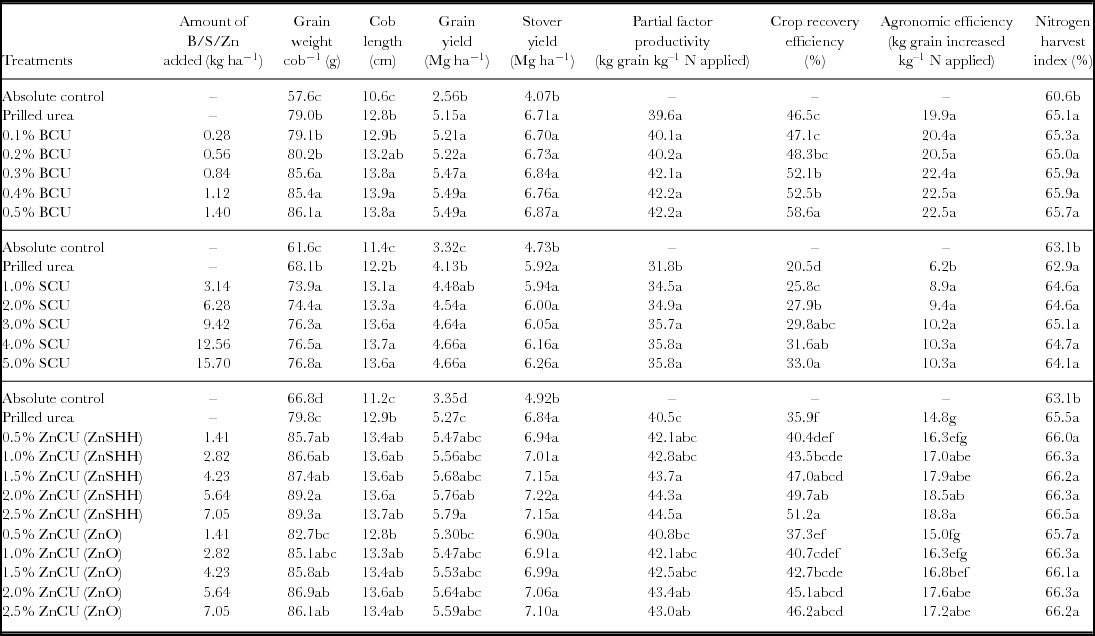
Application of uncoated PU significantly increased the yield attributes i.e., grain weight cob−1 and cob length over the absolute control (Table 2). Application of 0.5% BCU (supplying 1.4 kg B ha−1), 0.4% BCU (supplying 1.12 kg B ha−1) and 0.3% BCU (supplying 0.84 kg B ha−1) caused the highest grain weight cob−1 and cob length. SCU recorded significantly higher values for grain weight cob−1 and cob length over PU and absolute control, regardless SCU concentrations. Coating of urea with 2% and 2.5% ZnSHH produced significantly more grain weight cob−1 than 0.5% ZnO, PU and absolute control and was the similar in the other coating treatments. Cob length of ZnCU (ZnSHH and ZnO) treatments was very close to each other and significantly superior to the absolute control.
Effect of boron-coated urea, sulphur-coated urea and Zn-coated urea materials on yield attributes and nitrogen use efficiencies in maize. Means in a column with at least one letter common are not statistically significant using Fisher's least significant difference.

BCU did not increase the grain and stover yields significantly over PU (Table 2). However, the application of PU and BCU increased maize yield as compared to the absolute control. Application of 2 to 5% SCU increased grain yield significantly over PU. For stover yield, SCU and PU were similar and significantly higher than the absolute control (Table 2). Among the ZnCU treatments, 2.5% ZnSHH recorded the highest grain yield though it did not differ from the rest of the ZnCU treatments, with the exception of 0.5% ZnO and PU. Coating of urea with ZnSHH and ZnO and use of PU caused similar stover yields, which were significantly superior to absolute control (Table 2).
Nitrogen concentration and uptake
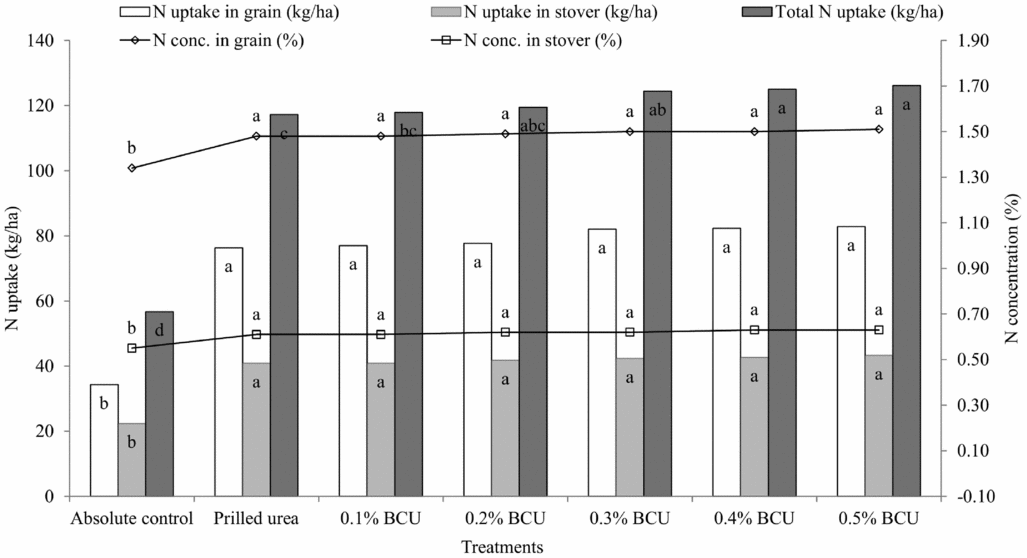
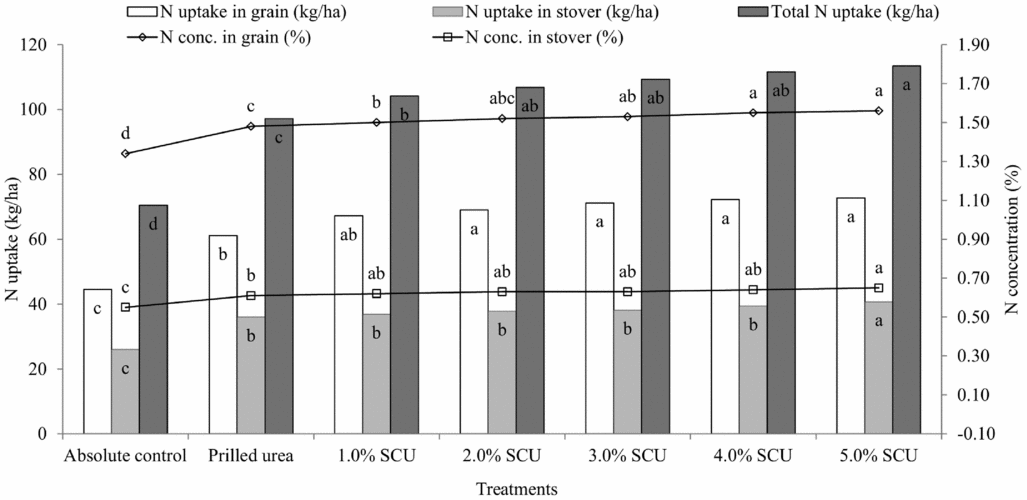
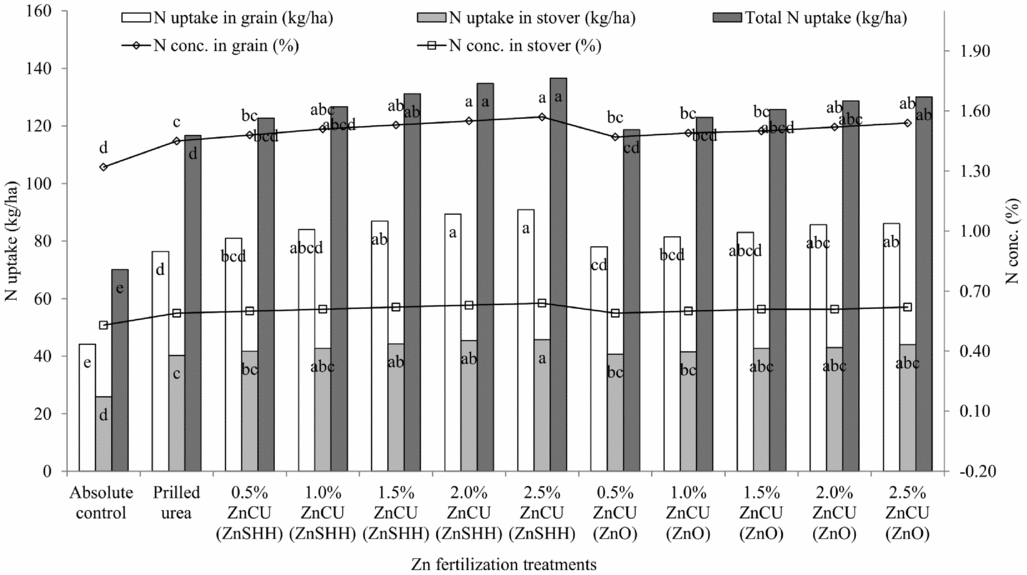
Increasing concentration of boron in BCU (0.1 to 0.5%) and PU improved N concentrations and uptake in grain and stover over absolute control (Figure 1). A significant increase in total N uptake (grain + stover) was recorded with 0.5% BCU over PU, 0.1% BCU and absolute control. On average, application of 0.5% BCU resulted in 7.6% higher total N uptake than the PU treatment (Figure 1). Application of 5% SCU significantly increased N concentration and uptake in grain as well as total N uptake compared to PU, 1% SCU and absolute control (Figure 2). Application of N as 2 or 2.5% ZnSHH registered the highest N concentrations and uptake in grains (Figure 3). Considering the stover, 2.5% ZnSHH gave the maximum N concentration and uptake closely followed by 2.0 or 1.5% ZnSHH or ZnO. Likewise, the highest total N uptake was recorded in 2.5% ZnSHH treatment (Figure 3). In the current study, total N uptake with 2.5% ZnSHH was enhanced by 14.6% over PU (Figure 3).
N concentration and uptake in maize as influenced by boron-coated urea. Means for each parameter with at least one letter common are not statistically significant using Fisher's least significant difference.

N concentration and uptake in maize as influenced by sulphur-coated urea. Means for each parameter with at least one letter common are not statistically significant using Fisher's least significant difference.

Effect of zinc-coated urea materials on N concentrations and uptake in maize. Means for each parameter with at least one letter common are not statistically significant using Fisher's least significant difference.

Zinc concentration and uptake
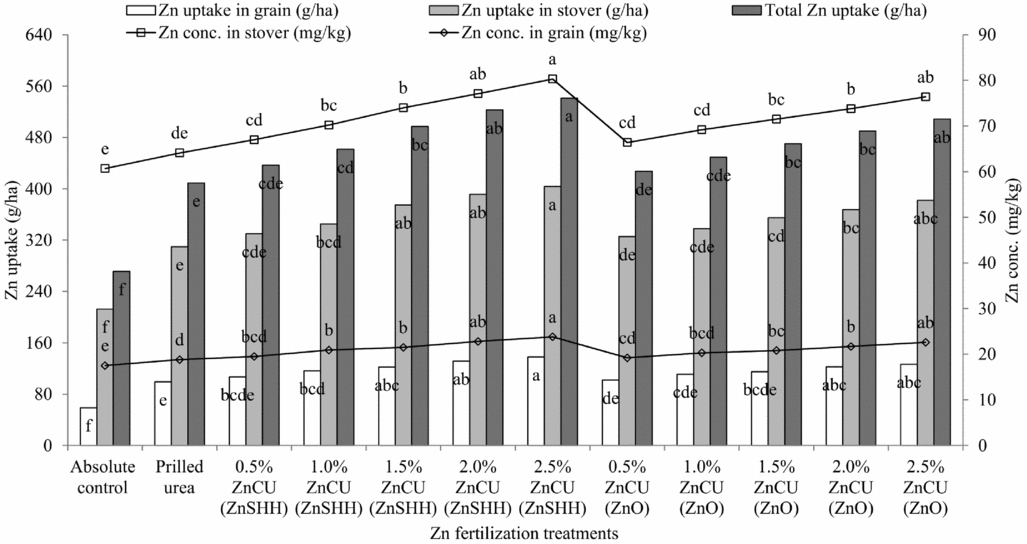
The highest Zn concentration and uptake by maize grain and stover was recorded with 2.5% ZnSHH closely followed by 2% ZnSHH and 2.5% ZnO (Figure 4). For total Zn uptake (grain + stover), 2.5% ZnSHH was also superior and remained on par with 2.0% ZnSHH and 2.5% ZnO treatments. Per cent increase in total Zn uptake with 2.5% ZnSHH was 26% over PU. In general, coating of PU with ZnSHH caused more benefits to Zn uptake than coating with ZnO.
Effect of zinc-coated urea materials on zinc concentrations and uptake in maize. Means for each parameter with at least one letter common are not statistically significant using Fisher's least significant difference.

Nitrogen use efficiency
BCU treatments (0.1–0.5%) did not differ significantly from PU with respect to PFPN and AEN (Table 2). The highest REN was found with 0.5% BCU and all BCU treatments were similar to PU with respect to HIN but significantly superior to the absolute control (Table 2). REN increased from 20.5% with PU to 33.0% with 5% SCU, while the highest HIN was similar in SCU treatments and PU (Table 2). With respect to PFPN, all SCU treatments recorded similar values, which were significantly higher than PU. SCU at 5% recorded significantly higher REN than PU, 1 and 2% SCU. All the SCU treatments were similar with respect to AEN but significantly superior to PU. Among ZnCU treatments, the highest PFPN was registered with 2.5% ZnSHH and it was equal to the rest of the treatments except 0.5% ZnO and PU (Table 2). REN and AEN also increased with 2.5% ZnSHH, but this treatment did not differ significantly of 2.0, 1.5% ZnSHH and 2.5, 2.0% ZnO treatments. On average, coating of urea with 2.5% ZnSHH increased the REN and AEN by 29.5 and 21.3% over PU. The coated urea materials, either with ZnSHH and ZnO, did not differ from each other with respect to HIN but were significantly superior to the absolute control (Table 2).
Economics
Total cost involved in coating of PU with boron ranged from US$6.75 for 0.1% BCU to US$26.7 for 0.5% BCU (Table 1). Among treatments, 0.5% BCU was the costliest cultivation treatment, which was 4.6% higher than the PU treatment (Table 1). Applications of 0.3, 0.4 and 0.5% BCU recorded significantly higher gross and net returns as well as benefit: cost ratio than the PU, 0.1% and 0.2% BCU.
The cost of sulphur required for 1% SCU was 6.25% of the cost of PU whereas for 5% SCU was 31.4%. The total cost of coating PU with sulphur ranged from US$3.42 for 1% SCU to US$10.2 for 5% SCU (Table 1). Data on economics of SCU showed that significant improvements in gross and net returns were obtained with 3, 4 or 5% SCU (Table 1). However, the benefit:cost ratio was similar among SCU treatments.
Input cost of 2.5% ZnSHH was US$17.5 and 2.5% ZnO US$13.1 per ha. Cost of urea coating with Zn ranged from US$1.98 to US$2.95 for ZnSHH and US$1.91 to US$2.64 per ha for ZnO. Thus, total cost involved in coating of PU with ZnSHH or ZnO varied from US$30.2 to 45.1 (0.5 to 2.5% ZnSHH coated urea) and US$29.2 to 40.5 (0.5 to 2.5% ZnO coated urea) ha−1 (Table 1). Economics of ZnCU revealed that significant improvement in gross and net returns was obtained when 2.5 or 2% ZnSHH was coated onto PU. However, a significant benefit:cost ratio was obtained with 2% ZnSHH (Table 1).
DISCUSSION
Boron-coated urea
BCU (0.1–0.5%) supplying 0.28–1.4 kg B ha−1 improved maize yield, N concentration and its uptake, as well as N use efficiencies (PFPN, REN, HIN and AEN) as compared to PU and control. However, the highest net returns and benefit:cost ratio occurred with 0.3–0.5% BCU (Table 1). The amount of B supplied by 0.3% BCU (0.84 kg B ha−1) is within the recommended range of 0.30 to 2 kg B ha−1 for B deficient Indian soils (Singh, Reference Singh1999). Our experiment also indicated that N concentration in both grain and stover of maize increased due to urea application whether with or without B, while total N uptake was significantly increased with 0.2–0.5% BCU (Figure 1). Accordingly, Singh (Reference Singh2013) reported that boron application helped in increasing uptake of N in cereal crops, indicating a positive interaction between B and N. Positive effects of B and N are likely associated with accumulation of metabolites in the reproductive organs, which would increase protein or carbohydrate synthesis and improve crop yield. Our data revealed that application of 0.5% BCU is a promising strategy for maize production in boron deficient soils, allowing farmers to apply boron to maize and other cereals along with nitrogen.
Sulphur-coated urea
Previously, SCU was evaluated mainly in rice and wheat crops to enhance efficiency of nitrogen fertilization but studies did not evaluate economic aspects of different graded levels. Combined use of N or sulphur through SCU in intensive cereal–cereal rotations will assure regular/controlled supply of sulphur in deficient soils. Response to nitrogen and sulphur in cereal crops have been reported by a number of researchers but the literature on response of SCU to maize is limited. There was a significant improvement in PFPN, REN and AEN with SCU as compared to PU (Table 2) and this is in accordance with earlier findings (Shivay et al., Reference Shivay, Pooniya, Prasad, Pal and Bansal2016). Nitrogen application through SCU might have increased N as well as S concentrations due to positive N × S interactions, which ultimately enhanced their uptake in grain and stover. Prasad (Reference Prasad2005) reported that heavy N fertilization depletes native S in intensive cereal-based rotations in Asian countries.
Herein, application of SCU not only improved S status of the soil but also increased maize productivity. The elemental sulphur is slightly costlier than calcium sulphate and phosphogypsum and for that reason coating of sulphur onto urea prills is an important strategy. Combined application of N and sulphur through 5% SCU (supplying 15.7 kg S ha−1, at an N application of 130 kg N ha−1) was adequate to bring out the benefits of sulphur supplying to the soil and to enhance maize productivity. Generally, the sulphur recommendation to cereals ranges from 10 to 40 kg ha−1 (Morris, Reference Morris, Tewatia, Choudhary and Kalwe2007), thus 5.0% SCU would help to meet the sulphur requirements in most situations and is also economically viable. The use of 5% SCU supplied ~45% crop sulphur needs and increased REN by 60% over PU (Table 2). Also, the highest net returns and benefit:cost ratio were found with 5% SCU.
Zinc-coated urea
Limited information is available on use of graded levels of Zn-enriched urea (ZnEU) and Zn-coated fertilizers (ZnSHH or ZnO) in maize. Small scale land holders of South Africa, Zimbabwe and other African countries are not using Zn fertilizers due to their poor socio-economic conditions and non-availability of Zn fertilizers (Prasad et al., Reference Prasad, Shivay and Kumar2014). However, soil Zn deficiency reduces plant performance and decreases crop productivity in countries such as India, Pakistan, Australia and China (Alloway, Reference Alloway2008b). Thus, ZnCU (ZnSHH or ZnO) has great potential for improving productivity and Zn concentrations in maize (Shivay and Prasad, Reference Shivay and Prasad2014) as well as its nutritional quality. In this study, Zn-coated fertilizers (2.0% or 2.5% ZnSHH) significantly improved grain yield of maize (Table 2) over absolute control (no N and no Zn) and control (only PU). A similar positive response of applied Zn has been reported by several workers in rice grown in Zn deficient soils of India (Pooniya and Shivay, Reference Pooniya and Shivay2013; Pooniya et al., Reference Pooniya, Shivay, Rana, Nain and Prasanna2012; Shivay et al., Reference Shivay, Kumar, Prasad and Ahlawat2008).
The 2.5% ZnSHH caused the highest total uptake of N and Zn, which was due to increased grain and stover yields and increased concentration therein (Figures 3 and 4). Synergistic interaction between Zn × N in soil is mainly attributed to an increased availability of Zn due to the acid forming effect of nitrogen (Prasad, Reference Prasad2006). Although Zn coating onto PU had same Zn concentration from different sources (ZnSHH and ZnO), the total uptake of Zn significantly differed between sources with the same level of N input. This might be because the mobility of Zn in soil differs among Zn sources, influencing Zn uptake. In fact, ZnSHH moves easier than the relatively water insoluble ZnO in soil, affecting Zn uptake in maize grain and stover (Pooniya et al., Reference Pooniya, Shivay, Rana, Nain and Prasanna2012).
ZnCU with 2.5% ZnSHH lead to the highest N concentration in maize and this can be explained due to an increase in N uptake through slow released of N from Zn-coated material (Mhaskar and Thorat, Reference Mhaskar and Thorat2005; Pooniya and Shivay, Reference Pooniya and Shivay2013). Pooniya and Shivay (Reference Pooniya and Shivay2013) also reported that soil Zn application either as ZnSO4 or ZnEU increased N concentrations and their uptake. The positive improvement in REN, AEN and PFPN with ZnCU over PU (Table 2) was due to the positive effect of applied ZnCU on maize yield and N uptake, leading to an increase in their use efficiency. Both 2.5 and 2% ZnSHH led to a respective significant enhancement in PFPN and AEN by 9.9 and 27.0% over PU plots owing to higher yield and total N uptake. In contrast, the low N use efficiencies of uncoated PU plots are attributed to more N losses through denitrification, leaching and runoff (Prasad, Reference Prasad2005) compared to ZnCU. An effort is therefore being made by the fertilizer industries in India to produce ZnEU/ZnCU, which would permit farmers to use Zn along with N where cereal–cereal rotation is common practice under Zn deficient conditions. From the manufacturer's viewpoint, ZnO is easier to coat because it forms a good emulsion with oil (Prasad et al., Reference Prasad, Shivay and Kumar2014). On the other hand, ZnSO4 is the most widely applied inorganic source of zinc for soil or foliar applications due to its higher solubility, low cost and easier availability in the market (http://www.zinc.org). Zn sources such as ZnO, Zn(OH)2 and ZnCO3 are ~105 times more soluble than soil Zn and therefore these products could be used as coating materials (Kiekens, Reference Kiekens and Alloway1995; Prasad et al., Reference Prasad, Shivay and Kumar2014). Although location specific recommendations are not available with respect to Zn application, this study suggests that ZnCU would be prescribed for soil application. Overall, 2.5% ZnCU (ZnSHH) is an economically feasible option to meet the Zn requirement and increase productivity over PU. However, 2.0% ZnCU (ZnSHH) is the best option for maximum benefit:cost ratio.
CONCLUSION
Our field study clearly demonstrated the beneficial effects of BCU, SCU and ZnCU on maize productivity and economic feasibility. From an economic point of view, 0.3% BCU, 5% SCU, 2% ZnCU (as ZnSHH) were the best choices for maximum benefits to the farmers. These are important findings for environmental sustainability since coating of urea presumably reduces N losses and increases N use efficiency in the Indo-Gangetic plains of Northern India.
Acknowledgements
The authors duly acknowledge the partial financial support received from the Matix Fertilisers and Chemicals Limited (MFCL), Mumbai, Maharashtra, India. Our sincere thanks are due to Director, Joint Director Research and Head, Division of Agronomy, Indian Agricultural Research Institute, New Delhi for their advice and support.