International trade flows prior to the First World War were unprecedented for their time, and yet were unable to preclude such a destructive conflict from taking place, contrary to the expectations of liberals who posit the peace through trade hypothesis. The failure of economic ties to prevent the First World War has important implications for the contemporary period, which at first glance looks quite similar to the pre-First World War period with record flows of trade and investment across countries and with almost universally decreasing levels of protectionism.Footnote 1 While Russett and Oneal note that the pacifying effect of trade alone could not be expected to counterbalance the effects of alliance systems, weak international organizations and lack of democratic regimes in the period leading up to the First World War,Footnote 2 this similarity across epochs nonetheless suggests an unsettling question: is the relatively peaceful, globalized international system today just as tenuous as that of the early twentieth century?
Yet there is an important distinction between the international trade environment today and that just prior to the onset of the First World War. Findlay and O'Rourke refer to the period between 1780 and 1914 as the ‘Great Specialization’,Footnote 3 a time in which the industrial revolution combined with rapid and sharp decreases in transportation costs spurred trade of manufactured goods from Europe and North America in exchange for agricultural commodities and raw resources from the undeveloped global periphery – a global system created and maintained by military force.Footnote 4 Although a great deal of this inter-industry trade persists today, it exists along with a growing volume of intra-industry trade, or international trade of the same or similar commodities, in which foreign and domestic brands compete openly.Footnote 5 Intra-industry trade has expanded considerably in the period since the Second World WarFootnote 6 and now accounts for the majority of total international trade – between 55 per cent and 75 per cent according to Milner.Footnote 7
In this article, we present a new theory regarding the relationships between trade, development and conflict. We argue that intra-industry trade, but not inter-industry trade, is associated with lower levels of dyadic conflict. Indeed, existing theories of trade and conflict utilize classical trade models that ignore even the potential for intra-industry trade to exist because they are based on the theory of comparative advantage. Conversely, Krugman's reformulation of trade theory explains intra-industry trade as resulting from the mutually reinforcing phenomena of economies of scale and the public's demand for both foreign and domestic varieties of a given product.Footnote 8 We demonstrate that distinguishing between intra-industry and inter-industry trade has consequences for our understanding of the relationship between trade and conflict, and specifically for clearing up ambiguities in extant theoretical expectations. Our argument has important policy implications for the prospects for peace between trading states, particularly, peace between developed states and emerging powers such as China – and with Russia, a relatively developed state that depends primarily on inter-industry trade.
We proceed with a discussion of the existing literature linking development and trade to conflict. As we demonstrate, most of the prevailing theoretical approaches to this relationship are rooted in classical models of trade. We then introduce the distinction between intra-industry and inter-industry trade and its theoretical relationship to development and conflict. We present three hypotheses that link intra-industry trade to peace, while carefully distinguishing its effects from inter-industry trade and development. We find support for these three hypotheses in empirical tests using logit models in a sample of dyad years from 1963 to 2001. Finally, we conclude with a discussion of the implications of our findings for future research on trade and conflict.
Development, Trade and Conflict
The connection between development and conflict has drawn significant attention in the literature. This discussion is often depicted as a theoretical battle between realists and liberals, as has often been the case in the literature on interdependence and conflict.Footnote 9 Rather than revisit this debate at a theoretical level, which previous studies have accomplished, we focus on work that has proven directly relevant to empirical contributions examining the relationship between development, trade, and conflict.Footnote 10
Rosecrance's idealized depiction of states choosing to interact in the trading or military-political worlds highlights the importance of development in the possibilities available to contemporary states.Footnote 11 Development affects four key variables that are crucial to a state's choice in this framework: it increases the gains from trade, it increases both the economic and political costs of war, and it decreases the benefits of conquest relative to trade. Overall, Rosecrance suggests that as states develop economically, they are much more likely to opt for the trading world rather than the military-political world. Drawing upon Rosecrance's logic, Hegre tests prevailing claims in the literature concerning the relationship between interdependence, development and conflict.Footnote 12 Hegre finds that trade and development both significantly reduce the occurrence of fatal militarized interstate disputes (MIDs). Additionally, an interaction term also demonstrates that the pacifying effect of trade increases with the level of economic development. This empirical support for Rosecrance's suggestion that development would lead to a peaceful world of trading states has also been explored from other perspectives relying on different underlying mechanisms.Footnote 13
Gartzke attempts to take this work one step further in his development of an argument for a ‘capitalist peace’ as an alternative to the democratic peace.Footnote 14 He argues that economic development, financial markets and monetary policy co-ordination are much more likely to achieve that goal. Similarly to Rosecrance and Hegre, Gartzke suggests that development has altered state preferences away from conquest and towards trade, since modern production processes ‘de-emphasize land, minerals, and rooted labor in favor of intellectual and financial capital.’Footnote 15 Thus, Gartzke also implicitly posits a conditional relationship between development and trade.Footnote 16
We believe that the aforementioned empirical studies have demonstrated an important boundary condition on the relationship between trade and conflict, heeding calls for greater nuance in the literature.Footnote 17 While building on the importance of development in conditioning the effect of trade on conflict, we also suggest the need to reconsider the prevailing approach that treats all trade as equivalent in its impact on conflict. We are certainly not the first to make this claim, as scholars have previously debated the potential theoretical effects of strategic vs. nonstrategic goods on conflict.Footnote 18
Yet, as Dorussen demonstrates, very few have actually disaggregated trade flows for empirical analysis.Footnote 19 Park, Abolfathi and Ward and Polachek focus on the effects of trade in oil, Gasiorowski and Polachek differentiate between agriculture and manufactured goods in trade between the United States and the Warsaw Pact countries, Polachek and McDonald differentiate manufactures and raw materials in analysing the sources of conflict, and Reuveny and Kang and Reuveny and Li analyse nine categories of commodity goods, though at a high level of aggregation.Footnote 20 Dorussen himself distinguishes between manufactured and non-manufactured goods, which he then decomposes into ten sub-categories.Footnote 21 He finds that trade in manufactured goods significantly reduces conflict, while non-manufactured goods do not; even as aggregate measures of trade retain their overall pacifying effect. We believe these efforts to disaggregate trade are a move in the right direction, though we suggest that the key distinction is between intra-industry and inter-industry trade. In fact, Dorussen's finding that manufactured goods reduce conflict may simply be an artefact of the effect of intra-industry trade.Footnote 22
Peace through Intra-Industry Trade
We contend that existing theoretical models of trade and conflict are inherently limited. The economic foundations of these models typically ignore the potential for states to engage in intra-industry trade, and thus examine contemporary conflict using nineteenth-century trade models that only capture a small fraction of late twentieth and early twenty-first century trade. Specifically, theories of trade and conflict typically utilize classical economic models in which trade gains arise from inter-industry specialization and exchange.Footnote 23 Importantly, political scientists note the potentially crosscutting influence that this specialization may have on states’ propensities for conflict. Specifically, although trade gains resulting from inter-industry specialization are an opportunity cost to conflict, given that trade terminates with conflict onset,Footnote 24 inter-industry specialization may lead states to forgo domestic production of strategic goods, rendering them dependent on trade partners, who may then use this dependence as political leverage.Footnote 25
As stated above, extant models do not well account for the rise of intra-industry trade, in which countries exchange similar goods – evident, for example, in the availability in the United States of cars from Japan, Germany, Sweden, South Korea and elsewhere, along with domestic brands.Footnote 26 Krugman contends that consumer demand for variety, in conjunction with the existence of increasing returns to scale, both of which are ignored in classical economic models, facilitates intra-industry specialization.Footnote 27 Intra-industry trade is characterized by monopolistic competition, in which there are fewer firms with more market power than under perfect competition, and in which commodities tend to be differentiated rather than homogenous.
Krugman's model has important implications for political scientists, who focus on the political costs as well as the economic benefits associated with trade. By highlighting the distinction between intra-industry trade and inter-industry trade, we reassess the traditional arguments connecting trade to conflict, suggesting a redefinition of terms such as ‘vulnerability’ that are inherent in the literature. We contend that intra-industry trade is qualitatively distinct from inter-industry trade because the former does not entail the same strategic dependencies that are often inherent in the latter. First, termination of intra-industry trade results only in the loss of goods for which domestic substitutes are easily available. Yet, because intra-industry trade tends to consist primarily of trade in differentiated goods, the termination of this trade would deprive both trade partners of the variety that consumers demand.Footnote 28 Consumers and firms within both states benefit from intra-industry trade, and while termination of trade would not be likely to impose high – or, importantly, asymmetric – costs on former trade partners, both sides have an incentive to retain the benefits associated with participation in global markets. While this is not ‘vulnerability’ as defined by Keohane and Nye, because states do not depend on trade partners for strategic commodities, there is nonetheless considerable and symmetric political pressure within states to maintain these global trade ties.Footnote 29 Conversely, inter-industry trade is a double-edged sword because it may be leveraged as political power, if, for example, trade partners face unequal costs associated with terminating trade, as Keohane and Nye demonstrate with the case of the United States and Japan prior to the Second World War.Footnote 30
Secondly, inter-industry trade may be less stable due to the typically smaller trade gains and higher asset specificity associated with the export of primary commodities relative to manufactured commodities, which may contribute to dependence of primary products-exporting states on their manufactures exporting trade partners.Footnote 31 Inter-industry trade (at least in one direction) typically consists of trade in homogeneous goods, such as oil, which, by definition, can be obtained from any state exporting that good. For example, cutting off trade in oil may simply result in a reshaping of trade patterns, as the price of the former oil exporter's oil should decrease while the price of oil in the importing country increases, leading third parties to fill the vacuum of lost dyadic trade.Footnote 32
Thirdly, intra-industry trade often conveys one additional benefit typically absent from inter-industry trade: mutual brand recognition. Proponents of the Kantian peace claim that trade reduces conflict by rendering nations members of global communities, facilitating information exchange and communication.Footnote 33 Yet the flow of a homogeneous, non-branded commodity like oil into the United States probably does little to improve citizen views of Saudi Arabians or Venezuelans.Footnote 34 Conversely, the flow of BMWs may indeed improve American citizens’ views of Germans, facilitating an interest in intercultural exchange. Importantly, the bilateral exchange of brands is possible only within intra-industry trade. American goods flowing into raw resource exporting states may result in resentment as well as unilateral brand recognition, potentially fostering backlashes against globalization, and, ultimately, contributing to an ambiguous impact of inter-industry trade on dyadic conflict.Footnote 35
Finally, it is important to note that intra-industry trade tends to correlate with low trade barriers. McDonald suggests that free trade is necessary for trade to promote peace, because protectionism empowers domestic actors who tend to support conflict.Footnote 36 As such, there is potential for spurious correlation in which intra-industry trade appears pacifying only because it typically enjoys low trade barriers. However, there are two defences of the pacifying role of intra-industry trade with regard to the previously identified role of liberalization. First, conventional wisdom suggests that intra-industry trade promotes liberalization because domestic actors are not harmed as much by the removal of trade barriers.Footnote 37 Indeed, high levels of bilateral intra-industry trade may signal that liberalization is feasible, given that it suggests, all else equal, relatively similar factor endowments among trade partners.Footnote 38 If one state has a considerable productivity advantage over another, even for commodities in which consumer tastes vary, the less productive firms may lobby their government for protectionism, as did the American automotive firms in the 1980s when facing superior Japanese competitors.Footnote 39 Given that differential productivity tends to lead to comparative advantage (and therefore, to inter-industry trade) in the absence of this protectionism, the existence of intra-industry trade suggests that these conditions – possibly promoting both protectionism and militarized conflict – are absent. As such, this beneficial aspect of the commercial peace may be enabled – perhaps even dependent – on the existence of intra-industry trade.
Secondly, protectionism has been employed by states in a manner that led to increased or maintained levels of intra-industry trade, which we suggest has made peace more durable.Footnote 40 Most notably in recent years, developing countries have raised tariffs in ‘infant industries’ until these industries matured. For example, South Korea initially enacted tariffs to protect its infant auto industry, and later lowered these barriers to engage in global competition. As such, South Korea (like Japan before it) joined the ranks of developed states and began to engage in considerable intra-industry trade, enjoying peaceful relations with its trade partners.
In short, intra-industry trade serves to reduce conflict because the pacifying elements of trade (i.e. trade gains that function either as an opportunity cost to conflict or to facilitate information flow, communication and intercultural exchange) remain while its potentially aggravating impact (i.e. the incentive to use trade as leverage in bargaining, the fear of coercion thereof, and potential resentment stemming from seemingly ‘neocolonial’ trade in which primary commodity exporting countries are vulnerable to exporters of manufactured goods) disappears. This argument leads to our first hypothesis:
HYPOTHESIS 1: Higher intra-industry trade is associated with a lower likelihood of dyadic conflict.
It is impossible to disentangle intra-industry trade from development completely. Studies have shown that bilateral intra-industry trade is more likely as both states have higher gross domestic product (GDP) and when GDP per capita is similar.Footnote 41 It tends to be richer states in which consumers develop varied tastes (and are not preoccupied merely with survival), while similarly large economies suggest convergence in relative factor endowment, typically towards capital abundance. Krugman's model cites these consequences of increased wealth as necessary for the growth of intra-industry trade. However, we contend that although development (i.e., relatively high GDP per capita) may be necessary, it is not sufficient to facilitate intra-industry trade – hence the rather modest correlation of 0.34 between our intra-industry trade variable and (the natural log of) GDP per capita in our data. For example, Russia is a relatively developed state, yet its exports consist mainly of primary commodities (fuels, timber, metals, etc.), while its main imports are manufactured goods.
Prior work suggests that development and trade together reduce the likelihood of dyadic conflict.Footnote 42 However, we contend that development and overall trade interaction have an ambiguous influence on conflict, both separately and interactively. This ambiguity stems from synthesizing arguments regarding the costs of conquest relative to trade with Keohane and Nye's argument regarding vulnerabilities inherent in trade.Footnote 43 First, given that inter-industry trade may have as a consequence strategic dependence and vulnerability as well as trade gains, we expect these crosscutting influences to lead to an uncertain impact of overall trade on conflict when we control for intra-industry trade.Footnote 44
Similarly, Rosecrance's contention that development secures the ability to gain without resorting to conquest while simultaneously increasing the costs of conflict must be balanced against Liberman's similarly reasonable argument that development raises the benefits as well as the costs of (attempted) conquest.Footnote 45 Liberman provides the classic example: Hitler was able to employ the subjugated, developed economies in Europe for his military aims, suggesting that the added costs of invading developed states seem to be outweighed, at least under certain circumstances, by the benefits thereof. Taken together, these arguments suggest crosscutting influences of development, some pacifying and some aggravating. We contend that these forces will cancel out in the aggregate, leading to an unclear impact of development.Footnote 46 However, the exclusion in existing studies of intra-industry trade, a pacifying force, may cause omitted variable bias in which development appears pacifying. We argue that development is pacifying only when intra-industry trade accompanies it. These expectations lead to Hypothesis 2 and 3:Footnote 47
HYPOTHESIS 2: There is no relationship between the extent of overall trade interaction and dyadic conflict, regardless of development, when controlling for intra-industry trade.
HYPOTHESIS 3: There is no relationship between development and dyadic conflict in the absence of intra-industry trade.
Research Design
We test our hypotheses using a sample of dyad years spanning from 1963 to 2001. This relatively short time-span (for a trade and conflict study) follows because our sample is truncated on the left due to the availability of commodity-level trade data, and to the right by the availability of conflict data. We use logit analyses for all presented models, clustering standard errors on the dyad to account for non-independence by country pairs. Furthermore, we lag most independent variables by one year to mitigate simultaneity bias, crucially important in studies of trade and conflict, given the propensity for conflict to reduce trade.Footnote 48 Finally, we correct for duration dependence by including variables for peace years, peace years squared and peace years cubed.Footnote 49 All models are estimated using Stata version 11.
Following recent literature on trade and conflict, our dependent variable is fatal MID onset, a binary variable taking the value of 1 for all dyad years in which one dyad member uses force against the other, with the consequence that there is at least one fatality on either side.Footnote 50 If there are multiple MIDs in a given year, our dependent variable equals 1 if any of them result in battle deaths. We code this variable using the Correlates of War (COW) 3.1 dyadic MID dataset.Footnote 51 We focus specifically on fatal MIDs, rather than any MID, in order to exclude relatively common, but arguably not meaningful minor instances of militarized conflict, such as the seizure of commercial vessels, which are typically released with minor repercussions.Footnote 52 Additionally, this modelling choice facilitates comparison of results with Hegre and Hegre et al., who also use this dependent variable.Footnote 53
Operationalizing Intra-Industry Trade
Our primary explanatory variable captures the extent of intra-industry trade within dyads. We capture intra-industry trade using commodity-level dyadic trade data from Feenstra et al.Footnote 54 These data capture commodity flows from exporter to importer at a reasonably disaggregated level, spanning 1962 to 2000. We construct a bilateral measure of intra-industry trade using a procedure developed by Bergstrand.Footnote 55 This index conveys the proportion of dyadic trade of a given commodity that can be considered intra-industry, controlling for multilateral trade imbalances of each dyad member. The commodity-level measure is constructed as follows:
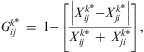 $${G_{{ij}}^{{k^{\rm{\ast}}}} \, = \,{\rm{1 - }}\left[ {\frac{{\left| {X_{{ij}}^{{k^{\rm{\ast}}}} {\rm{ - }}X_{{ji}}^{{k^{\rm{\ast}}}} } \right|}}{{X_{{ij}}^{{k^{\rm{\ast}}}} \, + \,X_{{ji}}^{{k^{\rm{\ast}}}} }}} \right]},$$
where  $X_{{ij}}^{{k^{\ast} }} $ is the value of exports from country i to country j (or, conversely, imports of j from i) of commodity k, weighted by each state's trade balance; and
 $X_{{ji}}^{{k^{\ast} }} $ is the value of exports from country j to country i (or imports of i from j) of commodity k, weighted by each state's trade balance. The trade-balanced values are calculated as:
 $${X_{{ij}}^{{k^{\rm{\ast}}}} \, = \,\frac{{\rm{1}}}{{\rm{2}}}\left[ {\frac{{\left( {{{X}_i}\, + \,{{M}_i}} \right)}}{{{\rm{2}}{{{\rm{X}}}_i}}}\, + \,\frac{{\left( {{{X}_j}\, + \,{{M}_j}} \right)}}{{{\rm{2}}{{{\rm{M}}}_j}}}} \right] \ast X_{{ij}}^{k}, }$$
and
 $${X_{{ji}}^{{k^{\rm{\ast}}}} \, = \,\frac{{\rm{1}}}{{\rm{2}}}\left[ {\frac{{\left( {{{X}_j}\, + \,{{M}_j}} \right)}}{{{\rm{2}}{{{\rm{X}}}_j}}}\, + \,\frac{{\left( {{{X}_i}\, + \,{{M}_i}} \right)}}{{{\rm{2}}{{{\rm{M}}}_i}}}} \right] \ast X_{{ji}}^{k} }$$
where Xi and Mi are country i's exports and imports, respectively; Xj and Mj are country j's exports and imports, respectively;  ${X_{{ij}}^{k} }$ is the value of exports from country i to country j in commodity k; and
 ${X_{{ji}}^{k} }$ is the value of exports from country j to country i in commodity k.Footnote 56
To create a single measure for a given dyad-year, we take the weighted average of each commodity-level measure with respect to the proportion of dyadic trade comprised by the given commodity, as follows:
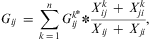 $${{{G}_{ij}}\, = \,\mathop{\sum}\limits_{k\, = \,{\rm{1}}}^n {G_{{ij}}^{{k^{\rm{\ast}}}} \ast \frac{{X_{{ij}}^{k} \, + \,X_{{ji}}^{k} }}{{{{X}_{ij}}\, + \,{{X}_{ji}}}}} },$$
where Xij is the value of exports from i to j across all commodities; and Xji is the value of exports from j to i across all commodities. Our final measure varies from 0 to 1, where 0 represents no intra-industry trade and 1 signifies that all trade within the dyad is intra-industry trade, controlling for trade imbalances.Footnote 57 For example, if, within a dyad ij, the i-to-j flows equal j-to-i flows, and both states have balanced multilateral trade (i.e. their total exports equal total imports) then the index will equal 1.Footnote 58 Although this measure is reasonably straightforward, there are nonetheless (at least) two important conceptual problems to overcome when utilizing measures of intra-industry trade. We turn now to each of these issues.
The aggregation problem: What is an ‘industry'?
There are theoretical and practical concerns involved in determining the appropriate level of aggregation at which to construct the intra-industry trade index. Grimwade shows that measures of intra-industry trade can vary dramatically when using different levels of aggregation.Footnote 59 As such, it is vital to capture intra-industry trade consistent with theoretical expectations. Krugman's new trade theory suggests that (horizontal) intra-industry trade follows from consumer tastes for variety. In other words, an ‘industry’ can be defined as a group of trade goods that can generally be considered substitutes by consumers (a group in which we include firms as well as individuals). However, this theoretical concern must be balanced against a more practical concern, given the scarcity of data available at various commodity levels.
In a recent study, Kono discusses the aggregation problem, arguing that the Harmonized Schedule (HS) six-digit level of aggregation is superior to the Standard Industrial Classification (SIC) four-digit level, showing that the latter groups together many goods that should not be considered substitutes – for example, passenger vehicles, vehicles for the transportation of goods, and industrial machinery like concrete mixers (among others).Footnote 60 Kono uses data from the United Nations’ COMTRADE database, however, the availability of which is limited.Footnote 61
We contend that the data from Feenstra et al. at the Standard International Trade Classification (SITC) four-digit level satisfy both the theoretical and practical concerns associated with constructing a valid measure of intra-industry trade.Footnote 62 First, this level of disaggregation separates distinct goods (from the perspective of consumers), for example, passenger cars, motor-cycles, and industrial vehicles, similar to the HS six-digit level data employed by Kono.Footnote 63 Secondly, these data are available for a wide array of dyads over the entire range between 1962 and 2000.
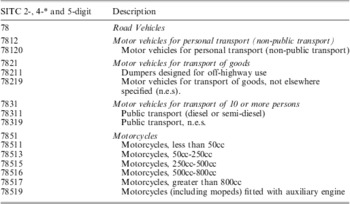
To illustrate the usefulness of Feenstra et al.'s data, Table 1 presents an example of commodity aggregation by SITC two-, four- and five-digit levels. The table shows that, at the SITC two-digit level, all road vehicles are aggregated into one category. Any measure of intra-industry trade obtained using data aggregated to this level may be severely problematic.Footnote 64 Conversely, the SITC four-digit level separates out passenger vehicles from public transport, goods transport, and motorcycles, which we argue is most useful for this analysis. As Table 1 shows, moving to the SITC five-digit classification does not necessarily add significant and useful disaggregation. For example, SITC four-digit code 7812: Motor vehicles for personal transportation (non-public transportation), is already at its most disaggregated level.Footnote 65 Also, while SITC four-digit code 7851: Motorcycles, does expand into six less-aggregated categories, these categories represent engine size (e.g., 50cc–250cc, 250cc–500cc, etc.) and arguably may be too disaggregated if one's goal is to capture consumer substitutes in accordance with Krugman's conception of intra-industry trade, given that a typical consumer planning to purchase a motorcycle may consider a variety of models, both foreign and domestic, with varying engine power.
Aggregation by SITC Commodity Codes

*Used in this study.
Horizontal v. vertical intra-industry trade
The second conceptual and empirical consideration regarding the construction of a useful intra-industry trade measure is the decision whether to include ‘vertical’ intra-industry trade or ‘intra-firm’ trade in our measure of intra-industry trade.Footnote 66 First, vertical intra-industry trade suggests a situation in which one state imports a component for some good from a given trade partner and then exports the finished good back to that same trade partner.Footnote 67 Once again, the American automotive industry provides fertile grounds for illustrating this concept. For example, Ford F-150 s are built in Claycomo, Missouri, and Dearborn, Michigan, and yet these vehicles contain up to 25 per cent foreign parts as of 2009. If the countries from which Ford imports these parts threaten to terminate trade with the United States, Ford would be forced to find alternative sellers or produce the parts domestically, in either case most likely resulting in higher prices for Ford trucks.Footnote 68 Although, in this example, damage to the United States would probably not be catastrophic, there remains a significant (if varying by commodity) exit cost associated with vertical intra-industry trade, as with inter-industry trade. When this cost is high, trade is most likely to have crosscutting effects on the stability of peace.
Furthermore, we conceptualize the pacifying effect of intra-industry trade in terms of horizontal flows of commodities, from which states receive mutual benefit from the availability of a wide array of alternative goods. In this sense, vertical intra-industry trade does not fit our conceptualization of pacifying ‘brand-trading’. In fact, Blanes and Martin refer to growth in vertical intra-industry trade as a return to comparative advantage as a trading model, implying a return to the crosscutting influence of opportunity cost and vulnerability inherent therein.Footnote 69 As such, we exclude vertical intra-industry trade from our measure, as it is better grouped with inter-industry trade in terms of its effects on state behaviour.
Intertwined with the concept of vertical intra-industry trade is intra-firm trade. Although intra-firm trade can consist of horizontal intra-industry trade (and is included in our measure when it does), it is most often composed of vertical intra-industry trade wherein, for example, foreign intermediate goods are imported and final goods exported. Globalized corporations, therefore, stand to benefit from peace between states, which facilitates their international business models. Nonetheless, while intra-firm trade almost certainly binds the interests of a given firm, it may not ultimately pacify governments. This mutually beneficial relationship may secure peace, at least conditionally, yet there remains an incentive for states to use asymmetric vulnerability as leverage, particularly during recessions or after economic shocks. As such, even intra-firm trade is often more similar to inter-industry trade than it is to horizontal intra-industry trade. Ultimately, vertical intra-industry trade and intra-firm trade, while important facets of globalization, are distinct from trade of substitute goods, and as such, do not confer the same pacifying influence as that we ascribe to horizontal intra-industry trade.
Other Primary Explanatory Variables
To assess the importance of intra-industry trade, we code variables for development and trade interaction, using data from Gleditsch.Footnote 70 First, we code lower development within the dyad as the lower of the two states’ (logged) GDP per capita. We rescale lower development such that its minimum value equals zero. We code lower dependence as dyadic trade flow divided by the lower of the two states’ GDP.Footnote 71Lower dependence captures the importance of dyadic trade to state income, arguably the most important concern of the state itself.Footnote 72
Given that the intra-industry trade index captures the percentage of dyadic trade that is intra-industry rather than the importance of intra-industry trade to each state's economy, we run robustness checks in which we include an interaction term for lower dependence × intra-industry trade in order to determine whether a high proportion of intra-industry trade is pacifying regardless of trade volume. It may be that a small volume of trade that is entirely intra-industry is more pacifying than a very large volume of trade that is primarily inter-industry, even if the monetary value of intra-industry trade is identical in these cases. This logic follows because large flows of inter-industry trade, through their crosscutting effect on conflict, could introduce additional error to the relationship between trade and fatal MID onset. Finally, in order to account for the potentially conditional relationship between intra-industry trade and development, we present a model in which we include an interaction term for intra-industry trade × lower development.
Control Variables
We control for the common correlates of conflict. Additionally, we select control variables similar to those used by Hegre and Hegre et al. in order to facilitate comparison of results.Footnote 73 Broadly, our control variables capture relative democratization within the dyad, relative power, as well as the opportunity and willingness for conflict.
First, we code two dummy variables to gauge the relative level of democracy within the dyad. Specifically, we code a variable for both autocratic, which equals 1 when both states score lower than 5 on the Polity IV project's Polity 2 variable.Footnote 74Both democratic takes the value of 1 when both states score at least a 5 on the Polity 2 variable.
We also include several control variables from Hegre et al.Footnote 75 First, we include a dummy variable for contiguity, as well as a variable for (the natural log of) distance. We capture the existence of a dyadic alliance using the Alliance Treaty Obligations and Provisions (ATOP) data.Footnote 76 Finally, we code two variables of capability using the Composite Index of National Capabilities (CINC) from EUGene: the higher capability score within the dyad, and relative capabilities, defined as the CINC score of the more powerful state divided by the sum of both dyad members’ CINC scores.Footnote 77
Analysis
We find support for our hypotheses that intra-industry trade is associated with peace within dyads, while overall trade interaction has an ambiguous effect. We also find that development and intra-industry trade are jointly necessary to secure a pacifying influence. Finally, we show that development, absent intra-industry trade, is not associated with a lower likelihood of fatal conflicts.
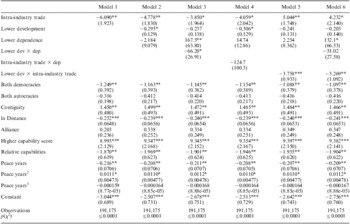
Table 2 presents the results for Models 1 through 6, assessing Hypothesis 1, 2 and 3, controlling for several specifications of trade extent and development. Model 1 includes only the intra-industry trade index, in order to demonstrate its impact absent any trade extent or development variables that might conceivably be correlated with it.Footnote 78 Model 2 includes lower dependence and lower development, while Model 3 also includes the interaction of lower development and lower dependence. Model 4 includes an interaction between intra-industry trade and lower dependence to address whether the impact of intra-industry trade depends on the degree to which states’ economies depend on it, while Models 5 and 6 include an interaction between intra-industry trade and lower development to determine whether these variables are jointly necessary to promote peace.
Intra-Industry Trade and the Onset of Fatal MIDs

Notes: Robust standard errors in parentheses. ***p < 0.001, **p < 0.01, *p < 0.05; two-tailed test.
In Models 1 through 4, the coefficient for intra-industry trade is negative and significant, suggesting that higher intra-industry trade is associated with lower likelihood of fatal MID onset. Substantively, an increase in intra-industry trade from one standard deviation below the mean to one standard deviation above, while holding all other variables at their medians, is associated with a 32 per cent decrease in the probability of fatal MID onset.Footnote 79Lower development is likewise negative and significant in Model 2, suggesting that development appears to have some pacifying effect when simply controlling for intra-industry trade. Model 3, in which lower development and lower dependence are interacted, suggests that lower development is not pacifying in the absence of trade interaction and that trade interaction is aggravating in the absence of joint development. However, the negative and significant interaction term suggests that both of these effects become more pacifying as the other is held at higher levels.Footnote 80 Hegre finds similar results: that trade dependence can have aggravating or pacifying effects depending on the level of joint development within dyads.Footnote 81
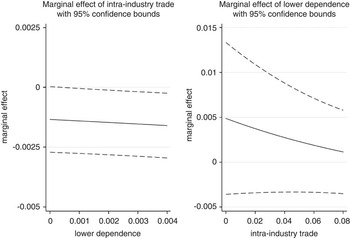
Because Models 1 through 3 include the intra-industry trade index without reference to the salience of intra-industry trade to each state's economy, we present Model 4, including an interaction term for intra-industry trade × lower dependence. In this model, only intra-industry trade retains significance. The coefficient for lower dependence is not significant (p ≤ 0.252), suggesting that trade interaction is not pacifying when the dyad engages in no intra-industry trade. The interaction term is negative, but not significant at the 0.05 level (p ≤ 0.214). Figure 1 presents the interaction effects. Specifically, the marginal effect of intra-industry trade over a mean −1 to mean +1 standard deviation of lower dependence is presented on the left, while the marginal effect of lower dependence over a mean −1 to mean +1 standard deviation of intra-industry trade is presented on the right.Footnote 82 Both of these marginal effects are slightly decreasing, but essentially flat over the respective range of the other interaction component. However, the marginal effect of intra-industry trade is negative and significant over this range of lower dependence, while the marginal effect of lower dependence is positive, but not significant, with wide confidence bounds, over the range of intra-industry trade. Overall, Figure 1 suggests that when dyadic trade is composed more of intra-industry trade – regardless of the extent of trade interaction - fatal disputes are less likely to occur. Substantively, a mean −1 to mean +1 standard deviation increase in intra-industry trade, holding all other variables at their medians, is associated with approximately a 29 per cent decrease in the probability of fatal MID onset regardless of the level at which lower dependence is held.
Marginal effects of intra-industry trade and lower dependence (from Model 4)

Models 5 and 6 address Hypothesis 3 that development has no effect absent intra-industry trade by adding an interaction term for intra-industry trade × lower development to the specification presented in Models 2 and 3. In both of these models, the coefficient for lower development is not significant, suggesting that, when holding intra-industry trade at zero, an increasingly developed dyad is no less likely to enter into a fatal MID than any other dyad. This result supports Hypothesis 3. Furthermore, in Model 6, the coefficient for lower dependence is positive and significant, and lower dependence × lower development is not significant, suggesting that, when controlling for intra-industry trade, there is no combination of development and overall trade that is associated with decreased likelihood of fatal MID onset.Footnote 83 These results provide support for Hypothesis 2.
Unexpectedly, the component for intra-industry trade is positive and significant (p ≤ 0.004 and p ≤ 0.048) in Models 5 and 6, suggesting that, at the minimum level of development, intra-industry trade actually has a positive impact on conflict. However, intra-industry trade is least likely to occur when at least one state is very undeveloped (according to Krugman's theory and our data). Additionally, a possible explanation for this result is that intra-industry trade between undeveloped states may not consist of trade in branded goods. Instead, states may trade raw resources or, perhaps most likely, agricultural goods. Given the homogeneous nature of these goods, the pacifying impact of intra-industry trade may not hold.
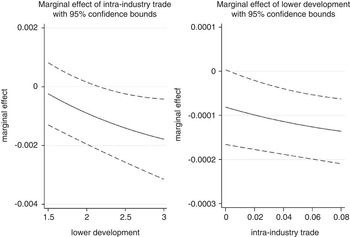
The interaction term for lower development × intra-industry trade is negative and significant in Models 5 (p ≤ 0.001) and 6 (p ≤ 0.003), suggesting that intra-industry trade and lower development become pacifying as the other variable is held at higher values.Footnote 84 Turning to a substantive interpretation of Model 5, Figure 2 illustrates the marginal effects of intra-industry trade and lower development, over a mean −1 to mean +1 standard deviation range of the other variable. Figure 2 shows that both intra-industry trade and lower development become increasingly pacifying as the other increases. The marginal effect of both of these variables becomes negative and significant at near the mean of the other variable.
Marginal effects of intra-industry trade and lower development (from Model 5)

Substantively, holding lower development at its mean, a mean −1 to mean +1 standard deviation increase in the intra-industry trade index is associated with a 33 per cent decrease in the probability of fatal MID onset. When lower development is held at one standard deviation above its mean, however, this same change in intra-industry trade is associated with a 66 per cent decrease in the probability of fatal MID onset. Similarly, the pacifying impact of lower development is higher as intra-industry trade increases. An increase in lower development from a standard deviation below its mean to a standard deviation above its mean is associated with a 50 per cent decrease in probability of fatal MID onset when intra-industry trade is held at its mean, and with a 75 per cent decrease in fatal MID onset when intra-industry trade is held at one standard deviation above its mean.
Conclusion
We find empirical support for our three hypotheses linking intra-industry trade to peace within dyads. Higher levels of intra-industry trade are associated with lower levels of dyadic militarized conflict. Overall trade interaction typically has no effect on the likelihood of dyadic conflict when controlling for intra-industry trade. Finally, development has no effect on the likelihood of dyadic conflict in the absence of intra-industry trade. Our study is the first to demonstrate these important boundary conditions on the commercial peace.
Adherents to the liberal perspective that trade promotes peace view the rapid increases in global trade in the era following the Second World War with optimism. Yet the case of the First World War, which occurred despite record levels of global trade and investment, serves as a reminder that interdependence, by itself, may do little to prevent massive conflicts from erupting. In this article, we point to a key factor distinguishing the contemporary period from that preceding the Great War. Our results suggest that there is a distinct element of the current trend towards globalization that raises the prospects for peace; due to the unprecedented increases in intra-industry trade, the contemporary trade regime is more conducive to peace than was the more asymmetric, arguably exploitative trading environment that flourished in the late nineteenth century. Nonetheless, our results suggest that there are crosscutting effects, and potentially, militarized consequences to the continuing prevalence of inter-industry trade.
Our results have important implications for trade patterns and policy worldwide, suggesting that research would benefit from continuing to explore the relationship between the commodity makeup of bilateral trade and militarized conflict. Although current scholarship examines (and, typically commends) rapidly expanding trade ties, little attention is paid to the commodity composition thereof. The potential for states to become dependent on trade partners or, alternatively, to co-operate in large, interstate markets for similar, potentially branded goods suggests that expanding trade may only pacify interstate relationships in specific circumstances. Furthermore, given the correlation between intra-industry trade and liberalization, future research may benefit from examining whether it is the lack of vulnerability inherent in trade among states facing low trade barriers that is responsible for this aspect of the capitalist peace.