Introduction
Alzheimer's disease (AD) is one of the most common causes of dementia in the elderly. There is increasing evidence that medical, behavioral and social interventions can delay the cognitive and functional decline associated with AD (Burns and O'Brien, Reference Burns and O'Brien2006). Even though several treatment options are available, treatment is often started too late, i.e. when considerable neuropathological changes have already occurred (Hulette et al., Reference Hulette, Welsh-Bohmer, Murray, Saunders, Mash and McIntyre1998). For early intervention, it is essential to identify subjects who will later develop AD (Heun et al., Reference Heun, Kolsch and Jessen2006). This evaluation could be improved by a better knowledge of the early signs of AD, and the presence of mild cognitive impairment (MCI) could be an early sign of AD. MCI was first defined as an isolated memory disorder that can precede dementia, characterized by subjective memory complaints and objective memory impairment on neuropsychological testing in non-demented individuals (Petersen et al., Reference Petersen, Smith, Waring, Ivnik, Tangalos and Kokmen1999). A substantial number of subjects with MCI progress to dementia. However, not all MCI subjects develop AD, as subjects may remain stable for a long period, revert to a normal state, or progress to another type of dementia (Petersen et al., Reference Petersen, Stevens, Ganguli, Tangalos, Cummings and DeKosky2001). Moreover, the clinical diagnosis per se is often uncertain in MCI. To increase the accuracy of detection of MCI and its subtypes, a great number of neuropsychological assessments have been proposed because several studies have shown that elderly individuals with MCI constitute a high-risk population for developing dementia (Luck et al., Reference Luck, Luppa, Briel and Riedel-Heller2010). Clinic-based cohort studies provide the opportunity to characterize MCI extensively and carefully. However, in community-based cohort studies, the burden of strict memory examinations or complicated neuropsychological assessments is too heavy for subjects and examiners. In clinical practice, it is quite beneficial to identify high-risk groups for developing dementia by using simple cognitive tests and additional evaluation of the risk of progression to clinically diagnosable AD or dementia.
Previously, we proposed criteria for mild memory impairment/no dementia (MMI/ND) using only the Mini-mental State Examination (MMSE) in a community-based prospective cohort study, because memory impairment was proposed to be the most common early sign of AD (Petersen et al., Reference Petersen, Smith, Waring, Ivnik, Tangalos and Kokmen1999). We followed the subjects with MMI/ND for five years and demonstrated that MMI/ND was almost the same as MCI (Ishikawa et al., Reference Ishikawa, Ikeda, Matsumoto, Shigenobu, Brayne and Tanabe2006). In the present study, we assessed whether or not progression from MMI/ND to dementia is affected by several established and emerging risk factors.
Methods
This study was approved by the Ethics Committee of the Ehime University Graduate School of Medicine and conducted after obtaining informed consent from all subjects or their responsible relatives.
The Nakayama study
Nakayama is a Japanese rural community adjacent to Matsuyama City, a metropolis on Shikoku Island. We selected this town because of its population size (5038 total residents, of whom 1438 were over 65 years of age), population stability (only 3.1% of people aged over 65 had moved elsewhere, including those in institutions, in the three years preceding the first survey), and the active collaboration offered by family doctors. The first Nakayama study included all residents aged over 65 years living at home in the rural community of Nakayama between January 1997 and March 1998 by means of a door-to-door survey. Of 1438 inhabitants, 1162 (80.8%) completed the protocol. A more detailed description of the methods has been reported previously (Ikeda et al., Reference Ikeda2001). In brief, the screening interview consisted of a semi-structured questionnaire containing questions on education, occupation, daily life activities (Physical Self-Maintenance Scale (PSMS) and Instrumental Activities of Daily Living Scale (IADL)), alcohol consumption, exposure and risk factor profile, previous disease, Geriatric Depression Scale (GDS; Yesavage, Reference Yesavage1988), medication, sleep, and appetite, followed by the MMSE for participants and the short memory questionnaire (SMQ) for a family member of each participant. All subjects were examined by senior neuropsychiatrists, and cranial CT was conducted on all subjects with any sign of dementia.
Subjects
Subjects were selected from the participants in the first Nakayama study (Ikeda et al., Reference Ikeda2001). Subjects in a community-based elderly cohort of MMI/ND were followed longitudinally. MMI/ND was defined according to the following criteria:
(i) normal general cognitive function, with MMSE ≥24;
(ii) objective memory impairment, assessed by three-word recall in MMSE (delayed recall 0/3 or 1/3);
(iii) neuropsychiatric examination: absence of dementia or depression, diagnosed by a senior neuropsychiatrist according to the criteria of the Diagnostic and Statistical Manual of Mental Disorders (DSM-IIIR; American Psychiatric Association, 1987); and
(iv) no ADL impairment.
Follow-up assessment and diagnosis
Five-year follow-up was conducted on all these individuals between April and December 2003. A senior neuropsychiatrist administered MMSE to subjects, while a public health nurse conducted PSMS and IADL interviews with a family member of each subject. Subjects who had been hospitalized or were living in institutions were included. Cranial CT was conducted on all subjects whose MMSE score had declined by 2 or more points from baseline (Mohs et al., Reference Mohs2001) or who had any sign of dementia. The diagnosis of dementia was established according to the DSM-IIIR criteria. Finally, subjects with dementia were classified into subgroups by the cause of dementia. AD was defined according to the NINCDS-ADRDA criteria for probable AD (McKhann et al., Reference McKhann, Drachman, Folstein, Katzman, Price and Stadlan1984), while VaD was defined according to the NINDS-AIREN criteria (Román et al., Reference Román1993).
Statistics
Student's two-tailed t-test and χ2 test were used to compare cohorts in terms of continuous and categorical variables, respectively. Univariate and multivariate logistic regression analysis based on the maximum likelihood method were used to estimate associations between putative risk factors and the progression from MMI/ND to AD, VaD or dementia. Odds ratios (OR) with the corresponding 95% confidence intervals (CI) were calculated. Statistical significance was indicated if p values <0.05. Variables shown to be significant in univariate analysis were entered in the model by means of a forward stepwise logistic regression procedure until no variable not in the model made a significant (P < 0.05) contribution. Before being entered into the logistic regression model, factors were tested for multicollinearity. If a factor was strongly correlated (r > 0.5) with another, the factor with the stronger association with the progression was included. All analyses were performed using the Statistical Package for the Social Sciences (SPSS), release 16 (SPSS Inc., Chicago, IL).
Results
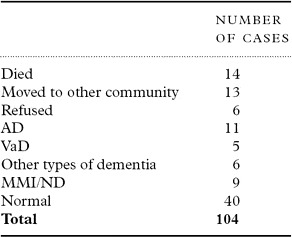
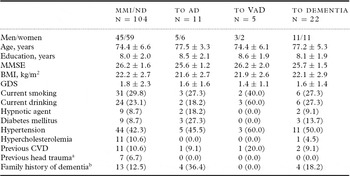
Of the 1242 inhabitants who participated in the first Nakayama study, 104 subjects were diagnosed with MMI/ND (45 men, 59 women), all of whom consented to participate in the study. During the five-year follow-up period, 14 subjects died, 13 moved to other communities (mainly due to institutionalization), and six refused to participate in the follow-up investigation. Eleven (10.6%) subjects were diagnosed with AD (five men, six women), five (4.8%) with VaD (three men, two women), two (1.9%) with dementia with Lewy bodies (one man, one woman), one (1.0%) with alcohol-related dementia (one man), and three (2.9%) with unclassified dementia (one man, two women). Nine (8.7%) subjects remained in a state of MMI/ND. Furthermore, 40 (38.5%) subjects showed restored three-words recall in MMSE (delayed recall 3/3 or 2/3) and were assessed as having normal general cognitive function (MMSE ≥ 24) (Table 1). The socialdemographic and clinical characteristics at baseline of these four groups are given in Table 2. Table 3 shows the baseline characteristics of MMI/ND participants who progressed to develop AD compared with those who did not. Those who converted to dementia had a significantly higher prevalence of diabetes mellitus (DM) (p = 0.020) and family history of dementia (p = 0.019).
Final diagnoses for 104 cases of MMI/ND

AD = Alzheimer's disease; VaD = vascular dementia; MMI/ND = mild memory impairment/no dementia
Baseline characteristics of study subjects

Values are number or mean ± SD. Numbers in parentheses are percentages.
a with loss of consciousness.
b within 3rd-degree relatives.
BMI = body mass index; GDS = Geriatric Depression Scale; CVD = cerebrovascular disease.
Characteristics of study subjects categorized by conversion to AD

Values are number or mean ± SD. Numbers in parentheses are percentages.
a with loss of consciousness.
b within third-degree relatives.
BMI = body mass index; GDS = Geriatric Depression Scale; CVD = cerebrovascular disease; n.s.: not significant.
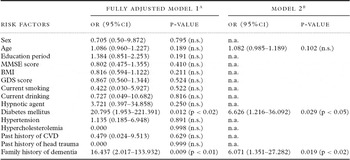
To investigate the association of risk factors with the progression from MMI/ND to clinically diagnosable AD, VaD or all types dementia, univariate and forward logistic regression analyses based on the maximum likelihood method were used. Univariate logistic regression analysis revealed that DM (OR = 5.437; 95% CI 1.138–25.971, p = 0.034) and a family history of dementia (OR = 4.743; 95% CI 1.178–19.093, p = 0.028) were positively associated with progression from MMI/ND to AD, while sex, age, body mass index (BMI), education period, GDS score, hypertension, hypercholesterolemia, current smoking, current drinking, use of hypnotics, history of cerebrovascular disease and history of head trauma were not. On the other hand, univariate logistic regression analysis revealed that no factor was significantly associated with progression from MMI/ND to VaD or all types of dementia (data not shown). In addition, forward stepwise logistic regression analysis revealed that factors independently associated with progression from MMI/ND to AD were DM (OR = 6.626; 95% CI 1.216–36.091; p = 0.029) and a family history of dementia (OR = 6.071; 95% CI 1.351–27.282; p = 0.019) (Table 4), while no factor was significantly associated with progression from MMI/ND to VaD or all types of dementia (data not shown).
Association of risk factors and other characteristics with conversion from MMI/ND to AD in multivariate logistic regression analysis in all study subjects (n = 104)

a Fully adjusted model 1: adjusted for all other variables in table.
b Model 2: included only significant variables (forward stepwise method).
OR = odds ratio; CI = confidence interval; BMI = body mass index; GDS = Geriatric Depression Scale; CVD = cerebrovascular disease; n.s. = not significant; n.a. = not applicable.
Discussion
MCI defines a transitional state along a continuous spectrum that ranges from normal aging to fully developed dementia (Petersen et al., Reference Petersen, Stevens, Ganguli, Tangalos, Cummings and DeKosky2001). MCI is classified as four clinical subtypes: single domain amnestic MCI, multiple domain amnestic MCI, single domain non-amnestic MCI and multiple domain non-amnestic MCI. These four clinical subtypes are assumed to differ in etiology and outcome. Amnestic MCI is widely considered to be the condition most commonly associated with a high risk of progression to AD (Petersen, Reference Petersen2004), and is therefore regarded by most authors as a prodromal state of AD (Gauthier et al., Reference Gauthier2006). Previously, we estimated the rate of a shift to dementia in subjects with mild memory impairment/no dementia (MMI/ND) in a community-based cohort study (Ishikawa et al., Reference Ishikawa, Ikeda, Matsumoto, Shigenobu, Brayne and Tanabe2006). In our study, MMI/ND was not strictly defined as MCI because we did not use standardized memory tests except for MMSE to detect prodromal dementia subjects. Of the 1242 eligible inhabitants aged over 65 years, we selected 104 subjects with MMI/ND. The prevalence of MMI/ND was 8.95%, consistent with that in previous community- based studies ranging from 7.3% to 13.3% (Luck et al., Reference Luck, Luppa, Briel and Riedel-Heller2010). We followed these 104 elderly subjects with MMI/ND for five years and showed that the annual conversion rates from MMI/ND to AD and dementia were 3.1% and 6.2% per year, respectively. These annual conversion rates from MMI/ND to AD and dementia were also almost the same as those in the previous community-based cohorts with strict memory examinations, ranging from 1.1 to 9.0% per year and 1.6 to 10.3% per year, respectively (Mitchell and Shiri-Feshki, Reference Mitchell and Shiri-Feshki2009). Hence MMI/ND is considered to be almost the same as MCI (mainly amnestic MCI) (Ishikawa et al., Reference Ishikawa, Ikeda, Matsumoto, Shigenobu, Brayne and Tanabe2006).
Compared with community-based cohorts, annual conversion rates from MCI to AD and dementia are often substantially higher in clinic-based cohorts (4.4–19.6% per year and 4.4–17.6% per year, respectively) (Mitchell and Shiri-Feshki, Reference Mitchell and Shiri-Feshki2009). There are several explanations for the differences in findings between clinic-based and community-based cohorts. Farias et al. (Reference Farias, Mungas, Reed, Harvey and DeCarli2009) reported that clinic-based cohorts rather than community-based cohorts may be vulnerable to selection bias. The composition of clinic samples is shaped by various factors (e.g. the demographics of the individuals studied, patterns of self-referral and provider referral, etc.) that make generalization impossible (Farias et al., Reference Farias, Mungas, Reed, Harvey and DeCarli2009). In general, community subjects are recruited after the age of 65 without dementia and develop dementia during the study, whereas clinic patients are typically recruited at baseline with a history of cognitive decline and this impairment worsens during the course of the study. Clinic patients may also have greater financial, social and personal resources, resulting in longer survival after diagnosis, more severe pathology at death and a higher conversion rate to dementia (Schneider et al., Reference Schneider, Aggarwal, Barnes, Boyle and Bennett2009). In agreement with these reports, the annual conversion rates to AD and dementia in our community-based cohort were relatively lower than those in clinic-based cohorts.
The present study showed that DM significantly increased the risk of progression from MMI/ND to clinically diagnosable AD. Patients with diabetes, of both type 1 (T1DM) and type 2 (T2DM), have been found to have cognitive dysfunction that can be attributed to their disease (Kodl and Seaquist, Reference Kodl and Seaquist2008). The association of DM with impaired cognitive function suggests that DM may contribute to dementia and AD. In fact, several longitudinal population-based studies showed that the incidence of dementia was higher in individuals with diabetes than in those without diabetes, and several researchers reported that DM has been implicated as a risk factor for the development of dementia and AD (MacKnight et al., Reference MacKnight, Rockwood, Awalt and McDowell2002; Arvanitakis et al., Reference Arvanitakis, Wilson, Bienias, Evans and Bennett2004). Our results are in good agreement with these previous reports. DM might accelerate cognitive decline and conversion to AD by a number of potential mechanisms. They may be attributable to vascular risk factors such as hypertension, dyslipidemia, and atherosclerosis. Other mechanisms, such as accelerated aging of the brain, have also been implicated. As it accelerates cerebral atrophy, DM may reduce cognitive reserve and the threshold for the development of AD symptoms (Biessels et al., Reference Biessels, De Leeuw, Lindeboom, Barkhof and Scheltens2006). DM may regulate cerebral amyloid and tau metabolism. In the preclinical syndrome of T2DM, hyperinsulinemia precedes hyperglycemia by many years. Insulin increases the secretion of Aβ into the extracellular space and stimulates tau phosphorylation to form neurofibrillary tangles (Gasparini and Xu, Reference Gasparini and Xu2003). Insulin also affects APP processing in vivo, a critical molecular step in generating Aβ, to promote secretion of sAPP (Gasparini and Xu, Reference Gasparini and Xu2003). Insulin degrading enzyme (IDE) has also been shown to play a major role in the degradation and clearance of insulin in vivo. Among all secreted proteases from cells, only IDE can degrade Aβ. When the insulin level increases in the brain, it can competitively inhibit IDE, which may cause Aβ neurotoxicity and then accelerate AD pathology (Qiu and Folstein, Reference Qiu and Folstein2006). In addition, insulin resistance seems to accelerate biological aging by fostering the formation of advanced glycation end-products (AGE) and, consequently, ROS (reactive oxygen species) (Roriz-Filho et al., Reference Roriz-Filho2009). All these mechanisms are thought to contribute to mild cognitive impairment and AD. Although we did not clarify its mechanism, we demonstrated that DM was a significant risk factor for a shift from prodromal cognitive impairment to fully developed AD.
We also showed that the presence of a family history of AD significantly increased the risk of progression from MMI/ND to clinically diagnosable AD. A positive family history of AD suggests the relevance of genetic risk factors. A Swedish twin study has reported that 60–80% of AD is attributable to genetic effects (Gatz et al., Reference Gatz2005), and several genetic risk factors are known to increase the risk of AD (Bendlin et al., Reference Bendlin2010). For early-onset AD, the APP, presenilin (PS)-1, and PS-2 genes play an important role. For late-onset AD, variation in the apolipoprotein E (APOE) gene is the strongest genetic risk factor. As the number of APOE-ɛ4 alleles increases, the risk of late-onset AD increases from 20% to 90%, and the mean age at onset decreases from 84 to 68 years (Chen et al., Reference Chen, Lin and Chen2009). Because of this overwhelming effect of APOE on late-onset AD, we speculated that a positive family history of AD was related to the APOE genotype, although further genetic investigation is required to confirm this assumption. In addition, Mosconi et al. recently reported that normal subjects with a maternal family history of late-onset AD showed more amyloid β deposition in the cerebral cortex than normal subjects with a paternal family history (Mosconi et al., Reference Mosconi2010). In our study, four MMI/ND subjects (three maternal, one paternal) developed clinically diagnosable AD while ten MMI/ND subjects (six maternal, three parental, one unidentified) did not. Although we could not demonstrate a positive correlation between the incidence of AD and a maternal family history, further epidemiological investigation is required to confirm this notion.
Vascular dementia (VaD) is defined as loss of cognitive function sufficient to cause functional disability in everyday life, resulting from ischemic, hypoperfusive, or hemorrhagic brain lesions due to cerebrovascular or cardiovascular disease. VaD and AD are the most prevalent types of dementia in the elderly. VaD is considered to have an abrupt onset of dementia, followed by stepwise deterioration of cognitive performance associated with neurological signs and symptoms reflecting focal brain lesions (Román et al., Reference Román1993). It has generally been accepted that cognitive function deteriorates rapidly from normal at the time of or shortly after stroke, which warrants the diagnosis of VaD (Román et al., Reference Román1993). However, subcortical ischemic VaD often has a more insidious onset with gradual cognitive deterioration, and the temporal relation between cognitive impairment and evidence of cerebrovascular disease may not be clear (Meyer et al., Reference Meyer, Xu, Thornby, Chowdhury and Quach2002). Recently, the concept of vascular cognitive impairment (VCI) has been introduced to describe the spectrum of cognitive change related to vascular causes, from early cognitive decline to dementia (O'Brien et al., Reference O'Brien2003). By analogy with the concept of amnestic MCI, vascular cognitive impairment with no dementia (VCIND) has been proposed as a preclinical state linked to a high risk of dementia progression and a prodromal state of VaD (Stephan et al., Reference Stephan, Matthews, Khaw, Dufouil and Brayne2009). Since vascular risk factors for stroke, such as hypertension, diabetes mellitus, hypercholesterolemia, and smoking, are also associated with a higher risk of AD as well as VaD (Kirshner, Reference Kirshner2009; Viswanathan et al., Reference Viswanathan, Rocca and Tzourio2009), we speculated that some of these established vascular risk factors for VaD may be risk factors for progression from MMI/ND to VaD. However, we showed that no factor, including previous history of CVD, significantly increased the risk of progression from MMI/ND to VaD. Although we cannot exclude the possibility that the number of examined subjects was too small to detect significant risk factors, our negative result implies that amnestic MCI (or at least MMI/ND) is not a prodromal state of cognitive impairment for VaD.
The main limitation of this study was that we did not evaluate MCI strictly. This would certainly lead to an overestimate of the prevalence of MCI because of its high sensitivity and low specificity. Our finding of a relatively low conversion rate from MMI/ND to AD might reflect this overestimate. However, any such overestimate is unlikely to alter our conclusion substantially, and we at least showed that DM and a family history of dementia were significant risk factors of progression to AD in subjects with objective mild memory impairment/no dementia. Second, we did not perform genotyping for the apolipoprotein E (APOE) alleles, although APOE is the strongest genetic risk factor for late-onset AD. In this study, we showed that a family history of AD was a significant risk factor for progression to AD in subjects with MMI/ND. As mentioned above, a positive family history of AD might reflect the effect of the APOE genotype. Furthermore, we identified a few patients with VaD, which could bias the results in some way. In fact, the latest community-based study demonstrated that DM was a significant risk factor for progression to VaD as well as AD in elderly subjects aged over 85 years (Ahtiluoto et al., Reference Ahtiluoto2010).
Conflict of interest
None.
Description of authors’ roles
Naomi Sonobe supervised the data collection and wrote the paper. Ryuji Hata and Manabu Ikeda contributed to the concept and design of the study. Tomohisa Ishikawa, Kantaro Sonobe, Teruhisa Matsumoto, Yasutaka Toyota, Takaaki Mori, Ryuji Fukuhara and Satoshi Tanimukai collected and analyzed the data. Kenjiro Komori and Shu-ichi Ueno were responsible for the statistical design of the study and for carrying out the statistical analysis. All authors commented critically on the draft and contributed important intellectual content. All authors approved the final version.
Acknowledgments
This project was supported, in part, by grants from the Ministry of Education, Science, Sports and Culture of Japan. The authors thank the late Professor H. Tanabe (Department of Neuropsychiatry, Ehime University Graduate School of Medicine, Ehime, Japan) for his encouragement and helpful suggestions on our research.